


Community hub
Recent from talks
Contribute something
Nothing was collected or created yet.
Order of Victory
View on Wikipedia | You can help expand this article with text translated from the corresponding article in Russian. (May 2022) Click [show] for important translation instructions.
|
| Order of Victory | |
|---|---|
 The Order of Victory | |
| Type | Single-grade order |
| Awarded for | Conducting combat operations involving one or more army groups and resulting in a "successful operation within the framework of one or several fronts resulting in a radical change of the situation in favor of the Red Army" |
| Presented by |  Soviet Union Soviet Union |
| Eligibility | Military Generals and Marshals only |
| Status | No longer awarded |
| Established | November 8, 1943 |
| First award | April 10, 1944 |
| Final award | February 20, 1978 (was revoked) |
| Total | 20 |
 Ribbon of the Order of Victory | |
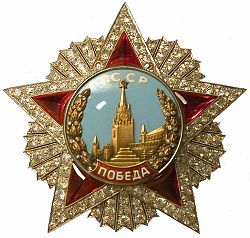
The Order of Victory (Russian: Орден «Победа», romanized: Orden "Pobeda") was the highest military decoration awarded for World War II service in the Soviet Union, and one of the rarest orders in the world. The order was awarded only to Generals and Marshals for successfully conducting combat operations involving one or more army groups and resulting in a "successful operation within the framework of one or several fronts resulting in a radical change of the situation in favor of the Red Army."[1] The Order of Victory is a standalone decoration awarded specially for service in World War II; unlike other awards such as the Hero of the Soviet Union, it does not belong to any order of ranking. In the history of the Soviet Union, the award had been awarded twenty times to twelve Soviet leaders and five foreign leaders, with one revocation. The last living recipient was King Michael I of Romania, who died on 5 December 2017.
History
[edit]The order was proposed by Colonel N. S. Neyelov, who was serving at the Soviet Army Rear headquarters around June 1943. The original name that Colonel Neyelov suggested was Order for Faithfulness to the Homeland; however, it was given its present name around October of that year.[2]
On October 25, 1943, artist A. I. Kuznetsov, who was already the designer of many Soviet orders, presented his first sketch to Stalin. The sketch of a round medallion with portraits of Lenin and Stalin was not approved by the Supreme Commander. Instead, Stalin wanted a design with the Spasskaya Tower in the centre. Kuznetsov returned four days later with several new sketches, of which Stalin chose one entitled "Victory". He asked Kuznetsov to slightly alter the design, and on the 5th of November a prototype was finally approved. The order was officially adopted on November 8, 1943, and was first awarded to Georgy Zhukov, Aleksandr Vasilevsky, and Joseph Stalin. All three were awarded a second order a year or more later.[citation needed]
The order was also bestowed to top commanders of the Allied forces. Every order was presented during or immediately after World War II, except for the controversial 1978 award to Leonid Brezhnev, who was not given a personal award, but an older one, originally awarded to Leonid Govorov, Marshal of the Soviet Union. (Govorov was already deceased, with his award returned to the state)[3] Brezhnev's award was revoked posthumously in 1989 for not meeting the requirements for the award.[citation needed]
Like other orders awarded by Communist nations, the Order of Victory could be awarded more than once to the same individual. In total, the order was presented twenty times to seventeen people (including Brezhnev).[citation needed]
Unlike all other Soviet orders, the Order of Victory had no serial number on it, the number was only mentioned in the award certificate. After a holder of the Order of Victory died, the award was to be given back to the state. Most of awards are now preserved by the Diamond Fund in the Moscow Kremlin. Notable exceptions are King Michael I of Romania's Order of Victory, which is held in the collection of the Romanian Royal Family, Dwight D. Eisenhower's Order of Victory, which is on display at the Dwight D. Eisenhower Presidential Library and Museum in Abilene, Kansas, Field Marshal Bernard Montgomery's Order of Victory, which is on display at the Imperial War Museum in London, and Josip Broz Tito's Order of Victory, which is kept in the Museum of Yugoslav History in Belgrade.[citation needed]
Construction details
[edit]
Against the sky, the letters "СССР" (USSR) appear in white enamel centered on the top of the medallion, while the word "Победа" (Victory) in white, is displayed on the red banner at the bottom, also made with enamel. The total mass of the order is 78g, which consists of 47g of platinum, 2g of gold, 19g of silver, and 16 carats of diamond. The rubies in the Order are artificial, as natural rubies would differ too much in color.[4] The medal is estimated to be worth $10 million.
Instead of being made at a mint, each Order was made in a jeweler's workshop.[citation needed]
Dwight D. Eisenhower had his star valued by an American jeweler; according to Bernhard, Prince Consort of the Netherlands (who, having been Commander of the Dutch Armed Forces during the war, was interested in receiving such a prestigious award himself but never got it), Eisenhower told him that his stones were "fakes".[5]
Ribbon
[edit]The ribbons of various Soviet orders have been combined to create the Order Ribbon. The total length of the ribbon is 44 mm and it is mostly worn on the field uniform.[6] The following featured orders are depicted on the ribbon (read from outside towards the center):
- Order of Glory (Орден Славы/Orden Slavy). Orange with black center stripe
- Order of Bogdan Khmelnitsky (Орден Богдана Хмельницкого/Orden Bogdana Khmelnitskogo). Light blue stripe
- Order of Alexander Nevsky (Орден Александра Невского/Orden Aleksandra Nevskogo). Dark red stripe
- Order of Kutuzov (Орден Кутузова/Orden Kutuzova). Dark blue stripe
- Order of Suvorov (Орден Суворова/Orden Suvorova). Green stripe
- Order of Lenin (Орден Ленина/Orden Lenina). Large Red stripe (center section)
List of recipients
[edit]| # | Date | Name | Image | Died | Note |
|---|---|---|---|---|---|
| 1 | April 10, 1944 |  Georgy Zhukov Georgy Zhukov
|

|
June 18, 1974 | |
| 2 | April 10, 1944 | Aleksandr Vasilevsky
|

|
December 5, 1977 | |
| 3 | April 10, 1944 | Joseph Stalin
|
_(cropped)(2).jpg)
|
March 5, 1953 | |
| 4 | March 30, 1945 |  Konstantin Rokossovsky Konstantin Rokossovsky
|

|
August 3, 1968 | |
| 5 | March 30, 1945 | Ivan Konev
|

|
May 21, 1973 | |
| 6 | April 19, 1945 | Aleksandr Vasilevsky
|
|
December 5, 1977 | (2nd time) |
| 7 | April 26, 1945 | Rodion Malinovsky
|

|
March 31, 1967 | |
| 8 | April 26, 1945 | Fyodor Tolbukhin
|

|
October 17, 1949 | |
| 9 | May 31, 1945 | Leonid Govorov
|

|
March 19, 1955 | |
| 10 | May 31, 1945 | Georgy Zhukov
|

|
June 18, 1974 | (2nd time) |
| 11 | June 4, 1945 | Semyon Timoshenko
|

|
March 31, 1970 | |
| 12 | June 4, 1945 | Aleksei Antonov
|

|
June 18, 1962 | |
| 13 | June 5, 1945 |  Bernard Montgomery Bernard Montgomery
|

|
March 24, 1976 | |
| 14 | June 10, 1945 |  Dwight D. Eisenhower Dwight D. Eisenhower
|

|
March 28, 1969 | |
| 15 | June 26, 1945 | Joseph Stalin
|
|
March 5, 1953 | (2nd time) |
| 16 | July 6, 1945 |  Michael I of Romania Michael I of Romania
|

|
December 5, 2017 | |
| 17 | August 9, 1945 | Michał Rola-Żymierski
|

|
October 15, 1989 | |
| 18 | September 8, 1945 | Kirill Meretskov
|

|
December 30, 1968 | |
| 19 | September 9, 1945 |  Josip Broz Tito Josip Broz Tito
|
May 4, 1980 | ||
| 20 | February 20, 1978 | |
.jpg)
|
November 10, 1982 | Revoked posthumously in 1989[a] |
- ^ Brezhnev's receipt of the Order of Victory was controversial. Brezhnev was a young political commissar during the war who did reach the rank of lieutenant general (two-star rank), but did not command responsibility close to the other recipients of the Order. He only received the decoration after he was General Secretary of the Communist Party and thus able to essentially award the medal to himself. As a result of general hostility to Brezhnev after his death and belief that this award had been done out of vanity rather than earned from merit, the Order of Victory was posthumously revoked in 1989.[7]
Fate of the Orders
[edit]
After the death of the recipient of the Order of Victory, it was to be given back to the state.
- All orders awarded to Soviet commanders are in Russia.
- The Central Armed Forces Museum in Moscow has five orders: two of Vasilevsky, two of Zhukov and one of Malinovsky.
- The State Precious Metals and Gems Repository (Gokhran) in Russia has two orders: Rokossovski, and Rola-Żymierski.
- All other orders that are in Russia are stored in the Moscow Kremlin, preserved by the Diamond Fund.
- King Michael I of Romania (d. 2017) was for 28 years the only living holder, following the death in 1989 of M. Rola-Żymierski; his order is held in the Royal Collection of the Romanian Royal Family.[8]
- Tito's order is at the Museum of Yugoslavia, Belgrade (former the May 25th Museum)
- Dwight D. Eisenhower's Order is on display at the Dwight D. Eisenhower Presidential Library and Museum in Abilene, Kansas.[9]
- Bernard Montgomery's Order is in the Imperial War Museum in London.
See also
[edit]References
[edit]- ^ "Decree of the Presidium of the Supreme Soviet of the USSR of November 8, 1943" (in Russian). Legal Library of the USSR. 1943-11-08. Retrieved 2012-02-25.
- ^ Dmitry Markov, Order of Victory - 1943 (Russian-medals.net)
- ^ "Орден для генсека: как Брежнева наградили за победу, которой не было". BBC News Русская Служба.
- ^ "Орден "ПОБЕДА"". mondvor.narod.ru. Retrieved 2024-10-12.
- ^ Prince Bernhard of the Netherlands in an interview with H.G. Meijer, published in "Het Vliegerkruis", Amsterdam 1997, ISBN 90-6707-347-4 . page 92
- ^ (in Russian) Awards and medals of the Soviet Union Орден "Победа"
- ^ Dobbs, Michael (September 30, 1989). "Presidium Takes Back Brezhnev's Medal". The Washington Post. Retrieved May 31, 2021.
- ^ 96 de fapte în 96 de ani (romaniaregala.ro, December 5, 2019, (in Romanian))
- ^ "Featured Museum Artifact". Archived from the original on 2019-02-15. Retrieved 2017-11-13.
External links
[edit]
- Decorated with the Supreme Military Victory Order
- Order of Victory - 1943
- (in Russian) Orders and Medals of the USSR - Order of Victory
- (in Russian) Legal Library of the USSR

Order of Victory
View on GrokipediaHistory
Institution and World War II Origins
The Order of Victory was instituted on November 8, 1943, by a decree of the Presidium of the Supreme Soviet of the USSR, establishing it as the Soviet Union's supreme military decoration for recognizing the achievements of high-ranking commanders in orchestrating large-scale operations that decisively altered the course of the war.[1] Designed exclusively for marshals and generals, the award targeted successes involving entire fronts or multiple army groups, surpassing the prestige of prior honors such as the Hero of the Soviet Union title and emphasizing strategic planning and execution that yielded radical advantages over Nazi German forces.[2] A prototype was prepared as early as November 5, 1943, amid intensifying Eastern Front campaigns following the Battle of Stalingrad and the Battle of Kursk, reflecting the regime's imperative to formalize incentives for operational mastery in a conflict demanding coordinated mass maneuvers.[5] This creation addressed empirical gaps in Soviet command incentives during total war, where victories required synchronizing vast forces across theater-wide fronts to exploit breakthroughs, as per evolving Red Army doctrine influenced by pre-war theorists like Vladimir Triandafillov and Mikhail Tukhachevsky—though the latter's execution in 1937 underscored the purges' disruption.[6] The decree specified awards for actions resulting in "a radical change of the situation in favor of the Red Army," prioritizing causal outcomes like encirclements and territorial reconquests over individual heroism, to counter the attritional stalemates of 1941–1942. Initial considerations highlighted figures like Marshal Georgy Zhukov, whose defenses of Leningrad and Moscow in 1941 and coordination of the Stalingrad counteroffensive in 1942–1943 exemplified the scale of command the order sought to reward, though formal presentations occurred later in 1944.[2] The pre-war Great Purges of 1937–1938 profoundly shaped this institutional response, having eliminated roughly 35,000 officers—including 90% of generals and most senior cadres—which eroded doctrinal expertise and contributed to the Red Army's catastrophic losses in 1941, with over 3 million casualties in the initial invasion phase.[7] This decimation fostered a command structure reliant on survivors promoted for loyalty and adaptability, such as Zhukov, but initially hampered coordinated deep operations essential against mechanized blitzkrieg tactics. The Order of Victory thus served to realign incentives toward bold, high-stakes decision-making at the front-army group level, compensating for purge-induced gaps in experience by elevating proven strategic risk-takers amid the 1943 shift to Soviet offensives.[8] Quantitative analyses confirm the purges' role in early-war inefficiencies, with purged units showing higher defeat rates, underscoring the award's role in post-1942 recovery through selective recognition of efficacious leadership.[7][9]Wartime Awards and Key Victories
The first wartime conferral of the Order of Victory occurred on 26 November 1943 to Marshal Georgy Zhukov, recognizing his coordination of Soviet defenses during the Battle of Kursk in July–August 1943, the largest armored engagement in history involving over 6,000 tanks and 2 million troops across fronts. Soviet forces, employing prepared defenses and deep battle principles of successive echelons for penetration and encirclement, repelled the German Operation Citadel, inflicting roughly 200,000 Axis casualties while suffering about 860,000 of their own, including 250,000 dead or missing; this victory enabled counteroffensives that liberated Orel and Kharkov, shattering German offensive capacity on the Eastern Front.[10][2] On 10 April 1944, Marshal Aleksandr Vasilevsky received the award for orchestrating the liberation of Crimea, including Sevastopol on 9 May 1944 after a 10-day assault by the 4th Ukrainian Front involving 470,000 troops against fortified German-Romanian positions, resulting in over 110,000 Axis casualties and the recapture of a key Black Sea base essential for southern logistics. This operation exemplified Soviet operational art through combined arms assaults that neutralized German salients, though Western assessments highlight the heavy toll of such attritional engagements, with Soviet casualties exceeding 87,000 in the final push.[11][12] Marshal Konstantin Rokossovsky was awarded the Order on 29 July 1944 for commanding the 1st Belorussian Front in Operation Bagration (22 June–19 August 1944), a multi-front offensive with 2.4 million Soviet troops that annihilated German Army Group Centre, destroying 28–32 divisions and inflicting 350,000–450,000 German casualties through rapid armored advances and encirclements covering 600 km. Soviet deep battle tactics prioritized operational depth over frontal assaults, yet incurred 765,000 casualties, including 170,000 irrecoverable losses, prompting debates in military historiography on the balance between doctrinal innovation and the demographic costs of mass mobilization.[13][14] Joseph Stalin received the Order on the same date, 29 July 1944, cited for supreme command in orchestrating strategic mobilizations that fielded over 6 million troops by mid-1944, enabling victories like Bagration through centralized planning of logistics and reserves, though critics attribute high Soviet losses—totaling over 8 million military dead by war's end—to rigid command structures favoring quantity over tactical finesse. Marshal Ivan Konev earned the award on 30 April 1945 for the Vistula–Oder Offensive (12 January–2 February 1945), where his 1st Ukrainian Front's 2 million soldiers advanced 483 km in 23 days, capturing Warsaw and Kraków while encircling and destroying German forces, inflicting 450,000–750,000 Axis casualties at a cost of 43,000 Soviet dead but over 300,000 total losses. This set the stage for the Berlin Offensive in April 1945, involving Konev's forces in the final assault on the Reich capital with 2.5 million troops, culminating in Germany's surrender on 8 May. Soviet records emphasize heroic breakthroughs via tank armies, while empirical analyses underscore the unsustainability of such casualty ratios, with overall war demographics reflecting 27 million total Soviet deaths.[15][16][17]Post-War Awards
In June 1945, following the unconditional surrender of Nazi Germany on May 8, Joseph Stalin received his second Order of Victory by decree dated June 25, recognizing his role as [Supreme Commander](/page/Supreme Commander) in achieving the overall victory in the Great Patriotic War. This award came after the Soviet Union had incurred staggering losses of approximately 27 million people, including 8.7 million military deaths and over 18 million civilians, dwarfing Axis military casualties of about 5 million on the Eastern Front. The conferral emphasized the strategic culmination of operations that not only defeated the Wehrmacht but also positioned Soviet forces to occupy much of Eastern Europe, altering the continental balance of power. [18] [19] [3] Marshal Rodion Malinovsky, awarded on April 26, 1945, for commanding the 2nd Ukrainian Front's advances into Austria and Czechoslovakia, exemplified recognitions tied to the war's closing phases, though his later tenure as Defense Minister involved indirect Cold War engagements, such as advisory roles in Korea and preparations for European contingencies. These late-war awards reflected a broadening criteria to encompass theater-wide successes amid the transition to post-hostilities occupation duties. However, with the Pacific theater concluding in September 1945, no further Soviet conferrals occurred immediately after. [20] [21] The Order of Victory then lapsed into dormancy for over three decades post-1945, with no awards during Nikita Khrushchev's leadership despite interventions like the 1956 Hungarian suppression or the 1962 Cuban Missile Crisis standoff. This hiatus indicated that Cold War-era actions—often proxy conflicts, stabilizations, or ideological enforcements rather than decisive field victories—did not satisfy the original statute's emphasis on major strategic operations yielding enemy capitulations or vast territorial liberations. Revived in the Brezhnev era during the 1970s, subsequent uses aligned with geopolitical consolidations within the Warsaw Pact, prioritizing bloc loyalty over hot-war merits. [2] [22]
Design and Symbolism
Physical Construction
The badge of the Order of Victory consists of a convex five-pointed platinum star measuring 72 mm across its points, with rays between the arms inlaid with artificial rubies totaling 25 carats.[23][4] The star's edges and central circular medallion, depicting the Spasskaya Tower of the Moscow Kremlin with laurel wreaths below, are set with 174 diamonds weighing a collective 16 carats.[3][24] The medallion's reverse bears the inscription "For the Victory" in Russian Cyrillic.[2] Crafted from 47 grams of platinum, 2 grams of gold, and 19 grams of silver, the badge weighs approximately 78 grams in total.[2] Production was limited to around 20-22 exemplars, hand-assembled by jewelers at the Moscow Jewelry and Clock Factory due to the complexity of setting the precious stones.[23][2] Surviving artifacts reveal minor variations in diamond faceting and ruby tint between early wartime issues and later post-war pieces, attributable to evolving artisanal techniques amid material shortages.[3]Ribbon, Insignia, and Presentation
The ribbon of the Order of Victory consists of a 46 mm wide silk moiré strip with a central red band of 15 mm, flanked on each side by 4 mm stripes in light blue, burgundy, dark blue, and green, respectively, terminating in 2 mm gold fringes along the edges.[25] [26] This composite design symbolically incorporates colors from subordinate Soviet orders, such as those of Suvorov (green), Kutuzov (blue), and Bogdan Khmelnitsky (light blue).[25] The full order badge attaches directly to the ribbon via a pin and nut, positioned on the left side of the chest, 12-14 cm above the waist, exclusively on formal dress uniforms to underscore its exceptional status.[26] [27] Due to the order's rarity—awarded only 20 times—a dedicated ribbon bar for everyday wear exists but sees limited use; it mounts separately on the left chest, 1 cm above other order bars, as stipulated in the August 18, 1944, decree by the Presidium of the Supreme Soviet of the USSR approving the ribbon sample and protocol.[24] Awards were presented via formal decree, accompanied by a certificate documenting the recipient's achievements and the order's details, though the badge itself bears no serial number.[24] The insignia, optimized for prominent display during parades and state ceremonies, aligned with Soviet practices prioritizing visual symbolism to inspire military discipline and national pride.[2]Criteria and Recipients
Award Criteria
The Order of Victory was established by decree of the Presidium of the Supreme Soviet of the USSR on November 8, 1943, as the highest military decoration, conferred exclusively upon marshals and generals for the successful command of one or more offensive or defensive operations conducted on the scale of one or more fronts or fleets, resulting in a major defeat of enemy forces and a radical shift in the strategic situation favorable to Soviet objectives.[2][1] This criterion emphasized collective operational leadership yielding tangible strategic gains, such as the liberation of significant territories or industrial regions, rather than individual acts of valor recognized by lesser awards like the Hero of the Soviet Union title.[28] In contrast to subordinate orders such as the Order of Suvorov, which applied to achievements at the army or flotilla level, the Order of Victory demanded demonstrable impact at the army group equivalent (front) scale, verified through metrics including kilometers of territorial advance, enemy divisions defeated, or key objectives captured, as outlined in the original statute.[2] Conferral required explicit approval via decree of the Presidium of the Supreme Soviet, ensuring centralized validation of the operation's decisiveness in altering wartime dynamics. Posthumous awards were prohibited, underscoring the focus on living commanders capable of sustained strategic influence.[1] Statutory amendments after World War II remained limited, preserving the core threshold of front-level operational success tied to verifiable enemy setbacks, though interpretations occasionally broadened to encompass overarching contributions to final victory without altering the emphasis on scale and outcome.[2]Soviet Recipients
The Order of Victory was conferred on 12 unique Soviet military leaders during World War II for orchestrating large-scale operations that decisively shifted the war's momentum against the Axis powers, involving commands of multiple fronts with forces exceeding one million personnel each in key battles. These awards recognized empirical successes in breaking German defenses, such as encirclements at Stalingrad and massive offensives like Operation Bagration, which destroyed Army Group Center and facilitated the advance to Berlin. Recipients, mostly Marshals of the Soviet Union, had often endured Stalin's 1937-1938 purges that executed or imprisoned thousands of officers, yet rose to lead the Red Army's causal contributions to victory through coordinated mechanized assaults and logistical superiority.[20][4][3]| Recipient | Date(s) Awarded | Rank at Award | Key Operation(s) | Death Date |
|---|---|---|---|---|
| Georgy Zhukov | April 10, 1944; May 31, 1945 | Marshal of the Soviet Union | Moscow defense, Stalingrad encirclement, Berlin capture; commanded 1st Belorussian Front with 2.5 million troops | June 18, 1974 |
| Aleksandr Vasilevsky | April 10, 1944; April 19, 1945 | Marshal of the Soviet Union | Stalingrad planning as Chief of Staff, Manchurian offensive; oversaw Transbaikal Front with 1.5 million soldiers | December 5, 1977 |
| Joseph Stalin | April 10, 1944; June 25, 1945 | Generalissimo | Supreme command directing overall strategy, including 1944-1945 offensives liberating Eastern Europe | March 5, 1953 |
| Konstantin Rokossovsky | July 29, 1944 | Marshal of the Soviet Union | Operation Bagration destroying 28 German divisions; 1st Belorussian Front advance | February 3, 1968 |
| Ivan Konev | June 1, 1945 | Marshal of the Soviet Union | Vistula-Oder Offensive capturing Warsaw, Prague; 1st Ukrainian Front with over 2 million troops | May 21, 1973 |
| Rodion Malinovsky | June 1, 1945 | Marshal of the Soviet Union | Iasi-Kishinev Offensive annihilating Army Group South Ukraine; 2nd Ukrainian Front | March 31, 1967 |
| Fyodor Tolbukhin | April 26, 1945 | Marshal of the Soviet Union | Vienna Offensive, Budapest siege relief; 3rd Ukrainian Front forces | October 17, 1949 |
| Leonid Govorov | May 31, 1945 | Marshal of the Soviet Union | Lifting Leningrad siege, Vyborg-Petrozavodsk; Leningrad Front with 600,000 troops | March 19, 1955 |
| Semyon Timoshenko | June 4, 1945 | Marshal of the Soviet Union | Southwestern Front reforms post-Kharkov defeats, early war stabilizations | March 31, 1970 |
| Aleksei Antonov | June 4, 1945 | Army General | Deputy Chief of General Staff planning major 1944-1945 operations | June 30, 1962 |
| Kirill Meretskov | September 8, 1945 | Marshal of the Soviet Union | Vyborg-Petrozavodsk, Manchurian Kwantung Army defeat; Karelian Front | December 30, 1968 |
Foreign Recipients
The Order of Victory was conferred on five foreign recipients during and immediately after World War II, primarily to acknowledge their roles in operations against Axis forces and to cultivate diplomatic ties amid the shifting alliances of the era. These awards, decreed by the Soviet Supreme Soviet, targeted leaders whose actions aligned with Soviet strategic interests, such as switching belligerents or coordinating against Germany on multiple fronts. The presentations occurred in formal ceremonies, often involving Soviet marshals, and reflected a mix of genuine wartime collaboration and efforts to extend influence into Eastern Europe and beyond.[29][21]| Recipient | Date Awarded | Country | Key Contribution |
|---|---|---|---|
| Dwight D. Eisenhower | June 5, 1945 | United States | Supreme Allied Commander in Europe, overseeing the Western Front campaigns including the Normandy invasion and advance into Germany.[29] |
| Bernard Law Montgomery | June 5, 1945 | United Kingdom | Command of 21st Army Group in Operation Overlord and subsequent Northwest Europe operations.[2] |
| Michael I | July 6, 1945 | Romania | Orchestrating the August 23, 1944, coup d'état that ousted pro-Axis leader Ion Antonescu, enabling Romania's switch to the Allies and declaration of war on Germany. |
| Michał Rola-Żymierski | August 9, 1945 | Poland | As commander-in-chief of the Polish People's Army, directing anti-Nazi operations in coordination with Soviet forces during the liberation of Poland.[2] |
| Josip Broz Tito | September 9, 1945 | Yugoslavia | Leadership of Yugoslav Partisans in guerrilla warfare that tied down Axis divisions and contributed to the liberation of Yugoslav territory.[20] |