Hubbry Logo
Military Order of WilliamMilitary Order of WilliamMain
Open search
Military Order of William
Community hub
Military Order of William
logo
8 pages, 0 posts
0 subscribers
Be the first to start a discussion here.
Military Order of William
from Wikipedia

Military William Order
Militaire Willems-Orde
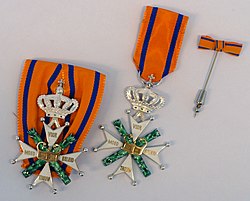
Knight Military William Order 4th class medal (post 2000 model)
Awarded by King of the Netherlands
TypeChivalric order with four degrees
Established30 April 1815
CountryNetherlands
MottoVoor Moed, Beleid en Trouw (For Bravery, Leadership and Loyalty)
Awarded forPerforming acts of excellent Bravery, Leadership and Loyalty in battle.
StatusCurrently constituted
Grand MasterKing Willem-Alexander
ChancellorMajor general H. Morsink[1]
GradesKnight Grand Cross
Commander
Knight 3rd class
Knight 4th class
Orange Lanyard (unit award)
Statistics
First inductionWilliam Frederick, Prince of Orange
Last induction Major Roy de Ruiter
Total inductees5,877
Precedence
Next (higher)None (highest)
Next (lower)Cross for Courage and Fidelity

Ribbon bar of Knight Grand Cross

Ribbon bar of Commander

Ribbon bar of Knight 3rd class

Ribbon bar of Knight 4th class

The Military William Order, or often named Military Order of William (Dutch: Militaire Willems-Orde, abbreviation: MWO), is the oldest and highest honour of the Kingdom of the Netherlands. It is named after St. William of Gellone (755–814), the first Prince of Orange.[2][3] Its motto is Voor Moed, Beleid en Trouw (For Bravery, Leadership and Loyalty). The chivalric order was established on 30 April 1815 by King William I and was presented for feats of excellent bravery on the battlefield and as a meritorious decoration to senior military officers. Comparable with the French Legion of Honour but far less often awarded, it is open to everyone regardless of rank or nobility—not only to Dutch military, but also to foreigners. To date, membership in the Order is extremely rarely awarded, and only for exceptional bravery in battle. Since its creation, more than 6,000 knights have been admitted to the Order.[4]

In the spring of 1940 it was decided that civilians would receive the Order for heroic acts in the resistance. After the liberation of the Netherlands and the Dutch East Indies, several men and one woman from the resistance were awarded it.

History

[edit]
King William II as Sovereign of the Order

Most knighthoods of the Military Order of William were awarded in 1815 and shortly afterwards to military of the Allies that fought Napoleon at the Battle of Waterloo, in total 1,005 knighthoods were awarded at this time. The Knight Grand Cross was awarded to Prince William of Orange, the Duke of Wellington, Fürst Blücher von Wahlstatt, Graf von Bülow von Dennewitz and Graf von Gneisenau.[5]

During the 19th century the Order was awarded to military serving in the campaign against the Belgian Revolution and military of the Royal Netherlands East Indies Army (KNIL) serving in the Dutch East Indies, mostly in the Aceh War. Until 1940, a total of 5,874 persons had been awarded the Military Order of William. In 1940, the Order was awarded to soldiers who had served with extreme valour in the defence of the Netherlands from the invasion by Nazi-Germany. In 1944 and 1945, with the liberation of the Netherlands from German occupation, the Order was again awarded, this time to Dutch citizens as well as members of the Allied forces for deeds of gallantry. Of the 3,500 servicemen who served in the Netherlands United Nations Detachment in the Korean War, three servicemen – two posthumously – were admitted to the Order. Since 1940, 199 names have been added to the register of the Military Order of William. The latest conflict that has been cause for the honour to be awarded was the war in Afghanistan.

On 29 May 2009 a ceremony was held at which the knights met, at Queen Beatrix's bestowal of the knighthood (fourth class) of the Order on Marco Kroon, platoon commander with the Korps Commandotroepen, at the Binnenhof, in The Hague.[6] Kroon was honoured for conspicuous bravery, leadership, and devotion to duty during his service in Afghanistan from March to August 2006. The knights met on 4 December 2014 at King Willem-Alexander's bestowal of the knighthood (fourth class) of the Order on Gijs Tuinman, commander with the Korps Commandotroepen, at the Binnenhof, in The Hague. The knights met on 31 August 2018 at King Willem-Alexander's bestowal of the knighthood (fourth class) of the Order on Roy de Ruiter, (reserve-) Major, Royal Netherlands Air Force.[7] Maj. Kenneth Mayhew, 101 at the time, was unable to attend the ceremony on 31 August 2018, which he explained in an interview broadcast on Dutch national television during the ceremony.[8]

Ranks

[edit]

By 1945, the following classes of the Military William Order were in existence.

  • Knight Grand Cross – wears the badge on a sash on the right shoulder, plus the star on the left chest;
  • Commander – wears the badge on a necklet, plus an identical breast cross on the left chest;
  • Knight 3rd class – wears the badge on a ribbon with rosette on the left chest;
  • Knight 4th class – wears the badge on a ribbon on the left chest.

The rank of Knight Grand Cross could also be awarded as an exceptional presentation to heads of state which had displayed feats of loyalty to the Netherlands during wartime. Only the US President Franklin Delano Roosevelt, the Ethiopian Emperor Haile Selassie, and the British King George VI were conferred such an honour in the 20th century. In the 19th century, the Knight Grand Cross was often conferred on foreign monarchs as a mere mark of respect.

The 4th class could also be awarded as a unit presentation to military commands which had displayed feats of gallantry during wartime.

Knight Grand Cross
(badge with sash and accompanying star)
Commander
(badge with necklet and breast cross)
Knight 3rd class
(badge with ribbon)
Knight 4th class
(badge with ribbon)


Insignia

[edit]
Prince Bernhard of Lippe-Biesterfeld, Commander of the Military Order of William

The badge of the Order is a white-enamelled Maltese Cross, in silver for the 4th class and in gilt for higher classes; a green enamelled Burgundy Cross appears between the arms of the Maltese Cross. The obverse bears a golden firesteel at the centre, and the motto Voor Moed – Beleid – Trouw (For Bravery – Leadership – Loyalty) on the arms of the Maltese Cross. Both the Burgundy Cross and the firesteel were symbols of the House of Valois-Burgundy during their lordship of the Netherlands and probably are meant to recall its crucial unifying role in the history of the Netherlands. The reverse central disc bears a crowned monogram "W" (for King William I) surrounded by a laurel wreath. The badge hangs from a royal crown.

The star of the Knight Grand Cross is a silver, 8-pointed star with straight rays; the obverse of the badge of the Order, minus the crown, appears at its centre.

The breast cross of the Commander is completely identical to the obverse of the badge of the Order.

The ribbon of the Order is orange (House of Orange-Nassau) with blue (Nassau-blue) stripes near the border.

Knighthood oath

[edit]

The oath to be taken by the accolade to the Military Order of William states: "I swear that I shall conduct myself as a faithful and valiant Knight, to stand ever ready to defend King and Country with my Life, and with all my Powers to always strive to be worthy of this Distinction, which the King has bestowed upon me. So help me God almighty."

Unit award

[edit]
Military William Order awarded to the Polish 1st Independent Parachute Brigade, 31 May 2006

To be awarded the Military William Order a military unit must distinguish itself in battle to such a degree as would warrant the personal presentation of the Military William Order. The unit's Regimental Colour are decorated with the badge of the 4th class itself, which hangs from the finial of the pike. The version of the Military William Order for unit members is known as the Orange Lanyard. Only those who served in a military unit at the particular time of action are entitled to wear the Orange Lanyard.

The Orange Lanyard is worn as a cord around the right shoulder and can be worn simultaneously with the French or Belgian Fourragère of the Croix de Guerre. The Orange Lanyard is considered a permanent decoration and is worn for the duration of a military member's career.

The military units or formations that were awarded the Military William Order or continue their traditions are:

Most military units or formations of the Netherlands and foreign armed forces were decorated as a consequence of their actions during the Second World War. In 2016 the Korps Commandotroepen were awarded the Military William Order for their actions in Afghanistan.

Current living members

[edit]
Left to right: Maj. Marco Kroon, Lt. Col. Gijs Tuinman, Maj. Roy de Ruiter.

As of 2024, there are only three living knights of the Military Order of William, all Dutch.[10] Below a list of the names of the living Knights, with the date of their induction in parentheses:

Privileges

[edit]

Members of the Military William Order are awarded certain privileges:

  • When wearing the decorations, a member must be saluted by all Dutch military personnel regardless of rank or branch.
  • Once a year all members of the Order are invited to the palace by the monarch on the Ridderdag (Knights day).
  • Individual members of the Order are granted an annual pension by the Dutch state, when they receive it while holding a rank below officer.
  • Individual members of the Order are granted a military funeral.
  • Members of the Order are granted VIP seats during military ceremonies, the annual address of parliament by the monarch and during state funerals.

See also

[edit]

References

[edit]

Further reading

[edit]
[edit]
Revisions and contributorsEdit on WikipediaRead on Wikipedia
from Grokipedia
The Military Order of William (Dutch: Militaire Willems-Orde) is the oldest and highest honour in the Kingdom of the Netherlands, established on 30 April 1815 by King William I as a royal decoration to recognize exceptional bravery (moed), leadership (beleid), and devotion to duty (trouw) in battle. Originally intended for military personnel of all ranks and regardless of noble birth, it was first awarded during the 1815 campaign against , including the Battles of Quatre-Bras and Waterloo, with over 1,000 recipients from that period alone. The order has been conferred more than 6,000 times throughout history, extending to foreign allies, civilians for resistance acts since , and even military units whose colours bear the decoration. The order comprises four classes: Knight Grand Cross (the highest, often reserved for royalty and senior commanders), , Knight Third Class, and Knight Fourth Class (the most common for individual acts of valour). include a white-enameled cross with a central medallion depicting William of Orange at the Battle of Heiligerlee, suspended from an orange ribbon with blue borders. Notable recipients include the first Knight Grand Cross, Hereditary Prince William Frederick George Louis of Orange-Nassau, and more recent honorees such as Major in 2009 for actions in , one of only three living knights as of 2025. Beyond individual awards, the Military Order of William has been bestowed on nine military units, including the Polish 1st Independent Parachute Brigade for their role in the during and the U.S. for contributions to the liberation of the . Governed by the Military Order of William Council, which advises the on nominations, the order remains a symbol of extraordinary courage and remains active, though rarely awarded in peacetime.

History

Establishment

The Military Order of William was founded on 30 April 1815 by King William I of the during the brief existence of the , amid the resurgence of Napoleonic threats following the emperor's escape from . This establishment occurred just weeks before the pivotal on 18 June 1815, reflecting the urgent need to honor military valor in the ongoing coalition efforts against . The order was instituted by Royal Decree No. 5, a comprising 12 articles that outlined its structure and criteria, marking it as the highest military decoration in the Dutch honors system. The original purpose of the order was to recognize exceptional acts of bravery (moed), (beleid), and to the (trouw) demonstrated in active , making it a merit-based chivalric honor accessible to all ranks regardless of noble birth. Its motto, "Voor , Beleid en ," encapsulated these principles, drawing inspiration from the heroism witnessed in the , particularly the campaigns of 1815. Unlike more exclusive orders, it emphasized devotion to the fatherland and the , serving as a of national pride during a period of political reconfiguration in . The initial statute established four classes of knighthood: Knight Grand Cross, Commander, Knight Third Class, and Knight Fourth Class, designed to reflect varying levels of distinction while maintaining a focus on exploits. Awards were granted retroactively for service in the 1815 campaign, including the Battles of Quatre-Bras and Waterloo, resulting in over 1,000 knighthoods bestowed in the order's inaugural year to commemorate the allied victory. This rapid distribution underscored the order's role in bolstering and forging a legacy of Dutch tradition. Administration of the order was vested in the Grand Master, the reigning who holds supreme authority, supported by the Chapter of the Order, a advisory body responsible for reviewing nominations and ensuring adherence to the statute's standards. From its , this framework provided an institutional backbone, with the Chapter offering counsel on awards to maintain the order's prestige and impartiality in honoring combat merits.

Key Awards and Events

The Military Order of William saw its most extensive distribution in the early years following its establishment, particularly during the campaign against in 1815. At the , over 1,000 knighthoods were conferred on Allied military personnel for acts of bravery, marking the order's inaugural major application in a significant conflict. Notable recipients included Arthur Wellesley, Duke of Wellington, who received the Grand Cross for his leadership, and , recognized similarly for his contributions to the victory. By 1940, the cumulative total of inductees had reached 5,874, reflecting widespread awards during 19th-century conflicts such as the and colonial campaigns. During , the order recognized exceptional service in resistance and liberation efforts, with 199 knighthoods awarded post-war for actions against occupation forces. These included honors for Dutch and Allied personnel involved in operations like the and the liberation of the . International figures such as U.S. President and Ethiopian Emperor received the Grand Cross in recognition of their supportive roles in the Allied cause, with Selassie's award dated November 3, 1954. Post-World War II awards became markedly rarer, underscoring stricter criteria for the honor. In the , only three recipients were named—two posthumously—for outstanding bravery among the Netherlands Detachment serving under . The order's application extended to modern conflicts in the 2000s, particularly in , where individual knighthoods were granted for exceptional leadership and valor in combat operations. Unit recognitions also occurred, such as the 2016 award to the for collective bravery and devotion during deployments there. To date, approximately 6,200 individuals have been knighted into the order, with a notable decline in frequency after 1945 due to elevated standards emphasizing extraordinary merit. No new individual awards have been conferred between 2018 and 2025, the last being to Major Roy de Ruiter for his actions as an pilot in .

Organization and Ranks

Classes of Knighthood

The Military Order of William consists of four distinct classes of knighthood, forming a hierarchical structure that recognizes exceptional military valor, leadership, and loyalty. The highest class, Knight Grand Cross, is reserved for supreme commanders and equivalent high-level figures, such as monarchs or top generals, and is worn as a sash across the right shoulder. The Commander class is awarded to senior officers for outstanding service, typically accompanied by a breast star. The Knight Third Class honors field officers, with the insignia worn as a neck badge, while the Knight Fourth Class is bestowed upon junior ranks and enlisted personnel for acts of bravery, featuring a chest badge. These classes maintain strict exclusivity, reflecting the order's prestige as the ' highest military honor. The Knight Grand Cross is particularly rare, with only two awards recorded between 1873 and 1927, often limited to a small number of recipients like heads of state or elite commanders. By 1927, the lower classes had seen broader but still selective conferrals: six Commanders, 42 Knights Third Class, and over 800 Knights Fourth Class. Overall, until 1940, approximately 5,874 individuals received the order across all classes, with post-1940 awards totaling around 200, underscoring the infrequency of bestowal in modern times. There is no system for promotion between classes; each is awarded independently based on the merit of specific actions or contributions, allowing recipients to receive honors at any level without prerequisite lower classes. As a complement to individual knighthoods, the order also recognizes collective unit achievements through the Orange Lanyard, a distinctive honor worn by personnel of awarded units.

Award Criteria

The Military Order of William is conferred for extraordinary acts demonstrating (courage), beleid (skillful leadership or policy), and trouw (loyalty or devotion) to the , typically in active or equivalent demanding service. These core qualities, inscribed on the order's , must involve exceptional bravery or merit that goes beyond standard duty, as outlined in the order's founding statute. Eligibility primarily encompasses Dutch military personnel of all ranks and branches, though it extends to civilians since and military units for collective outstanding performance. Foreign recipients are rare, limited to allied leaders or units whose actions exceptionally advanced Dutch interests, such as the U.S. during . Awards are generally made to living individuals, with posthumous conferrals possible but exceptional. Nominations originate from immediate superiors or, in some cases, self-application, supported by detailed reports and evidence of the acts in question; proposals over five years old are not considered. These are submitted hierarchically through military channels to the Minister of Defense, who consults the Kapittel der Militaire Willems-Orde—a body of up to ten members representing the armed forces—for thorough investigation and advisory recommendation. Final approval rests with the via royal decree, ensuring decisions reflect a majority vote of at least five chapter members. In modern contexts, the criteria have expanded beyond traditional combat to include non-combat heroism, such as resistance activities during occupation or exemplary conduct in peacekeeping operations, reflecting adaptations in the order's statutes for contemporary conflicts like those in . This prestige aligns it with equivalents like the British for battlefield valor or the French for supreme military distinction. The order's rarity underscores its exceptionalism, with fewer than a individual awards since 1945—primarily during the and recent missions—contrasting sharply with over 5,800 decorations by 1940 amid earlier colonial and world wars.

Insignia and Regalia

Design Elements

The central of the Military Order of William is a white-enamelled , crafted in silver for the Fourth Class and in for higher classes. At the center is a golden firesteel, with the Voor Moed, Beleid en Trouw ("For Bravery, Leadership and Loyalty") inscribed on the arms of the cross. Between the arms appears a green-enamelled Burgundy cross, and the badge is suspended from a and ring. The reverse features a crowned "W" encircled by a . Variations in design correspond to the order's classes. The Knight Grand Cross class includes a larger worn on an orange with blue borders, accompanied by a star consisting of a white-enamelled overlaid on an eight-pointed , with the obverse of the (minus the crown) at its center. Commanders wear the on a neck and a cross (identical to the but pinned to the chest), while Knights of the Third and Fourth Classes receive simpler versions without stars, suspended from a . Materials primarily consist of or silver metals with enamel accents for durability and visual distinction. Symbolically, the Maltese cross draws from crusader traditions, evoking the chivalric military orders of the medieval period and underscoring the order's emphasis on battlefield valor. The green Burgundy cross and central firesteel reference the House of Valois-Burgundy's historical lordship over the , symbolizing their foundational role in Dutch state formation. The orange sash ties to the , representing national heritage and royal lineage, while the gold crown denotes monarchical authority. Since its establishment in , the design has seen minor evolutions, such as refinements in enamel application and updates in the to align with reigning monarchs, but core elements remain consistent.

Wear and Presentation

The insignia of the Military Order of William are presented according to strict protocols that vary by class of knighthood, occasion, and whether the wearer is in or civilian attire. The , constructed from orange moiré silk featuring two narrow Nassau-blue stripes along the edges, serves as the primary mounting element for all classes. This is worn in full size for formal ceremonies and scaled down for less formal contexts, ensuring the order's prestige is maintained while adhering to practical standards. For recipients of the Knight Grand Cross, the badge hangs from a wide sash measuring 101 mm, draped over the right shoulder to the left hip, complemented by an eight-pointed star of 80 mm affixed to the left chest. Commanders wear the badge suspended from a 55 mm neck ribbon, also accompanied by the on the left chest. Knights of the Third Class attach the badge to a 27 mm ribbon on the left chest, distinguished by a rosette of the same colors, while Knights of the Fourth Class use the 27 mm ribbon without the rosette. These placements position the closest to the heart, symbolizing valor in a literal . In military uniforms across the Royal Army, , and , the decorations are mounted on the left side at chest height, following the national with the Military Order of William holding the highest position among Dutch honors. Civilians, including former service members, wear the on the left or chest of formal suits, with women permitted to form the ribbon into a bow at the left shoulder for compatibility with attire. Full , including sashes and stars, is reserved for state ceremonies and investitures, whereas miniature badges (scaled to approximately half size) or simple ribbon bars may be used for evening dress or daily professional settings to balance formality and convenience. When the order is conferred upon a military unit for collective gallantry, all eligible members—both active and qualified veterans—wear a distinctive orange lanyard looped over the left shoulder as a visible emblem of the unit's shared honor. This variant underscores the order's application to group achievements, such as those during World War II operations.

Conferral Process

Knighthood Oath

The knighthood oath of the Military Order of William is a solemn pledge recited by recipients during their investiture, affirming their commitment to chivalric duties of bravery, loyalty, and service. The full text of the oath, as stipulated in the governing statute, reads: "Ik zweer (beloof) mij als een getrouw en wakker ridder te zullen gedragen, mijn leven altoos te zullen veil hebben voor Koning en Vaderland en door al mijn vermogen mij steeds trachten waardig te maken de onderscheiding, mij door den Koning toegestaan. Zoo waarlijk helpe mij God almachtig. (Dat beloof ik.)" This translates to English as: "I swear (promise) to conduct myself as a faithful and valiant knight, to always stake my life for King and Fatherland, and by all my power to always strive to make myself worthy of the distinction granted to me by the King. So help me God Almighty. (That I promise.)" Foreign recipients are exempt from taking the oath. The is administered as a central element of the ceremony, typically held at significant locations such as the in —a historic site associated with the Dutch royal palace—or during formal military events. The , serving as Grand Master of the Order, or a designated representative, personally receives the from the inductee before affixing the order's to their , symbolizing the formal bestowal of knighthood. This ritual underscores the personal bond between the recipient and the sovereign, with senior knights or officers often present to witness and assist. Established with the Order's founding in 1815, the oath has remained largely consistent through subsequent legal revisions in 1864, 1886, 1920, and 2010, preserving its emphasis on unwavering to the , , and the ideals of and fidelity. The inclusion of "(beloof)" allows for an affirmation option in place of the religious "Zoo waarlijk helpe mij almachtig," accommodating recipients of non-Christian faiths while maintaining the oath's binding ethical force. By concluding the conferral process, the formally seals the inductee's entry into the Order, obligating them to uphold its chivalric principles of valor, , and devotion in all future endeavors, thereby perpetuating the institution's of and excellence.

Unit Awards

The unit awards of the Military Order of William serve to recognize entire military units for collective demonstrations of extraordinary , , and in operations. Established as part of the order's framework since its inception in 1815 but first conferred to units in 1945, these awards honor group achievements rather than individual exploits. The nomination process for unit awards mirrors that for individuals, focusing on documented group actions, but emphasizes the unit's overall conduct and impact. The Chapter of the Military Order of William reviews submissions, conducts investigations, and advises the Minister of Defence, who forwards recommendations to the King for final approval. Upon conferral, the award is permanently attached to the unit's colors or standard, granting enduring recognition. Notable examples include the United States , awarded in October 1945 for its pivotal role in during , marking the first foreign unit to receive the honor. The 1st Polish Independent Parachute Brigade was similarly recognized in 2006 for its contributions to the same operation. In a more contemporary context, the received the award in 2016 for exceptional performance during deployments in from 2005 to 2010. Entitlements from a unit award include the right for all current and permanent members to wear the , a distinctive orange cord symbolizing the honor, which is inherited by successor units upon reorganization. This lanyard is worn over the left shoulder on service uniforms. No individual knighthoods or personal decorations are granted through these collective awards. No new unit awards have been conferred between 2020 and 2025.

Notable Recipients

Historical Figures

Arthur Wellesley, 1st Duke of Wellington, received the Grand Cross of the Military Order of William on 8 July 1815 in recognition of his strategic leadership during the Battle of Waterloo, where he commanded the Anglo-allied army to victory against Napoleon Bonaparte. His award exemplified the order's early purpose of honoring exceptional bravery and merit in coalition efforts against French forces. Similarly, Gebhard Leberecht von Blücher, the Prussian field marshal and allied commander, was bestowed the Grand Cross on the same date for his pivotal role in coordinating Prussian reinforcements that turned the tide at Waterloo. These honors, part of over 1,000 knighthoods distributed to allied troops following the 1815 campaign, significantly boosted morale among multinational forces and strengthened post-Napoleonic alliances by symbolizing shared sacrifice and unity. Queen Wilhelmina of the Netherlands was awarded the Grand Cross in 1948 by her daughter, Queen Juliana, as one of the new sovereign's first official acts, honoring Wilhelmina's resolute leadership during , including her exile in Britain and efforts to sustain against Nazi occupation. This rare civilian conferral underscored the order's adaptation to recognize extraordinary national devotion beyond the battlefield, portraying her as the "Mother of the Fatherland" in official ceremonies. The order's international scope was evident in awards to foreign allies, typically reserved for heads of state or senior generals who demonstrated profound loyalty to the . King George VI of the received the Grand Cross on 1 July 1946 for providing refuge to the Dutch royal family and supporting the Allied liberation of the during . Such distinctions, sparingly granted to foreign allies historically, reinforced diplomatic ties and mutual respect among wartime partners. In colonial contexts, the order recognized bravery during campaigns in the , particularly the (1873–1904). Joannes Benedictus van Heutsz, military and civil governor of Aceh, earned the Knight 3rd Class in 1897 and Commander in 1899 for his command in subduing resistance and pacifying the region. During interwar periods, awards were less frequent but continued for service in maintaining colonial order, reflecting the order's application to imperial defense efforts amid global tensions.

Modern Knights

In the post-World War II era, the Military Order of William has been awarded sparingly to recognize exceptional bravery in contemporary conflicts, with a notable focus on operations in . The first such conferral since 1955 occurred in 2009 to Major , a in the , for his leadership during a 2006 deployment in . Kroon directed his unit through 16 armed engagements with forces, including a critical where his , outnumbered, repelled the enemy in a without incurring casualties on the Dutch side. Subsequent awards continued this pattern of honoring special forces personnel. In 2014, Lieutenant Colonel Gijs Tuinman, then a major serving as Multiple Team Operations Commander, received the order for his actions in Uruzgan in 2009, where he exposed enemy positions in intense combat, orchestrated a assault on a stronghold leading to arrests and seizures, and coordinated a under fire that saved a wounded comrade without additional losses. The most recent individual knighthood went to Major (Reserve) Roy de Ruiter in 2018, an pilot with the Royal Air Force, for heroic support to ground troops in from 2007 to 2009; his actions included neutralizing a mortar threat on 2007 and enabling the evacuation of a wounded on September 6, 2009, while preventing the compromise of sensitive equipment under extreme risk. As of November 2025, only these three individuals—Kroon (age 55), Tuinman (age 46), and de Ruiter (age 44)—remain living knights of the order, yielding an average age of approximately 48; this scarcity reflects the order's historical infrequency, with survival rates among recipients diminished by the passage of time since earlier 20th-century awards. Recent trends underscore a shift toward recognizing elite units in peacekeeping and counterinsurgency missions, particularly within NATO operations, rather than conventional warfare; no individual knighthoods have been granted since 2018, further emphasizing the distinction's rarity.

Privileges and Significance

Conferred Rights

Upon induction into the Military Order of William, knights receive specific military privileges that recognize their exceptional service. When wearing the order's visibly, military knights are entitled to receive a military salute from non-decorated personnel of equal rank or status. Additionally, sentries must accord knights the same honors as officers when the insignia is displayed. Knights in active , or those who request it upon retirement, are granted a with enhanced honors, including a ceremony equivalent to a higher rank, an escort from the unit they served with, placement of the order's insignia on the , pallbearers from fellow knights if possible, and knights following in the . A key practical benefit is the annual allowance, or toelage, provided to knights below rank, scaled according to their class and sub-rank at the time of . For knights of the fourth class, this includes €295 per year for those equivalent to under-lieutenants, €246 for sergeant-majors, and €182 for other ranks; amounts are doubled for class. These payments continue for life, even after promotion to status or departure from , and are disbursed quarterly. Widows receive half the knight's allowance, while minor children share it equally if there is no . The structure, established since the order's founding and last adjusted in 2010 by law revision, underscores the enduring financial recognition of bravery. Social honors emphasize the order's prestige in ceremonial contexts. Knights hold precedence in official military and state events due to the order's status as the Netherlands' highest distinction, often receiving priority seating and protocol accommodations. The title of "Ridder" (Knight) is formally granted, and non-noble recipients may optionally use the predicate "Jonkheer" in social and official address, equivalent to a knighthood honorific. Historically, the 1815 statutes focused benefits on symbolic and material rewards like pensions, with modern iterations emphasizing enduring status over tangible assets. For units awarded the order, members who served at the time of the deed—and often all subsequent members—gain the right to wear the Orange Lanyard perpetually as a distinguishing emblem, alongside inscription of the honor in the unit's battle record.

Cultural and Historical Impact

The Military Order of William holds unparalleled prestige as the oldest and highest military honor in the Kingdom of the , instituted in to recognize exceptional bravery, leadership, and loyalty in combat. Comparable to the United Kingdom's or the ' Medal of as the pinnacle of national valor awards, it symbolizes Dutch resilience and national pride, particularly during when it was bestowed upon resistance fighters and Allied forces for acts of defiance against occupation. This era cemented its status as an icon of perseverance, with awards highlighting collective sacrifices that contributed to liberation efforts. The order's legacy extends beyond individual recognition, influencing the structure and ethos of subsequent Dutch military honors by establishing a model for merit-based chivalric awards open to all ranks and occasionally civilians. Its insignia and historical artifacts are prominently displayed in institutions such as the National Military Museum in Soesterberg, where exhibits underscore its role in shaping Dutch armed forces traditions, and in royal collections at the , featured in state portraits of monarchs. Annual commemorations, including unit parades and ceremonies on significant dates like the anniversary of key battles, reinforce its enduring place in military heritage, fostering public appreciation for historical valor. Internationally, the order has bolstered diplomatic ties through rare awards to foreign recipients, notably during when it was granted to units like the U.S. for their role in and the Polish 1st Independent Parachute Brigade for actions at the Rhine Crossing, marking the first such honors to non-Dutch forces. These grants, limited to just a handful of foreign entities among over 6,000 total awards, underscore their symbolic weight in affirming alliances and mutual respect in global conflicts. In modern contexts, the order remains relevant amid discussions on its application to , where traditional criteria of battlefield bravery adapt to irregular engagements, as seen in post-2000 awards for operations in and . The statute, first substantively amended in 1946 to include civilians for resistance acts and comprehensively revised in 2010, has seen no further changes as of 2025, preserving its focus on extraordinary merit without altering eligibility frameworks. Recipients have historically been predominantly male, reflecting demographics, though women have received the honor, including for resistance efforts during ; as women increasingly serve in combat roles, the order remains open to all eligible individuals.

References

Add your contribution
Related Hubs
User Avatar
No comments yet.