


Community hub
Recent from talks
Contribute something
Nothing was collected or created yet.
Ground rules
View on Wikipedia
Ground rules are rules applying to the field, objects on and near it, and special situations relating to them, in the game of baseball. Major League Baseball has defined a set of "universal ground rules" that apply to all MLB ballparks;[1] individual ballparks have the latitude to set ground rules above and beyond the universal ground rules, as long as they do not directly contradict each other. Additionally, a set of universal ground rules exists for the seven MLB stadiums with retractable roofs, with the individual ballparks able to set additional rules.
Unlike the well-defined playing field of most other sports, the playing area of a baseball field extends to an outfield fence in fair territory and the stadium seating in foul territory. The unique design of each ballpark, including fences, dugouts, bullpens, railings, stadium domes, photographer's wells and TV camera booths, requires that rules be defined to handle situations in which these objects may interact or interfere with the ball in play or with the players, and adaptable by ballpark within the universal rules.
The term is familiar to most fans through the ground rule double, a batted ball that bounces fair, then over the outfield fence in fair or foul territory for a two-base hit. This is, in fact, not a ground rule, as it is universally applicable to any baseball field.
MLB
[edit]Universal
[edit]- Ball on the top step (lip) of the dugout is in play.
- No equipment is permitted to be left on the top step (lip) of the dugout. If a ball hits equipment left on the top step it is dead.
- A player is not permitted to step or go into a dugout to make a catch.
- A player is permitted to reach into a dugout to make a catch. If a player makes a catch outside the dugout and the player's momentum carries him into the dugout, then the catch is allowed and the ball remains alive as long as the player does not fall while in the dugout.
- A batted ball in flight can be caught between or under railings and around screens.
- A catch may be made on the field tarp.
- Batted or thrown ball lodging in the rotating signage behind home plate or along first base or third base stands is out of play.
- Batted or thrown ball resting on the rotating signage behind home plate or along first base or third base stands is in play.
- The facings of railings surrounding the dugout and photographers areas are in play.
- Any cameras or microphones permanently attached on railings are treated as part of the railings and are in play.
- Any recessed railings or poles that are in the dugout and photographers areas are out of play and should be marked with red to mark them out of play.
- Robotic cameras attached to the facing of the backstop screen are considered part of the screen.
- A batted ball striking the backstop camera is considered a dead ball.
- A thrown ball striking the backstop camera is considered in play.
- A ball striking the guy wires that support the backstop is a dead ball.
- A ball lodging behind or under canvas on field tarp is out of play.
- A ball striking the field tarp and rebounding onto the playing field is in play.
- No chairs can be brought out of the dugout or bullpen and onto the playing field.
- All yellow lines are in play.
- A live ball striking the backstop screen or protective netting located on the field boundaries along the first and third base lines is in play.
- A ball striking protective netting located behind out-of-play areas such as dugouts and photographer areas is dead even if it rebounds onto the field.
- Where a roof is present, a batted ball that becomes lodged in the roof above fair territory is dead and the runners including batter-runner are awarded two bases. Ballpark-specific ground rules may supersede this rule.
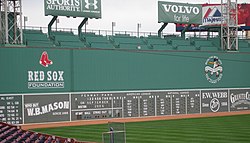
- On outfield walls composed of sections with different heights (e.g., Fenway Park, Oracle Park), a batted ball in flight that strikes a taller section of the wall in fair territory at a point higher than the top of the adjacent shorter wall, then bounds out of play over the shorter wall, is a home run.
- Conversely, a batted ball in flight that strikes the shorter wall in fair territory then bounds out of play over the adjacent taller wall is a dead ball and the runners including batter-runner are awarded two bases.[2]
Individual ballpark
[edit]Individual ballpark ground rules vary greatly from ballpark to ballpark. MLB maintains a list of each ballpark's specific ground rules.[2] Examples of ground rules that have been or are still in major league ballparks include:
- Fenway Park (Boston Red Sox) – A fly ball that strikes the top of the ladder on the Green Monster and then bounces out of play is two (2) bases.[3]
- Daikin Park (Houston Astros) – A batted ball striking the flagpole in center field and bouncing onto the field is in play; a ball striking the flagpole while in flight and leaving the playing field is a home run. The flagpole and the hill that it was on were removed following the 2016 season, and the rule has been removed from the specific ballpark rules list.[4][5][6]
- Tropicana Field (Tampa Bay Rays) – A batted ball that hits either of the two lower catwalks (C Ring and D Ring) between the yellow foul poles is ruled a home run. The two upper catwalks (the A Ring and B Ring) are considered in play; a ball that touches either can drop for a hit or be caught for an out.[7]
- Wrigley Field (Chicago Cubs) – A fair ball becoming lodged in the ivy on the outfield fence awards two bases to the batter and all runners; if the ball falls out of the ivy, it remains in-play.[8]
- Citi Field (New York Mets) – Any fair ball in flight hitting the overhanging Pepsi-Cola sign is ruled an automatic home run. The sign was changed following a new sponsorship in 2016 and no longer overhangs. The rule has since been removed from the specific ballpark rules.[9]
- London Stadium (MLB London Series) – Any ball that hits the roof that overhangs home plate is ruled a dead ball.[10]
Movement of retractable roofs
[edit]These ground rules only apply at ballparks featuring retractable roofs. As of the 2025 season, these are: Rogers Centre, Chase Field, T-Mobile Park, American Family Field, Daikin Park, LoanDepot Park, and Globe Life Field. Rules governing batted balls striking the roof are defined in each individual ballpark's ground rules.
Universal
[edit]- The decision as to whether a game begins with the roof open or closed rests solely with the home club.
- If the game begins with the roof open:
- It shall be closed only in the event of impending rain or other adverse weather conditions. The decision to close the roof shall be made by the home club, after consultation with the Umpire Crew Chief.
- The Umpire Crew Chief shall notify the visiting club, which may challenge the closing of the roof if it feels that a competitive imbalance will arise. In such an event, the Umpire Crew Chief shall make a final decision based on the merits of the challenge.
Ballpark-specific
[edit]All ballpark-specific retractable roof ground rules concern opening of the roof after a game has started.
If the game starts with the roof closed:
- American Family Field, Chase Field, Daikin Park, and T-Mobile Park permit its opening during the game if weather conditions warrant, as long as the following procedure is followed:[1]
- The roof may be opened only once during the game.
- The Umpire Crew Chief will be notified at the beginning of the inning that the roof will be opened at the inning's end.
- The Umpire Crew Chief shall notify the visiting club, which may challenge the opening of the roof. In such an event, the Umpire Crew Chief shall make a final decision based on the merits of the challenge.
- The opening of the roof shall only begin between innings.
- Chase Field requires that the roof is opened in two sets of 2-minute-and-15-second intervals, at the conclusion of one inning and the conclusion of the following inning.[1]
If the game starts with the roof open and it is closed during the game:
- American Family Field permits re-opening during the game as long as the above procedure is followed.
- At Chase Field, Daikin Park, T-Mobile Park and Rogers Centre, once the roof is closed during a game, it shall not be reopened.[1]
References
[edit]- ^ a b c d "Umpires: Ground Rules". Major League Baseball. Archived from the original on 2017-09-08. Retrieved 11 April 2017.
- ^ a b "Ground Rules". MLB.com. Retrieved 2025-02-17.
- ^ "Ground Rules | Boston Red Sox". MLB.com. Retrieved 2025-02-17.
- ^ "National League Ballpark Ground Rules, Ballparks of Baseball". www.ballparksofbaseball.com. Retrieved 2025-02-17.
- ^ "Sexson triples off of Tal's flag pole in Houston | 07/01/2003". MLB.com. Retrieved 2025-02-17.
- ^ "Minute Maid Park Ground Rules | Houston Astros". MLB.com. Retrieved 2025-02-17.
- ^ "Tropicana Field Ground Rules | Tampa Bay Rays". MLB.com. Retrieved 2025-02-17.
- ^ "Ground Rules | Chicago Cubs". MLB.com. Retrieved 2025-02-17.
- ^ "Ground Rules | New York Mets" (PDF). MLB.com. March 28, 2024.
- ^ "High cheese comes to land of high tea: Yanks vs Red Sox". FOX Sports. Associated Press. March 4, 2020. Retrieved 2025-02-17.
External links
[edit]


Ground rules
View on GrokipediaOverview and History
Definition and Purpose
Ground rules in baseball are stadium-specific modifications to the official rules of the game, designed to accommodate irregularities in field dimensions, surfaces, or structures that deviate from standard specifications. These rules address unique aspects of each ballpark, such as unusual walls, railings, or overhanging elements, by clarifying how they impact play. Unlike the uniform Official Baseball Rules established by Major League Baseball (MLB), ground rules are tailored to individual venues to ensure equitable application across diverse playing environments.[1][3] The primary purpose of ground rules is to prevent disputes arising from interactions between the live ball and non-standard field features, thereby promoting consistency in umpiring decisions and enhancing player safety. For instance, they specify outcomes for balls that bounce off or deflect from obstacles, avoiding ambiguity in whether a play results in a fair ball, foul, or out. This scope is limited to live ball behavior—such as deflections or bounces—while excluding standard rulebook elements like strikes, outs, or base running on routine plays. By standardizing responses to venue-specific anomalies, ground rules maintain the integrity of the game without altering core mechanics.[1][3] Ground rules originated from informal agreements in the early 20th century, when varying field conditions necessitated ad hoc decisions during games, as seen in the 1903 World Series where managers and umpires established temporary rules for crowd interference in the outfield. These practices evolved into formalized regulations within MLB by the 1950s, with the official rule book incorporating a dedicated section on ground rules starting in 1950 to provide structured guidelines for all ballparks.[4][5]Historical Development in Baseball
Ground rules in baseball originated in the late 19th century amid the irregular layouts of early amateur and professional fields, where fences, buildings, and uneven terrain often interfered with play. For instance, 1880s amateur fields frequently featured makeshift boundaries like wooden barriers or adjacent structures, prompting local agreements to define fair territory and ball outcomes. These ad hoc arrangements evolved into formalized ground rules as the National League established enclosed parks; the first documented examples appeared around 1900 in league venues, such as the original Polo Grounds, to clarify rulings on balls hitting outfield obstacles or short porches.[6][7] During the 1920s, MLB commissioners, including Kenesaw Mountain Landis, pursued greater standardization to address inconsistencies across ballparks, particularly regarding boundary plays. A pivotal shift occurred in 1931 when the rules committee altered the treatment of fair balls bouncing over fences—from automatic home runs to ground-rule doubles—aiming to balance offense and fairness in an era of expanding parks. This change, building on 1920 live-ball adjustments, marked early efforts to codify ground rules universally while allowing park-specific variations.[8][9] The 1958 edition of the Official Baseball Rules formalized ground rule provisions under Rule 4.05, empowering umpires to establish special guidelines for each venue before games. This coincided with stricter field dimension mandates, requiring new constructions after June 1, 1958, to maintain at least 325 feet from home plate to foul poles and 400 feet to center field, reducing reliance on idiosyncratic rules but preserving them for legacy parks.[10][11] In the 1970s, the proliferation of multi-purpose stadiums—such as Riverfront Stadium, which opened in 1970—necessitated expanded ground rules to accommodate artificial turf, symmetrical configurations, and dual-sport adaptations. These venues, designed for both baseball and football, introduced rulings for balls entering seating bowls or rebounding off turf seams, reflecting broader shifts toward modern, enclosed facilities that prioritized versatility over traditional asymmetry. The 1990s retro ballpark movement, epitomized by Oriole Park at Camden Yards' 1992 debut, spurred more tailored ground rules to highlight architectural quirks while ensuring equity. Camden Yards' guidelines, for example, designated hits striking the Eutaw Street warehouse facade as home runs and addressed the flag court in right field as a potential ground-rule double zone, influencing subsequent parks like Coors Field and PNC Park to adopt similar customizations. This era emphasized preserving park identity amid MLB's push for intimate, historic-inspired designs.[12] Into the 2020s, ground rules evolved with safety priorities, including protocols for retractable roofs in domed stadiums like Rogers Centre, where the home team determines the initial roof status and adjustments are permitted only for imminent weather between innings.[2]MLB Universal Ground Rules
Field and Base Path Rules
In Major League Baseball (MLB), the universal ground rules for field surface and base paths ensure consistent play across all ballparks by addressing how batted balls interact with the playing surface and how runners navigate the field. These rules standardize judgments on fair play, boundaries, and obstacles, preventing disputes arising from field conditions. Established by the Commissioner's Office, they apply uniformly to mitigate variations in stadium designs while adhering to the Official Baseball Rules.[1] Regarding field surface rules, a batted ball that strikes the dirt cutout surrounding home plate is considered in play, as this area lies entirely within fair territory. Home plate itself is part of fair territory, so any ball contacting it or the adjacent dirt before entering foul ground remains live, allowing fielders to pursue it without interruption. Additionally, temporary lines or markings on the field—such as those added for non-baseball events like concerts—are disregarded unless explicitly approved by MLB officials in advance, ensuring that only permanent foul lines and base paths govern play.[13][14] Boundary rules clarify outcomes for balls interacting with perimeter features. A fair batted ball that lodges in the chain-link fence or outfield padding is ruled a ground-rule double, with all runners awarded two bases from their time-of-pitch positions; this prevents prolonged delays in retrieving stuck balls. Similarly, if a fair ball in flight strikes the foul pole above the fence line, it is scored as a home run, as the pole extends fair territory indefinitely upward. These provisions promote fairness by treating such contacts as automatic advances rather than live plays.[15][16][17] For base path specifics, runners are required to avoid fixed field obstacles, such as rain tarps placed in foul territory during inclement weather; contact with these stationary objects may result in the runner being called out for leaving the playing field or obstructed play. Base coaches are restricted to their coaches' boxes near first and third bases. If a base coach physically assists a runner in leaving a base or interferes with a fielder making a play on a thrown ball, the runner is called out per Official Baseball Rule 6.01(d). Runners must maintain their established base paths, which are straight lines between bases, while navigating these elements to avoid penalties.[2][18] Universal enforcement of these rules begins pre-game, with umpires announcing key ground rules to managers and players during the plate meeting to ensure awareness. No equipment, including bats, gloves, or chairs, may be left on the field or dugout lips; violations result in a dead ball, with runners awarded bases based on the umpire's judgment of where they would have reached had the ball remained live. Umpires enforce these uniformly, consulting the Official Rules for any ambiguities.[2][19]Dugout, Equipment, and Spectator Interference Rules
In Major League Baseball (MLB), universal ground rules govern interactions with dugouts to ensure fair play while distinguishing between the playing field and team areas. A ball that comes to rest on the top step or lip of the dugout remains in play, allowing fielders to retrieve it without interruption.[2] However, no equipment, such as helmets or bats, is permitted on the top step or lip of the dugout; if a live ball strikes such unattended equipment, the ball is immediately dead.[2] Fielders are prohibited from stepping or entering the dugout to make a catch on a fly ball, but they may reach over the dugout railing or into the dugout without entering, provided their momentum does not carry them inside after the catch; in the latter case, the ball becomes dead per Official Baseball Rule 5.09(a)(1) Comment.[2][13] The facing of dugout railings is considered in play, while any recessed railings or poles marked in red are out of play.[2] Equipment rules under MLB's universal ground rules and official rules emphasize maintaining a clear field of play. Teams are forbidden from placing chairs or any other items from the dugout or bullpen onto the field during live play.[2] Loose player equipment, including helmets, water bottles, or detached items like gloves, must not be left on the field; if a fair batted ball or thrown ball in play contacts such equipment, the ball is dead, the batter is awarded first base, and each runner advances two bases from their position at the time of the pitch, as stipulated in Official Baseball Rule 5.06(b)(3)(E).[13] Permanently attached cameras or microphones on railings or outfield walls are treated as part of the field and remain in play, but robotic backstop cameras hit by a batted ball render it dead, while thrown balls contacting them stay live.[2] Spectator interference rules, outlined in Official Baseball Rule 6.01(e), address disruptions from fans in the stands to protect the integrity of live plays. If a spectator reaches out of the stands onto the field of play and touches a live batted or thrown ball, or hinders a fielder's attempt to make a play, the ball is immediately dead, and the umpire imposes penalties to nullify the interference by placing runners where they would have been without it.[13][20] For example, if the interference clearly prevents a fielder from catching a fly ball, the batter is ruled out, and runners return to their time-of-pitch bases or advance based on umpire judgment of "ordinary effort" by the fielder.[20] These rules also cover thrown objects from spectators, such as bottles, which can lead to similar dead-ball judgments and awards.[13] Umpires exercise discretion in determining interference, signaling "Time" with both hands overhead before grasping their left wrist with the right to indicate the call, ensuring consistent enforcement across all ballparks.[21]Ballpark-Specific Ground Rules
Rules for Historic Ballparks
Historic ballparks in Major League Baseball, constructed in the early 20th century, feature asymmetric dimensions and quirky architectural elements that deviate from modern standardized designs, necessitating bespoke ground rules to ensure fair play. These venues, such as Fenway Park, Wrigley Field, and the original Yankee Stadium, were built before uniform field specifications were enforced, leading to tailored regulations for unique features like irregular walls, vines, and scoreboards. These rules address how batted balls interact with such elements, often resulting in automatic advances for runners to maintain game integrity without exhaustive retrieval efforts.[1] At Fenway Park, opened in 1912, the 37-foot-high left-field wall known as the Green Monster exemplifies legacy design challenges. A fair ball striking the ladder attached to the Green Monster below the top of the wall and bounding out of the park awards two bases to the batter and runners. This rule prevents prolonged delays in retrieving balls from inaccessible areas beyond the park's boundaries. Additionally, the Pesky Pole—a narrow extension from the right-field foul pole to the front of the wall—is treated as part of the foul pole itself; a ball in flight striking this extension is ruled a home run, while a ball hitting the top of the outfield wall and then the extension also counts as a home run, and a bounding ball striking it awards two bases. These provisions accommodate Fenway's tight right-field dimensions and pole placement, which favor pull hitters.[22] Wrigley Field, dating to 1914, incorporates natural elements into its outfield that require specific guidelines for lodged or rebounding balls. A fair batted ball lodging in the ivy vines covering the outfield walls awards two bases, reflecting the difficulty of extracting the ball from the dense foliage without disrupting play. Conversely, if a fair ball enters the ivy and rebounds onto the playing field, it remains in play, allowing fielders to pursue it normally. Despite renovations including LED lighting upgrades completed in 2022, no significant changes to these ivy rules were implemented by 2025, though wind patterns continue to influence ball trajectories in ways not governed by formal ground rules.[23][24][25] The original Yankee Stadium, opened in 1923 and influencing the 2009 rebuild, featured a notably short right-field porch measuring 295 feet to the foul pole, a dimension grandfathered in before MLB's 1958 minimum of 325 feet. Balls clearing the right-field wall and auxiliary scoreboard are automatically home runs, capitalizing on the proximity to enhance offensive opportunities for left-handed pull hitters. Fan interference rules apply stringently here due to the close bleachers; if spectators reach over the low wall into the field of play to touch a live ball, it results in a dead ball, with umpires awarding bases based on what would have occurred absent the interference, often two bases from the time of pitch. These regulations balance the stadium's hitter-friendly layout with spectator safety and fairness.[26][2]Rules for Modern Ballparks
Modern ballparks, constructed primarily since the late 1990s, feature engineered designs that emphasize fan accessibility, deeper outfield dimensions to mitigate excessive home runs during the lively ball era, and advanced safety measures such as extended protective netting and padded barriers. These elements necessitate tailored ground rules to address interactions with structural quirks while adhering to MLB's universal standards, ensuring consistent play across venues. For instance, deeper center fields—often exceeding 400 feet—reduce the likelihood of cheap home runs, prompting rules that treat rebounds from elevated walls as live balls to maintain defensive opportunities.[27][28] Oracle Park, which opened in 2000 as the San Francisco Giants' home, exemplifies adaptations to waterfront proximity with its right-field arcade overlooking McCovey Cove. A fair batted ball that clears the arcade railing and enters the cove is ruled a home run, regardless of whether it lands on the fly or bounces over. Kayaks and boats positioned in the cove for retrieval do not influence the call, as the ball has exited the field of play, aligning with universal rules for balls leaving stadium boundaries. This setup has led to over 100 recorded "splash hits" since opening, highlighting the rule's impact on gameplay.[29][30] Citizens Bank Park, the Philadelphia Phillies' venue since 2004, incorporates high outfield walls—such as the 13-foot barrier in left field—to enhance safety and create challenging plays. Balls rebounding from these padded walls remain live, allowing fielders to pursue them unless the ball lodges in the padding or fence, at which point runners advance two bases per MLB guidelines. Similar provisions apply to plexiglass barriers atop the outfield walls, where deflections onto the field keep the play active, promoting dynamic defense in the park's compact yet fortified layout.[31][32] loanDepot park, opened in 2012 as the Miami Marlins' stadium (formerly Marlins Park), features innovative glass-paneled operable walls behind left-center field, with a recessed center-field zone for visual appeal. A batted ball in flight striking the glass or entering the recessed area is a home run, while bounding balls into the zone are out of play, typically awarding two bases as a ground rule double. These rules account for non-movement scenarios, distinct from retractable roof operations, and ensure fair resolution for deflections off the transparent barriers without disrupting play flow.[33][34] Recent adaptations in modern venues underscore evolving interactions with environmental and technological elements. At PNC Park, the Pittsburgh Pirates' 2001 ballpark, 2024 ground rules affirm that "splash hits" clearing the right-field stands into the Allegheny River are home runs, with a record nine such instances that season emphasizing the rule's consistency. Broader modern rules also address LED video board collisions, such as those in outfields where strikes above certain heights result in home runs, while lower impacts keep balls in play to balance offense and safety.[35][36]Ground Rules for Stadium Features
Retractable Roof Operations
In Major League Baseball (MLB), the operation of retractable roofs in stadiums equipped with this feature is governed by universal ground rules designed to ensure fairness, safety, and consistency across games. The decision to start a game with the roof open or closed during the regular season rests solely with the home team management.[37] This protocol allows the home team to balance fan comfort, player performance, and environmental factors while minimizing disputes. Once the game begins, changes to the roof's status are limited to maintain competitive integrity. If the game starts with the roof open, it may only be closed in response to impending rain or other adverse weather conditions threatening play; if the game starts closed, the roof may be reopened once under suitable conditions.[37] Roof adjustments are permitted only between innings or during appropriate pauses in play. These rules apply to the seven MLB ballparks featuring retractable roofs as of the 2025 season: Rogers Centre (Toronto Blue Jays), Chase Field (Arizona Diamondbacks), T-Mobile Park (Seattle Mariners), American Family Field (Milwaukee Brewers), Daikin Park (Houston Astros), loanDepot Park (Miami Marlins), and Globe Life Field (Texas Rangers).[38] In the postseason, authority shifts to the MLB Commissioner or a designated official, who consults with the home club and umpire crew chief to finalize the roof status, prioritizing neutral conditions for playoff equity.[37] Safety protocols during roof operations emphasize halting play immediately upon initiation of movement to prevent hazards from shifting panels or structural components. These measures, refined through MLB's ongoing oversight of stadium features, underscore the league's commitment to player and spectator protection in dynamic environments.Unique Field Elements and Structures
In Major League Baseball (MLB), ground rules for outfield walls and railings generally treat batted balls that carom off these structures as live, allowing play to continue unless the ball lodges or deflects into an out-of-play area. For instance, any cameras or microphones permanently attached to railings or outfield walls are considered part of the field and remain in play if struck by a live ball. At Yankee Stadium, a batted ball in flight that strikes the concrete portion of the outfield wall, including metal areas and recessed fan railings in the short porch, and rebounds into the playing field is ruled in play, while one that clears the top of the wall or railing is a home run. These rules ensure consistency while accounting for the stadium's unique dimensions, where the right-field porch measures just 314 feet from home plate. Protective screens and netting, such as those behind home plate, are treated similarly to walls under universal MLB ground rules: a live ball striking the screen or netting is equivalent to hitting the wall or railing, remaining in play unless it lodges, in which case the ball is dead and runners advance two bases. Interference from the netting is rare due to its design, but if a fair batted ball becomes lodged in the netting, it results in a dead ball scenario. At Coors Field, the high altitude of 5,280 feet affects ball trajectories and bounces due to thinner air, which reduces drag and allows balls to travel farther and rebound differently off padded walls; however, ground rules follow standard protocols without unique padding specifications for altitude, relying on the 8-foot outfield wall height for determinations of home runs or in-play bounces. Foliage and overhangs in ballparks introduce specific ground rules to handle natural or structural irregularities. At Wrigley Field, the iconic ivy covering the outfield walls since 1937 results in a ground rule double if a fair batted ball lodges in the vines, whether visible or not, as outfielders must signal the umpire if unable to retrieve it immediately. Historically, similar ivy adorned walls at older stadiums like Indianapolis' Bush Stadium, influencing designs such as Wrigley's, but MLB's Busch Stadium (opened 2006) never featured ivy, with any prior foliage elements from predecessor venues removed during demolitions in the mid-2000s. For overhead structures, Tropicana Field's catwalks—suspended above the field—dictate outcomes based on height: balls striking the lower catwalks (C-Ring at approximately 150 feet and D-Ring at 195 feet) in fair territory are ruled home runs, while those hitting the upper catwalks (A-Ring and B-Ring above 200 feet) remain in play, allowing fielders to catch them for an out if possible.[39] Note that Tropicana Field's roof was severely damaged by Hurricane Milton in October 2024, and the Tampa Bay Rays played all 2025 home games at George M. Steinbrenner Field; the catwalk rules applied to the original venue.[40] Enforcement of these ground rules relies on umpires' judgment, supplemented by video review for ambiguous deflections or lodgments, as seen in postseason plays where crew chiefs like Sam Holbrook have overturned initial calls on ground-rule doubles after examining replays. In open-air ballparks, additional considerations include the Federal Aviation Administration's (FAA) prohibitions on drone flights within one hour before and after events at stadiums seating over 30,000, aimed at preventing interference with play; violations, such as those disrupting MLB games in 2024, can lead to immediate game delays and federal penalties under airspace restrictions.[41]References
- the rules on which a person or organization bases their behaviour: He says that one of his ground rules is to not look at businesses that are not yet ...
- Group agreements (also referred to as class norms, participation norms, ground rules, community agreements, or group contracts) are rules, intentions, or ...
- Ground rules should be established at the beginning of a course, and the instructor should explain the purpose they serve (for example, to ensure that ...
- Ground rules are the rules of conduct for a conflict resolution process, such as negotiation, mediation, arbitration, or consensus-building.
- Ground Rules. Definition. The Commissioner's Office issues a list of universal ground rules that are to be used in every Major League ballpark each season.