Hubbry Logo
Outer DarkOuter DarkMain
Open search
Outer Dark
Community hub
Outer Dark
logo
8 pages, 0 posts
0 subscribers
Be the first to start a discussion here.
Outer Dark
Outer Dark
from Wikipedia

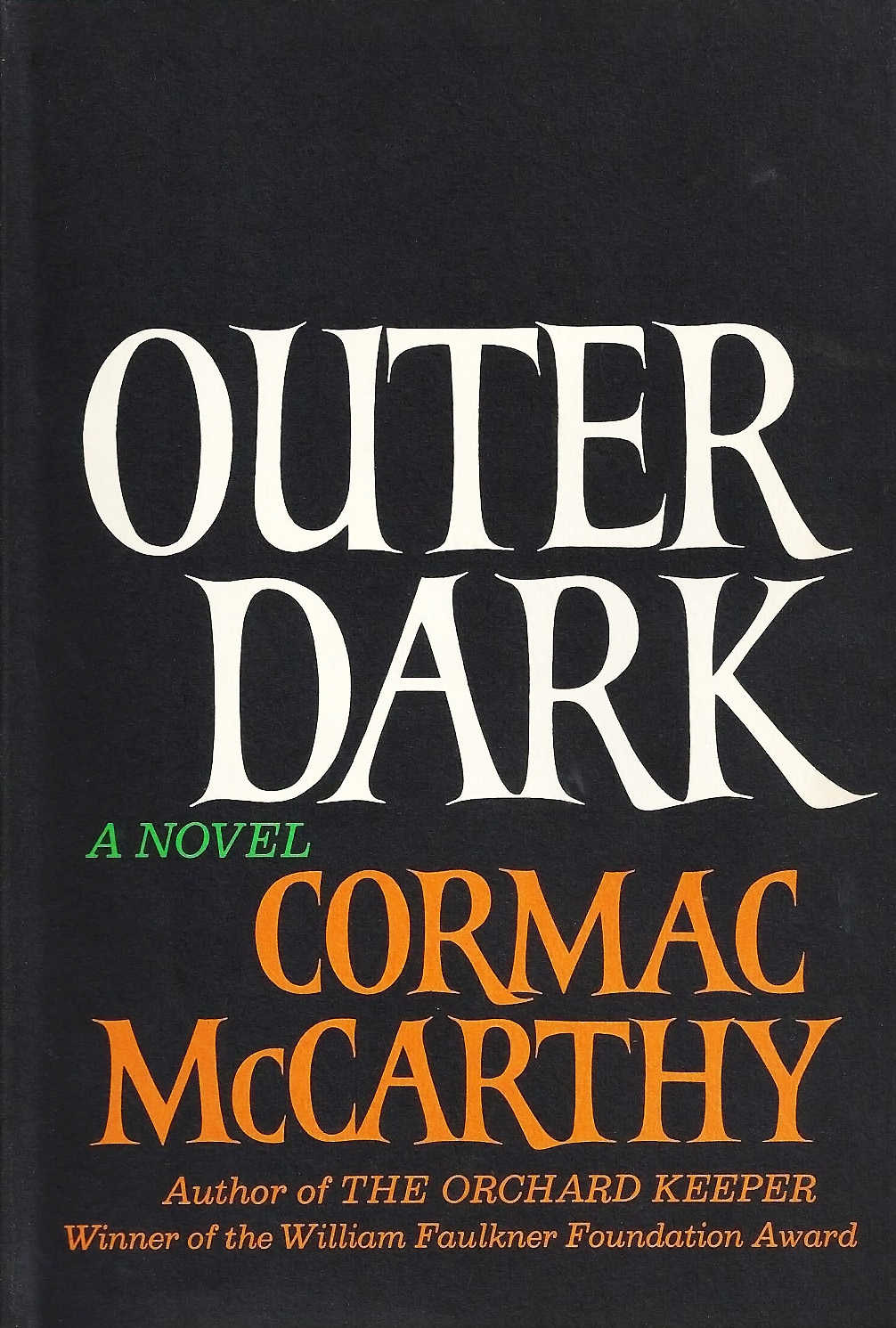
Outer Dark is the second novel by American writer Cormac McCarthy, published in 1968. The time and setting are nebulous, but likely take place sometime around the turn of the twentieth century somewhere in Appalachia. The novel tells of a woman named Rinthy who bears her brother's baby. The brother, Culla, leaves the nameless infant in the woods to die, but tells his sister that the newborn died of natural causes and had to be buried. Rinthy discovers this lie and sets out to find the baby for herself.

Key Information

The name of the novel is derived from the Gospel of Matthew, specifically the meeting between the Roman centurion and Jesus, during which Jesus says: "But the children of the kingdom shall be cast out into outer darkness: there shall be weeping and gnashing of teeth".[1]

Writing process

[edit]

McCarthy began writing the novel on December 15, 1962, in Asheville, North Carolina, and finished the first draft in New Orleans, in 1964. He wrote the early draft of the final version in Knoxville, Tennessee, and the middle and final drafts during a stay in Ibiza, Spain. Several different events occurred in McCarthy's private life during the writing of the first draft, the most important of which being the failure of his marriage to Lee Holleman McCarthy and their subsequent divorce in July 1963. During this time, McCarthy submitted The Orchard Keeper for review to Random House Books, subsequently receiving a lengthy list of suggested changes from his editor Larry Bensky, interrupting his work on the novel. His revision of The Orchard Keeper would at different times interrupt further work on Outer Dark. Aside from the work on his first novel, McCarthy suffered loneliness during this period, with his wife and son having left him, and with McCarthy having moved to Knoxville, Tennessee. He wrote the final version of the novel 18 months after his marriage to Anne DeLisle.[2]

Characters

[edit]
  • Culla Holme – the main male character, brother and former lover of Rinthy Holme
  • Rinthy Holme – the main female character, sister and former lover of Culla Holme
  • The Tinker – the man who finds the abandoned child and takes him home to care for him
  • The Unnamed Child – abandoned child of Rinthy and Culla Holme
  • The Trio – a mysterious group of nameless men who are following Culla, they are ruthless killers who seem to be punishing Culla for his sins, but also routinely murder others along their journey

Plot

[edit]

Introduction

[edit]

The novel introduces the siblings Culla and Rinthy Holme. As a result of their sexual relationship, Rinthy is pregnant and only a few days from labor. Shortly, they encounter the tinker, a traveling salesman peddling odds-and-ends and pornography out of a shoddy cart. Due to Culla's unwillingness to get help during the birth, it becomes clear that he is ashamed of what he has created. After the child is born and Rinthy falls asleep, Culla takes the baby out to die in the woods, telling Rinthy when she awakes that the child has died.

The baby is found by the tinker, who takes him to a wet nurse without knowing who his parents are. Rinthy finds an empty grave and sets out to find the child.

Culla's journey

[edit]

After abandoning the child, Culla tries to escape his sin and sets out across the country to find work.

His first job is with a local squire, who puts him to work chopping wood, for which he is paid half a dollar. After he leaves, it is discovered that a pair of expensive boots have been stolen. Immediately blaming Culla, the squire pursues him. The squire is set upon by an unknown trio of men and killed.

Culla travels to the town of Cheatham looking for work, where someone has desecrated three graves near the church. Culla is blamed and runs away from the town.

His next job is painting the roof of a barn some distance from Cheatham, but he is found by law enforcement. Culla injures himself while fleeing.

Culla finds an old man who gives him a drink of water and shows off his gun and hunting trophies. He invites Culla to stay and learn snake hunting from him. He refuses. The trio again shows up and kills the man.

In Preston Falls, Culla finds employment digging graves. Returning to town for payment, he finds it abandoned and quickly runs away from it. Culla tries to cross a river on a ferry with the ferryman and a man on horseback. During their night crossing, the river surges too quickly and the ferryman, the man and the horse are killed. Near dawn, Culla is helped ashore by the trio that have followed him. They suspect him of murdering the two men aboard the ferry. While in their company, Culla is obliged to eat strange meat from their fire. Ultimately, the men take his boots.

Culla stumbles upon an abandoned home and takes refuge in it. In the morning, he is apprehended by an armed man who takes him to the squire, who again accuses him of a crime, this time of trespassing. He pleads guilty to this crime for a lighter sentence, and works off his fine.

The final episode of his journey is his being accused of inciting a herd of pigs off a cliff, along with the murder of a young hog-driver. To evade being executed, Culla jumps off a cliff into a river, injuring his leg. Coming ashore, he again finds the trio, as well as his child (burned on one side of his body and missing an eye) and the body of the Tinker. After accusing Culla of fathering and abandoning the child, the leader of the trio slays the baby, after which a companion appears to begin to eat it.

Rinthy's journey

[edit]

Careful to avoid her brother, Rinthy sets out to look for their child. After travelling a while, during the night she stumbles upon a house. Here the family take her in, feeding her and offering her a place to sleep. The oldest boy of the family expresses interest in her, which she rejects. Travelling with them to the town, she is unable to find sign of the child and sets out again alone.

Travelling further she stays briefly with two families, realizes that she is still lactating and retains hope for the child's well-being. She stays for some time with an old woman living in a forest with a dislike for snakes and dogs.

Next she meets a lawyer who treats her kindly and allows her to rest at his office while she waits for a doctor, who keeps business across from the lawyer. The doctor gives her hope that her child is still alive and a salve for her breasts which are sore from the lactation and have begun bleeding.

Rinthy finally catches up to the Tinker, who takes her to his cabin in order to reunite her with her child. He instead berates her for abandoning the baby, telling her he deserves the child far more than she. Beginning to guess at the truth, the Tinker demands to know if Culla is the child's father. When Rinthy tells him he is, the Tinker refuses to believe it, calling Rinthy a liar and storming from the cabin saying he will kill her if she follows him.

Later, she appears to be living with an unidentified man on a small farm. The man insists she speak to him but she says she does not have anything to say. In the middle of the night, she steals away from the farm and the “dead and loveless house,” returning to the road.

Finally, she comes upon the clearing where her child’s body has been burned, along with the Tinker’s cart, and where the Tinker’s body hangs in a tree. She lingers in the clearing, and goes to sleep as night falls.

Ending

[edit]

Years later, Culla talks to a blind man who tells him of the blessings of being blind, and that he prays for what he needs. Culla later watches the blind man walking towards a swamp, which for him means certain death. The novel ends with Culla thinking, "Someone should tell a blind man before setting him out that way."

Major themes

[edit]

Consequences of sin

[edit]

In his second novel, McCarthy moved away from the naturalistic conventions of The Orchard Keeper. A number of writing conventions which were present in his first novel are here lacking: a distinct chronology, allusions to the modern world beyond the mountain culture, or forays into frontier and absurdist comedy. Instead, McCarthy introduces a Calvinistic conception of sin and retribution, which creates a cruel and bleak world in contrast to a world in the original state of innocence. The state of innocence is here present in the familial isolation, surrounded by nature, which was desecrated by incest. The ugliness of the sin is underscored by the ugliness of the child found at the end of the novel, while the sexual nature of the siblings' sin is underscored by the Tinker who found the child, as he is a lecherous and deformed seller of supplies and pornography. Culla further commits a double sin of attempted infanticide. The forces of retribution are present in the trio of murderous men, McCarthy's grotesque equivalent of the Erinyes (or Furies, or Eumenides) of Greek myth. However, cosmic retribution in Outer Dark does not simply punish those who have committed a sin; it punishes those who are innocent and guilty alike.[3]

Nihilism

[edit]

Ethical considerations do not seem to exist in the world of Outer Dark, while the fates of characters are not determined by the morality of their lives. The world of Outer Dark appears to be devoid of meaning, which can be seen in both the opening and closing scenes of the novel. In the beginning of the novel, the salvation and happiness promised by the prophet in Culla's dream never arrives. Instead, the world remains in cold darkness, unchanged. The last scene of the novel, in which a blind man walks off into the mire of a bog, is a paradigm for a dead-end, paradigmless world.[4]

Reception

[edit]

Thomas Lask gave the novel a positive review, complimenting McCarthy's ability to combine the mythic and the actual in a perfect work of imagination.[5]

Walter Sullivan, one of McCarthy's most demanding critics, noted the power, literary virtuosity, and universality of his characters. He further highlights McCarthy's ability to find devices and characters that grasp us in their strangeness and force us to grapple with the reality surrounding us.[6]

Adaptations

[edit]

In 2009, a fifteen-minute film based on the book, directed by Stephen Imwalle and with Jamie Dunne and Azel James playing as Rinthy Holme and Culla Holme respectively, was released[7] on the U.S. festival circuit.

László Nemes is set to direct a feature film adaptation starring Jacob Elordi and Lily-Rose Depp. Principal photography is planned for 2026.[8]

References

[edit]
Revisions and contributorsEdit on WikipediaRead on Wikipedia
from Grokipedia
Outer Dark is a 1968 novel by American author , marking his second published work of fiction after . The story is set in an unspecified rural location in around the turn of the and centers on the incestuous relationship between siblings Culla Holme and his sister Rinthy, who gives birth to their child. After the birth, Culla abandons the infant in the woods, falsely claiming to Rinthy that the child died, while she embarks on a desperate search for him across a harsh, unforgiving landscape. The narrative parallels the siblings' separate journeys with the ominous pursuit by three mysterious, violent strangers who acquire and ultimately harm the child, culminating in a tragic and apocalyptic confrontation. Published by , Outer Dark exemplifies McCarthy's early style, characterized by sparse dialogue, biblical undertones, and vivid depictions of human depravity in isolated Southern settings. The novel explores profound themes of sin, guilt, and retribution, drawing on allegorical elements reminiscent of , where characters embody figures like humanity, Christ, and in a world marked by moral ambiguity and inevitable suffering. It also delves into the consequences of and familial betrayal, portraying a posthumanist view of fractured by isolation and , while critiquing existential through motifs of blindness, namelessness, and environmental hostility. As part of McCarthy's Appalachian Gothic phase, Outer Dark received critical attention for its unflinching portrayal of evil and has been analyzed in scholarly contexts for its and psychological depth, influencing discussions of Southern literature and moral philosophy.

Background

Publication history

Outer Dark is the second by American author , published in hardcover by Random House in New York on September 25, 1968. The first edition consisted of 242 pages and retailed for $4.95, with an initial print run of 5,000 copies. The novel received generally positive critical reception upon its release. In a September 23, 1968, review for , Thomas Lask described it as a "perfectly executed work of the imagination" that blends mythic elements with gritty realism, praising McCarthy's ability to evoke a doom-haunted Southern society through soft, musical amid scenes of violence and suspicion. A week later, on September 29, offered another favorable assessment in the same publication, calling it finer than McCarthy's debut and highlighting its lean Gothic style, allegorical depth, and disciplined depiction of Appalachian isolation and moral symmetry. , in its September 12, 1968, preview, characterized the book as McCarthy's second parabolic tale, set in a sparse, indefinite of anonymous wanderers and grim fate, though it noted the narrative's somnolent, spectral quality. Subsequent editions followed soon after the initial release. Ballantine Books issued the first U.S. edition later in 1968. The first British edition appeared in 1970 from André Deutsch, in with 238 pages priced at £1.80. Later reprints include the Vintage International from Knopf Doubleday Publishing Group in 1993, which ran to 256 pages. released another edition in 2007. These editions helped sustain the novel's availability as McCarthy's reputation grew in subsequent decades.

Writing and development

Cormac McCarthy began composing Outer Dark in late 1962, following the acceptance of his debut novel The Orchard Keeper for publication by Random House. This second work emerged amid professional pressures, as McCarthy drafted a detailed defense to his editor, Larry Bensky, addressing critiques of The Orchard Keeper's stylistic choices, particularly its handling of interiority and narrative structure. The composition process involved iterative revisions across drafts labeled "Rough/First Draft" and "Early Draft," where McCarthy shifted from internal monologues to dream sequences and externalized manifestations of the protagonist Culla Holme's psyche, such as encounters with a mysterious triune figure, to create an objective correlative for psychological depth. The novel's development was deeply intertwined with McCarthy's personal circumstances, including the emotional strain of his separation from his first wife, Lee McCarthy, in early 1963. Archival evidence suggests the work served as a means to process and guilt, with themes of loss and isolation mirroring his experiences during this period of marital dissolution and relocation. By 1965, after 's release, McCarthy continued advancing the manuscript while living itinerantly, including stints in the Appalachian region that informed the novel's rural setting. In 1966, McCarthy received a two-year fellowship from the , which provided financial support to travel and write abroad. He and his companion, Anne DeLisle, journeyed through before settling on the island of in the Mediterranean, an artists' colony where McCarthy completed significant revisions to Outer Dark. The isolated, sun-drenched environment of Ibiza contrasted with the novel's bleak, forested landscapes but allowed uninterrupted focus on refining its mythic and allegorical elements. By 1967, the manuscript was finalized, leading to its publication by in September 1968. This period marked McCarthy's transition toward more experimental prose, building on Faulknerian influences while honing a sparse, biblical cadence that defined his early oeuvre.

Plot summary

Overview

Outer Dark is Cormac McCarthy's second novel, published in , and is set in a timeless, rural Appalachian landscape reminiscent of the early . The narrative revolves around the incestuous relationship between siblings Culla Holme, a shiftless and deceitful young man, and his sister Rinthy, who becomes pregnant with his child. Following a difficult labor in their isolated mountain cabin, Culla takes the newborn boy into the woods and leaves him to die, later falsely telling Rinthy that the infant succumbed to natural causes. Unbeknownst to Culla, a passing discovers and rescues the abandoned child, raising him as his own while continuing his nomadic life. When Rinthy learns of her brother's lie through a dreamlike , she departs their home in search of her son, enduring , illness, and rejection from the sparse communities she encounters. Meanwhile, Culla flees as well, taking odd jobs and drifting through the countryside, where he faces suspicion, violence, and accusations of wrongdoing that force him into constant evasion. The siblings' parallel journeys are interwoven with interludes featuring a trio of shadowy, itinerant strangers—often described as tall men on horseback—who commit brutal acts and appear to shadow Culla, embodying an inexorable force of retribution. The novel's structure alternates between chapters focused on Culla's and Rinthy's quests, punctuated by italicized vignettes depicting the trio's ominous travels, creating a sense of inevitable convergence. As the Holme siblings traverse a marked by isolation, decay, and biblical-scale harshness, their searches lead to encounters with and tragic figures, underscoring themes of abandonment and pursuit. The story culminates in a harrowing reunion amid escalating horror, where the consequences of the initial unfold in an apocalyptic manner.

Culla Holme's journey

After abandoning his newborn son in a wooded swamp near their isolated cabin, Culla Holme flees into the rural Appalachian landscape, driven by guilt over the incestuous relationship with his sister Rinthy and the . He takes up temporary labor with Salter, a local landowner who imparts moral lectures on and diligence, but Culla's presence coincides with the arrival of three enigmatic, violent strangers who Salter and implicate Culla in the crime. Accused in a nearby town of grave desecration by the same trio—who despoil local cemeteries to frame him—Culla escapes pursuing deputies and continues his nomadic existence, marked by and evasion. He briefly works painting a barn before fleeing again as lawmen close in; the strangers, meanwhile, lynch two innocent millhands for Salter's killing, heightening the web of retribution shadowing Culla's path. His encounters underscore a of escalating and moral decay, as he rejects opportunities for stability, such as an offer from a retired snake hunter to learn the trade, only for the trio to slay the man shortly after. Deeper into his wanderings, Culla digs graves in the forsaken town of , where he discovers the inhabitants hanged by the relentless pursuers, who taunt him with veiled accusations of his . Crossing a treacherous river on a , the cable snaps, drowning the ferryman; the trio rescues Culla from the waters, their intervention laced with ominous threats. He persists in his evasion, facing further suspicions and violence in his continued flight through the landscape.

Rinthy Holme's journey

Rinthy Holme, a nineteen-year-old rural woman impregnated by her brother Culla, gives birth alone in their isolated Appalachian cabin after a grueling labor. While she sleeps, Culla takes the infant boy into the woods, intending to abandon him, and falsely tells her the child died and was buried. Upon waking and finding no grave, Rinthy, driven by maternal instinct and disbelief, sets out on foot to search for her son, beginning an arduous odyssey through the harsh backcountry of rural around the turn of the twentieth century. Her journey is characterized by vulnerability and encounters that highlight fleeting human kindness amid pervasive isolation. Barefoot and destitute, Rinthy receives shelter and food from a sympathetic who pities her condition, and later from a farmer named Bud and his wife after she forages turnips from their field, though the meal is interrupted by a violent dispute. She briefly stays with an elderly woman who initially accuses her of but relents, offering advice on treating her painfully engorged breasts, which continue lactating months after the birth. Seeking medical help for her bleeding nipples, Rinthy visits a doctor who encourages her that the child might still be alive, reinforcing her resolve. These interactions underscore Rinthy's childlike innocence, which often elicits from strangers, contrasting the hostility Culla faces on his parallel path. Determined to locate the child, Rinthy tracks down the itinerant tinker who had discovered and briefly cared for the infant after Culla's abandonment. Confronting him, she demands the baby's return, but the tinker, learning of the incestuous conception, deems her unfit as a mother and refuses, fleeing in disgust. Devastated yet undeterred, Rinthy persists in her wanderings, experiencing omens of death such as a massive black horse that portends tragedy, and briefly living with another farmer before resuming her quest. Her path leads her to a scorched glade where she finds a tiny charred ribcage—remains of her son, who was brutally killed and partially devoured by a trio of marauders after the tinker's group. In a state of quiet grief, Rinthy circles the dead fire pit, waiting in vain for some sign or explanation, her search culminating in unresolved loss.

Resolution

As the siblings' journeys converge toward their tragic ends, Culla encounters a group of hog drovers herding along a narrow cliff path above a river. When the hogs stampede off the cliff, one drover, Vernon, falls to his ; the others accuse Culla of causing the and pursue him. To escape a , Culla jumps from the cliff into the river below and swims to safety. Wandering onward, Culla stumbles upon the three mysterious strangers—the tall man, the squire, and the varmint—beside a fire in a remote glade. There, he discovers the tinker has been murdered, and their child, now severely injured with burns and missing an eye after torture in their care, lies in their possession. The leader confronts Culla, demanding he claim the child, but Culla denies paternity; in response, the strangers kill the infant by slitting its throat, feed its remains to the mute varmint, burn the glade, and depart, sparing Culla's life to leave him in torment. Rinthy, meanwhile, reaches the same scorched site, where she finds a small ribcage amid the ashes but fails to comprehend its significance as the remnants of her child. Exhausted, she lies down to wait through the night for the tinker's return, but no reunion occurs, leaving her quest unfulfilled and her fate ambiguous. The novel concludes with Culla resuming his solitary travels through barren marshes and shadowed roads. He encounters a blind man who offers solace through , which Culla rejects amid futile theological questioning, railing against an absent under "mute and windy heavens." Embodying unrelieved isolation and unacknowledged guilt, Culla persists in aimless drifting, forever exiled in the "outer dark" of moral and spiritual desolation.

Characters

Culla Holme

Culla Holme is Rinthy Holme's older brother and one of the novel's two protagonists. He impregnates his sister and abandons their newborn child in the woods, claiming to her that it died. Haunted by guilt, Culla wanders the countryside, denying his violent impulses while being pursued by three mysterious strangers who hold him accountable for various atrocities. His character is symbolized by his shadow, representing inescapable guilt.

Rinthy Holme

Rinthy Holme, a young woman of about nineteen, is Culla's sister and the other protagonist. After giving birth to their child alone in a remote cabin, she sets out on a desperate search for the infant, believing it to be alive. Her innocence and determination elicit kindness from strangers she encounters, though her quest leads her to the brink of madness. Rinthy embodies themes of purity and maternal devotion amid tragedy.

The Three Strangers

The three nameless strangers are ominous figures who acquire the abandoned child from the tinker and subject it to abuse before murdering it. They represent malevolent forces, possibly supernatural, and pursue Culla, confronting him about his sins. The trio consists of a leader who speaks, a mute companion, and a third follower, embodying violence and retribution in the novel's allegorical framework.

The Tinker

The tinker is an itinerant peddler who discovers the abandoned infant and takes it in, initially demanding payment from Culla. Repulsed upon learning the child's incestuous origins, he later reveals its whereabouts to the three strangers, leading to his own . He serves as a transient figure highlighting the novel's themes of isolation and ambiguity.

The Child

The unnamed , born of the incestuous relationship between Culla and Rinthy, is abandoned and later found by the tinker. Passed to the three strangers, it suffers , including being burned and blinded in one eye, before being killed. The symbolizes tainted and the consequences of sin in the story.

Themes

Sin and retribution

In Cormac McCarthy's Outer Dark, the theme of is centrally embodied in the incestuous relationship between siblings Culla and Rinthy Holme, which results in the birth of a that Culla abandons , an act that symbolizes and profound moral transgression. This paternal rejection extends the sin beyond the initial , representing a of familial responsibility and connection, as Culla's actions echo biblical precedents like Lot's with his daughters. Critics interpret this as a manifestation of inherent human depravity, where the "nameless weight" of the child in Rinthy's belly underscores the inescapable burden of illicit creation. Retribution unfolds inexorably through supernatural and naturalistic agents, most notably the "grim triune"—a shadowy trio that pursues Culla across the landscape, demanding he "name his deeds" and ultimately murdering the abandoned infant in a grotesque act of cannibalistic justice. This punitive force serves as a psychic avenger of Culla's guilt, parodying the Christian Trinity and evoking the Gadarene swine from Mark 5:1-17, where demonic possession leads to self-destruction. The novel's title, drawn from Matthew 8:12—"But the children of the kingdom shall be cast out into outer darkness: there shall be weeping and gnashing of teeth"—frames this retribution as a descent into hellish exile, where Culla's wandering is haunted by a doppelganger-like shadow that pools at his feet, symbolizing the inescapability of moral consequences. Natural elements, such as insects breaking on Culla's face like rain (evoking the locust plague of Exodus 10), further amplify this cosmic punishment, blending biblical judgment with the indifferent harshness of the Appalachian wilderness. Guilt permeates the narrative as an internal torment that externalizes into the characters' fates, contrasting Culla's denial with Rinthy's redemptive search for her child. While Culla represses his remorse, burying his face in the infant's remains only after the fact, Rinthy embodies a Madonna-like figure of suffering, circling the "dead fire" in futile hope, her cries reflecting an accepted burden that offers glimmers of grace amid damnation. Yet McCarthy subverts traditional Christian redemption, portraying a Gnostic cosmos of dualistic darkness where divine intervention is absent—Rinthy waits, but "no one returned"—leaving retribution as a secular, historical force rather than godly mercy. This absence underscores the novel's bleak theodicy: sin invites eternal punishment without absolution, affirming human isolation in a world of moral decay.

Nihilism and fate

In Cormac McCarthy's Outer Dark, manifests as a pervasive sense of meaninglessness in a world governed by random and ambiguity, where human actions yield no discernible purpose or redemption. Literary Vereen M. Bell describes the novel as "brutally nihilistic," portraying existence as "an incoherent and unrationalized gestalt of mass and process, without or purpose," presided over by a "demented and unapproachable ." This nihilistic framework is embodied in Culla Holme's abandonment of his incestuously conceived child, an act that unleashes a cascade of futile suffering without ethical resolution, underscoring a indifferent to striving. The theme extends to the characters' existential isolation, where attempts to impose order—such as Rinthy Holme's quest to find her child—dissolve into encounters with grotesque anonymity and decay, reflecting a postmodern exposure of "the dark side of the characters as the representation of and realism." Culla's failure to name the infant symbolizes a deeper rupture, collapsing the link between word and flesh, and affirming an "incessant of unguided process" that denies transcendent meaning. Yet, the novel's ambiguous tempers absolute despair; subtle hints of grace, such as Rinthy's fleeting moments of connection, suggest a via negativa approach that questions total metaphysical darkness without fully endorsing hope. Fate in Outer Dark operates as an inexorable, often tragic force, intertwining with to depict human lives as predetermined trajectories of retribution and isolation. Culla's wanderings are pursued by a "grim triune" of mysterious avengers—the tall man, the dwarf, and the hermit—who embody cosmic or historical reckoning, leading inexorably to the child's and Culla's into an "earthly ." Critic John M. Grammer interprets this as retribution arising "not from but from ," where the siblings' sins summon secular agents in a fallen world, evoking a fatalistic cycle akin to Oedipal inevitability. This is reinforced by the novel's structure, with journeys of Culla and Rinthy converging in futility, their paths marked by "random and futility" that draw them into "a web of horrifying consequence." James R. Giles views the triune as " avengers" of Culla's guilt, transporting him into a self-imposed that blends Hellenic tragedy with biblical undertones, where deviation from moira (fate) offers no escape. The ending, with Culla's isolation in the swamp and Rinthy's death, culminates in a bleak affirmation of foreclosed destiny, yet philosophical readings note an ambiguous tension: fate as either a crushing corrective or a path potentially veering toward . Nihilism and fate converge to critique humanistic illusions of agency, portraying a where moral choices precipitate inevitable downfall without divine intervention. The tinkerer's philosophical monologues, expounding on a who has "abandoned humanity due to the evil man has committed," underscore this interplay, framing the siblings' plight as emblematic of a post-theistic void. While some analyses reject outright in favor of existential , the novel's dominant tone aligns with a fatalistic realism, where "the foreclosed fate to which Culla committed himself" renders redemption illusory.

Biblical allusions

The novel Outer Dark is replete with biblical allusions that underscore its exploration of , damnation, and the human condition in a godless world. The title itself derives from Matthew 8:12, where "" represents a place of for the unfaithful, symbolizing spiritual exile and separation from . This motif permeates the narrative, portraying the Appalachian wilderness as a realm of moral and existential desolation, where characters grapple with guilt and retribution absent any clear redemptive arc. Scholarly analyses emphasize how these allusions elevate the story's cosmic stakes, drawing on imagery to critique faith's efficacy in the face of human depravity. Central to the biblical framework are parallels between the protagonists and scriptural figures. Culla Holme's abandonment and indirect role in his child's murder evoke Cain's fratricide in Genesis 4, marking him as a wanderer cursed by his actions, forever haunted by a spectral triune that pursues him like divine judgment. His denial of paternity to Rinthy mirrors Peter's threefold denial of Christ in the Gospels (e.g., Matthew 26:69–75), amplifying themes of betrayal and isolation. In contrast, Rinthy Holme embodies Marian archetypes, akin to the Virgin Mary in her sorrowful search for the lost child, standing amid its bones in a scene reminiscent of the Pietà or Madonna Dolorosa, symbolizing maternal purity amid suffering. Her journey toward light—drawn to moths and windows—contrasts Culla's descent into darkness, echoing the Genesis creation's division of light from void (Genesis 1:3–4), though subverted by the novel's gnostic undertones of a flawed, shadowy cosmos. The "grim triune," three nameless wanderers who murder the infant, inverts the Holy Trinity, parodying Christian doctrine as agents of grotesque evil rather than salvation. Their consumption of the child's flesh parodies the Eucharist, transforming the sacred rite of communion into a cannibalistic desecration that underscores the novel's subversion of redemptive theology. This act recalls biblical plagues, such as the locusts of Exodus 10, as divine—or demonic—retribution, with Culla's passive witnessing highlighting his complicity in moral decay. Additionally, the parodic preacher in Culla's dream, pleading amid an eclipse, evokes prophetic visions from Joel 2:31 or Revelation 6:12, but leads only to further condemnation, critiquing hypocritical religiosity. The figure of Mother She, a folk healer with rituals involving animal remains, alludes to witchcraft prohibitions in 1 Samuel 28, blending biblical warnings against sorcery with alternative spiritualities that fail to avert tragedy. These allusions collectively frame Outer Dark as a on biblical without restoration, where and flicker but rarely prevail. Diane Luce interprets the light-dark duality as gnostic, with Rinthy's resilience offering faint "inner " against the prevailing "outer dark," yet ultimately yielding to alienation. Steven Frye notes Culla's fleeting plea for the child as a nod to partial redemption, akin to Abraham's near-sacrifice in Genesis 22, but one thwarted by inaction. Such elements, rooted in McCarthy's dense biblical lexicon, resist simplistic , instead probing the void left by divine absence in a fallen world.

Style and influences

Southern Gothic elements

Outer Dark exemplifies the tradition through its portrayal of a decaying rural , where human depravity and environmental hostility intertwine to create an atmosphere of existential dread and moral ambiguity. Set in the early 20th-century backwoods, the novel draws on the genre's hallmarks—grotesquerie, violence, isolation, and a pervasive sense of decay—to explore the fractured lives of its protagonists, Culla and Rinthy Holme. Unlike the more urban or coastal Southern Gothic of or , McCarthy's Appalachian variant emphasizes the alien wilderness as a malevolent force, amplifying themes of alienation and futility. Central to the novel's grotesquerie is the incestuous relationship between siblings Culla and Rinthy, which results in the birth of a child that Culla abandons in the woods, leading to its gruesome fate at the hands of nomadic marauders who murder and cannibalize it. This act of infanticide, described with visceral detail as the child's throat erupting in a "dark smile," underscores the genre's fascination with the macabre and the breakdown of familial and social norms. The marauders, a "grim triune" of outlaws, embody the Southern Gothic archetype of the monstrous outsider, engaging in graverobbing and senseless violence that reflects a world devoid of redemption. Such elements evoke the grotesque as a lens for revealing the South's hidden corruptions, transforming the familiar rural landscape into a nightmarish "garden of the dead." The Appalachian setting further reinforces motifs of decay and isolation, with untamed forests and mountains depicted as "malign and baleful" spaces that reclaim human presence through overgrowth and . Characters like Rinthy wander these barren expanses in futile search of her child, her and seclusion highlighting the genre's exploration of marginalized figures adrift in a hostile environment. Encounters with figures such as the witch-like Mother She, portrayed as a "dried black and hairless figure" with physical decay, blend with horror, evoking the South's superstitious undercurrents. This rural desolation mirrors broader concerns with societal collapse, where the wilderness serves as both literal and metaphorical "outer dark," a pit of hopeless void. Violence permeates the narrative not as mere but as an intrinsic expression of the Gothic's of , with Culla's guilt-ridden flight through a of "mute and windy heavens" symbolizing spiritual and communal isolation. The novel's sparse, amplifies these elements, rendering the grotesque both poetic and unrelenting, much like the genre's tradition of using the abnormal to probe deeper truths about the American South.

Language and narrative techniques

In Outer Dark, Cormac McCarthy employs a sparse, mythic prose style characterized by biblical overtones and minimalism, which underscores the moral ambiguity and inner opacity of his characters. This language blends regional Appalachian diction—such as vernacular place names like Johnson and Cheatham, alongside detailed references to local flora and fauna—with a universal, timeless quality that elevates the narrative to an allegorical plane. The result is a prose that grounds the story in the material harshness of the Deep South while evoking prophetic undertones, as seen in descriptions of the landscape that merge naturalist imagery with existential dread, such as the "terror of the open land." McCarthy's revisions during composition further refined this style, transitioning from more explicit monologues to subtler projections of interiority through dreams and symbolic encounters, particularly in externalizing protagonist Culla Holme's guilt and isolation. Narratively, the utilizes parallel, episodic journeys of siblings Culla and Rinthy Holme, structured around motifs of and to symbolize aimless existential wandering and the human quest for meaning. This road narrative disrupts conventional temporal sequence through interstitial passages that create tension between coherence and disorder, simulating fragmented and while presenting characters in a recessive, allegorical manner. An impersonal, omniscient functions akin to a chorus, offering impartial judgment on actions without direct interior access, which heightens the sense of communal witnessing and moral reckoning. Predatory figures, such as the triune outlaws, serve as loquacious antagonists who dominate sparse, cagey dialogue, forcing philosophical confrontations and pronouncing sovereign truths that propel the plot toward retribution. McCarthy's techniques also differentiate affective experiences through gendered and . For Rinthy, declarative, rhythmic sentences emphasize embodied actions—"She laid her bundle," "She took the "—paired with sensory, haptic details like "gritty paste" and "caustic sting" to evoke her physical vulnerability and quest for her child. In contrast, Culla's sections employ darker, symbolic imagery that feminizes threatening spaces, such as a "vulvate welt," reinforcing binary oppositions between (Rinthy) and (Culla) while distorting conventional to challenge reader . These elements culminate in a style of disequilibrium, where mythic overtones and naturalist vividness blur the boundaries between human frailty and cosmic judgment, compelling readers to confront the novel's ethical ambiguities.

Reception

Upon its publication in 1968, Outer Dark received generally positive reviews from critics, who praised McCarthy's stylistic innovation and thematic depth, though some noted its challenging density. Thomas Lask, in The New York Times, described it as a "perfectly executed work of the imagination" that blends the mythic and the actual. Guy Davenport, writing in the New York Times Book Review, commended McCarthy's "sharply controlled sense of place and action," emphasizing the novel's lean prose and compassionate portrayal of its characters. However, the Kirkus Reviews found it to evoke a "somnolent fascination" but questioned its purpose and accessibility, calling it a "spectral charade." In subsequent years, the novel has garnered significant scholarly attention for its exploration of evil, morality, and elements. Critics have analyzed its allegorical structure, biblical allusions, and nihilistic worldview, often placing it within McCarthy's early Appalachian works.

Adaptations

In 2009, a 15-minute adaptation of Outer Dark was directed by Imwalle. A adaptation is in development as of November 2025, starring as Culla Holme and as Rinthy Holme, and directed by in his English-language debut. Production is scheduled to begin in 2026.

References

Add your contribution
Related Hubs
User Avatar
No comments yet.