Hubbry Logo
P. SubbarayanP. SubbarayanMain
Open search
P. Subbarayan
Community hub
P. Subbarayan
logo
8 pages, 0 posts
0 subscribers
Be the first to start a discussion here.
P. Subbarayan
P. Subbarayan
from Wikipedia

Key Information

Paramasivan Subbarayan (11 September 1889 – 6 October 1962) was an Indian politician, freedom fighter and diplomat and was the First Minister of Madras Presidency, India's ambassador to Indonesia and Union Minister of Transport and Communications in Jawaharlal Nehru's government. He was the father of General P. P. Kumaramangalam, who served as India's Chief of Army staff, and of politician Mohan Kumaramangalam. He was also the grandfather of INC and BJP politician and Union Minister Rangarajan Kumaramangalam.

Subbarayan was born at the British Raj era on 11 September 1889 in the family estate at Kumaramangalam, Salem district and had his education at Presidency College, Trinity College Dublin, the University of London and Christ Church, Oxford. In 1922, he was nominated to the Madras Legislative Council. He served as the First Minister of Madras Presidency from 4 December 1926 to 27 October 1930.

In 1933, Subbarayan joined the Indian National Congress and served as the Minister of Law and Education in Rajaji's cabinet and the Minister of Police and Home in Ramaswamy Reddiar's cabinet. Subbarayan participated and was imprisoned in the Quit India Movement. He served as independent India's ambassador to Indonesia and as Union Minister from 1959 to 1962. Subbarayan died on 6 October 1962 at the age of 73. He was the Governor of Maharashtra until his death.

Early life and education

[edit]

Subbarayan was born under British Raj colonial rule to Paramasiva Gounder[1] in the family estate of Kumaramangalam near Tiruchengode, Namakkal district on 11 September 1889.[2][3] He belonged to the family of Zamindars.[4][5] He graduated from the Presidency College[2][4] and obtained his M.A.[6] and LLD[7] from the Christ Church, Oxford[6][8] and Trinity College Dublin respectively.[6] He started practising as an advocate of the Madras High Court in 1918.[5]

Politics

[edit]

In 1922, Subbarayan was nominated to the Madras Legislative Council as an independent candidate representing the landowners of the South-Central division of the Madras Presidency[5] and served as a Council Secretary.[9][10] He took the side of C. R. Reddy and the Swarajists and voted against the Raja of Pangal during the no-confidence motion of 1923.[10]

As First Minister of Madras Presidency

[edit]

In the Assembly elections which took place on 8 November 1926, no party was able to get a clean majority.[11] The Swaraj Party won 41 of the 98 seats and emerged as the single largest party while the Justice Party won 21.[11] It was a setback for the Justice Party and its incumbent First Minister, the Raja of Panagal. However, none of the parties could form the Government as they did not have a clean majority.

The Governor invited the Swarajya Party to take the lead in forming a coalition government but the latter refused.[11] The Justice Party did not have enough seats. Hence, the Governor chose Subbarayan, who was not affiliated to either of these parties, to form the Government and nominated 34 new members to the Madras Legislative Council to support him.[3][12] An independent ministry was formed with A. Ranganatha Mudaliar and R. N. Arogyaswamy Mudaliar as the second and third ministers. The Justice Party took the place of an opposition.[13]

Subbarayan's Cabinet
Portfolio Minister
Education, Local Self-Government P. Subbarayan (Also First Minister) (1926–1930)
Public health, excise A. Ranganatha Mudaliar (1926–1928)
S. Muthiah Mudaliar (1928–1930)
Development R. N. Arogyasamy Mudaliar (1926–1928)
M. R. Sethuratnam Iyer (1928–1930)
Source: Encyclopaedia of Political Parties

Because Subbarayan's regime was appointed and largely controlled by the Governor, it became the target of strong criticism both from the Justicites as well as the Swarajists.[13] In March 1927, P. Munuswamy Naidu of the Justice Party passed a motion recommending salary cuts for Government ministers. However, they were defeated by a margin of 41 votes.[13] A no-confidence motion was passed on 23 August 1927, but was defeated 56 to 67 with the support of the Governor and the members nominated by him.[14]

The Simon Commission was appointed by the British Parliament in 1927 to report on the working of the progress of the Montagu-Chelmsford reforms.[14] The Swarajya Party moved a resolution to boycott the commission and this was passed 61 to 50 with 12 remaining neutral.[15] Subbarayan opposed the resolution but his cabinet ministers Ranganatha Mudaliar and Arogyaswamy Mudaliar supported it.[15] Subbarayan resigned as First Minister, but at the same time, he also compelled his ministers to submit their resignations.[15] Fearing the possibility of the formation of a Swarajya Party-Justice Party coalition Government, the Governor stepped in to foster discord amongst the opposition. In order to obtain the support of the Raja of Panagal, he appointed Krishnan Nair, a leading member of the Justice Party as his Law Member.[15] Led by the Raja of Panagal, the Justice Party switched sides and lent its support to the Subbarayan government. Soon afterwards, the Justice Party passed a resolution welcoming the Simon Commission.[16] The Simon Commission visited Madras on 28 February 1928[16] and 18 February 1929[17] and was boycotted by the Swarajya Party and the Indian National Congress. However, the Justicites and the Subbarayan Government accorded the commission a warm reception.[17]

In the 1930 elections, due to the non-participation of the Indian National Congress and the Swarajya Party, the Justice Party won an overwhelming majority and was voted to power. Subbarayan was succeeded as First Minister by Munuswamy Naidu.[18]

Reforms

[edit]

The Raja of Panagal government had introduced the Communal Government Order (G. O. No. 613) in 1921 which introduced reservations in the Presidency.[19] However, the provisions of this act were not implemented till 1927. The Subbarayan government, therefore, introduced the Communal G. O. Ms No. 1021 to implement the 1921 order.[19][20][21] The act was introduced by S. Muthiah Mudaliar, the Education Minister in Subbarayan's cabinet on 11 April 1927.[20] This act, it is believed, introduced provisions for reservations for Dalits and increased representation for Indian Christians and Muslims.[22] At the same time, it reduced the reservations for Brahmins from 22% to 16% and non-Brahmins from 48% to 42%.[22] This act was in effect till India's independence on 15 August 1947.

Subbarayan introduced the Madras District Municipalities Act and Local Boards Act during his tenure.[21] The Annamalai University, founded by Rajah Sir Annamalai Chettiar was opened by Subbarayan in Chettinad in 1929.[23] The Annamalai University is the first residential university in Madras Presidency.[23]

From 1930 to 1937

[edit]

Subbarayan was re-elected as an independent to the Madras Legislative Council in 1930. As a member of the legislature, Subbarayan was instrumental in introducing prohibition in Salem district in 1930. Prohibition was enforced in Salem till 1943 when it was scrapped by the British. In 1932, C. S. Ranga Iyer passed the Untouchability Abolition Bill in the Imperial Legislative Council.[24] On 1 November 1932, Subbarayan proposed the Temple Entry Bill which permitted low-caste Hindus and Dalits enter Hindu temples and made their prohibition illegal and punishable.[25][26][27] He also passed a copy of the resolution and the proceedings of the council to Mahatma Gandhi who was in jail.[28] The Viceroy, however, refused permission explaining that temple entry was an all-India problem and should not be dealt with in a provincial basis even while clearing Ranga Iyer's bill.[29] The Temple Entry Bill was not passed until the Indian National Congress came to power in 1937.[25] Subbarayan had been a follower of Mahatma Gandhi from his early days[26] and he officially joined the Indian National Congress in 1933.[26] He also served as the President of the Tamil Nadu Harijan Sevak Sangh.[26]

In the state cabinet and the Quit India Movement

[edit]

Subbarayan was an admirer of Indian National Congress leader Chakravarti Rajagopalachari (Rajaji) right from his early days.[26] Rajaji had been his personal lawyer in property cases. In 1937, when the Indian National Congress swept to power in the Madras Presidency and Rajaji took over as the Prime Minister of the Presidency, he appointed Subbarayan the Minister of Law and Education.[2][3][30][31][32][33] Subbarayan resigned along with other members of the Rajaji cabinet when war was declared in 1939.[3] Subbarayan also served as the President of the Board of Control for Cricket in India from 1937–38 to 1945–46.[34]

Subbarayan actively participated in the Quit India Movement and was arrested along with other Congress leaders as Sathyamurthy and M. Bakthavatsalam.

In 1947, he served as a Minister for Home and Police in the Ramaswamy Reddiar Cabinet in Madras[2][3] and was a member of the Constituent Assembly of India.[2][35] He served as a member of the Provincial Constitution Committee.[36]

India's Ambassador to Indonesia

[edit]

From 1949 to 1951, Subbarayan served as independent India's first ambassador to Indonesia.[3][37] He was instrumental in the signing of a mutual treaty of friendship with the Indonesian Foreign Minister Mohammad Roem on 3 March 1951.[38][39] Subbarayan's tenure came to an end in 1951 and he was succeeded by Alagappan.[37]

On his return to India, Subbarayan was elected president of the Tamil Nadu Congress Committee (TNCC).[40]

Member of Indian Parliament

[edit]

Subbarayan also served as a member of Rajya Sabha from 1954 to 1957.[3] In 1957, Subbarayan was elected to the Lok Sabha from Tiruchengode and served as a member till 1962.[41][42] He was elected again in 1962[43] but was instead made Governor of Maharashtra.[42]

Subbarayan was a member of the first Official Language Commission constituted by Prime Minister Jawaharlal Nehru on 7 June 1955, under the chairmanship of B. G. Kher. The commission delivered its report on 31 July 1956. It recommended a number of steps to eventually replace English with Hindi as the sole official language of India. Subbarayan and another member – Suniti Kumar Chatterji from West Bengal – did not agree with its findings and added dissenting notes to the report.[44][45] Later when the Indian President Rajendra Prasad sought his opinion on making Hindi as the sole official language, Subbarayan advised against it.[46][47]

In the Union cabinet

[edit]

Subbarayan served as the Minister of Transport and Communications in the Government of India union cabinet from 1959[48] to 1962.[49][50][51]

Other interests

[edit]

Subbarayan took a keen interest in sports during his lifetime. He wrote numerous articles on cricket[52] and was the Founder-president of the Indian Cricket Federation, the first association in the Madras Presidency to represent Indian cricketing interests. He also served as the president of the Board of Control for Cricket in India (BCCI) during the Second World War.[34] With Sir John Beaumont and Sikandar Hayat Khan, he formed the commission that investigated the return of Lala Amarnath from the India's tour of England in 1936. He also served as the president of the Madras Olympic Association and the Madras Hockey Association.[53]

Death

[edit]

Subbarayan died at the age of 73 on 6 October 1962.[54]

Family and legacy

[edit]

Subbarayan married Kailash Radhabai Kulmud,[3] a Mangalorean Brahmo of Brahmin parentage,[10][55] who was his colleague in Presidency College, by Brahmo rites despite opposition from family members. Radhabai Subbarayan was an active campaigner for women's rights and served as a member of the Indian parliament.

Subbarayan's eldest son Mohan Kumaramangalam was a minister in Indira Gandhi's cabinet.[12] His second son, General P. P. Kumaramangalam was a Second World War veteran and served as India's Chief of Army staff. A third son Gopal Kumaramangalam headed important public sector undertakings. Mohan's son and Subbarayan's grandson Rangarajan Kumaramangalam was a minister in Indian National Congress and NDA governments.[12] Subbarayan's daughter Parvathi Krishnan was a politician belonging to the Communist Party of India. She was a Member of the Rajya Sabha from 1954 to 1957 and represented Coimbatore in the Lok Sabha three times.[56]

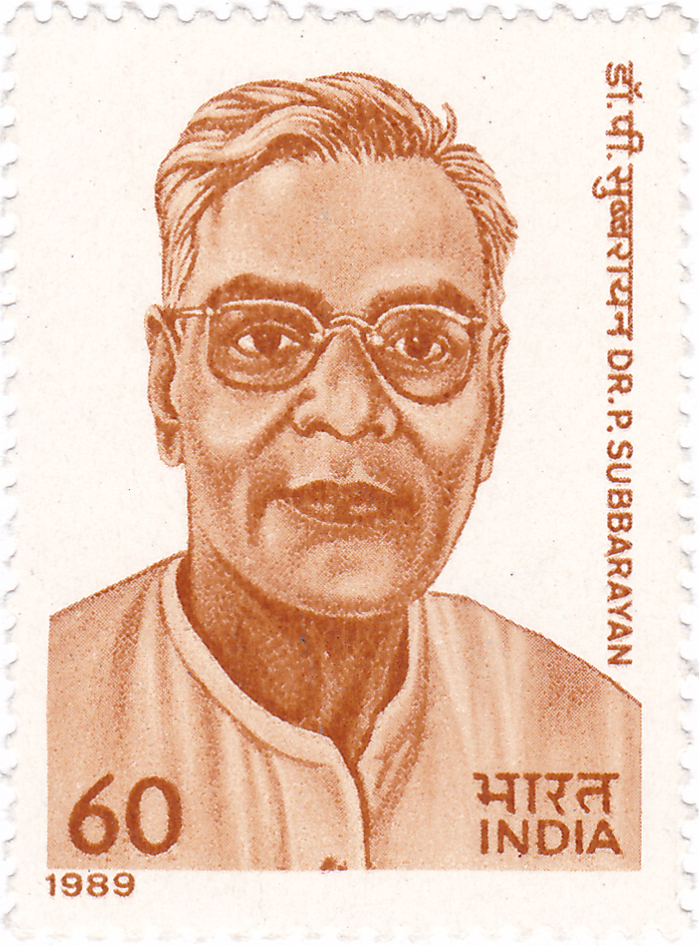
A portrait of Subbarayan was unveiled in the central hall of the Indian Parliament on 16 October 1989.[26][57]

See also

[edit]

Notes

[edit]

References

[edit]
[edit]
Revisions and contributorsEdit on WikipediaRead on Wikipedia
from Grokipedia

Paramasivan Subbarayan (11 September 1889 – 6 October 1962) was an Indian politician, freedom fighter, , and who held key roles in provincial and national governance, including as of from December 1926 to October 1930, India's inaugural Ambassador to from 1949 to 1951, Union Minister of Transport and Communications from 1959 until his death, and Governor of in 1962. Born into a family in Kumaramangalam, , he pursued higher education abroad, earning an M.A. from the , an LL.B. from the , and an honorary L.L.D. from , before practicing as an advocate in the .
Initially aligned with the Justice Party, Subbarayan was appointed as an independent by the amid political instability, during which he enacted reforms promoting education, combating through dedicated legislation, and advancing rights to foster . Shifting to the in 1933 under Gandhi's influence, he actively participated in the independence movement, including the , leading to his arrest alongside other leaders. As a member of the elected from Madras on a ticket, he contributed substantively to debates on adult franchise, civil services recruitment, the , and the choice of , notably advocating for the retention of English in a 1955 dissent note. His diplomatic tenure in marked early post-independence foreign relations efforts, while later parliamentary service included terms in the Madras until 1949, from 1954 to 1957, and from in 1957. Subbarayan's career bridged dyarchy-era provincial with , emphasizing legal and social reforms grounded in empirical governance needs over partisan rigidities.

Early Life and Education

Birth and Family Background

Paramasivan Subbarayan was born on 11 September 1889 in the family estate at Kumaramangalam, near in (present-day [Namakkal district](/page/Namakkal district)), . Subbarayan hailed from a prominent zamindari family, among the largest land-owning estates in , which provided him with early exposure to administrative and economic responsibilities typical of such agrarian elites under British colonial rule. His father, Paramasiva Gounder, a local landowner, died in an accident when Subbarayan was a , leaving the family to navigate its affairs amid the socio-economic structures of the . This background in a zamindar lineage, rooted in regional agricultural dominance, influenced his later political orientation toward reformist governance rather than radical upheaval.

Academic and Professional Training

Paramasivan Subbarayan completed his early schooling at Hindu High School in Madras before pursuing undergraduate studies at Presidency College, Madras, from which he graduated around 1910. Subbarayan then traveled abroad for advanced education, earning an M.A. from the , an LL.B. from the , and an LL.D. from , by the early 1920s. Returning to India, he established his professional practice as an advocate at the , focusing on legal work prior to entering politics in the mid-1920s.

Political Career Beginnings

Affiliation with the Justice Party

Subbarayan entered politics in the early 1920s by affiliating with the Justice Party, formally the South Indian Liberal Federation, a organization founded in 1916 to champion non- representation against perceived Brahmin dominance in administration and education within the . As a from and trained physician with a background in advocacy, Subbarayan aligned with the party's emphasis on communal reservations, , and administrative reforms favoring backward classes, reflecting his own experiences in non-elite landowning circles. His membership facilitated election to the Madras , where he contributed to debates on agrarian issues and caste-based opportunities, though specific legislative records from this phase highlight limited individual initiatives tied directly to party platforms. By mid-decade, internal party fractures over leadership and policy—exacerbated by linguistic and regional divides—prompted Subbarayan's strategic distancing, culminating in his resignation from the Justice Party ahead of the November 1926 elections. The Justice Party secured only 21 seats in the 98-member council, falling short of a , while the Swaraj Party's 42 seats came with a refusal to form a government under dyarchy constraints. Governor George Goschen then invited Subbarayan to lead an independent ministry on December 27, 1926, bolstered by Justice Party votes and nominated members to achieve a working majority of 53 supporters. This arrangement preserved loose ties, enabling policies like expanded non-Brahmin quotas in services—continuations of Justice Party legacies—but strained relations emerged quickly. In 1927, the Justice Party initiated a no-confidence motion against Subbarayan's administration, citing deviations from communal priorities and over-reliance on gubernatorial intervention; it failed 46-41 with ties broken by nominated votes. Subbarayan's premiership until November 1930 thus marked the effective end of his formal Justice Party affiliation, shifting toward broader nationalist engagements amid the party's declining cohesion.

Transition to Nationalist Congress Alignment

Following the end of his premiership in December 1930, amid internal factionalism within the Justice Party that contributed to its electoral setbacks in the 1930 elections, P. Subbarayan severed ties with the party. He had initially aligned with the Justice Party for its non-Brahmin advocacy but grew disillusioned with its communal focus and administrative inefficiencies, prompting a pivot toward broader nationalist ideals. In the interim, he received support from the Swarajya Party, a nationalist faction within the framework, to contest as an independent candidate. Subbarayan's longstanding admiration for Mahatma Gandhi's non-violent independence movement facilitated his formal entry into the in 1933. This shift marked his embrace of pan-Indian nationalism over regional caste-based politics, aligning him with 's push for self-rule and social reform beyond sectional interests. By joining, he positioned himself for roles in the freedom struggle, including legislative advocacy against British policies. The transition reflected broader trends in Madras politics, where the Justice Party's decline due to infighting allowed to consolidate nationalist support.

Leadership in Madras Presidency (1926–1930)

Ascension to Premiership

In the 1926 Madras Presidency Legislative Council election, conducted under the dyarchical system established by the , the secured 41 seats, the Justice Party obtained 22, and independents won 36. The , aligned with the Indian National Congress's non-cooperation policy, declined to form a government despite its plurality, adhering to a of legislative participation. Governor George Lloyd invited P. Subbarayan, a nominated member of the since 1922 and an independent with nationalist leanings, to form an administration. Subbarayan assembled a coalition ministry drawing support from independent members and the Justice Party, mustering sufficient votes to govern without backing. This independent cabinet, emphasizing administrative continuity and moderate reforms, took office on 4 December 1926. Subbarayan's selection reflected the Governor's preference for a stable, non-confrontational leadership amid political fragmentation, as the Justice Party lacked a majority and 's abstention created a vacuum. His background as a physician trained in the and a critic of communal politics positioned him to bridge non-Brahmin interests with broader provincial governance, though his ministry faced ongoing opposition in the council.

Administrative Reforms and Policies

Subbarayan formed an independent ministry in December 1926 following a hung assembly in the elections, securing support from elements of the and independents to assume the premiership without formal party affiliation. His administration prioritized social equity measures to counter dominance in public services, building on prior Justice Party initiatives amid ongoing non-Brahmin advocacy. A cornerstone policy was the issuance of Government Order Ms. No. 1071 on October 26, 1927, which formalized communal reservations in government employment. This allocated 44% of posts to non-Brahmin Hindus, 11% each to Brahmins, Muslims, Christians, and Anglo-Indians, and 8% to Scheduled Castes (then termed Depressed Classes), reflecting proportions of English-literate populations—estimated at just 7% overall at the time. The order extended to educational admissions, aiming to broaden access for underrepresented communities and reduce caste-based disparities in bureaucracy, where Brahmins held disproportionate influence despite comprising a minority of the population. These quotas persisted in modified form until 1950, influencing subsequent reservation frameworks in the region. Administrative efforts under Subbarayan emphasized efficient governance within dyarchical constraints, though no major legislative overhauls in or were enacted during the tenure. The ministry's focus on representational reforms faced criticism for entrenching communal divisions, yet it advanced empirical redress of service imbalances backed by demographic data on and . Subbarayan's resigned in amid growing opposition, marking the end of this interim phase of policy experimentation.

Political Opposition and Critiques

Subbarayan's independent ministry, formed on December 4, 1926, following the Justice Party's electoral defeat on November 8, 1926, faced immediate opposition from the ousted Justice Party, which positioned itself as the primary antagonist in the Madras Legislative Council. Critics within the Justice Party accused Subbarayan of undermining non-Brahmin solidarity by breaking ranks and accepting the Governor's nomination without a clear electoral mandate, portraying his government as a contrived coalition reliant on transient Swaraj Party support rather than genuine majority backing. This internal rift exacerbated existing factionalism, with Justice Party leaders like those aligned with the late Panaganti Ramarayaningar (Panagal Raja), who died on December 16, 1928, viewing Subbarayan's administration as a dilution of the party's communal representation agenda. Nationalist elements, particularly the faction within the , initially lent conditional support to Subbarayan to block a potential Congress resurgence but soon withdrew it, branding the ministry as excessively communal for perpetuating policies like the 1921 Communal G.O. that reserved government posts for non-Brahmins. This critique stemmed from the Swarajists' broader push for dyarchy's dismantlement and , contrasting Subbarayan's pragmatic engagement with British institutions, which they derided as loyalist compromise amid rising anti-colonial fervor. Subbarayan's reluctance to fully endorse non-cooperation tactics further alienated radicals, who saw his reforms—such as expanded non-Brahmin education quotas—as insufficiently transformative and overly conciliatory to colonial authorities. The ministry's fragility was underscored by recurrent challenges to its stability, including a no-confidence motion moved by C.R. Reddy, which highlighted disputes over patronage distribution and exposed the coalition's dependence on alliances. These episodes fueled accusations of administrative inefficiency and policy inconsistency, particularly in handling caste-based tensions and fiscal measures, contributing to Subbarayan's resignation on October 27, 1930, ahead of the elections that restored Justice Party rule. Conservative groups also voiced opposition, protesting the entrenched reservation system as discriminatory, though Subbarayan defended it as corrective justice grounded in demographic realities of overrepresentation in services. Overall, these critiques reflected deeper divides between communal pragmatism and nationalist urgency, undermining the ministry's legitimacy despite its enactment of progressive social legislation.

Interwar and Wartime Political Engagement (1930–1947)

Legislative Roles and Policy Advocacy

Subbarayan was re-elected as an independent to the Madras Legislative Council in the 1930 elections, where he assumed the role of opposition leader following the Justice Party's formation of government under P. Munuswamy Naidu. In this capacity, he prioritized social reform legislation, most notably advocating for and successfully introducing prohibition in Salem district that year—a policy that curbed alcohol sales and consumption there until 1943, reflecting his long-standing temperance views rooted in public health and moral grounds. He also drafted bills aimed at alleviating disabilities faced by depressed classes, including efforts to promote temple entry and combat untouchability, though these faced resistance from conservative elements and did not pass during the non-Congress regime. Aligning with the in 1933, Subbarayan shifted toward nationalist advocacy while maintaining his legislative focus on progressive policies. He contested the 1937 provincial elections under the banner, securing a seat in the and appointment as Minister of and Education in C. Rajagopalachari's ministry. In this portfolio, spanning 1937 to 1939, he oversaw legal codification efforts and educational expansions, including support for compulsory and curriculum reforms to foster civic awareness, aligning with the government's broader agenda of rollout and Harijan upliftment despite fiscal constraints and opposition from landed interests. The ministries' resignation in October 1939, in response to Viceroy Linlithgow's unilateral declaration of India's war involvement, curtailed Subbarayan's ministerial influence amid the impasse. He remained active in deliberations, critiquing British administrative overreach, and joined the in August 1942, resulting in his imprisonment alongside other leaders until the war's end. Post-release, as provincial politics revived, Subbarayan contributed to interim governance; in March 1947, following the 's 1946 election victory, he was appointed Minister of Police and Home Affairs in O. P. Ramaswamy Reddiar's short-lived cabinet, where he managed transitions, communal tensions, and preparations for dominion status, emphasizing adherence and minority protections amid partition negotiations.

Participation in the Quit India Movement

Subbarayan, aligned with the by the early 1940s following his earlier independent and nationalist leanings, endorsed the passed by the on August 8, 1942, at Bombay, which demanded the end of British rule and initiated widespread across . As a prominent Madras-based leader, he mobilized support for the movement's objectives of immediate independence amid , participating in protests and organizational efforts despite the British government's suppression, which included mass arrests of Congress figures. His active involvement led to his arrest by British authorities in 1942, alongside fellow Congress leaders and , resulting in imprisonment as part of the crackdown that detained over 100,000 participants nationwide. This incarceration highlighted Subbarayan's shift from provincial governance to direct confrontation with colonial rule, reflecting his prioritization of national sovereignty over prior administrative roles. Released after the movement's suppression, Subbarayan's experience reinforced his post-war advocacy for constitutional reforms, contributing to his later election to the from Madras in 1946.

Post-Independence Diplomatic and National Service

Ambassadorship to

In December 1949, Paramasiva Subbarayan was appointed as India's first ambassador to , resigning from his position in the Provisional Parliament to assume the role amid the establishment of full diplomatic relations following the ' transfer of sovereignty to earlier that year. His tenure, from 1949 to 1951, coincided with both nations' post-colonial transitions, where had already extended early recognition of Indonesian independence in 1947. As ambassador, Subbarayan focused on building foundational diplomatic engagement between the two countries, promoting mutual interests in , , and regional stability in . His service helped solidify early bilateral ties, reflecting India's emphasis on among newly independent states outside traditional power blocs. Subbarayan returned to India in 1951, transitioning to further national roles.

Service in Parliament and Constituent Assembly

Subbarayan was elected to the from the Madras Province in July 1946 on an ticket, representing one of the 29 seats allocated to the province. During the Assembly's proceedings from 1946 to 1950, he contributed to key debates on adult franchise, emphasizing its expansion while cautioning against potential administrative strains; civil services recruitment and structure; the entrenchment of the ; and the choice of , where he supported but with safeguards for regional languages. He also served on a sub-committee under , alongside K.N. Katju, tasked with examining provincial constitutions and the governorship, initially proposing elected governors to enhance democratic accountability before the Assembly adopted nominated appointments. Following India's independence, Subbarayan entered the as a nominated or elected member representing Madras (later ) on April 3, 1954, serving until March 1957 when he transitioned to the . In the , he was appointed to the Committee of Privileges, which investigated breaches of parliamentary and member , reflecting his experience in legislative oversight from pre-independence councils. Notably, in 1955, he authored a dissent note to the First Official Language Commission, advocating retention of English alongside as an official language to ensure administrative continuity and national unity amid linguistic diversity. In 1957, Subbarayan contested and won the election from the constituency in as a candidate, securing the seat in the polls during the second general elections. His tenure in the extended from March 1957 until April 1962, when he was appointed of , during which he participated in debates on national development, transport policy, and federal relations, drawing on his prior administrative roles. Throughout his parliamentary service, Subbarayan emphasized pragmatic governance, federal balance, and continuity in , consistent with his earlier nationalist engagements.

Ministerial Roles in the Union Government

Appointment and Key Portfolios

P. Subbarayan was appointed to the Union Cabinet as Minister of Transport and Communications on 2 September 1959, during Jawaharlal Nehru's third ministry. This role marked his return to high-level executive positions in the central government following his ambassadorship to and prior legislative service. The appointment reflected his extensive experience in administration from his tenure as Premier of in the late 1920s and his advocacy for infrastructure development within the . The portfolio encompassed critical sectors vital to India's post-independence economic expansion, including postal services, , civil aviation, shipping and ports, and . Subbarayan's oversight extended to policy formulation for expanding telegraph and networks, enhancing air connectivity through initiatives like the expansion of domestic airlines, and improving maritime infrastructure to support trade. He served in this capacity until 9 April 1962, when he was elevated to the governorship of , amid ongoing efforts to modernize transport systems amid rapid industrialization. During his tenure, Subbarayan prioritized integrating transport modes for national integration, such as coordinating road-rail linkages and addressing bottlenecks in , though specific achievements were constrained by the era's fiscal limitations and bureaucratic challenges. His approach emphasized pragmatic reforms over ideological overhauls, drawing from his earlier provincial governance experience.

Policy Contributions and Challenges

As Minister of Transport and Communications from 1959 to 1962, P. Subbarayan oversaw key sectors including railways, highways, shipping, civil aviation, and postal and telegraph services, amid India's Third Five-Year Plan emphasis on expansion. His tenure focused on administrative coordination and legislative updates to support national development, though constrained by post-independence fiscal limitations and resource shortages typical of the era's . A notable contribution was Subbarayan's introduction of the Indian Post Office (Amendment) Bill in December 1960, aimed at refining postal operations and service delivery mechanisms to enhance efficiency in a rapidly growing network. He actively engaged in discussions on infrastructure, including progress on road bridges in and regional telephone expansions, advocating for state-led improvements while addressing queries on project timelines and contractor implementations. These efforts aligned with broader priorities for integrating modes, though specific quantitative outcomes like mileage added or capacity increases during his brief three-year term remain tied to ongoing plan implementations rather than unique initiatives attributable solely to him. Challenges included parliamentary scrutiny over service delays and regional disparities, such as telephone messenger services in high-demand areas like Bombay and , where Subbarayan defended ministry responses amid complaints of inefficiencies. Opposition critiques in debates highlighted tensions between state policies and influences, with Subbarayan intervening to clarify government stances on and . His sudden death on October 6, 1962, at age 73 curtailed potential longer-term reforms, leaving the portfolio amid unresolved pressures from economic bottlenecks and the impending Sino-Indian conflict's logistical demands.

Additional Interests and Contributions

Involvement in Sports and Diplomacy

Subbarayan demonstrated a lifelong enthusiasm for sports, with a particular focus on cricket administration and promotion. He served as President of the Board of Control for in India (BCCI) in 1948, overseeing the organization's activities during a transitional period for Indian cricket following . In this capacity, he advocated for engagements to foster goodwill between and Britain. Subbarayan leveraged his position to advance as a diplomatic instrument. In September 1948, he wrote to British Prime Minister , proposing a tour of by the (MCC) as a symbolic gesture of post-colonial amity and mutual respect. This initiative reflected his broader view of sports as a bridge for interstate relations amid the end of British rule in , though the tour's realization depended on subsequent negotiations. Beyond formal roles, Subbarayan contributed to sports discourse through writings on strategy and development, emphasizing its role in national unity and international outreach. His efforts aligned with early post-independence attempts to integrate sports into India's framework, distinct from his later ambassadorship postings.

Intellectual and Social Engagements

Subbarayan demonstrated a commitment to social reform through legislative initiatives during his premiership in (1925–1926), including the establishment of minimum marriage ages at 21 years for males and 16 years for females to curb child s, and the passage of a bill aimed at preventing immoral trafficking of women. These measures reflected his emphasis on practical improvements in societal norms, prioritizing social awakening as a foundation for broader progress over immediate political agitation. In 1932, as a member of the Madras Legislative Council, Subbarayan introduced the Hindu Temple Entry Disabilities Removal Bill, seeking to eliminate caste-based barriers to temple worship and promote inclusivity in religious practices; though it faced opposition and was not immediately enacted, it highlighted his advocacy for dismantling discriminatory traditions rooted in orthodoxy. His efforts intertwined with critiques of entrenched customs, often invoking rational arguments against practices like the system, where he linked reform to the interplay of , , and in legislative debates. Intellectually, Subbarayan explored epistemological themes, authoring "Aptavakyam as a Strategy of Learning," in which he contrasted esoteric traditions with scientific inquiry as complementary paths to universal knowledge, underscoring the need for balanced approaches in human understanding. He also wrote on agricultural modernization in "The New Strategy in Indian Agriculture," applying empirical analysis to economic challenges. As Education Minister in Madras, he advanced curricular reforms, such as mandating as a compulsory high school subject in 1949, to foster national integration while endorsing schemes like the Wardha plan. Subbarayan's worldview aligned with universal , emphasizing profound faith in human equality and rational progress, as evidenced in tributes portraying him as a figure who bridged traditional values with modern without dogmatic rejection of either.

Death, Family, and Legacy

Final Years and Passing

Subbarayan served as the of from March 1962 until his death, overseeing the state's administration during a period of post-independence consolidation. He died on 6 October 1962 in , , at the age of 73.

Familial Political Influence

P. Subbarayan's progeny extended his political legacy through diverse roles in national governance and activism, reflecting ideological breadth from centrism to communist labor advocacy. His son entered politics in the 1930s, aligning with the after initial communist leanings, and served as a member before his appointment as Union Minister for and Mines in 1971, a position he held until his death in an crash near on July 31, 1973. Subbarayan's daughter, Parvati Krishnan, pursued a contrasting path with the (CPI), elected to the for from 1954 to 1957. She later became vice-president of the (AITUC) and championed reforms for textile workers in , including better wages and conditions amid industrial strife, until her death on February 20, 2014, at age 94. This influence persisted into the next generation via Mohan's son, , who joined and won Lok Sabha seats from Salem in 1991, 1996, and 2004, culminating in his tenure as Union Minister for Power and New and from May 2004 to November 2005 under the UPA government. Rangarajan died on August 29, 2000, at age 51, having leveraged family ties while building an independent profile in politics. The Kumaramangalam lineage thus bridged executive, legislative, and union spheres, with Subbarayan's early 20th-century provincial leadership seeding three generations of national-level engagement, though marked by partisan variance rather than unified dynasty-building.

Historical Assessments and Viewpoints

Historians have evaluated P. Subbarayan as a pragmatic nationalist who pursued "responsive cooperation" with the colonial administration, advocating collaboration on reforms while pushing for greater Indian self-governance, in contrast to the Indian National Congress's broader non-cooperation policy during the 1920s. This approach led him to form an independent ministry in the Madras Presidency in 1926 after the Swaraj Party's electoral gains but refusal to assume office under dyarchy, a move supported by the Governor's nominations but criticized by Congress hardliners as undermining the boycott of councils and by the Justice Party as opportunistic. Subbarayan's tenure as (1926–1930) is assessed positively for legislative efforts to combat , promote Harijan upliftment, and expand access, reflecting his commitment to social reform amid political fragmentation. Despite joining the in and participating in the , contemporaries like Swarajists viewed his earlier constitutionalism as diluting anti-colonial fervor, though later evaluations credit it with sustaining administrative continuity in Madras. In the , Subbarayan's interventions are regarded as substantive, particularly his advocacy for universal adult franchise regardless of literacy—arguing on , 1949, that barriers would perpetuate exclusion—and defense of an independent to uphold . His 1955 dissent to the Commission, favoring English retention for accessing global knowledge, highlighted linguistic pragmatism but drew opposition from proponents, underscoring his enduring emphasis on practical governance over ideological purity. Posthumously, his legacy is affirmed through state honors, including a 1989 by , recognizing his bridging of pre- and post-independence roles in diplomacy, transport policy, and .

References

Add your contribution
Related Hubs
User Avatar
No comments yet.