Hubbry Logo
Paspalum notatumPaspalum notatumMain
Open search
Paspalum notatum
Community hub
Paspalum notatum
logo
8 pages, 0 posts
0 subscribers
Be the first to start a discussion here.
Paspalum notatum
Paspalum notatum
from Wikipedia

Paspalum notatum
Scientific classification Edit this classification
Kingdom: Plantae
Clade: Tracheophytes
Clade: Angiosperms
Clade: Monocots
Clade: Commelinids
Order: Poales
Family: Poaceae
Subfamily: Panicoideae
Genus: Paspalum
Species:
P. notatum
Binomial name
Paspalum notatum

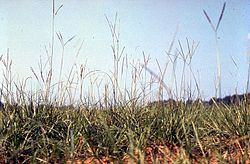
Paspalum notatum, known commonly as bahiagrass, common bahia, and Pensacola bahia, is a tropical to subtropical perennial grass (family Poaceae). It is known for its prominent V-shaped inflorescence consisting of two spike-like racemes containing multiple tiny spikelets, each about 2.8–3.5 millimetres (0.11–0.14 in) long.

This grass is low-growing and creeping with stolons and stout, scaly rhizomes. The stolons are pressed firmly to the ground and root freely from the internodes, forming a dense sod. The flat, tough-textured leaves are usually hairless, with blades 2–6 millimetres (0.079–0.236 in) wide. They are flat, folded, and inrolled, tapering to a fine point. The leaf bases at the terminus of each rhizome usually have a purplish hue. The stems reach 20–75 centimetres (7.9–29.5 in) tall.[1]

The terminal dual racemes are each attached to the top of a slender stem or with one slightly below the other. There is occasionally a third. The spikelets closely overlap in two rows. They are broad, rounded, smooth and shiny. Inside each spikelet is a tiny flower. The tiny, black, featherlike stigmas and black stamens can be seen dangling at the tips of the flowers.

Bahia grass is native to Mexico and South America, but has been naturalized elsewhere in North America and in other regions. It prefers sandy soils and is tolerant of shade. It is also fairly hardy, tolerating saline conditions and drought.[2]

This grass is used primarily as a forage. The nutritive value remains high when mature, but it is not very productive. It is also valued as an erosion-controlling soil stabilizer, as well as for its productivity, ease of establishment, and persistence. It makes a relatively low-maintenance turf as well, with its toleration for minimal maintenance, drought tolerance, and with less disease and insect damage than some of the other warm-season grasses.[3]

The grass uses C4 photosynthesis.[4]

References

[edit]
[edit]
Revisions and contributorsEdit on WikipediaRead on Wikipedia
from Grokipedia
Paspalum notatum, commonly known as bahiagrass, is a polymorphic grass in the family , characterized by rhizomatous and stoloniferous growth, erect culms reaching 20–90 cm in height, linear-lanceolate leaves 3–12 mm wide, and digitate inflorescences consisting of 2–5 racemes each bearing paired spikelets 2.5–4 mm long. Native to , the , and , it is a warm-season C4 plant adapted to tropical and subtropical environments, with deep roots extending up to 2–3 m that enable and . Taxonomically, it belongs to the subfamily , tribe Paspaleae, with two main varieties: the tetraploid var. notatum (2n=40) and the diploid var. saurae (2n=20). Widely naturalized beyond its native range, P. notatum has spread to (particularly the southeastern United States, including states like , , and Georgia), parts of , (such as , , and ), , and the Pacific islands, often introduced for forage or purposes. It thrives in sandy, infertile soils with 5.5–6.5, tolerating annual rainfall of 700–2,500 mm, temperatures around 20°C optimally, moderate , periodic flooding up to 36 days, and , but performs best on well-drained sites from to 2,300 m . Ecologically, its aggressive rhizomatous spread and ability to form dense mats make it valuable for preventing along roadsides and in disturbed areas, though it can become invasive in some regions, outcompeting native vegetation in pastures and natural habitats. As a major crop, P. notatum is extensively used in permanent pastures for production, yielding 3–20 t/ha/year of under good management, with high nutritive value when grazed young but declining digestibility at maturity. It supports heavy , is suitable for hay production with a 6-week cutting interval, and aids in crop rotations to suppress nematodes, though it is less productive for due to lower voluntary intake. Several cultivars, such as 'Pensacola' and 'Argentine', have been developed for improved seed production and adaptation, and it occasionally hosts minor toxicities like paspalum , but poses low risk from cyanogenic compounds. Establishment is achieved via seed (2–20 kg/ha) or vegetative planting, though slow initial growth requires for 1–3 years to achieve full cover.

Taxonomy and nomenclature

Classification

Paspalum notatum is classified within the kingdom Plantae, phylum , class Liliopsida, order Poales, family Poaceae, subfamily Panicoideae, tribe Paspaleae, subtribe Paspalinae, genus L., and species Paspalum notatum Flügge, first described in 1810. Accepted synonyms include Paspalum distachyon Willd. ex Döll and Paspalum taphrophyllum Steud., while varietal synonyms encompass Paspalum notatum var. latiflorum Döll and Paspalum notatum var. saurae Parodi. The species includes two recognized varieties: var. notatum (the common form) and var. saurae. Notable cultivars developed for forage and turf applications include 'Pensacola', selected from introductions originating in and widely used in the United States for its adaptation to poor soils; 'Argentine', known for denser sod formation and finer texture; 'Tifton 9', which offers improved palatability, seed yield, and overall productivity compared to 'Pensacola'; 'UF-Riata', bred for enhanced cold tolerance; and 'AU Sand Mountain', selected for winter hardiness in northern regions. Paspalum notatum exhibits a polyploid complex, with the typical number being tetraploid (2n=40) in most populations, which are often apomictic and facultatively sexual, though diploid (2n=) sexual forms and triploid (2n=) variants also occur.

Etymology and common names

The name Paspalum originates from the word paspalos, denoting a type of millet and reflecting the millet-like appearance of the inflorescences in of this . The specific notatum derives from the Latin notatus, meaning "marked" or "noted," likely alluding to the multi-colored spikelets that distinguish the plant. The most widely used common name for Paspalum notatum is , which stems from the Brazilian state of , a region central to its native range and early collections for cultivation. Variants include common bahia and Pensacola bahia, the latter honoring the locality where a prominent was identified and promoted in by agricultural agent E. H. Finlayson. In certain regions, it is also known as highway grass due to its frequent use along roadsides. Paspalum notatum was first formally described by the German Gustav Flügge in 1810, in his Monographia Paspalorum. The gained prominence in English-language during the early through agricultural publications, coinciding with its introduction to the in 1913 by the Agricultural Experiment Station for and purposes.

Description

Morphology

Paspalum notatum is a warm-season C4 grass that forms dense swards through sod-forming growth, typically reaching heights of 20–90 cm. It exhibits horizontal expansion via stolons and stout, scaly, J-shaped rhizomes up to 5 mm in diameter, complemented by a deep extending 1–2 m. The vegetative structure includes coarse, light-green leaves that are primarily basal and whorled, flat to folded or in-rolled, measuring 3–12 mm wide and 8–30 cm long, with a tapering fine point and fringed with hairs. Stems are erect or geniculately ascending, 20–75 cm tall, often with overlapping sheaths. The rhizomes are robust and woody, facilitating vegetative propagation. The forms a distinctive Y-shaped on an elongated peduncle, comprising 2–3 (occasionally up to 5) smooth, shiny racemes 4–12 cm long, each bearing two rows of paired spikelets. These spikelets are tiny, ovate to obovate, 2–4 mm long and 1.5–3 mm wide, and dark brown to black. The seeds are ovoid, glossy, and yellowish-green. Distinguishing features include the robust, woody rhizomes and narrow leaves up to 10 mm wide, which contrast with broader-leaved relatives such as Paspalum dilatatum.

Reproduction

_Paspalum notatum reproduces through both sexual and asexual mechanisms, with apomixis being predominant in many populations, particularly the common tetraploid races that produce seeds asexually without fertilization, resulting in offspring genetically identical to the parent plant. Some sexual tetraploid populations exist, enabling genetic recombination, while diploid cytotypes typically reproduce sexually. Vegetative propagation occurs via rhizomes and stolons, allowing the plant to spread horizontally and form dense mats through clonal growth. As a long-day plant, P. notatum initiates flowering when day lengths exceed approximately 13.8 hours, typically occurring from mid- to late summer (June to October in northern latitudes), with inflorescences emerging at the boot stage. Flowering commences early to mid-summer depending on genotype, such as earlier in 'Pensacola' compared to 'Argentine'. Seed production is prolific in apomictic populations, with yields ranging from 150 to 400 pounds per acre in cultivars like Tifton 9 under optimal conditions. Seeds remain viable for 1 to 2 years and exhibit dormancy, germinating slowly over weeks to months under warm, moist conditions with soil temperatures above 60°F (15.6°C), though optimal germination occurs at 30–35°C. Seed dispersal is primarily anemochorous, facilitated by due to the lightweight spikelets, but also includes zoochory through attachment to or ingestion by animals and anthropochory via activities such as hay transport.

Distribution and habitat

Native distribution

Paspalum notatum is native to subtropical , with its primary range encompassing northern , southern (including the Bahia region), eastern , and . Some authoritative sources extend the native distribution northward to include parts of and . This species evolved in the humid subtropical grasslands and savannas of these regions, where it was first described by August Friedrich Adolphe von Flügge in 1810 based on specimens from . In its native habitats, P. notatum commonly occurs in open woodlands, floodplains, and disturbed areas, particularly on sandy or light-textured soils at low altitudes. These ecosystems typically receive 31–79 inches (800–2000 mm) of annual rainfall, with periods of heavy precipitation followed by seasonal dryness, supporting the grass's adaptation to variable moisture conditions. Early botanical surveys documented its presence in these environments, highlighting its role as a component of natural pastures. Prior to its introduction elsewhere, P. notatum was not commercially cultivated in its native range; instead, wild populations formed dense, sod-like mats in low-altitude pastures and grasslands, contributing to the structure of subtropical ecosystems without human intervention.

Introduced distribution

Paspalum notatum was first introduced to the in 1913 by the Florida Agricultural Experiment Station from as a grass. The 'Pensacola' accession, a widely used , was introduced from in the 1930s. This perennial grass, native to subtropical , has since become naturalized across more than 4 million acres in the , spanning from to the and from to central . Beyond , Paspalum notatum has been widely introduced to tropical and subtropical regions worldwide, including the , , , (particularly ), (southwestern lowlands), , and various Pacific islands. These introductions were primarily for agricultural purposes, such as production, turf establishment, and in warm, humid environments. The species spreads through both intentional and accidental means. Intentional dissemination occurred via seed imports for forage and pasture improvement, exemplified by the 'Pensacola' variety's distribution in the early 20th century. Unintentional spread happens through contaminants in hay, crop seeds, , and along roadsides, facilitating its establishment in disturbed areas. In some regions, such as the Pensacola area of , it was inadvertently introduced before 1926 via contaminated materials from . Currently, Paspalum notatum dominates pastures and roadsides in humid subtropical states of the , including , Georgia, and . It is considered invasive in certain non-native habitats, such as and parts of , where it forms dense stands that outcompete native vegetation.

Ecology

Environmental requirements

Paspalum notatum, commonly known as bahiagrass, is adapted to sub-humid to humid subtropical climates where it exhibits optimal growth during warm seasons with long photoperiods. It thrives in daytime temperatures ranging from 80 to 95°F (27 to 35°C), particularly from to when day lengths exceed 12 hours, though production peaks in midsummer. The species requires a minimum annual rainfall of more than 31 inches (800 mm) for sustained productivity, but once established, it demonstrates high due to its deep , allowing survival in drier periods. It prefers full sun exposure for maximum vigor, although it shows moderate compared to other warm-season grasses. In terms of temperature thresholds, bahiagrass requires soil temperatures above 60°F (15.5°C), with optimal rates occurring between 85 and 95°F (29 to 35°C). Active growth ceases below 50°F (10°C), and it is winter hardy in USDA zones 7 through 11, with cultivars like Pensacola extending hardiness into cooler marginal areas. The plant tolerates periodic freezing but may suffer top-kill in severe winters below 20°F (-6.7°C) in less hardy varieties. Bahiagrass is versatile in requirements, thriving across a wide spectrum including sandy, poorly drained, and fine-textured types, with a preference for low-fertility acidic soils such as sandy spodosols common in its range. It performs best at a of 4.0 to 6.5, where it avoids deficiencies and stunting seen above pH 6.5, and it exhibits notable tolerance to aluminum prevalent in acidic subsoils. Additionally, it withstands periodic flooding for up to 36 days without significant damage, making it suitable for intermittently wet sites. Nutrient demands for P. notatum are generally low, enabling persistence in infertile conditions without supplemental inputs, though it responds positively to fertilization at rates of 20 to 75 pounds per acre annually to enhance yield and . Phosphorus and applications are beneficial based on tests but are not essential for in low-fertility environments. In its native South American habitats, these tolerances allow it to occupy marginal, acidic, and seasonally dry grasslands.

Interactions and invasiveness

Paspalum notatum is susceptible to several insect pests, including fall armyworms (Spodoptera frugiperda) and mole crickets (Scapteriscus spp., particularly the tawny mole cricket), which can damage foliage and roots in pastures and turf. These pests are often managed through biological controls such as entomopathogenic nematodes (Steinernema scapterisci) and parasitoid wasps (Larra bicolor), which target mole crickets effectively without broad chemical intervention. Thrips (Frankliniella spp.) may occasionally infest P. notatum, though it serves as a suboptimal host for some polyphagous species, limiting population buildup compared to preferred crops. Fungal diseases affecting the species include dollar spot caused by Sclerotinia homoeocarpa, ergot from Claviceps paspali (which produces toxic sclerotia harmful to grazing livestock), and leaf blights from pathogens like Cladosporium herbarum and Rhizoctonia solani, typically occurring in humid conditions and mitigated by cultural practices such as mowing seedheads to reduce ergot spread. In its interactions with other organisms, P. notatum forms dense mats that suppress native plant species through resource competition, particularly in disturbed habitats, thereby reducing overall biodiversity. It hosts soil microbial communities that can alter nutrient dynamics and favor its persistence over competitors, though specific microbial associations enhancing invasion have been increasingly studied, with meta-analyses showing greater facilitation for invasives by soil biota. Due to its predominantly apomictic reproduction in tetraploid forms, reliance on pollinators is minimal, yet bees such as European honey bees (Apis mellifera), bumblebees (Bombus spp.), and sweat bees (Halictidae) still forage on its spikelets for nectar and pollen. The plant provides seeds as forage for wildlife including deer, birds, and small mammals, but this benefit is offset by its displacement of more diverse native vegetation. Recent research (as of 2025) indicates that in can interact antagonistically with herbivory to influence the plant's growth, potentially modulating its invasive potential in polluted environments. Paspalum notatum exhibits high invasive potential in disturbed areas such as roadsides, pastures, and turfs, spreading prolifically via apomictic and rhizomes, with vegetative expansion rates of 0.24–0.49 m per year. It is invasive in the United States (e.g., gardens and southeastern pastures), (eastern and as an environmental weed), and (forming dense mats in roadsides and lawns), where it impedes native regeneration through competition for light, water, and nutrients. The USDA classifies it as a weedy or in managed landscapes due to its ability to dominate over 2 million hectares in the southeastern U.S., though it rarely invades intact native ecosystems. Invasion by P. notatum disrupts ecosystems by altering soil cycles through enhanced microbial activity and by changing fire regimes via continuous fuel layers, which favor its fire-adapted growth over less resilient natives. It also modifies hydrological patterns in wetlands and pastures by promoting drainage, further reducing suitability for biodiversity-dependent and perpetuating cycles of native displacement.

Uses and cultivation

Agricultural uses

Paspalum notatum, commonly known as bahiagrass, serves as a primary grass in low-maintenance systems across the , valued for its persistence under and adaptation to poor soils. It is primarily utilized for livestock , with rotational management recommended to optimize yields and stand longevity, allowing harvest at 10–12 inches height to maintain productivity. Annual yields typically range from 2 to 5 tons per acre, supporting acceptable animal performance such as average daily gains of 1 to 1.5 pounds for . For hay production, bahiagrass is cut every 30–35 days at the to early heading to preserve quality, though declines with maturity, featuring crude protein levels of 8–12%. Cultivars such as Tifton 9, with their upright growth habit, are particularly suited for hay due to higher yields (10–30% more than common types) and better recovery after cutting, often requiring 80 pounds of per acre applied in early spring and post-harvest. Overseeding bahiagrass pastures enhances year-round forage availability; it pairs well with like white clover at seeding rates of 2–3 pounds per acre to boost and overall quality, or with winter annuals such as ryegrass for extended into cooler months. In systems, bahiagrass improves subsequent yields of and by suppressing root-knot nematodes and reducing stem rot incidence, making it a key component in practices. Economically, bahiagrass covers more than 4 million acres in the , primarily in the Southeast, due to its low input requirements and resilience under heavy pressure, providing cost-effective while also supporting seed production for additional revenue.

Turf and erosion control

Paspalum notatum, commonly known as bahiagrass, serves as a low-maintenance turfgrass option for high-traffic utility areas, including roadsides and highway rights-of-way, where its aggressive production enables rapid establishment of dense . This wear-resistant quality makes it suitable for stabilizing soil in demanding environments, though its coarse texture and light green color reduce its ornamental value in formal lawns. For turf installations, seeding rates of 5–10 pounds of pure live seed per 1,000 square feet are recommended to achieve effective coverage. In applications, bahiagrass is widely planted along pond banks, levees, and in gullies, aligning with (NRCS) practices such as Grassed Waterway (code 412) and Critical Area Planting (code 342). Its deep , featuring J-shaped rhizomes, effectively stabilizes both sandy and clay soils, while the grass's tolerance for and low fertility supports persistence in challenging conditions. These attributes also make it valuable for reclaiming disturbed sites, where quick ground cover prevents further degradation. However, bahiagrass exhibits invasive tendencies in high-quality turf settings, where its prolific seeding and rhizomatous spread can suppress desirable species like bermudagrass. As a result, it is often regarded as a weed in maintained lawns and is better suited to non-ornamental uses. When incorporated into mixed plantings for conservation, bahiagrass offers ecological benefits, such as seeds that attract birds and small mammals, alongside providing cover habitat.

Propagation and management

Paspalum notatum, commonly known as bahiagrass, is primarily propagated by seed or sod in cultivated settings. Seed propagation involves broadcasting or drilling hulled seed at a rate of 15–20 pounds per acre for pasture establishment, with a planting depth of ¼ to ½ inch to ensure quick emergence and seedling vigor. Optimal planting occurs in spring or early summer, from after the last frost until early June, when soil temperatures support germination, which can take several weeks to months due to a high proportion of hard seed in most cultivars. Initial fertilization with 20–40 pounds of nitrogen per acre is applied 7–10 days after seedling emergence to promote growth, followed by soil testing to guide further nutrient needs. Sod propagation is faster for uniform stands but more labor-intensive, often used for turf applications, while vegetative methods like plugging are discouraged due to the grass's slow lateral spread, which leaves areas vulnerable to weeds. Weed control during establishment includes pre-plant tillage or nonselective herbicides like glyphosate, followed by mowing to 8 inches before applying broadleaf herbicides such as 2,4-D. Ongoing management of established stands emphasizes based on testing, with annual applications of 35–75 pounds per acre split into 2–3 doses during the to maintain productivity without excess leaching. supplementation at 30 pounds per ton of hay harvested replaces nutrients removed by cutting or , while is added only if soil tests indicate deficiency. at 3-inch stubble height optimizes utilization and reduces invasion, extending stand longevity compared to continuous stocking. Overseeding with cool-season annuals like ryegrass or clovers in late fall extends the and improves overall quality. For seed production, fields are fertilized in early spring and grazed until mid-June, when cultivars like TifQuik—known for rapid —are harvested to yield viable without legal restrictions on protected varieties. Paspalum notatum experiences few severe pests or diseases in well-managed fields, but integrated approaches address occasional issues. Fall armyworms, which defoliate foliage, are controlled with targeted insecticides applied at early infestation signs. , damaging roots through tunneling, respond to biological controls like entomopathogenic nematodes released preventively, reducing reliance on chemical options. , a fungal disease affecting seedheads, is managed by burning post-harvest residues to eliminate sclerotia and prevent spore spread. Growth regulators such as imazapic provide effective seedhead suppression in roadside or non-crop areas, applied at 0.3–0.5 pounds per acre during active growth, though they may temporarily stunt desirable grasses. For removal in non-desired areas like gardens or sensitive habitats, control focuses on persistence from rhizomatous spread. Nonselective herbicides like , applied at 1–2 quarts per acre in multiple treatments, effectively kill established stands but require follow-up to prevent regrowth. Selective options such as sethoxydim target grassy weeds including Paspalum notatum in broadleaf crops or turf, at rates of 0.2–0.3 pounds per acre during active growth. Mechanical methods like hand rouging or mulching with thick organic layers suppress seedlings in small-scale settings, while avoiding disturbance in erosion-prone areas to prevent further spread.

References

Add your contribution
Related Hubs
User Avatar
No comments yet.