Hubbry Logo
search
logo
2002111

Pathum Wan district

logo
Community Hub0 Subscribers
Read side by side
from Wikipedia

Pathum Wan (Thai: ปทุมวัน, pronounced [pā.tʰūm.wān]) is one of the fifty districts (khet) of Bangkok, Thailand. It lies just beyond the old city boundary of Khlong Phadung Krung Kasem and was a rural area on the eastern outskirts of the city when royal villas were built there in the late nineteenth century. The district was officially established in 1915, and covers an area of 8.37 square kilometres (3.23 sq mi). A large part of the district area is taken up by the campus of Chulalongkorn University and the green expanses of Lumphini Park and the Royal Bangkok Sports Club. By the turn of the 20th–21st centuries, the district had become known as the modern-day city centre, home to the prominent shopping areas of Siam and Ratchaprasong.

Key Information

History

[edit]

When King Rama I established Bangkok as his capital in 1782, he had canals dug including Khlong Maha Nak, which extended eastward from the fortified city proper of Rattanakosin Island. Communities formed along its bank, including Ban Khrua, a Muslim community mainly of Cham settlers, which stood at the end of the canal. As the canal was extended further eastward and became known as Khlong Bang Kapi (later Khlong Saen Saep), the outlying areas were cleared for paddy fields, though apart from the canal's banks the areas remained sparsely populated.[1]

Urban development

[edit]

By the reign of King Mongkut (Rama IV, 1851–1868), the city had spread beyond its original walls, and Khlong Phadung Krung Kasem was dug to extend the city's periphery in 1852. The eastern fringe of the city was then dominated by expansive rice fields, with Thung Bang Kapi occupying the areas along Bang Kapi Canal. The area that is now Pathum Wan was occupied by royal paddy fields by the canal, between Khlong Phadung Krung Kasem and Ban Khrua to the west and the Bang Kapi fields to the east. Some Lao war captives had also been settled in the area following the razing of Vientiane in 1827.[2]

Sometime before 1855, Mongkut had part of the royal fields south of the canal landscaped with ponds and waterways, which were planted with decorative lotuses, for leisurely visits. A royal villa was built there, which was named Pathum Wan, meaning "lotus forest" (from Pali paduma + vana). A temple, named Wat Pathumwanaram, was also built next to the palace. The King made annual visits to the palace and the temple, at first travelling by boat. A road was later built, continuing eastward from Bamrung Mueang Road, linking the palace to the city. It was originally known as Sa Pathum or Pathum Wan Road before being renamed Rama I Road in 1920.[1]

Windsor Palace, which stood from 1884 to 1935, occupied extensive grounds in what is now Wang Mai Subdistrict.

With the royal development, the area began to attract more residents, and more palaces were built during the following reign of King Chulalongkorn (Rama V, 1868–1910). The King had a palace built for Prince Svasti Sobhana west of Pathum Wan Palace in 1880, and commissioned Windsor Palace in 1881 for his own son Prince Vajirunhis, buying up large amounts of land for what was to be its extensive grounds.[3] He also later gifted a plot of land to another son, Prince Mahidol Adulyadej, though it was Mahidol's mother Queen Savang Vadhana who oversaw the construction Sa Pathum Palace there after Chulalongkorn died in 1910.[2]

Windsor Palace had become vacant following Vajirunhis's death in 1895, and its grounds became the site of several successive educational institutions which became established as Chulalongkorn University in 1917 by King Vajiravudh (Rama VI, r. 1910–1925). By then, several canals, roads and railways had been built through the area. West of the university grounds the Bangkok Railway Station, the country's main terminus, had been built in 1916. To the east, the Phloen Chit area was developed by the enterprising businessman Nai Lert around the same time. When the administration of Bangkok's districts was reorganized in 1915, the district was established as Amphoe Pathum Wan, bounded by Khlong Saen Saep to the north, the Chong Nonsi Railway to the east, Khlong Hua Lamphong to the south, and Khlong Phadung Krung Kasem to the west. Its status, along with Bangkok's other districts', was later changed from amphoe to khet in 1972.[1]

20th century

[edit]

Pathum Wan District saw increasing development throughout the 20th century, especially since the 1970s when the area along Rama I and Phloenchit roads became developed as a major shopping and commercial district. The Erawan Hotel opened on Ratchaprasong Intersection in 1956, and the Thai Daimaru department store, famous for introducing air conditioning and the escalator, opened on the opposite corner in 1964. Siam Square was developed as a low-rise retail area by Chulalongkorn University the same year, and the Siam Inter-Continental Hotel opened opposite it in 1966. Rajadamri Arcade—a modern, enclosed shopping mall—opened at Ratchaprasong in 1972, and Siam Center (next to the Inter-Continental) followed the next year. Gradually, Siam and Ratchaprasong supplanted the Wang Burapha area as Bangkok's centre of urban retail and youth culture.[4][5] With the opening of the BTS Skytrain in 1999, the location of its central interchange at Siam station helped cement the neighbourhood's prominence as Bangkok's modern-day city centre.[6] The area's prominence led to its occupation by anti-government protesters in 2010, which ended in a violent military crackdown.

Geography and administration

[edit]

Pathum Wan District occupies 8.369 square kilometres (3.231 sq mi) in Bangkok's Phra Nakhon side (east of the Chao Phraya River). It is bordered by Dusit and Ratchathewi districts to the north across Khlong Saen Saep, Watthana and Khlong Toei to the east across the Maenam railway, Sathon and Bang Rak to the south across Rama IV Road, and Pom Prap Sattru Phai to the west across Khlong Phadung Krung Kasem.

District map

The district is served by two major thoroughfares running roughly west–east: Rama I–Phloen Chit near Saen Saep Canal and Rama IV Road along the district's southern edge. They are crossed by several roads running north–south: Rama VI–Charu Mueang, Banthat Thong, Phaya Thai, Henri Dunant, Ratchadamri, Chit Lom–Lang Suan, and Witthayu. The Si Rat and Chaloem Maha Nakhon expressways run above Phra Ram VI–Charu Mueang and alongside the Maenam railway, respectively.

Banthat Thong, Phaya Thai and Ratchadamri roads divide the district into four subdistricts (khwaeng). They are, from east to west: Rong Mueang, Wang Mai, Pathum Wan and Lumphini. Together, they have a registered population of 47,685 as of October 2019.[7]

Name Area (km2) Population (2019)
1. Rong Mueang รองเมือง 1.423 16,827
2. Wang Mai วังใหม่ 1.423 6,877
3. Pathum Wan ปทุมวัน 2.276 6,022
4. Lumphini ลุมพินี 3.247 17,959

Neighbourhoods

[edit]

Rong Mueang remains the district's least developed area, occupied mostly by low-rise residential neighbourhoods. Rama VI Road crosses Rama I at Phong Phraram Intersection, and becomes known as Charu Mueang Road towards Rama IV to the south. The subdistrict's most prominent landmark is the Bangkok Railway Station (commonly known as Hua Lamphong), which lies in its southwestern corner at Hua Lamphong Intersection; the railway yard occupies most of the area along Phadung Krung Kasem Canal.

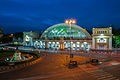
The campus of Chulalongkorn University and the Royal Bangkok Sports Club form open spaces against the backdrop of Ratchadamri skyscrapers (background, right).

The area of Wang Mai and Pathum Wan subdistricts (the former is known after another name of Windsor Palace) is dominated by the campus of Chulalongkorn University, which owns most of the land between Banthat Thong, Rama I, Henri Dunant and Rama IV roads. The neighbourhoods of Suan Luang (the east side of Banthat Thong) and Sam Yan (on the intersection of the same name where Phaya Thai Road meets Rama IV) are managed and developed for revenue by the university's Property Management Office.

Along Rama I Road, Charoen Phon Intersection (where it crosses Banthat Thong) is marked by the nearby National Stadium, which stands on the former location of Windsor Palace. Opposite the stadium complex to the north still lies part of the historic Ban Khrua community (though the main settlement is across Saen Sap Canal in Ratchathewi District). East of the stadium complex, the length of Rama I Road from Pathum Wan Intersection (where the road crosses Phaya Thai Road) to Chaloem Phao (where it meets Henri Dunant) serves the major shopping area known as Siam, after the retail area of Siam Square and several shopping centres opposite it. Further east, past Wat Pathumwanaram, the chain of shopping malls continues through the Ratchaprasong area (the intersection where Rama I is crossed by Ratchadamri Road) and along Phloen Chit Road (which continues off from Rama I). The coterminous areas of Siam and Ratchaprasong have been observed to form a "central shopping district" marking the city centre, as opposed to the central business district concept usually found elsewhere.[6]

The area of Lumphini Subdistrict south of the shopping area consists mainly of luxury residential towers and hotels along Ratchadamri, Lang Suan and Witthayu Roads, as well as numerous embassies. The subdistrict's main feature, giving it its name, is Lumphini Park, which sits between Ratchadamri and Witthayu roads and fronts Rama IV from Sala Daeng to Witthayu intersections. Lower-income neighbourhoods form the residential communities of Polo (off Witthayu Road, opposite the park) and Bon Kai (on Rama IV Road, in the district's southeast corner).

Notable locations

[edit]

Shopping

[edit]
Wat Pathum Wanaram forms an oasis of tranquillity flanked by the Siam Paragon (in back) and CentralWorld (not shown) shopping malls.

Pathum Wan is best known for the shopping district of Siam and Ratchaprasong. Siam Square is a low-rise area consisting of many small blocks of shops and buildings, sitting opposite the enclosed malls MBK Center on one side, and Siam Discovery, Siam Center and Siam Paragon (the last of which stands on the former site of the Siam Inter-Continental) on the other. The Ratchaprasong intersection is lined by the CentralWorld, BigC Ratchadamri (on the former site of Rajadamri Arcade), Narayana Phan, and Gaysorn shopping malls, as well as Central Chidlom, the Central Group's flagship department store.

Culture

[edit]

On the opposite corner of Pathum Wan Intersection from Siam Square is the Bangkok Art and Culture Centre, which shares the contemporary art scene with several galleries operated by Chulalongkorn University. The Jim Thompson House museum is popular as a tourist attraction. It is a complex of traditional Thai houses near the Ban Khrua community from where the designer sourced the silk he popularized internationally.[8]

The Erawan Shrine stands on a corner of Ratchaprasong, in front of the Grand Hyatt Erawan hotel (which replaced the Erawan in 1991). It is a famous place of worship where locals and tourists come to make wishes, but also the site of Bangkok's deadliest terrorist attack in 2015. Formal religious sites in the district include Wat Pathumwanaram, Wat Borom Niwat, Wat Duang Khae, Wat Chamni Hatthakan, Wat Sa Bua, Wat Chai Mongkhon, Masjid Indonesia, and the Holy Redeemer Church.[7]

Institutions

[edit]
The Erawan Shrine at Ratchaprasong Intersection

Much of the district's area is occupied by public institutions, most notably Chulalongkorn University, whose campus occupies several large blocks, mainly between Phaya Thai Road (which bisects it) and Henri Dunant Road. The latter is named after the founder of the Red Cross, as the Thai Red Cross Society straddles its southern end, with the Queen Saovabha Memorial Institute (famous for its snake farm) on one side and King Chulalongkorn Memorial Hospital (one of the country's largest teaching hospitals, affiliated with the university) on the other.[9] Another major public hospital, Police General Hospital, is within the Royal Thai Police headquarters between Chaloem Phao and Ratchaprasong intersections. The offices of the State Railway of Thailand (next to the Bangkok Railway Station) and the Ministry of Energy sit beside Khlong Phadung Krung Kasem in Rong Mueang. Other educational institutions include the rival technical colleges Pathumwan Institute of Technology (on the former site of Prince Svasti Sobhana's palace) and the Uthenthawai campus of Rajamangala University of Technology Tawan-ok, and schools Triam Udom Suksa School, Chulalongkorn University Demonstration School, the Patumwan Demonstration School of Srinakharinwirot University, and Mater Dei School (the last of which is the only private institution).

Sports

[edit]
Lumphini Park

Sports venues also form distinctive features in the district. In addition to the public National Stadium, the exclusive Royal Bangkok Sports Club (RBSC), with its golf course, forms a large green area between the two hospitals and gave Henri Dunant Road its former name: Thanon Sanam Ma or Racecourse Road. It has a second branch at the RBSC Polo Club off Witthayu Road. The Lumpinee Boxing Stadium used to stand on Rama IV Road near Witthayu Intersection, but was relocated in 2014.[10] Sporting activities also take place in Lumphini Park—one of the largest parks in the city—and its various facilities. Newer parks built in the 2010s include Chulalongkorn University Centenary Park on Banthat Thong and Pathumwananurak Park near Ratchaprasong. The latter was developed by the Crown Property Bureau, which, like the university, owns a lot of land in the area, especially in Lumphini Subdistrict. Other green spaces include the compound of Sa Pathum Palace—the area's only remaining royal residence—and the embassies of the United States and the Netherlands, two of the many diplomatic missions lining Witthayu Road or occupying office towers in the area.

Festivals

[edit]

Every year around Christmas and New Year, shopping centres, hotels and sidewalks in the Ratchaprasong shopping district are decorated with lights. It was started by The Peninsular Plaza[11] (closed since 1 March 2022[12]) and the Regent Hotel, and later expanded to Sogo (now out of business), Amarin Plaza, CentralWorld, Central Chidlom, Gaysorn and more. The Bangkok Metropolitan Administration (BMA) provides lights along the BTS Skytrain pillars.

Transportation

[edit]

Pathum Wan is served by multiple public transport systems. Both lines of the BTS Skytrain and the Blue Line of the MRT serve the district's neighbourhoods, while the Khlong Saen Saep water bus stops at multiple piers along its northern edge. Multiple bus lines run on the major streets, while both expressways have entrances and exits on Rama IV Road.

The Siam Station serves as the main interchange between the BTS's Sukhumvit and Silom lines. The other stations are Chit Lom and Phloen Chit on the Sukhumvit Line, and National Stadium and Ratchadamri on the Silom Line. The MRT runs beneath Rama IV Road along the district's southern edge, with Hua Lamphong, Sam Yan, Si Lom, and Lumphini stations serving their respective neighbourhoods.

Prior to the opening of Krung Thep Aphiwat Central Terminal, the current central station in Chatuchak district of Bangkok, Hua Lamphong railway station was the central station of Bangkok.

[edit]

References

[edit]
[edit]
Revisions and contributorsEdit on WikipediaRead on Wikipedia
from Grokipedia
Pathum Wan (Thai: ปทุมวัน) is one of the 50 districts of Bangkok, the capital of Thailand, situated in the central part of the city and serving as a major commercial and educational hub.[1] Covering an area of 8.37 square kilometres, the district had a population of 84,356 according to the 2010 census.[2] It features prominent landmarks such as the expansive Lumphini Park, Thailand's oldest public park established in 1920, and Chulalongkorn University, the country's oldest institute of higher learning founded in 1917.[3] The district is renowned for its concentration of high-end shopping centers including Siam Paragon, CentralWorld, and MBK Center, which attract millions of visitors annually and underscore Pathum Wan's role as Bangkok's premier retail destination.[4] Religious sites like the Erawan Shrine at Ratchaprasong Intersection and Wat Pathum Wanaram, a royal temple built in 1857, blend cultural heritage with modern urban development in the area.[3]

Etymology and Administration

Name Origin

The name Pathum Wan (ปทุมวัน) originates from the Thai term combining pathum (ปทุม), derived from the Pali word paduma meaning "lotus," and wan (วัน), an adaptation of vana meaning "forest," evoking the area's historical lotus groves and forested wetlands.[5][6] This nomenclature directly references Wat Pathum Wanaram (วัดปทุมวนาราม), a royal Buddhist temple constructed in 1857 under the orders of King Rama IV (Mongkut), whose name translates literally as "Temple in the Lotus Forest."[7][8] The district's name also draws from the adjacent Sa Pathum Palace (สระปทุม), erected on the site of a former expansive lotus pond known as Sa Pathum (meaning "Lotus Pond"), further emphasizing the region's pre-urban floral landscape dominated by lotus cultivation and natural ponds prior to 20th-century development.[6][8] The formal district (amphoe) was delimited and named Pathum Wan on April 9, 1914, during the administrative reorganization of Bangkok under King Vajiravudh (Rama VI), incorporating these landmarks as central identifiers.[7][9]

Administrative Structure

Pathum Wan District constitutes one of the 50 districts (khet) within the Bangkok Metropolitan Administration, which oversees municipal governance in Thailand's capital. The district is administered by a district office headed by an appointed district director reporting to the Governor of Bangkok, responsible for local services including urban planning, public health, and infrastructure maintenance.[10] The district is subdivided into four subdistricts (khwaeng): Lumphini, Pathum Wan, Rong Mueang, and Wang Mai, which serve as the primary units for local administrative functions such as resident registration and community services.[11] These divisions are delineated primarily by major roads including Rama I, Phaya Thai, and Ratchadamri, facilitating targeted governance and zoning.[12] The total area spans 8.37 square kilometers, with subdistrict areas varying: Pathum Wan at 2.18 km² and Rong Mueang at 1.30 km², among others.[11]

History

Pre-Modern Development

The Pathum Wan area, situated east of Bangkok's original city walls established in 1782, remained largely undeveloped marshland during the early Rattanakosin period, forming part of the extensive [Saen Saep](/page/Saen Saep) (Bang Kapi) fields suited for rice cultivation and traversed by canals for transport and drainage.[13] Small agrarian communities dotted the landscape, but permanent settlement was sparse, with the terrain characterized by swamps and seasonal flooding that limited intensive habitation until infrastructural interventions in the mid-19th century.[13] Under King Rama IV (r. 1851–1868), royal projects initiated modest development, including the construction of the Phadung Krungkasem canal in 1853, which functioned as an outer defensive moat and improved connectivity to the capital, positioning the area as an nascent suburban zone.[14] Concurrently, Rama IV established Sa Pratum Palace as a personal retreat amid the wetlands, fostering localized elite presence and administrative oversight.[13] A pivotal cultural anchor emerged with the founding of Wat Pathum Wanaram in 1857 by Rama IV, constructed adjacent to Sa Pratum Palace to serve royal residents and nearby villagers; the temple complex, embodying Thammayut Nikaya monastic traditions, included viharas and chedis amid rice paddies and waterways, symbolizing early integration of religious institutions into the peripheral landscape.[15] [16] These initiatives under Rama IV marked the transition from uninhabited swamplands to semi-rural enclaves with royal patronage, though population density stayed low, with growth constrained by natural topography until land reclamation efforts intensified post-1900.[13]

20th Century Urbanization

The establishment of Chulalongkorn University in March 1917 as Thailand's first institution of higher learning initiated key urban developments in Pathum Wan, with the campus occupying former royal lands along Phayathai Road and fostering educational infrastructure amid surrounding marshlands and rice fields previously used for diverse ethnic communities including Lao, Malay, and Cham residents.[17] In 1925, King Rama VI designated over 500,000 square meters of royal reserve as Lumphini Park, Bangkok's inaugural public green space modeled after Western urban parks, which replaced private royal gardens and introduced recreational planning to the district's outskirts.[18] These early 20th-century initiatives, building on Rama V's prior designation of the area as a secondary administrative hub with Siamese nobility and foreign enclaves plus the Pak Nam Railway terminus, shifted Pathum Wan from peripheral agrarian zones toward organized settlement supported by improved road access like Rama I Road.[19] The 1932 Siamese Revolution curtailed absolute monarchy privileges, leading to the 1937 formation of the Crown Property Bureau to oversee former royal assets, which enabled land reallocations for non-royal uses including commerce.[19] By 1939, Chulalongkorn University repurposed portions of its holdings for revenue-generating activities, setting precedents for mixed-use expansion amid Bangkok's broader population growth from under 1 million in 1900 to over 2 million by mid-century.[19] Urban transformation gained momentum post-World War II with national economic policies under leaders like Field Marshal Sarit Thanarat in the 1950s-1960s, promoting industrialization and infrastructure such as widened Sukhumvit and Rama IV Roads, which integrated Pathum Wan into central Bangkok's expanding grid and attracted commercial investments.[19] Mid-to-late century commercialization accelerated through quasi-public entities, exemplified by Siam Square's 1960 development on 300 rai (approximately 119 acres) of university land, where initial wooden structures gave way to 610 leased buildings by 1970 at rates of 180,000-200,000 baht per decade-long term, establishing the district's retail dominance.[20] Crown Property Bureau projects, including the Dusit Thani Hotel near Ratchaprasong, further densified the area, converting suburban fringes into high-density nodes by leveraging policy-driven land releases and proximity to emerging transport like the 1970s Greater Bangkok Plan precursors.[19] This era's causal drivers—property regime shifts, institutional land monetization, and state-led growth—propelled Pathum Wan's population density and built environment from low-rise, canal-oriented sprawl to vertically oriented commercial cores, though retaining traces of royal-era layout.[19]

Post-1945 Expansion and Commercialization

Following the end of World War II, Pathum Wan district underwent significant urban expansion amid Thailand's broader economic modernization, with accelerated physical changes emerging distinctly in the 1970s under the developmental policies of Prime Minister Sarit Thanarat (1957–1963), which emphasized infrastructure and capitalist growth in central Bangkok areas.[13] This period saw the district transition from semi-rural outskirts to a burgeoning commercial node, supported by improved road networks like Rama I Road and proximity to established institutions such as Chulalongkorn University, established in 1917 but expanding its influence post-war.[21] Commercialization intensified in the 1960s with the development of Siam Square, where Chulalongkorn University initiated construction of the first multi-story shophouses in 1964 on its owned land, replacing wooden houses, slums, and vegetable plantations to create a pedestrian-oriented retail zone targeted at students and emerging middle-class consumers.[22] By the late 1960s, this area along Rama I Road had evolved into Bangkok's premier shopping and entertainment district, supplanting older commercial centers like Wang Burapha and drawing investment through university-managed leasing that prioritized mixed-use buildings with shops below and residences above.[23] Adjacent Ratchaprasong intersection, enhanced by the 1956 installation of the Erawan Shrine as a spiritual-commercial landmark, further catalyzed retail growth, with roadside vendors and department stores proliferating amid post-war tourism and U.S. military-related economic inflows during the Vietnam War era.[21] The 1970s and 1980s marked Pathum Wan's consolidation as Bangkok's dominant retail hub, as quasi-public entities like universities and state-linked firms drove large-scale projects that shifted land use from residential to commercial, increasing density and economic output.[13] Key milestones included the opening of MBK Center (originally Mahboonkrong Center) on February 7, 1985, as Asia's largest mall at the time with over 2,000 shops on land leased from Chulalongkorn University, and the World Trade Center (later CentralWorld) on December 3, 1989, which expanded retail capacity with department stores, cinemas, and convention spaces along Ratchadamri Road.[24] [25] These developments, fueled by Thailand's export-led boom and foreign investment, transformed Pathum Wan into a high-density commercial enclave, with skywalks and BTS Skytrain integration by the late 1990s enhancing accessibility and sustaining its role as the city's central business and shopping precinct.[21]

Geography

Location and Boundaries

Pathum Wan District occupies a central position within Bangkok, Thailand, forming part of the Bangkok Metropolitan Region and spanning approximately 8.37 square kilometers.[11] It is situated immediately south of the historic core of Rattanakosin Island, extending beyond the Khlong Phadung Krung Kasem canal, which historically delineated the boundaries of the old city walls established in the late 18th century.[13] The district's boundaries are defined primarily by major arterial roads and waterways, reflecting Bangkok's urban grid. To the north, it is delimited by Rama I Road and Phaya Thai Road, separating it from Ratchathewi District. The eastern edge follows Witthayu Road (commonly known as Wireless Road) and portions of Rama IV Road, bordering Bang Rak District. Southward, Rama IV Road marks the division with Sathon District, while a southeastern segment along Rama IV and adjacent roads abuts Khlong Toei District. Western limits align with Phaya Thai Road and local alignments, interfacing with Ratchathewi.[9] These delineations encompass subdistricts including Pathum Wan, Rong Mueang, and Lumphini, integrating commercial, educational, and green spaces within the district's compact footprint.[10]

Physical and Environmental Features

Pathum Wan District occupies a flat, low-lying terrain typical of Bangkok's central plain, situated east of the Chao Phraya River at an average elevation of about 1.7 meters above sea level.[26] The area features level topography with no significant hills or variations in height, originally consisting of swampland drained for urban development.[27] Underlying soils comprise soft alluvial deposits from the delta region, contributing to subsidence risks in the broader Bangkok metropolitan area due to groundwater extraction and urban loading.[28] The district's environmental profile is dominated by urban impervious surfaces, with limited natural water bodies restricted to artificial lakes and canals. Lumphini Park, covering 57 hectares in the Lumphini subdistrict, serves as the primary green space, featuring a central lake, diverse tree cover, and habitats for species including monitor lizards.[29] This park, established in the early 20th century, provides ecological relief amid high-density development, supporting biodiversity and recreation while linking to adjacent green corridors like Benjakitti Park.[30] Climatically, Pathum Wan experiences a tropical savanna regime with high temperatures averaging 28–32°C year-round, pronounced wet (May–October) and dry seasons, and humidity levels often exceeding 70%.[31] Urban heat island effects intensify local temperatures due to concrete and asphalt coverage, though green areas like Lumphini Park mitigate microclimatic extremes by reducing surface heat.[32] Air quality varies, influenced by traffic emissions along major roads such as Rama I and Wireless Road, with parks offering localized filtration through vegetation.[33]

Demographics

Population and Density

As of 2023, Pathum Wan district had a registered population of 65,672, consisting of 31,456 males and 34,216 females, according to data from Thailand's National Statistical Office derived from household registration records.[34] This figure reflects the official de jure population, which tracks individuals registered at local addresses, but undercounts actual residents in central commercial districts like Pathum Wan due to internal migration; many workers and students from other provinces reside there temporarily without updating their registration. The 2010 national census, which enumerated de facto residents present on census day, recorded a higher population of 84,356, indicating a substantial floating population tied to the district's role as a business and education hub.[2] The district spans 8.37 square kilometers, yielding a registered population density of approximately 7,846 persons per square kilometer in 2023—above the Bangkok metropolitan average of about 5,875 persons per square kilometer but lower than peak densities in some inner-city areas.[35] This density supports Pathum Wan's urban-commercial character, with residential areas concentrated in subdistricts like Wang Mai and Lumphini, while commercial zones such as Siam and Ratchaprasong accommodate high daytime influxes that can multiply effective density during business hours. Historical trends show registered population growth from 84,356 in 2010 to the current figure, but adjusted for migration patterns, actual nighttime residency likely remains stable or slightly declining amid urban densification and high land costs favoring non-residential development.[2]

Socioeconomic Composition

Pathum Wan district encompasses a population of approximately 97,683 residents, comprising 48.6% males and 51.4% females, reflecting a gender balance typical of urban Bangkok areas.[35] The socioeconomic composition is characterized by a concentration of higher-income professionals, students, and expatriates, influenced by the district's status as a prime commercial and educational hub. Spatial econometric analyses using satellite data and National Statistical Office (NSO) surveys identify central Bangkok districts, including Pathum Wan, as high-socioeconomic clusters, contrasting with lower conditions in peripheral regions.[36] [37] Educational attainment in the district benefits from institutions like Chulalongkorn University, attracting a youthful demographic with advanced degrees; nationally, Thailand's population aged 25+ holds at least upper secondary qualifications at 39.11%, but urban centers like Bangkok exceed this due to tertiary enrollment rates around 50% in recent years.[38] Occupations skew toward white-collar roles in services, retail, finance, and academia, aligning with the area's dominance in shopping complexes and business offices, though precise district-level breakdowns remain unavailable in public NSO datasets.[39] Household incomes in Greater Bangkok, encompassing Pathum Wan, average 39,100 THB monthly, surpassing national medians influenced by urban economic activity.[40] Affluent residential pockets coexist with transient populations of commuters and migrants, contributing to income inequality patterns observed in central urban zones, where top deciles control disproportionate wealth amid overall upper-middle development.[41] Luxury developments and high rental premiums—starting at 25,000 THB for upscale units—underscore the appeal to high earners, reinforcing Pathum Wan's profile as one of Bangkok's more prosperous districts.[42]

Economy

Commercial and Retail Dominance

Pathum Wan district exemplifies commercial and retail dominance in Bangkok via its dense cluster of landmark shopping centers in the Siam and Ratchaprasong precincts, which serve as primary hubs for consumer spending on apparel, electronics, luxury items, and leisure activities. These facilities, interconnected by the BTS Skytrain, facilitate massive foot traffic from domestic shoppers, expatriates, and tourists, positioning the area as a linchpin of the city's service-oriented economy.[43] MBK Center, established in 1985 on Rama I Road, spans multiple floors with over 2,000 vendors specializing in affordable goods, drawing roughly 115,000 daily patrons including 35,000 international visitors focused on bargains and street food.[44] Adjacent Siam Paragon, opened in 2006, caters to upscale markets with global brands, an indoor aquarium attracting 2.5 million annual guests, and entertainment venues that amplify its role in experiential retail.[45] CentralWorld, anchoring the Ratchaprasong intersection, operates as Southeast Asia's largest shopping complex with over 830,000 square meters of space, accommodating 150,000 average daily visitors and hosting events that boost seasonal sales surges.[46][47] Collectively, these venues underpin Bangkok's retail recovery, contributing to sector revenues reaching 1.2 trillion baht by fiscal year-end, a 43% rise from pre-pandemic benchmarks amid tourism rebound.[48] This retail concentration not only generates substantial local employment but also stimulates ancillary services like hospitality and transport, reinforcing Pathum Wan's economic primacy without reliance on heavy industry.[49]

Tourism and Service Sector

Pathum Wan district functions as a central hub for Bangkok's tourism and service economy, drawing visitors through its concentration of upscale retail, entertainment venues, and cultural sites. The area's appeal lies in the Siam-Ratchaprasong commercial zone, where integrated shopping malls offer luxury brands, dining, and leisure activities, catering primarily to international tourists and affluent locals. Pre-COVID-19, flagship destinations like Siam Paragon recorded over 100 million annual visitors, underscoring the district's role in retail tourism.[50] Cultural attractions complement commercial offerings, with the Erawan Shrine at Ratchaprasong intersection serving as a focal point for religious tourism; thousands visit daily to offer prayers and witness traditional Thai dance performances, particularly popular among East Asian travelers.[51] Adjacent sites like Jim Thompson House provide insights into Thai silk heritage and modern design, attracting niche cultural tourists. Lumphini Park offers green space for recreation amid urban density, hosting exercise groups and seasonal events that enhance the district's livability and visitor draw.[3] The service sector thrives on hospitality and ancillary services supporting tourism, with over 180 hotels ranging from luxury properties like The Okura Prestige Bangkok and Centara Grand at CentralWorld to mid-range options such as Pathumwan Princess Hotel.[52] These establishments benefit from proximity to BTS Skytrain stations, facilitating access for the district's estimated high footfall in shopping areas, where Siam Piwat Group's properties alone generated over 516 billion baht in tourism revenue since early 2025.[53] Food and beverage services, including street vendors and high-end restaurants in malls like MBK Center and CentralWorld, further bolster visitor spending, though the sector faces challenges from seasonal fluctuations and competition.[54] ![MBK Center on Rama I Road](./assets/MBK_CENTER_(8)

Notable Landmarks

Shopping and Entertainment Centers

![MBK Center on Rama I Road](./assets/MBK_CENTER_(8) Pathum Wan district hosts several of Bangkok's largest shopping complexes, forming a central hub for retail, fashion, and leisure activities that attract millions of visitors annually. These centers integrate extensive retail spaces with entertainment facilities such as cinemas, aquariums, and interactive exhibits, blending commercial dominance with experiential offerings.[55] MBK Center, situated at 444 Phayathai Road, spans eight stories with approximately 2,000 shops specializing in electronics, clothing, souvenirs, and handicrafts, catering to both locals and tourists seeking bargains. Opened in 1986, it connects via skybridge to the BTS Siam station and National Stadium, enhancing accessibility. Its entertainment zone includes SF Cinema, arcade games, karaoke rooms, and themed cafes like maid cafes, providing diverse leisure options amid the shopping frenzy.[56][57] Siam Paragon, located at 991 Rama I Road adjacent to MBK, represents upscale retail with over 250 luxury and international brands across its floors, alongside a food hall and department store. The complex features SEA LIFE Bangkok Ocean World, one of Southeast Asia's largest aquariums, Madame Tussauds wax museum, and Paragon Cineplex with multiple screens for films. KidZania Bangkok, an edutainment center simulating professions for children, operates within, drawing families for interactive play. Directly linked to BTS Siam, it opened in 2005 as a flagship destination for high-end shopping and family entertainment.[58][59][60] CentralWorld, at 4 Rama I Road near Ratchaprasong intersection, is among the world's largest shopping complexes, encompassing retail outlets, office spaces, and a hotel with over 500 stores ranging from fashion to electronics. It hosts frequent events, exhibitions, and live performances in its open plazas, supplemented by cinemas and dining zones. Rebuilt and expanded in 2006 after a fire, the site connects to BTS Chit Lom and Siam stations via walkways, positioning it as a key entertainment venue during festivals like New Year's celebrations.[61][62] Platinum Fashion Mall, on 111 Ratchadamri Road in the Lumphini subdistrict, focuses on wholesale and retail apparel with over 2,000 shops across seven floors themed after global fashion districts like Ginza and Orchard. Primarily targeting bulk buyers and trend-seekers, it offers accessories, cosmetics, and fast fashion at competitive prices, with food courts for on-site dining. Accessible near BTS Ratchadamri, it serves as a specialized hub for garment trade, emphasizing volume sales over luxury.[63][64]

Cultural and Religious Sites

The Erawan Shrine, formally known as Thao Mahaprom Shrine, features a golden statue of Phra Phrom, the Thai representation of the Hindu god Brahma with four faces symbolizing insight in all directions.[65] Established in 1951 during the construction of the Erawan Hotel at Ratchaprasong Intersection to appease spirits following accidents and delays, the shrine draws worshippers seeking blessings for success, health, and prosperity.[65] It operates daily from 6 a.m. to midnight and is renowned for traditional Thai classical dance performances sponsored by devotees fulfilling vows after prayers are answered.[66] The site's syncretic practices blend Hindu elements with Thai Buddhist and animist traditions, attracting both locals and visitors amid the district's commercial bustle.[67] Wat Pathum Wanaram Rachaworawihan, a royal temple of the third class under the Thammayut monastic order, was founded in 1857 by King Rama IV (Mongkut) as a place of worship near the royal residence, originally amid canals and rice fields that have since urbanized.[16] The complex includes a main chapel with traditional Thai architectural features, a meditation garden for quiet reflection, and enshrines the Phra Serm Buddha statue as its spiritual centerpiece, alongside urns containing ashes of royal family members.[68] [69] Open daily from 9 a.m. to 5 p.m., it serves as a serene Buddhist sanctuary promoting tranquility and cultural continuity in Pathum Wan's high-density environment.[70] The Jim Thompson House, a museum complex assembled from traditional Thai teakwood houses relocated to its current site along the Saen Saep Canal, preserves the residence and art collection of James H.W. Thompson, an American entrepreneur who revived Thailand's silk industry post-World War II.[71] Established as a public museum after Thompson's 1967 disappearance in Malaysia, it displays Southeast Asian antiquities, including Cambodian stone heads, Burmese Buddhas, and Thai bencharong ceramics, alongside demonstrations of silk weaving techniques.[72] The site underscores Thompson's role in promoting Thai crafts globally through his company, Thai Silk Company Limited, founded in 1948, and exemplifies mid-20th-century cultural exchange between East and West.[73]

Educational and Sports Facilities

Chulalongkorn University, Thailand's oldest and highest-ranked institution of higher education, occupies a 637-rai campus in the Pathum Wan district along Phayathai Road.[74] Established as a public research university, it offers programs across 19 faculties and research institutes, serving over 35,000 students as of recent enrollment data.[74] The university's central location facilitates collaborations with Bangkok's business and government sectors, contributing significantly to the district's intellectual and economic landscape.[74] Smaller educational entities include the Patumwan Demonstration School, affiliated with Srinakharinwirot University, which emphasizes progressive education methods for primary and secondary students.[75] International options like Crest School, situated in the MBK Tower on Phaya Thai Road, provide Australian curriculum-based high school education targeting expatriate families.[76] The Pathumwan Institute of Technology offers vocational and technical programs, focusing on fields like engineering and business since its founding in 1999.[77] Sports facilities in Pathum Wan center on major venues supporting national and recreational activities. The Suphachalasai Stadium, part of the National Stadium complex opened in 1941, serves as a primary site for football matches, athletics events, and concerts, with a capacity exceeding 40,000 spectators.[78] Chulalongkorn University's Sports Complex provides indoor and outdoor amenities including swimming pools, tennis courts, badminton halls, and a fitness center, accessible to students and the public for various athletic pursuits.[79] Lumphini Park offers open-air exercise areas for jogging and tai chi, though formal sports infrastructure remains limited beyond university and stadium resources.[9]

Culture and Festivals

Religious and Traditional Practices

Pathum Wan district exemplifies Thailand's syncretic religious landscape, where Theravada Buddhism predominates alongside Hindu-influenced shrines and animist traditions. The district's practices center on merit-making through offerings, prayers for prosperity, and ritual performances, often integrated into daily urban life amid commercial hubs.[80][81] The Erawan Shrine, dedicated to Phra Phrom (the Thai manifestation of the Hindu god Brahma), draws continuous crowds for devotional rituals. Devotees circumambulate the four-faced statue clockwise, lighting incense and offering garlands, jasmine flowers, or teakwood elephants symbolizing prayers for success in business, health, or relationships; upon fulfillment, many commission traditional Thai classical dance troupes to perform gratitude offerings, featuring elaborate costumes and synchronized movements to rhythmic music.[80][81][82] These practices reflect Brahmanical influences persisting in Thai culture, with the shrine's location at Ratchaprasong intersection amplifying its role in urban spiritual routines since its establishment in 1956.[83] Wat Pathum Wanaram, a royal Buddhist temple founded in 1857 by King Rama IV (Mongkut) of the Thammayut order, serves as a serene counterpoint for orthodox Theravada observances. Monks and laypeople engage in chanting, meditation, and alms-giving ceremonies within its viharn and chedi, which house relics including royal ashes; the temple hosts periodic Buddhist festivals with candlelit processions and merit accumulation activities, preserving scriptural traditions amid surrounding modernity.[15][84][16] Animist elements persist through ubiquitous spirit houses in commercial areas, where offerings of food, flowers, and incense appease guardian spirits (phi) believed to influence fortune, blending folk beliefs with formal religions in everyday district life.[3] These practices underscore causal linkages between ritual adherence and perceived worldly outcomes, as evidenced by high participation rates among locals and expatriates seeking empirical validation through personal testimonies of wish fulfillment.[85]

Annual Events and Celebrations

The Ratchaprasong intersection, encompassing CentralWorld and adjacent sites in Pathum Wan, hosts Bangkok's premier New Year's Eve countdown annually on December 31, featuring live performances by Thai artists, drone shows, and a fireworks display exceeding 10,000 effects, drawing millions of attendees.[86][87] This event, organized by Central Pattana, transforms the commercial hub into Asia's "Original Times Square," with free public access starting at 6:00 PM and peaking at midnight.[88] Songkran, Thailand's traditional New Year from April 13-15, features district-specific water festivals and music events in the Siam area, including the Siam Songkran Music Festival at Siam Paragon and nearby venues, where participants engage in water fights, cultural parades, and concerts.[89] These gatherings emphasize merit-making and renewal rituals amid the urban commercial landscape.[90] The Erawan Shrine commemorates the annual birthday of Phra Phrom (the four-faced Brahma) on November 9 with enhanced worship ceremonies, classical Thai dance offerings, and increased floral tributes from dawn, attracting devotees seeking blessings in this high-traffic spiritual site.[91][92] Lumpini Park hosts recurring seasonal events, including the Concert in the Park series every Sunday from January to March at the Sala Bhirombhakdi amphitheater, offering free performances of classical, jazz, and contemporary music by the Royal Bangkok Symphony Orchestra and guests.[93][94] The annual Red Cross Fair in mid-December features food stalls, games, charity auctions, and cultural shows to support the Thai Red Cross, running daily from 11:00 AM to 10:00 PM over 12 days.[95][96]

Transportation and Infrastructure

Road Networks and Traffic Management

Pathum Wan district's road network integrates with Bangkok's central arterial system, featuring key thoroughfares such as Rama I Road and Witthayu Road (also known as Wireless Road), which delineate the district's eastern boundary and support connectivity to adjacent areas.[7] Rama I Road functions as a major east-west corridor, facilitating heavy commercial traffic through shopping and business hubs.[97] The network includes radial and circumferential routes that converge at critical intersections like Ratchaprasong, where Rama I intersects with Phloen Chit and Ratchadamri Roads, handling substantial daily vehicular volumes amid dense urban development. Traffic in Pathum Wan is characterized by persistent congestion, exacerbated by high retail footfall, tourism, and proximity to educational institutions, with Ratchaprasong Intersection frequently experiencing rush-hour gridlock from cars, motorcycles, and pedestrians.[98] To mitigate these issues, the Bangkok Metropolitan Administration enforces dynamic adjustments, such as temporary lane reallocations on Rama I Road during peak construction periods for the Orange Line subway extension, aiming to reduce delays by up to 15%.[97] Additionally, restrictions on street vending along roads like Ploenchit in Pathum Wan have been imposed to reclaim space and improve flow.[99] Management strategies emphasize technology and enforcement, including the deployment of AI-enabled cameras under the "Ratchaprasong Model" initiative since May 2024 to detect and penalize violations like illegal parking and lane encroachments at high-risk junctions.[98] These systems integrate with broader area traffic control measures, such as adaptive signal optimization, which have demonstrated reductions in intersection delays across Bangkok by 10-41% in tested locations.[100] Ongoing infrastructure enhancements, including elevated walkways and underpasses near commercial nodes, further aim to segregate pedestrian and vehicular movements, though enforcement consistency remains a challenge amid rising urban demand.[101]

Public Transit Systems

The primary public transit systems serving Pathum Wan district consist of the BTS Skytrain and MRT subway networks, which provide elevated and underground rail services connecting the district to central Bangkok and beyond.[102][103] The BTS, operated by the Bangkok Mass Transit System Corporation, features two lines intersecting at Siam station: the Sukhumvit Line with stations at Phloen Chit, Chit Lom, and Siam, and the Silom Line with stations at Ratchadamri, Siam, and National Stadium.[102] These stations facilitate access to key areas like Siam Square, MBK Center, and Chulalongkorn University, with trains running from approximately 6:00 AM to midnight and fares starting at 16 Thai baht based on distance.[104] The MRT Blue Line, managed by the Mass Rapid Transit Authority of Thailand, includes underground stations such as Si Lom and Sam Yan within Pathum Wan, located along Rama IV Road near Sala Daeng and Phayathai Road, respectively.[105] Si Lom station, opened in 2019 as part of the Blue Line extension, serves as an interchange point with the BTS Sala Daeng station above ground, while Sam Yan provides connectivity to educational and commercial hubs.[103] MRT services operate similarly to BTS, with frequencies of 3-5 minutes during peak hours and fares from 16 to 42 Thai baht, enhancing intra-district mobility and links to northern and southern Bangkok routes.[106] Public bus services, operated by the Bangkok Mass Transit Authority, supplement rail networks with numerous routes traversing Pathum Wan, including lines 40, 48, 54, and 73 along major roads like Rama I and Phloen Chit.[107] These air-conditioned and non-air-conditioned buses run from early morning to late evening, with fares typically 8-20 Thai baht, though reliability can vary due to traffic congestion; routes often connect to BTS and MRT interchanges for multimodal travel.[108] Integration between systems occurs via contactless cards like the Rabbit Card for BTS and stored-value cards for MRT, though separate ticketing is required for cross-system transfers.[109]

Urban Challenges

Environmental Degradation

Pathum Wan district experiences significant air pollution, primarily from vehicular exhaust and construction activities, contributing to elevated levels of fine particulate matter (PM2.5). Monitoring at Chulalongkorn University, located within the district, has detected high concentrations of PM2.5-bound metals, attributed to heavy traffic on surrounding roads. [110] As of 2022, air quality indices in Pathum Wan frequently reached moderate to unhealthy ranges, with PM2.5 accumulations driven by urban emissions. [111] Predictive models indicate persistent PM2.5 dispersion risks in the area, exacerbated by the district's dense commercial and educational hubs like Siam and Ratchaprasong intersections. [112] Waste generation poses another challenge, particularly from high-traffic shopping districts such as Siam Paragon and MBK Center, where consumer activities produce substantial food and packaging refuse. Initiatives like the Pathum Wan Zero Waste network have diverted over 2,000 tons of food waste through community efforts, highlighting underlying management strains in the absence of such programs. [113] Commercial waste volumes necessitate collaborative handling between operators and local authorities, as uncontrolled disposal could intensify local pollution. [114] Urban development has led to reduced green coverage and heightened heat island effects, with road and building expansion diminishing vegetation that once moderated temperatures. [115] Despite the presence of Lumphini Park, the district's overall impervious surfaces amplify environmental pressures, including noise and secondary pollutants from traffic congestion. [116] These factors underscore ongoing degradation amid rapid urbanization, though data from official monitoring stations provide a basis for targeted interventions. [117]

Social Disparities and Slums

Pathum Wan district, despite its reputation as a commercial hub with luxury retail and high-rise developments, harbors social disparities rooted in Bangkok's broader urban inequality, where affluent zones coexist with marginalized populations. Low-wage service workers, including migrants from rural Thailand and neighboring countries, sustain the district's economy through labor in malls, hotels, and offices but often reside in overcrowded informal rentals or peripheral substandard housing lacking basic amenities. This contrast underscores income polarization, with average household incomes in central Bangkok districts like Pathum Wan exceeding national medians, yet supporting a underclass vulnerable to eviction and economic shocks.[118] Historically, informal settlements dotted the district, exemplified by the Lang Wat Pathum Wanaram community near the temple, which emerged as a resilient slum in the mid-20th century and was studied for its internal leadership and social organization amid state interventions. By the 1970s, such chumchon (informal communities) proliferated along canals and underutilized lands, housing thousands displaced by rural-urban migration.[119] However, aggressive redevelopment in the Siam-Ratchaprasong area—encompassing key commercial nodes—led to systematic evictions starting in the 2000s, displacing piecemeal-constructed settlements to prioritize elite infrastructure like shopping complexes and transit links. These evictions, often justified as modernization, displaced residents without adequate relocation, exacerbating homelessness and informal dwelling in adjacent zones.[120] Contemporary slums in and around Pathum Wan are smaller and more fragmented than those in peripheral districts like Khlong Toei, reflecting partial upgrading efforts under programs such as Baan Mankong, which provided subsidies for secure tenure in select communities. Nonetheless, residual informal pockets persist, particularly among construction and retail laborers, where self-management practices—such as community savings and health initiatives—demonstrate adaptive resilience but highlight inadequate public services and sanitation risks. As of 2019, the district sheltered 224 homeless individuals, many sleeping under overpasses or in public spaces near Lumphini Park, amid housing costs inflated by proximity to employment centers.[121] [122] These conditions contribute to health vulnerabilities, including higher rates of informal debt and limited access to education, perpetuating intergenerational poverty despite Thailand's overall poverty decline to 6.3% nationally by 2021.[41]

Infrastructure Strain and Overdevelopment

Pathum Wan's central location and concentration of commercial, retail, and educational hubs, including major shopping complexes like Siam Paragon and CentralWorld, have driven rapid overdevelopment, exacerbating infrastructure strain amid high urban density exceeding 20,000 residents per square kilometer in core areas. This growth, fueled by tourism and office expansion, has outpaced upgrades to roads and utilities, leading to frequent bottlenecks and overloads.[13][123] Traffic congestion represents a primary strain, with intersections such as Pathumwan (Phaya Thai and Rama I roads) handling 62,453 vehicles daily, prompting proposals for congestion charges to mitigate gridlock. Siam Centre, a key retail node, ranks among Bangkok's top contributors to jams, particularly during peak hours and events, where average travel times inflate by over 50% due to vehicular and pedestrian volumes. Bangkok's overall congestion index reached 59.66 in November 2023, with central districts like Pathum Wan suffering amplified delays from limited road capacity and construction disruptions, such as those from the Orange Line subway extensions altering flows on Rama I Road.[124][125][126][97] Beyond roads, overdevelopment pressures utilities and drainage, as unchecked high-rise proliferation—evident in citywide violations across 13 projects by mid-2025—intensifies demands on aging sewage and water systems in dense zones. Flooding risks persist despite rainwater harvesting pilots in Pathum Wan, where urban impervious surfaces hinder natural recharge, compounding subsidence and overflow during monsoons. These causal pressures stem from quasi-public commercial expansions reshaping spatial patterns since the 1930s, prioritizing density over resilient capacity.[127][128][21]

References

User Avatar
No comments yet.