


Community hub
Recent from talks
Contribute something
Nothing was collected or created yet.
Jasmine
View on Wikipedia
| Jasmine | |
|---|---|

| |
| Jasminum flower | |
Scientific classification 
| |
| Kingdom: | Plantae |
| Clade: | Tracheophytes |
| Clade: | Angiosperms |
| Clade: | Eudicots |
| Clade: | Asterids |
| Order: | Lamiales |
| Family: | Oleaceae |
| Tribe: | Jasmineae |
| Genus: | Jasminum L. |
| Type species | |
| Jasminum officinale | |
| Species | |
|
More than 200, see List of Jasminum species[1][2][3] | |
| Synonyms[4] | |
| |

Jasmine (botanical name: Jasminum, pronounced /ˈjæsmɪnəm/ YAS-min-əm)[5] is a genus of shrubs and vines in the olive family of Oleaceae.[4][6][7]: 193 It contains around 200 species native to tropical and warm temperate regions of Eurasia, Africa, and Oceania.[7]: 194 Jasmines are widely cultivated for the characteristic fragrance of their flowers.
The village of Shubra Beloula in Egypt grows most of the jasmine used by the global perfume industry.[8]
Description
[edit] | This section needs additional citations for verification. (March 2023) |
Jasmine can be either deciduous or evergreen, and can be erect, spreading, or climbing shrubs and vines. The leaves are borne in opposing or alternating arrangement and can be of simple, trifoliate, or pinnate formation.
The flowers are typically around 2.5 cm (0.98 in) in diameter. They are white or yellow, although in rare instances they can be slightly reddish. The flowers are borne in cymose clusters with a minimum of three flowers, though they can also be solitary on the ends of branchlets. Each flower has about four to nine petals, two locules, and one to four ovules. They have two stamens with very short filaments. The bracts are linear or ovate. The calyx is bell-shaped. They are usually very fragrant.[7][9]
The basic chromosome number of the genus is 13, and most species are diploid (2n=26). However, natural polyploidy exists, particularly in Jasminum sambac (triploid 3n=39), Jasminum flexile (tetraploid 4n=52), Jasminum mesnyi (triploid 3n=39), and Jasminum angustifolium (tetraploid 4n=52).[7][additional citation(s) needed]
Distribution and habitat
[edit]Jasmines are native to tropical and subtropical regions of Eurasia, Africa, Australasia within Oceania, although only one of the 200 species is native to Europe.[10][11][12] Their center of diversity is in South Asia and Southeast Asia.[13]
Several jasmine species have become naturalized in Mediterranean Europe. For example, the so-called Spanish jasmine (Jasminum grandiflorum) was originally from West Asia, the Indian subcontinent, Northeast Africa, and East Africa, and is now naturalized in the Iberian Peninsula.[7][14]
Jasminum fluminense (which is sometimes known by the inaccurate name "Brazilian Jasmine") and Jasminum dichotomum (Gold Coast Jasmine) are invasive species in Hawaii and Florida.[15][16] Jasminum polyanthum, also known as pink jasmine, is an invasive weed in Australia.[17]
Etymology
[edit]The name comes from Old French jessemin, from Persian: یاسمن, romanized: yāsamin[18] which is derived from the Middle Persian word yāsaman and yāsamīn (يَاسَمِين) in Arabic.[19][20] The word entered Middle French around 1570 and was first used in English in 16th century England.[20] The Persian name is also the origin of the genus name, Jasminum.[21]
Taxonomy
[edit]Species belonging to the genus are classified under the tribe Jasmineae of the olive family (Oleaceae).[7] Jasminum is divided into five sections—Alternifolia, Jasminum, Primulina, Trifoliolata, and Unifoliolata.[22]

Species
[edit]Species include:[23]
- J. abyssinicum Hochst. ex DC. – forest jasmine
- J. adenophyllum Wall. – bluegrape jasmine, pinwheel jasmine, princess jasmine
- J. andamanicum N.P.Balakr. & N.G.Nair
- J. angulare Vahl
- J. angustifolium (L.) Willd.
- J. auriculatum Vahl – Indian jasmine, needle-flower jasmine
- J. azoricum L.
- J. beesianum Forrest & Diels – red jasmine
- J. dichotomum Vahl – Gold Coast jasmine
- J. didymum G.Forst.
- J. dispermum Wall.
- J. elegans Knobl.
- J. elongatum (P.J.Bergius) Willd.
- J. floridum Bunge
- J. fluminense Vell.
- J. fruticans L.
- J. grandiflorum L. – Catalan jasmine, jasmin odorant, royal jasmine, Spanish jasmine
- J. grandiflorum L.Vell.
- J. humile L. – Italian jasmine, Italian yellow jasmine
- J. lanceolarium Roxb.
- J. laurifolium Roxb. ex Hornem. angel-wing jasmine
- J. malabaricum Wight
- J. mesnyi Hance – Japanese jasmine, primrose jasmine, yellow jasmine
- J. multiflorum (Burm.f.) Andrews – Indian jasmine, star jasmine, winter jasmine
- J. multipartitum Hochst. – starry wild jasmine
- J. nervosum Lour.
- J. nobile C.B.Clarke
- J. nudiflorum Lindl. – winter jasmine
- J. odoratissimum L. – yellow jasmine
- J. officinale L. – common jasmine, jasmine, jessamine, poet's jasmine, summer jasmine, white jasmine
- J. parkeri Dunn – dwarf jasmine
- J. polyanthum Franch.
- J. sambac (L.) Aiton – Arabian jasmine, Sambac jasmine
- J. simplicifolium G.Forst.
- J. sinense Hemsl.
- J. subhumile W.W.Sm.
- J. tortuosum Willd.
- J. urophyllum Hemsl.
- J. volubile Jacq..
-
 Jasminum sambac "Grand Duke of Tuscany"
 -
 A double-flowered cultivar of Jasminum sambac in flower with an unopened bud.
 -
 Jasmine buds
 -
 Lifecycle of Arabian jasmine flower
 -
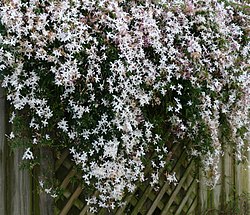
 Jasmine flowers


Jasmonates
[edit]Jasmine lends its name to jasmonate plant hormones, as methyl jasmonate isolated from the oil of Jasminum grandiflorum led to the discovery of the molecular structure of jasmonates.[24] Jasmonates occur ubiquitously across the plant kingdom, having key roles in responses to environmental cues, such as heat or cold stress, and participate in the signal transduction pathways of many plants.[25]
Cultural importance
[edit]Jasmine is cultivated commercially for domestic and industrial uses, such as the perfume industry.[26] It is used in rituals like marriages, religious ceremonies, and festivals.[27] Jasmine flower vendors sell garlands of jasmine, or in the case of the thicker motiyaa (in Hindi) or mograa (in Marathi) varieties, bunches of jasmine are common.[28] They may be found around entrances to temples, on major thoroughfares, and in major business areas.
A change in presidency in Tunisia in 1987[29][30] and the Tunisian Revolution of 2011 are both called "Jasmine revolutions" in reference to the flower.[31]
"Jasmine" is a common female given name.
-
 surface of Jasmine tea
 -
 The White Jasmine Branch, painting of ink and color on silk by Chinese artist Zhao Chang, early 12th century
 -
 Jasmine used as garland
 -
 Jasmine flower blooming
 -
 Jasmine flowers harvest in Reggio Calabria, Italy (1965)

_001.jpg)


Symbolism
[edit]Several countries and states consider jasmine as a national symbol.
- Syria: The Syrian city Damascus is called the City of Jasmine.[32]
- Hawaii: Jasminum sambac ("pikake") is a common flower used in leis and is the subject of many Hawaiian songs.[33]
- Indonesia: Jasminum sambac is the national flower, adopted in 1990.[34] It goes by the name "melati putih" and is used in wedding ceremonies for ethnic Indonesians, especially on the island of Java.
- Pakistan: Jasminum officinale is known as the "chambeli" or "yasmin", it is the national flower.[35]
- Philippines: Jasminum sambac is the national flower. Adopted in 1935, it is known as "sampaguita" in the islands. It is usually strung in garlands which are then used to adorn religious images.[36]
- Thailand: Jasmine flowers are used as a symbol of motherhood.[37]
- Tunisia: The national flower of Tunisia is jasmine. It was chosen as a symbol for the Tunisian Revolution.
- Iran: (and/or Shia Islam), Jasmine is considered as a symbol for Fatimah al-Zahra, the daughter of the Islam prophet Muhammad.[38]
Other plants called "jasmine"
[edit]- Brazilian jasmine Mandevilla sanderi
- Cape jasmine Gardenia
- Carolina jasmine Gelsemium sempervirens
- Crape jasmine Tabernaemontana divaricata
- Chilean jasmine Mandevilla laxa
- Jasmine rice, a type of long-grain rice
- Madagascar jasmine Stephanotis floribunda
- New Zealand jasmine Parsonsia capsularis
- Night-blooming jasmine Cestrum nocturnum
- Night-flowering jasmine Nyctanthes arbor-tristis
- Orange jasmine Murraya paniculata
- Red jasmine Plumeria rubra
- Star jasmine, Confederate jasmine Trachelospermum jasminoides
- Paraguaian jasmine Brunfelsia australis
References
[edit]- ^ "Jasminum". Index Nominum Genericorum. International Association for Plant Taxonomy. Retrieved 2008-06-03.
- ^ "10. Jasminum Linnaeus". Chinese Plant Names. 15: 307. Retrieved 2008-06-03.
- ^ UniProt. "Jasminum". Retrieved 2008-06-03.
- ^ a b "Tacca J.R.Forst. & G.Forst". Plants of the World Online. Royal Botanic Gardens, Kew. 2023. Retrieved 25 March 2023.
- ^ Sunset Western Garden Book. 1995. pp. 606–607.
- ^ "Jasminum L." World Flora Online. World Flora Consortium. 2023. Retrieved 25 March 2023.
- ^ a b c d e f Singh, A. K. (2006). Flower Crops: Cultivation and Management. New India Publishing. pp. 193–205. ISBN 978-81-89422-35-6.
- ^ Shubra Beloula: The tiny Egyptian village few know
- ^ A Modern Herbal
- ^ Townsend, C. C. and Evan Guest (1980). "Jasminum officinale," in Flora of Iraq, Vol. 4.1. Baghdad, pp. 513–519.
- ^ Ernst Schmidt; Mervyn Lötter; Warren McCleland (2002). Trees and shrubs of Mpumalanga and Kruger National Park. Jacana Media. p. 530. ISBN 978-1-919777-30-6.
- ^ Jasminum @ EFloras.org.
- ^ Panda, H. (2005). Cultivation and Utilization of Aromatic Plants. National Institute Of Industrial Research. p. 220. ISBN 978-81-7833-027-3.
- ^ "Jasminum". Germplasm Resources Information Network. Agricultural Research Service, United States Department of Agriculture.
- ^ NRCS. "Jasminum fluminense". PLANTS Database. United States Department of Agriculture (USDA).
- ^ NRCS. "Jasminum dichotomum". PLANTS Database. United States Department of Agriculture (USDA).
- ^ "Weeds of the Blue Mountains Bushland – Jasminum polyanthum". Archived from the original on 2014-02-04.
- ^ Weekley, Ernest (1921). "Jasmine, Jessamine". An etymological dictionary of modern English. London J. Murray. p. 779.
- ^ "Definition of Jasmine". Merriam-Webster. 2021-10-23. Retrieved 2022-01-20.
- ^ a b "Jasmine". Online Etymology Dictionary. 2022. Retrieved 4 March 2022.
- ^ Bayton, Ross (2019). The Gardener's Botanical: An Encyclopedia of Latin Plant Names. London, UK: Royal Horticultural Society. p. 170. ISBN 978-1-78472-677-5.
- ^ USDA, ARS, National Genetic Resources Program. "Jasminum L." Germplasm Resources Information Network, National Germplasm Resources Laboratory. Archived from the original on January 26, 2012. Retrieved November 22, 2011.
{{cite web}}: CS1 maint: multiple names: authors list (link) - ^ GRIN. "Jasminum information from NPGS/GRIN". Taxonomy for Plants. National Germplasm Resources Laboratory, Beltsville, Maryland: USDA, ARS, National Genetic Resources Program. Archived from the original on September 24, 2015. Retrieved October 19, 2012.
- ^ Demole E; Lederer, E.; Mercier, D. (1962). "Isolement et détermination de la structure du jasmonate de méthyle, constituant odorant caractéristique de l'essence de jasmin". Helv Chim Acta. 45 (2): 675–85. doi:10.1002/hlca.19620450233.
- ^ Sharma, M; Laxmi, A (2016). "Jasmonates: Emerging Players in Controlling Temperature Stress Tolerance". Frontiers in Plant Science. 6: 1129. doi:10.3389/fpls.2015.01129. PMC 4701901. PMID 26779205.
- ^ "What's So Great About the Jasmine Flower?". Earth.com. Retrieved 2022-04-27.
- ^ August 8; Comments, 2018 | Micaela Nerguizian |. "Hopa! Rituals and Symbols of an Armenian Wedding". Smithsonian Folklife Festival. Retrieved 2022-04-27.
{{cite web}}: CS1 maint: numeric names: authors list (link) - ^ "10 Different Types of Jasmine Plants (Photos) - Garden Lovers Club". www.gardenloversclub.com. 22 February 2020. Retrieved 2022-04-27.
- ^ Michael, Ayari; Vincent Geisser (2011). "Tunisie : la Révolution des "Nouzouh"* n'a pas l'odeur du jasmin" (in French). Témoignage chrétien. Archived from the original on 2011-01-28. Retrieved 2011-03-14.
- ^ "La révolution par le feu et par un clic" (in French). Le Quotidien d'Oran/moofid.com. 2011-02-25. Archived from the original on 2011-07-14. Retrieved 2011-03-14.
- ^ Kim, Elvis H (September 2021). "Democratization and Authoritarianism in the Information Age". International Area Studies Review. 24 (3): 205–223. doi:10.1177/22338659211026006. ISSN 2233-8659. S2CID 237434616.
- ^ Anabel Bachour (23 February 2017). "Damascus, the City of Jasmine". Peacock Plume, Student Media, The American University of Paris, France. Retrieved 26 May 2019.
- ^ Hitt, Christine (1 May 2018). "7 of Hawaii's Most Popular Lei and What Makes Them Unique". Hawaii Magazine. Retrieved 1 March 2022.
- ^ Keputusan Presiden No. 4 Tahun 1993 Archived 2012-04-02 at the Wayback Machine
- ^ Akhtar, Moin (26 October 2020). "Pakistan National Flower, Animal and Bird". ILM.com.pk. Retrieved 2 March 2022.
- ^ "Philippine National Flower- Sampaguita". National Museum of the Philippines. 10 November 2021. Retrieved 2 March 2022.
- ^ "Symbolic and spiritual meaning of jasmine flowers". Gardening Tips | Flower Wiki. 2017-01-03. Retrieved 2019-04-25.
- ^ علت نامگذاری حضرت زهرا (س) به گل یاس و مهدی موعود (عج) به گل نرگس چیست ؟ التماس دها (i.e.: What is the reason for naming Hazrat Zahra (PBUH) after the jasmine flower and the Promised Mahdi (PBUH) after the narcissus flower?)
Further reading
[edit]- "Jasminum Linn". Flora of Pakistan: 12. Retrieved 2008-06-03.
- Metcalf, Allan A. (1999). The World in So Many Words. Houghton Mifflin. ISBN 0-395-95920-9.
External links
[edit]


- "Flora Europaea Search Results". Flora Europaea. Royal Botanic Garden, Edinburgh. Retrieved 2008-06-03.
- "African Plants Database". South African National Biodiversity Institute, the Conservatoire et Jardin botaniques de la Ville de Genève and Tela Botanica.
- Chisholm, Hugh, ed. (1911). . Encyclopædia Britannica. Vol. 15 (11th ed.). Cambridge University Press. pp. 277–278.
| International | |
|---|---|
| National | |
| Other | |

Jasmine
View on GrokipediaBotanical Characteristics
Morphology and Growth Habits
Species of the genus Jasminum are primarily shrubs or scandent vines in the family Oleaceae, characterized by stems that are often square in cross-section and capable of twining or climbing with support.[6][7] Many exhibit vigorous growth, reaching heights of 3 to 6 meters or more when trained on trellises or walls, though some form erect or sprawling habits up to 6 meters in spread.[8][9] Leaves are typically opposite or occasionally alternate, ranging from simple and ovate-lanceolate to pinnate or ternate compound forms with 3 to 9 leaflets; they are generally glossy and evergreen in tropical species but may be deciduous in temperate ones.[7][6] Flowers arise in terminal or axillary cymes, featuring a tubular to salverform corolla that is usually white or yellow, 2-5 cm in diameter, with a five- to eight-lobed limb and exserted stamens; the calyx is cylindrical and cleft.[7] Fruits develop as paired berries, often black and globose, containing one to four seeds each.[9] Growth habits vary by species and climate: tropical jasmines like J. sambac maintain evergreen foliage and bushy, upright to climbing forms, while temperate species such as J. nudiflorum are deciduous with arching, non-twining branches that root at nodes.[6][8] Most prefer full sun to partial shade and well-drained soils, with scandent types requiring pruning to control spread and encourage flowering.[8] In cultivation, they can adapt to containers or ground planting, though cold-hardy varieties withstand temperatures down to -10°C in protected sites.[9]Distribution and Habitat
The genus Jasminum encompasses approximately 200 species of shrubs and vines native to tropical and subtropical regions across the Old World, spanning Asia, Africa, and Australia.[6] These plants are particularly diverse in southeastern Asia and the Indian subcontinent, with additional distributions in the eastern Himalayas, western Africa, and parts of Oceania.[10] [1] Some species, such as Jasminum officinale, extend into warm temperate zones of Eurasia, including the Himalayas, Asia Minor, and China, where they endure seasonal cooler temperatures down to USDA zone 7 with protection.[11] In natural settings, Jasminum species occupy varied habitats including forest margins, scrublands, thickets, and rocky slopes in humid, warm environments that provide ample sunlight and moisture without waterlogging.[12] They favor well-drained, fertile soils with a neutral to slightly acidic pH and thrive in full sun to partial shade, reflecting adaptations to understory or edge positions in tropical woodlands.[13] Species like Jasminum dichotomum from tropical West Africa grow as scrambling vines in evergreen shrublands, while others in drier subtropical areas tolerate periodic drought once established.[14] Overall, their ecological niche emphasizes frost-free climates with temperatures consistently above 10°C (50°F), limiting wild persistence in regions prone to hard freezes.[15]Etymology and Historical Context
Origin of the Name
The English word jasmine derives from the Old French jasmin, adopted around the 1570s from the Arabic yasmin, which traces back to the Middle Persian yāsamīn (یاسمین), denoting a fragrant flowering shrub of the olive family.[16] [17] This etymon entered European languages via trade routes from Persia and the Arab world, where the plant—particularly Jasminum officinale and Jasminum sambac—was cultivated for its perfume-yielding blooms as early as the 10th century CE in regions spanning Iran to India.[18] The term first appeared in English texts in the 16th century, aligning with the introduction and horticultural adoption of jasmine species in European gardens.[16] Interpretations linking yāsamīn to "gift from God" appear in some cultural accounts but lack direct philological support, as the root primarily signifies the plant itself rather than a theological connotation.[19] The scientific genus name Jasminum, formalized by Carl Linnaeus in Species Plantarum (1753), directly adopts this Persian-derived form to reflect the flower's historical nomenclature in its native Eurasian contexts.[17]Early Cultivation and Spread
Jasmine cultivation originated in the tropical and subtropical regions of Asia, particularly in areas corresponding to modern-day Iran (ancient Persia) and the Indian subcontinent, where species such as Jasminum officinale and Jasminum grandiflorum were domesticated for their fragrant flowers.[20] In India, archaeological and textual evidence indicates use during the Vedic period (circa 1500–500 BCE), with organized cultivation developing around Madurai by the 5th century BCE, likely driven by religious and ornamental demands in temple practices.[20] Persian records, reflected in the etymological root yāsamin, suggest parallel early horticultural efforts, emphasizing the plant's role in perfumery and medicine by at least the 1st millennium BCE.[19] From these core areas, jasmine spread eastward to China via the Silk Road trade routes during the Western Han Dynasty (206 BCE–9 CE), as documented in texts like Journey to Southern Yue, where it was initially prized for ornamental and aromatic purposes before integration into tea production.[21] Cultivation in Fuzhou, a key center, is attested from this era, with expansion during the Tang Dynasty (618–907 CE) supporting large-scale plantations.[22] Westward dissemination occurred through Persian intermediaries to the Middle East and Egypt around 1000 BCE, facilitated by maritime and overland commerce across the Red Sea, introducing varieties for elite gardens and distillation.[23] By the medieval period, jasmine reached southern Europe via Islamic horticultural traditions, appearing in Andalusian and Sicilian gardens by the 12th century CE, where it adapted to Mediterranean climates for perfumery and landscaping.[24] Northern European cultivation lagged until the late Middle Ages, limited by climatic constraints, though trade in essential oils preceded widespread planting. Species like Jasminum sambac, originating from the Malay Peninsula, followed similar trajectories but gained prominence in Southeast Asian and later Arabian contexts before broader diffusion.[25] This early spread underscores jasmine's value in cross-cultural exchanges, propelled by its economic utility in fragrance extraction—yielding up to 8,000 flowers per kilogram of absolute—rather than subsistence agriculture.[26]Taxonomy and Systematics
Classification and Phylogeny
Jasminum L. is a genus within the family Oleaceae, which includes 24–29 genera and approximately 600 species of mostly woody plants distributed across tropical and temperate regions.[27] The genus, established by Carl Linnaeus in Species Plantarum in 1753, encompasses roughly 200 species of shrubs and scandent vines, though estimates range higher to 450 owing to inconsistent species delimitation and inclusion of related taxa.[2][28] In the Angiosperm Phylogeny Group IV system, Oleaceae resides in the order Lamiales under the euasterids I clade.[28] Oleaceae traditionally divides into two subfamilies: Oleeae (with two ovules per locule) and Jasminae (with one to several ovules per locule), the latter containing Jasminum alongside genera such as Menodora and Notelaea.[28] The tribe Jasminieae is often treated as monotypic under Jasminum sensu lato, incorporating former Menodora species.[10] Molecular phylogenetic analyses using chloroplast (trnL-F, rps16) and nuclear (nrITS) markers demonstrate that Jasminum in its classical morphological circumscription is paraphyletic, as Menodora embeds within Jasminum clades, rendering the genus non-monophyletic without inclusion of Menodora.[27][28] Excluding Menodora, sampled Jasminum species, particularly from India (22 taxa analyzed), form a monophyletic group with strong bootstrap support (100%), resolving into three clades differentiated by traits like corolla lobe number and inflorescence type.[29] Clade 1 comprises exclusively yellow-flowered species, while clades 2 and 3 exhibit mixed white- and yellow-flowered taxa, indicating homoplasy in flower color with white flowers evolving multiple times from yellow ancestors.[29] Comparative chloroplast genome sequencing of multiple Jasminum species, including J. sambac and relatives, reinforces monophyly within the genus for the sampled taxa and highlights structural variations such as inversions and gene duplications distinguishing Jasmineae from other Oleaceae tribes.[30] These findings underscore hybridization, incomplete lineage sorting, and reticulate evolution as contributors to phylogenetic complexity, necessitating further genomic sampling for a revised classification that aligns with evolutionary history.[31]Recognized Species
The genus Jasminum comprises 202 accepted species, as cataloged in the Plants of the World Online database by Royal Botanic Gardens, Kew.[32] These species are predominantly shrubs or vines native to tropical and subtropical regions across Eurasia, Africa, and Oceania, with a concentration in areas like India, China, and Southeast Asia.[1] The taxonomic recognition of species within Jasminum relies on morphological traits such as leaf arrangement, flower structure, and corolla tube length, though ongoing phylogenetic studies continue to refine boundaries due to hybridization and morphological variability.[32] Notable recognized species include Jasminum officinale (common jasmine), a deciduous climber native to the Caucasus, Himalayas, and western China, valued for its intensely fragrant white flowers.[33] Jasminum sambac (Arabian jasmine), an evergreen shrub from India and Southeast Asia, features clustered, highly fragrant blooms and is extensively cultivated in tropical climates.[34] Jasminum grandiflorum (Spanish jasmine), originating from the Indian subcontinent and adjacent regions, produces large, double-petaled flowers used in essential oil extraction.[35] These species, along with others like Jasminum auriculatum and Jasminum mesnyi, represent the economically significant subset, while the majority remain lesser-known wild taxa with limited horticultural or commercial application.[36]Genomic and Molecular Research
The genome of Jasminum sambac, a widely cultivated species known as Arabian jasmine, has been sequenced multiple times, providing foundational resources for molecular studies. A chromosome-level assembly published in 2021 yielded a 507 Mb genome with a contig N50 of 17.6 Mb, annotating 21,143 protein-coding genes and enabling analyses of pseudomolecules.[37] Another assembly from 2022 produced a 520.80 Mb genome (scaffold N50 of 145.53 kb) comprising 35,363 genes, highlighting expansions in gene families linked to floral scent biosynthesis and jasmonate pathways.[38] These efforts, primarily on J. sambac cultivars like single-petal and double-petal varieties, underscore the species' economic value in perfumery and ornamentals, with genomes revealing structural variations influencing petal morphology and trait inheritance.[39][40] Pan-genome analyses have further elucidated genetic diversity across J. sambac varieties. A 2025 study sequenced chromosome-level genomes of five cultivars, including 'Yuanye' (double-petal) and 'Bijian', with sizes ranging from 487 to 517 Mb and repeat content of 53.54%–57.86%; it identified copy number variations in terpene synthase genes critical for jasmine scent formation.[41][42] Such variations correlate with differential expression in floral volatiles, supporting marker-assisted breeding for enhanced fragrance traits.[43] Organelle genomics complement nuclear studies, revealing evolutionary insights. Twelve complete chloroplast genomes from seven Jasminum species, assembled in 2024, exhibited conserved structures with species-specific nucleotide variations, aiding phylogenetic resolution within the Oleaceae family.[30] Mitochondrial genomes of J. sambac accessions, reported in 2024, display divergent sub-genomic conformations—ranging from two to four circular chromosomes (35.7–405 kb)—with 58 shared genes, indicating recombination events and potential adaptive significance.[44] Molecular marker-based research assesses intraspecific diversity. Inter-simple sequence repeat (ISSR) profiling of nine Jasminum populations in 2021 detected 79% genetic variance among groups, informing conservation strategies for wild relatives amid cultivation pressures.[2] These tools, combined with genomic data, have pinpointed loci for jasmonate accumulation, where expanded lipoxygenase and allene oxide synthase gene families drive signaling pathways essential for defense and development.[45][3] Overall, such research prioritizes J. sambac but highlights needs for broader genus coverage to address taxonomic ambiguities and trait engineering.Biochemical Composition
Jasmonates and Signaling
Jasmonates comprise a class of lipid-derived signaling molecules in plants, with jasmonic acid (JA) serving as the core structure and derivatives such as methyl jasmonate (MeJA) and jasmonoyl-isoleucine (JA-Ile) acting as bioactive forms.[46] MeJA was first isolated in 1962 from the essential oil of Jasminum grandiflorum flowers, providing the etymological basis for the jasmonate nomenclature due to its prominence in jasmine floral volatiles.[47] In jasmine species, jasmonates contribute to the characteristic fragrance, with MeJA comprising a key odorant that volatilizes to influence pollinator attraction and potentially intra-plant signaling.[48] Biosynthesis of jasmonates in Jasminum occurs via the octadecanoid pathway, initiating from α-linolenic acid in chloroplast membranes and involving sequential enzymatic steps: 13-lipoxygenase (13-LOX) catalyzes hydroperoxide formation, followed by allene oxide synthase (AOS) and allene oxide cyclase (AOC) to produce cyclopentenone intermediates, culminating in 12-oxo-phytodienoic acid (OPDA) reduction and β-oxidation to yield JA.[3] Genome analysis of Jasminum sambac has identified orthologs of these core genes, including LOX, AOS, and AOC, indicating conserved machinery for JA production across Oleaceae family members, with potential upregulation under wounding or pathogen challenge.[3] JA is then methylated to MeJA by jasmonate methyltransferase or conjugated to isoleucine by JAR1 to form JA-Ile, the primary signaling ligand.[49] In plant signaling, JA-Ile perception occurs in the nucleus via the F-box protein CORONATINE INSENSITIVE1 (COI1), which, in complex with cullin-RING ubiquitin ligases, binds JA-Ile and recruits JASMONATE ZIM-DOMAIN (JAZ) repressor proteins for proteasomal degradation.[50] This derepresses basic helix-loop-helix transcription factors like MYC2, activating downstream genes for defense responses, including protease inhibitors, alkaloids, and terpenoids—compounds relevant to jasmine's essential oil profile for herbivore deterrence.[51] [52] Jasmonate signaling integrates with other phytohormones, such as antagonism with salicylic acid pathways, to fine-tune immunity; in jasmine, this may underpin resilience in tropical habitats prone to biotic stresses.[53] Exogenous MeJA application elicits secondary metabolite accumulation in various plants, suggesting analogous roles in enhancing jasmine's volatile defenses or floral development.[54] Developmentally, jasmonates regulate senescence and reproductive processes in jasmine, with elevated JA levels correlating to flower wilting post-anthesis, a trait observed in J. grandiflorum during essential oil harvest.[55] Under abiotic stresses like drought or heat—common in jasmine cultivation regions—JA signaling promotes stomatal closure and osmolyte synthesis for acclimation, as evidenced by conserved mechanisms in related species.[56] While direct Jasminum-specific mutants are lacking, genomic evidence supports JA's multifaceted role in balancing growth inhibition with survival, underscoring its evolutionary conservation from the genus that lent it its name.[3][57]Essential Oils and Volatile Compounds
Jasmine essential oils are obtained primarily as absolutes via solvent extraction from the flowers of species such as Jasminum grandiflorum and Jasminum sambac, rather than steam distillation, due to the delicate nature of the blooms and their susceptibility to heat degradation.[58][59] Flowers are harvested at dawn, when volatile emissions peak, and immediately extracted using non-polar solvents like hexane followed by alcohol to yield the concentrated absolute.[58] This method captures over 100 volatile compounds responsible for the flower's intense floral, fruity, and green notes.[60] In J. grandiflorum absolute from Indian sources, benzyl acetate constitutes 23.7–37% of the composition, benzyl benzoate 20.7–34.7%, linalool 8.2–9.6%, phytol 10.9%, and isophytol 5.5%, with these esters and alcohols dominating the aroma profile.[61][62] For J. sambac, key volatiles include benzyl acetate, linalool, α-farnesene, indole, benzyl alcohol, and geraniol, varying by cultivar and flowering stage, with emissions monitored via solid-phase microextraction showing peaks in linalool and cis-3-hexenyl acetate during anthesis.[63][64]| Species | Major Volatile Compounds (Approximate %) |
|---|---|
| J. grandiflorum | Benzyl acetate (23.7–37%), benzyl benzoate (20.7–34.7%), linalool (8.2–9.6%)[61][62] |
| J. sambac | Benzyl acetate, linalool, α-farnesene, indole, geraniol[63][65] |