Hubbry Logo
Paul ChelimoPaul ChelimoMain
Open search
Paul Chelimo
Community hub
Paul Chelimo
logo
8 pages, 0 posts
0 subscribers
Be the first to start a discussion here.
Paul Chelimo
Paul Chelimo
from Wikipedia

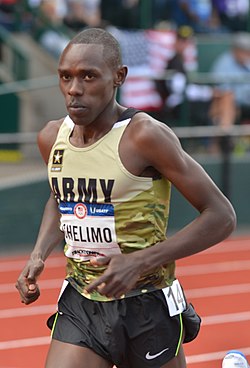
Chelimo finishing runner-up in the men's 5,000 m at the 2016 Olympic Games

Key Information

Paul Kipkemoi Chelimo (born October 27, 1990) is a Kenyan born American track and field athlete. He is the 2016 Olympic silver medalist and the 2020 Olympic bronze medalist in the 5000 meters and is known for his success at the highest level of athletics and controversial racing tactics.

Career

[edit]

Born and brought up in Kenya, Chelimo initially went to the US in 2010 to run for Shorter College where he won the 3000 meters and was part of their winning distance medley relay team as Shorter won the 2011 NAIA National Indoor Championship. Later that year, Shorter won the NAIA Men's Outdoor Track and Field Championship as Chelimo won the 5000 meters and 10000 meters at the championships. He transferred to the University of North Carolina at Greensboro, taking 2nd place in the 2012 NCAA Championships 5000 meters and repeated the place in 2013.[2]

Chelimo found his path to US citizenship by joining the United States Army through the Military Accessions Vital to National Interest (MAVNI) program as a water treatment specialist, then entering their World Class Athletic Program in 2014.[3]

2016 Olympics 5000m Silver

[edit]

He represented the United States in the 3000 meters at the 2016 IAAF World Indoor Championships held in Portland, Oregon. He qualified to the World Championships by taking second place at the USA Indoor Track and Field Championships on the same track a week earlier, setting a personal record of 7:39.00.[4]

Later in 2016, he finished third in the 5000 meters at the Olympic Trials. Running aggressively, Chelimo was the first to cover an early breakaway, which was eventually swallowed by another breakaway by previous trials winner Galen Rupp. Again, Chelimo led the last lap charge to run down Rupp, and after catching him, Chelimo held the lead onto the final straightaway. Chelimo was eventually run down by the sprint finish of 41-year-old Kenyan American Bernard Lagat, followed closely by Hassan Mead. But Chelimo was able to hold his position to the finish, beating Eric Jenkins to the line by 0.06 of a second and qualifying for the 2016 Summer Olympics.[1]

Chelimo ran a personal best 13:19.54 in the prelim of the 5000 metres at the 2016 Summer Olympics. During the final he stayed near the lead the entire race, withstanding every attack three Ethiopian teammates were trying to throw against eventual winner Mo Farah. When Farah launched his final kick to win the race, Chelimo was the last to follow Farah, looking, for a few moments at the head of the final stretch, like he would be the only one able to outsprint Farah to the line. Farah pulled away and Chelimo followed him across the finish line. On the scoreboard, he was initially announced as the silver medal winner. Then his name was removed from the results, along with Canadian Mohammed Ahmed and Ethiopian Muktar Edris. Chelimo had exchanged elbows with both of them during the final turn. Video showed Chelimo stepping inside of the track. Hagos Gebrhiwet was elevated to second place, American Bernard Lagat was elevated to third. The United States appealed and the medal was reinstated, with Edris, the initiator of the contact remaining disqualified.[5] He set a new personal best of 13:03.90 in the race. Chelimo's medal was the first for the US in the event since Bob Schul and Bill Dellinger in the 1964 Summer Olympics, held in Tokyo.[6]

2017 World Championships

[edit]

Now an American star, he won the National Championships by seven seconds in record time. At the World Championships, it was a set of familiar faces on the last lap. This time though, Edris and his teammate Yomif Kejelcha got the jump on Farah and Chelimo going in to the final lap and Chelimo was running virtually even with Farah. In their pursuit of eventual winner Edris, both had to weave around Kejelcha then sprint for the line. In his last championship track race, Farah again beat Chelimo across the line, but this time it was much closer, barely a half meter separating the two, Chelimo getting bronze.

2018 USA Championships and London Diamond League

[edit]

Chelimo participated in the 3000m of the 2018 USA Indoor Track and Field Championships held in Albuquerque, New Mexico. He won the race with a time of 7:57.88, thereby qualifying for the 2018 World Championships.[7] In the heats of the World Indoor Championships, he was one of many victims of a spate of disqualifications at that meet. After appeal, he did not get to run in the final.[8] In June, Chelimo won his second outdoor U.S. title in the 5000m at the 2018 USA Outdoor Track and Field Championships,[9] and, later that summer, won the London Diamond League also at the 5000m distance.[10]

2021 Tokyo Olympics 5000 m Bronze

[edit]

Chelimo won his third U.S. outdoor title in the 5000m in a dramatic three-man sprint finish where he controversially drifted to lane four to prevent his competitors from overtaking him.[9] In another notable finish, Chelimo narrowly out-leaned Nicholas Kimeli for the bronze medal in the Tokyo 2020 Olympic 5000m. Chelimo dedicated the performance to his brother, who suddenly died earlier in the year.[11]

2023 World Championships

[edit]

After his success in 2021 and relatively poor season in 2022, where he finished only 11th in the U.S. Championships 5000m, Chelimo once again qualified for the World Championships with his second-place finish in the U.S. Championships. He also competed in the 10,000m and placed fifth. At the 2023 World Athletics Championships in Budapest, Chelimo placed 15th in the 5000m.

2024 Olympic Cycle

[edit]

Chelimo competed in his first marathon at the 2024 U.S. Olympic Marathon Trials in hopes of qualifying for his third Olympics. He dropped out mid-way through the race.[12] In June, Chelimo took his second attempt at qualifying for the Olympics, this time in the 10,000m. He placed tenth.[13] In his third and final attempt at Olympic qualification, Chelimo placed twelfth in his heat of the 5,000m and failed to advance to the final.

Major competitions

[edit]

References

[edit]
[edit]
Revisions and contributorsEdit on WikipediaRead on Wikipedia
from Grokipedia
Paul Chelimo (born October 27, 1990) is a Kenyan-born American long-distance runner specializing in the 5000 meters, who has represented the in major international competitions, earning two Olympic medals and one medal. Born in , , Chelimo moved to the in 2010 on an , initially attending Shorter College before transferring to the at Greensboro (UNCG), where he competed in cross country and track from 2011 to 2014. During his college career at UNCG, he won seven individual titles, including three in cross country (2011, 2012, 2013), and earned five honors, finishing as NCAA runner-up in the outdoor 5000 meters in both 2012 and 2013. He was named Runner of the Year three times and inducted into UNCG's Athletics Hall of Fame in 2024. Chelimo enlisted in the U.S. Army in 2014 through the World Class Athlete Program, which supported his training while serving as a specialist, and he became a naturalized U.S. citizen in 2014. His breakthrough came at the 2016 Rio Olympics, where he won silver in the men's 5000 meters, becoming the first American to medal in the event since 1964. He followed this with a bronze medal in the same event at the 2017 World Championships in London and another bronze at the 2020 Tokyo Olympics (held in 2021). Chelimo also placed seventh in the 5000 meters at the 2019 World Championships and competed in the 3000 meters at the 2016 and 2018 Indoor World Championships. His personal best in the 5000 meters is 12:57.55, set in 2018. In recent years, Chelimo has transitioned toward longer distances, making his half-marathon debut with a third-place finish at the 2019 United Airlines NYC Half in 1:02:19 and his full marathon debut at the 2024 U.S. Olympic Trials, where he withdrew mid-race due to preparation challenges. He completed his first full marathon at the 2024 Málaga Marathon in 2:18:08 and, as of October 2025, resides in Colorado Springs, training with the American Distance Project while aiming for the 2028 Los Angeles Olympics in the marathon. In September 2025, he placed second in the 5,000 meters at the Boulderthon with a time of 13:52.

Early life

Upbringing in Kenya

Paul Chelimo was born on October 27, 1990, in , Kenya, a high-altitude town in the celebrated as the "Home of Champions" for producing numerous world-class distance runners. Iten's running heritage, rooted in the region's landscape and cultural emphasis on endurance, permeated daily life and inspired local youth from an early age. Chelimo grew up in a close-knit of five siblings, including three brothers—Moses Kiptoo, Denis Chelimo, and Alberto Chelimo—and one sister, Emmanuela Chelimo—raised by parents Gabriel Suter and Roselyne Cheruiyot. The family resided in modest circumstances typical of rural , where homes often featured posters of global athletic figures like and Kenyan runners such as John Kibowen, reflecting the pervasive influence of the town's running culture on household aspirations. This environment fostered an early awareness of athletic excellence, even as the family prioritized practical survival over pursuits like sports. Life in Iten presented early challenges, including limited access to resources and the physical toll of farm labor, which demanded resilience and adaptability from a young age. Chelimo's mother, Roselyne, emphasized education over physical activities, underscoring the economic constraints that shaped family decisions and instilled a strong work ethic in her children. These hardships, set against Iten's motivational backdrop of perseverance in a running-centric community, contributed to Chelimo's formative character.

Introduction to athletics

Paul Chelimo discovered his affinity for running during his high school years at Chebiemit Boys High School in , , where the sport emerged as a potential avenue to transcend the economic hardships of his upbringing. Growing up in a rural area marked by poverty, Chelimo initially viewed running not as a passion but as a practical means to secure opportunities, such as scholarships that could lead to and stability abroad. His early involvement was spurred by informal games; as a child around age 10, he outpaced his brothers in tag, hinting at his natural endurance, though structured racing began later in with a discouraging first 5K on a dirt track, run barefoot and ending in early withdrawal after being lapped. In high school, Chelimo's talent began to surface through participation in local races, particularly 5K events at high altitude, where he progressively improved his times from 15:09 to 14:45, demonstrating potential in track distances despite initial setbacks like fatigue from farm duties during planting season, which once forced him to drop out of a race in . He also attended training camps, such as one at St. Patrick’s High School, where grueling forest workouts in ill-fitting secondhand shoes tested his resolve, nearly prompting him to abandon the sport altogether. These experiences in cross-country-style terrain and track competitions honed his resilience, laying the groundwork for his development as a distance runner in Kenya's competitive running culture. His mother played a supportive role, transporting him to these camps and encouraging persistence amid the challenges. Chelimo later reflected on running's transformative impact, stating, "The way I grew up, the only way I could get out of and a tough life is just with my running. Running saved me," underscoring how the sport became a lifeline diverting him from a precarious path and igniting a deeper commitment. A pivotal moment came as a teenager when he entered a tryout race aimed at earning a U.S. ; though he performed poorly, the attempt crystallized running's role as his escape route, fostering an enduring love for the discipline that propelled him forward.

Education and college career

Time at Shorter University

Paul Chelimo arrived in the United States in 2010 on a full to , an NAIA institution located in . Coming from , , with just $450 to his name, he began his collegiate career as a distance runner under coach Jay Stephenson, marking a significant transition from his high school racing background to organized American college athletics. During the 2010-11 indoor season, Chelimo quickly adapted to the demands of U.S. training regimens, which emphasized structured workouts and team dynamics differing from his more informal Kenyan experiences. He contributed to Shorter's NAIA national indoor championship by winning the 3000 meters in 8:28.31 and anchoring the victorious team with a time of 9:58.15. Outdoors, he further excelled, securing individual titles in the 5000 meters (14:05.88) and 10,000 meters (29:44.42), helping the Hawks claim the NAIA outdoor team title as well. These performances highlighted his rapid adjustment to competitive environments, including cultural shifts like team camaraderie and rigorous scheduling. Chelimo's standout freshman year at Shorter laid the groundwork for his development, though he transferred to the at Greensboro after one season to pursue higher-level competition.

Achievements at UNC Greensboro

Paul Chelimo transferred to the University of North Carolina at Greensboro (UNC Greensboro) in 2011 after competing at , where he began adapting to collegiate distance running in the United States. During his time at UNC Greensboro from 2011 to 2014, he established himself as one of the top collegiate distance runners, earning multiple conference and national honors while majoring in community health education. Chelimo dominated the (SoCon), securing seven individual championships between 2011 and 2013. These included three consecutive cross country titles in 2011, 2012, and 2013, where he won the 8,000-meter race each year with times such as 24:19.8 in 2013. He also claimed the indoor mile in 2012, the outdoor 1,500 meters in 2013, the 3,000 meters at the 2013 indoor championships, and anchored the winning team. Additionally, he was named SoCon Runner of the Year three times (2011–2013) and earned first-team All-SoCon honors in cross country each of those years. At the national level, Chelimo achieved five honors, becoming the first UNC Greensboro athlete to earn cross country recognition. In cross country, he placed 14th at the 2011 NCAA Championships and 10th in 2012, both in the 10,000 meters. On the track, he finished as national runner-up in the 5,000 meters at the Outdoor Championships in both 2012 and 2013, earning first-team honors each time; he also placed fourth in the 3,000 meters at the 2013 NCAA Indoor Championships. He won the NCAA East Regional 5,000 meters in 2012 and 2013. Internationally, Chelimo represented at the 2013 World University Games in , where he earned a in the 5,000 meters with a time of 13:37.09. During his UNC Greensboro tenure, he set several school records and personal bests, including 3:49.26 in the 1,500 meters (2013), 13:21.89 in the 5,000 meters (2012), and indoor marks in the mile (4:02.80, 2012) and 3,000 meters (7:49.87, 2012). In 2025, he was inducted into UNCG's Athletics Hall of Fame.

Military service

Enlistment in the US Army

In 2014, following his graduation from the University of North Carolina at Greensboro, Paul Chelimo enlisted in the U.S. Army through the Military Accessions Vital to the National Interest (MAVNI) program as a water purification specialist and joined the World Class Athlete Program (WCAP), a specialized initiative designed to support elite Soldier-athletes in pursuing international competition while fulfilling military service. The program, based at Fort Carson in Colorado Springs, Colorado, enabled Chelimo to train full-time for Olympic-level events without deployment obligations, allowing him to focus on athletic development as a non-deployable specialist. Chelimo's role required him to balance routine duties with rigorous demands, typically spending about three days per week on base for formations, administrative tasks, and other requirements that occasionally disrupted recovery and consistency. Despite these challenges, such as attending base events or dealing with unexpected issues like food poisoning from communal meals, the structured environment of WCAP provided essential benefits, including access to strength and conditioning specialists, nutritionists, athletic trainers, and support to optimize performance and prevent injuries. His regimen at involved daily morning workouts, including warm-ups, interval sessions, and long runs up to 16 miles, fostering the discipline needed to elevate his distance running career. The WCAP's role was pivotal in sustaining Chelimo's professional trajectory, offering a stable platform that integrated with high-level athletics and allowed him to compete nationally and internationally under auspices for the duration of his four-year-and-five-month contract. This support not only honed his skills but also instilled a sense of purpose, as he later reflected on the program's demands requiring constant adaptation between and identities.

Path to citizenship

Chelimo's path to U.S. citizenship was facilitated by his enlistment in the U.S. Army, which qualified him for expedited under Section 328 of the Immigration and Nationality Act (INA). This provision allows non-citizen service members who have served honorably for at least one year during peacetime to apply for without the standard five-year residency requirement, streamlining the process for . After completing basic training as part of the Army's World Class Athlete Program, Chelimo submitted his application, leveraging the military's support for immigrant recruits to accelerate his eligibility. He was naturalized as a U.S. citizen in 2014 during a ceremony, taking the and enabling him to represent the in international competitions. The ceremony, conducted under the auspices of U.S. Citizenship and Immigration Services (USCIS), symbolized the culmination of his journey from a student visa holder to a full-fledged American service member. The emotional weight of this achievement was profound for Chelimo, who described relinquishing his Kenyan nationality as a difficult but grateful decision, acknowledging the opportunities the U.S. had provided since his arrival in 2010. Gaining not only fulfilled a personal aspiration but also allowed him to honor his commitment while pursuing his athletic dreams under the American , instilling a deep sense of pride and belonging.

Professional career

Breakthrough season (2015–2016)

Chelimo's breakthrough came in 2015 when he won the U.S. Army Ten-Miler, a prestigious 10-mile road race, finishing in 48 minutes and 19 seconds and leading an Army sweep of the top five male individual positions. This victory highlighted his emerging talent in longer distances and marked his first major national-level success as a professional athlete in the U.S. Army World Class Athlete Program. Although he placed 11th in the 5000 meters at the 2015 U.S. Outdoor Championships, preventing selection for the World Championships team, his road racing prowess established him as a rising contender on the American distance scene. Chelimo had gained U.S. citizenship in 2014, enabling his eligibility to represent the internationally. His first significant international appearance came at the IAAF World Indoor Championships in , where he qualified for the 3000 meters final by placing second at the U.S. Indoor Championships and ultimately finished seventh in the final with a time of 8:00.76. Later that year, he secured a spot on the U.S. Olympic team by finishing third in the men's 5000 meters at the U.S. Olympic Trials in , clocking 13:35.92. To prepare for the Games, Chelimo relocated his training base to the U.S. Olympic and Paralympic Training Center in , beginning in early 2016, where the high altitude aided his endurance development. At the 2016 Rio Olympics, Chelimo advanced to the 5000 meters final after winning his heat in a personal best of 13:19.54, the fastest qualifying time overall. In the final on August 20, he delivered a career-defining performance, surging in the final lap to finish second behind Great Britain's Mo Farah in a new personal best of 13:03.90—just 0.60 seconds off the gold medal time of 13:03.30. Initially disqualified for obstructing a competitor by running outside his lane during the final straightaway, Chelimo and the U.S. team successfully appealed the decision after a review by the Jury of Appeal, reinstating him and awarding the silver medal. This marked the first U.S. medal in the men's 5000 meters since Billy Mills' gold in 1964, ending a 52-year drought and cementing Chelimo's status as an elite international competitor.

2017–2019 competitions

In 2017, Chelimo earned a in the men's 5000 m at the IAAF World Championships in , crossing the line third in 13:33.30 behind winner Muktar Edris of and of . This performance marked his second consecutive global medal following the Olympic silver in Rio the previous year, solidifying his status as a top international contender. Chelimo continued his strong form in 2018 by winning the men's 5000 m at the USATF Outdoor Championships in , with a time of 13:29.47 to secure his second national title in the event. Later that summer, he claimed victory in the 5000 m at the Müller Anniversary Games in , part of the series, clocking 13:14.01 and edging out Edris by 0.34 seconds in a tactical race that saw three athletes finish within 0.38 seconds. This win earned him eight Diamond League points and contributed to his consistent accumulation of series points across multiple meets that season. During this period, Chelimo also improved his personal bests, running 13:04.60 in the 5000 m final at the 2019 IAAF World Championships in , , where he placed seventh in a competitive field led by Edris. This season-best effort highlighted his ongoing progression, while maintaining elite-level consistency in major competitions.

2020 Tokyo Olympics and recovery

The COVID-19 pandemic severely disrupted Paul Chelimo's training regimen in 2020, compelling him to isolate and modify workouts amid fears that the virus could impair his lung capacity, a critical concern for a distance runner. With the Tokyo Olympics postponed to 2021, the qualification window extended, allowing Chelimo to secure his spot based on his 2019 performances, including a seventh-place finish at the World Championships in , which met the Olympic entry standards. Chelimo clinched bronze in the men's 5000m at the 2021 Tokyo Olympics, clocking 12:59.05 in a season-best performance that edged out Kenya's Kipkorir Kimeli by 0.12 seconds via a desperate dive across the line, all while overcoming setbacks from prior years and the emotional strain of his brother Alberto's earlier that year. The effort exacted a heavy physical toll, as Chelimo collapsed immediately after the finish, lying prone on the track for several moments before being assisted by medical staff. In the aftermath, Chelimo focused on recovery from the race's demands and nagging minor injuries, marking 2021 as one of his most challenging seasons professionally and personally. He gradually returned to form through targeted U.S. races in 2022, though results were inconsistent; at the U.S. Championships—serving as trials for the —he placed 11th in the 5000m, failing to medal or qualify for the global event in Eugene. Chelimo's early 2023 campaign included indoor meets where he competed but did not secure medals, reflecting ongoing efforts to rebuild momentum post-recovery amid a transitional period in his career.

2023–2024 Olympic cycle

In 2023, Chelimo competed at the in , , where he advanced to the men's 5000m final but finished 15th with a time of 13:30.88. Early in 2024, Chelimo made his marathon debut at the U.S. Olympic Team Trials in , but dropped out midway through the race around the 12-kilometer mark due to physical difficulties. Later that year, at the U.S. Olympic Trials in , he placed 10th in the men's 10,000m final with a time of 28:18.31, failing to secure qualification for the Paris Olympics. Later in 2024, Chelimo completed his first full marathon at the Marathon, finishing 10th in 2:18:08. These results marked Chelimo's non-qualification for a third consecutive Olympic Games, concluding his track career without advancing to Paris. Reflecting on the 10,000m performance, Chelimo announced that the 2024 season would be his last focused on track events, attributing his struggles to the demands of marathon-specific training and acknowledging that his competitive peak had occurred earlier, highlighted by his bronze medal in the 5000m at the 2020 Tokyo Olympics. Amid this transition, Chelimo was inducted into the (SoCon) Hall of Fame in May 2024, recognizing his collegiate achievements at UNC Greensboro, where he won seven conference titles in cross country and track & field from 2011 to 2013.

Transition to marathons (2025)

In mid-2024, Paul Chelimo announced his retirement from track racing, shifting his primary focus to marathon preparation beginning the following season. This decision came after a long career marked by Olympic medals in the 5000 meters, as he sought to explore longer distances for fresh challenges. Chelimo intensified his marathon-specific training at his long-term base in , where he has resided and worked out since 2016. His regimen emphasized building endurance for , supported by his ongoing partnership with Kiprun, the French running brand he joined in 2023 to aid his adaptation to longer events. In 2025, Chelimo began integrating shorter road races to tune his marathon form, placing second in the Boulderthon 5K on September 28 with a time of 13:52 at high elevation. He entered the elite field for the on September 14 but did not start. As of November 2025, Chelimo is training for upcoming marathons, including a potential entry in the in December. This pivot builds on lessons from his initial marathon attempt, a DNF at the 2024 U.S. Olympic Trials, which provided valuable insights into pacing and fueling over 26.2 miles, as well as his completion of the Marathon. As of October 2025, Chelimo remains optimistic about his marathon prospects, continuing high-mileage training in Colorado Springs while expressing confidence in achieving competitive times.

Personal life

Family

Paul Chelimo is married to Kerubo, a Kenyan native who moved to the to build a life with him. The couple welcomed their daughter, Arianna Chebet Chelimo, in late 2018. has been instrumental in balancing family responsibilities with Chelimo's demanding schedule, often managing childcare during his training absences while pursuing her own studies. Chelimo maintains close ties to his Kenyan family, where he was born to parents Gabriel Suter and Roselyne Cheruiyot in . He has three brothers—Moses Kiptoo, Denis Chelimo, and the late Alberto Chelimo—and one sister, Emmanuela Chelimo. His mother has visited the U.S. to assist with newborn care following Arianna's birth, underscoring ongoing familial support across continents. Chelimo makes occasional trips back to , including multiple visits in 2021 to attend to family matters, which help preserve his cultural connections to his roots. Family plays a pivotal role in motivating Chelimo's athletic pursuits, providing emotional drive during competitions. He has described his as a key incentive, stating, "There’s a reason for me to kick harder than the others… I have to pay the bills and take care of my baby." Brenda's encouragement enables him to train abroad when needed, such as during periods in , while his extended family's inquiries about his life reinforce his sense of purpose. This support network has been essential in sustaining his career amid personal challenges.

Residence and training base

In 2014, after completing his college career, Paul Chelimo relocated to , upon enlisting in the U.S. Army and joining the World Class Athlete Program (WCAP) at , where he connected with coach Scott Simmons following his 2016 Rio Olympics performance. Chelimo's through the WCAP at provided access to specialized facilities tailored for elite athletes, including high-altitude environments around 6,000 feet elevation that enhance endurance by improving oxygen efficiency and aerobic capacity. This setup supported his development as a distance runner during his service, which lasted four years. Over the subsequent years, he transitioned to with the American Distance Project under Simmons in Colorado Springs, utilizing local venues such as Bear Creek Regional Park and the Mesa Ridge High School track while maintaining 's resources as part of the broader infrastructure. As of 2025, Chelimo continues to reside in Colorado Springs amid his shift to marathon racing, praising the area's "beautiful" natural surroundings—featuring mountain views and ample trails—for fostering mental resilience and physical adaptation to endurance demands. This long-term base, nearly a decade strong, integrates seamlessly with his family life, providing stability as he aims for future competitions like the 2028 Los Angeles Olympics.

References

Add your contribution
Related Hubs
User Avatar
No comments yet.