


Community hub
Recent from talks
Contribute something
Nothing was collected or created yet.
Ron Clarke
View on Wikipedia
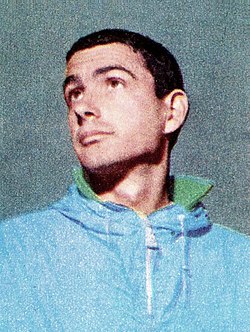
Ronald William Clarke, AO, MBE (21 February 1937 – 17 June 2015) was an Australian athlete, writer, and the Mayor of the Gold Coast from 2004 to 2012. He was one of the best-known middle- and long-distance runners in the 1960s, notable for setting seventeen world records.
Key Information


Early life and family
[edit]Clarke was born 21 February 1937 in Melbourne, Victoria.[1] He attended Essendon Primary School, Essendon High School (now part of Essendon Keilor College) and Melbourne High School. His brother Jack Clarke and father Tom played Australian rules football in the Victorian Football League with Essendon. He was a qualified accountant.[3]
In 1956, when Clarke was still a promising 19-year-old, he was chosen to light the Olympic Flame in the Melbourne Cricket Ground during the opening ceremonies of the 1956 Summer Olympics in Melbourne.[4]
Athletic career
[edit]During the 1960s, Clarke won 9 Australian championships[5] and 12 Victorian track championships ranging from 1500 m to 6 miles (9.7 km).

He won the bronze medal in the 10,000 metre (m) race at the 1964 Summer Olympics when he was upset by Billy Mills, and never won an Olympic gold medal.[1] However, Emil Zátopek gave him one of his own gold medals, which Clarke described as one of his most cherished presents. At the 1968 Summer Olympics in Mexico City, Clarke collapsed and nearly died from altitude sickness sustained during the gruelling 10,000 m race final. Despite training in the Alps to get acclimatised to high altitudes at Mexico City, this could not put him on par with many opponents from Africa, who had always run at high altitude (with the notable exception of 5,000 m gold medalist and 10,000 m bronze medalist Mohammed Gammoudi of Tunisia, who was born and lived not far above sea level). Clarke finished in sixth place,[1] but remembered nothing of the last lap. He recovered sufficiently to compete in the 5,000 metre heats a few days later.[6]
In the 1962 British Empire and Commonwealth Games, he won silver in the 3-mile event, and in the 1966 Games he won silver medals in the 3 miles (4.8 km) and 6 miles (9.7 km) events.[7]
During a 44-day European tour in 1965, he competed 18 times and broke 12 world records, including the 20,000 m (12.4 miles). On 10 July, at London's White City Stadium, during the 1965 AAA Championships, he became the first man to run 3 miles in under 13 minutes, lowering the world record to 12:52.4.[8][9] Four days later, in Oslo, he lowered his own 10,000 m world record by 36.2 seconds to 27:39.4, becoming the first man to break the 28 minute barrier.[10][11] Clarke went on to win the British AAA title again in 1966 and 1967.[12][13]
World records
[edit]| Distance | Time / distance |
Location | Date | Note |
|---|---|---|---|---|
| 5000 m | 13:34.8 | Hobart, Australia | 1965-01-16[14] | |
| 5000 m | 13:33.6 | Auckland, New Zealand | 1965-02-01[15] | |
| 5000 m | 13:25.8 | Los Angeles, United States | 1965-06-04[16] | |
| 5000 m | 13:16.6 | Stockholm, Sweden | 1966-07-05[17] | |
| 10,000 m | 28:15.6 | Melbourne, Australia | 1963-12-18[18] | |
| 10,000 m | 27:39.4 | Oslo, Norway | 1965-07-14[19] | |
| 20,000 m | 59:22.8 | Geelong, Australia | 1965-10-27[20] | As part of 1-hour world record. |
| 1 hour | 20,232 m | Geelong, Australia | 1965-10-27[20] | |
| 2 miles | 8:19.8 | Västerås, Sweden | 1967-07-27[21] | |
| 2 miles | 8:19.6 | London, England | 1968-08-24[22] | |
| 3 miles | 13:07.6 | Melbourne, Australia | 1964-12-03[23] | |
| 3 miles | 13:00.4 | Los Angeles, United States | 1965-06-04 | As part of 5000 m world record. |
| 3 miles | 12:52.4 | London, England | 1965-07-10 | |
| 3 miles | 12:50.4 | Stockholm, Sweden | 1966-07-05[21] | As part of 5000 m world record. |
| 6 miles | 27:17.8 | Melbourne, Australia | 1963-12-18[18] | |
| 6 miles | 26:47.0 | Oslo, Norway | 1965-07-14[19] | As part of 10,000 m world record |
| 10 miles | 47:12.8 | Melbourne, Australia | 1965-03-04[24] |
In 1965, Clarke beat the 10,000-metre world record in Turku, Finland, with a time of 28:14.0; however, it was never ratified, as it was said that permission to run was requested too late.[11][25]
Political career
[edit]Clarke was elected mayor of the Gold Coast in 2004, defeating incumbent Gary Baildon. Clarke and his wife, Helen, first came to the Gold Coast for a holiday in 1957. The couple returned almost every year thereafter, and in 1995, after 14 years abroad, mainly in Europe, came back for good.[26] He was re-elected in 2008.[27]
Clarke resigned as Mayor of the Gold Coast on 27 February 2012, when he announced his nomination to run as an independent candidate for the seat of Broadwater in the 2012 Queensland state election.[28] Clarke failed in this campaign, coming fourth and recording only a 4.6% primary vote.[29]
Former Australian Football League CEO Andrew Demetriou stated that Clarke as Mayor of the Gold Coast played a major role in the AFL establishing a new team Gold Coast Suns on the Gold Coast.[30]
In 2011, Clarke was part of the lobbying team that secured the 2018 Commonwealth Games for the Gold Coast, Queensland.[31]
Honours
[edit]In 1966, Clarke was appointed a Member of the Order of the British Empire (MBE) "In recognition of service to athletics".[1][32]
In 2000, he was awarded the Australian Sports Medal for "Significant contribution as a competitor (Athletics)".[33]
In 2001, he was awarded the Centenary Medal for "Distinguished service to the eco-tourism industry".[33]
In the 2013 Queen's Birthday Honours List, he was appointed an Officer of the Order of Australia (AO) "for distinguished service to the community through a range of leadership roles with local government and philanthropic organisations, and to the promotion of athletics."[1][34]
Awards and recognition
[edit]- 1965 – awarded the Prix Du President by the French Sports Academy[35]
- 1965 – Helms Award for Australasia[36]
- 1965 – ABC's Sportsman of the Year
- 1965 – Track & Field News Male Athlete of the Year
- 1965 – BBC Sportsman of the Year – Overseas Personality[37]
- 1965 – World Sportsman of the Year by the International Association of Sports Writers[38]
- 1982 – awarded Victorian Father of the Year.[39]
- 1985 – inaugural inductee into the Sport Australia Hall of Fame[1][38]
- 2000 – inaugural inductee into the Athletics Australia Hall of Fame in 2000.[10]
- 2022 - Sport Australia Hall of Fame Legend[40]
In 2005, Geelong Athletics honoured Clarke with an athletics meet to commemorate the 40th anniversary of his breaking the world record for the 20,000 metres and his one-hour run at Landy Field in October 1965. This meet is held annually as part of the Athletics Australia National Meet Series.
On 15 March 2006, Ron Clarke was one of the final four runners who carried the Queen's Baton around the MCG stadium during the 2006 Commonwealth Games Opening Ceremony in Melbourne, Victoria, Australia.[41]
Emil Zátopek had great respect for Ron Clarke. In 1966 (often erroneously noted as 1968), he invited the Australian to Czechoslovakia, and as a parting gift he gave him his 1952 Olympic 10,000-metre gold medal with the following words: "Not out of friendship but because you deserve it."[42][43]
Death
[edit]Clarke died of kidney failure on 17 June 2015 at Allamanda Hospital in Southport, Queensland.[44] Clarke is survived by his wife Helen and sons Marcus and Nicolas. His daughter Monique died of breast cancer in 2009.[3][45]
Prime Minister Tony Abbott and Opposition Leader Bill Shorten paid tribute to Clarke in Parliament on the day of his death by stating that a great Australian had been lost with his death.[46] Herb Elliott, an Australian 1500-metre Olympic gold medallist, said "Ron was a great man. His contribution to athletics was enormous. He was also a wonderful contributor to public health through lifestyle programs and gymnasiums and the communities in which he lived. Ron will be greatly missed".[47]

John Landy, who famously helped Clarke when he fell during a mile race at the 1956 Australian Championships, said, "Ron Clarke, by his running feats inspired Australian distance runners and in a world sense, demonstrated the potential athletics achievements possible."[47] Frank Shorter, the 1972 Olympic marathon gold medallist, said: "Ron Clarke was my idol. I grew up seeing Ron Clarke in the dark blue singlet with the V on it – to me that was the symbol of running."[48]
Bibliography
[edit]- The Measure of Success : a personal perspective. South Melbourne, Vic. : Lothian Books, 2004.
- Run Easy. Melbourne : Information Australia, 2001.
- Never Say Never : Couran Cove Resort from dream to reality. Avalon, N.S.W. : Banyan Tree Creative Services, 1999.
- Fixing the Olympics. Melbourne : Information Australia, 1999.
- Enjoying Life : a champion's guide to the good life. Melbourne : Information Australia, 1999.
- Total Living : for everyone who wants to be fitter, trimmer and smarter. London : Pavilion, 1995.
- Ron Clarke's Running Book. Collingwood, Vic. : Outback Press, 1979.
- Successful Athletics : from beginner to expert in forty lessons, with Raelene Boyle. Melbourne : Thomas Nelson, 1976.
- Ron Clarke Talks Track edited by Jon Hendershott. Los Altos, California : Tafnews, 1972.
- Athletics the Australian Way. Melbourne : Lansdowne, 1971.
- The Lonely Breed, with Norman Harris. London : Pelham, 1967.
- The Unforgiving Minute, as told to Alan Trengrove. London : Pelham, 1966.
See also
[edit]References
[edit]- ^ a b c d e f g "Ron Clarke". Sports Reference – Olympic Sports. Archived from the original on 6 August 2015. Retrieved 17 June 2015.
- ^ Ron Clarke Archived 30 October 2017 at the Wayback Machine. trackfield.brinkster.net
- ^ a b Johnson, Len (16 June 2015). "The man who changed the world". The Runner's Tribe. Archived from the original on 17 June 2015. Retrieved 17 June 2015.
- ^ Organizing Committee of the XVI Olympiad, Melbourne, 1956. "THE OFFICIAL REPORT OF THE ORGANIZING COMMITTEE FOR THE GAMES OF THE XVI OLYMPIAD MELBOURNE 1956" (PDF). p. 227. Archived from the original (pdf-34.4 MB) on 12 September 2008. Retrieved 17 June 2015 – via www.la84foundation.org.
{{cite web}}: CS1 maint: multiple names: authors list (link) CS1 maint: numeric names: authors list (link) ('Snippet' Archived 17 June 2015 at the Wayback Machine via Google books) - ^ "Ron Clarke". athhistory.imgstg.com. Australian Athletics Historical Results. Archived from the original on 4 March 2016. Retrieved 18 June 2015.
- ^ Nichols, Peter (19 June 2015). "Ron Clarke obituary". The Guardian.
- ^ "Ronald 'Ron' Clarke MBE". Australian Commonwealth Games Association website. Archived from the original on 18 July 2015.
- ^ "White City results". Daily Mirror. 10 July 1965. Retrieved 8 May 2025 – via British Newspaper Archive.
- ^ "White City Details". Sunday Mirror. 11 July 1965. Retrieved 8 May 2025 – via British Newspaper Archive.
- ^ a b "Athletics Australia Hall of Fame". Athletics Australia website. Archived from the original on 17 August 2015. Retrieved 17 June 2015.
- ^ a b "Australian IAAF World Record Holders * World Best Performances as of January 2008". Athletics Australia website. Archived from the original on 9 June 2016. Retrieved 18 June 2015.
- ^ "AAA, WAAA and National Championships Medallists". National Union of Track Statisticians. Retrieved 8 May 2025.
- ^ "AAA Championships (men)". GBR Athletics. Retrieved 8 May 2025.
- ^ "Clarke's new record". Canberra Times. 18 January 1965. Retrieved 19 June 2015.
- ^ "Clarke betters own world time". Canberra Times. 2 February 1965. Retrieved 18 June 2015.
- ^ "Clarke has four world records ratified". Canberra Times. 16 January 1966. Retrieved 18 June 2015.
- ^ "Clarke ill but still breaks record". Canberra Times. 7 July 1966. Retrieved 18 June 2015.
- ^ a b "Clarke sets two world times". Canberra Times. 19 December 1963. Retrieved 18 June 2015.
- ^ a b "Clarke shatters record". Canberra Times. 16 July 1965. Retrieved 18 June 2015.
- ^ a b "Clarke smashes records". Canberra Times. 28 October 1965. Retrieved 18 June 2015.
- ^ a b "Another record to Clarke". Canberra Times. 29 June 1967. Retrieved 18 June 2015.
- ^ "Clarke races alone to record". Canberra Times. 26 August 1968. Retrieved 18 June 2015.
- ^ "Clarke smashes world record". Canberra Times. 4 December 1964. Retrieved 18 June 2015.
- ^ "Another record to Clarke". Canberra Times. 4 March 1965. Retrieved 18 June 2015.
- ^ "Vale Ron Clarke – a fitting tribute by Paul Jenes and Brian Roe". Athletics Australia website. Archived from the original on 18 June 2015. Retrieved 18 June 2015.
- ^ Gold Coast City Council. "Mayor Cr Ron Clarke MBE". Archived from the original on 12 February 2012. Retrieved 17 June 2015.
- ^ "2008 Gold Coast City - Mayoral Election - Election Summary". Electoral Commission of Queensland.
- ^ Kelly, James (27 February 2012). "Clarke says Gold Coast needs independent MP". ABC News. Archived from the original on 28 February 2012. Retrieved 6 March 2012.
- ^ "2012 State General Election – Broadwater – Booth Details". Electoral Commission of Queensland. 2012. Archived from the original on 4 March 2014. Retrieved 6 August 2012.
- ^ Smart, Nick (17 June 2015). "Suns, says former AFL boss Andrew Demetriou". Herald Sun. Retrieved 18 June 2015.
- ^ Kimmorley, Sarah (17 June 2015). "Legendary Australian athlete and former Gold Coast Mayor, Ron Clarke has died aged 78". Business Insider Australia. Archived from the original on 17 June 2015. Retrieved 17 June 2015.
- ^ "CLARKE, Ronald William". itsanhonour.gov.au. 11 June 1966. Archived from the original on 22 February 2019. Retrieved 17 June 2015.
- ^ a b "CLARKE, Ronald William". It's an Honour. Archived from the original on 17 June 2015. Retrieved 17 June 2015.
- ^ "Queen's Birthday Honours List 2013". Herald Sun. News Corp. 10 June 2013. Retrieved 17 June 2013.
- ^ "France honours Ron Clarke". Canberra Times. 7 January 1967. Retrieved 18 June 2015.
- ^ "Helms award to Ron Clarke". Canberra Times. 14 January 1966. Retrieved 18 June 2015.
- ^ "Past Winners". BBC Sports Personality of the Year. Archived from the original on 21 November 2015. Retrieved 19 June 2015.
- ^ a b "Ron Clarke". Sport Australia Hall of Fame. Retrieved 24 September 2020.
- ^ "Past winners". Fathers Day Council of Victoria. Archived from the original on 17 June 2015. Retrieved 17 June 2015.
- ^ "Clarke & Warne Elevated to Legend Status". Sport Australia Hall of Fame. 4 December 2022. Retrieved 5 December 2022.
- ^ "Queen's Baton Relay". Melbourne 2006 Commonwealth Games website. Archived from the original on 10 August 2015. Retrieved 17 June 2015.
- ^ Bunrton, Simon (22 June 2012). "50 stunning Olympic moments No 41: Emil Zátopek the triple-gold winner". The Guardian. Archived from the original on 17 June 2015. Retrieved 17 June 2015.
- ^ Richard Askwith, Today We Die a Little: Emil Zátopek, Olympic Hero to Cold War Legend, Vintage Digital, 2016
- ^ Weston, Paul (17 June 2015). "Former Gold Coast mayor and Olympic medallist Ron Clarke dies, aged 78". Gold Coast Bulletin. Archived from the original on 17 June 2015. Retrieved 17 June 2015.
- ^ Anderson, Jon (17 June 2015). "Australian athletics legend Ron Clarke dies aged 78". Geelong Advertiser. Archived from the original on 17 June 2015. Retrieved 17 June 2015.
- ^ "Abbott, Shorten pay tribute to a great". 9News.com.au. 17 June 2015. Archived from the original on 17 June 2015. Retrieved 17 June 2015.
- ^ a b "Vale Ron Clarke". Australian Olympic Committee News, 17 June 2015. Archived from the original on 17 June 2015. Retrieved 17 June 2015.
- ^ Johnson, Len. "Former world record-holder Ron Clarke dies". IAAF News, 17 June 2015. Archived from the original on 17 June 2015. Retrieved 18 June 2015.
External links
[edit]
- Ron Clarke at IMDb
- Ron Clarke at the Sport Australia Hall of Fame
- Ron Clarke at the Athletics Australia Hall of Fame
- Ron Clarke at Australian Athletics Historical Results
- Ron Clarke at the Australian Olympic Committee
- Ron Clarke at Olympedia
- Ron Clarke at Olympics.com


| International | |
|---|---|
| National | |
| People | |
| Other | |
Ron Clarke
View on GrokipediaEarly Life
Family and Upbringing
Ronald William Clarke was born on 21 February 1937 in Melbourne, Victoria, Australia, into an athletically inclined family.[4] His father, Tom Clarke, was a prominent Australian rules footballer who played for Essendon Football Club and won the club's best and fairest award in 1932, while also having a background in boxing.[5] Clarke's mother was Annie Clarke.[6] As the second son, Clarke grew up alongside his older brother Jack, who followed in their father's footsteps as an elite Australian rules footballer for Essendon, later earning induction into the Australian Football League Hall of Fame.[2] The family's emphasis on physical activity shaped Clarke's early years, with his father encouraging all children to engage in sports to build fitness and resilience.[7] Clarke later attributed his turn to running to a lack of aptitude for team sports like Australian rules football, despite the family's prowess in that arena; he found individual endurance events better suited his abilities from a young age.[2] This upbringing in a competitive, sports-oriented household in Melbourne fostered his initial interest in athletics, setting the foundation for his later achievements without formal early coaching.[8]Education and Entry into Athletics
Clarke was born on 21 February 1937 in Melbourne, Victoria, Australia.[9] He received his primary education at Essendon Primary School and continued secondary schooling at Essendon High School before transferring to Melbourne High School, where he completed his education.[2] [9] During his time at Melbourne High School, Clarke developed an interest in athletics, particularly distance running, through school sports programs. At age 17 in 1955, he demonstrated early promise by recording times of 4:19.4 in the mile and 9:17.8 in the two miles, marking his emergence in competitive running.[10] The following year, as a 19-year-old, he achieved a mile time of 4:06.8, further highlighting his talent.[11] Clarke initially competed for the Melbourne High School Old Boys athletic club before joining the Glenhuntly Athletics Club, which emphasized distance events and provided a stronger competitive environment for his development.[12] His entry into national prominence came in 1956 when, selected for his athletic potential, he lit the Olympic flame at the opening ceremony of the Melbourne Olympics on 22 November, an honor that elevated his profile despite his relative inexperience at the elite level.[6] This event coincided with the beginning of his serious commitment to the sport, though he later took a four-year break from competitive running between 1957 and 1960 to focus on work and other pursuits before resuming training.[10]Athletic Career
Training Methods and Innovations
Clarke's training regimen centered on high-volume endurance work, typically involving double daily sessions that accumulated approximately 100 miles per week. Morning runs consisted of steady 10-mile efforts, while afternoon workouts incorporated tempo runs or intervals, such as 10 repetitions of 400 meters or sustained 5-mile pushes at paces up to 4:20 per mile. Influenced by Emil Zátopek's intensity and initially guided by coach Percy Cerutty's emphasis on mental toughness and natural terrain, Clarke prioritized stamina-building over speed drills alone.[13] A key innovation in Clarke's approach was the systematic use of threshold training, featuring long runs of 3 to 14 miles at moderately hard efforts, executed up to three times daily without heavy reliance on recovery periods. This method, detailed in analyses of his routines, contrasted with prevailing interval-heavy protocols by fostering sustained aerobic capacity through consistent submaximal stress, enabling his rapid progression across distances from 3 miles to the hour run. Clarke often conducted these on grass tracks or hilly roads, such as 8-10 laps of a roughly 2 km course at about 5-minute mile pace, to simulate race demands and enhance resilience.[14][15] Clarke critiqued repetitive interval training for conditioning athletes to expect relief and accumulating lactate without addressing endurance deficits, advocating instead for "rising rate" tempo sessions where pace accelerated gradually—e.g., from 4:40 to 4:30 per mile over the final 5-6 km—to instill rhythm and discomfort tolerance. He integrated weekly Sunday runs blending steady efforts with hill sprints, producing groups of athletes capable of sub-13:30 5,000 meters. This philosophy, rooted in daily progression over 16-20 km tempos five days a week for 50 weeks annually, underscored his belief that true champions emerge from relentless, race-like volume rather than isolated speed work.[15][13]World Records and Major Achievements
Clarke set a total of 17 official world records during his career, holding every record from two miles to the one-hour run for seven years.[1][16] His first world record came on December 6, 1963, in Melbourne, where he ran 10,000 meters in 28:15.6, also covering six miles en route.[17] In a prolific 1965 season, Clarke shattered 12 world records across distances from three miles to 20 kilometers in just 44 days and 18 races, including becoming the first man to break 13 minutes for three miles (12:52.4 in London on July 10) and 28 minutes for 10,000 meters (27:39.89 in Oslo on July 14, improving his own mark by 36.2 seconds).[18][19] Earlier that year, on January 16, he set the 5,000 meters world record, and on June 5 in Los Angeles, he recorded 13:00.4 for three miles and 13:25.8 for 5,000 meters.[20][13]| Distance | Record Time | Date | Location |
|---|---|---|---|
| 5,000 m | 13:25.8 (initial 1965 mark) | June 5, 1965 | Los Angeles, USA[13] |
| 3 miles | 12:52.4 | July 10, 1965 | London, UK[18] |
| 10,000 m | 27:39.89 | July 14, 1965 | Oslo, Norway[21] |