Hubbry Logo
Involutory matrixInvolutory matrixMain
Open search
Involutory matrix
Community hub
Involutory matrix
logo
7 pages, 0 posts
0 subscribers
Be the first to start a discussion here.
Involutory matrix
Involutory matrix
from Wikipedia

In mathematics, an involutory matrix is a square matrix that is its own inverse. That is, multiplication by the matrix is an involution if and only if where is the identity matrix. Involutory matrices are all square roots of the identity matrix. This is a consequence of the fact that any invertible matrix multiplied by its inverse is the identity.[1]

Examples

[edit]

The real matrix is involutory provided that [2]

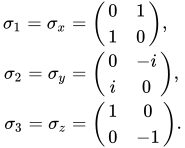
The Pauli matrices in are involutory:

One of the three classes of elementary matrix is involutory, namely the row-interchange elementary matrix. A special case of another class of elementary matrix, that which represents multiplication of a row or column by −1, is also involutory; it is in fact a trivial example of a signature matrix, all of which are involutory.

Some simple examples of involutory matrices are shown below.

where
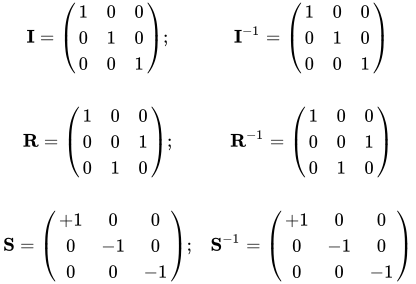
  • I is the 3 × 3 identity matrix (which is trivially involutory);
  • R is the 3 × 3 identity matrix with a pair of interchanged rows;
  • S is a signature matrix.

Any block-diagonal matrices constructed from involutory matrices will also be involutory, as a consequence of the linear independence of the blocks.

Symmetry

[edit]

An involutory matrix which is also symmetric is an orthogonal matrix, and thus represents an isometry (a linear transformation which preserves Euclidean distance). Conversely every orthogonal involutory matrix is symmetric.[3] As a special case of this, every reflection and 180° rotation matrix is involutory.

Properties

[edit]

An involution is non-defective, and each eigenvalue equals , so an involution diagonalizes to a signature matrix.

A normal involution is Hermitian (complex) or symmetric (real) and also unitary (complex) or orthogonal (real).

The determinant of an involutory matrix over any field is ±1.[4]

If A is an n × n matrix, then A is involutory if and only if is idempotent. This relation gives a bijection between involutory matrices and idempotent matrices.[4] Similarly, A is involutory if and only if is idempotent. These two operators form the symmetric and antisymmetric projections of a vector with respect to the involution A, in the sense that , or . The same construct applies to any involutory function, such as the complex conjugate (real and imaginary parts), transpose (symmetric and antisymmetric matrices), and Hermitian adjoint (Hermitian and skew-Hermitian matrices).

If A is an involutory matrix in which is a matrix algebra over the real numbers, and A is not a scalar multiple of I, then the subalgebra generated by A is isomorphic to the split-complex numbers.

If A and B are two involutory matrices which commute with each other (i.e. AB = BA) then AB is also involutory.

If A is an involutory matrix then every integer power of A is involutory. In fact, An will be equal to A if n is odd and I if n is even.

See also

[edit]

References

[edit]
Revisions and contributorsEdit on WikipediaRead on Wikipedia
from Grokipedia
An involutory matrix is a square matrix AA that is equal to its own inverse, meaning A2=IA^2 = I, where II is the identity matrix of the same order. This property implies that applying the matrix twice returns the original vector unchanged, making it a linear transformation of order at most 2. In linear algebra, involutory matrices exhibit several key properties that distinguish them from general invertible matrices. They are always diagonalizable over fields where the characteristic polynomial splits, such as the complex numbers, because their minimal polynomial divides x21=(x1)(x+1)x^2 - 1 = (x-1)(x+1), which has distinct linear factors. Consequently, the eigenvalues of an involutory matrix are restricted to +1+1 and 1-1, corresponding to eigenspaces that represent fixed points and reflections, respectively. Additionally, the identity matrix II is the trivial example of an involutory matrix, as I2=II^2 = I, and the negative identity I-I also satisfies the condition since (I)2=I(-I)^2 = I. Notable non-trivial examples include Householder reflection matrices, which are used in numerical algorithms like QR decomposition for their orthogonal and involutory nature, ensuring H2=IH^2 = I where H=I2vvTvTvH = I - 2 \frac{v v^T}{v^T v} for a nonzero vector vv. Involutory matrices also appear in applications such as cryptography, where they simplify key management in systems like the Hill cipher by making encryption and decryption operations identical modulo a prime. Their role in representing involutions—symmetries that are their own inverses—extends to group theory and geometry, underscoring their importance in modeling reversible transformations.

Fundamentals

Definition

An involutory matrix is a square matrix AA of order n×nn \times n over a field, typically the real or complex numbers, that satisfies the equation A2=IA^2 = I, where II is the n×nn \times n identity matrix. This property implies that AA is invertible and A1=AA^{-1} = A, since AA=IA \cdot A = I. Only square matrices can be involutory, as the identity matrix II is defined exclusively for square dimensions, precluding non-square matrices from satisfying the condition. The term "involutory" derives from the Latin involvere, meaning "to roll up," which evokes the self-inverse nature of the matrix, whereby applying it twice "unrolls" back to the identity. The concept has been studied in linear algebra since the 19th century.

Basic Properties

An involutory matrix AA satisfies A2=IA^2 = I, where II is the identity matrix of the same order, implying that AA is invertible with A1=AA^{-1} = A. This relation leads to a simple pattern in the powers of AA: for any positive integer kk, Ak=AA^k = A if kk is odd, and Ak=IA^k = I if kk is even and greater than or equal to 2. To see this, note that A3=A2A=IA=AA^3 = A^2 A = I A = A and A4=(A2)2=I2=IA^4 = (A^2)^2 = I^2 = I; higher powers follow by induction, as odd powers reduce to multiplication by AA and even powers to powers of II. The determinant of an n×nn \times n involutory matrix AA over the real or complex numbers is ±1\pm 1. This follows from the multiplicative property of determinants: det(A2)=det(A)det(A)=[det(A)]2=det(I)=1\det(A^2) = \det(A) \det(A) = [\det(A)]^2 = \det(I) = 1, so det(A)=±1\det(A) = \pm 1. For an n×nn \times n involutory matrix AA, the trace tr(A)\operatorname{tr}(A) is an integer satisfying ntr(A)n-n \leq \operatorname{tr}(A) \leq n. The involutory property is invariant under similarity transformations. Specifically, if B=P1APB = P^{-1} A P for some invertible matrix PP, then B2=(P1AP)(P1AP)=P1A(PP1)AP=P1A2P=P1IP=IB^2 = (P^{-1} A P)(P^{-1} A P) = P^{-1} A (P P^{-1}) A P = P^{-1} A^2 P = P^{-1} I P = I. The minimal polynomial mA(x)m_A(x) of an involutory matrix AA divides x21=(x1)(x+1)x^2 - 1 = (x-1)(x+1), and hence has degree at most 2. This is because mA(A)=0m_A(A) = 0 and A2I=0A^2 - I = 0, so mA(x)m_A(x) annihilates AA and must divide any such polynomial.

Characterization and Structure

Spectral Properties

An involutory matrix ACn×nA \in \mathbb{C}^{n \times n} satisfies A2=InA^2 = I_n, where InI_n is the n×nn \times n identity matrix. The eigenvalues λ\lambda of AA must satisfy λ2=1\lambda^2 = 1, implying that every eigenvalue is either +1+1 or 1-1. The algebraic multiplicities of these eigenvalues sum to nn, the dimension of the space. The trace of AA, denoted tr(A)\operatorname{tr}(A), equals the sum of its eigenvalues (counted with algebraic multiplicity). If kk is the algebraic multiplicity of the eigenvalue +1+1, then the multiplicity of 1-1 is nkn - k, yielding tr(A)=k1+(nk)(1)=2kn\operatorname{tr}(A) = k \cdot 1 + (n - k) \cdot (-1) = 2k - n. The eigenspace corresponding to λ=1\lambda = 1 is ker(AIn)\ker(A - I_n), and for λ=1\lambda = -1 it is ker(A+In)\ker(A + I_n). Since the minimal polynomial of AA divides x21=(x1)(x+1)x^2 - 1 = (x - 1)(x + 1) and has distinct roots, the space Cn\mathbb{C}^n decomposes as the direct sum ker(AIn)ker(A+In)\ker(A - I_n) \oplus \ker(A + I_n), with the dimensions of these eigenspaces adding to nn. Over the complex numbers, every involutory matrix is diagonalizable because its minimal polynomial splits into distinct linear factors. Thus, there exists an invertible matrix PP such that P1AP=diag(Ik,Ink)P^{-1} A P = \operatorname{diag}(I_k, -I_{n-k}) for some kk. For real involutory matrices, the eigenvalues remain ±1\pm 1 (real numbers), and the minimal polynomial again splits into distinct linear factors over R\mathbb{R}, ensuring diagonalizability over the reals as well.

Jordan Canonical Form

An involutory matrix AA satisfies A2=IA^2 = I, implying that its minimal polynomial mA(x)m_A(x) divides x21=(x1)(x+1)x^2 - 1 = (x-1)(x+1), a polynomial with distinct linear factors over both R\mathbb{R} and C\mathbb{C}. Consequently, AA is diagonalizable over these fields, and its Jordan canonical form is a diagonal matrix consisting of entries ±1\pm 1. The absence of repeated roots in the minimal polynomial ensures that there are no non-trivial Jordan blocks; all blocks are 1×1 with eigenvalues ±1\pm 1. This structure holds over C\mathbb{C}, where the characteristic polynomial splits completely into linear factors. Over R\mathbb{R}, the eigenvalues ±1\pm 1 are real, so AA is diagonalizable over R\mathbb{R} as well, yielding the same diagonal Jordan canonical form with no larger blocks. There exists an invertible matrix PP such that P1AP=DP^{-1} A P = D, where D=diag(λ1,,λn)D = \operatorname{diag}(\lambda_1, \dots, \lambda_n) and each λi=±1\lambda_i = \pm 1; the columns of PP form a basis of eigenvectors for AA. If AA is symmetric, the spectral theorem guarantees that PP can be chosen orthogonal, yielding an orthogonal diagonalization.

Examples

Algebraic Examples

The identity matrix InI_n of order nn provides the simplest algebraic example of an involutory matrix, satisfying In2=InI_n^2 = I_n by definition. Likewise, the scalar multiple In-I_n is involutory, as (In)2=In(-I_n)^2 = I_n. Permutation matrices associated with involutions in the symmetric group SnS_n form another class of involutory matrices. An involution σSn\sigma \in S_n satisfies σ2=id\sigma^2 = \mathrm{id}, and the corresponding permutation matrix PσP_\sigma, with entries (Pσ)i,j=δi,σ(j)(P_\sigma)_{i,j} = \delta_{i, \sigma(j)}, then obeys Pσ2=InP_\sigma^2 = I_n. For instance, the transposition σ=(1 2)\sigma = (1\ 2) yields the matrix P=(0110),P = \begin{pmatrix} 0 & 1 \\ 1 & 0 \end{pmatrix}, and direct computation confirms P2=I2P^2 = I_2. The exchange matrix JnJ_n, defined with 1's along the anti-diagonal and 0's elsewhere, is a specific involutory permutation matrix known as the reversal matrix. It satisfies Jn2=InJ_n^2 = I_n for any nn, as repeated reversal restores the original order. An example for n=3n=3 is J3=(001010100),J_3 = \begin{pmatrix} 0 & 0 & 1 \\ 0 & 1 & 0 \\ 1 & 0 & 0 \end{pmatrix},
Add your contribution
Related Hubs
User Avatar
No comments yet.