Hubbry Logo
Peel CastlePeel CastleMain
Open search
Peel Castle
Community hub
Peel Castle
logo
8 pages, 0 posts
0 subscribers
Be the first to start a discussion here.
Peel Castle
Peel Castle
from Wikipedia

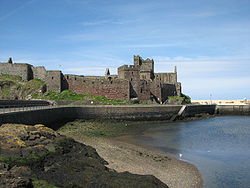
Peel Castle (Cashtal Phurt ny h-Inshey in Manx Gaelic) is a castle in Peel in the Isle of Man, originally constructed by Norwegians. The castle stands on St Patrick's Isle, which is connected to the town by a causeway. It is now owned by Manx National Heritage and is open to visitors during the summer.

Key Information

The castle was built in the 11th century by Norwegians, under the rule of King Magnus Barefoot. While there were older stone Celtic monastic buildings on the island, the first Norwegian fortifications were built of wood. The prominent round tower was originally part of the Celtic monastery, but had battlements added at a later date. In the early 14th century, the majority of the walls and towers were built primarily from local red sandstone, which is found abundantly in the area. After the rule of Norway, the castle continued to be used by the Church due to the cathedral built there – the see of the diocese of Sodor and Man – but was eventually abandoned in the 18th century.

The castle remained fortified, and new defensive positions were added as late as 1860. The buildings within the castle are now mostly ruined, but the outer walls remain intact. Excavations in 1982–87 revealed an extensive graveyard as well as the remains of Magnus Barefoot's original wooden fort. The most spectacular finds were the 10th century grave of "The Pagan Lady" which included a fine example of a Norwegian necklace and a cache of silver coins dating from about 1030. The castle's most famous "resident" is the so-called Moddey Dhoo or "Black Dog" ghost.

Peel Castle features today on the reverse side of the £10 banknotes issued by the Isle of Man Government.[1]

Peel Castle may occasionally be confused with Piel Castle, located on Piel Island, to the east across the Irish Sea. This particularly occurs in reference to the William Wordsworth poem describing Piel, spelling its name as 'Peele': especially as Wordsworth is documented as having visited Peel Castle, and wrote several times about the Isle of Man.[2]

Peel Castle has been proposed as a possible location of the Arthurian Avalon.[3][4][5]

St. Patrick's Isle from Peel Hill

Cathedral of St German (ruins)

[edit]

The cathedral ruins located within the walls of Peel Castle are those of the former Cathedral of St German.[6] Like the structures throughout the castle grounds, the cathedral's roof is completely missing. Robert Anderson examined the ruins to determine what repairs were required to restore the cathedral, and he reported to the island's Lieutenant Governor in 1877.[7] However, none of the suggested repairs were carried out.

There is a pointed barrel-vaulted crypt below the chancel, measuring 34 feet by 16 feet by 9 feet high at the west end (10 × 5 × 3 metres), sloping to the entrance at the east.[7]

In the middle of the transept is the tomb where Bishop Rutter was interred in 1661.[7]

There is a cemetery in what was once the cathedral's nave.

In 1980, the parish of German, part of the Church of England's Diocese of Sodor and Man, was officially transferred to the newer Cathedral Church of St German on Albany Road in Peel.

References

[edit]
[edit]
Revisions and contributorsEdit on WikipediaRead on Wikipedia
from Grokipedia
Peel Castle, known in Manx Gaelic as Cashtal Phurt ny h-Inshey, is a medieval fortress and former ecclesiastical complex situated on St Patrick's Isle, a small tidal islet connected by a to the town of Peel on the west coast of the Isle of Man in the . Enclosing nearly 2 hectares within a 700-meter-long curtain wall, the site features the ruins of St German's Cathedral, St Patrick's Church, chapels, a dating to around 1124, and other fortifications developed over seven centuries from the 11th to the . Originally established as a Celtic Christian monastery in the 5th or , it later became a Viking stronghold under King in 1098 and served as a royal residence, prison, and administrative center for the Lords of Mann. Human occupation at the site dates back over 7,000 years to the Neolithic period, when it functioned as a settlement, though the most prominent remains stem from its religious and defensive phases beginning in the early medieval era. Archaeological excavations, including those conducted by the University of Liverpool from 1982 to 1987, have uncovered evidence of Viking-era activity, such as a wooden fort built by Magnus Barefoot, silver coins from around 1030, and a burial ground, alongside medieval artifacts like imported pottery, iron tools, window glass, and extensive faunal remains indicating trade networks with Britain, Europe, and local fishing economies. Key developments include the construction of St German's Cathedral in red sandstone around 1230 and 14th- to 15th-century enhancements like flanking towers and private apartments added by the English Lords of Mann and Earls of Derby. As one of the most significant historic and religious sites in the , Peel Castle played a central role in the Isle of Man's Viking and medieval history, including events like the imprisonment of local figure Edward Christian in 1643 for protesting tithes and military fortifications during the in the early . The site is also associated with , notably the spectral black dog known as the Moddey Dhoo, said to haunt its grounds. Today, managed by Manx National Heritage, it attracts visitors for its scenic coastal views—often featuring seals—and ongoing conservation efforts, such as the restoration of its eroding sandstone curtain wall, with the site open seasonally for exploration.

Location and Description

Geographical Setting

Peel Castle occupies St Patrick's Isle, a small situated in the off the west coast of the Isle of Man, directly adjacent to the town of Peel via a . The isle measures about 300 meters in length and is connected to the mainland by a that becomes submerged at high , historically restricting access to low-tide periods or by boat. Its geographic coordinates are 54°13′21″N 4°41′34″W, placing it at the entrance to Peel Harbour. The landscape of St Patrick's Isle consists of a rocky promontory rising from the sea, characterized by steep cliffs that drop sharply into the surrounding waters, offering expansive views across the toward to the west. The site averages an elevation of 15 meters (49 feet) above , with its highest points providing vantage over the adjacent harbor and the town of Peel. This coastal setting, influenced by strong tidal currents and frequent westerly winds, underscores the isle's isolation and exposure to maritime conditions. Geologically, St Patrick's Isle is formed predominantly from the red sandstones of the Peel Formation, early rocks that extensively along the western coast of the Isle of Man. These s, deposited in a terrestrial environment during the period, exhibit a distinctive reddish hue due to content and have been quarried locally for construction materials. The formation's folded and faulted structure contributes to the rugged cliffs and shape, reflecting the broader tectonic history of the region as part of an uplifted horst block in the .

Site Layout and Features

Peel Castle is situated on St Patrick's Isle, a rocky promontory connected to the mainland by a built in the , with the core site enclosed by a late 14th-century curtain wall stretching approximately 700 meters and encompassing nearly two hectares of fortifications. The entrance to the complex is via a fortified 14th-century , a squat red tower accessed by a over the harbor and ascending 24 historic steps to a pay barrier, beyond which lies uneven ground and grassy slopes. The layout divides naturally into a higher central area, housing the prominent ruins of the Cathedral of St German and St Patrick's Church, and a lower perimeter zone featuring defensive elements such as batteries and structures, all surrounded by the encircling curtain wall. Key visible features include extensive cemeteries dating from , weathered ruined walls with loopholes added in the , a well-preserved dating to around 1124 originally serving as a lookout, and scattered remnants of buildings like the 16th-century great hall and armoury. For modern visitors, the site incorporates accessible paths winding through the uneven , interpretive audio guides available at the entrance , and elevated viewing platforms providing panoramic vistas of the sea and surrounding coastline, though the area remains largely unrestored to preserve its atmospheric ruins. These additions facilitate exploration while highlighting the site's isolation, which is influenced by tidal movements around the .

History

Pre-Norse Origins

Human occupation on St Patrick's Isle dates back over 7,000 years to the period, when it served as a settlement, though the most substantial remains are from later periods. The site shows evidence of early Christian occupation predating the Norse arrival around 800 AD. Archaeological investigations indicate that the isle was likely settled by a Celtic monastic community as early as the late 6th or early , with some traditions linking it to Irish missionaries who were disciples of St. Patrick around 550 AD. This period aligns with the broader spread of in the region, where isolated coastal locations like St Patrick's Isle were favored for their defensibility and spiritual seclusion. The monastery served as a key religious outpost, fostering a community dedicated to , learning, and under Celtic ecclesiastical traditions. Excavations have uncovered hints of this pre-Norse activity, including remnants of small chapels known as keeills and an extensive burial ground. Up to three keeills may have existed on the site, with St Patrick's Chapel—originally constructed in the but potentially incorporating earlier elements—standing as a prominent example of these modest oratories. The burial grounds, explored during digs from 1982 to 1987, revealed several hundred graves featuring stone-lined '' tombs and simple incised crosses dating to the late 600s or early 700s AD. Additional evidence includes herringbone-patterned masonry in surviving structures, suggesting early monastic buildings constructed from local . These findings confirm the site's role as an active Christian settlement from roughly 500 to 900 AD, though direct traces of 5th- or 6th-century foundations remain elusive. As a religious center under Celtic influence, the monastery on St Patrick's Isle functioned as a hub for spiritual life and community burial practices, attracting pilgrims and maintaining ties with Irish monastic networks. This early establishment provided continuity for in the face of emerging threats, positioning the site as a foundational ecclesiastical locale before the disruptions of Viking raids in the . The Celtic foundations laid the groundwork for the isle's enduring sacred character, even as subsequent cultures built upon them.

Norse and Norwegian Period

The Norse period in the history of Peel Castle began with Viking raids and settlements on the Isle of Man around 800 AD, when pagan Norse seafarers, likely originating from or , arrived and established control over the island's western coast, including St Patrick's Isle. These early disrupted existing Celtic monastic communities, transforming the site into a strategic foothold amid their expansion across the region. Archaeological evidence, such as pagan burials discovered on the isle, supports this transition, marking the shift from religious to fortified use of the promontory. By the late 11th century, St Patrick's Isle had become a central power base within the newly formed , established in 1079 by the Norse-Gaelic ruler following his victory at the Battle of Sky Hill. Under Crovan's dynasty, the site served as a royal residence and defensive hub, enabling control over maritime trade routes and from surrounding territories in the . This kingdom, encompassing Mann and parts of the and western Scotland, leveraged the isle's defensible position to assert Norwegian influence against rival Celtic and Anglo-Saxon powers. The initial fortifications at Peel Castle were constructed in 1098 under the Norwegian king during his campaigns to consolidate control over the Kingdom of the Isles. According to the Chronicles of the Kings of Man and the Isles, Magnus ordered the erection of wooden structures, including a rampart and prefabricated forts on St Patrick's Isle, which archaeological excavations in the confirmed through remnants of timber defenses north of the later site. These wooden elements underscored the castle's role as a outpost, protecting Norse kings like Godred Crovan's successors—such as Godredsson—who used it as a and base for defending against invasions. The strategic placement overlooking Peel Harbour allowed of shipping lanes, reinforcing Norwegian dominance in the region until the early .

Medieval Development and Ecclesiastical Role

Following the in 1266, by which King Magnus VI of ceded the Isle of Man to in exchange for a monetary payment, the island's control shifted, with Peel Castle transitioning from Norse secular authority to a site increasingly dominated by ecclesiastical oversight. Initially under Scottish influence, the Isle of Man passed into English suzerainty in the early 14th century after the in 1346, when Scottish King II was captured, leading to the island's grant to English lords such as William Montagu, . This political realignment reinforced the castle's role as an administrative and defensive hub, while its ecclesiastical prominence grew as the established seat of the , which encompassed the Isle of Man and formerly the Scottish until their detachment in 1334. The construction of St. German's Cathedral in the , beginning around the 1220s, marked a pivotal medieval development, transforming the site—previously featuring initial wooden structures from the Norse era—into a major religious center built primarily from local grey stone rubble. Serving as the mother church of the , the cathedral functioned not only as a but also as the bishop's and administrative for , overseeing spiritual affairs, legal judgments, and even maintaining a in Peel Castle for detaining offenders against both church and secular law. Bishops, who held significant temporal power as lords of Mann until the late medieval period, used the complex to manage the diocese's affairs, reflecting the intertwined nature of religious and political authority on the island. In the , amid escalating Anglo-Scottish conflicts, substantial fortifications were added to Peel Castle to bolster its defenses, including extensive stone walls and towers constructed mainly from local red , converting parts of the complex into a fortified stronghold. These enhancements, initiated around 1390 under English control, were a direct response to Scottish incursions, with the site garrisoned as a key military and administrative outpost to resist threats from across the . governance persisted robustly through this era, with the diocese maintaining its independence under bishops suffragan to after 1542, until the influences of the in the began to alter its structures and doctrines, leading to the dissolution of associated monasteries and shifts in church authority.

Decline and Modern Fortifications

Following the in the 16th century, Peel Castle experienced significant decline as the bishopric of Sodor and Man saw reduced activity, with many bishops becoming absentees from the diocese, leading to inevitable decay of the ecclesiastical structures. The site's administrative importance waned as power shifted toward , which became the primary seat of governance by the mid-, while Peel retained a joint role only until the period. During this time, notable events included the imprisonment of Edward Christian, the Earl of Derby's , in 1643 for leading protests against tithes. By the late , parts of the castle, including the , fell into disrepair, with lead stripped from the roof and stained glass removed, exacerbating the deterioration. In the , the garrison was relocated, marking the castle's full abandonment as a and residential stronghold, though the briefly continued its functions until the last bishop's in 1785. Materials from the ruins were partially demolished and reused locally, including stones from service quarters, contributing to the site's transition into picturesque ruins by the mid-. The bishop's served as a for Sabbath breakers until 1780, representing one of the final uses of the complex. A brief 19th-century revival occurred amid fears of , with the of a Napoleonic Battery between 1813 and 1816 to defend against privateers, featuring an bank for pivoting guns, a guardhouse, and a powder magazine built from salvaged castle stones. Further fortifications were added in the in response to threats from , including a for heavy guns, temporarily re-garrisoning the site until the Royal Naval Reserve battery operated there until 1906. By the early , the castle was recognized as a heritage site, fully embracing its status as ruins after the roof collapsed in a 1824 storm.

Architecture

Defensive Structures

The defensive structures of Peel Castle evolved over centuries to safeguard the strategic islet of St Patrick's Isle, with major fortifications dating to the under English control. The outer walls, constructed primarily from local red in the late 14th century, form a substantial curtain wall enclosing nearly the entire two-hectare site. These walls, featuring battlements for archers, were designed to repel seaborne raids and integrate with the natural tidal surroundings, reflecting adaptations from earlier Norse timber defenses. A key element among these defenses is the prominent , recognized as the oldest surviving structure on the site, dating to around 1124 and likely adapted from Celtic monastic architecture in the style. Built of squared blocks, the tower originally served as a and lookout, with its conical roof later replaced by medieval battlements for enhanced military use. By the , associated defensive features, such as gun ports in nearby batteries, were added to accommodate early , underscoring the structure's transition from to fortified role. The , a squat two-story tower also from the late , anchors the primary landward entrance and exemplifies self-contained defensive design with internal guard rooms and fighting platforms. Flanking the are short stretches of curtain wall, while inner defenses include reinforced towers and earthworks adapted for in the 16th and 17th centuries, such as the Half-Moon Battery with emplacements. The site's tidal setting provided a natural moat-like barrier, accessible primarily by until a was built in the , allowing strategic focus on seaward threats through loopholed walls for .

Cathedral of St German

The Cathedral of St German, the principal ecclesiastical structure within Peel Castle, was built in phases spanning the 12th and 13th centuries, forming a layout with a , , north and south transepts, and a central tower. The ruins preserve substantial remnants of these elements, including the arcade of three arches (originally four) separating the from the , with the elevated higher due to accumulated burials and the south aisle demolished in the for defensive purposes. Overall, the cathedral measures approximately 110 feet in length by 70 feet in breadth, reflecting its role as the medieval seat of the . Beneath the lies the 13th-century crypt, possibly incorporating earlier 12th-century fabric, measuring 34 feet by 16 feet and about 9 feet high at the west end, sloping toward the east entrance. Originally featuring ribbed vaulting supported by a central and 13 pilasters along each side, the vault was reinforced with a pointed in the ; a small provided limited light near the east , and access was via steps in the south wall. The space served as a chamber for ecclesiastical figures and parishioners from the medieval period onward, later repurposed as an into the . Prominent among the surviving memorials is the of Bishop Samuel Rutter (d. 1666), positioned between the transepts and featuring a monumental with a demi-effigy of the bishop attired in full pontificals, including a and crosier as symbols of his authority. The inscription on the records his tenure and expresses hope for , underscoring the cathedral's continued religious significance into the post-medieval era despite its decline.

Other Buildings and Artifacts

The ruins of the Bishop's palace at Peel Castle, located north of the Cathedral of St German, represent a significant medieval residential complex dating to the medieval period, as early as the . This structure served as the primary residence for the bishops of Sodor and Man, featuring a main hall and private chambers that indicate high-status living quarters with provisions for administration and personal use. Archaeological evidence from excavations reveals foundations of stone-built rooms, including fireplaces and storage areas, suggesting a self-sufficient household for the bishop and his entourage, with alterations over time reflecting changes in occupancy from episcopal to possibly choral vicars. Adjacent to the main fortifications, the incorporates a small and associated , both constructed in the as auxiliary structures for administrative and religious functions. The , a modest single-room addition likely dedicated to St Patrick, provided a space for quick devotions or rites for travelers and guards, built from local red sandstone to integrate with the defensive entrance. Remnants of the , used for storing tithes and agricultural goods, include low wall foundations and post holes indicating a rectangular outbuilding for domestic and economic management of the site's resources. These features highlight the castle's role as a multifunctional center beyond defense and worship. The graveyard at Peel Castle forms an extensive medieval cemetery spanning from the early Christian period through the , with excavations uncovering nearly 330 in stone-lined graves that reflect evolving practices from Christian to Viking-influenced and back to Christian rites. Notable among the artifacts are two 8th-century carved cross slabs discovered beneath later medieval structures, featuring simple incised designs typical of early Insular Christian commemoration, and inscriptions on later tombs such as that of Bishop Isaac Rutter (d. 1662), which reads in part, "In this house which I share with my brothers the worms." These elements provide evidence of continuous use as a burial ground for , , and locals, offering insights into diet, , and through skeletal analysis.

Archaeology

Excavation History

The archaeological investigation of Peel Castle began in the late 19th century with exploratory digs conducted in by members of the Isle of Man Natural History and Antiquarian Society, focusing on tumuli and cists on Peel Hill adjacent to the site. These efforts, led by local antiquarian Richard Wood, involved opening burial mounds and examining stone-lined interments, employing basic trenching techniques typical of the era to uncover structural foundations and artifacts. The work provided initial insights into prehistoric and early medieval activity but was limited by the absence of systematic recording methods. In the 1920s, further surveys and limited excavations were undertaken, notably in 1929 under the auspices of the Isle of Man government, which allocated £100 for the project coordinated by the Manx Museum and . These investigations targeted mounds known as "The Giant's Grave," wall foundations around the cathedral, and features like the flagstaff mound and a pottery kiln, using manual excavation and cleaning to assess defensive and industrial elements. Additional probing in 1947 extended this phase, revealing post-medieval layers but confirming no earlier structures in certain areas. The most comprehensive archaeological project occurred from 1982 to 1988, directed by Dr. David Freke of the Centre for Manx Studies at the in collaboration with Manx National Heritage. This seven-season effort employed systematic trenching, geophysical surveys, and stratigraphic analysis across St. Patrick's Isle, targeting prehistoric settlements, Viking fortifications, and medieval ecclesiastical structures to establish a chronological framework for the site's development. The methodology integrated environmental sampling, , and specialist studies on materials like and coins, culminating in a detailed published in 2002. Following the 1988 conclusion, archaeological activity shifted toward conservation and monitoring, with Manx National Heritage overseeing periodic surveys and targeted interventions, including stonework assessments in 2024 and ongoing curtain wall repairs in 2025 (as of August 2025) to evaluate and restore structural integrity. These efforts have involved international experts in heritage preservation, focusing on non-invasive techniques like and mortar analysis to support ongoing site management without large-scale digging.

Key Discoveries

Prehistoric discoveries from the 1982-88 excavations include pottery sherds and stone tools, such as axe heads, along with outlines of buildings, evidencing settlement from the period onward. One of the most notable archaeological discoveries at Peel Castle is the 10th-century burial known as the "Pagan Lady," unearthed during excavations in the within a Christian on St. Patrick's Isle. This female grave, dated to around 950 AD, contained a rich array of indicative of high status and pagan practices, including a composed of high-quality glass beads sourced from Britain and —some as old as 300 years at the time of burial—along with two amber beads, an ammonite fossil used as an amulet, a bone comb, three iron knives, iron shears, a stone pestle and mortar, a pouch with needles, and an iron rod wrapped in a goose wing, possibly a staff associated with (Norse pagan magic). These items suggest the woman was a traveler and potentially a practitioner of or , such as a völva or seeress, highlighting her role in a society where women held significant influence despite patriarchal norms. The burial's location in a Christian context underscores cultural between incoming Norse pagan traditions and established Celtic-Christian practices on the Isle of Man. Accompanying the Pagan Lady's grave were six other 10th-century pagan Viking burials—five adult males and two children—also interred in the same Christian cemetery, representing a total of seven pagan inhumations from the . These graves, while less richly furnished, included basic personal items and reflect the persistence of Norse customs amid Christian dominance, with no evidence of accompanying weapons that might denote status, though the adult male burials imply community members of varying social roles. The discoveries, revealed through systematic digs between 1982 and 1988, illustrate the layered coexistence of religious traditions during the early Norse settlement period. Further key finds include a hoard of silver coins dating to circa 1030 AD, alongside fragments of locally produced pottery, which provide critical dating evidence for Norse activity and trade connections across the Irish Sea region. Structural excavations uncovered foundations of timber buildings with multiple phases of construction, including a Norse hall-like structure refloored five times, demonstrating ongoing occupation and modifications from the 10th to 12th centuries. These artifacts and architectural remains, interpreted as evidence of phased development from pagan settlement to medieval ecclesiastical center, emphasize Peel Castle's role as a hub of cultural and economic exchange.

Legends and Cultural Significance

Moddey Dhoo Legend

The Moddey Dhoo, meaning "black dog" in Manx Gaelic, is a spectral black hound central to 17th-century folklore surrounding Peel Castle, where it was said to haunt the castle's corridors and guard chamber as an omen of impending doom. Tales of the apparition emerged in the late 1600s, with reports of the dog appearing nightly around dusk from a subterranean passage connecting the guardroom to the church, lying silently by the fire until dawn, and instilling terror among the soldiers who grew accustomed to its presence over time. The spirit was described as a large, shaggy spaniel with curled black hair, visible only on its own terms and believed to embody an evil force that forbade profanity in its vicinity. The most prominent narrative, recorded by English topographer George Waldron in his 1731 work A Description of the Isle of Man, recounts an incident circa 1671 involving a drunken soldier stationed at the castle. Mocking the legend, the soldier volunteered to lock the gates alone despite warnings, encountering the Moddey Dhoo in the passage; he returned pale and speechless, refusing to recount the event, and died in convulsions three days later. Following this occurrence, the apparition ceased appearing, and the passage was sealed to prevent further encounters, as attested by an elderly soldier Waldron interviewed. Waldron's account, based on local testimonies, portrays the dog as a harbinger of death, with its vanishing tied to the soldier's fate. In Manx literature, the Moddey Dhoo has been preserved and analyzed in A.W. Moore's seminal 1891 collection The Folk-Lore of the Isle of Man, which links it to broader Celtic motifs of phantom dogs as malevolent spirits or omens, often manifesting in processions that dissolve at church thresholds. The legend symbolizes supernatural warnings in , reflecting Gaelic beliefs in spectral visions and second sight tied to mortality. Today, it influences modern cultural experiences, including audio guides and educational tours at Peel Castle managed by Manx National Heritage, where visitors learn of the hound's hauntings, and contemporary retellings like David Livesey's artistic depictions that revive the tale for new audiences.

Arthurian and Mythological Associations

Peel Castle on St Patrick's Isle has been speculatively linked to Arthurian legend, particularly as a candidate for the mythical , the enchanted realm where was taken after his final battle to be healed by mystical means. This theory, proposed by scholar Norma Lorre Goodrich in her 1986 book King Arthur, draws on the site's tidal isolation—accessible only by at —and its ancient sacred associations, including nearby holy wells like Chibbyr Pherick (St Patrick's Well), which evoke the apple orchards and healing springs of Avalon in medieval texts such as Geoffrey of Monmouth's . Goodrich positioned the isle as Arthur's religious capital, emphasizing its Celtic monastic heritage and separation from the mainland as mirroring the otherworldly quality of the legendary island. An earlier Arthurian connection appears in 19th-century Manx folklore, where is said to have been imprisoned for three months by the sea god in a beehive-shaped of human bones on the isle, underscoring the site's role as a liminal space between the human and worlds. This tale, collected in A.W. Moore's Folk-Lore of the Isle of Man (1891), integrates into local mythic narratives, portraying Peel Castle as Manannán's stronghold where the god used illusions to make a single guard appear as a legion of warriors, repelling invaders. Beyond Arthurian ties, the castle embodies broader Manx sea legends rooted in , with St Patrick's Isle revered as the domain of , the shape-shifting ruler of the who shrouded the Isle of Man in mists to protect it as a fairy realm. In these traditions, Manannán's grave is a green mound just outside the castle walls, and the site facilitated his magical crossings of the sea, linking it to concepts of the as a watery paradise akin to the Irish Tír na nÓg. These myths, preserved in oral lore and early folklore compilations, influenced 19th-century romantic literature's fascination with Celtic revivalism, as seen in works evoking misty isles and ancient gods, though specific literary depictions of Peel Castle remain sparse. In modern interpretations, these associations enhance Peel Castle's appeal as a mystical destination, with tourism promotions highlighting its potential as Arthur's and a portal to Celtic lore to draw visitors seeking an aura of enchantment amid the ruins. Sites like Visit feature the castle in heritage walks emphasizing its legendary isolation and heritage, positioning it within fantasy-inspired narratives that blend with mythic intrigue, though direct appearances in contemporary fantasy media are limited.

Preservation and Access

Ownership and Conservation

Peel Castle's ownership was transferred from the British Crown to the Isle of Man Government Property Trustees on July 8, 1929, following negotiations initiated in 1928 to recognize these sites as national assets of the Manx people. Prior to this, the site had been under Crown control since the purchases of the Dukes of Atholl's rights in 1765 and 1828. The cathedral within the castle complex remained under the jurisdiction of the Church of England Diocese of Sodor and Man until 1980, when the parish of German was relocated from the ruins of St German's Cathedral to a new cathedral in Peel town. In 1983, responsibility for the site passed to Manx National Heritage, the independent statutory body established under the Manx Museum and National Trust Act 1959 and granted corporate status in 1982 to manage the island's cultural and natural heritage. Conservation efforts intensified after major archaeological excavations conducted between 1982 and 1987 by the at the request of the Manx Museum, which uncovered significant artifacts and structural details. Post-excavation stabilisation focused on securing the ruins, including the and defensive walls, to prevent further collapse while preserving their historical character. The site is protected as an under Isle of Man legislation, specifically the Ancient Monuments Act, which imposes penalties including fines and imprisonment for any damage or defacement. Ongoing repairs, such as those to the 14th-century curtain wall with completion expected in late 2025, employ traditional techniques to ensure long-term stability. The site's coastal position on St Patrick's Isle exposes it to significant challenges, including erosion from tidal surges, high winds, and salt-laden that accelerates the deterioration of its soft pink fabric. Manx National Heritage addresses these through regular maintenance programs, supported by government funding, charitable donations, and external grants, as the organization operates as a registered charity (no. 603). These efforts prioritize minimal intervention to retain the ruins' authenticity while mitigating environmental threats.

Visitor Information and Cultural Impact

Peel Castle serves as a key on of , accessible via a short from the town of Peel on St Patrick's Isle. The site is open daily from 11:00 a.m. to 4:30 p.m. from late March to early November, with last entry at 4:00 p.m.. Admission fees are £11 for adults, £5.50 for students with valid ID, and free for children under 16 when accompanied by an adult; group discounts apply for pre-booked visits of 15 or more.. Visitors can explore independently with the aid of an audio guide that details the site's history, or opt for special guided experiences during peak season.. In summer, the castle hosts engaging events that enhance its appeal, including historical reenactments. Additionally, Shakespeare Castle Tours feature outdoor performances like in August, drawing crowds to the atmospheric ruins.. These activities, combined with the site's legends like the Moddey Dhoo, attract tourists seeking immersive experiences.. Culturally, Peel Castle symbolizes Manx heritage and has been depicted on the reverse of the Isle of Man's £10 banknotes since 1998, showcasing an view of the fortress to highlight its enduring significance.. It reinforces local identity as a cornerstone of the island's Viking and medieval past, integral to community pride and historical narrative.. Educationally, Manx National Heritage offers tailored school programs at the site, including explorations and storytelling sessions on its monastic origins, with free admission for local classes to foster heritage awareness.. The castle's impact extends to and media, bolstering the local through related spending.. It has appeared in films and documentaries, such as the 2025 short film The Moddey Dhoo exploring its ruins and the BBC's Blood of the Vikings series, promoting Manx heritage on a broader stage..

References

Add your contribution
Related Hubs
User Avatar
No comments yet.