Hubbry Logo
PentawerPentawerMain
Open search
Pentawer
Community hub
Pentawer
logo
8 pages, 0 posts
0 subscribers
Be the first to start a discussion here.
Pentawer
Pentawer
from Wikipedia
p
n
t&A wr
r
Z5
Pentawer
in hieroglyphs
Era: New Kingdom
(1550–1069 BC)

Key Information

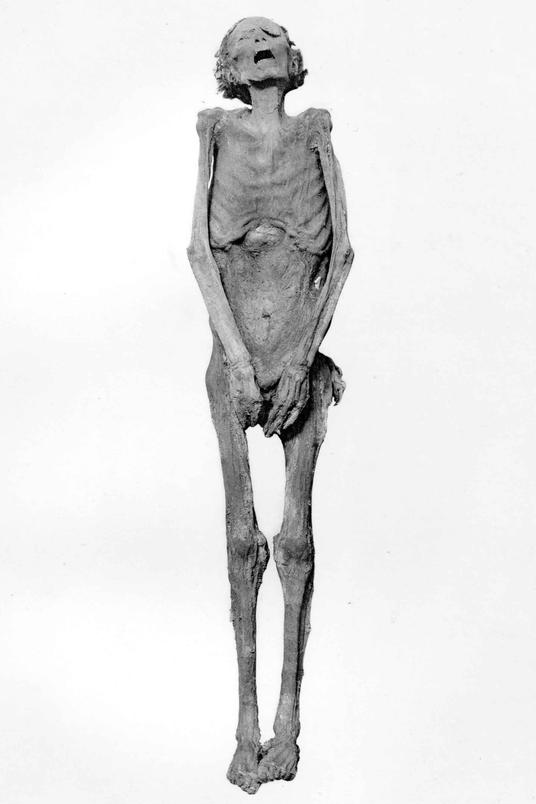
Pentawer (also Pentawere and Pentaweret) was an ancient Egyptian prince of the 20th Dynasty, a son of Pharaoh Ramesses III and his secondary wife, Tiye.[1] He was involved in the so-called "harem conspiracy", a plot to kill his father and place him on the throne. The details of his trial are recorded in the Judicial Papyrus of Turin; he committed suicide following his trial.[2] A candidate for his body is a mummy known as "Unknown Man E", discovered in the Deir el-Bahari cache in 1881. This mummy is unusual as it was found wrapped in a sheep or goat skin and was improperly mummified, being left with all his organs. Bob Brier has suggested that this mummy does indeed belong to the disgraced prince;[3] DNA analysis has confirmed a father-son relationship with Pentawer's known father, Ramesses III, with both sharing the same Y chromosomal haplogroup and half of their DNA.[4]

Conspiracy

[edit]

The actual name of this prince is unknown, "Pentawer" being a pseudonym given to him on the Judicial Papyrus of Turin.[5] He was to be the beneficiary of the harem conspiracy, probably initiated by his mother Tiye, to assassinate the pharaoh.[6] Tiye wanted her son to succeed the pharaoh, even though the chosen heir was a son of the queen Tyti.[7] According to the Judicial Papyrus, Pentawer was among those who were made to stand trial for their participation in the conspiracy. He was forced to kill himself:

Pentawere, to whom had been given that other name. He was brought in because he had been in collusion with Teye, his mother, when she had plotted the matters with the women of the harem concerning the making rebellion against his lord. He was placed before the butlers in order to be examined; they found him guilty; they left him where he was; he took his own life.[2]: 156 

James Henry Breasted argued that Pentawer "was in all probability only an unfortunate tool" in the conspiracy.[5] Susan Redford speculates that Pentawer, being a noble, was given the option to kill himself by taking poison and so be spared the humiliating fate of some of the other conspirators who were executed. If the means of execution was burning as Redford proposes - the related papyri themselves do not indicate the method of execution - this would have served to make a strong example since it emphasized the gravity of their treason for ancient Egyptians who believed that one could only attain an afterlife if one's body was mummified and preserved — rather than being destroyed by fire. By killing himself, Pentawer could avoid the harsher punishment of a second death. This could have permitted him to be mummified and move on to the afterlife.[8] A recent study of the remains of "Unknown Man E" which are a candidate for his suggest that he died by strangulation or hanging. If the remains indeed are his, then he would have been about 18-20 years old at the time of his death.[4]

Probable mummy

[edit]
withered, grimacing corpse
Mummy of "Unknown Man E" in 2011.

In recent times, the Egyptologist Bob Brier has revived the old hypothesis that the famed mummy of the "Unknown Man E" found in the Deir el-Bahari cache (DB320) might, indeed, be Pentawer.[9] The mummy is very unusual because it appears to have been embalmed quickly, without removing the brain and viscera, and to have been placed in a cedar box, the interior of which had to be crudely hacked to widen it. Brier hypothesizes that Pentawer was mummified very rapidly and placed in an available coffin, likely by a relative, in order to give him a proper burial.[10]

Subsequent DNA analysis supports the theory that the mummy was a son of Ramesses as they both share the paternal Y-DNA haplogroup E1b1a and half their DNA.[4]

References

[edit]
Revisions and contributorsEdit on WikipediaRead on Wikipedia
from Grokipedia
Pentawer (also spelled Pentawere or Pentaweret) was an ancient Egyptian prince of the Twentieth Dynasty, a son of by his secondary wife . He is primarily known for his central role in the , a coup attempt orchestrated by his mother to assassinate around 1155 BC and elevate Pentawer to the throne. The plot, detailed in the primary historical record known as the , involved accomplices from the royal , military officials, and the use of magical incantations to facilitate the . Although the succeeded in Ramesses III's death—likely by throat-cutting, as evidenced by CT scans of his —Pentawer failed to seize power, with his half-brother ascending instead. Tried by a special court, Pentawer was condemned but granted the option of , after which his body was denied proper mummification and , treated as ritually impure by being wrapped in an animal skin. In modern times, Pentawer has been tentatively identified with the "screaming mummy" (designated Unknown Man E), an unembalmed corpse discovered in the Deir el-Bahri cache, characterized by an open mouth and contorted features resulting from post-mortem decomposition and hasty preparation. A 2012 multidisciplinary study, incorporating genetic analysis, confirmed a close paternal relationship to through shared Y-chromosome E1b1a and autosomal markers, supporting the historical attribution despite the absence of direct epigraphic confirmation of Pentawer's tomb or inscriptions. This identification underscores the conspiracy's familial dynamics and the severe posthumous penalties imposed on conspirators.

Background

Parentage and Royal Lineage

Pentawer was a prince of ancient Egypt's 20th Dynasty, identified in historical records as the son of Pharaoh (reigned c. 1186–1155 BCE) and his secondary wife . , also spelled Tiy, held the status of a lesser consort within the royal , distinct from Ramesses III's principal wife , who bore the primary heirs. This positioned Pentawer outside the favored line of succession, which prioritized sons from the chief queen, such as the eldest surviving prince who became . Ramesses III fathered numerous children—estimated at over 100 across his consorts—but royal succession traditionally followed among legitimate heirs from the , sidelining those from secondary unions like Pentawer's. Pentawer's half-siblings included prominent princes such as (an earlier heir who predeceased his father) and others listed in temple reliefs at , where Pentawer notably does not appear among the designated successors. His birth, likely in the later years of Ramesses III's reign around the late BCE, placed him as a younger son with theoretical claim to the throne through paternal lineage, though his mother's lower rank limited practical elevation absent extraordinary circumstances.

Position in the Court of Ramesses III

Pentawer was a prince of the 20th Dynasty, identified as a son of Pharaoh (r. c. 1186–1155 BC) by his secondary wife , rather than the principal queen (Iset Ta-Hemdjert). As such, he occupied a position within the royal family but lacked the designation of , which was reserved for elder sons such as (later ), who succeeded his father and is attested in administrative and funerary contexts as the primary heir. Other princes, including Paraherwenemef and Khaemwaset, held prestigious titles like "First King's Son" and appear in inscriptions and tombs reflecting active courtly or military involvement, such as depictions in the temple processions. No surviving inscriptions, administrative papyri, or monumental reliefs from Ramesses III's reign prior to the late years explicitly document Pentawer's titles, appointments, or public roles, indicating relative marginalization compared to siblings who featured in royal iconography and held positions like charioteers or overseers. This absence contrasts with the visibility of princes like Montuherkhopshef and , whose tombs in the Valley of the Queens and mentions in temple scenes underscore their integration into court hierarchies. Pentawer's limited attestation suggests he did not participate prominently in the pharaoh's military campaigns or administrative duties, privileges typically afforded to favored heirs. Ramesses III's court operated amid broader challenges, including the aftermath of invasions repelled by year 8 (c. 1178 BC), as detailed in reliefs, and later economic strains evidenced by worker strikes at in year 29 (c. 1157 BC), recorded in ostraca and tomb inscriptions reflecting grain shortages and labor unrest. These conditions formed a backdrop of internal pressures, though no direct evidence links them to individual princely status.

Harem Conspiracy

Plot Origins and Motivations

The , documented in the , emerged circa 1155 BCE during the final years of Ramesses III's reign (c. 1186–1155 BCE) and centered on ambitions to assassinate the pharaoh and enthrone Prince Pentawer as successor. The plot sought to disrupt the established line of succession, which favored heirs from Ramesses III's principal wives, such as the renamed Amenherkhepeshef (later ), over Pentawer, son of a secondary consort. Instigated within the royal at Thebes, the conspiracy reflected entrenched power dynamics where secondary royal women maneuvered for influence amid the pharaoh's aging rule and the New Kingdom's administrative complexities. , Pentawer's mother and a minor queen, spearheaded efforts to position her son on the , leveraging networks to challenge norms that prioritized seniority and maternal status in royal inheritance. The attests to this as a calculated bid for dynastic control, without explicit references to broader policy grievances, though the era's economic pressures from post-Sea Peoples recovery may have amplified intra-court rivalries. Historical records emphasize the plot's inception through covert communications and oaths of allegiance among harem insiders, underscoring causal tensions in polygamous royal structures where multiple heirs vied for supremacy. This episode highlights how harem intrigue, rather than overt , served as a primary vector for challenging pharaonic authority in late 20th Dynasty Egypt.

Key Participants and Methods

The against involved a network of co-conspirators drawn from the royal , court administration, and military elements, as detailed in the , a primary record of the ensuing trials. The plot was orchestrated by , a secondary wife of the and mother of Pentawer, who sought to elevate her son to the throne; she enlisted support from harem women, including messengers and servants who facilitated communications. Key male participants included high-ranking officials such as the chief steward of the harem, scribes responsible for drafting incriminating letters, army officers tasked with mobilizing forces, and magicians who prepared ritual elements. These individuals, numbering over a dozen in the main prosecution group, confessed under interrogation to roles in planning and execution support, with the papyrus enumerating charges against specific figures like the overseer of the king's weapons and guards who were to neutralize palace security. Operational tactics relied on a combination of subterfuge, , and armed coordination within confines, per the trial confessions preserved in the Turin Papyrus and supplementary documents like the Lee Papyrus. Conspirators employed , including the creation of wax effigies of the and guards to invoke paralysis through spells recited from texts such as the "Book of Overthrowing ," aiming to incapacitate opposition without direct confrontation. Secret letters were dispatched to provincial officials and military units outside to secure loyalty and post-assassination backing for Pentawer, while internal agents prepared weapons and plotted synchronized strikes during a when security was relaxed. These methods exploited insider access, blending ritual —rooted in Egyptian beliefs about sympathetic effects—with practical intrigue to bypass the 's protections. Pentawer's involvement appears primarily as the designated rather than an active operative, with trial records indicating he was aware of and consented to the plot through communications with his mother, though no direct participation in is attributed to him in the confessions. The notes his prosecution alongside principal plotters, based on admissions from accomplices implicating him in the scheme's objective of usurpation, distinguishing his role from those who handled logistics or violence. This passive complicity, derived from extracted testimonies under judicial oversight, underscores the conspiracy's focus on dynastic replacement over personal execution by .

Assassination of Ramesses III

The assassination attempt against occurred around 1155 BCE during a period of internal unrest, culminating in a violent attack that inflicted a severe throat wound on the . Forensic analysis of his via computed (CT) scans conducted in 2012 revealed a deep, transverse cut measuring approximately 7 cm wide and severing major structures including the , trachea, and , consistent with a sharp-edged such as a or . This injury, showing no signs of healing or post-mortem infliction, would have caused rapid asphyxiation and , leading to immediate death rather than a prolonged survival. Contemporary Egyptian inscriptions, such as those on the walls of the temple complex, portray as having repelled the conspiracy and emerged victorious, emphasizing divine protection and the pharaoh's resilience against "enemies" within the palace. However, this propagandistic narrative contrasts sharply with the from the mummy, which indicates the attack succeeded in fatally wounding the king, undermining claims of his survival or triumph. The discrepancy highlights potential efforts by royal scribes to maintain stability and uphold the pharaoh's divine image posthumously, as no archaeological or textual records from the era explicitly confirm the king's demise from the assault at the time. In the immediate aftermath, the throne passed smoothly to , the pharaoh's designated heir and third son, averting a prolonged despite the plot's aim to install an alternative claimant. 's accession inscriptions and administrative continuity, including ongoing temple constructions initiated by his father, demonstrate rapid stabilization of the royal line, with the conspiracy's failure to disrupt governance evident in the uninterrupted flow of state records and inundation notations from year 26 of onward. This outcome underscores the resilience of Egypt's bureaucratic and priestly institutions in containing the plot's repercussions to the palace confines.

Trial and Conviction

Judicial Proceedings

Following the assassination of , a high known as the kenbet enhet (great council) was convened under royal authority to investigate the , comprising approximately 14 officials including viziers, the royal treasurer, army commanders, and judges from the qenbet courts. This body systematically examined suspects in multiple sessions, prioritizing documented confessions over unverified reports to establish culpability. The primary record of these proceedings survives in the Judicial Papyrus of Turin, a fragmentary hieratic document detailing four distinct prosecution phases involving over 40 implicated individuals, from harem members to court officials. Interrogations followed Egyptian legal norms, beginning with oaths invoking divine judgment and escalating to physical coercion—such as repeated beatings with sticks—to compel testimony, as authorized for extracting truth in serious crimes against the state. Confessions thus obtained were transcribed verbatim, forming the empirical basis for assessing participation in the plot's magical, poisonous, and violent elements. Pentawer, the royal prince and son of secondary queen , emerged as a central figure in the tribunal's scrutiny during the final prosecution phase, with records noting his direct involvement alongside co-conspirators in devising the scheme. The process underscored the Egyptian system's reliance on hierarchical oversight, where senior viziers cross-verified statements to mitigate fabrication risks inherent in coerced admissions.

Verdict and Sentencing

The trial records in the document Pentawer's conviction for treason in the conspiracy to assassinate and install himself as . As a royal prince, he received a differentiated sentence: exemption from the or reserved for common conspirators, with permission instead to end his own life, a concession reflecting his high birth status. Punishments among the approximately 40 tried individuals varied by rank and involvement: lower officials and servants, such as butlers and guards, were typically sentenced to immediate execution, while select elites faced compelled to preserve some dignity and avoid ritual of the body. Lesser accomplices, including some who failed to report the plot, incurred fines or , such as nose and ear removal for corrupt judges. This tiered system exemplified hierarchical justice in , where social position influenced penalty severity without negating guilt. No provisions for appear in , with the great kenbet court's decisions—overseen by a pharaonic commission—final and binding, thereby reinforcing the monarchy's unassailable even amid dynastic . The outcomes ensured the plot's principals were eliminated, securing Ramesses IV's unchallenged accession around 1155 BCE.

Death and Punishment

Manner of Execution

The records that Pentawer, after examination by court officials and a guilty verdict, was left unmolested to end his own life, a concession phrasing interpreted as permitting to spare royal blood from ritual . This occurred promptly post-trial, around 1155 BCE, as part of the conspiracy's judicial aftermath under Ramesses III's successor. Unlike lower-status conspirators subjected to , beheading, or burning—methods ensuring spiritual and public deterrence—nobles like Pentawer received this measured leniency to uphold elite decorum while enforcing accountability. The papyrus omits the precise method, though ancient precedents for coerced noble deaths favor or self-strangulation to avoid overt violence. Such practices aligned with Egyptian views on preserving for the , even for the condemned, barring explicit denial of necropolis rites.

Cultural Implications of the Punishment

The punishment meted out to Pentawer included the denial of ritual purity essential for the , as his body was wrapped in rather than the prescribed for proper mummification. In ancient Egyptian cosmology, sheepskin was deemed ritually impure, associated with animals linked to , the deity of chaos and disorder who opposed , the god of and the . This treatment precluded Pentawer's identification with Osiris during embalming rites, barring the transformative process believed necessary for the ka (life force) and ba (soul) to achieve eternal existence in the , thereby condemning him to a form of spiritual oblivion. Further erasure of Pentawer's identity manifested in the judicial records, where his true name was suppressed and replaced with the pseudonym "Pentawer," signifying a deliberate obscuring to invoke a partial . Such practices in aimed to unmake the offender's historical and metaphysical presence, preventing their name from invoking power or continuity in posterity and serving as a deterrent against regicidal . This omission aligned with broader conventions of excising enemies from monuments and texts, ensuring their deeds and essence faded from . These measures collectively functioned to reaffirm ma'at, the cosmic order of and disrupted by the conspiracy's threat to divine kingship. By imposing punishments that negated the perpetrators' claims to legitimacy and , the state reasserted pharaonic authority as the upholder of equilibrium against chaos, without which societal and divine structures risked unraveling. , as a profound violation of this order, warranted such symbolic restitution to signal the restoration of stability under Ramesses IV's succession.

Mummy and Post-Mortem Identification

Discovery and Initial Examination

The royal mummy cache at Deir el-Bahri (DB320) was discovered on July 5, 1881, by Émile Brugsch-Bey, who evacuated its contents under orders from Gaston Maspero to prevent . Among the mummies recovered was one unlabeled and designated Unknown Man E, placed in a plain, undecorated without typical royal wrappings. On June 30, 1886, during systematic unwrapping of the cache mummies, Gaston Maspero oversaw the examination of Unknown Man E by Daniel Fouquet. Maspero documented its anomalous preparation: lacking resin or traditional bandages, the body was shrouded in —a material associated with impurity—and secured with linen strips binding the hands behind the back and ankles together, suggesting deliberate degradation rather than standard . The mummy displayed a severely emaciated frame, darkened skin, and a rigid posture with the mouth forced open, exposing teeth and evoking a "scream," which Maspero attributed to possible poisoning or strangulation inducing prior to mummification. In the early 1900s, anatomist conducted a forensic assessment, confirming Unknown Man E as the remains of a robust adult male, approximately 174 cm in height, with no evident external trauma but mummification techniques indicative of the 20th Dynasty, marked by hasty, non-elite processing atypical for royalty.

Physical Anomalies and Mummification

The mummy known as Unknown Man E, recovered from the Deir el-Bahri in 1881, displays distinctive physical features observed during its unwrapping and initial examination by Maspero in 1886. The mouth is fixed in a wide-open position, with the jaws separated, creating an expression of apparent agony, while the hands are clenched into tight fists with the arms crossed over the chest. These rigid poses deviate from the typical serene postures of properly mummified royal remains. Standard mummification rites, which included evisceration of internal organs via an abdominal incision and removal of the brain through the , were evidently omitted in this case. Instead, the body appears to have undergone a rudimentary drying process, possibly with paste applied externally, but without the full suite of techniques or incision observed in contemporaneous royal mummies. This abbreviated procedure indicates either extreme haste or intentional deviation from protocol. Uniquely among the royal mummies in the cache, Unknown Man E was encased in rather than the prescribed white linen wrappings. In ancient Egyptian cosmology, was deemed ritually impure, associated with , the god of chaos and disorder, and its use here likely served as a deliberate act of symbolic degradation or pollution, denying the deceased conventional rites. Early assessments of skeletal maturity, including dental development and fusion, estimated the age at death to be that of a , around 18 to 20 years. This aligns with the timeline for Pentawer, the prince implicated in the against , who would have been in late adolescence during the events of circa 1155 BCE.

Modern Forensic Analysis

In 2012, a collaborative study by Egyptian and European researchers utilized computed tomography (CT) scans and genetic analysis on the mummy designated as Unknown Man E, revealing physical evidence consistent with ligature strangulation, including horizontal creases and furrows across the anterior neck without associated laryngeal fractures or hyoid damage. These findings aligned with historical accounts of Pentawer's punishment, potentially involving as an alternative to formal execution. Short tandem repeat (STR) profiling of autosomal and Y-chromosomal markers demonstrated that Unknown Man E shared the same paternal (E1b1a) and approximately 50% of his DNA with , confirming a direct father-son relationship and excluding other royal candidates. Further examination indicated the absence of standard mummification procedures, such as abdominal incisions for organ evisceration, brain removal via transnasal routes, or application of salts for , with the body instead hastily wrapped in irregular —a material ritually impure for elites—suggesting post-mortem treatment befitting a disgraced individual rather than ritual murder. This supports the judicial verdict allowing self-inflicted death, as protocols were typically denied to executed criminals to prevent . The integrated radiological, anthropological, and genetic data provided the first empirical linkage between Unknown Man E and Pentawer, reinforcing the harem conspiracy's role in Ramesses III's demise without contradicting ancient judicial papyri.

Debates on Identification

The identification of the mummy designated as Unknown Man E with Pentawer, a son of implicated in the circa 1155 BCE, enjoys broad scholarly consensus, primarily anchored in genetic, chronological, and contextual evidence. A 2012 multidisciplinary study employing CT scans, radiological analysis, and short tandem repeat (STR) established a direct paternal relationship between Unknown Man E and , with matching Y-chromosome haplotypes and autosomal markers sufficient to confirm father-son kinship at high confidence levels. This aligns with the historical timeline, as the records Pentawer's trial and punishment during Ramesses III's regnal year 27, and the mummy's estimated age at death (18–22 years) fits an adult prince active in that era, while other royal sons from the period are either accounted for via identified remains or lack comparable punitive indicators. The irregular mummification—lacking a heart, wrapped in sheepskin rather than , and interred in an undecorated cache—mirrors the prescribed "second death" erasure for conspirators, denying standard rites. Skepticism persists among a minority of researchers, particularly those emphasizing pre-DNA uncertainties or potential analytical limitations. Critics argue that STR-based paternity testing, while robust for modern forensics, faces challenges with ancient degraded samples prone to or allelic dropout, potentially yielding false positives without full mitochondrial or genome-wide sequencing to distinguish among Ramesses III's numerous sons (over 20 documented). Some pre-2012 analyses, such as those questioning the sheepskin wrapping's exclusivity to impurity (noting variable New Kingdom practices), proposed Unknown Man E as an unrelated noble or another disgraced figure, like a minor prince unlinked to the . Fringe critiques have claimed Y-chromosome discrepancies with expected Ramesside lineages, though these lack peer-reviewed substantiation and contradict the 2012 dataset's haplotype alignment. Counterarguments reinforce the identification's validity by integrating multiple lines of evidence beyond genetics. The absence of direct epigraphic naming on the mummy is typical for punitive erasures, but the confluence of timeline, anomalous burial (e.g., no canopic provisions, suggesting self-inflicted or abbreviated processing), and forensic signs of possible toxic ingestion—such as the hyperextended jaw interpreted as a perimortem grimace rather than mere decomposition artifact—aligns uniquely with Pentawer's documented suicide to evade ritual impalement. Subsequent studies, including 2017 genomic confirmations of Ramesside paternal continuity, have not overturned the linkage, underscoring that alternative candidates fail to match the combined forensic and historical profile. Thus, while absolute certainty eludes mummy identifications without inscriptions, the probabilistic case for Pentawer remains compelling against sparse dissenting views.

References

Add your contribution
Related Hubs
User Avatar
No comments yet.