


Community hub
Recent from talks
Contribute something
Nothing was collected or created yet.
Mohegan-Pequot language
View on Wikipedia| Mohegan-Pequot | |
|---|---|
| Mohiks-Piqut Uyôtowáwôk | |
| Native to | United States |
| Region | Southern New England, Eastern Long Island |
| Ethnicity | Mohegan, Montauk, Niantic, Pequot, and Shinnecock |
| Extinct | 1908, with the death of Fidelia Fielding[1] |
| Revival | beginning 2010 |
Algic
| |
| Latin script | |
| Language codes | |
| ISO 639-3 | xpq |
| Glottolog | pequ1242 |
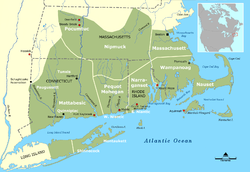
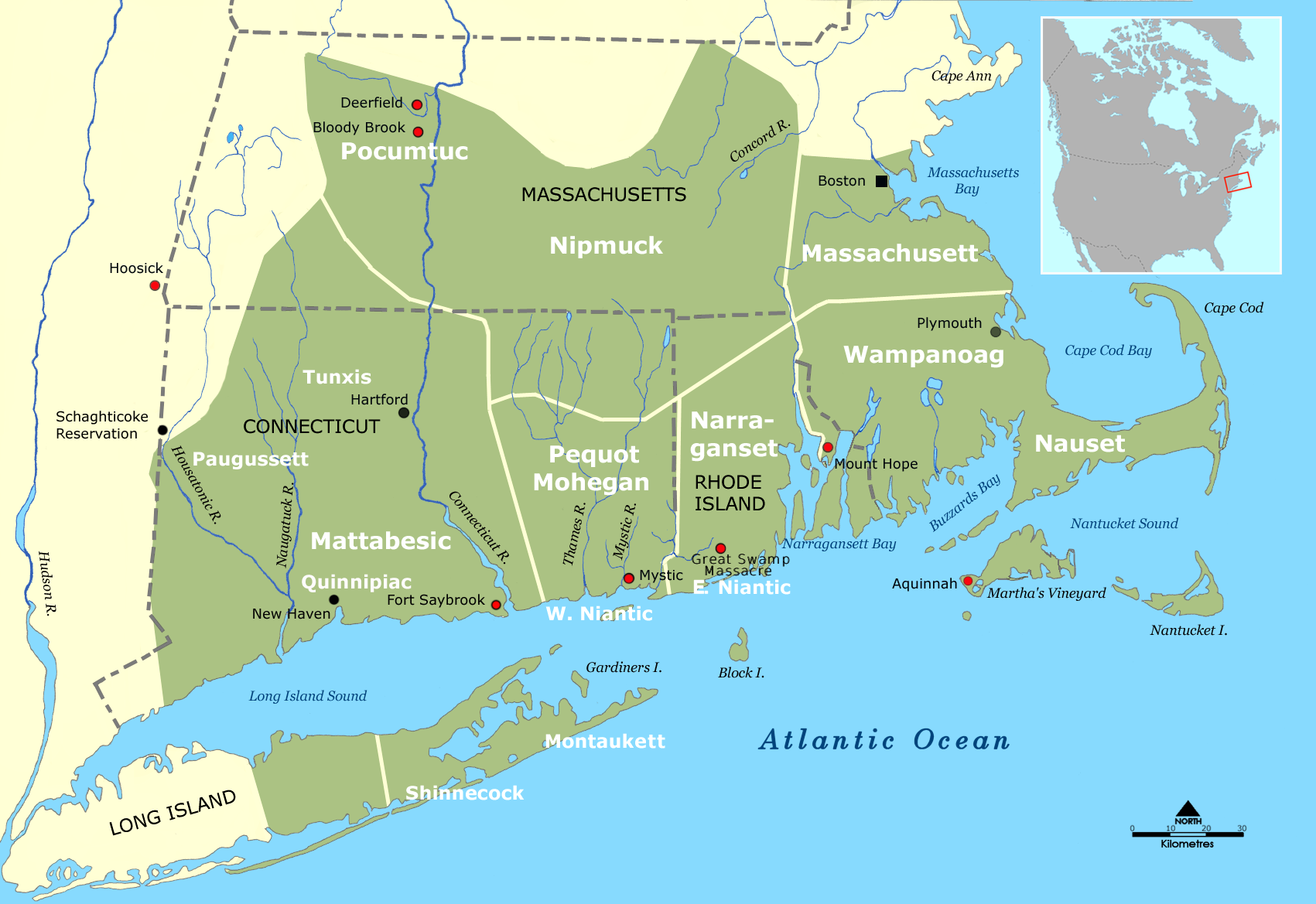
 The location of the Mohegan, Pequot, Montaukett, Niantic, and Shinnecock, and their neighbors, c. 1600 | |
Mohegan-Pequot (also known as Mohegan-Pequot-Montauk, Secatogue, and Shinnecock-Poosepatuck; dialects in New England included Mohegan, Pequot, and Niantic; and on Long Island, Montaukett and Shinnecock) is an Algonquian language formerly spoken by the Indigenous peoples of southern present-day New England and eastern Long Island.[2]
Language endangerment and revitalization efforts
[edit]As of 2014, there are between 1,400 and 1,700 recorded tribal members (these figures vary by source). The Mohegan language has been dormant for approximately 100 years; the last native speaker, Fidelia Fielding, died in 1908. Fielding, a descendant of Chief Uncas, is deemed the preserver of the language. She left four diaries that are being used in the 21st-century process of restoring the language. She also took part in preserving the traditional culture. She practiced a traditional Mohegan way of life and was the last person to live in the traditional log dwelling.
Another important tribal member was Gladys Tantaquidgeon, who was the tribe's medicine woman from 1916 until her death in 2005. She too assisted greatly in maintaining the Mohegan culture, as she collected thousands of tribal documents and artifacts. These documents were of critical importance to supporting the tribe's documentation for its case for federal recognition, which was approved in 1994.[3]
As of 2010, the Shinnecock and Unkechaug nations of Long Island, New York, had begun work with the State University of New York at Stony Brook, Southampton Campus, to revive their languages, or dialects of the above.[4]
As of 2012, the Mohegan Language Project had created lessons, a dictionary, and other online learning materials to revive their language.[5] The project also has a complete grammar in the works, which has been put together by Stephanie Fielding. The primary goal of the project is for the next generation of Mohegan people to be fluent.
Many of the dictionaries circulating are based on John Dyneley Prince and Frank G. Speck's interpretation of testimony by Dji's Butnaca (Flying Bird), also known as Fidelia Fielding.[6]
The Mashantucket Pequot Museum and Research Center collection includes a 1992 menu "which attempts to translate such words as hamburger and hot dog into Mohegan-Pequot."[7]
The language was documented as early as the 17th century.
"In 1690, a Pequot vocabulary list was compiled by Rev. James Noyes in Groton. In 1717, Experience Mayhew, a Congregational Minister translated the Lord's Prayer into Mohegan-Pequot. Ezra Stiles, president of Yale University collected Pequot linguistic data in Groton in 1762."[7]
Prayers from the Baháʼí Faith have been translated into the Mohegan-Pequot language.[8]
"It is a sacred obligation," says the Golden Hill Paugussett Chief, Big Eagle. "Indian people must keep their languages alive. If the language is not spoken, it must be made to live again."[7]
Phonology
[edit]| Labial | Alveolar | Post- alveolar |
Velar | Glottal | ||
|---|---|---|---|---|---|---|
| plain | lab. | |||||
| Nasal | m (m) | n (n) | ||||
| Stop | p (p) | t (t) | k (k) | kʷ (q) | ||
| Affricate | tʃ (c) | |||||
| Fricative | s (s) | ʃ (sh) | h (h) | |||
| Approximant | j (y) | w (w) | ||||
/n/ is realized as [ŋ] only before [k].
Vowel sounds
Simple vowels
[edit]| Front | Central | Back | |
|---|---|---|---|
| Close | iː (i) | uː (o) | |
| Mid | ə (u) | ɔ̃ː (ô) | |
| Open | a aː (a á) |
The nasal /ɔ̃/ sound can range to being an oral [ɔ] sound. ⟨a⟩ written with an acute accent (⟨á⟩) represents a long /aː/ sound.
Diphthongs
[edit]| Central | Back | |
|---|---|---|
| Close | au | |
| Mid | ɔ̃i | |
| Open | ai |
Orthography
[edit]Historically, Mohegan-Pequot has not had a writing system, and its speakers relied on oral transfer of knowledge, as opposed to writing. The only significant historic writings have been produced by European colonizers who interacted with the speakers of Mohegan-Pequot.
The dictionaries, grammar books, and other materials that are being developed in recent decades as part of the effort to revitalize Mohegan-Pequot Language, have adopted and used a standardized Latin orthography consisting of twelve consonants and six vowels.[11]
| Sound | Phonetic | Mohegan-Pequot examples | Gloss | English equivalent |
|---|---|---|---|---|
| c | [dʒ] ~ [tʃ] | nutcôhtam | 'I want' | beach |
| h | [h] | mohiks | 'Mohegan, Mohegan Indian' | hi |
| k | [g] ~ [k] | ôkatuq | 'cloud' | geese, ski |
| m | [m] | pôcum | 'cranberry' | man |
| n | [n] | nupáw | 'five' | name |
| p | [b] ~ [p] | páyaq | 'ten' | spit |
| q | [kw] ~ [kw] | sôyôqat piyámáq |
'It is cold' 'fish' |
queen |
| s | [s] ~ [z] [z] beginning of a word [z] between two vowels [s] ~ [ʃ] in clusters sk, sp, sq |
nis pahsukôsq |
'two' 'board, floorboard' |
miss |
| sh | [ʃ] | nihsh ôtshohkôk |
'eel' 'legend, myth' |
shoreline |
| t | [d] ~ [t] | manto | 'God' | do, stop |
| w | [w] | wacuw | 'hill, mountain' | weasel |
| y | [j] | nut'huyô | 'I call him' | mayor |
| Sound | Phonetic | Mohegan-Pequot examples | Gloss | English equivalent |
|---|---|---|---|---|
| a | [ə] ~ [a] | ahki | 'land, Earth' | handle |
| á | [aː] | yáw | 'four' | father |
| i | [ɪ] ~ [i] | maci | 'bad, wicked' | pin |
| o | [uː] ~ [o] | nupotawá | 'I make a fire' | obey, book |
| ô | [ɔ̃:] ~ [ɔː] | kôq | 'porcupine' | bonbon |
| u | [ʌ] | shwut | 'third' | cut |
Morphology
[edit]Nouns[11]
Nouns in Mohegan have two forms: animate and inanimate. They are further distinguished by number. Animate nouns include people, animals, heavenly bodies (sun, moon, stars, but not clouds), and spirits. There are other items that fall into the category of animate such as certain cultural items and plants, but it is not known why these items are considered animate. It is something that is simply learned and memorized. One way to help identify if a noun is animate or inanimate is to look at its plural form. Plural animate nouns typically end in -k while plural inanimate nouns end in -sh.
Animate nouns have four forms: singular, plural, obviative and locative. The obviate form is used when there are two or more animate third person nouns in a sentence to mark the noun which is less salient (less relevant to the discourse). The unmarked noun is called the proximate, which is more salient/relevant to the discourse. The obviative is also used to mark a third-person possessed noun, with the possessor considered as the proximate, even if the possessed noun is more salient than its possessor. The locative is used to show where something is spatially. There is no obviative form for inanimate nouns, and neither the obviative nor the locative have plural forms (plurality is known through context).
| Animate Nouns (with regular stems) | Mohegan Form | English Translation |
|---|---|---|
| Singular | winay | old woman |
| Plural | winayak | old women |
| Obviative | winayah | old woman/women |
| Locative | winayuk | at the old woman/women |
| Inanimate Nouns (with regular stems) | Mohegan Form | English Translation |
|---|---|---|
| Singular | wacuw | hill |
| Plural | wacuwash | hills |
| Locative | wacuwuk | at the hill/on the hill |
Verbs[11]
Verbs in Mohegan come in several forms. Independent verbs exist in four forms: inanimate intransitive, animate intransitive, transitive inanimate and transitive animate. There is also the conjunct form which does not carry the affixes (used to clarify person) that the aforementioned hold.
Person, number and gender
[edit]Person[11]
Mohegan animate intransitive verbs show who the subject is by utilizing affixes. Singular forms have prefixes, but third person (singular and plural) only have suffixes. In the plural forms there are inclusive and exclusive suffixes; the inclusive we includes the person who is speaking as well as the person he/she is talking to whereas the exclusive we does not include the person the speaker is talking to. When an animate intransitive verb stem ends in a long vowel (á, i, o or ô) the third person singular does not take a final -w, and in the third person plural these same verbs take -k as an ending in lieu of - wak.
| Person | Mohegan | English Translation |
|---|---|---|
| 1st person singular | nukumotu | I steal |
| 2nd person singular | kukumotu | you steal |
| 3rd person singular | kumotuw | he/she steals |
| 3rd person obviative | kumotuh | he/she (obviative) steals |
| 1st person plural exclusive | nukumotumun | we (I and he/she) steal |
| 1st person plural inclusive | kukumotumun | we (I and you) steal |
| 2nd person plural | kukumotumô | you (more than one) steal |
| 3rd person plural | kumotuwak | they steal |
*affixes indicated in bold type
| Person | Mohegan | English Translation |
|---|---|---|
| 1st person singular | nuyáhshá | I breathe |
| 2nd person singular | kuyáhshá | you breathe |
| 3rd person singular | yáhshá | he/she breathes |
| 3rd person obviative | yásháh | he/she (obviative) breathes |
| 1st person plural exclusive | nuyáhshámun | we (I and he/she) breathe |
| 1st person plural inclusive | kuyáhshámun | we (I and you) breathe |
| 2nd person plural | kuyáhshámô | you (more than one) breathe |
| 3rd person plural | yáhshák | they breathe |
*affixes indicated in bold type
Numbers[11]
| Cardinal | Ordinal | ||
|---|---|---|---|
| nuqut | one | nikôni | first |
| nis | two | nahahtôwi | second |
| shwi | three | shwut | third |
| yáw | four | yáwut | fourth |
| nupáw | five | nupáwut | fifth |
| qutôsk | six | qutôskut | sixth |
| nisôsk | seven | nisôskut | seventh |
| shwôsk | eight | shwôskut | eighth |
| pásukokun | nine | pásukokunut | ninth |
| páyaq | ten | páyaqut | tenth |
Space
[edit]Locative case
The locative case is used to show where something is. Mohegan utilizes the suffix -uk to indicate spatial relationships, which can be compared to the English prepositions on, at, and in. In Mohegan there is no plural form to go with the obviative and the locative: the same form is used for singular and plural with the difference being distinguished by context.
Example of the Locative Case
| Mohegan | English Translation |
|---|---|
| cáhqin | house |
| cáhqinash | houses |
| cáhqinuk | in the house/houses |
Absentative case
The absentative case is used to when referencing a person who has died (this includes any property that they left behind). This is accomplished by adding a suffix to either his/her name, title or the property.
| Mohegan | English Translation | |
|---|---|---|
| singular | nokunsi | my late grandfather |
| plural | nokunsuk | my late grandfathers |
| obviative singular | wokunsah | his late grandfather |
| obviative plural | wokunsukah | his late grandfathers |
| departed's possession singular | mushoyi | my late father's boat |
| departed's possessions plural | mushoyuk | my late father's boats |
*suffix indicated by bold type
The following example shows the absentative case in use:
Niswi nusihsuk wikôtamak áposuhutut.
'Both of my late uncles enjoyed cooking.'
Syntax
[edit]Possession
In Mohegan, there are two types of possession, alienable possession and inalienable possession. Nouns receive different marking depending on the relationship between the possessor and the possessed noun. If the possessed noun is connected (physically or sometimes metaphorically) to the possessed noun it is considered inalienable possession. For example in the phrase "the man's hand", the hand is possessed inalienably because it is inseparable from the man. Inalienable possession can also be metaphorical; for example, in the phrase "the man's mother", the mother is possessed inalienably because of a cultural perception of kinship as a "strong" connection. Inalienable nouns must always receive marking. If the possessor owns the possessed noun, but is not physically attached to it, it is considered alienable possession. In the phrase "the man's house", the house is possessed alienably because the house is not attached to the man.
Nouns pertaining to kinship and body parts are always classified as inalienable, but there are some terms that do not fall under either of these umbrellas that must be classified as inalienable, such as the noun home. Various affixes are used to denote inalienability and different affixes are used to differentiate animate/inanimate and singular/plural. Additionally, when a term requires possession but the possessor is unclear or unknown it is marked with a prefix that indicates an indefinite possessor.
| Person | Mohegan | English Translation |
|---|---|---|
| 1st person singular | nutônihs | my daughter |
| 2nd person singular | kutônihs | your daughter |
| 3rd person singular | wutônihsah | his/her daughter |
| 1st person plural exclusive | nutônihsun | our (exclusive) daughter |
| 1st person plural inclusive | kutônihsun | our (inclusive) daughter |
| 2nd person plural | kutônihsuw | your (plural) daughter |
| 3rd person plural | wutônihsuwôwah | their daughter |
| indefinite possessor | mutônihs | an unknown person's daughter |
| Person | Mohegan | English Translation |
|---|---|---|
| 1st person singular | nusit | my foot |
| 2nd person singular | kusit | your foot |
| 3rd person singular | wusit | his/her foot |
| 1st person plural exclusive | nusitun | our (exclusive) foot |
| 1st person plural inclusive | kusitun | our (inclusive) foot |
| 2nd person plural | kusituw | your (plural) foot |
| 3rd person plural | wusituw | their foot |
| indefinite possessor | musit | an unknown person's foot |
The locative (-uk) and obviate (-ah) suffixes are added to the 1st, 2nd, and 3rd person singular forms. Whether the word is singular or plural should be suggested in the content of the sentence. The obviate affixes only go on animate nouns.
When a possessed noun is plural it must be shown. With an animate noun then suffix -ak is combined with the possessive ending (with the exception of third person singular and third person plural, where the plural is the same as the singular).
| Person | Mohegan | English Translation |
|---|---|---|
| 1st person singular | nutônihsak | my daughters |
| 2nd person singular | kutônihsak | your daughters |
| 3rd person singular | wutônihsah | his/her daughters |
| 1st person plural exclusive | nutônihsunônak | our (exclusive) daughters |
| 1st person plural inclusive | kutônihsunônak | our (inclusive) daughters |
| 2nd person plural | kutônihsuwôwak | your (plural) daughters |
| 3rd person plural | wetônihsuwôwah | their daughters |
| Person | Mohegan | English Translation |
|---|---|---|
| 1st person singular | nusitash | my feet |
| 2nd person singular | kusitash | your feet |
| 3rd person singular | wusitash | his/her feet |
| 1st person plural exclusive | nusitunônash | our (exclusive) feet |
| 1st person plural inclusive | kusitunônash | our (inclusive) feet |
| 2nd person plural | kusituwôwash | your (plural) feet |
| 3rd person plural | wusituwôwash | their feet |
| indefinite possessor | musitash | an unknown person's feet |
*affixes on all charts are marked by bold type
Clause combining
In Mohegan grammar verbs that are in a dependent clause are said to be in the conjunct order. Conjunct verbs have the same numbers of persons for each verb, but they do not have prefixes, only suffixes. In turn, all of the person information is at the end of the word.
| Person | Mohegan | English Translation |
|---|---|---|
| 1st person singular | yáhsháyôn | that I breathe |
| 2nd person singular | yáhsháyan | that you breathe |
| 3rd person singluar | yáhshát | that he/she breathes |
| 1st person plural (incl & excl) | yáhsháyak | that we breathe |
| 2nd person plural | yáhsháyáq | that you (more than one) breathe |
| 3rd person plural | yáhsháhutut | that they breathe |
| 3rd person plural participle | yáhshácik | those who breathe |
| indefinite subject | yáhshámuk | that someone breathes |
*suffixes on chart marked by bold type
Example: Mô yáyuw maci ákacuyǒn.
Translation: 'It was so bad that I am ashamed.'
When in the conjunct form if the first vowel of the word is a short vowel, that is /a/ or /u/, it changes to a long /á/.
Transitive verbs with inanimate objects take only a suffix as well. The suffix varies based on the ending of the stem.
For stems that end in -m- or -n- the suffixes are as follows:
1st person singular: -ôn
2nd person singular: -an
3rd person singular: -k
1st person plural: -ak
2nd person plural: -áq
3rd person plural: -hutut
3rd person plural participle: -kik
Indefinite subject (passive): -uk
For stems that end in -o- the suffixes are as follows:
1st person singular: -yôn
2nd person singular: -yan
3rd person singular: -ôk
1st person plural: -yak
2nd person plural: -yáq
3rd person plural: -w'hutut
3rd person plural participle: -ôkik
Indefinite subject (passive): -muk
For stems that end in -u- the suffixes are as follows:
1st person singular: -wôn
2nd person singular: -wan
3rd person singular: -k
1st person plural: -wak
2nd person plural: -wáq
3rd person plural: -'hutut
3rd person plural participle: -kik
Indefinite subject (passive): -muk
See also
[edit]Notes
[edit]- ^ "Canku Ota - Aug. 11, 2001 - Mohegans Rebuilding Language". Archived from the original on 2014-05-02. Retrieved 2014-12-23.
- ^ Lewis, M. Paul (ed.), 2009. Ethnologue: Languages of the World. 16th edition. Dallas: Summer Institute of Linguistics
- ^ "Medicine Woman Gladys Tantaquidgeon and Mohegan Cultural Renewal". Connecticut History. 2022-03-08. Retrieved 2024-09-11.
- ^ Cohen, Patricia (2010-04-05). "Indian Tribes Go in Search of Their Lost Languages". The New York Times. ISSN 0362-4331. Retrieved 2024-05-09.
- ^ "Mohegan Language Project". Archived from the original on 2010-04-24. Retrieved 2012-11-12.
- ^ J. Dyneley Prince and Frank G. Speck (March 1904). "Glossary of the Mohegan-Pequot Language" (PDF). American Anthropologist. New Series. 6 (1): 18–45. doi:10.1525/aa.1904.6.1.02a00030. hdl:11858/00-001M-0000-0015-3ED6-D.
- ^ a b c Libby, Sam (18 October 1998). "Tribes to Revive Language". The New York Times. p. 6.
- ^ "Ôkosuwôkak wuci Mohiks-Piqut Uyôtowáwôk - Bahá'í Prayers in the Mohegan-Pequot Language". Retrieved 2012-11-12.
- ^ Granberry, Julian (2003). A Lexicon of Modern Mohegan. Lincom Europa.
- ^ Fielding, Stephanie (2006). A Modern Mohegan Dictionary.
- ^ a b c d e Fielding, Stephanie (2006), A Modern Mohegan Dictionary 2006 Ed.
References
[edit]Articles
[edit]- Cowan, William. Pequot from Stiles to Speck. International Journal of American Linguistics. The University of Chicago Press. Vol. 39, No. 3 (Jul., 1973), pp. 164–172
- De Forest, John W. "The Lord's Prayer in the Pequot Tongue." In History of the Indians of Connecticut. 1852. Reprint, Brighton, MI: Native American Book Publishers, 1994.
- Michelson, Truman. "The Linguistic Classification of Pequot-Mohegan." American Anthropologist 26 (1924): 295. doi:10.1525/aa.1924.26.2.02a00240
- Pickering, John, ed. "Doctor Edwards' Observations on the Mohegan Languages." Collections of the Massachusetts Historical Society. Series 2 Volume 10 (1823): 81-160.
- Prince, J. Dyneley and Frank G. Speck. "Glossary of the Mohegan-Pequot Language." American Anthropologist 6 (1904): 18-45. doi:10.1525/aa.1904.6.1.02a00030
- Prince, J. Dyneley and Frank G. Speck. "The Modern Pequots and Their Language." American Anthropologist 5 (1903): 193-212. doi:10.1525/aa.1903.5.2.02a00010
- Speck, Frank. "A Modern Mohegan-Pequot Text." American Anthropologist 6 (1904): 469-76. doi:10.1525/aa.1904.6.4.02a00070
- Speck, Frank and Fidelia Fielding. "A Pequot Mohegan Witchcraft Tale." Journal of American Folklore 16 (1903): 104-6.
- Speck, Frank. "Native Tribes and Dialects of Connecticut: A Mohegan-Pequot Diary." Smithsonian Institution Bureau of American Ethnology Annual Report 43 (1903): 199-287.
- Speck, Frank. Speck Papers and Photograph Collection. (17 microfilm reels)
- Speck, Frank. "Text of the Pequot Sermon." American Anthropologist 5 (1903): 199-212.
External links
[edit]
- Mohegan Language Project, website with assorted Mohegan Language resources
- A Modern Mohegan Dictionary (2006 Edition)—contains Guide to Using the Dictionary, Mohegan Grammar Paradigms, Mohegan to English Dictionary, and English to Mohegan Word Finder
- Mohegan-English Dictionary (December 2012 edition by S.Fielding ) — update of the Mohegan to English Dictionary section of above
- Mahican vs. Mohegan
- OLAC resources in and about the Mohegan-Pequot language
| International | |
|---|---|
| National | |
| Other | |

Mohegan-Pequot language
View on GrokipediaHistorical Context
Pre-contact Distribution and Dialects
Prior to sustained European contact in the early 17th century, the Mohegan-Pequot language was spoken by the Pequot people and their subordinate Mohegan relatives across southeastern Connecticut, from the vicinity of the Niantic River eastward to the Rhode Island border.[7] This territory encompassed the coastal areas, the Thames River drainage basin, and adjacent inland regions, with principal Pequot villages located at sites such as Mystic, Mashantucket, Pawcatuck, and Noank.[7] The Mohegan occupied lands primarily west of the Thames River, including areas around Shantok, Uncasville, Norwich, and Old Lyme.[4] These groups had migrated southward from the upper Hudson River valley in present-day New York around 1500, establishing dominance over the lower Connecticut River trade routes.[7] The Pequot population, including Mohegan speakers, numbered approximately 6,000 individuals circa 1620, reflecting a consolidated linguistic and cultural sphere prior to epidemics and political fission.[7] The Mohegan-Pequot language formed part of the Eastern Algonquian branch, characterized by the "Y-dialect" phonological features, which it shared with neighboring languages spoken by the Narragansett, Niantic, Montauk, and Shinnecock peoples.[7] Evidence for internal dialects within Mohegan-Pequot prior to contact is inferential, derived from post-contact documentation and tribal subdivisions, as no indigenous writing system existed.[6] Linguistic classifications treat Pequot-Mohegan as a dialect cluster within Southern New England Algonquian, with variations likely corresponding to the Mohegan (inland Thames valley) and Pequot (eastern coastal) territories, though mutual intelligibility prevailed across the region.[2] The shared language reinforced alliances and trade among these groups before the disruptive effects of colonization.[4]Contact Period and Early Documentation
European contact with Mohegan and Pequot speakers began in the early 17th century, primarily through Dutch traders and explorers. Adriaen Block, a Dutch navigator, documented interactions with groups he distinguished as "Morhicans" (Mohegan) and Pequots along the Connecticut River and Long Island Sound around 1614, marking initial recorded European awareness of these Algonquian-speaking peoples. English colonization intensified contact from the 1630s, culminating in the Pequot War (1636–1638), where Mohegan leader Uncas allied with English forces against the Pequots, leading to the subjugation of the latter and the emergence of distinct Mohegan political identity. These events facilitated direct linguistic exchanges, though systematic documentation remained limited amid warfare and displacement.[4] The earliest known vocabulary list for the Mohegan-Pequot language dates to 1690, compiled by Reverend James Noyes, a Congregational minister in Groton and Stonington, Connecticut, from interactions with surviving Pequot speakers.[8] [9] This list represents the first targeted effort to record lexical items, reflecting post-war colonial interest in Native languages for missionary and administrative purposes. In 1717, Experience Mayhew, another Congregational minister, produced a translation of the Lord's Prayer into Mohegan-Pequot, providing one of the initial textual samples and demonstrating early orthographic attempts based on English conventions.[9] [10] These documents, derived from oral informants amid declining speaker populations, preserved basic vocabulary and phrases but lacked comprehensive grammatical analysis, as colonial recorders prioritized practical utility over linguistic scholarship. Prior to these, no verified word lists exist, though incidental terms may appear in colonial narratives from the 1630s–1660s, influenced by related Algonquian documentation like Roger Williams' 1643 Narragansett glossary.[11]Decline and Extinction Factors
The decline of the Mohegan-Pequot language commenced in the early 17th century amid European colonization, which precipitated demographic collapse through epidemics such as smallpox outbreaks in 1633–1634 that ravaged southern New England Native populations, including Algonquian speakers.[6] The Pequot War (1636–1638), involving English colonial forces and allies against the Pequot tribe, resulted in the deaths of hundreds—primarily via the Mystic Massacre on May 26, 1637—and the enslavement or dispersal of survivors, rendering the Pequot subgroup nearly extinct and sharply curtailing the pool of dialect speakers.[12][13] Although the Mohegan, who had separated from the Pequot around 1630 and allied with the English, avoided total annihilation, these events initiated a broader erosion of community structures essential for language maintenance.[4] Subsequent land dispossession exacerbated the decline, as Mohegan territory shrank through sales in the 1790s and the termination of their reservation in 1861, fragmenting social networks and hindering oral transmission within families and gatherings.[4] Assimilation pressures, including intermarriage with non-Native populations leading to mixed-ancestry communities by the 19th century, promoted a shift to English for economic participation, trade, and interaction with colonial authorities.[14] The language's reliance on oral tradition, without a pre-contact writing system, amplified vulnerability, as knowledge transfer depended on uninterrupted fluent-speaker lineages disrupted by these factors.[6] By the late 19th century, fluent speakers were confined to elderly individuals, with Fidelia Fielding (1827–1908), a Mohegan woman who documented vocabulary and phrases in her diaries, identified as the final native fluent speaker whose death in 1908 signified the language's extinction from everyday use.[15][16] No children acquired fluency thereafter, as English dominance in education, governance, and daily life precluded revitalization until modern reclamation projects.[4]Linguistic Classification
Affiliation within Algonquian Family
The Mohegan-Pequot language is a member of the Eastern Algonquian subgroup within the Algonquian language family, which comprises approximately 30 historically attested languages spoken across eastern and central North America prior to European contact.[17] This affiliation is established through comparative reconstruction, revealing shared innovations from Proto-Algonquian, including the reflex of *r as /w/ or /j/ in certain environments and the development of a prefixed independent indicative verb paradigm absent in Western Algonquian branches like Cree-Montagnais-Naskapi.[17] Linguist Ives Goddard, in his analysis of Eastern Algonquian, positions Mohegan-Pequot among coastal languages from Labrador to the Carolinas, differentiated from inland Western varieties by these diagnostic traits.[18] Within Eastern Algonquian, Mohegan-Pequot aligns with the Southern New England branch, a cluster of closely related varieties spoken by indigenous groups in present-day Connecticut, Rhode Island, and southeastern Massachusetts.[17] This subgroup includes dialects associated with the Narragansett, Niantic, and Massachusett peoples, evidenced by over 80% cognate retention in core vocabulary (e.g., terms for body parts and numerals) and parallel grammatical structures, such as obviative marking in third-person forms.[17] Goddard’s subgrouping further refines Southern New England Algonquian as distinct from northern varieties like Abenaki-Penobscot, based on innovations like the loss of Proto-Eastern Algonquian *č in favor of /s/ in specific morphemes.[18] Mohegan and Pequot proper constitute mutually intelligible dialects within this branch, diverging primarily in the early 17th century following the political separation of the Mohegan under Uncas from the Pequot confederacy around 1634–1637, though lexical and phonological differences remained minimal, with shared forms like *mə̀hkə̀n for "wolf."[4] Earlier proposals, such as Frank T. Siebert Jr.'s 1970s attribution to a Natick division of Central Algonquian, have not gained consensus, as they conflict with broader evidence of Eastern innovations and geographic continuity.[3] Revival efforts since the 1990s, drawing on 19th-century manuscripts, reinforce this classification by aligning reconstructed forms with documented Eastern Algonquian patterns.Distinct Features Compared to Related Languages
The Mohegan-Pequot language, part of the Eastern Algonquian branch, exhibits phonological traits that align it closely with Narragansett in the Southern New England subgroup but distinguish it from northern relatives like Abenaki or western ones like Delaware. A key innovation is the absence of a phonemic /r/ sound, with Proto-Algonquian *r typically realized as /y/, as in *ge·pya·mehkw- "spoon" yielding forms akin to geyommon, contrasting with Abenaki retention of /r/ (amkuán) or Delaware development to /l/.[19] This y-reflex, emblematic of the "Y-dialect" shared with Narragansett and Montauk, arises from clusters like *nr > y, setting it apart from Massachusett's n-retention in comparable environments.[11] Consonant inventory includes a palatalized sibilant /tsʃ/ (noted as "ts" in early records) and variable /g/ ~ /dʒ/ realizations, such as chawgwan or goggwan for "what," alongside frequent elision of nasals like /l/, /r/, or /n/ in clusters (e.g., moish hen akin to Narragansett monish "path").[19] Vowels feature a system with short and long variants (e.g., /a/ as in "father," /ɛ/ as in "met," /i/ as in "machine"), but late documentation shows indeterminate short /ə/ marked by apostrophe, potentially reflecting dialectal simplification not as pronounced in more conservative Eastern Algonquian varieties like early Massachusett records.[19] Morphologically, Mohegan-Pequot retains core Algonquian polysynthesis, with verb stems inflecting for animacy, person, and number via prefixes and suffixes, but 20th-century attestations from the last fluent speaker indicate partial loss of moods (e.g., only conditional preserved as -seyon in wombunseyon "if I live"), unlike fuller modal systems in Delaware or Abenaki.[19] Imperatives use -ush (beush "come"), and past tense employs ma- negation with verbs (ne-ma-mud "I did not gather"), features paralleled in Narragansett but with lexical divergences, such as squadw "woman" involving s > ʃ before consonants, a shift less systematic in northern dialects.[19] Nouns distinguish animate/inanimate genders, as in neweek tumum "I see it (inanimate indefinite)," mirroring broader Algonquian patterns yet adapted in diminutive forms unique to local usage.[19] These traits, drawn from limited late-19th-century data primarily from Fidelia Fielding, suggest mutual intelligibility with Narragansett but underscore Mohegan-Pequot's niche innovations amid language shift pressures.[19]Phonology
Consonant Inventory
The consonant inventory of Mohegan-Pequot consists of 13 phonemes, including voiceless stops, an affricate, fricatives, nasals, a lateral approximant, and glides, as reconstructed from 19th- and early 20th-century documentation and standardized in modern revitalization orthographies.[20] These reflect Proto-Algonquian reflexes adapted in Southern New England dialects, with distinctions such as a back velar or labialized stop /q/ (from PA *k before rounded vowels) separate from /k/. Stops are unaspirated in phonemic descriptions, though allophonic aspiration may occur word-finally or in clusters, a feature critiqued in some reconstructive analyses as non-phonemic.[21] The following table presents the consonants in the orthography used by the Mohegan Tribe's language program, with approximate IPA equivalents and pronunciation notes derived from historical glossaries and comparative Algonquian phonology:| Place/Manner | Bilabial | Alveolar | Postalveolar | Velar | Glottal |
|---|---|---|---|---|---|
| Stops | p /p/ (voiceless, as in "spill") | t /t/ (voiceless, as in "star") | k /k/ (voiceless, as in "skate"); q /kʷ/ or /q/ (labialized or uvular, as "qu" in "square," with puff word-finally) | ||
| Affricate | c /tʃ/ (as "ch" in "mischief") | ||||
| Fricatives | s /s/ (~z intervocalically) | sh /ʃ/ (as "sh" in "shy") | h /h/ (as in "hay") | ||
| Nasals | m /m/ | n /n/ | |||
| Lateral | l /l/ (as in "light") | ||||
| Glides | w /w/ (as in "way") | y /j/ (as in "yes") |
Vowel System and Diphthongs
The Mohegan-Pequot vowel system, reconstructed from early 20th-century speaker elicitations such as those from Fidelia A. H. Fielding (d. 1908), features an inventory of short and long vowels with distinct qualities, typical of Eastern Algonquian but with regional variations. Short vowels include forms approximated as /ɛ/ (represented as ĕ, like "e" in "met"), /ɔ/ (â, like "aw" in "awful"), and /ɒ/ or /ɔ/ (ŏ, like "o" in "not"), while long vowels encompass /ɑ:/ (ā, like "a" in "father"), /eɪ/ or /e:/ (ē, like "ay" in "may"), /i:/ (ī, like "ee" in "see"), /oʊ/ or /o:/ (ō, like "o" in "note"), and /u:/ (û, like "oo" in "boot").[22] These distinctions reflect phonemic length and quality shifts, with length often correlating to prosodic emphasis in Algonquian structure. Modern revitalization orthographies, informed by historical data and tribal efforts, standardize the system using six primary symbols: a (open low back, akin to "a" in "father"), á (long /a:/), i (high front unrounded, like "i" in "machine"), o/u (high back rounded, like "u" in "flute," with o and u as positional variants), and ô (mid-back rounded, a non-English sound resembling "aw" but shorter and purer).[20][23] A short fronted or central vowel, orthographically â (like "a" in "cat") or e (like "e" in "bed"), appears in some representations, potentially corresponding to a reduced schwa-like /ə/ or /ɛ/ derived from Proto-Algonquian *ə in Eastern dialects.[20] Vowel length is phonemic, affecting meaning, and nasalization arises contextually before nasal consonants (/m, n/) rather than as independent phonemes.[24]| Vowel | Orthographic Representation | Approximate English Equivalent | Phonetic Value |
|---|---|---|---|
| Short low back | a | father | /ɑ/ |
| Long low back | á | father (prolonged) | /ɑ:/ |
| Short mid front | e or â | cat or bed | /æ/ or /ɛ/ |
| High front | i | machine | /i/ |
| High back | o, u | flute | /u/ |
| Mid-back rounded | ô | law (shortened) | /ɔ/ |
Prosodic Features
The prosodic features of Mohegan-Pequot, encompassing stress, rhythm, and intonation, remain sparsely documented due to the language's extinction by the early 20th century and the focus of historical records on segmental phonology and lexicon rather than suprasegmental elements. Early glossaries, such as those compiled by Frank G. Speck from the last fluent speaker Fidelia Fielding in 1908, provide phonetic transcriptions but omit systematic notation of stress or pitch contours. This paucity reflects broader challenges in documenting prosody in low-resource, polysynthetic languages like those of the Eastern Algonquian branch, where oral traditions prioritized fluency over metalinguistic analysis. Comparative evidence from closely related Southern New England Algonquian languages, such as Wôpanâak (formerly Natick), suggests Mohegan-Pequot likely employed a rule-governed stress system sensitive to morphological boundaries and syllable structure. In Wôpanâak, primary stress is reconstructed as falling on heavy syllables (those with long vowels or coda consonants) within iambic feet, with secondary stresses propagating leftward in longer words, as evidenced by rhyme patterns in 17th-century metrical texts like the Eliot Psalms.[26] Analogous patterns appear in other Eastern Algonquian varieties, including Passamaquoddy-Maliseet, where pitch accent influences stress placement, often aligning with penultimate syllables in independent words but shifting under cliticization or compounding. While direct attestation for Mohegan-Pequot is absent, shared Proto-Eastern Algonquian retentions imply a comparable prosodic template, potentially involving syncope or vowel reduction in unstressed positions to resolve hiatus, akin to mechanisms in Powhatan. (Note: Wikipedia cited here only for pattern reference, cross-verified with primary linguistic analyses.) Intonation in Mohegan-Pequot is even less attested, though Algonquian languages generally utilize rising or falling pitch for interrogatives, declaratives, and focus marking, with phrase-level rhythm driven by agglutinative morphology rather than fixed metrical feet. Revitalization initiatives by the Mohegan Tribe since 1996 draw on these comparative models, incorporating inferred penultimate stress in pedagogical materials to approximate natural prosody, as no audio recordings of fluent speakers survive.[11] Ongoing efforts prioritize empirical reconstruction over assumption, cautioning against overgeneralization from living relatives like Mi'kmaq, where prosody exhibits areal influences.[27]Writing System
Development of Orthography
The Mohegan-Pequot language, like most Eastern Algonquian tongues, possessed no indigenous writing system prior to European contact, relying instead on oral transmission for cultural and linguistic continuity. Early colonial-era records from the 17th and 18th centuries, such as Rev. James Noyes's 1690 Mohegan vocabulary list and Samson Occom's writings, employed ad hoc Latin alphabet adaptations influenced by English phonetics, resulting in highly variable spellings that did not reflect systematic phonological analysis. [28] Systematic documentation advanced in the early 20th century through anthropological fieldwork, notably Frank G. Speck's elicitations from semi-speakers like Jits Bodunaxa between 1902 and 1905, which produced glossaries and texts using broad phonetic notations to capture dialectal features. These efforts, published in outlets like the American Anthropologist, prioritized descriptive accuracy over orthographic uniformity, serving primarily scholarly rather than pedagogical purposes. Fidelia Fielding, the last known fluent speaker who died in 1908, contributed personal diaries that preserved lexical and grammatical data, later repatriated to the Mohegan Tribe in 2020 to inform reconstruction.[29] [15] The contemporary standardized orthography emerged amid 1990s revitalization initiatives by the Mohegan Tribe, formalized in 1998 through consensus by the Tribal Language Committee and Council of Mohegan Elders. This practical Latin-based system, comprising 12 consonants (e.g., c for /tʃ/ or /dʒ/, sh for /ʃ/) and 6 vowels (e.g., a, â, i, o, ô, u), draws from phonemic reconstructions in works like Robert S. Granberry's Modern Mohegan (1996), which analyzed historical speaker data for consistent representation. Designed for accessibility in teaching materials, dictionaries, and immersion programs—such as those led by Stephanie Fielding and the Mohegan Language Learning Project—it incorporates diacritics for nasalization and length while adapting comparative insights from sister languages like Wôpanâak to resolve ambiguities in primary sources.[20] [30] [31] This orthography prioritizes phonemic transparency over historical European variants, enabling production of learner resources like the Mohegan Dictionary and online lessons, though minor dialectal variations persist between Mohegan and Pequot subdialects. Its adoption reflects empirical grounding in surviving corpora rather than prescriptive ideals, supporting semi-speaker fluency goals without over-reliance on potentially biased academic interpretations.[32]Standardized Conventions
The standardized orthography for the Mohegan-Pequot language, developed through the Mohegan Tribe's language revival program, utilizes a practical Latin-based script adapted to capture the language's phonological distinctions, including nasalization and length, which were absent in traditional oral transmission.[20] This system prioritizes consistency for educational materials, dictionaries, and community instruction, drawing from historical records and last fluent speakers like Fidelia Fielding while incorporating modern linguistic analysis.[23] Variations exist across sources, such as Julian Granberry's phonemic representations in Modern Mohegan, but the tribal program's conventions form the basis for contemporary usage in revitalization. Key conventions include the use of acute accents (á) for long vowels and a circumflex (ô) for nasalized vowels, with stress often falling on marked syllables to reflect prosodic patterns.[20] Consonants are represented without aspiration markers, emphasizing unaspirated stops (e.g., p, t, k pronounced as in "spy," "sty," "sky"), while "h" denotes preaspiration before stops (e.g., hk as breathy /kʰ/). "S" varies contextually between /s/ and /z/, and clusters like "sq" or "sk" may yield affricates. Diphthongs such as áy (/aj/) and áw (/aw/) are explicitly formed, aiding in distinguishing morphemes. Apostrophes separate clusters for clarity, preventing misreading of geminates or junctions.[31] The orthographic inventory comprises the following:| Category | Symbols | Notes |
|---|---|---|
| Vowels | a, á, i, o, ô, u | a as in "father" (short/long variants); ô nasalized (e.g., French "bon"); i as /ɪ/ or /iː/.[20] [23] |
| Diphthongs | áy, áw | áy as "eye"; áw as "cow".[20] |
| Consonants | c, h, k, l, m, n, p, q, s, sh, t, w, y | c as /tʃ/ (e.g., "cello"); q as /kʷ/ or velar /k/; sh as /ʃ/; l rare, often in loans. Stops unaspirated; s voiced intervocalically.[20] [31] |
Grammatical Structure
Morphological Patterns
The Mohegan-Pequot language exhibits polysynthetic morphology typical of Algonquian languages, with words incorporating multiple morphemes to encode grammatical relations, including person, number, animacy, and obviation through prefixes, suffixes, and stem modifications.[23] Nouns are classified into animate (NA) and inanimate (NI) categories, influencing inflection and agreement; animate nouns typically form plurals with the suffix -ak (e.g., skitôp 'person' → skitôpák 'people') and obviatives with -ah, while inanimate nouns use -sh for plurals (e.g., wacuw 'thing' → wacuwash 'things') and share locative -uk with animates. Possession is marked by prefixes such as nu- 'my', ku- 'your', and wu- 'his/her', often combined with suffixes for number (e.g., nu muhtuqun 'our tree').[23] Verbs are central to the morphology, divided into four classes based on transitivity and animacy: VAI (intransitive animate subject, e.g., pumshá 'to travel'), VII (intransitive inanimate subject, e.g., wihpqat 'it tastes good'), VTA (transitive animate object, e.g., kayoy 'speak to him'), and VTI (transitive inanimate object, e.g., quctam 'taste it'). Inflection relies on preverbal prefixes for subject person (nu- 1sg, ku- 2sg, wu-/u- 3sg) and suffixes for object, number, and mode; for instance, VTI forms distinguish singular (-m) versus plural (-munash) objects (e.g., nu takatam 'I strike it' vs. nu takatamunash 'I strike them').[23] TA verbs employ inverse markers for directionality (e.g., tákamuqiyôn 'that he/she strikes me' in conjunct mode) and exhibit stem alternations, such as Y-stems changing /y/ to /s/ in imperatives (e.g., miyô → mis 'give to him sg').[23]| Conjunct TI Paradigm (-u- Stem, e.g., 'eat it' from micu-) | 1sg | 2sg | 3sg | 1pl | 2pl | 3pl |
|---|---|---|---|---|---|---|
| Form | micuwôn | micuwan | micuk | micuwak | micuwáq | mic’hutut |
| Translation | that I eat it | that you eat it | that he/she eats it | that we eat it | that you (pl) eat it | that they eat it[23] |
Nominal Categories
Nouns in the Mohegan-Pequot language are fundamentally categorized by gender into animate and inanimate classes, a hallmark of Algonquian languages that affects inflectional morphology, verb agreement, and demonstrative selection. Animate nouns generally denote entities with perceived agency, such as humans, animals, trees, and certain abstract concepts like spirits or illnesses, while inanimate nouns cover most other referents, including objects, substances, and natural forces without agency. This binary distinction lacks physiological sex correlation and instead reflects a cultural ontology where animacy signals relational potency rather than biological life alone.[23] Number marking further differentiates nominal forms, with singular as the base and plurals exhibiting gender-specific suffixes: animate plurals typically terminate in -k (e.g., wùskigw 'fox' becomes wùskigwuk 'foxes'), while inanimate plurals often use -uk or -og (e.g., mùt 'food' to mùtuk 'foods'). Obviation, a discourse feature common in Algonquian, introduces proximate (foregrounded, speaker-proximal) and obviative (backgrounded, third-person shifted) distinctions, primarily on animate nouns via suffixes like -ah for obviative singular, aiding hierarchical reference in narratives but less attested in sparse Mohegan-Pequot corpora due to historical documentation gaps.[23] Nouns are also classified by dependency: independent nouns function autonomously, while dependent (or inalienably possessed) nouns—encompassing kinship terms (e.g., nukni 'my mother'), body parts (e.g., nupèsem 'my eye'), and some locatives—require possessive prefixes marking the possessor’s person and number (e.g., singular prefixes nu- 'my', ku- 'your', wu- 'his/hers/its'). Possession on independent nouns employs distinct suffixes or periphrastic constructions, reflecting alienable versus inalienable distinctions not rigidly tied to semantic universals but to cultural possession norms. Diminutives and augmentatives may append to stems for size or affection, though examples remain underdocumented in revitalization materials.[23]Verbal Conjugation and Syntax
Verbs in the Mohegan-Pequot language are classified into four categories based on transitivity and animacy: animate intransitive (AI), inanimate intransitive (II), transitive inanimate (TI), and transitive animate (TA).[23] AI verbs describe actions or states of animate subjects without a direct object, such as kumotuw "he/she steals" or nuqunôhqus "I am tall".[23] II verbs apply to inanimate subjects, exemplified by piwácuw "it is little" or sokuyôn "it rains".[23] TI verbs involve an animate subject acting on an inanimate object, like takatam "I strike it" or nutayakunum "I paint it".[23] TA verbs feature an animate subject affecting an animate object, such as takamô "I strike him/her" or nutahsamô "I feed him".[23] Verbal forms appear in independent, conjunct, and imperative orders. The independent order marks main clause verbs in the indicative mode, using prefixes for subject person and suffixes for object and number, as in nutakamô "I strike him" (1st singular TA).[23] Prefixes include nu- for 1st singular (nuqutam "I swallow it"), ku- for 2nd singular or inclusive dual (kuqutamumun "you and I swallow"), and zero-marking for 3rd singular (qutam "he swallows").[23] Suffixes vary by class: AI forms end in -uw for 3rd singular (kumotuw) and -ak for 3rd plural (kumotuwak); TI often use -am (takatam); TA employ -ô for 3rd object (takamô) with stem alternations like y-to-s shifts in Y-stems (miyô "I give to him" vs. imperative mis "give to him!").[23] The conjunct order denotes subordinate or dependent clauses, with distinct endings such as -t for 3rd singular AI (yáhshát "that he/she breathes") or -k for TI (micuk "that he/she eats it").[23] Imperatives command actions, adding -sh or -q for singular or plural, as in qutamsh "swallow it!" or qutamoq "swallow it, plural!".[23] Passive constructions exist, formed with -uc (takamuc "I am struck").[23]| Independent AI Paradigm (kumotu- "steal") | Form | Translation |
|---|---|---|
| 1st singular | nukumotu | I steal |
| 3rd singular | kumotuw | he/she steals |
| 3rd plural | kumotuwak | they steal |
| Conjunct TI Paradigm (micu- "eat it", -u- stem) | Form | Translation |
|---|---|---|
| 1st singular | micuwôn | that I eat it |
| 2nd singular | micuwan | that you eat it |
| 3rd singular | micuk | that he/she eats it |
| 1st plural | micuwak | that we eat it |
Modern Status
Speaker Demographics and Endangerment
The Mohegan-Pequot language has no known first-language (L1) speakers, with the last fluent L1 speaker, Fidelia Fielding, dying in 1908.[6] Current speakers are exclusively second-language (L2) learners, primarily enrolled members of the Mohegan Tribe (approximately 2,400 individuals as of 2024) and the Mashantucket Pequot Tribal Nation (enrollment details vary but typically around 1,000).[31] These L2 speakers, numbering in the low dozens at most based on revitalization program participation, are concentrated in southeastern Connecticut, where both tribes maintain reservations and cultural centers.[33] Demographics skew toward adults in language classes and youth in immersion initiatives, with efforts targeting children to foster basic proficiency rather than full fluency.[30] The language's speaker base reflects targeted tribal programs rather than organic community use, with learners often motivated by cultural preservation rather than daily communication. No comprehensive census of proficiency levels exists, but project reports indicate small cohorts—such as groups of 20-30 participants in Mohegan-led workshops—achieving conversational skills through reconstruction from historical documents and related Algonquian languages.[34] Geographic distribution remains limited to tribal communities, with negligible non-tribal or diaspora speakers. Age demographics emphasize intergenerational transmission, prioritizing school-age children (under 18) in curricula developed since the early 2010s, though adult learners predominate current active users.[30] Classified as dormant by linguistic databases due to the absence of L1 acquisition and intergenerational transmission, Mohegan-Pequot faces critical endangerment, with vitality hinging on sustained revival efforts.[5] Historical colonial pressures and assimilation policies eradicated fluent transmission by the early 20th century, leaving the language reliant on archival revival rather than living speakers. Recent initiatives, including the Mohegan Language Project since 2012, have produced incremental gains in L2 proficiency, but without broader institutional support or media integration, the risk of reversion to dormancy persists if programs falter.[33] Assessments from sources like Ethnologue underscore low vitality, noting no societal use beyond educational contexts.[5]Revitalization Initiatives
The Mohegan Tribe initiated the Mohegan Language Learning Project to reconstruct the language from historical records, as no fluent speakers have existed since Fidelia Fielding's death in 1908. This effort, active as of 2024, involves tribal members developing teaching materials, including lessons and dictionaries, with a focus on community classes for adults and youth.[30] Key advancements include the 2020 repatriation of Fielding's diaries from Cornell University, which contain the last native speaker's vocabulary and phrases, enabling more accurate reconstruction.[15] In 2022, the tribe acquired 18th-century papers from Mohegan minister Samson Occom, providing early written examples that support immersion classes, workbooks, and spoken practice sessions offered to tribal members.[35] Complementing these, the Mohegan Tribe secured a 2020 Institute of Museum and Library Services grant to revitalize museum gardens by labeling native plants with Mohegan terms and producing MP4 videos of plant-related vocabulary, aiming to integrate language into everyday cultural activities and extend access to off-reservation members.[36] Online resources and periodic workshops further promote self-study, though progress relies on piecing together fragmented 19th- and early 20th-century documentation due to the absence of living transmission.[30] The Mashantucket Pequot Tribal Nation established the Pequot Language Revitalization Project as an ongoing initiative to document and repatriate historic Algonquian materials specific to Pequot dialect variants. In fall 2003, the tribe adopted a formal strategic plan, committing casino-generated funds to hire linguists and develop curricula, with initial three-year funding to analyze archival texts and create beginner-level instruction.[34] By 2008, researchers at the Mashantucket Pequot Museum and Research Center were actively decoding century-old records to build a foundational grammar and lexicon, emphasizing collaboration with Algonquian linguists for phonetic accuracy.[37] Current activities include public events like the Talking Circle series, which incorporate language elements into cultural discussions to foster incremental usage.[38] These parallel tribal programs, while independent, share goals of halting extinction through reconstruction rather than natural acquisition, drawing on sources like 17th-century missionary glossaries and Speck's ethnographic notes; however, challenges persist due to dialectal divergences and limited primary data, with no reports of emergent fluent speakers as of 2024.[39]Empirical Outcomes and Criticisms
Revitalization efforts for the Mohegan-Pequot language have produced limited empirical success in terms of speaker proficiency, with no fully fluent speakers documented as of 2024, over a century after the death of Fidelia Fielding, the last known fluent speaker, in 1908.[15][6] The Mohegan Tribe's Language Learning Project, launched to reconstruct the language from historical documents, has enabled partial proficiency among dedicated individuals, including two tribal teachers described in 2022 as more advanced than any since Fielding's era, though still short of full fluency.[35][30] Repatriation of Fielding's diaries and other 18th- and 19th-century materials, such as Samson Occom's papers, in 2020 and 2022 has supported dictionary development and basic instructional resources, but these have not translated into conversational use or intergenerational transmission within the community.[15][35] Quantitative outcomes remain sparse, with the language classified as critically endangered and dormant, relying on second-language learners rather than native acquisition; tribal programs emphasize reconstruction over revival, acknowledging the absence of living fluent models.[30][40] Stephanie Fielding, a key figure in these initiatives, has taught comparative linguistics courses and contributed to preservation, yet reports confirm no community-wide fluency.[28] Efforts funded by tribal resources, including those from casino revenues in related Pequot programs, have facilitated activities like plant vocabulary recordings, but measurable gains in speaker numbers or daily usage are not evident in available data.[41][36] Criticisms of these reconstruction efforts center on inherent methodological challenges, including the scarcity of primary sources due to the language's historical oral tradition and lack of a pre-contact writing system, which complicates accurate phonology and idiomatic reconstruction.[30][6] Linguists highlight the risk of incomplete cultural embedding, as dormant languages lose nuanced contextual knowledge, potentially yielding inauthentic variants without native speaker validation; for instance, reliance on 19th-century anthropological records, such as those by Frank Speck, introduces possible transcription biases from non-native collectors. General assessments of similar Native American reconstruction projects note frequent failures to achieve fluency due to fragmented data and the absence of immersive environments mirroring natural acquisition, with success rates low for languages extinct over a century.[42] Some Native scholars critique external linguistic frameworks for prioritizing dissection over holistic cultural integration, arguing that such approaches may perpetuate colonial epistemologies despite good intentions.[43] Despite these hurdles, proponents maintain that partial revival fosters cultural continuity, though empirical evidence of broader linguistic viability remains unproven.[44]References
- https://en.wikisource.org/wiki/Glossary_of_the_Mohegan-Pequot_Language