Hubbry Logo
search
logo
1835412

Perfectly matched layer

logo
Community Hub0 Subscribers
Read side by side
from Wikipedia
A FDTD scheme for a light scattering problem. The striped borders correspond to perfectly matched layers, which are used to simulate open boundaries by absorbing the outgoing waves.

A perfectly matched layer (PML) is an artificial absorbing layer for wave equations, commonly used to truncate computational regions in numerical methods to simulate problems with open boundaries, especially in the FDTD and FE methods.[1][2] The key property of a PML that distinguishes it from an ordinary absorbing material is that it is designed so that waves incident upon the PML from a non-PML medium do not reflect at the interface—this property allows the PML to strongly absorb outgoing waves from the interior of a computational region without reflecting them back into the interior.

PML was originally formulated by Berenger in 1994[3] for use with Maxwell's equations, and since that time there have been several related reformulations of PML for both Maxwell's equations and for other wave-type equations, such as elastodynamics,[4] the linearized Euler equations, Helmholtz equations, and poroelasticity. Berenger's original formulation is called a split-field PML, because it splits the electromagnetic fields into two unphysical fields in the PML region. A later formulation that has become more popular because of its simplicity and efficiency is called uniaxial PML or UPML,[5] in which the PML is described as an artificial anisotropic absorbing material. Although both Berenger's formulation and UPML were initially derived by manually constructing the conditions under which incident plane waves do not reflect from the PML interface from a homogeneous medium, both formulations were later shown to be equivalent to a much more elegant and general approach: stretched-coordinate PML.[6][7] In particular, PMLs were shown to correspond to a coordinate transformation in which one (or more) coordinates are mapped to complex numbers; more technically, this is actually an analytic continuation of the wave equation into complex coordinates, replacing propagating (oscillating) waves by exponentially decaying waves. This viewpoint allows PMLs to be derived for inhomogeneous media such as waveguides, as well as for other coordinate systems and wave equations.[8][9]

Technical description

[edit]
Absorption of a pulsed spherical wave through stretched coordinate PML in 2D FDTD method. The white border indicates the simulation boundary.

Specifically, for a PML designed to absorb waves propagating in the x direction, the following transformation is included in the wave equation. Wherever an x derivative appears in the wave equation, it is replaced by:

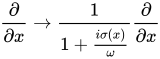
where is the angular frequency and is some function of x. Wherever is positive, propagating waves are attenuated because:

where we have taken a planewave propagating in the +x direction (for ) and applied the transformation (analytic continuation) to complex coordinates: , or equivalently . The same coordinate transformation causes waves to attenuate whenever their x dependence is in the form for some propagation constant k: this includes planewaves propagating at some angle with the x axis and also transverse modes of a waveguide.

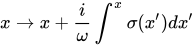
The above coordinate transformation can be left as-is in the transformed wave equations, or can be combined with the material description (e.g. the permittivity and permeability in Maxwell's equations) to form a UPML description. The coefficient σ/ω depends upon frequency—this is so the attenuation rate is proportional to k/ω, which is independent of frequency in a homogeneous material (not including material dispersion, e.g. for vacuum) because of the dispersion relation between ω and k. However, this frequency-dependence means that a time domain implementation of PML, e.g. in the FDTD method, is more complicated than for a frequency-independent absorber, and involves the auxiliary differential equation (ADE) approach (equivalently, i/ω appears as an integral or convolution in time domain).

Perfectly matched layers, in their original form, only attenuate propagating waves; purely evanescent waves (exponentially decaying fields) oscillate in the PML but do not decay more quickly. However, the attenuation of evanescent waves can also be accelerated by including a real coordinate stretching in the PML: this corresponds to making σ in the above expression a complex number, where the imaginary part yields a real coordinate stretching that causes evanescent waves to decay more quickly.

Limitations of perfectly matched layers

[edit]

PML is widely used and has become the absorbing boundary technique of choice in much of computational electromagnetism.[1] Although it works well in most cases, there are a few important cases in which it breaks down, suffering from unavoidable reflections or even exponential growth.

One caveat with perfectly matched layers is that they are only reflectionless for the exact, continuous wave equation. Once the wave equation is discretized for simulation on a computer, some small numerical reflections appear (which vanish with increasing resolution). For this reason, the PML absorption coefficient σ is typically turned on gradually from zero (e.g. quadratically) over a short distance on the scale of the wavelength of the wave.[1] In general, any absorber, whether PML or not, is reflectionless in the limit where it turns on sufficiently gradually (and the absorbing layer becomes thicker), but in a discretized system the benefit of PML is to reduce the finite-thickness "transition" reflection by many orders of magnitude compared to a simple isotropic absorption coefficient.[10]

In certain materials, there are "backward-wave" solutions in which group and phase velocity are opposite to one another. This occurs in "left-handed" negative index metamaterials for electromagnetism and also for acoustic waves in certain solid materials, and in these cases the standard PML formulation is unstable: it leads to exponential growth rather than decay, simply because the sign of k is flipped in the analysis above.[11] Fortunately, there is a simple solution in a left-handed medium (for which all waves are backwards): merely flip the sign of σ. A complication, however, is that physical left-handed materials are dispersive: they are only left-handed within a certain frequency range, and therefore the σ coefficient must be made frequency-dependent.[12][13] Unfortunately, even without exotic materials, one can design certain waveguiding structures (such as a hollow metal tube with a high-index cylinder in its center) that exhibit both backwards- and forwards-wave solutions at the same frequency, such that any sign choice for σ will lead to exponential growth, and in such cases PML appears to be irrecoverably unstable.[14]

Another important limitation of PML is that it requires that the medium be invariant in the direction orthogonal to the boundary, in order to support the analytic continuation of the solution to complex coordinates (the complex "coordinate stretching"). As a consequence, the PML approach is no longer valid (no longer reflectionless at infinite resolution) in the case of periodic media (e.g. photonic crystals or phononic crystals)[10] or even simply a waveguide that enters the boundary at an oblique angle.[15]

See also

[edit]

References

[edit]
[edit]
Revisions and contributorsEdit on WikipediaRead on Wikipedia
from Grokipedia
A perfectly matched layer (PML) is an artificial absorbing boundary condition employed in numerical simulations of wave propagation to truncate unbounded computational domains while minimizing reflections from outgoing waves, thereby simulating open-space conditions with high accuracy.[1] It achieves this by creating a layer with material properties that perfectly match the impedance of the adjacent medium, ensuring that waves incident normally are absorbed without reflection in the continuous case.[2] The PML concept was introduced by Jean-Pierre Bérenger in 1994 as a solution to longstanding challenges in simulating electromagnetic wave problems using finite-difference time-domain (FDTD) methods, where traditional absorbing boundaries like Mur's condition suffered from reflections, particularly for evanescent waves.[1] Bérenger's original formulation, published in the Journal of Computational Physics, demonstrated through theory and numerical experiments that PML outperforms prior techniques by reducing reflection errors to below -50 dB while requiring fewer computational resources.[1] This innovation stemmed from earlier work on split-field methods and complex coordinate stretching, building on ideas from Engquist and Majda's absorbing boundary conditions from the late 1970s.[2] In its foundational electromagnetic application, PML operates by splitting the electric and magnetic field components into auxiliary variables within the layer, introducing anisotropic conductivity that varies spatially to dampen waves exponentially without altering their propagation characteristics at the interface.[2] Subsequent formulations, such as the uniaxial PML and convolutional PML (CPML), extended this to frequency-domain methods and improved stability for broadband simulations by incorporating complex frequency-shifted parameters, achieving reflection coefficients as low as -200 dB in optimized setups.[2] These variants address limitations like numerical instabilities in discrete implementations, where coarse grids or grazing incidence can introduce minor reflections on the order of 10^{-4} or less.[2] Beyond electromagnetics, PML has been adapted for other wave equations, including acoustics and elastodynamics, where it serves as a non-reflecting boundary to model open domains in seismic simulations and sound propagation.[3] For instance, in acoustic models, PML absorbs pressure waves by mimicking perfectly absorbing media, enabling efficient finite element analysis in tools like COMSOL Multiphysics.[4] In elastic wave propagation, extensions like those proposed by Chew and Liu in 1996 apply PML to shear and compressional waves, reducing domain sizes by factors of 2 or more in practical engineering applications such as dam safety assessments.[3] Today, PML remains a cornerstone of computational physics software, including MEEP for photonic simulations, due to its versatility across isotropic, anisotropic, and dispersive media.[5]

Overview

Definition and Purpose

The perfectly matched layer (PML) is an artificial, non-physical absorbing boundary condition employed in numerical simulations of wave propagation to mimic unbounded domains. It consists of a thin layer of material parameters engineered such that outgoing waves are absorbed with theoretically zero reflection at the interface, making it suitable for solving wave equations including Maxwell's equations for electromagnetics, the Helmholtz equation for frequency-domain problems, and acoustic wave equations.[6][1] The primary purpose of PML is to truncate infinite or semi-infinite computational domains in finite-difference time-domain (FDTD) or other numerical methods, allowing simulations of open-space scenarios without the need for an excessively large grid. By placing the PML at the outer boundaries, it effectively absorbs radiating waves, reducing spurious reflections to negligible levels, particularly for plane waves incident at normal angles, thereby enabling accurate modeling of wave scattering, radiation, and propagation in practical engineering and scientific applications.[6][1] PML achieves this "perfect" absorption through a coordinate transformation that renders the impedance at the PML-free space interface identical to that of free space, ensuring no mismatch and thus no reflection for outgoing waves. This innovation, first introduced by Jean-Pierre Bérenger in 1994, directly addresses the shortcomings of earlier absorbing boundary conditions (ABCs), such as Mur's ABCs, which exhibit significant angle-dependent reflections for oblique incidences greater than about 30 degrees from the normal.[6][1][7]

Historical Development

The concept of the perfectly matched layer (PML) was first introduced by Jean-Pierre Bérenger in 1994 as an absorbing boundary condition for numerical simulations of electromagnetic wave propagation using the finite-difference time-domain (FDTD) method.[1] Bérenger's split-field formulation demonstrated near-perfect absorption of outgoing waves without reflections at the interface, addressing limitations of prior absorbing boundary conditions like Mur's ABC.[1] This seminal work, published in the Journal of Computational Physics, marked the inception of PML specifically tailored for electromagnetics, enabling efficient truncation of open-domain computational regions.[1] Building on Bérenger's approach, the uniaxial PML (UPML) formulation emerged in 1996, developed by Stephen D. Gedney and collaborators, which reformulated PML using anisotropic, lossy materials to generalize its applicability.[8] This variant, presented in IEEE Transactions on Antennas and Propagation, provided a more unified theoretical framework by incorporating complex coordinate stretching, making it compatible with frequency-domain methods and easier to implement in existing FDTD codes.[8] UPML's equivalence to the original split-field PML was rigorously shown, enhancing its adoption for simulations involving dispersive and lossy media.[8] By 1998, PML concepts began extending beyond electromagnetics to acoustic wave equations, with adaptations demonstrating effective absorption for scalar fields in computational acoustics.[9] Further generalizations to scalar wave equations and elastodynamics occurred in 1996, incorporating PML into velocity-stress formulations for seismic and mechanical wave simulations.[10] A significant advancement came around 2000 with the convolutional PML (CPML), introduced by J.A. Roden and S.D. Gedney, which improved time-domain stability and absorption efficiency through recursive convolution for complex frequency-shifted parameters.[11] Published in Microwave and Optical Technology Letters, CPML addressed late-time reflections in broadband simulations, becoming a standard for arbitrary media in FDTD applications.[11] These developments solidified PML as a cornerstone technique in computational wave physics.

Theoretical Basis

Principle of Perfect Matching

The perfectly matched layer (PML) achieves absorption without reflection by ensuring impedance matching at the interface between the computational domain and the absorbing layer. This matching condition is satisfied when the wave impedance in the PML equals that of the interior free-space domain, typically through the relation σ/ε=σ/μ\sigma / \varepsilon = \sigma^* / \mu, where σ\sigma is the conductivity, ε\varepsilon the permittivity, and μ\mu the permeability.[12] As a result, plane waves incident on the boundary at any angle and frequency experience zero reflection in theory, as the tangential components of the fields are continuous across the interface without generating backward-propagating waves. Inside the PML, artificial absorption is introduced via damping terms that modify the material properties, such as complex-valued permittivity and permeability or equivalent conductivities. These terms cause outgoing waves to attenuate exponentially as they propagate through the layer, preventing wrap-around effects in simulations of open domains. For plane waves propagating normal to the interface, the field amplitude decays according to exp(σds)\exp\left(-\int \sigma \, ds\right), where σ\sigma represents the absorption profile along the path ss.[12] This attenuation is controlled by grading the damping parameter σ\sigma to increase toward the outer boundary, optimizing absorption while minimizing computational overhead. Unlike physical absorbing materials, which rely on inherent dissipative properties and may introduce frequency-dependent reflections, the PML is a purely mathematical construct derived from coordinate transformations or field splitting in the governing equations. It has no physical counterpart and is valid exclusively within numerical discretization schemes, where it approximates perfect absorption for linear waves in lossless media.

Coordinate Transformation

The coordinate transformation in perfectly matched layers (PMLs) is a frequency-domain approach that stretches the spatial coordinates into the complex plane to achieve absorption without reflections at the interface. This method replaces the real coordinate xx with a complex stretched coordinate x~=xsx(x)dx\tilde{x} = \int^x s_x(x') \, dx', where the stretching function is defined as $ s_x = 1 + i \frac{\sigma_x(x)}{\omega} $, with σx(x)\sigma_x(x) being a position-dependent conductivity profile that is zero in the computational domain and increases gradually within the PML region to promote attenuation.[13][6] Under this transformation, partial derivatives in the wave equation are modified such that $ \frac{\partial}{\partial x} \to \frac{1}{s_x} \frac{\partial}{\partial x} = \frac{1}{1 + i \sigma_x / \omega} \frac{\partial}{\partial x} $, effectively scaling the spatial gradients in a frequency-dependent manner while leaving the temporal derivative unchanged. This alteration is applied component-wise to the gradient and curl operators in Maxwell's equations or analogous wave equations, ensuring the transformed equations remain formally identical to the original ones but evaluated in the stretched coordinates.[13][6] To illustrate the attenuation mechanism, consider an incident plane wave $ e^{i(kx - \omega t)} $ propagating along the xx-direction. Upon analytic continuation into the complex coordinate, it becomes $ e^{i(k \tilde{x} - \omega t)} = e^{i(kx - \omega t)} e^{-(k/\omega) \int^x \sigma_x(x') , dx'} $, where the additional exponential term introduces purely decaying behavior without altering the phase velocity or introducing dispersion. This results in exponential decay of the wave amplitude as it penetrates the PML, with the decay rate controlled by the integral of the conductivity profile, while maintaining the impedance matching at the boundary to prevent reflections.[6] In the frequency domain, the stretching $ s_x = 1 + i \sigma_x / \omega $ can be generalized to anisotropic media by allowing direction-dependent conductivities σx,σy,σz\sigma_x, \sigma_y, \sigma_z, leading to tensorial forms of the permittivity and permeability that enable independent absorption in each coordinate direction. This formulation preserves the analytic structure of the original wave equation, ensuring that solutions remain valid across the PML interface without spurious reflections, as the transformation is continuous and matches the free-space impedance.[13][6]

PML Formulations

Berenger's Split-Field Method

Berenger's split-field method, introduced in 1994, forms the foundational formulation of the perfectly matched layer (PML) for absorbing electromagnetic waves in time-domain numerical simulations, particularly within the finite-difference time-domain (FDTD) framework. This approach achieves perfect matching at the interface between the computational domain and the absorbing layer by artificially decomposing the electromagnetic fields into sub-components, each subjected to direction-specific damping that mimics coordinate stretching without introducing reflections for any angle of incidence or frequency. The core of the method involves splitting each transverse field component into auxiliary parts aligned with the transverse coordinates, enabling independent absorption in those directions. For instance, in a 3D PML region, the electric field component parallel to one axis, such as ExE_x, is expressed as Ex=Ex1+Ex2E_x = E_{x1} + E_{x2}, where Ex1E_{x1} and Ex2E_{x2} correspond to damping governed by conductivities in the y- and z-directions, respectively. Similar splitting applies to other transverse components like Ey=Ey1+Ey3E_y = E_{y1} + E_{y3} and Ez=Ez2+Ez3E_z = E_{z2} + E_{z3}, while the normal component ExE_x remains unsplit in single-interface layers but follows the decomposition in corners. The magnetic fields undergo analogous splitting, such as Hy=Hy1+Hy3H_y = H_{y1} + H_{y3}. These decompositions lead to modified Maxwell's equations with auxiliary damping terms, implemented in time domain as update equations for FDTD. A representative equation for one split component is
Ex1t=σyϵEx1+1ϵ(HzzHyy), \frac{\partial E_{x1}}{\partial t} = -\frac{\sigma_y}{\epsilon} E_{x1} + \frac{1}{\epsilon} \left( \frac{\partial H_z}{\partial z} - \frac{\partial H_y}{\partial y} \right),
with a parallel equation for Ex2E_{x2} incorporating σz\sigma_z instead of σy\sigma_y, ensuring separate transverse damping while preserving the total field curl structure. This formulation is inherently non-Maxwellian, as the field splitting creates a non-physical anisotropic lossy medium that deviates from standard Maxwell's equations by decoupling components artificially; nonetheless, it exactly recovers the original Maxwellian form in lossless regions where conductivities vanish, maintaining equivalence and stability. The method's simplicity on Cartesian grids facilitates straightforward FDTD implementation with minimal additional variables—reducing the total from 12 to 10 in 3D PML regions—and delivers near-perfect absorption, with numerical reflections below -80 dB for plane waves across all angles in both 2D and 3D electromagnetic simulations.

Uniaxial PML (UPML)

The Uniaxial Perfectly Matched Layer (UPML) represents a 1996 generalization of the PML concept, reformulating the absorbing boundary as a lossy uniaxial anisotropic medium that preserves the standard form of Maxwell's equations.[14] This approach introduces diagonal permittivity ([15]) and permeability (μ\boldsymbol{\mu}) tensors incorporating complex coordinate-stretching factors sxs_x, sys_y, and szs_z along the principal axes, enabling effective absorption of waves without splitting the fields as in earlier methods.[14] By modeling the PML region with these anisotropic material properties, the formulation ensures impedance matching at interfaces, minimizing reflections for both normal and oblique incidences.[14] The core of the UPML lies in the constitutive relations between the electric displacement D\mathbf{D}, electric field E\mathbf{E}, magnetic flux density B\mathbf{B}, and magnetic field H\mathbf{H}:
D=ϵ0ϵPMLE,B=μ0μPMLH, \mathbf{D} = \epsilon_0 \boldsymbol{\epsilon}^{\text{PML}} \cdot \mathbf{E}, \quad \mathbf{B} = \mu_0 \boldsymbol{\mu}^{\text{PML}} \cdot \mathbf{H},
where ϵ0\epsilon_0 and μ0\mu_0 are the free-space permittivity and permeability, respectively.[14] The relative tensors ϵPML\boldsymbol{\epsilon}^{\text{PML}} and μPML\boldsymbol{\mu}^{\text{PML}} are diagonal, with components defined using the stretching factors:
ϵx=syszsx,ϵy=sxszsy,ϵz=sxsysz, \epsilon_x = \frac{s_y s_z}{s_x}, \quad \epsilon_y = \frac{s_x s_z}{s_y}, \quad \epsilon_z = \frac{s_x s_y}{s_z},
and similarly for the permeability tensor components (with μx=ϵx\mu_x = \epsilon_x, etc., for isotropic media matching).[14] In the frequency domain, the stretching factors take the form si=1+iσi/ωs_i = 1 + i \sigma_i / \omega (for i=x,y,zi = x, y, z), where σi\sigma_i is a position-dependent conductivity profile that increases toward the outer boundary to enhance absorption, and ω\omega is the angular frequency.[14] These factors effectively stretch the spatial coordinates in the complex plane, damping outgoing waves exponentially while maintaining perfect matching at the PML interface.[14] A key advantage of the UPML is its retention of the canonical structure of Maxwell's equations, which facilitates implementation in diverse numerical solvers beyond time-domain methods, such as frequency-domain finite element methods (FEM).[14] This Maxwellian formulation also improves handling of oblique incidence and curved boundaries compared to the original split-field PML, achieving reflection coefficients below -60 dB in numerical validations for 3D problems.[14] Unlike the split-field approach, which decouples field components and can introduce discretization instabilities, the UPML avoids such splitting, enhancing stability and computational efficiency.[14]

Convolutional PML (CPML)

The convolutional perfectly matched layer (CPML) represents an advanced time-domain formulation of the PML designed to enhance broadband absorption in numerical simulations, particularly within the finite-difference time-domain (FDTD) method. It approximates the frequency-dependent complex coordinate stretching inherent in PML formulations through recursive time-domain convolutions, avoiding the need for field splitting and enabling efficient implementation for arbitrary media, including lossy, dispersive, or anisotropic materials. This approach leverages auxiliary variables to capture the convolutional history of the fields, effectively modeling the inverse of the stretching function in the time domain. For instance, in the frequency domain, the auxiliary variable ψ\psi can be expressed as ψ(ω)=κ1e(α+iω)/κE(ω)\psi(\omega) = \kappa^{-1} e^{-(\alpha + i\omega)/\kappa} E(\omega), where κ\kappa, α\alpha, and the exponent relate to the complex frequency-shifted (CFS) parameters that ensure causality and improved absorption across a wide frequency range; in the time domain, this translates to a convolution integral ψ(t)=0tg(tτ)E(τ)dτ\psi(t) = \int_0^t g(t - \tau) E(\tau) \, d\tau, with g(t)g(t) being the inverse Fourier transform of the stretching factor.27:5%3C334::AID-MOP14%3E3.0.CO;2-A) The core of CPML lies in its field update equations, which incorporate these convolutional terms via auxiliary memory variables for computational efficiency. In FDTD, the electric field update, for example along the x-direction, takes the form
Exn+1=Exn+Δtϵ0[1κyHzyn+1/21κzHyzn+1/2+ψhzyn+1/2ψhyzn+1/2], E_x^{n+1} = E_x^n + \frac{\Delta t}{\epsilon_0} \left[ \frac{1}{\kappa_y} \frac{\partial H_z}{\partial y} \bigg|^{n+1/2} - \frac{1}{\kappa_z} \frac{\partial H_y}{\partial z} \bigg|^{n+1/2} + \psi_{h_{zy}}^{n+1/2} - \psi_{h_{yz}}^{n+1/2} \right],
where ψhzy\psi_{h_{zy}} and similar auxiliaries are updated recursively as
ψhzyn+1/2=geyψhzyn1/2+bey(Hzyn+1/2Hzyn1/2), \psi_{h_{zy}}^{n+1/2} = g_{e_y} \psi_{h_{zy}}^{n-1/2} + b_{e_y} \left( \frac{\partial H_z}{\partial y} \bigg|^{n+1/2} - \frac{\partial H_z}{\partial y} \bigg|^{n-1/2} \right),
with coefficients beyb_{e_y} and geyg_{e_y} derived from the CFS parameters to approximate the exponential decay in the convolution kernel. These coefficients are tuned for polynomial grading of the conductivity σ\sigma, typically σ(ρ)=σmax(ρ/δ)m\sigma(\rho) = \sigma_{\max} (\rho / \delta)^m where ρ\rho is the distance into the PML, δ\delta its thickness, and mm (often 3 or 4) controls the profile to minimize reflections at normal incidence while maintaining stability. This grading ensures smooth absorption without abrupt interfaces that could introduce artifacts.27:5%3C334::AID-MOP14%3E3.0.CO;2-A)[2] CPML offers significant advantages over earlier PML variants, particularly in reducing late-time ringing and reflections for wideband signals in FDTD simulations, achieving reflection coefficients below -100 dB across decades of frequency for typical configurations. Its stability for evanescent waves and broadband sources stems from the CFS incorporation, which shifts poles away from the real axis to prevent instability, making it suitable for long-duration transient analyses. Developed by Roden and Gedney in 2000 as an efficient realization of the CFS-PML, CPML has become a standard absorbing boundary in modern electromagnetic simulation software, such as CST Studio Suite, due to its versatility and low computational overhead—requiring only a few additional auxiliary variables per field component.27:5%3C334::AID-MOP14%3E3.0.CO;2-A)[16]

Implementation in Numerical Methods

In Finite-Difference Time-Domain (FDTD)

In finite-difference time-domain (FDTD) simulations, perfectly matched layers (PMLs) are integrated by surrounding the computational domain with absorbing regions typically 8 to 12 grid cells thick to minimize reflections from artificial boundaries while balancing computational cost and accuracy. These layers are placed adjacent to the outer edges of the Yee grid, ensuring that outgoing waves enter the PML without abrupt interfaces that could introduce scattering. The conductivity profile σ within the PML is often graded using a quadratic or higher-order polynomial function to smoothly increase absorption from the inner edge (σ = 0) to the outer edge, preventing late-time instabilities; a common choice is σ(z) = σ_max (z / d)^m, where d is the PML thickness, z is the distance into the layer, m is the grading order (typically 3), and σ_max is the maximum conductivity given by σ_max = (m+1) ln(1/R) / (150 π Δt), with R as the target reflection coefficient (e.g., 10^{-6}) and Δt the time step.[17] This scaling ensures the PML impedance matches free space at the interface while providing sufficient damping deeper in the layer. On the staggered Yee grid, PML implementation modifies the standard FDTD update equations for electric and magnetic fields near the boundaries by incorporating position-dependent damping terms derived from the PML parameters (σ, κ, and α in advanced formulations). These modifications adjust the finite-difference approximations to account for anisotropic absorption, effectively stretching coordinates in the PML region without altering the core leapfrog time-stepping scheme; for instance, the electric field update includes multiplicative factors involving σ and auxiliary memory variables for convolutional variants. The convolutional PML (CPML) is preferred in modern FDTD solvers for its superior numerical stability, particularly in handling evanescent waves and late-time reflections, compared to earlier split-field or uniaxial PMLs; typical parameters include m = 3 for polynomial grading and κ ranging from 1 (no stretching) to 10 for enhanced absorption in high-contrast scenarios.[17] With proper parameter scaling, such as the aforementioned σ_max for normal incidence, FDTD simulations achieve reflection coefficients |R| below 10^{-6} at the PML interface, enabling accurate modeling of wave propagation over thousands of time steps without significant boundary artifacts. This performance is verified in benchmarks for plane-wave absorption, where CPML outperforms basic PML by reducing residual reflections by orders of magnitude in broadband applications.

In Finite Element Methods (FEM)

In finite element methods (FEM), the perfectly matched layer (PML) is integrated by augmenting the computational mesh with a surrounding layer of elements in which the governing partial differential equations are formulated using complex stretched coordinates. This extension transforms the variational or weak form of the equations to incorporate absorption within the PML domain, ensuring outgoing waves decay exponentially without reflections at the physical-PML interface. The PML region contributes to the global stiffness matrix through domain integration, effectively simulating an open boundary by damping waves as they propagate into the layer.[6] For the scalar Helmholtz equation (2+k2)u=0(\nabla^2 + k^2) u = 0, the PML modifies the weak formulation to ΩΩPMLu(s1v)k2uvdx=Ωfvdx\int_{\Omega \cup \Omega_{\text{PML}}} \nabla u \cdot (s^{-1} \nabla v) - k^2 u v \, dx = \int_{\Omega} f v \, dx, where Ω\Omega is the physical domain, ΩPML\Omega_{\text{PML}} is the PML domain, ss is the diagonal complex stretching tensor derived from coordinate transformation, and vv is a test function; this form is discretized using standard Galerkin FEM, leading to a complex-valued linear system.[18] The absorption is achieved via the integration over ΩPML\Omega_{\text{PML}}, where the imaginary part of ss induces decay proportional to the absorption profile, typically quadratic or cubic in the PML thickness.[19] Anisotropy in PML formulations, such as the uniaxial PML (UPML), is handled by representing the layer as an artificial anisotropic medium with position-dependent permittivity ϵ\epsilon and permeability μ\mu tensors, which are incorporated directly into the element stiffness and mass matrices during assembly. For electromagnetic problems, these tensors arise from the stretched coordinates and ensure impedance matching; the stiffness matrix for a vector field element then involves terms like e(×Ni)(μ1×Nj)dV\int_e (\nabla \times \mathbf{N}_i) \cdot (\mu^{-1} \nabla \times \mathbf{N}_j) \, dV, where Ni\mathbf{N}_i are basis functions and μ1\mu^{-1} is the inverse permeability in the PML.[2] This approach preserves the structure of standard FEM codes, requiring only material property modifications in the PML elements.[20] PML in FEM is well-suited for unstructured meshes, enabling flexible geometries, and excels in frequency-domain analyses where implicit solvers handle the resulting indefinite systems efficiently. However, near curved PML interfaces, the analytic coordinate stretching can induce mesh distortion, leading to poorly conditioned elements and increased numerical dispersion or reflections; this is particularly pronounced in low-order meshes, often necessitating higher-order curvilinear elements or locally conformal PML mappings to maintain accuracy.[21] Practical implementations include the commercial software COMSOL Multiphysics, which employs UPML in its FEM solver for 3D electromagnetic scattering simulations, such as antenna radiation patterns, achieving reflection coefficients below -40 dB with 8-10 PML layers. Similarly, the open-source deal.II library supports PML via complex material coefficients in its FEM framework, as demonstrated in tutorials for 3D Helmholtz and Maxwell problems.[22][23]

Applications

Electromagnetic Simulations

Perfectly matched layers (PMLs) are widely employed in electromagnetic simulations to truncate computational domains while minimizing spurious reflections, enabling accurate modeling of open structures such as antennas, photonic devices, and metamaterials by solving Maxwell's equations. In antenna design, PMLs facilitate the computation of radiation patterns by absorbing outgoing waves, allowing simulations of far-field behavior without infinite domains. For instance, the finite-difference time-domain (FDTD) method with convolutional PML (CPML) has been used to analyze broadband antenna impedance, such as in ultra-wideband (UWB) microstrip antennas, where it provides precise return loss predictions across a wide frequency range by effectively damping transient fields.[24] In photonics, PMLs are crucial for simulating periodic structures like photonic crystals, where they absorb Bloch modes at the boundaries to compute band structures and defect modes accurately. This is particularly important for evanescent waves in subwavelength features, as standard PMLs can be modified to enhance absorption of non-propagating fields, ensuring reliable transmission spectra in nanoscale waveguides. Similarly, for scattering problems involving dielectric objects, PMLs enable efficient full-wave simulations of plane-wave interactions, capturing near-field effects without boundary artifacts; hybrid finite element-boundary integral methods incorporating PMLs have demonstrated high accuracy for buried dielectric scatterers.[25][26][27] PML implementations are integral to commercial and open-source tools for these applications. In CST Microwave Studio, PML boundaries are standard for open-radiation problems in antenna and microwave simulations, supporting accurate far-field calculations with low reflection errors. The open-source MEEP FDTD package relies on PMLs for broadband electromagnetic modeling, including photonic and metamaterial structures, where PML thickness is tuned to half the longest wavelength for optimal absorption. In finite element methods (FEM), uniaxial PML (UPML) is applied to eigenvalue problems in waveguides, truncating the domain to solve for propagation modes while maintaining numerical stability.[28][29][30] A representative example is the simulation of plane-wave absorption in plasmonic solar cells, where PMLs achieve reflection errors below 0.1% by layering multiple absorbing regions to handle broadband incidence, enabling precise evaluation of efficiency enhancements from subwavelength nanostructures.[31]

Acoustic and Elastic Wave Propagation

The perfectly matched layer (PML) has been extended to scalar acoustic wave propagation, where it effectively absorbs pressure waves by incorporating complex coordinate stretching into the wave equation. This adaptation modifies the Laplacian operator to a stretched form, enabling near-perfect absorption without significant reflections for waves incident normally or at oblique angles. The approach is particularly valuable in simulations of room acoustics, where PML layers surround computational domains to mimic open boundaries, and in ultrasound modeling, allowing accurate prediction of wave scattering in medical imaging applications. An early formulation for computational acoustics was developed by evaluating PML performance in absorbing radiated and scattered acoustic waves, demonstrating reflection coefficients below -50 dB for a wide range of incidence angles.[9] For elastic wave propagation, PML formulations address the vector nature of the equations, distinguishing between compressional (P) and shear (S) waves through split-field methods or anisotropic damping tensors. In two-dimensional P-SV problems, fields are decoupled into scalar potentials for longitudinal and transverse components, with PML applied separately to ensure absorption of both wave types. In three dimensions, anisotropic PML media simulate the required damping while preserving the elastic constitutive relations. These extensions are crucial for seismic modeling, where PML boundaries prevent artificial reflections from contaminating wavefield simulations in heterogeneous media. A seminal implementation for the second-order elastic wave equation used a split-field PML, achieving absorption efficiencies comparable to electromagnetic cases, with applications to global seismology.[32] Recent advancements include a 2022 reflectionless discrete PML tailored for acoustic wave propagation, which eliminates numerical reflections at the interface by matching the discrete wave operator exactly, improving stability in finite-difference simulations of seismic events. For acoustics, a 2025 stable decoupled PML formulation for three-dimensional problems employs nodal discontinuous Galerkin methods, ensuring long-time stability through optimized damping profiles and energy estimates. In practice, PML is integrated into the SPECFEM software package for earthquake wave propagation, where convolutional PML layers at domain edges absorb outgoing P- and S-waves, enabling accurate modeling of rupture dynamics over large scales without boundary artifacts.[33][34][35]

Other Domains

In quantum mechanics, perfectly matched layers (PMLs) have been adapted to simulate open quantum systems by absorbing outgoing particles in solutions to the Schrödinger equation, enabling efficient modeling of unbound or scattering scenarios without reflections at artificial boundaries. This approach typically employs complex absorbing potentials (CAPs) integrated into the Hamiltonian, such as $ H_{\text{eff}} = H - i \Gamma $, where $ \Gamma \geq 0 $ represents the absorption operator, to mimic PML damping in the Fock space of many-body systems. By transitioning probability density from an N-particle subspace to an (N-1)-particle subspace via Lindblad master equations, PML-like conditions preserve the dynamics of the remaining system while minimizing backscattering, as demonstrated in simulations of particle loss in dynamical many-body quantum processes.[36] In geophysics and seismology, PMLs are incorporated into finite-volume methods to handle boundary absorption in simulations of fault dynamics and earthquake rupture propagation, allowing for accurate modeling of wave interactions in complex, unbounded domains like the Earth's crust. These implementations couple finite-volume schemes with PML damping to suppress spurious reflections from computational boundaries, particularly in velocity-stress formulations using time-staggered schemes like the Newmark method, which enhance stability during dynamic rupture events.[37] PMLs have also been generalized to non-wave problems, such as parabolic equations modeled by the heat and advection-diffusion equations, through analytic continuation of kernel functions or coordinate stretching, enabling their use in systems like groundwater flow where only decaying modes are present. In these contexts, PMLs accelerate solution decay exponentially with damping parameters, outperforming simpler boundary conditions in finite-element discretizations and providing reflection coefficients that are independent of viscosity or advection terms. A notable recent advancement involves integrating PMLs with Gabor-enhanced physics-informed neural networks (Gabor-PINNs) for fast seismic inversion in 2025, where the PML formulation in a custom Gabor coordinate system improves convergence and accuracy on complex velocity models like Marmousi, reducing mean absolute errors significantly compared to standard PINNs without increasing trainable parameters.[38][39]

Limitations and Improvements

Common Limitations

Despite its theoretical perfection in the continuous domain, the perfectly matched layer (PML) exhibits numerical reflections when discretized in methods such as finite-difference time-domain (FDTD), arising from approximations in the wave equation solution. These reflections manifest as late-time ringing in time-domain simulations, where residual waves persist and interfere after the primary signal has passed. Additionally, reflection errors are angle-dependent, becoming pronounced at grazing incidence angles near 90 degrees due to reduced effective absorption along the interface normal. Without specific optimizations, such as careful parameter tuning, these numerical reflections typically reach levels around 10310^{-3}.[6][4] PML implementations can become unstable in certain media, particularly those with negative refractive indices like metamaterials, where backward-propagating waves—characterized by opposing phase and group velocities—lead to exponential blow-up of fields within the PML region. This instability stems from the dispersive nature of such materials, where the PML's coordinate stretching fails to properly damp the anomalous wave behavior, resulting in unphysical growth rather than absorption. Similar issues occur with backward waves in plasmas or other exotic media, invalidating the standard PML formulation.[40] The PML assumption of analytic continuation breaks down in periodic or spatially varying structures along the PML direction, rendering it ineffective for accurate absorption. For instance, in waveguides supporting oblique modes, the combination of non-normal incidence and material inhomogeneity causes significant reflections, as the PML cannot maintain its matching properties. Furthermore, PML fails to absorb evanescent waves properly, instead introducing unwanted oscillations without sufficient decay, which is particularly problematic near singularities or in quasi-periodic media where alternative formulations like q-PML may be required.[6]

Recent Advances and Mitigations

In 2022, the reflectionless discrete perfectly matched layer (RD-PML) was developed for acoustic wave simulations, leveraging discrete complex analysis to eliminate numerical reflections at PML interfaces and reduce grid dispersion artifacts. This approach uses a constant attenuation profile, enabling effective absorption with fewer layers compared to traditional PMLs; for instance, a 10-layer RD-PML outperformed a 20-layer conventional PML in heterogeneous models by achieving near-zero reflections for both propagating and grazing waves.[33] A 2025 advancement introduced a stable decoupled PML formulation for 3D acoustic wave equations discretized via the nodal discontinuous Galerkin method, addressing instabilities at PML edges and corners by independently applying damping in each Cartesian direction. This reduces auxiliary variables to three per direction, ensuring long-time stability up to 10^6 time steps, with exponential convergence rates of approximately -1.2 in PML width and optimal damping profiles minimizing reflections for grazing incidences.[34] Also in 2025, PML integration within Gabor-enhanced physics-informed neural networks (PINNs) enabled fast hybrid machine learning-numerical simulations for geophysical wavefield modeling, particularly aiding inversion tasks by incorporating Gabor basis functions to capture oscillatory wave behaviors. The PML, implemented as a 0.5 km thick boundary layer, effectively suppressed edge reflections in the Marmousi velocity model, allowing rapid convergence (within 7,000 epochs) and high accuracy without additional trainable parameters, thus facilitating efficient full-waveform inversion in complex media.[39] Recent refinements to the complex frequency-shifted PML (CFS-PML) have enhanced absorption of evanescent modes in second-order wave equations, with a 2023 high-order formulation improving attenuation for low-frequency and evanescent waves through optimized pole configurations in the spectral-element time-domain method. This mitigates late-time instabilities common in evanescent-dominated scenarios, such as near-grazing propagations.[41] For periodic media, quasi-PML variants have seen limited but targeted updates,

References

User Avatar
No comments yet.

