Hubbry Logo
LeapfrogLeapfrogMain
Open search
Leapfrog
Community hub
Leapfrog
logo
8 pages, 0 posts
0 subscribers
Be the first to start a discussion here.
Leapfrog
Leapfrog
from Wikipedia
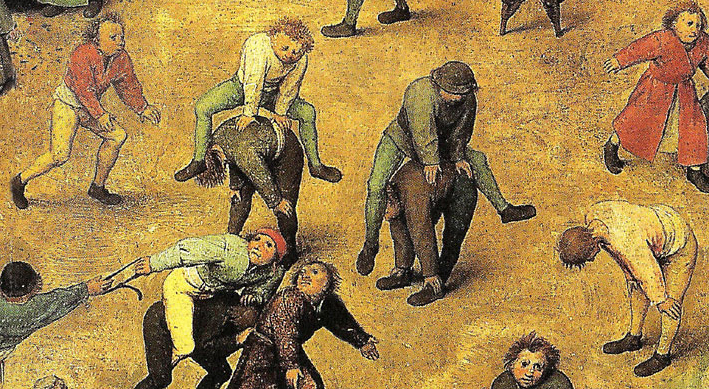
Children playing leapfrog in Bruegel's Children's Games
A game of leapfrog at a girls' school in Mussoorie, India

Leapfrog is a children's game of physical movement of the body in which players vault over each other's stooped backs. The term has also become a verb describing any situation in which a person or entity at the rear of a line advances directly to the front.

History

[edit]

Games of this sort have been called by this name since at least the late sixteenth century.[1]

Gameplay

[edit]

The first participant remains still after placing their hands on their own knees while bending forward, a move known as giving a back.[citation needed] The next player swiftly dashes forward, briefly plants their hands on the first player's back for support (while straddling legs wide apart) while hoping to vault over the first player. This jumper, upon landing, advances a few steps ahead and then gives a back by vaulting over in the next participant in the same manner as the first player. (Meanwhile, the first player continues giving a back.) A third player leaps over the first two participants and also gives a back by vaulting over. A fourth jumper would leap over all previous jumpers successively. Additional players can join in the same way: leaping over others and then vaulting over (giving a back) to be jumped over by the next. The number of participants is not fixed. When all players are eventually stopped, the last person in line begins leaping over all the others in turn. The length of gameplay and determining the winner (if any) is not standardized; participants decide among themselves.

Variations

[edit]
Eadweard Muybridge, Boys playing Leapfrog (1883–86)

The French version of this game is called saute-mouton (literally "leapsheep"), and the Romanian is called capra ("mounting rack" or "goat"). In India it is known as Aar Ghodi Ki Par Ghodi in Hindi (meaning horseleap). In Italy the game is called la cavallina (i.e. small or baby female horse). In Dutch it is called bokspringen (literally goatjumping; a bok is a male goat) or haasje-over (literally hare-over).[citation needed]

In China this game is known as [citation needed] leap goat ("跳山羊"), which is played in pairs. One player, acting as "the goat", leaps over the back of the other player, who plays the role of "the rock/mountain". Then they switch roles, and "the rock" rises a bit each time they switch. Both players continue playing until one "goat" fails leaping "the rock/mountain" as the result of its rising.

A line of half-naked prisoners performing "leap frog", under supervision of one of the Kapos. In the background the main gate to Mauthausen as well as two wooden barracks are visible.
At the Mauthausen concentration camp, forced leapfrogging and other greuling physical activity was a method of "wearing the inmates down".

In the Filipino culture, a similar game is called luksóng báka (literally "leap cow"), in which the "it" rests his hands on his knees and bends over, and then the other players —in succession—place their hands on the back of the “it” and leaps over by straddling legs wide apart on each side; whoever's legs touch any part of the body of the “it” becomes the next “it.”

In the Korean and Japanese versions (말뚝박기 lit. "piledriving" and 馬跳び うまとび umatobi, lit. "horseleap", respectively), one player 'leaps' over the backs of the other players who stoop close enough to form a continuous line, attempting to cause the line to collapse under the weight of the riders.[citation needed]

At times, leapfrog's demanding physical exertion was coercively forced upon unwilling adults, as happened at some Nazi German camps. Bundesarchiv photos document such activity having occurred at Mauthausen concentration camp and other sites.

References

[edit]
[edit]
Revisions and contributorsEdit on WikipediaRead on Wikipedia
from Grokipedia

Leapfrog is a children's game in which players take turns vaulting over the stooped backs of others who bend forward from the waist with hands on knees. The leaping player places hands on the back of the bent player for support before jumping over, often in a line where each jumper becomes the next base. This physical activity emphasizes agility, coordination, and balance, commonly played outdoors in groups. Variants include competitive versions where players attempt to leap over multiple bases in sequence or incorporate rules for elimination based on failed jumps. The game derives its name from the frog-like leaping motion and has been documented in English-speaking cultures since the late 16th century.

Historical Development

Early Origins and References

The game of leapfrog is visually attested in Pieter Bruegel the Elder's painting Children's Games (1560), which depicts children performing the characteristic vaulting over stooped figures amid over two hundred other pastimes, suggesting its prevalence in mid-16th-century Flemish childhood activities. This artwork provides one of the earliest documented representations of the activity in European art, illustrating it as part of unstructured outdoor play without formal rules. In English literature, the earliest textual references to leapfrog emerge in the late 16th century, coinciding with the . William Shakespeare's Henry V (c. 1599) alludes to the game in Act V, Scene II, where King Henry jests, "If I could win a lady at leap-frog, or by vaulting into my saddle," indicating familiarity with vaulting over bent bodies as a recognizable children's diversion. Such mentions reflect its integration into Tudor recreational culture, akin to other physical games like . The term "leapfrog" derives from the compound words leap and frog, first recorded between 1590 and 1600, evoking the arched, bounding motion of a frog's jump applied to human play. However, linguistic variations across Europe highlight differing animal analogies for the crouching player: Dutch bockspringen (buck-jumping), Italian la cavallina (little mare), and similar terms implying goats or horses rather than frogs, underscoring the game's roots in mimetic imitation predating the specific English . These attestations position leapfrog as a longstanding element of European folk play, distinct from organized sports and rooted in spontaneous physical expression.

Evolution in Modern Eras

![Boys playing leapfrog by Eadweard Muybridge, 1883-1886][float-right] In the 19th century, leapfrog became a staple of playground culture in England and the United States, often depicted in illustrations of Victorian schoolboys engaging in the activity during breaks. Educational and recreational contexts emphasized such games for physical vigor among children, with engravings showing groups vaulting over stooped peers in schoolyards. By the early 20th century, a 1904 survey of New York City street games ranked leapfrog among the top ten popular activities for immigrant children, reflecting its persistence in urban environments despite growing city densities. During the , leapfrog integrated into formal school and youth organizations, appearing in Boy Scout manuals as relay variants to promote and in structured settings. Recess periods in American schools commonly featured the game as a free-play option, maintaining its role in unstructured childhood exercise amid expanding systems. Urbanization constrained open spaces, prompting adaptations like confined versions, yet the game's inherent simplicity ensured minimal rule alterations, allowing continuity from informal play to organized formats.

Core Gameplay Mechanics

Fundamental Rules

Leapfrog is played with a minimum of two participants, though additional players extend the sequence of actions. One player serves as the "back," crouching low to the ground with hands placed on or near the knees to create a firm, level platform along the upper back and shoulders. The leaper positions hands flat on this platform—typically the shoulders or upper back—for support and vaults forward over the back, landing on both feet ahead without additional contact to the crouching player. The game proceeds in turns, with the leaper assuming the back position after a successful vault, prompting the former back to then leap over. This alternation continues sequentially until players experience or mutually decide to conclude, fostering a cycle of roles without a fixed endpoint. No is required, relying solely on participants' body weight for and support, and the activity demands open, unobstructed space suitable for safe movement.

Player Dynamics and Techniques

In leapfrog, the leaper generates through a brief run-up toward the crouched base, then places hands flat on the base's upper back or shoulders to pivot and elevate the body, extending the legs fully to clear the without lower-body contact. This technique relies on coordinated upper-body push and lower-body swing, converting horizontal speed into vertical lift for efficient vaulting. The base maintains stability by bending at the hips with knees slightly flexed and feet shoulder-width apart, placing hands on or near the knees to lower the center of gravity and engage core and muscles against the leaper's force. This posture distributes pressure evenly, minimizing wobble and enabling multiple sequential leaps without collapse. In multi-player setups, participants align in a single file, with the lead player crouching as the initial base while trailing players leap over in order; each successful leaper advances to the line's end, rotating roles to ensure equitable and sustained engagement. This flow encourages endurance as the chain lengthens, with coordination emerging from synchronized timing between leapers' approaches and the base's readiness. The interplay prioritizes iterative practice over rivalry, as players refine vaults through immediate feedback from successes or minor contacts, building interpersonal trust and rhythmic flow absent formal scoring.

Variations and Adaptations

Traditional Forms

One traditional variant, often observed in 19th-century British playgrounds, features the stooping player widening their stance with legs spread to elevate the back's height and complicate the leaper's vault. This adjustment demands greater leg strength and coordination from the leaper compared to the standard crouched form. Regional naming conventions incorporate local without modifying core , such as designating the bent player a "" in early American play, a "sheep" in , a "goat" in , , and , a "" in , or a "cow" in the . These terms reflect cultural linguistic preferences rather than substantive rule differences, with documentation tracing back to at least the late 1500s across and beyond. Chain leapfrog extends the format by arranging multiple players in a sequential line of stooped positions, enabling the trailing player to vault over the entire group before rejoining at the head. This collective progression, noted in Korean and Japanese traditions as well as early 20th-century American folk practices, amplifies group participation and sequential challenge.

Regional and Contemporary Twists

In the , a Southeast Asian variant known as modifies traditional leapfrog by having the base player form a "cow" pose with bent legs and back arched, over which leapers vault while the pair performs rhythmic claps or chants to synchronize jumps and increase difficulty levels progressively. This adaptation integrates performative and auditory elements, fostering group coordination beyond mere physical vaulting, as observed in descriptions of indigenous Filipino children's play. Contemporary school programs in Western physical education have introduced inclusive twists, such as scaling vault heights or allowing assisted leaps for participants with varying physical capacities, aiming to broaden participation in line with frameworks. These modifications, implemented since the early in U.S. and European curricula, prioritize but can attenuate the game's core demands for explosive power and proprioceptive feedback, potentially undermining gains in neuromuscular coordination that require unassisted full-range exertion. Digital simulations, including motion-tracking apps and hybrid systems like LeapFrog's LeapMove, which prompt children to mimic leaping motions via console-guided prompts for ages 4-7, emerged in the as attempts to virtualize the activity. However, empirical comparisons in research demonstrate that such screen-mediated approximations yield inferior outcomes in transfer and spatial awareness compared to direct physical enactment, as virtual interfaces disrupt the causal loop of real-time haptic and vestibular input essential for . Physical variants thus retain causal advantages for developing integrated sensorimotor schemas, unmediated by algorithmic intermediaries. ![Leapfrog in Mussoorie][float-right]

Physical and Developmental Benefits

Health and Fitness Gains

Leapfrog engages participants in repeated explosive lower-body movements, such as squatting, jumping, and vaulting, which strengthen the , glutes, calves, and core while elevating to enhance cardiovascular . These plyometric actions mimic patterns that build power and , as seen in similar hopping and jumping exercises that demand controlled landings and rapid directional changes. In children, such gross motor activities contribute to overall by promoting anaerobic capacity without requiring specialized equipment. The game's demands on body positioning and spatial navigation foster —the sense of body position in space—and balance through dynamic stability challenges during vaults and recoveries. Hopping and leaping variants, integral to leapfrog play, provide proprioceptive input via compression and muscle feedback, aiding in the development of foundational balance skills essential for everyday mobility. Regular engagement counters sedentary lifestyles, which contribute to rates of approximately 19.7% among U.S. youth aged 2–19 years, as active play correlates with healthier (BMI) trajectories by increasing energy expenditure and reducing fat accumulation. Over time, mastery of leapfrog's gross motor patterns—such as coordinated bending, propelling, and stabilizing—establishes neuromuscular foundations that enhance resilience in sports by improving joint stability and movement efficiency. Longitudinal data indicate that early proficiency in fundamental motor skills predicts sustained levels into adulthood, potentially lowering overuse risks through better biomechanical patterns. These benefits accrue independently of formal , relying on unstructured play to reinforce adaptive responses to varied physical loads.

Cognitive and Motor Skill Enhancements

Participating in leapfrog requires children to execute controlled leaps over stationary or moving partners, thereby refining gross and balance as they adjust body positioning mid-air to avoid collisions. This process engages proprioceptive feedback, where players gauge limb extension and landing stability, contributing to enhanced development observed in jumping-based activities. is specifically trained through estimating the height and width of the "frog" below, demanding accurate spatial judgment of distances ranging from 0.5 to 1 meter in typical play setups for ages 5–8. Timing precision emerges from synchronizing jumps with the sequential progression of the player line, where delays or premature movements disrupt flow, thus cultivating anticipatory akin to principles in locomotor learning tasks. Children learn to modulate jump velocity—often 1–2 seconds per leap—to match group , which strengthens neural pathways for predictive timing, as evidenced in studies of rhythmic gross improving interlimb coordination by up to 20% after repeated sessions. On the cognitive front, leapfrog's turn-based structure fosters , including , as players must suppress urges to jump out of sequence amid group excitement, mirroring demands in less-structured play that predict superior self-regulation scores in longitudinal child assessments. A 2014 study of 11,000 children aged 9 found that greater unstructured activity time correlated with higher executive functioning, independent of socioeconomic factors, suggesting games like leapfrog provide causal practice in planning and flexibility over rigid screen alternatives. Socially, maintaining the bent-over chain necessitates cooperative signaling—verbal cues or gestures for readiness—which builds impulse modulation and shared , outcomes linked to improved peer interaction in free-play interventions enhancing executive function facets like . Unlike solitary digital tasks, leapfrog's interpersonal dynamics counter claims of equivalent cognitive gains from screens, as empirical data show unstructured physical play uniquely bolsters under mild risk, such as calibrating leap force to prevent falls.

Safety Considerations and Risks

Common Hazards and Injuries

In leapfrog, primary hazards stem from the physical dynamics of leaping over a crouched base, where misjudged distance, height, or timing can result in falls leading to sprains, strains, or contusions upon awkward landings. Unstable bases—arising when the supporting player fails to maintain a low, balanced crouch—may collapse under the leaper's momentum, causing the leaper to topple forward or the base to suffer lower back or strains from sudden overload. Documented injuries include knee ligament damage, as reported in a 1987 medical analysis of a modified adult variant requiring the base to extend knees fully locked, which led to three cases among female leapers: one medial collateral ligament sprain and two anterior cruciate ligament tears upon landing over male bases in wide stances. These occurred due to the leaper's body weight compressing the extended joint at impact, highlighting how rule alterations amplify torsional forces absent in traditional crouched play. Fractures remain rare, typically confined to unsupervised scenarios with high-energy misleaps onto rigid surfaces, per isolated emergency reports rather than systematic data. Exacerbating factors include hard playing surfaces like asphalt or concrete, which transmit higher impact forces during falls compared to forgiving grass, increasing the likelihood of severe bruising or joint trauma. Overcrowding in group lines heightens collision risks, as trailing players may encroach on landing zones, leading to tripped leaps or piled impacts. The scarcity of peer-reviewed reports on standard leapfrog injuries—despite centuries of play, including Shakespearean references to its —suggests incidence rates far below those of elevated playground equipment, where falls account for 80% of traumas like fractures. This contrasts with overprotective institutional responses, such as bans driven by liability fears rather than empirical harm , which overlook the game's ground-level and inherent low-risk profile relative to activities involving heights or speeds.

Mitigation Strategies and Best Practices

Selecting play areas with soft, impact-absorbing surfaces such as grass or padded mats minimizes the risk of from falls during leaps, as hard surfaces like exacerbate impacts on joints and extremities. Open spaces free of obstacles ensure unobstructed movement, preventing collisions that could destabilize players. Adult supervisors should demonstrate proper techniques prior to play, including maintaining a low, stable crouch with knees bent and hands on the ground for the base player to distribute weight evenly and avoid spinal strain, while jumpers place hands flat on the base's back or shoulders without gripping or knuckle-doubling to preserve balance. Close supervision allows for immediate correction of unsafe forms, such as excessive height in jumps or unstable crouches, which empirical observations in structured play settings identify as common precursors to mishaps. Grouping players by age and size similarity reduces mismatches in physical capability, as larger or older participants leaping over smaller ones increase the likelihood of imbalance; protocols recommend matching pairs to align strength and coordination levels. Incorporating brief warm-up activities, such as dynamic stretches targeting legs and core, prepares muscles for the explosive movements involved, following established routines in that enhance flexibility and . Rather than imposing rigid rules that interrupt natural flow, facilitators should prioritize observing children's inherent self-regulation, where peers often cue safer techniques through trial and feedback during unstructured segments, as documented in play programs that emphasize and minimal body contact beyond necessary hand placement. This approach aligns with causal dynamics of free play, where over-intervention can hinder , whereas guided observation fosters voluntary caution without stifling engagement.

Cultural and Social Impact

Representations in Literature and Folklore

The leapfrog game appears in English literature as early as the late , documented in William Shakespeare's Henry V (c. 1599), where King Henry V jests during his courtship of Princess Katharine: "If I could win a lady at leap-frog, or by vaulting into my saddle with my armor on my back, I should quickly leap into one of these your fair virtuous flesh, compounded of such delightful breath and rough beard." This reference employs the game metaphorically to evoke agile, unconventional pursuit, contrasting physical playfulness with the decorum of royal wooing and highlighting themes of bold progression over obstacles. Literary allusions to leapfrog in the 16th and 17th centuries often portray it as a children's pastime symbolizing evasion or hierarchical skipping, as in Ben Jonson's works, where it underscores opportunistic advances amid social chaos. Such depictions reflect the game's mechanics—leaping over a bent figure—as a motif for surpassing peers without direct confrontation, rooted in observed play rather than prescriptive moralizing. In and fables, leapfrog ties to animal mimicry, particularly frogs' leaping as emblems of agility and survival in oral traditions across . Hans Christian Andersen's "The Leap-Frog" () personifies a leap-frog in a against a and , where the unassuming wins a princess's hand by accidentally landing in her lap during the leap, satirizing superficial judgments and prophetic associations with frogs in folk beliefs. The tale draws on fable conventions of creaturely rivalry to illustrate hierarchy disruption through sheer physical capability, echoing broader motifs in Aesopic traditions of underdogs prevailing via innate prowess rather than cunning. These narratives avoid anthropomorphic idealization, instead grounding symbolism in the raw causality of motion and chance.

Role in Physical Education and Play

Leapfrog has historically served as a fundamental activity in school recesses and informal youth programs, encouraging spontaneous, unscripted physical engagement among children. References to similar vaulting games date back to at least the late 1500s, with the activity commonly featured in 20th-century schoolyard play during breaks, as recalled in educational anecdotes from urban and rural settings. In structured physical education contexts, such as early 19th-century programs emphasizing gymnastics and hygiene, traditional games like leapfrog complemented formal drills by promoting free-form movement without equipment. Inclusion of traditional in recess periods has been linked to heightened student engagement and levels, countering structured classroom environments. Studies indicate that recess, where like leapfrog occur organically, accounts for up to 27% of children's daily step counts despite comprising only about 5.6% of time, fostering of play that boosts participation. Programs advocating unstructured outdoor recess highlight how such activities enhance peer-led dynamics, with observations showing children spending significant time in active group across territories. In contemporary settings, leapfrog is promoted as a to pervasive , which has supplanted traditional outdoor play and contributed to sedentary childhoods. groups emphasize reviving low-equipment games to restore active play cultures, critiquing school policies that curtail recess or "risky" exertion in favor of protocols, potentially undermining developmental opportunities from moderate physical challenges. Initiatives like those from Leapfrog integrate the game into curricula to build foundational movement skills, serving as an accessible entry to physical literacy that supports long-term active lifestyles, as evidenced by programs focusing on , balance, and coordination from early ages. Longitudinal evidence on childhood underscores how such play patterns correlate with sustained engagement in and reduced inactivity in adulthood.

References

Add your contribution
Related Hubs
User Avatar
No comments yet.