Hubbry Logo
Fibularis longusFibularis longusMain
Open search
Fibularis longus
Community hub
Fibularis longus
logo
8 pages, 0 posts
0 subscribers
Be the first to start a discussion here.
Fibularis longus
Fibularis longus
from Wikipedia
fibularis longus
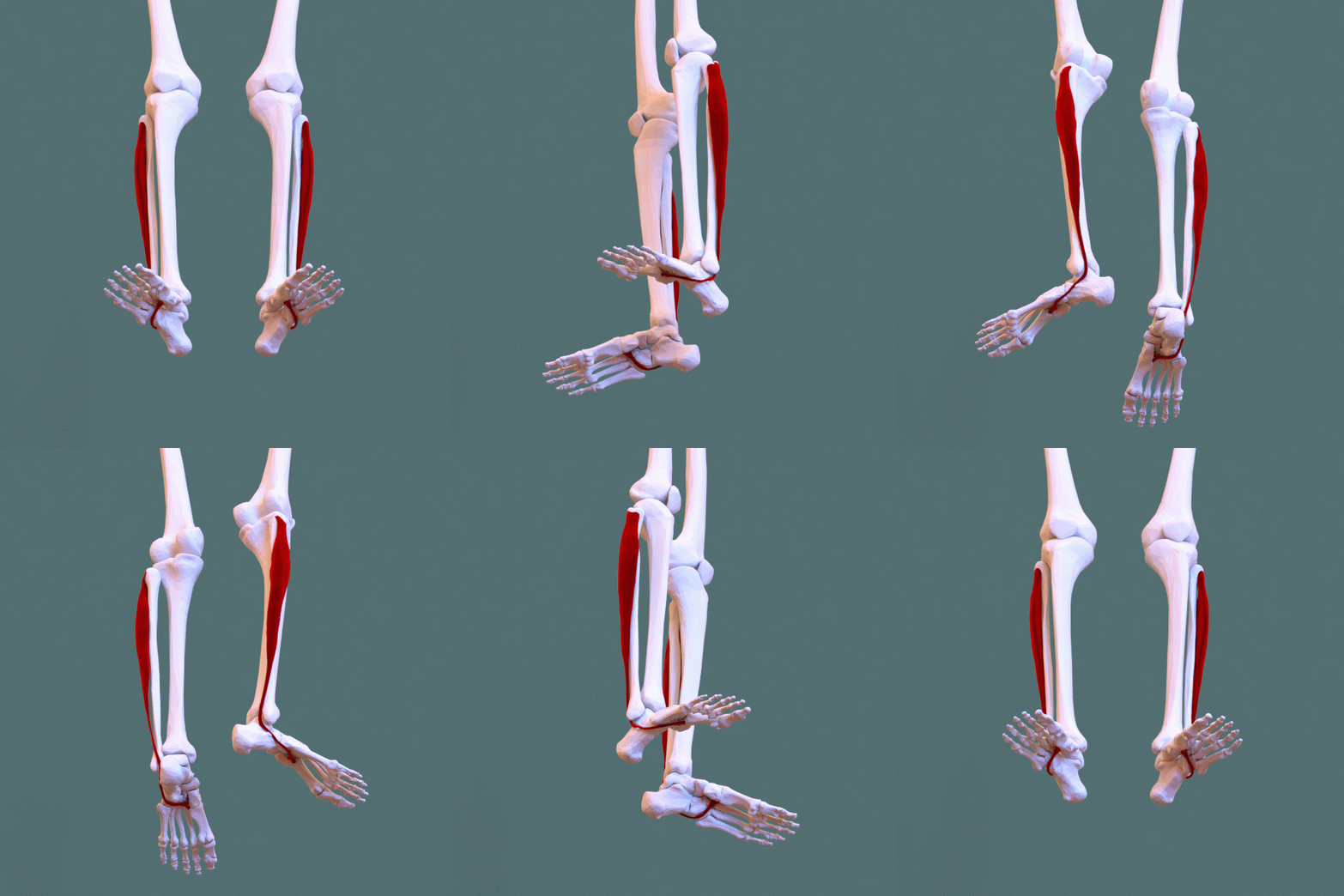
Animation
Mucous sheaths of tendons around right ankle, lateral aspect. (Tendon-sheath of fibularis longus labeled as peronaeus longus at bottom center.)
Details
OriginProximal part of lateral surface of shaft of fibula[1] and head of fibula
InsertionFirst metatarsal, medial cuneiform[1]
ArteryFibular (peroneal) artery
NerveSuperficial fibular nerve[1]
ActionsPlantarflexion, eversion, support arches[1]
AntagonistTibialis anterior muscle
Identifiers
Latinmusculus fibularis longus
TA98A04.7.02.041
TA22652
FMA22539
Anatomical terms of muscle

In human anatomy, the fibularis longus (also known as peroneus longus) is a superficial muscle in the lateral compartment of the leg. It acts to tilt the sole of the foot away from the midline of the body (eversion) and to extend the foot downward away from the body (plantar flexion) at the ankle.

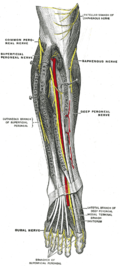
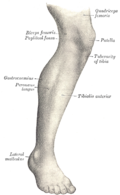
The fibularis longus is the longest and most superficial of the three fibularis (peroneus) muscles. At its upper end, it is attached to the head of the fibula, and its "belly" runs down along most of this bone. The muscle becomes a tendon that wraps around and behind the lateral malleolus of the ankle, then continues under the foot to attach to the medial cuneiform and first metatarsal. It is supplied by the superficial fibular nerve.

Structure

[edit]

The fibularis longus arises from the head and upper two-thirds of the lateral, or outward, surface of the fibula, from the deep surface of the fascia, and from the connective tissue between it and the muscles on the front and back of the leg. It occasionally is also connected by a few fibers from the lateral condyle of the tibia. Between the muscle's attachments to the head and body of the fibula, there is a gap through which the common fibular nerve passes to the front of the leg.[2]

The muscle ends in a long tendon, which runs behind the lateral malleolus of the ankle in a groove that it shares with the tendon of the fibularis brevis; the groove is converted into a canal by the superior fibular retinaculum, and the tendons in it are contained in a common mucous sheath.[2]

The tendon then extends forward at an angle across the lateral side of the foot, below the fibular trochlea and the tendon of the fibularis brevis, and under cover of the inferior fibular retinaculum.[2] It crosses the lateral side of the cuboid and then runs underneath the cuboid in a groove that is converted into a canal by the long plantar ligament. The tendon then crosses the sole of the foot at an angle and inserts into the lateral side of the base of the first metatarsal and the lateral side of the medial cuneiform.[2] Occasionally, it also sends a slip to the base of the second metatarsal.[2]

The tendon changes direction at two points: first, behind the lateral malleolus; second, on the cuboid bone. In both of these locations, the tendon is thickened. At the cuboid, a fibrocartilaginous sesamoid (sometimes a sesamoid bone) usually develops in the substance of the tendon.[2]

The fibularis longus muscle is supplied by the superficial fibular nerve, which arises from the fifth lumbar and first sacral roots of the spinal cord.[3]

Function

[edit]

The fibularis longus, together with the fibularis brevis and the tibialis posterior, extend the foot downward away from the body at the ankle (plantar flexion). It opposes the tibialis anterior and the fibularis tertius, which pull the foot upward toward the body (dorsiflexion).[2]

The fibularis longus also tilts the sole of the foot away from the midline of the body (eversion). Because of the angle at which it crosses the sole of the foot, it plays an important role in maintaining the transverse arch of the foot.[2]

Together, the fibularis muscles help to steady the leg upon the foot, especially in standing on one leg.[2]

Nomenclature and etymology

[edit]

Terminologia Anatomica designates "fibularis" as the preferred word over "peroneus.".[4]

The word "peroneus" comes from the Greek word "perone," meaning pin of a brooch or a buckle. In medical terminology, the word refers to being of or relating to the fibula or to the outer portion of the leg.

Additional images

[edit]

See also

[edit]

References

[edit]
Revisions and contributorsEdit on WikipediaRead on Wikipedia
from Grokipedia
The fibularis longus muscle, also known as the peroneus longus, is a superficial muscle in the lateral compartment of the that originates from the head and upper two-thirds of the of the , as well as the adjacent intermuscular septum and . Its long tendon passes behind the lateral malleolus, through a groove on the , and inserts primarily at the base of the first metatarsal and the medial cuneiform bone of the foot. Innervated by the superficial peroneal nerve (with root values L5–S1), the muscle receives its blood supply from branches of the fibular and anterior tibial arteries. This muscle plays a key role in foot movement and stability, working alongside the in the same compartment. In terms of function, the fibularis longus primarily everts the foot at the subtalar joint and assists in weak plantarflexion at the ankle joint, helping to stabilize the foot during walking and running. It also contributes to maintaining the lateral longitudinal arch and transverse arches of the foot by depressing the first metatarsal head, which is essential for weight-bearing and propulsion. The muscle's actions are crucial for activities requiring lateral stability, such as single-leg stance or uneven terrain navigation, and it works synergistically with other lower leg muscles to prevent excessive inversion. Clinically, the fibularis longus is susceptible to injuries including , tendon or , tears, and rupture, particularly in young athletes or individuals engaging in sports with repetitive ankle stress, such as running or . These conditions often arise from overuse, trauma, or anatomical variations like an os peroneum within the tendon, and may present with lateral ankle pain, swelling, or instability. Initial management typically involves conservative measures like rest, ice, anti-inflammatory medications, and , while severe cases may require surgical intervention such as tendon repair or .

Anatomy

Origin and insertion

The fibularis longus muscle originates from the head of the and the upper two-thirds of the lateral surface of the fibular shaft, extending to the adjacent anterior and posterior intermuscular septa of the . This broad origin provides a stable proximal attachment within the lateral compartment of the , where the muscle lies superficial to the . Distally, the muscle fibers give rise to a that courses posterior to the lateral malleolus, then turns medially to run in a groove on the inferior surface of the . The , which is rounded in its course beyond the cuboid, inserts primarily on the plantar aspect of the base of the first metatarsal and the medial cuneiform bone. In some cases, an accessory slip from the attaches to the base of the second metatarsal.

Course and relations

The fibularis longus muscle originates from the head and upper of the fibula, as well as adjacent structures on the and intermuscular septa, and its muscular belly descends along the lateral compartment of the , lying superficial to the muscle throughout this region. At approximately the midpoint of the , the muscle fibers converge into a long, flat that passes posteriorly to the lateral malleolus, occupying the superficial portion of a common fibro-osseous groove shared with the tendon of the . This tendon is then stabilized by the superior peroneal retinaculum as it courses inferiorly, passing deep to the inferior peroneal retinaculum before curving forward across the of the and bones. The tendon continues medially by traversing the cuboid tunnel, a groove on the inferior aspect of the bridged by the long plantar ligament, which forms its roof and helps guide the tendon toward the medial aspect of the foot. Within the sole of the foot, the tendon lies deep to the as it reaches its insertion points at the base of the first metatarsal and the medial cuneiform. Along its path, the fibularis longus tendon maintains close spatial relationships with the lateral foot's osseous and ligamentous structures, including superficial passage over the peroneal trochlea of the and interaction with the near its medial termination. Anatomical variations in the tendon path of the fibularis longus are not uncommon, with reported instances including bifurcation or splitting of the proximal to the cuboid tunnel, as well as accessory slips that may extend to adjacent metatarsals or the . These variations can alter the 's trajectory but typically preserve its overall lateral-to-medial course across the foot.

Innervation

The fibularis longus muscle receives its motor innervation from the superficial branch of the (also known as the ), a terminal division of the that arises just below the knee at the fibular neck. This nerve descends within the lateral compartment of the leg, initially between the and soleus muscles before passing between the and , where it issues muscular branches to supply the fibularis longus along its course. The originates from spinal root levels L4 through S1, with primary contributions from L5 and S1 segments of the . The does not pierce the to reach the fibularis longus; instead, it remains within the lateral compartment to provide this innervation before continuing distally and perforating the deep crural fascia in the lower third of the leg to become predominantly sensory. This anatomical arrangement positions the nerve in close proximity to the fibularis longus throughout much of its , facilitating direct for the muscle's role in foot eversion.

Blood supply

The fibularis longus muscle receives its primary arterial blood supply from the peroneal (fibular) artery, which arises from the tibioperoneal trunk and descends along the posterior aspect of the interosseous membrane, giving off muscular branches that perforate the intermuscular septum to reach the lateral compartment of the leg. Additional contributions come from the anterior tibial artery, specifically its superior and inferior lateral fibular branches, which supply the proximal portions of the muscle. These vessels ensure oxygenation and nutrient delivery to the muscle belly as it courses along the lateral surface of the fibula. Venous drainage of the fibularis longus follows the arterial supply through accompanying venae comitantes, which converge into the peroneal vein and ultimately empty into the popliteal vein. The tendon of the fibularis longus exhibits regional variations in , with the muscle-tendon junction and proximal tendon well-supplied by branches from the peroneal and anterior tibial arteries, but the distal tendon demonstrating poorer , particularly in the region around the where it changes direction, forming an avascular zone supplied only by limited branches of the medial tarsal artery.

Function

Primary actions

The fibularis longus muscle primarily facilitates eversion of the foot, which involves tilting the sole laterally away from the midline of the body, thereby counteracting inversion forces at the ankle joint. This action is essential for maintaining lateral stability and is achieved through the muscle's contraction, which pulls the foot into an everted position via its tendon passing posterior to the lateral malleolus. In addition to eversion, the fibularis longus contributes to plantarflexion of the foot, pointing the toes downward and assisting in propulsion during movement. This dual role—eversion combined with plantarflexion—arises from the muscle's oblique line of pull across the lateral ankle and foot, enhancing the foot's adaptability to ground contact. At the , contraction of the fibularis longus aids in pronation, a combined motion of eversion, abduction, and dorsiflexion that unlocks the foot for acceptance during the cycle. This pronatory contribution helps distribute forces across the foot's arches and is particularly active in the early stance phase of walking. Beyond isolated joint actions, the fibularis longus plays a key role in stabilizing the ankle during , providing mediolateral support to prevent excessive inversion, especially on uneven where peroneal muscle activity increases to enhance ankle and balance. This stabilization is critical for safe locomotion over irregular surfaces, reducing the risk of lateral ankle sprains by dynamically countering destabilizing torques.

Biomechanical role

The fibularis longus contributes to the maintenance of the transverse and lateral longitudinal through the tension generated by its as it crosses the sole, pulling the base of the first metatarsal inferiorly and medially to counteract flattening forces during activities. This biomechanical support enhances foot stability by distributing loads across the metatarsal heads and preventing excessive pronation or collapse of the arch structure. In addition to its primary actions of eversion and plantarflexion, the fibularis longus plays a key role in counteracting inversion forces at the ankle, thereby aiding overall balance during dynamic movements such as walking or standing on uneven surfaces. By generating an everting torque, the muscle dynamically stabilizes the ankle joint against lateral perturbations, reducing the risk of excessive varus positioning and promoting equilibrium in the lower limb. During the gait cycle, the fibularis longus is particularly active in the push-off phase, where it assists in by everting the foot and supporting plantarflexion to facilitate forward . It also contributes to shock absorption in the early stance phase by modulating eversion to help dissipate ground reaction forces, ensuring smooth transition through the foot's pronation-supination mechanics. The fibularis longus interacts synergistically with the to enable coordinated eversion of the foot, with the longus providing the primary distal force across the midfoot while the brevis reinforces proximal stabilization at the ankle. This complementary action allows for precise control of foot alignment during multi-planar movements, enhancing overall lower limb efficiency.

Clinical significance

Common injuries

The fibularis longus tendon is susceptible to several common injuries, primarily due to its anatomical position and mechanical demands during foot eversion and plantarflexion. Tendon tears, often longitudinal in nature, frequently occur in association with ankle inversion sprains, where the peroneal tendons are compressed against the posterior lateral . These tears are reported in 23-77% of cases involving lateral ankle and account for approximately 4% of all ankle injuries overall. Peroneal tendon subluxation or represents another prevalent , typically arising from tears in the superior peroneal retinaculum, which normally stabilizes the tendons behind the lateral . The mechanism involves sudden forceful dorsiflexion and eversion of the ankle, often during sports activities, leading to the tendons dislocating anteriorly over the . This injury is commonly seen in athletes engaging in cutting or pivoting maneuvers, with the retromalleolar groove's shallow fibro-osseous structure contributing to vulnerability. Tendinopathy of the fibularis longus develops primarily from repetitive overuse, particularly in athletes such as long-distance runners and dancers who subject the ankle to high-volume eversion stresses. This degenerative condition involves tendon thickening and , often exacerbated by improper progression or biomechanical imbalances, and is a frequent cause of lateral ankle in endurance sports. Painful os peroneum syndrome, involving or diastasis of the os peroneum sesamoid within the , can cause lateral foot and is associated with acute trauma or . Isolated tears of the fibularis longus can lead to chronic ankle and functional , distinct from more common brevis involvement, by disrupting the 's role in foot stabilization. Risk factors include cavus foot deformity, which increases lateral tension and predisposition to attrition at sites like the retromalleolar groove and . Cadaveric studies indicate that such longus tears occur less frequently than brevis tears but are still present in up to 13% of operative cases for peroneal .

Diagnostic and treatment approaches

Diagnosis of fibularis longus tendon issues typically begins with a clinical examination, where patients present with lateral ankle pain exacerbated by eversion, swelling posterior to the lateral , and tenderness along the course. Resisted eversion and passive inversion tests elicit pain, while in the retromalleolar groove may reveal or instability. modalities are essential for ; plain radiographs assess for avulsion fractures or hindfoot alignment issues, while provides dynamic evaluation of subluxation with 100% sensitivity and 85% specificity. (MRI) is the gold standard for detecting tears, (fluid >3 mm), and tendinosis, offering 83% sensitivity and 75% specificity, particularly useful for longitudinal tears at the notch. Conservative management forms the initial approach for most fibularis longus disorders, emphasizing rest, ice, compression, and elevation (RICE protocol), alongside nonsteroidal anti-inflammatory drugs (NSAIDs) to reduce inflammation. Immobilization in a cast, boot, or brace for 4-6 weeks, combined with focused on peroneal strengthening, , and , promotes healing in mild to moderate cases. , such as lateral heel wedges, address biomechanical contributors like cavovarus foot alignment, while activity modification prevents exacerbation. Platelet-rich plasma (PRP) or injections may be considered for refractory , though evidence for long-term efficacy remains limited. Surgical intervention is indicated for persistent symptoms after 3-6 months of conservative care or acute severe injuries. For , and tubularization are performed if more than 50% of the remains intact, using absorbable sutures to restore continuity. In cases of or , repair or reconstruction of the superior peroneal retinaculum is standard, often with groove deepening or rerouting to prevent recurrence. Severe degenerative involving over 50% of the may require tenodesis to the or transfer, particularly in chronic scenarios. Outcomes for fibularis longus interventions are generally favorable with early and treatment, achieving 80-90% success rates in pain relief and functional restoration. Conservative approaches resolve symptoms in up to 70% of mild cases within 12 weeks, while surgical repairs yield 87-98% return to full activity or by 13 months, with rehabilitation protocols stressing gradual loading and peroneal strengthening to minimize complications like rerupture.

Terminology

Etymology

The name fibularis longus is derived from Latin roots reflecting the muscle's anatomical associations. "Fibularis" pertains to the fibula, the lateral bone of the lower leg to which the muscle primarily attaches; the term "fibula" itself originates from the Latin word for "clasp" or "brooch," alluding to the bone's slender, pin-like shape reminiscent of an ancient fastening device. "Longus" is Latin for "long," a descriptor commonly used in anatomical nomenclature to denote the muscle's distinctive feature: its elongated tendon that extends from the lateral leg compartment across the foot. This terminology was formalized in the (1998), the international standard for anatomical naming established by the Federative Committee on Anatomical Terminology (now under FIPAT), which prioritized "fibularis" to emphasize the muscle's attachment to the —using consistent Latin-derived terms—over the synonymous but Greek-origin "peroneus," and was reaffirmed in the second edition (2019). The adoption reflects a broader effort in modern to standardize based on Latin etymologies for precision and uniformity across scientific literature.

Historical nomenclature

The fibularis longus muscle was historically referred to as the peroneus longus, a name rooted in term "peronē" for , reflecting its origin on that . In 1998, the Federative Committee on Anatomical Terminology (FCAT) of the International Federation of Associations of Anatomists officially renamed it fibularis longus in the , adopting the Latin "fibularis" to promote uniformity with other -related terms and to prevent confusion between "peroneus/peroneal" structures (such as the peroneal nerve) and perineal anatomy. Although the updated nomenclature is now the international standard, the older term "peroneus longus" continues to appear in some clinical texts, orthopedic literature, and regional practices due to its entrenched familiarity among practitioners. The "longus" descriptor, indicating its elongated form, has remained consistent throughout these shifts.

References

Add your contribution
Related Hubs
User Avatar
No comments yet.