


Community hub
Recent from talks
Contribute something to knowledge base
Content stats: 0 posts, 0 articles, 1 media, 0 notes
Members stats: 0 subscribers, 0 contributors, 0 moderators, 0 supporters
Subscribers
Supporters
Contributors
Moderators
Hub AI
Phasmatodea AI simulator
(@Phasmatodea_simulator)
Hub AI
Phasmatodea AI simulator
(@Phasmatodea_simulator)
Phasmatodea
The Phasmatodea (also known as Phasmida or Phasmatoptera) are an order of insects whose members are variously known as stick insects, stick bugs, walkingsticks, stick animals, or bug sticks. They are also occasionally referred to as Devil's darning needles, although this name is shared by both dragonflies and crane flies. They can be generally referred to as phasmatodeans, phasmids, or ghost insects, with phasmids in the family Phylliidae called leaf insects, leaf-bugs, walking leaves, or bug leaves. The group's name is derived from the Ancient Greek φάσμα phasma, meaning an apparition or phantom, referring to their resemblance to vegetation while in fact being animals. Their natural camouflage makes them difficult for predators to detect; still, many species have one of several secondary lines of defense in the form of startle displays, spines or toxic secretions. Stick insects from the genera Phryganistria, Ctenomorpha, and Phobaeticus include the world's longest insects.
Members of the order are found on all continents except Antarctica, but they are most abundant in the tropics and subtropics. They are herbivorous, with many species living unobtrusively in the tree canopy. They have an incomplete metamorphosis life cycle with three stages: egg, nymph and adult. Many phasmids are parthenogenic or androgenetic, and do not require fertilized eggs for female offspring to be produced. In hotter climates, they may breed all year round; in more temperate regions, the females lay eggs in the autumn before dying, and the new generation hatches in the spring. Some species have wings and can disperse by flying, while others are more restricted.
Phasmids vary greatly in size, with females typically growing larger than males of the same species. Males of the smallest species, such as Timema cristinae, reach about 2 centimetres (0.8 in) long, while females of the longest, an undescribed species informally known as Phryganistria "chinensis", can be up to 64 centimetres (25 in) in total length, including outstretched legs. This makes it the world's longest insect. The heaviest species of phasmid is likely to be Heteropteryx dilatata, the females of which may weigh as much as 65 g (2.3 oz).
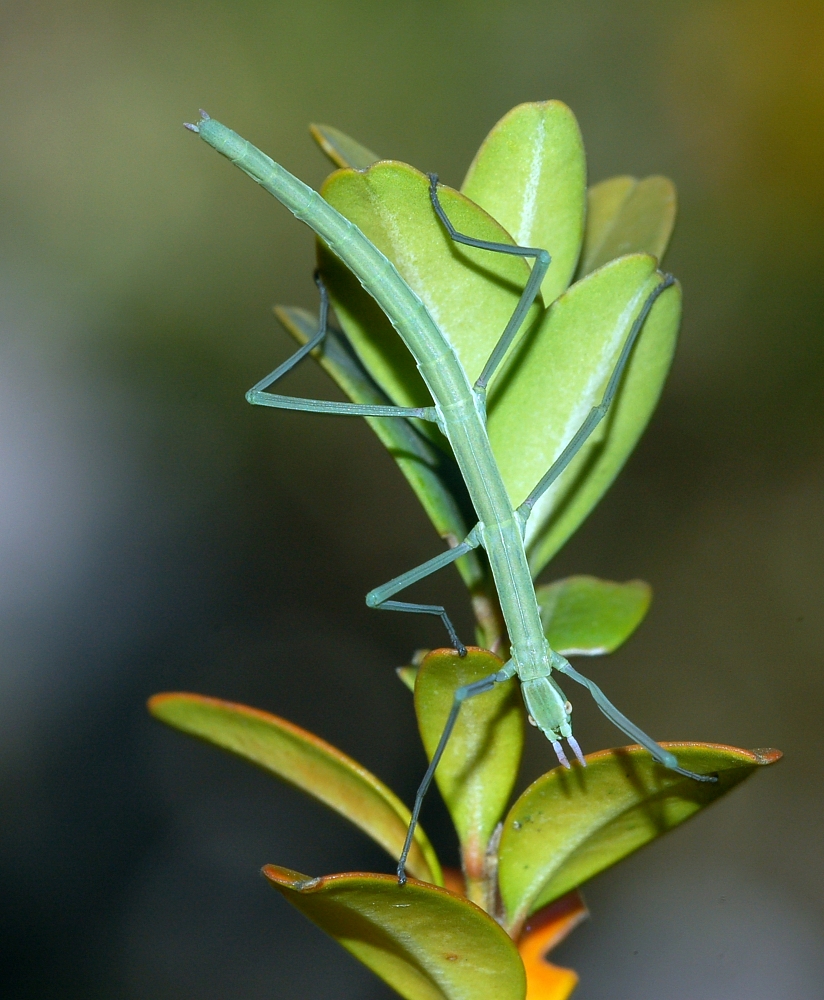
Some phasmids have cylindrical stick-like shapes, while others have flattened, leaflike shapes. Many species are wingless, or have reduced wings. The thorax is long in the winged species, since it houses the flight muscles, and is typically much shorter in the wingless forms. Where present, the first pair of wings is narrow and cornified (hardened), while the hind wings are broad, with straight veins along their length and multiple cross-veins. Their wing venation is unique among insects. The body is often further modified to resemble vegetation, with ridges resembling leaf veins, bark-like tubercles, and other forms of camouflage. A few species, such as Carausius morosus, are even able to change their pigmentation to match their surroundings. The mouthparts project out from the head. Chewing mandibles are uniform across species. The legs are typically long and slender, and some species are capable of limb autotomy (appendage shedding). Phasmids have long, slender antennae, as long as or longer than the rest of the body in some species.
All phasmids possess compound eyes, but ocelli (light-sensitive organs) are only known from the five groups Lanceocercata, Necrosciinae, Pseudophasmatidae, Palophidae and Phylliidae. Of these only the first three groups have females with ocelli, which like the wings seems to have re-evolved from ancestors that had lost them. Phasmids have an impressive visual system that allows them to perceive significant detail even in dim conditions, which suits their typically nocturnal lifestyle. They are born equipped with tiny compound eyes with a limited number of facets. As phasmids grow through successive molts, the number of facets in each eye is increased along with the number of photoreceptor cells. The sensitivity of the adult eye is at least tenfold that of the nymph in its first instar (developmental stage). As the eye grows more complex, the mechanisms to adapt to dark/light changes are also enhanced: eyes in dark conditions evidence fewer screening pigments, which would block light, than during the daytime, and changes in the width of the retinal layer to adapt to changes in available light are significantly more pronounced in adults. The larger size of the adult insects' eyes makes them more prone to radiation damage. This explains why fully grown individuals are mostly nocturnal. Lessened sensitivity to light in the newly emerged insects helps them to escape from the leaf litter wherein they are hatched and move upward into the more brightly illuminated foliage. Young stick insects are diurnal (daytime) feeders and move around freely, expanding their foraging range.
Stick insects have two types of pads on their legs: sticky "toe pads" and non-stick "heel pads" a little further up their legs. The heel pads are covered in microscopic hairs which create strong friction at low pressure, enabling them to grip without having to be peeled energetically from the surface at each step. The sticky toe pads are used to provide additional grip when climbing but are not used on a level surface.
Phasmatodea can be found all over the world except for the Antarctic and Patagonia. They are most numerous in the tropics and subtropics. The greatest diversity is found in Southeast Asia and South America, followed by Australia, Central America, and the southern United States. Over 300 species are known from the island of Borneo, making it the richest place in the world for Phasmatodea.
Phasmatodea species exhibit mechanisms for defense from predators that prevent an attack from happening in the first place (primary defense), and defenses that are deployed after an attack has been initiated (secondary defense).
Phasmatodea
The Phasmatodea (also known as Phasmida or Phasmatoptera) are an order of insects whose members are variously known as stick insects, stick bugs, walkingsticks, stick animals, or bug sticks. They are also occasionally referred to as Devil's darning needles, although this name is shared by both dragonflies and crane flies. They can be generally referred to as phasmatodeans, phasmids, or ghost insects, with phasmids in the family Phylliidae called leaf insects, leaf-bugs, walking leaves, or bug leaves. The group's name is derived from the Ancient Greek φάσμα phasma, meaning an apparition or phantom, referring to their resemblance to vegetation while in fact being animals. Their natural camouflage makes them difficult for predators to detect; still, many species have one of several secondary lines of defense in the form of startle displays, spines or toxic secretions. Stick insects from the genera Phryganistria, Ctenomorpha, and Phobaeticus include the world's longest insects.
Members of the order are found on all continents except Antarctica, but they are most abundant in the tropics and subtropics. They are herbivorous, with many species living unobtrusively in the tree canopy. They have an incomplete metamorphosis life cycle with three stages: egg, nymph and adult. Many phasmids are parthenogenic or androgenetic, and do not require fertilized eggs for female offspring to be produced. In hotter climates, they may breed all year round; in more temperate regions, the females lay eggs in the autumn before dying, and the new generation hatches in the spring. Some species have wings and can disperse by flying, while others are more restricted.
Phasmids vary greatly in size, with females typically growing larger than males of the same species. Males of the smallest species, such as Timema cristinae, reach about 2 centimetres (0.8 in) long, while females of the longest, an undescribed species informally known as Phryganistria "chinensis", can be up to 64 centimetres (25 in) in total length, including outstretched legs. This makes it the world's longest insect. The heaviest species of phasmid is likely to be Heteropteryx dilatata, the females of which may weigh as much as 65 g (2.3 oz).
Some phasmids have cylindrical stick-like shapes, while others have flattened, leaflike shapes. Many species are wingless, or have reduced wings. The thorax is long in the winged species, since it houses the flight muscles, and is typically much shorter in the wingless forms. Where present, the first pair of wings is narrow and cornified (hardened), while the hind wings are broad, with straight veins along their length and multiple cross-veins. Their wing venation is unique among insects. The body is often further modified to resemble vegetation, with ridges resembling leaf veins, bark-like tubercles, and other forms of camouflage. A few species, such as Carausius morosus, are even able to change their pigmentation to match their surroundings. The mouthparts project out from the head. Chewing mandibles are uniform across species. The legs are typically long and slender, and some species are capable of limb autotomy (appendage shedding). Phasmids have long, slender antennae, as long as or longer than the rest of the body in some species.
All phasmids possess compound eyes, but ocelli (light-sensitive organs) are only known from the five groups Lanceocercata, Necrosciinae, Pseudophasmatidae, Palophidae and Phylliidae. Of these only the first three groups have females with ocelli, which like the wings seems to have re-evolved from ancestors that had lost them. Phasmids have an impressive visual system that allows them to perceive significant detail even in dim conditions, which suits their typically nocturnal lifestyle. They are born equipped with tiny compound eyes with a limited number of facets. As phasmids grow through successive molts, the number of facets in each eye is increased along with the number of photoreceptor cells. The sensitivity of the adult eye is at least tenfold that of the nymph in its first instar (developmental stage). As the eye grows more complex, the mechanisms to adapt to dark/light changes are also enhanced: eyes in dark conditions evidence fewer screening pigments, which would block light, than during the daytime, and changes in the width of the retinal layer to adapt to changes in available light are significantly more pronounced in adults. The larger size of the adult insects' eyes makes them more prone to radiation damage. This explains why fully grown individuals are mostly nocturnal. Lessened sensitivity to light in the newly emerged insects helps them to escape from the leaf litter wherein they are hatched and move upward into the more brightly illuminated foliage. Young stick insects are diurnal (daytime) feeders and move around freely, expanding their foraging range.
Stick insects have two types of pads on their legs: sticky "toe pads" and non-stick "heel pads" a little further up their legs. The heel pads are covered in microscopic hairs which create strong friction at low pressure, enabling them to grip without having to be peeled energetically from the surface at each step. The sticky toe pads are used to provide additional grip when climbing but are not used on a level surface.
Phasmatodea can be found all over the world except for the Antarctic and Patagonia. They are most numerous in the tropics and subtropics. The greatest diversity is found in Southeast Asia and South America, followed by Australia, Central America, and the southern United States. Over 300 species are known from the island of Borneo, making it the richest place in the world for Phasmatodea.
Phasmatodea species exhibit mechanisms for defense from predators that prevent an attack from happening in the first place (primary defense), and defenses that are deployed after an attack has been initiated (secondary defense).
Recent media
Recent media