
Hubbry Logo
Physical coding sublayerPhysical coding sublayerMain
Open search
Physical coding sublayer
Community hub
Physical coding sublayer
logo
7 pages, 0 posts
0 subscribers
Be the first to start a discussion here.
Physical coding sublayer
from Wikipedia

The physical coding sublayer (PCS) is a networking protocol sublayer in the Fast Ethernet, Gigabit Ethernet, and 10 Gigabit Ethernet standards. It resides at the top of the physical layer (PHY), and provides an interface between the physical medium attachment (PMA) sublayer and the media-independent interface (MII). It is responsible for data encoding and decoding, scrambling and descrambling, alignment marker insertion and removal, block and symbol redistribution, and lane block synchronization and deskew.[1]

Description

[edit]

The Ethernet PCS sublayer is at the top of the Ethernet physical layer (PHY). The hierarchy is as follows:

  • Data link layer (Layer 2)
  • PHY Layer (Layer 1)
    • Physical coding sublayer (PCS) – This sublayer determines when a functional link has been established, provides rate difference compensation, and performs coding such as 64b/66b encoding and scrambling/descrambling
    • Physical medium attachment (PMA) sublayer – This sublayer performs PMA framing, octet synchronization/detection, and scrambling/descrambling
    • Physical medium dependent (PMD) sublayer – This sublayer consists of a transceiver for the physical medium
Specifications

[edit]

10 Mbit/s Ethernet

[edit]

Fast Ethernet

[edit]
  • 100BASE-X for fiber (100BASE-FX) and twisted pair copper (100BASE-TX) encodes data nibbles to five-bit code groups (4B5B).[3]

Gigabit Ethernet

[edit]
  • 1000BASE-X for fiber and 150 Ω balanced copper (twinaxial) uses 8b/10b encoding with a symbol rate of 1.25 GBd.[4]
  • 1000BASE-T for twisted pair copper splits the data into four lanes and uses four-dimensional, five-level (quinary) trellis modulation with PAM-5 and a symbol rate of 125 MBd.[5]

2.5 and 5 Gigabit Ethernet

[edit]
  • 2.5GBASE-T and 5GBASE-T use the same encoding as 10GBASE-T slowed by a factor of four or two, respectively.

10 Gigabit Ethernet

[edit]
  • 10GBASE-R (LAN) is the serial encoded PCS using 64b/66b encoding that allows for Ethernet framing at a rate of 10.3125 Gbit/s. This rate does not match the rate 9.953 Gbit/s used in SONET and SDH and is not supported over a WAN based on SONET or SDH.
  • 10GBASE-X (LAN/WAN) uses 8b/10b encoding over four lanes at 3.125 GBd each and is used for 10GBASE-LX4 (single-mode and multi-mode fiber), 10GBASE-CX4 (twinax), and 10GBASE-KX4 (backplane).[6]
  • 10GBASE-W (WAN) defines WAN encoding for 10GbE. It uses 64/66b encoding and lowers the MAC rate to 9.95 Gbit/s, so that is compatible with SONET STS-192c data rates and SDH VC-4-64 transmission standards when wrapped into a SONET frame.
  • 10GBASE-T for twisted pair copper splits the data into four lanes and uses 64B/65B encoding, scrambling, and 128 double-square (DSQ128) checkerboard encoding with PAM-16 generated at 800 MBd.[7]

25 Gigabit Ethernet

[edit]
  • 25GBASE-R uses the same 64b/66b encoding as 10GBASE-R with a speed-up to 25.78125 GBd.[8]

40/100 Gigabit Ethernet

[edit]
  • 40GBASE-R and 100GBASE-R use 64b/66b encoding over multiple lanes of 10.3125 GBd or 25.78125 GBd each. These lanes – four for 40 Gbit/s, four or ten for 100 Gbit/s per direction – are either transmitted separately over short distance or together with coarse wavelength division multiplexing on long distance fiber (-LR).[9]

See also

[edit]

References

[edit]
[edit]
Revisions and contributorsEdit on WikipediaRead on Wikipedia
from Grokipedia
The Physical Coding Sublayer (PCS) is a functional sublayer within the (PHY) of the Ethernet standard, responsible for encoding outgoing from the (MII) into code groups suitable for transmission and decoding incoming signals from the Physical Medium Attachment (PMA) sublayer back into a bit stream for the MAC layer. It ensures reliable transfer by managing line coding, scrambling, frame delineation, and, in higher-speed variants, (FEC), while adapting to diverse such as twisted-pair , , and backplanes. In the overall PHY architecture, the PCS sits between the reconciliation sublayer (or MII family interfaces like GMII for 1 Gb/s or XGMII for 10 Gb/s) and the PMA, which handles and , ultimately connecting to the Physical Medium Dependent (PMD) sublayer for medium-specific signaling. Key functions include adding synchronization bits to maintain , balancing run lengths to prevent , and distributing data across multiple lanes in multilane configurations for speeds beyond 10 Gb/s. Encoding schemes vary by Ethernet variant: early implementations like (100 Mb/s) use 4B/5B coding for 100BASE-X, employs 8B/10B for 1000BASE-X, and modern high-speed Ethernet (e.g., 10 Gb/s and above) adopts 64B/66B block coding to minimize overhead while supporting FEC like Reed-Solomon in 200GBASE-R and 400GBASE-R. The PCS has evolved significantly with Ethernet's speed increases, from single-lane operations in legacy systems to complex multilane striping and (e.g., 64B/66B to 256B/257B) in 200 Gb/s and 400 Gb/s PHYs, enabling scalability for data centers and automotive applications while maintaining through standardized interfaces. In automotive Ethernet like 1000BASE-T1, it incorporates PAM3 modulation and RS-FEC to achieve low bit error rates (≤10⁻¹⁰) over single-pair cabling. This sublayer's design emphasizes flexibility, allowing PHY variants to support full-duplex operation, auto-negotiation, and energy-efficient modes across electrical and optical media.

Introduction

Definition and Scope

The Physical Coding Sublayer (PCS) is a sublayer within the IEEE 802.3 Physical Layer that encodes parallel data received from the Media Access Control (MAC) sublayer via the Media Independent Interface (MII) or equivalent into block codes for transmission to the Physical Medium Attachment (PMA) sublayer, and decodes block codes received from the PMA for delivery to the MAC, ensuring compatibility across various Ethernet physical implementations. The PCS interfaces with the MAC via the Media Independent Interface (MII) or its high-speed variants, providing a standardized boundary for data exchange independent of the underlying medium. Its primary purposes encompass maintaining DC balance to minimize baseline wander in the signal, embedding clock information to support synchronization at the receiver, incorporating coding overhead for basic error detection, and enabling adaptation to diverse transmission media such as twisted-pair cabling and . These functions collectively enhance and reliability in Ethernet networks by addressing challenges inherent to serial data transmission over physical channels. The PCS was first formally defined in the IEEE 802.3u amendment of 1995, which introduced at 100 Mbit/s and established the foundational PCS architecture for higher-speed operations. It has since evolved through subsequent amendments to support data rates up to 800 Gbit/s, as specified in the IEEE 802.3df amendment of 2024. The scope of the PCS remains confined to the under , distinguishing it from analogous coding mechanisms in standards like , which are tailored for synchronous optical transport networks.

Position in IEEE 802.3 Physical Layer

The Physical Coding Sublayer (PCS) serves as the uppermost sublayer within the (PHY), positioned above the Physical Medium Attachment (PMA) and Physical Medium Dependent (PMD) sublayers but below the Reconciliation Sublayer (RS) or directly interfacing with the Media Access Control (MAC) sublayer. This architecture ensures that the PCS acts as a bridge between the logical framing provided by higher layers and the physical transmission handled by lower sublayers. The PHY as a whole, comprising PCS, PMA, PMD, and sometimes additional components, encapsulates the media-independent aspects of data transmission while adapting to specific physical media. Key interfaces at the PCS boundaries facilitate data exchange across the PHY stack. On the transmit path, the PCS receives parallel data from the RS or MAC via standardized interfaces such as the (MII) for lower-speed implementations or Gigabit Media Independent Interface (GMII) and Ten Gigabit Media Independent Interface (XGMII) for higher speeds, performing necessary conversions including serial-to-parallel adjustments as required. On the receive path, it reverses this process, converting incoming data into parallel format for delivery to the upper layers. The PCS also manages reconciliation with the MAC by independently processing control signals, such as idle patterns, start-of-frame delimiters, and end-of-frame delimiters, without reliance on the PMA or PMD sublayers. This separation allows the PCS to maintain frame integrity and signaling consistency across diverse physical implementations. A core attribute of the PCS is its media independence, achieved by outputting standardized symbols—often through encoding schemes like 8B/10B or 64B/66B—to the PMA sublayer, enabling the same PCS design to support multiple media types including twisted-pair copper, , and interconnects. This promotes reusability and simplifies PHY development for different Ethernet variants. An optional Auto-Negotiation (AN) sublayer may integrate alongside or above the PCS to handle link parameter negotiation, further enhancing adaptability without altering the core PCS positioning. In a typical of the PHY architecture, the PCS is depicted centrally between the RS (or MAC) at the top and the PMA/PMD stack below, with bidirectional arrows illustrating the transmit and receive data flows through the interfaces. The diagram often highlights the PMA's role in serialization/deserialization and the PMD's connection to the (MDI), underscoring the PCS's pivotal role in abstracting upper-layer logic from physical transmission details.

Key Functions

Data Encoding and Decoding

The Physical Coding Sublayer (PCS) employs block coding to transform incoming parallel data streams into serialized code symbols optimized for reliable transmission across the . In this approach, groups of k data bits—typically organized as nibbles (4 bits) or bytes (8 bits)—are mapped to larger n-bit codewords (where n > k) that incorporate additional redundancy bits for control purposes, such as signaling frame boundaries and error detection. This mapping process ensures the encoded stream possesses desirable electrical characteristics, including sufficient bit transitions and balanced spectral content. For instance, 4B/5B coding maps 4 data bits to fixed 5-bit symbols, introducing a 25% bandwidth overhead to support these properties. The primary goals of PCS encoding include inserting regular transitions to aid at the receiver, achieving (DC) balance by equalizing the number of ones and zeros over time (via mechanisms like running disparity in certain schemes), and embedding special delimiters to mark frame starts and ends. For example, in 8B/10B coding used in , running disparity is calculated cumulatively across codewords, tracking the difference between the count of ones and zeros; the encoder selects codeword variants that minimize this disparity, ensuring the signal's long-term average voltage remains near zero to prevent baseline wander in AC-coupled systems. In contrast, 4B/5B schemes like those in use fixed mappings, with DC balance provided by subsequent or line coding in the PMA. These mechanisms collectively reduce the risk of transmission errors and improve synchronization without relying solely on external clock signals. Decoding in the PCS reverses this process by mapping received n-bit codewords back to the original k data bits, while performing integrity checks such as verifying running disparity compliance (in applicable schemes) and validating code groups against predefined tables. If a codeword exhibits incorrect disparity or belongs to an invalid set, the decoder flags it as erroneous, enabling early detection before data reaches higher layers; special alignment patterns, such as codes in 8B/10B schemes or block sync headers in 64B/66B, further assist in identifying valid symbol boundaries during deserialization. This bidirectional encoding-decoding framework ensures robust data recovery even in noisy environments. The of block coding is quantified by the code rate η = k/n, representing the fraction of transmitted bits that carry data; the corresponding overhead, or fraction, is 1 - η, often expressed relative to input data as (n - k)/k. For k/n coding, this overhead accounts for the control and balance bits: in 4B/5B, η = 4/5 = 0.8 (20% loss, or 25% overhead per data bit), while 64/66B yields η = 64/66 ≈ 0.9697 (overhead of 2/64 = 3.125%). To derive the overhead, consider that for every k input bits, n bits are output, so extra bits per input bit are (n/k) - 1, multiplied by 100% for ; this minimal balances performance with reliability across implementations. PCS block codes are broadly categorized into character-oriented schemes, which encode individual bytes or nibbles for simpler, lower-complexity operations, and packet-oriented schemes, which process larger blocks of data to reduce encoding frequency and overhead in high-throughput scenarios. Character-oriented codes like 8B/10B prioritize fine-grained control for disparity and transitions, whereas packet-oriented codes like 64B/66B aggregate multiple bytes into super-blocks for efficient delimiter insertion and lower relative overhead. In higher-speed Ethernet variants (e.g., 25 Gb/s and above), the PCS also incorporates (FEC), such as Reed-Solomon codes, which add parity symbols to data blocks during encoding to enable at the receiver, improving bit error rates over longer or noisier links. The encoded output from block coding is often subsequently scrambled to further randomize the bit sequence and suppress peaks, as detailed in related spectral control mechanisms.

Scrambling for Spectral Control

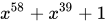
The physical coding sublayer (PCS) employs to randomize the , thereby whitening the signal and preventing the concentration of energy in specific frequency bands that could lead to (EMI) or regulatory emission violations. This process mitigates issues such as spectral lines caused by long sequences of identical bits and baseline wander in AC-coupled transmission systems, ensuring a more uniform average power across the band. By distributing the signal energy evenly, facilitates reliable clock extraction at the receiver through sufficient bit transitions, without requiring additional line coding overhead. Scrambling in PCS typically utilizes self-synchronizing scramblers based on linear feedback shift registers (LFSRs) driven by generator polynomials, which XOR the input with a pseudo-random derived from the itself. These scramblers are additive, meaning the output is the modulo-2 sum of the input and the scrambler state, allowing the receiver to recover the original by applying the inverse operation without needing prior synchronization. For lower-speed Ethernet variants, frame-synchronous may be used, where the scrambler state is reset at frame boundaries to align with , though self-synchronizing methods predominate for their robustness in continuous streams. In implementation, scrambling occurs after data encoding (such as 4B/5B or 64B/66B) but prior to and transmission, ensuring the randomized bits maintain the encoded structure's error detection properties. Descrambling at the receiver employs the identical and LFSR configuration, with mechanisms to detect loss—such as monitoring for invalid code patterns or excessive run lengths—triggering resynchronization if needed. Common polynomials include forms like 1+x9+x111 + x^9 + x^{11} for 100 Mbps systems, which provide adequate for twisted-pair media, and higher-degree polynomials such as x58+x39+1x^{58} + x^{39} + 1 for 10 Gbps and beyond, offering longer periods to handle increased data rates. This polynomial-based approach distributes single-bit errors across multiple bits during descrambling, potentially improving (BER) tolerance in noisy channels by avoiding clustered failures. The primary advantages of PCS scrambling include enhanced over various media, such as and , by reducing peak spectral emissions without introducing bandwidth overhead or latency. It is a mandatory feature in PCS designs from 100 Mbps onward, standardizing spectral control and enabling compliance with limits in high-speed networking environments.

Synchronization Mechanisms

Block and Frame Alignment

The physical coding sublayer (PCS) achieves block alignment by detecting unique synchronization headers prepended to each encoded block, which delineate block boundaries in the incoming serial bit stream. These sync headers, typically 2 bits long, distinguish data blocks from control blocks and ensure reliable reconstruction of the original data structure. For instance, in 64B/66B encoding used in higher-speed Ethernet variants, the sync header facilitates the identification of 66-bit blocks, allowing the receiver to parse the payload correctly. Frame alignment within the PCS involves the insertion and detection of Ethernet frame delimiters, such as the Start Frame Delimiter (SFD), which are encoded into specific control blocks or code groups. On transmission, the PCS maps the SFD from the media access control (MAC) layer interface—such as XGMII—into appropriate control characters (e.g., /S/ symbols) within the block structure, while idle patterns are filled with neutral control codes to maintain stream continuity. At the receiver, after block synchronization, the PCS decodes these delimiters to reconstruct frame boundaries, enabling accurate frame extraction and handling of inter-frame gaps. Alignment algorithms in the PCS vary by encoding scheme and speed. For lower-speed PCS using 8B/10B coding, comma alignment employs special comma characters (K-codes) that provide a unique bit pattern for word boundary detection, allowing the receiver to slide the until alignment is achieved. In multi-lane configurations, such as those in 40GBASE-R or higher, bit-slip mechanisms adjust lane skew by selectively discarding or inserting bits in individual lanes to synchronize all lanes to a common block boundary. Lock detector criteria typically require 64 consecutive valid sync headers without intervening invalid ones to declare block lock, ensuring robust synchronization against noise. Error handling in block and frame alignment includes mechanisms to detect and recover from misalignment. Disparity errors, common in balanced encodings like 8B/10B, flag invalid code groups that violate running disparity rules, prompting immediate realignment. Loss of block lock—triggered by 16 invalid sync headers within a 64-block window in variants like 10GBASE-KR, or 32 in 10GBASE-R—initiates resynchronization by resetting the alignment process. These procedures maintain by isolating erroneous blocks and preventing propagation of alignment failures. The PCS receive path employs a state machine to manage alignment, typically comprising three primary states: hunt, align, and lock. In the hunt state, the receiver scans the bit stream for potential sync headers, transitioning to the align state upon detecting a candidate pattern. The align state verifies and adjusts boundaries over multiple blocks, advancing to the lock state after meeting the lock criteria (e.g., 64 good blocks). From lock, excessive errors revert the machine to hunt for resync. This state-based approach supports clock recovery by providing stable transitions for timing extraction.

Clock Recovery Support

The Physical Coding Sublayer (PCS) in IEEE 802.3 Ethernet standards embeds clock information directly into the data stream to enable recovery at the receiver without dedicated clock lines, relying on encoding schemes that guarantee sufficient signal transitions to maintain timing synchronization. This approach uses run-length limited codes and scrambling to prevent excessively long sequences of identical bits, ensuring the data exhibits adequate edge density for reliable clock extraction. By limiting consecutive zeros or ones, the PCS output supports embedded clock recovery, which is essential for high-speed serial transmission where separate clock signals would introduce complexity and cost. At the receiver, the PCS delivers transition-rich serialized to the Physical Medium Attachment (PMA) and Physical Medium Dependent (PMD) sublayers, where Clock and Data Recovery (CDR) circuits—typically implemented with phase-locked loops (PLLs) or techniques—extract the embedded clock and retime the incoming bits. The PCS ensures that the data stream's characteristics facilitate this process by avoiding low-frequency components that could degrade PLL locking. In multi-lane configurations, such as those used in 40GBASE-R and higher Ethernet variants, occurs independently per lane in the PMA, with the PCS performing subsequent deskewing to align lanes and reconstruct the aggregate clock from a master lane, compensating for skew variations up to specified tolerances. Key performance metrics for PCS-supported clock recovery include run lengths limited by the 64B/66B encoding and scrambling, with a worst-case maximum of 65 bits and typical CDR tolerance up to 80 bits per SONET-derived specifications, preventing loss of lock in the receiver's timing circuits. IEEE 802.3 specifications define jitter tolerance requirements, such as sinusoidal jitter budgets that the PCS encoding must support without exceeding bit error rates, ensuring robust operation across link distances. Testing validates these aspects through eye diagram measurements at the PCS-to-PMA interface, where the signal must maintain sufficient opening to accommodate CDR jitter tolerance, ultimately achieving a bit error rate (BER) target of 10^{-12} influenced by clock stability.

Specifications for Ethernet Standards

10 and 100 Mbit/s Ethernet

The (PCS) for 10 Mbit/s Ethernet, as specified in Clause 14 for 10BASE-T, lacks a formal PCS sublayers; instead, PCS-like functions are handled within the overall (PHY), where data from the (MII) is converted from (NRZ) format to encoding for transmission over twisted-pair cabling. The MII, defined in Clause 22, serves as the 4-bit wide interface between the MAC and PHY for both 10 Mbit/s and 100 Mbit/s operations, enabling evolutionary compatibility by abstracting media-specific details like Manchester encoding, which embeds directly into the signal to ensure self-clocking without a separate PCS or block coding. This approach supports bit error rates below 10^{-10} over Category 3 cabling up to 100 meters, prioritizing simplicity for early Ethernet deployments. For 100 Mbit/s Ethernet, the PCS is formally defined in Clause 24 for both 100BASE-TX (over twisted-pair) and 100BASE-FX (over ), utilizing 4B/5B block encoding to map 4-bit nibbles from the into 5-bit symbols, introducing a 25% overhead to ensure sufficient transitions for reliable and DC balance. Special control code groups, such as /J/ (11000 in binary) and /K/ (10001 in binary), delineate the start of an by forming the /J/K/ pair aligned with the frame preamble's end, while the /T/R/ pair (01101 01110) signals the end of data; symbol alignment is achieved by detecting the unique within these groups, particularly the 00111 sequence in shifted positions, allowing the receiver to lock onto 5-bit boundaries via the JK0 (/J/ /K/ followed by data symbol /0/). Unlike 10 Mbit/s, the 100 Mbit/s PCS includes a with the x9+x5+1x^9 + x^5 + 1 to randomize the 125 Mbaud symbol stream, reducing and spectral peaks without affecting . Media adaptations occur in the Physical Medium Attachment (PMA) sublayer: for 100BASE-TX (Clause 25), the scrambled 5-bit symbols are serialized, NRZ-to-NRZI encoded, and modulated using multi-level transmit-3 (MLT-3) signaling over two pairs of Category 5 twisted-pair cabling; for 100BASE-FX (Clause 26), (NRZ) encoding is applied directly to the symbols for transmission over multimode . These PCS implementations, introduced in the IEEE 802.3u-1995 standard, achieve a bit error ratio (BER) of less than 10910^{-9} over 100 meters of cabling or 2 km of , establishing foundational block coding for higher-speed Ethernet evolutions.

1 Gbit/s Ethernet

The (PCS) for 1 Gbit/s Ethernet, as defined in , supports Gigabit speeds over various media through distinct implementations in Clauses 36 and 40, enabling reliable data transmission with full-duplex operation and auto-negotiation for link establishment. Introduced in 1998 for -based variants and 1999 for , these PCS designs prioritize encoding for , , and error detection without relying on scramblers in the case. The 1000BASE-X PCS, specified in Clause 36, serves optical interfaces like 1000BASE-SX (short-range multimode up to 550 m), 1000BASE-LX (long-range multimode or single-mode up to 5 km), and 1000BASE-ZX (extended single-mode up to 100 km), all sharing the same core PCS functions for balanced serial transmission. In parallel, the 1000BASE-T PCS in Clause 40 targets Category 5 twisted-pair cabling over four bidirectional pairs, achieving 1 Gbit/s aggregate throughput. For 1000BASE-X, the PCS receives 8-bit data from the (GMII) and applies 8B/10B encoding to map each byte into a 10-bit code group, incurring a 25% overhead to ensure DC balance and adequate transitions for receiver synchronization. This encoding distinguishes data symbols (D.x.y, where x derives from the 5 least significant bits and y from the 3 most significant bits) from control symbols (K.x.y) for of frame delimiters and idles. Running disparity (RD), tracked as positive (more 1s) or negative (more 0s), selects between complementary 10-bit representations to maintain overall balance within +/-5, preventing baseline wander in serial links. No dedicated is implemented; instead, the RD mechanism and code group selection inherently randomize the bit stream to avoid spectral issues. Alignment in 1000BASE-X relies on comma codes—specific K28.y symbols (K28.1, K28.5, K28.7) with unique patterns like 0011111 or 1100000—for word boundary detection, allowing the receiver to 10-bit blocks without external clocking. A block state machine monitors incoming code groups, requiring three consecutive ordered sets containing commas to establish sync, after which it locks onto data streams and flags invalid codes (non-standard D or K groups) for detection. The PCS outputs serialized 10-bit symbols via a Ten Bit Interface (TBI) to the Physical Medium Attachment (PMA), supporting the 1.25 Gbaud rate needed for 1 Gbit/s . The 1000BASE-T PCS, while also interfacing via GMII, diverges to handle parallel twisted-pair transmission, dividing the 1 Gbit/s stream into four 250 Mbps channels for simultaneous full-duplex operation over Category 5 cabling up to 100 m. It employs 4D-PAM5 encoding, where data is scrambled, partitioned into 9-bit words, and mapped to 4-dimensional 5-level symbols using trellis-coded modulation for a 6 dB coding gain, enhancing immunity without a separate 8B/10B step. This PCS processes per-pair at 250 Mbps, with robust start-of-stream (SSD) and end-of-stream (ESD) delimiters for frame alignment across pairs, and optional via the 4D-8 state trellis code to achieve bit error rates below 10^{-10} under worst-case . Auto-negotiation per Clause 28 facilitates link training, adapting to cable conditions for reliable startup.

10 Gbit/s Ethernet

The (PCS) for 10 Gbit/s Ethernet, primarily defined in Clause 49, supports variants such as 10GBASE-R for serial optical and electrical interfaces, including 10GBASE-SR, 10GBASE-LR, and 10GBASE-ER over multimode and single-mode . This PCS employs 64B/66B block encoding to map from the XGMII interface into transmission blocks, achieving a line rate of 10.3125 Gbit/s with minimal overhead. The encoding process groups 64 bits of or control information into blocks prefixed by a 2-bit header, where "01" indicates a data block and "10" denotes a control block containing ordered sets for link management. This scheme introduces a coding overhead of 2/66 ≈ 3.125%, significantly lower than prior methods like 8B/10B, enabling efficient high-speed operation while ensuring sufficient transitions for . Scrambling in the 10GBASE-R PCS utilizes a frame-synchronous (LFSR) with the polynomial x58+x39+1x^{58} + x^{39} + 1, applied only to the 64-bit after the sync header is prepended, to randomize the data spectrum and mitigate . The is self-synchronizing with no fixed initial seed requirement, though implementations often initialize the 58-bit register to all ones (0xFFFF... for the register length) to avoid prolonged zero sequences. Block alignment is achieved through a lock state machine that declares block lock after receiving 64 consecutive valid sync headers and loses it upon detecting 16 invalid headers within any 64-block , facilitating robust frame delineation. The PCS interfaces with the XGMII at 32 bits wide operating at 312.5 MHz, allowing parallel data transfer between the MAC and PHY layers, while error monitoring tracks block lock failures and sync header errors to indicate high bit error rates (hi_ber). For backplane applications, 10GBASE-KR in Clause 72 employs the same Clause 49 PCS with optional multi-lane configurations in variants like 10GBASE-KX4, where lane-to-lane skew is compensated up to a maximum deskew delay of approximately 200 ns to align blocks across lanes during reception. In contrast, the 10GBASE-T variant specified in Clause 55 uses a distinct PCS based on 128-dimensional signaling with DSQ128 (double-square 128-QAM) modulation and low-density parity-check (LDPC) integrated within the PCS to achieve reliable transmission over twisted-pair copper up to 100 meters. For passive optical networks, extends the PCS in Clause 75 to support burst-mode operation at the optical network unit (ONU), enabling (TDMA) upstream transmission at 10 Gbit/s with rapid enable/disable cycles for collision-free sharing. All 10 Gbit/s Ethernet PCS implementations operate in full-duplex mode exclusively, eliminating (CSMA/CD) and supporting a (BER) target of 101210^{-12} for reliable data delivery. The core standards were ratified in IEEE 802.3ae-2002, with later enhancements including (EEE) in Clause 78 for low-power idle modes to reduce energy consumption during periods of low utilization.

25 Gbit/s and Higher

The (PCS) for Ethernet rates of 25 Gbit/s and higher builds on the foundational scheme introduced at 10 Gbit/s, but incorporates multi-lane architectures, rate adaptation, and integrated (FEC) to address increased challenges at higher speeds. These evolutions, defined in amendments from 2016 onward, enable scalable operation up to 800 Gbit/s by distributing data across parallel lanes, incorporating Reed-Solomon FEC for error correction, and supporting diverse media types including backplanes, short-reach , and automotive twisted-pair cabling. For 25 Gbit/s Ethernet, the PCS reuses the Clause 49 structure from 10GBASE-R with modifications for rate adaptation, maintaining and the same self-synchronizing to ensure spectral shaping and DC balance. The 25GBASE-R PHY, as specified in IEEE 802.3by for (KR) and short-reach (CR) variants, operates over a single lane at a serialized rate of 25.78125 Gbit/s, interfacing via a 25GMII equivalent to the XGMII but scaled for 25 Gbit/s MAC rates. This reuse minimizes implementation complexity while achieving bit error rates (BER) below 10^{-12} pre-FEC, suitable for and enterprise applications. At 40 Gbit/s and 100 Gbit/s, the PCS employs a multi-lane distribution in Clause 82 of IEEE 802.3ba, aggregating four independent 64B/66B —each running at 10.3125 Gbit/s for 40GBASE-R or 25.78125 Gbit/s for 100GBASE-R—to achieve the aggregate rate. Lane mapping distributes client data across lanes using a round-robin scheme, with periodic alignment markers inserted for deskew and block synchronization, compensating for up to 200 ns of skew per lane. This architecture supports variants like 40GBASE-CR4 and 100GBASE-SR4 over and multimode , respectively, without mandatory FEC at this stage, though optional integration is possible for enhanced reach. The PCS for 200 Gbit/s and 400 Gbit/s, defined in IEEE 802.3bs Clause 119, extends the multi-lane approach to eight or sixteen lanes of , with mandatory Reed-Solomon FEC using RS(544,514) in Clause 119 to provide approximately 5.5% overhead and a net coding gain of over 9 dB, targeting a post-FEC BER of 10^{-13}. For 200GBASE-R variants like DR4 (over single-mode fiber), data is transcoded into 256B/257B blocks before RS-FEC encoding, distributed across eight lanes at 26.5625 Gbit/s each; 400GBASE-R like FR8 uses sixteen such lanes. An optional inner can be added for further burst error correction in noisy environments, while the remains consistent with lower rates for . Higher-speed PCS implementations, such as 800GBASE-R in IEEE 802.3df Clause 172, scale the Clause 119 structure by aggregating four 200GBASE-R PCS instances or equivalent, using followed by RS(544,514) FEC across thirty-two lanes at 26.5625 Gbit/s each, supporting PAM4 modulation in the underlying Physical Medium Attachment (PMA) sublayer while the PCS focuses on logical coding and lane alignment. This enables 800 Gbit/s over short-reach and copper, with alignment mechanisms handling skew up to 100 ns per group of lanes. The PCS logical coding remains independent of PMA modulation, ensuring flexibility for future extensions. Advanced PCS features for these rates include gearbox functions for rate matching, such as converting between 25 Gbit/s and 100 Gbit/s interfaces via multi-link aggregation, as standardized in OIF implementations to bridge mismatched lane counts without buffering. Low-latency modes, optional in IEEE 802.3ck for variants, reduce FEC decoding delay to under 100 ns by parallelizing parity computations. Automotive and adaptations, like 25GBASE-T1 in IEEE 802.3cy, incorporate 64B/66B PCS with a 33-bit tailored for PAM4 over unshielded , supporting 15 m reaches in vehicles with BER targets of 10^{-10} pre-FEC. Overall, these PCS designs support aggregate rates from 25 to 800 Gbit/s, achieving post-FEC BER of 10^{-13} across amendments up to IEEE 802.3df in 2024.

References

Add your contribution
Related Hubs
User Avatar
No comments yet.