Hubbry Logo
Pictish BeastPictish BeastMain
Open search
Pictish Beast
Community hub
Pictish Beast
logo
8 pages, 0 posts
0 subscribers
Be the first to start a discussion here.
Pictish Beast
Pictish Beast
from Wikipedia

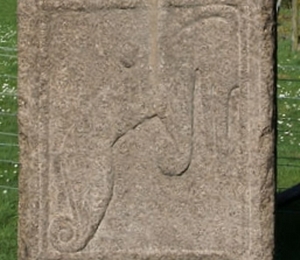
Maiden Stone, detail of eastern face.
Line drawing of Pictish beast.

The Pictish Beast (sometimes Pictish Dragon or Pictish Elephant) is a conventional representation of an animal, distinct to the early medieval culture of the Picts of Scotland. The great majority of surviving examples are on Pictish stones.

The Pictish Beast accounts for about 40% of all Pictish animal depictions, and so was likely of great importance.[citation needed]

Depiction on stones

[edit]

A comprehensive collection of depictions of the Pictish Beast was given by John Stuart as Plate 22 in Sculptured Stones of Scotland Volume 2, 1867.[1] Depictions are shown at a consistent scale and oriented as they were on the stones. The sequence in which they appear is described[1] as

indicating their development from the outline form in which they first appear on the rude pillars, to that in which the outline is filled up with the ornamental devices of the cross-slabs

The orientation of the beast's back on Stuart's Plate 22 is predominantly horizontal, or slightly inclined; only on the Maiden Stone and at Dunfallandy is it at 45° and on Meigle 5 vertical. The last may be explained by its position on the stone: it is on the narrow left side, where it occupies 90% of the available width. One omission from Stuart's plate is the symbol in the Doo Cave at East Wemyss, recorded by Anderson in 1881. Anderson described it as "the symbolic animal, with the long jaws and the crest and the scroll-like feet". Absent from the Doo Cave figure is the crest from the top of the beast's head and the tail; the rear scroll-like feet are clearly divided into two limbs.

Plate showing Pictish Beast from Stuart: Sculptured Stones of Scotland Vol 2, 1867

Interpretation

[edit]

In the Historic Scotland guidebook The Picts, Jill Harden writes[2]:

... most common of all [the animal symbols] is the Pictish beast. This intriguing figure is clearly swimming. Is it a porpoise, a dolphin or a creature of myth?

Cetaceans are present along the east coast of Scotland. Chanonry Point and the Sutors of Cromarty lie close to the Pictish monasteries at Portmahomack and Rosemarkie and are recognised as some of the best sites in Britain for viewing bottlenose dolphins from the land.

One characteristic of cetaceans is their blowhole (one for dolphins, porpoises and beaked whales; two for baleen whales). When cetaceans reach the water surface to breathe, they expel air through the blowhole. Water vapour in the exhalation condenses, producing a visible spout which trails behind the cetacean as it moves forward. This has a similar appearance to the crest from the head of the Pictish beast.

Other suggested identifications of the Pictish beast have included an elephant, a kelpie (or each uisge), a seahorse, and an anteater.

Whatever its origin, its presence on many Christian stones and its position on them implies that, as with the crescent and V-rod, it had by then acquired a Christian meaning[3] which appealed to those erecting the stones, e.g. salvation.

See also

[edit]

References

[edit]

Bibliography

[edit]
[edit]
Revisions and contributorsEdit on WikipediaRead on Wikipedia
from Grokipedia
The Pictish Beast is an enigmatic and distinctive animal symbol carved on early medieval symbol stones associated with the , a of tribes in northern and eastern from roughly the 3rd to 9th centuries AD. It typically depicts a serpentine creature with an elongated neck, small head, curved body, and fin-like appendages, evoking a hybrid of aquatic and equine forms such as a or , often infilled with or spiral patterns. This motif appears on more than 50 known stones, predominantly Class I (undecorated slabs with incised symbols) and Class II (cross-slabs with Christian iconography alongside symbols), concentrated in regions like , , , and and . Possibly emerging as early as the AD—with recent radiocarbon studies supporting origins in the 3rd–4th centuries, though most examples date to the 6th to 8th centuries—the Pictish Beast is one of around 50 recurring symbols in Pictish art, which likely served non-alphabetic functions such as marking territory, commemorating individuals, or denoting tribal affiliations during a period of cultural transition from to . Scholarly interpretations suggest possible influences from late Roman provincial art, including depictions of hippocampi or dolphins on altars and mosaics encountered through trade or conflict in northern Britain, though its precise significance—whether totemic, mythological, or social—remains debated due to the absence of written Pictish records. These symbols, including the Beast, highlight the ' sophisticated stone-carving tradition, which blended indigenous Celtic motifs with emerging Insular Christian styles, contributing to Scotland's early medieval artistic legacy.

Historical Context

The Picts and Their Culture

The were an ancient people inhabiting northern and eastern from the through the early medieval period, emerging as a distinct by around the AD and persisting until their assimilation into the Kingdom of Alba by the AD. The term "Picts," derived from the Latin Picti meaning "painted ones," was first recorded by the Roman orator Eumenius in 297 AD, likely referring to their practice of or tattooing, a custom noted by Roman writers to distinguish them from other Britons. Their territory spanned from the northward to the Highlands and eastern coasts, encompassing diverse landscapes that supported a primarily agricultural society organized into tribal groups or kingdoms, such as the Verturiones and Taexali. Pictish society functioned as a loose tribal , with power centered on kings and elites who coordinated defenses and alliances, evidenced by hillforts and ringworks from the late onward. They maintained hostile relations with the Romans, who built the (c. 142 AD) as a northern and described Pictish warriors as fierce raiders in accounts like Tacitus's Agricola. Later interactions included conflicts and cultural exchanges with incoming Scots ( from ) in the west and Norse from the , culminating in the Pictish victory at the Battle of Dunnichen (685 AD) over the Northumbrians and the eventual unification under around 843 AD. was gradually adopted among the starting in the 5th-6th centuries, influenced by missionaries like St. Ninian in the south (c. 397 AD) and St. Columba at (563 AD), with full integration by the 7th-8th centuries as seen in monastic foundations and the shift toward Gaelic ecclesiastical influence. The ethnic and linguistic origins of the Picts remain subjects of scholarly debate, with evidence suggesting they were indigenous to , possibly descending from Iron Age tribes like the Caledonii mentioned by Roman sources, rather than overseas migrants. Linguistically, Pictish is classified by most modern scholars as a Brittonic (P-Celtic) language closely related to Welsh or , diverging early from other Celtic tongues, though some argue for pre-Celtic or non-Indo-European substrates based on place-names and ogham inscriptions; their language became extinct by the 11th century, supplanted by Gaelic. Pictish inscriptions often employed the script, an Irish-derived alphabet adapted for their dialect, appearing on stones and artifacts from the 5th-7th centuries. Pictish art is characterized by abstract, non-figurative styles featuring intricate geometric symbols, animals, and motifs carved on stone slabs, metalwork, and jewelry, reflecting a sophisticated that likely served social or territorial functions. With the in the , artistic traditions evolved to incorporate Celtic crosses and biblical scenes on Class III symbol stones, blending pagan symbols with Christian iconography in a distinctive Insular style. These symbol stones remain the primary surviving artifacts of Pictish , offering key insights into their .

Pictish Symbol Stones

Pictish symbol stones are classified into three main categories based on their design, decoration, and historical context. Class I stones, dating primarily to the 6th and 7th centuries, consist of undecorated boulders or slabs featuring only incised symbols on one face, with the reverse typically left plain. Class II stones, from the 8th and 9th centuries, are more elaborate rectangular slabs with a prominent Christian cross and associated decoration on one side and Pictish symbols on the other. Class III stones, emerging in the later 8th and 9th centuries, feature crosses without accompanying symbols, reflecting a shift toward purely Christian iconography. These stones are distributed mainly across northeast Scotland, with concentrations in regions such as , Angus, and extending northward to the and southward to , though outliers appear as far west as the Western Isles. Over 200 such stones have been identified, with Class I examples forming the majority and often found in rural or coastal settings. The materials used were typically local varieties, including , , and , sourced from nearby quarries or natural outcrops to facilitate transport and erection. Carving techniques varied by class: Class I stones employed incising, where lines were chipped into the surface using hard stone or metal tools to create outline designs up to several centimeters deep. In contrast, Class II and III stones utilized relief carving, involving the removal of background material to raise motifs, often with finer detailing achieved through chiseling and abrasion for a more sculptural effect. Scholars propose that these stones served multiple functions, including as memorials for individuals or kin groups, territorial boundary markers, or communal religious monuments, supported by their frequent association with sites, settlements, and inscriptions naming persons. The evolution from pagan symbols in Class I to Christian crosses in later classes reflects the ' gradual adoption of from the 7th century onward.

Description and Depictions

Physical Characteristics of the Symbol

The Pictish Beast symbol is characterized by an elongated, sinuous body that typically adopts a horizontal or diagonal orientation, evoking a or pose. Its head features long jaws or a beak-like that curls outward at the tip, often accompanied by a indicated by one or two lines. A prominent crest or mane runs along the back in many depictions, adding to the creature's distinctive . The limbs end in scroll-like or spiraled forms resembling flippers or coiled feet, while the tail is usually drooping and spiral-ended, sometimes reduced to a simple line. The body is frequently infilled with decorative elements such as , , or spirals, rendered in incised lines of varying depth that contribute to a stylized rather than naturalistic style. This approach aligns with broader Pictish animal motifs, like boars and eagles, which emphasize abstract, non-impressionistic forms for symbolic consistency. Depictions vary slightly across examples, with the symbol most commonly horizontal but occasionally angled at 45 degrees or, rarely, vertical; some instances omit the crest or tail, as seen in cave carvings like those at the Wemyss Caves (including Doo Cave). On symbol stones, the Beast measures up to 1-2 meters in length, scaled to the slab's dimensions, and appears on both Class I (incised) and Class II (relief) stones. The symbol was first systematically cataloged and illustrated by John Stuart in his 1867 publication Sculptured Stones of Scotland, Volume 2, which compiled early archaeological documentation.

Notable Examples on Stones

The Pictish Beast symbol appears on over 50 known Pictish stone sculptures, making it one of the most frequently depicted motifs in the corpus, and it accounts for about 40% of all animal symbols on these monuments. It is found across a wide geographic range, from Orkney in the north to Fife in the south, often in association with other abstract symbols such as the crescent and V-rod, double disc and Z-rod, or mirror and comb. Many examples were discovered or documented in the 19th century during antiquarian surveys, with some stones now damaged, relocated to museums like the National Museums Scotland in Edinburgh, or preserved in situ at churchyards and roadside locations. One prominent Class II example is the Maiden Stone, located near in , where the Beast is carved in an angled pose on the eastern face below a notched rectangle and Z-rod, accompanied by a mirror and comb in a separate panel; the stone, standing about 3 meters tall, was likely erected in the 8th or and remains in its original roadside position despite some . Similarly, the Brodie Stone (also known as Rodney's Stone), a Class II cross-slab at Brodie Castle in , features the Beast in a swimming-like pose on the symbols face below two fish monsters and above a double disc and Z-rod; discovered in the 19th century and now displayed in a woodland setting near the castle, it measures approximately 2 meters and includes inscriptions on the edges. In Angus, a notable Class I example is the Aberlemno Horseshoe Stone, discovered in a field in 1962 and now in the Aberlemno churchyard, shows the Beast incised alongside a horseshoe symbol; this roadside monument, dating to the 7th-8th centuries, was recorded post-discovery and is well-preserved in its location. The Dunfallandy Stone in Perthshire, a Class II cross-slab near Pitlochry, displays the Beast in a near-vertical orientation above a crescent and V-rod and below a double disc on the reverse side, integrated with human figures like seated clerics and a horseman; erected around the 8th century and still in situ beside a church, it was documented in the 19th century with minimal damage. A rarer upright depiction appears on Meigle 5, a Class II fragment in the Meigle Sculptured Stone Museum in , where the Beast is carved on the side panel alongside interlace patterns and other motifs like a double disc; this 9th-century stone was found in the among a group of sculptures from a local and relocated to the museum for protection, though parts are missing due to erosion.

Interpretations and Symbolism

Early and Historical Theories

In the , early antiquarians began systematically documenting Pictish symbol stones, bringing attention to the enigmatic Pictish Beast as a prominent animal motif. John Stuart's comprehensive catalog, The Sculptured Stones of Scotland (volumes 1 and 2, published in 1856 and 1867 respectively), illustrated numerous examples of the Beast across various stones in Plate 22 of volume 2, describing it as a sinuous, elongated creature with a protruding snout, spiraled feet, and a curving body reminiscent of mythical serpents or dragons in ancient lore. These depictions were often interpreted through the lens of , where serpentine beasts symbolized chaos, guardianship, or supernatural forces, though Stuart himself focused primarily on rather than definitive meaning. Building on Stuart's work, late 19th- and early 20th-century scholars proposed that the Pictish Beast, along with other animal symbols, functioned as tribal representing clans, lineages, or territorial markers within Pictish society. J. Romilly Allen and Joseph Anderson, in their influential The Early Christian Monuments of (1903), classified the stones into three types and suggested that such symbols encoded social or information, potentially linking the Beast to specific Pictish groups or hereditary identities, while noting its absence of direct parallels in neighboring Celtic traditions. This totem theory emphasized the Beast's role in pre-Christian Pictish identity, distinguishing it from more geometric motifs and underscoring its uniqueness amid broader styles. Folk interpretations in Scottish traditions have occasionally equated the Pictish Beast with water-dwelling monsters from local legends, such as —malevolent shape-shifting spirits said to inhabit lochs and rivers, luring unwary travelers to their doom. This association arose from the symbol's fluid, aquatic posture, evoking tales of elusive water beasts preserved in Highland , with some early 20th-century accounts positing it as an ancient precursor to stories like that of the . By the early to mid-20th century, interpretations shifted toward more speculative origins, including suggestions that the Beast depicted an exotic animal like an , possibly encountered through Roman trade networks or Viking exchanges, though its stylized form and regional exclusivity led scholars to dismiss stronger Roman or Norse influences in favor of indigenous Pictish invention. On Class II stones, where the Beast appears alongside Christian crosses and inscriptions, early theories proposed a symbolic overlay, interpreting it as a representation of or akin to biblical serpents, serving to contrast pagan elements with emerging Christian during the ' conversion. For instance, the Beast on the Maiden Stone in integrates with cross imagery, potentially embodying such dual motifs.

Modern Scholarly Interpretations

In the 20th and 21st centuries, scholars have proposed various biological interpretations for the Pictish Beast, often emphasizing its aquatic features due to the coastal settings of many symbol stones. Some analyses suggest that the creature's elongated body, blowhole-like crest, and sinuous form resemble a cetacean such as a or harbor porpoise, particularly given the ' maritime environment along Scotland's northern and eastern coasts. This view aligns with the Beast's frequent depiction in a pose, appearing on approximately 44 stones primarily from the 6th to 8th centuries AD. Alternative biological identifications include a stylized or , drawing on the creature's curved tail and fin-like elements, with some researchers noting parallels to hybrid marine motifs in Irish ogham-inscribed stones from the same . Beyond literal identifications, modern interpretations often view the Beast as a , potentially representing a or status marker within Pictish , as its recurrence on prominent stones implies communal significance rather than individual portraiture. Linguistic analyses have explored links to the lost , which may have been Brittonic, with some symbols possibly encoding animal-related terms or names, though the non-alphabetic nature of the system renders such connections highly debated and unproven. Despite these theories, no scholarly consensus exists on the Beast's precise meaning, with critiques highlighting the speculative nature of biological analogies and the challenges posed by the ' undeciphered symbols. Recent 2020s projects by , including conservation efforts on Class I and II stones and the 2025 display of the rediscovered Ulbster 2 stone, underscore broader themes of cultural hybridity in Pictish art—blending indigenous, Celtic, and incoming influences—but have not yielded Beast-specific breakthroughs beyond reinforcing its enigmatic status.

Cultural and Archaeological Significance

Role in Pictish Society and Art

The Pictish Beast holds a prominent place within the repertoire of symbols carved on Pictish stones, appearing on over fifty sculptures and underscoring its significance in the artistic canon of early medieval . Its frequency, particularly in regions like , Angus, and , and , highlights its integration into a standardized system of motifs that evolved from the simpler incised designs of Class I stones (5th–7th centuries, associated with pagan contexts) to the more elaborate carvings of Class II stones (8th–9th centuries, incorporating Christian elements like crosses). This progression reflects the Beast's adaptability in Pictish art, transitioning from ritualistic expressions in pre-Christian monumental traditions to elements within a syncretic Christian-Pictish . In Pictish society, the Beast likely served multifaceted social functions, potentially acting as a tribal identifier or marker of lineage that denoted membership in specific kin groups or territories. Its frequent pairing with inscriptions, which often record personal names, supports interpretations of the symbol as part of a quasi-grammatical system used for memorials or commemorative purposes, possibly honoring the deceased or asserting social continuity. Placement of Beast-bearing stones near settlements or sacred landscapes further suggests roles in political or demarcation, reinforcing identity and in a fragmented tribal structure. Comparatively, the Beast exhibits parallels with other Pictish motifs, such as the and V-rod, both drawing from shared Classical influences like Roman depictions of dolphins and crescents on altars, which may symbolize complementary aspects of power or protection in a cohesive symbolic grammar. These interconnections highlight the Beast's role in a broader artistic framework that mirrors societal hierarchies, with potential echoes in later medieval Scottish , such as hybrid creatures in illuminated manuscripts. Scholarly hypotheses also link the Beast to or connotations, based on its association with high-status contexts like royal or ecclesiastical sites, where symbols authenticated socio-political legitimacy through ritual or mythological resonance. While some interpretations posit the Beast as an aquatic creature akin to a hippocampus, this remains secondary to its societal emblematic functions.

Preservation, Study, and Recent Research

Pictish symbol stones, including those featuring the Beast motif, face significant threats from environmental weathering and human activities such as vandalism, which have accelerated deterioration over centuries. Conservation initiatives in Scotland, such as the Pictish Trails in regions like Easter Ross, Moray, and Angus, promote public awareness and site protection by guiding visitors to key locations while emphasizing protective measures like seasonal coverings to shield stones from harsh weather. Additionally, relocations to controlled environments have preserved notable examples; for instance, the Dunnichen Stone, bearing Pictish symbols, was moved from its original site to the McManus: Dundee's Art Gallery and Museum in 1972 for long-term safeguarding. Advances in study methods since the have enhanced documentation and analysis of these stones through technologies like 3D laser scanning, enabling detailed virtual models that capture intricate carvings without physical contact. Projects such as those by Swedish researchers in 2019 and the University of Aberdeen's Ra-Pict initiative in 2023 have applied and to replicate Pictish symbols, facilitating non-invasive study and public access. Digital catalogs, including the Pictish Stone Database developed by the Universities of and , provide comprehensive inventories and interactive mapping of surviving stones, building on frameworks like the Corpus of early medieval sculpture to standardize recording. Geochemical analyses of stone provenance, though less emphasized for symbols specifically, have informed broader understanding of material sourcing in Pictish contexts through isotopic studies at sites like Rhynie. Post-2020 research by has focused on symbol documentation and conservation, including grants for cleaning and displaying newly discovered stones, such as the 2022 find near the Battle of Dunnichen site featuring multiple Pictish motifs. While no major breakthroughs specific to the Beast symbol have emerged, ongoing projects from 2022 to 2025 examine symbol standardization across carvings, using enhanced imaging to trace stylistic consistencies. Experimental applications of computational , drawing from earlier statistical models, have begun trialing motif clustering to identify variations in symbol deployment, though full AI integration remains in preliminary stages. Challenges persist due to the estimated loss or destruction of a substantial portion of original stones—approximately 350 are known to survive from potentially thousands, with many repurposed or eroded beyond recognition. Future directions emphasize interdisciplinary approaches, integrating genetic analyses of Pictish skeletal remains to contextualize cultural origins alongside linguistic decipherment efforts using statistical models on symbol pairings.

References

Add your contribution
Related Hubs
User Avatar
No comments yet.