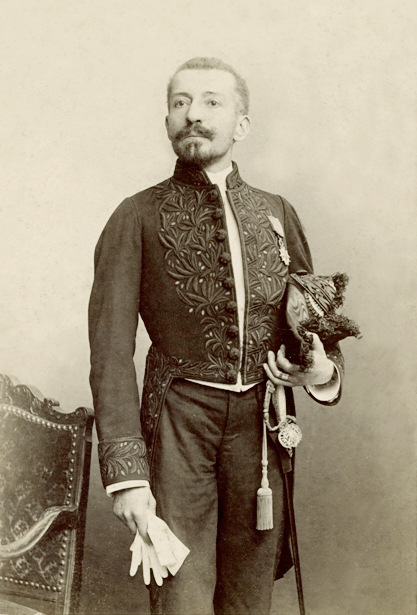

Pierre Loti
View on WikipediaPierre Loti (French: [pjɛʁ lɔti]; pseudonym of Louis Marie-Julien Viaud [lwi maʁi ʒyljɛ̃ vjo]; 14 January 1850 – 10 June 1923)[1] was a French naval officer and novelist, known for his exotic novels and short stories.[2]
Key Information


Biography
[edit]Born to a Protestant family,[3] Loti's education began in his birthplace, Rochefort, Charente-Maritime. At age 17 he entered the naval school in Brest and studied at Le Borda. He gradually rose in his profession, attaining the rank of captain in 1906. In January 1910 he went on the reserve list. He was in the habit of claiming that he never read books, saying to the Académie française on the day of his introduction (7 April 1892), "Loti ne sait pas lire" ("Loti doesn't know how to read"), but testimony from friends proves otherwise, as does his library, much of which is preserved in his house in Rochefort. In 1876 fellow naval officers persuaded him to turn into a novel passages in his diary dealing with some curious experiences in Istanbul. The result was the anonymously published Aziyadé (1879), part romance, part autobiography, like the work of his admirer, Marcel Proust, after him.
Loti proceeded to the South Seas as part of his naval training, living in Papeete, Tahiti for two months in 1872, where he "went native". Several years later he published the Polynesian idyll originally titled Rarahu (1880), which was reprinted as Le Mariage de Loti, the first book to introduce him to the wider public. His narrator explains that the name Loti was bestowed on him by the natives, after his mispronunciation of "roti" (a red flower). The book inspired the 1883 opera Lakmé by Léo Delibes. Loti Bain, a shallow pool at the base of the Fautaua Falls, is named for Loti.[4]
This was followed by Le Roman d'un spahi (1881), a record of the melancholy adventures of a soldier in Senegal. In 1882, Loti issued a collection of four shorter pieces, three stories and a travel piece, under the general title of Fleurs d'ennui (Flowers of Boredom).
In 1883 Loti achieved a wider public spotlight. First, he published the critically acclaimed Mon Frère Yves (My Brother Yves), a novel describing the life of a French naval officer (Pierre Loti), and a Breton sailor (Yves Kermadec, inspired by Loti companion Pierre le Cor), described by Edmund Gosse as "one of his most characteristic productions". Second, while serving in Tonkin (northern Vietnam) as a naval officer aboard the ironclad Atalante, Loti published three articles in the newspaper Le Figaro in September and October 1883 about atrocities that occurred during the Battle of Thuận An (20 August 1883), an attack by the French on the Vietnamese coastal defenses of Hue. He was threatened with suspension from the service for this indiscretion, thus gaining wider public notoriety. In 1884 his friend Émile Pouvillon dedicated his novel L'Innocent to Loti.
In 1886 Loti published a novel of life among the Breton fisherfolk, called Pêcheur d'Islande (An Iceland Fisherman), which Edmund Gosse characterized as "the most popular and finest of all his writings."[2] It shows Loti adapting some of the Impressionist techniques of contemporary painters, especially Monet, to prose, and is a classic of French literature. In 1887 he brought out a volume "of extraordinary merit, which has not received the attention it deserves", Propos d'exil, a series of short studies of exotic places, in his characteristic semi-autobiographic style. Madame Chrysanthème, a novel of Japanese manners that is a precursor to Madama Butterfly and Miss Saigon, was published the same year.[5]

In 1890 Loti published Au Maroc, the record of a journey to Fez in company with a French embassy, and Le Roman d'un enfant (The Story of a Child), a somewhat fictionalized recollection of Loti's childhood that would greatly influence Marcel Proust. A collection of "strangely confidential and sentimental reminiscences", called Le Livre de la pitié et de la mort (The Book of Pity and Death) was published in 1891.
Loti was aboard ship at the port of Algiers when news reached him of his election, on 21 May 1891, to the Académie française. In 1892 he published Fantôme d'orient, a short novel derived from a subsequent trip to Constantinople, less a continuation of Aziyadé than a commentary on it. He described a visit to the Holy Land in three volumes, The Desert, Jerusalem, and Galilee, (1895–1896), and wrote a novel, Ramuntcho (1897), a story of contraband runners in the Basque province. In 1898 he collected his later essays as Figures et Choses qui passaient (Passing Figures and Things).

In 1899 and 1900 Loti visited British India, with the view of describing what he saw; the result appeared in 1903 in L'Inde (sans les anglais) (India (without the English)). During the autumn of 1900 he went to China as part of the international expedition sent to combat the Boxer Rebellion. He described what he saw there after the siege of Peking in Les Derniers Jours de Pékin (The Last Days of Peking, 1902).
Loti's later publications include: La Troisième jeunesse de Mme Prune (The Third Youth of Mrs. Plum, 1905), which resulted from a return visit to Japan and once again hovers between narrative and travelog; Les Désenchantées (The Unawakened, 1906); La Mort de Philae (The Death of Philae, 1908), recounting a trip to Egypt; Judith Renaudin (produced at the Théâtre Antoine, 1898), a five-act historical play that Loti presented as based on an episode in his family history; and, in collaboration with Emile Vedel, a translation of William Shakespeare's King Lear, produced at the Théâtre Antoine in 1904. Les Désenchantées, which concerned women of the Turkish harem, was based like many of Loti's books, on fact. It has, however, become clear that Loti was in fact the victim of a hoax by three prosperous Turkish women.[6][7]
In 1912 at the Century Theatre in New York City, Loti mounted a production of The Daughter of Heaven, a George Egerton adaptation of his French play La fille du ciel, commissioned in March 1903 by Sarah Bernhardt, written in collaboration with Judith Gautier and published in 1911.[8][9][10][11] The play was never performed in France, since apparently Bernhardt lost interest when she learned she would have to wear a black wig over her red hair.[12] In New York the title role was performed by Viola Allen.[9]
He died in 1923 in Hendaye and was interred on the island of Oléron with a state funeral.
Loti was an inveterate collector and his marriage into wealth helped him support this habit. His house in Rochefort, a remarkable reworking of two adjacent bourgeois row houses, is preserved as a museum.[13] One elaborately tiled room is an Orientalist fantasia of a mosque, including a small fountain and five ceremoniously draped coffins containing desiccated bodies. Another room evokes a medieval banqueting hall. Loti's own bedroom is rather like a monk's cell, but mixes Christian, Persian and Muslim religious artifacts. The courtyard described in The Story of a Child, with the fountain built for him by his older brother, is still there. There is also a museum in Istanbul named after him located on a hill where Loti used to spend his free time during his sojourn in Turkey.
Works
[edit]
Contemporary critic Edmund Gosse gave the following assessment of his work:[2]
At his best Pierre Loti was unquestionably the finest descriptive writer of the day. In the delicate exactitude with which he reproduced the impression given to his own alert nerves by unfamiliar forms, colors, sounds and perfumes, he was without a rival. But he was not satisfied with this exterior charm; he desired to blend with it a moral sensibility of the extremest refinement, at once sensual and ethereal. Many of his best books are long sobs of remorseful memory, so personal, so intimate, that an English reader is amazed to find such depth of feeling compatible with the power of minutely and publicly recording what is felt. In spite of the beauty and melody and fragrance of Loti's books his mannerisms are apt to pall upon the reader, and his later books of pure description were rather empty. His greatest successes were gained in the species of confession, half-way between fact and fiction, which he essayed in his earlier books. When all his limitations, however, have been rehearsed, Pierre Loti remains, in the mechanism of style and cadence, one of the most original and most perfect French writers of the second half of the 19th century.
Bibliography
[edit]| French and Francophone literature |
|---|
| by category |
| History |
| Movements |
| Writers |
| Countries and regions |
| Portals |
- Aziyadé (1879)
- Le Mariage de Loti (originally titled Rarahu (1880))
- Le Roman d'un spahi (1881)
- Fleurs d'ennui (1882)
- Mon Frère Yves (1883) (English translation My Brother Yves)
- Les Trois Dames de la Kasbah (1884), which first appeared as part of Fleurs d'Ennui
- Pêcheur d'Islande (1886) (English translation An Iceland Fisherman)
- Madame Chrysanthème (1887)[14]
- Propos d'Exil (1887)
- Japoneries d'Automne (1889)
- Au Maroc (1890)
- Le Roman d'un enfant (1890)
- Le Livre de la pitié et de la mort (1891)
- Fantôme d'Orient (1892)
- L'Exilée (1893)
- Matelot (1893)
- Le Désert (1895)
- Jérusalem (1895)
- La Galilée (1895)
- Ramuntcho (1897)
- Figures et choses qui passaient (1898)
- Judith Renaudin (1898)
- Reflets sur la sombre route (1899)
- Les Derniers Jours de Pékin (1902)
- L'Inde (sans les Anglais) (1903)
- Vers Ispahan (1904)
- La Troisième Jeunesse de Madame Prune (1905)
- Les Désenchantées (1906)
- La Mort de Philae (1909)
- Le Château de la Belle au Bois dormant (1910)
- Un Pèlerin d'Angkor (1912)
- Turquie Agonisante (1913). An English translation, Turkey in Agony, was published in the same year.
- La Hyène enragée (1916)
- Quelques aspects du vertige Mondial (1917)
- L'Horreur allemande (1918)
- Les massacres d'Arménie (1918)
- Prime Jeunesse (1919)
- La Mort de notre chère France en Orient (1920)
- Suprêmes Visions d'Orient (1921), written with the help of his son Samuel Viaud
- Un Jeune Officier pauvre (1923, posthumous)
- Lettres à Juliette Adam (1924, posthumous)
- Journal intime (1878–1885), 2 vol (private diary, 1925–1929, posthumous)
- Correspondence inédite (unpublished correspondence from 1865 to 1904, 1929, posthumous)
Filmography
[edit]- Le Roman d'un spahi, directed by Henri Pouctal (1914, based on the novel Le Roman d'un spahi)
- Pêcheur d'Islande, directed by Henri Pouctal (1915, short film, based on the novel Pêcheur d'Islande)
- Ramuntcho, directed by Jacques de Baroncelli (1919, short film, based on the novel Ramuntcho)
- Pêcheur d'Islande, directed by Jacques de Baroncelli (1924, based on the novel Pêcheur d'Islande)
- Pêcheur d'Islande, directed by Pierre Guerlais (1934, based on the novel Pêcheur d'Islande)
- Le Roman d'un spahi, directed by Michel Bernheim (1936, based on the novel Le Roman d'un spahi)
- Ramuntcho, directed by René Barberis (1938, based on the novel Ramuntcho)
- The Marriage of Ramuntcho, directed by Max de Vaucorbeil (1947, based on the novel Ramuntcho)
- Ramuntcho, directed by Pierre Schoendoerffer (1959, based on the novel Ramuntcho)
- Pêcheur d'Islande, directed by Pierre Schoendoerffer (1959, based on the novel Pêcheur d'Islande)
References
[edit]- ^ "Pierre Loti | Encyclopedia.com". www.encyclopedia.com. Retrieved 15 August 2020.
- ^ a b c This article is derived largely from the Encyclopædia Britannica Eleventh Edition (1911) article "Pierre Loti" by Edmund Gosse. Unless otherwise referenced, it is the source used throughout, with citations made for specific quotes by Gosse.
- ^ Nemo, August (2019). Essential Novelists - Pierre Loti: literary impressionism. Tacet Books. ISBN 9788577772698.
"Pierre Loti," was born in Rochefort, of an old French-Protestant family, January 14, 1850..
- ^ "Buste de Pierre Loti, vallée de la Fautaua - Tahiti Heritage". www.tahitiheritage.pf (in French). 25 January 2015. Retrieved 8 March 2017.
- ^ See also Madame Chrysanthème by André Messager.
- ^ James, Graham (9 December 1923). "How Pierre Loti Was Duped". The New York Times.
- ^ Ömer Koç, 'The Cruel Hoaxing of Pierre Loti' Cornucopia, Issue 3, 1992.
- ^ Richard M. Berrong (2018). Pierre Loti, p. 185. London: Reaktion Books. ISBN 9781789140439.
- ^ a b "Loti-Gautier Play at Century Theatre", The New York Times, October 13, 1912.
- ^ Judith Gautier & Pierre Loti (1911). La Fille du ciel. Paris: Calmann Levy.
- ^ Danielle Mihram, "Judith Gautier", p. 174, in French Women Writers, edited by Eva Martin Sartori & Dorothy Wynne Zimmerman. Lincoln and London: University of Nebraska Press. ISBN 9780803292246.
- ^ Lesley Blanch (1983). Pierre Loti: Portrait of an Escapist. London: Collins. ISBN 9780002116497. London: BookBlast ePublishing, 2015. ISBN 9780993092787.
- ^ "Pierre Loti's House - Rochefort - Michelin Travel". Archived from the original on 14 August 2014. Retrieved 1 May 2015.
- ^ Pierre Loti (1908). Madame Chrysanthème. Current literature publishing company.
Sources
[edit]- This article incorporates text from a publication now in the public domain: Gosse, Edmund William (1911). "Loti, Pierre". Encyclopædia Britannica. Vol. 17 (11th ed.). pp. 19–20.
- Berrong, Richard M. (2013). Putting Monet and Rembrandt into Words: Pierre Loti's Recreation and Theorization of Claude Monet's Impressionism and Rembrandt's Landscapes in Literature. Chapel Hill: North Carolina Studies in Romance Language and Literature. vol 301.
- Aldrich, Robert (2002). Who's Who in Gay and Lesbian History from Antiquity to World War II. Routledge; London. ISBN 0-415-15983-0.
- Lesley Blanch (UK:1982, US:1983). Pierre Loti: Portrait of an Escapist. US: ISBN 978-0-15-171931-0 / UK: ISBN 978-0-00-211649-7 – paperback re-print as Pierre Loti: Travels with the Legendary Romantic (2004) ISBN 978-1-85043-429-0
- Edmund B. D'Auvergne (2002). Pierre Loti: The Romance of a Great Writer. Kessinger Publishing. ISBN 978-1-4325-7394-2 (paper), ISBN 978-0-7103-0864-1 (hardcover).
- Ömer Koç, 'The Cruel Hoaxing of Pierre Loti' Cornucopia,[1] Issue 3, 1992

External links
[edit]
Official
- Official site of Maison Pierre Loti Archived 26 February 2012 at the Wayback Machine, house museum in Rochefort, in French.
Sources
- Works by Pierre Loti at Project Gutenberg
- Works by Pierre Loti at Faded Page (Canada)
- Works by or about Pierre Loti at the Internet Archive
- Works by or about Julien Viaud at the Internet Archive
- Works by Pierre Loti at LibriVox (public domain audiobooks)


Commentary
- René Doumic. Contemporary French Novelists. New York, Boston : T. Y. Crowell & company. 1899. Biography and critical summary of Loti. From Internet Archive.
- Edmund Gosse. French Profiles. New York : Dodd, Mead and company. 1905. Collected reviews of Loti's works, by literary critic Edmund Gosse. From Internet Archive.
- Albert Leon Guerard. Five Masters of French Romance: Anatole France, Pierre Loti, Paul Bourget, Maurice Barrès, Romain Rolland. London T. Fisher Unwin. 1916. Biography and literary survey of major works. From Internet Archive.
- Frank Harris. Contemporary portraits. Second series. New York. 1919. Personal recollections of Loti. From Internet Archive.
- Henry James, ed. Impressions. Westminster : A. Constable and Co. 1898. Introduction by Henry James about Loti's life and works. From Internet Archive.
- Winifred (Stephens) Whale. French Novelists of To-day. London : John Lane; New York, John Lane company. 1908; see chapter "Pierre Loti", biography and literary survey. From Internet Archive.
- Easter Island Foundation sells an English translation of Loti's account of his visit to Easter Island, along with those of Eugène Eyraud, Hippolyte Roussel and Alphonse Pinart, under the title Early Visitors to Easter Island 1864–1877.
- Pierre Lotis' Madame Chrysanthème
- Newspaper clippings about Pierre Loti in the 20th Century Press Archives of the ZBW
| International | |
|---|---|
| National | |
| Academics | |
| Artists | |
| People | |
| Other | |

Pierre Loti
View on GrokipediaEarly Life
Family Background and Childhood
Louis Marie-Julien Viaud, who later adopted the pseudonym Pierre Loti, was born on January 14, 1850, in Rochefort, Charente-Maritime, France, into one of the city's few Protestant families amid a predominantly Catholic population.[1][3] His father, Théodore Viaud, converted to Protestantism shortly before his marriage, while his mother, Nadine Texier, hailed from a lineage deeply rooted in Huguenot traditions, with ancestors among the survivors of the Revocation of the Edict of Nantes in 1685.[1][3] The family belonged to the local bourgeoisie, reflecting a middle-class status typical of provincial French Protestant communities during the July Monarchy's later years.[6] As the youngest child in this pious Protestant household, Viaud experienced a childhood marked by strict religious observance and insular family dynamics, which initially fostered a deep faith that he would later abandon.[7][8] His early years in Rochefort, a naval port town, exposed him to maritime influences from a young age, though his immediate environment emphasized moral rigor and Protestant ethics over the seafaring world he would later embrace.[9] In 1866, the family faced scandal when Viaud's father was accused of embezzlement in his role as a customs official, an event that strained household stability and may have contributed to the young Viaud's introspective tendencies.[8] Despite such challenges, his upbringing instilled a sensitivity to exoticism and melancholy, themes that permeated his future writings, though these were shaped more by innate disposition than by overt family narratives.[7]Education and Entry into the Navy
Viaud received his initial education in Rochefort, Charente-Maritime, where he was born on 14 January 1850. Local schooling laid the foundation for his later pursuits, though specific details on primary or secondary institutions remain limited in contemporary records. Destined for a naval career, likely influenced by familial expectations in a maritime region, he transitioned to specialized training at age seventeen. In 1867, Viaud entered the École Navale in Brest, studying aboard the training ship Le Borda, a vessel used for practical instruction in seamanship and naval discipline.[1] This institution prepared cadets through rigorous drills, navigation exercises, and theoretical coursework, emphasizing the technical and operational demands of French naval service during the Second Empire. Graduating that same year, he commenced active duty as a midshipman (aspirant de marine), marking his formal entry into the navy.[7] By 1869, Viaud had embarked on his inaugural voyage to the Mediterranean, initiating a career that spanned over four decades and involved progressive promotions, including to officer in 1872.[1][10] This early phase underscored the navy's role in expanding French influence abroad, providing Viaud with direct exposure to global ports that later informed his literary works.[11]Naval Career
Key Assignments and Promotions
Viaud entered the École Navale in October 1867, completing initial training aboard the school ship Borda in Brest until August 1869, followed by instructional cruises on vessels such as Bougainville along the Atlantic coast and Jean-Bart in the Mediterranean, North Africa, Atlantic, Brazil, and North America.[12] Promoted to aspirant de marine around 1871, he participated in extended Pacific voyages, including from Lorient to Valparaíso via the Strait of Magellan on Vaudreuil (March to November 1871) and a Polynesian cruise on Flore until December 1872, experiences that informed his early literary depictions of exotic locales.[12][10] Elevated to enseigne de vaisseau in 1873, Viaud's assignments included brief Mediterranean duties on Bretagne and Savoie, followed by Senegal postings on Entreprenante (September 1873) and Pétrel (September 1873 to May 1874), where he engaged in coastal operations and transport amid colonial activities.[12] Further service encompassed Espadon along the Senegal coast (May to September 1874), Thétis (February 1876), and Couronne in the Mediterranean, including interventions near Salonica, Turkey (March to August 1876).[12] He continued with Black Sea patrols on Gladiateur from August 1876 and trials on Bouvet in 1877.[12] Promoted to lieutenant de vaisseau in 1881, Viaud saw action in the Tonkin campaign aboard Atalante in the China Seas (May to December 1883), contributing to French colonial efforts in Indochina.[11][12] From 1885 to 1891, he served extensively in Chinese and Japanese waters on ships including Château-Yquem, Triomphante, and Mytho, overseeing transports and operations that shaped his observations of East Asian societies.[11][12] Intermediate commands included Magicien at Rochefort (1886) and Ecureuil in the Charente (1888–1889).[12] Later promotions included capitaine de corvette by the late 1890s, with Mediterranean assignments on Formidable, Courbet, and Javelot (1891), and command of Vautour at Constantinople in 1903.[12] Advanced to capitaine de vaisseau around 1900, he served as aide-de-camp aboard Redoutable in the China Seas from August 1900 to March 1902, before retiring with full captain's rank circa 1900–1906 after over three decades of active duty.[12][11]Global Travels and Cultural Immersions
Julien Viaud's naval service from 1867 onward enabled a series of voyages that exposed him to diverse cultures across the globe. His initial campaign in 1869–1870 aboard the Jean Bart encompassed the Mediterranean, North Africa, Turkey, the Atlantic, South America, and North America, providing early encounters with Islamic and indigenous societies.[13] In 1871, serving on the Vaudreuil and Flore, he traversed the Strait of Magellan into the Pacific, reaching Easter Island before arriving in Tahiti in 1872, where he resided for several months, adopting Polynesian attire and customs in a deliberate immersion that influenced his pseudonym "Loti," derived from the Tahitian term for rose.[13][10] Subsequent assignments deepened these experiences. Between 1873 and 1874, Viaud was posted to Dakar and Saint-Louis in Senegal, engaging with West African communities amid colonial operations.[13] From 1876 to early 1877 in Salonika and Constantinople, he formed a profound attachment to Ottoman culture, frequenting Eyüp district and entering a relationship with a local woman known as Aziyadé, which involved adopting Turkish dress and habits during clandestine meetings.[13][1] This period marked a pattern of cultural adoption, as he later documented in private journals later published as Aziyadé. In the Far East, Viaud's immersions intensified. During the 1883 Tonkin campaign and 1885 China seas deployment, he visited Indochina and Nagasaki, Japan, from July 8 to August 12, where in 1886 he arranged a temporary union with a geisha named Oané, living in a Japanese house and collecting local artifacts to recreate exotic interiors upon return.[13][10] These stays, aboard ships like La Triomphante, yielded detailed observations of daily life, rituals, and social structures, which he transformed into semi-autobiographical narratives emphasizing sensory and emotional engagement over detached analysis.[1] Later voyages extended this pattern. In 1889, an official mission to Morocco involved travels through Fès, immersing in Berber and Arab customs.[13] The 1894 Holy Land expedition covered Egypt, Petra, Palestine from Gaza to Nablus, Damascus, Beirut, and Baalbeck, blending pilgrimage with ethnographic notes on Levantine peoples.[13] From 1899 to 1902, assignments took him to India (Ceylon, Pondicherry, Delhi, Benares), Persia, China (Peking post-Boxer Rebellion), Korea, and Angkor, where he documented decaying temples and local animism, often prioritizing personal reverie and artifact acquisition—such as Japanese bronzes and Chinese ceramics—for his Rochefort home's themed rooms.[13][10] These immersions, while romanticized in his writings, relied on direct participation rather than superficial tourism, fostering a lifelong collection that recreated foreign milieus in France.[10]Literary Output
Debut and Pseudonym Adoption
Louis Marie-Julien Viaud, a French naval officer, made his literary debut with the anonymous publication of the novel Aziyadé in 1879.[1] [14] The work, presented as excerpts from a diary, blended romance and autobiography, drawing on Viaud's experiences during a 1876 posting to Constantinople aboard the French corvette Tourville.[15] [16] It depicted a clandestine affair between a European officer and a local woman named Aziyadé, set against the backdrop of Ottoman Istanbul's exoticism and decay.[14] To safeguard his naval career from potential scrutiny over fictionalized personal revelations, Viaud opted for pseudonymity in his writing, a common practice among military authors of the era to avoid professional repercussions.[10] For subsequent publications, he formalized the pen name Pierre Loti, which originated as a nickname from his school days in Rochefort, bestowed by comrades reflecting his reserved personality and affinity for the heliotrope flower.[17] The "Loti" element evoked Tahitian linguistic influences encountered during early voyages, aligning with the exotic themes of his oeuvre, while "Pierre" served as a simple given name to complete the alias.[10] This pseudonym debuted prominently with Le Mariage de Loti in 1880, marking Viaud's transition from anonymity to recognized authorship.[1] Aziyadé's initial obscurity gave way to critical notice, praised for its atmospheric detail and emotional intimacy despite the lack of attribution, foreshadowing Loti's reputation for evocative travel-infused narratives.[18] The adoption of Pierre Loti thus not only preserved Viaud's dual identity but also encapsulated his blend of naval discipline and imaginative escapism.[10]Major Novels and Themes
Pierre Loti's novels, often semi-autobiographical, transformed his travels into narratives blending adventure, romance, and introspection, with publication beginning in the late 1870s. His debut, Aziyadé (1879), recounts a French officer's passionate affair with a Turkish woman in Istanbul, emphasizing themes of forbidden love and cultural immersion amid Ottoman decay.[19] Similarly, Le Mariage de Loti (1880, originally Rarahu), set in Tahiti, explores a sailor's temporary union with a local woman, highlighting transient pleasures and the clash between Western desires and Polynesian customs.[19] Other significant works include Le Roman d'un spahi (1881), which follows a French soldier's life in Senegal, delving into colonial duty and personal disillusionment, and Mon frère Yves (1883), a tale of Breton sailors grappling with hardship and loyalty.[20] Loti achieved widespread acclaim with Pêcheur d'Islande (1886), portraying the grim existence of Icelandic fishermen in the North Atlantic, marked by stoic endurance against nature's fury and familial bonds strained by loss—selling over 100,000 copies in its first year.[21] Madame Chrysanthème (1887), inspired by his Japanese posting, depicts a pragmatic, short-term marriage to a geisha, critiquing superficial exotic attractions while evoking fleeting beauty and alienation.[19] Recurring themes across these novels include the ephemerality of love, often framed as doomed intercultural romances between European men and non-Western women, underscoring Loti's fascination with otherness and inevitable separation.[8] Melancholy permeates his portrayals of the sea as both livelihood and destroyer, symbolizing human fragility against vast, indifferent forces, as seen in the fatalistic tone of Pêcheur d'Islande. Nostalgia for vanishing traditions and a subtle ambivalence toward imperialism emerge, with Loti romanticizing "exotic" cultures while noting their erosion under Western influence, though without overt advocacy for conquest.[22] These elements reflect his firsthand observations, prioritizing sensory detail and emotional authenticity over moralizing, which distinguished his style amid fin-de-siècle French literature.[23]Non-Fiction and Later Writings
In the later phase of his career, following the success of his novels, Pierre Loti turned increasingly to non-fiction, producing travelogues, essays, and political commentaries drawn from his global experiences and post-naval observations. These works often blended descriptive reportage with personal reflections, emphasizing sensory details and cultural immersion over fictional narrative. A notable early example is Figures et choses qui passaient (1898), a collection of essays capturing ephemeral impressions of people, places, and customs encountered during his travels, noted for its lyrical prose and melancholic tone.[24] Among his prominent travelogues, Les Derniers jours de Pékin (1902) provided a firsthand account of the Boxer Rebellion's aftermath in China, detailing the siege of the foreign legations and the city's desolation as witnessed during his naval involvement in the international relief expedition; the book, published amid ongoing European interest in the event, sold widely and was translated into English as The Last Days of Pekin.[25] Loti's later explorations yielded works like Un pèlerin d'Angkor (1907), chronicling his journey through Cambodia's ancient Khmer ruins, where he evoked a sense of timeless mystery amid colonial-era rediscovery.[26] These texts prioritized vivid, impressionistic descriptions over analytical history, reflecting Loti's aesthetic rather than scholarly approach. Post-retirement from the navy in 1910, Loti's writings increasingly addressed political themes, particularly his advocacy for the Ottoman Empire amid its territorial losses and internal crises. In La Turquie agonisante (1913), a compilation of newspaper articles and letters, he contested European portrayals of Turkish "barbarism" and decline—especially regarding Armenian events—arguing instead for the empire's cultural vitality and victimhood under foreign pressures, a stance rooted in his longstanding Turcophilia from earlier Istanbul sojourns.[27] This position drew criticism for downplaying documented Ottoman actions, yet aligned with Loti's pattern of privileging personal affinities over adversarial reports from missionaries or diplomats. His final major work, Suprêmes visions d'Orient (1921, co-authored with his son Samuel Viaud), revisited Istanbul post-World War I, lamenting Allied occupation and defending Turkish sovereignty against partition schemes.[28] Autobiographical non-fiction also marked his later output, including Prime Jeunesse (1919), excerpts from his journals detailing early emotional turmoil, and Un jeune officier pauvre sur le Yorktown (1923), reflections on youthful naval hardships aboard the American vessel during his training voyage. These pieces, published amid declining health, underscored themes of isolation and exotic longing that permeated his oeuvre, though they received less acclaim than his travel accounts.[11] Overall, Loti's non-fiction reinforced his reputation as a chronicler of vanishing worlds, with sales in the tens of thousands for key titles, though modern assessments critique their romanticism as occasionally obscuring geopolitical realities.Political and Ideological Stances
Views on Oriental Cultures
![Pierre Le Cor, Pierre Loti et Okané-San.jpg][float-right]Pierre Loti expressed a profound fascination with Oriental cultures, portraying them in his writings as realms of mystery, sensuality, and timeless beauty threatened by Western modernization. His novels and travelogues, drawing from personal naval voyages, emphasized exotic customs, landscapes, and interpersonal encounters, often blending autobiography with fiction to evoke a nostalgic longing for an unchanging East. This perspective, while criticized by later scholars as orientalist for its emphasis on sensory and instinctive elements, reflected Loti's genuine immersion, including adopting local attire and languages during extended stays.[6][29] Loti's affinity for Muslim societies was particularly pronounced, stemming from an early 1869 voyage to Algeria where he developed what he described as a "half-Arab soul" and admitted to a "partiality for Muslim countries." In works like Aziyadé (1879), inspired by his 1876-1877 affair with a Circassian woman in Istanbul, he depicted Ottoman Turkey with romantic intensity, immersing himself in its harems, mosques, and daily life while learning Turkish and Arabic. He revisited Constantinople multiple times, defending the Ottoman Empire against European encroachments, including vehement opposition to its partition during World War I, which he viewed as a profound injustice exacerbating Turkey's "anguish." His sympathy extended to Morocco in Au Maroc (1890), where he urged resistance to European progress to preserve indigenous traditions like Fez's architecture and tribal fantasias, portraying the land as an "almost-Eden" untainted by modernity.[6][29][6] In contrast, Loti's engagement with Japan, chronicled in Madame Chrysanthème (1887), presented a more transient and enigmatic view, based on a temporary marriage to a Nagasaki geisha during his 1885 naval visit. The novel shaped early Western perceptions of Japan as a land of doll-like fragility and inscrutable rituals, with the protagonist experiencing emotional detachment and cultural superficiality amid Meiji-era transformations. While exoticizing elements like tea ceremonies as a "doll's tea-party," Loti conveyed melancholy over Japan's rapid Westernization, aligning with his broader critique of progress eroding authentic Oriental essence, as seen in his laments for Egypt's Nile tourism and Philae's impending flooding in La Mort de Philae (1907).[6]