


Pink ivory
View on Wikipedia
| Pink ivory | |
|---|---|

| |
_5.jpg)
| |
Scientific classification 
| |
| Kingdom: | Plantae |
| Clade: | Tracheophytes |
| Clade: | Angiosperms |
| Clade: | Eudicots |
| Clade: | Rosids |
| Order: | Rosales |
| Family: | Rhamnaceae |
| Genus: | Phyllogeiton |
| Species: | P. zeyheri
|
| Binomial name | |
| Phyllogeiton zeyheri | |
_IUCN_range_2018.svg)
| |
| Synonyms[2] | |
| |

Pink ivory (Phyllogeiton zeyheri), also called red ivory, purple ivory, umnini or umgoloti, is an African hardwood used to make a variety of products (for example: billiard cues and knife handles).[3] The pink ivory tree grows predominantly in Zimbabwe, Mozambique, Northern Botswana and South Africa.[2] The tree is protected and sustainably maintained in South Africa, only felled by very limited permit.[4][5] The wood is extremely hard, with a density of 990 g/dm3.
Usage
[edit]Pink ivory was the royal tree of the Zulu people[6] and only members of the royal family were allowed to possess it until the Anglo-Zulu War of 1879. Before the Anglo-Zulu War, the Zulu king (and prior to 1818, Zulu chiefs) would possess a pink ivory knobkerrie (a stick with a knob at one end) and also wear jewellery made from precious pink ivory wood. According to rumour, non-royals who possessed the wood would summarily be put to death. After Zululand fell to the British and was separated into 13 separate "kinglets" in 1883, all vying to retake control of what was once theirs precedent to the onset of apartheid, the pink ivory wood became much less important a sign of control than genuine control could be.
The pink ivory tree produces a yellow, brownish, reddish, or purplish drupe fruit that is delicious to taste. Other parts of the tree have been used traditionally as remedies and medicines.
Pink ivory is often cited as one of the most expensive woods in the world, along with African blackwood, sandalwood, agarwood and ebony.[7][8]
Etymology
[edit]The species epithet honours Karl Zeyher (1799–1858), a German botanical and entomological collector active in the Cape Colony from 1822 until his death during the local smallpox epidemic of 1858.[9] Other taxa bearing his name include Combretum zeyheri, Erythrina zeyheri, Mimusops zeyheri, and Stachys zeyheri.
Gallery
[edit]-
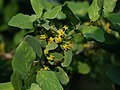 Flowers
 -
 Seeds
Seeds -
 Fruit
Fruit -
 Sombre greenbul (Andropadus importunus) on the eastern shore of Lake Sibayi, feeding on the fruit of the red ivory.


.jpg)
References
[edit]- ^ Botanic Gardens Conservation International (BGCI).; IUCN SSC Global Tree Specialist Group. (2020). "Berchemia zeyheri". IUCN Red List of Threatened Species. 2020 e.T61957049A146444651. doi:10.2305/IUCN.UK.2020-2.RLTS.T61957049A146444651.en. Retrieved 25 August 2024.
- ^ a b "Phyllogeiton zeyheri (Sond.) Suess". Plants of the World Online. Royal Botanic Gardens, Kew. Retrieved 10 September 2022.
- ^ "Berchemia zeyheri | PlantZAfrica.com". www.plantzafrica.com. Retrieved 2017-08-04.
- ^ "Archived copy" (PDF). Archived from the original (PDF) on 2014-11-10. Retrieved 2014-11-10.
{{cite web}}: CS1 maint: archived copy as title (link) - ^ Fisheries, Department of Agriculture, Forestry and. "Department of Agriculture, Forestry and Fisheries > Branches > Forestry & Natural Resources Management > Forestry Regulation & Oversight > Sustainable Forestry > Protected Trees". www.daff.gov.za. Archived from the original on 2017-08-04. Retrieved 2017-08-04.
{{cite web}}: CS1 maint: multiple names: authors list (link) - ^ "Berchemia zeyheri | PlantZAfrica.com". www.plantzafrica.com. Retrieved 2017-08-04.
- ^ "Top 10 Most Expensive Woods in the World". Salpoente Boutique. 18 November 2016. Archived from the original on 27 July 2020. Retrieved 19 September 2020.
- ^ "11 Most Expensive Woods in the World". Ventured. 22 July 2020. Retrieved 19 September 2020.
- ^ "Zeyher, Mr Carl Ludwig Philipp (botany)". S2A3 Biographical Database of Southern African Science. Southern Africa Association for the Advancement of Science. Retrieved 2026-01-07.
Pink ivory
View on GrokipediaTaxonomy and Description
Scientific Classification
Phyllogeiton zeyheri (Sond.) Suess. is the accepted binomial name for the species known as pink ivory, as determined by the Royal Botanic Gardens, Kew's Plants of the World Online database.[10] This name supersedes the previously used Berchemia zeyheri (Sond.) Grubov, which is now regarded as a synonym following taxonomic revisions.[11] The genus Phyllogeiton was reinstated in 2023 to accommodate southern African species previously classified under Berchemia, based on morphological and phylogenetic evidence distinguishing fruit and inflorescence traits.[12] The full taxonomic hierarchy, per the Angiosperm Phylogeny Group IV system integrated in POWO, is:| Rank | Taxon |
|---|---|
| Kingdom | Plantae |
| Phylum | Streptophyta |
| Class | Equisetopsida |
| Subclass | Magnoliidae |
| Order | Rosales |
| Family | Rhamnaceae |
| Genus | Phyllogeiton |
| Species | P. zeyheri |
Botanical Characteristics
Pink ivory (Berchemia zeyheri) is a deciduous shrub or small tree in the family Rhamnaceae, growing to heights of 5–12 meters (occasionally up to 15 meters) with a rounded, spreading, and leafy crown; the trunk diameter reaches up to 36 cm.[13][14] The bark on mature specimens is grey and rough, fissuring into rectangular segments, while younger bark is smooth, light brown to grey, and branchlets often exhibit purplish or reddish-purple hues.[2][13] Leaves are simple, arranged oppositely or sub-oppositely, elliptic to ovate, measuring 1.5–5 cm long by 1–3.5 cm wide, with a thin to leathery texture; the upper surface is shiny grey-green to dark green, paler beneath, and lateral veins form a herringbone pattern reaching the entire or slightly scalloped margins; petioles are short (1–5 mm), grooved, and sometimes reddish-purple.[2][13][14] Flowers are small (2–4 mm in diameter), bisexual, actinomorphic, and 5-merous, pale yellowish-green to greenish-white with ovate sepals and short orange petals; they occur in few-flowered axillary panicles or clusters on pedicels up to 18 mm long, blooming from September to December.[1][13][2] The fruit consists of small, fleshy, ovoid to ellipsoid drupes, 8–14 mm long by 3–5 mm wide, smooth, initially green, and maturing to glossy yellow, red, brownish-red, or purplish-black; they are edible and sweet-tasting.[1][2][13][14]Distribution and Habitat
Geographic Range
The pink ivory tree (Berchemia zeyheri) is endemic to southern Africa, with a restricted distribution primarily in subtropical and tropical woodland regions. Its range encompasses Zimbabwe, Mozambique, northern Botswana, Eswatini, and South Africa, where populations extend southward to KwaZulu-Natal province.[2] This limited geographic extent contributes to the species' rarity, as it does not occur naturally beyond these borders despite suitable habitats elsewhere in the continent.[13] Within South Africa, the tree is most abundant in the northern provinces, especially Limpopo, often on rocky hillsides, in bushveld, and along watercourses at low to medium altitudes.[1] Occurrences in Zimbabwe and Mozambique are similarly confined to savanna-woodland interfaces, while northern Botswana records are sporadic and tied to transitional zones between drier and wetter ecosystems.[2] No verified populations exist in neighboring countries like Namibia or further north into tropical Africa, underscoring the species' biogeographic isolation.[1]Ecological Requirements
Phyllogeiton zeyheri, commonly known as pink ivory, is adapted to subtropical biomes in southern Africa, favoring warm, humid conditions with seasonal rainfall characteristic of bushveld woodlands at low to medium altitudes. It occurs in open woodlands, rocky hillsides, stony ridges, and bushy areas, often on termite mounds or rocky outcrops, where it forms dense groups with associated tree species. The tree exhibits drought tolerance, allowing persistence in regions with irregular precipitation, but lacks frost resistance, restricting its range to areas without severe winter freezes.[1][13][15][10] Soil requirements emphasize well-drained substrates, with a preference for sandy types and neutral pH, though the species demonstrates versatility across soil profiles, including shallow, rocky soils on hillsides and deeper alluvial deposits in ravines. It tolerates nutrient-poor or compacted soils, such as those on termitaria, which facilitate root anchorage and water infiltration in otherwise challenging terrains. Full sun exposure is critical for growth and fruiting, reflecting its natural habitat in open, non-shaded vegetation where competition for light is minimal.[1][16][17] Water demands are moderate; established trees rely on drought resistance mechanisms, including semi-deciduous leaf shedding during dry seasons to conserve moisture, while seedlings and young plants benefit from consistent but not excessive irrigation to avoid waterlogging in cultivation analogs. This adaptation supports survival in semi-arid to mesic microhabitats, where groundwater access via deep roots supplements surface rainfall.[1][7]Historical and Cultural Significance
Traditional Uses in Indigenous Cultures
In Zulu tradition, pink ivory wood (Berchemia zeyheri) held sacred status and was reserved exclusively for royalty, with commoners facing severe penalties, including death, for unauthorized possession or use.[5] The dense, vibrantly colored heartwood was carved into ceremonial ornaments, jewelry, and status symbols, such as necklaces and handles, symbolizing power and prestige within the Zulu Kingdom.[18] This restriction underscored its cultural value as a marker of elite authority, distinct from utilitarian woods used by the broader populace. Indigenous groups in southern Africa, including Zulu and Venda communities, employed various tree parts for ethnomedicinal purposes, often in decoctions, powders, or smokes. The powdered bark was traditionally smoked to alleviate headaches, while extracts from the inner bark addressed backache.[1] Roots and bark served in remedies for anemia, cough, dysentery, rectal ulcers, and stomach disorders, with preparations attributed to traditional healers.[19] These parts also featured in magical rituals for protection or divination, reflecting the tree's integration into spiritual practices among Bapedi and Vhaven?a peoples.[20] Fruits, though edible, were secondary to these applications, occasionally consumed for minor ailments like gastritis.[21]Introduction to Global Trade
Pink ivory (Berchemia zeyheri), a rare hardwood native to southern Africa, transitioned from exclusive use within Zulu society—where it was reserved for royalty and unauthorized possession carried severe penalties—to broader commercial availability following the erosion of traditional restrictions in the late 19th century.[4] Historically limited to ceremonial and high-status items like ceremonial sticks and carvings, the wood's vibrant pink to reddish hues attracted international interest as colonial influences expanded access, leading to exports for luxury goods such as billiard cues, knife handles, and turned objects.[22] By the early 20th century, pink ivory had established a niche in global markets, particularly in Europe and North America, where its scarcity and aesthetic appeal drove demand among artisans and collectors.[9] Today, global trade remains constrained by the species' limited distribution in countries including South Africa, Zimbabwe, Mozambique, and Botswana, with commercial volumes low due to slow growth rates and small tree sizes typically reaching 6-10 meters.[6] Exports are primarily in the form of sawn lumber, turning blanks, and finished products, commanding premium prices often exceeding $6,500 per board foot, comparable to other rare African hardwoods like ebony.[23] Key markets include the United States and Europe for specialty applications such as musical instrument components (e.g., tonewoods) and decorative crafts, though supply is sporadic and reliant on permitted harvests.[3] The wood's high density (around 950 kg/m³) and fine grain further enhance its desirability, but overexploitation risks have prompted stricter controls.[4] Trade is governed by national regulations rather than international conventions like CITES, with South Africa classifying pink ivory as a protected tree species under the National Forests Act of 1998, requiring permits for harvesting, transport, and export to ensure sustainability.[24] Unauthorized trade can result in severe penalties, including imprisonment, reflecting efforts to curb illegal logging amid rising global demand.[24] Despite these measures, the wood's prestige continues to fuel a high-value, low-volume market, with much of the exported material destined for bespoke craftsmanship rather than mass production.[25]Physical and Mechanical Properties
Appearance and Color Variation
The heartwood of Phyllogeiton zeyheri, known as pink ivory, exhibits a distinctive color range from pale brownish pink to vibrant neon pink and deep red hues, with the most intensely colored specimens typically originating from smaller branches.[3][26] The sapwood contrasts as pale yellow to light brown, blending gradually into the heartwood without a sharp boundary.[3] Color intensity varies by tree age, branch size, and environmental factors, though the precise causes of the brightest pinks remain undocumented in detail; deeper reds may intensify with exposure or age in some cases.[3][4] Over time, the wood tends to fade or dull, shifting toward less saturated tones, potentially golden, which diminishes its initial vibrancy.[3][27] The wood's appearance is further defined by its fine, even texture and straight to interlocked grain, occasionally featuring curly or fiddleback figure that enhances luster when finished.[3][4] This combination yields a smooth, porcelain-like surface upon polishing, underscoring its ornamental appeal despite color instability.[4]Density and Strength
Pink ivory (Berchemia zeyheri) wood exhibits a high density, typically ranging from 990 to 1,100 kg/m³ when dried, with an average of approximately 1,040 kg/m³ (equivalent to 65 lbs/ft³).[3][8] This corresponds to a specific gravity of about 1.04 relative to water at standard conditions, contributing to its substantial weight and stability in applications requiring resistance to deformation.[26] In terms of mechanical strength, pink ivory ranks among the hardest and strongest tropical hardwoods, with a Janka side hardness of 3,230 lbf (14,370 N), indicating exceptional resistance to denting and wear compared to common species like oak (around 1,200 lbf) or even lignum vitae (around 4,390 lbf).[3][28] Its modulus of rupture measures 20,020 psi (138 MPa), reflecting high bending strength suitable for load-bearing uses, while the modulus of elasticity is approximately 15.12 GPa, denoting good stiffness under stress.[3][8]| Property | Value | Unit |
|---|---|---|
| Average Dried Density | 1,040 | kg/m³ |
| Specific Gravity | 1.04 | (12% MC) |
| Janka Hardness | 3,230 | lbf (N) |
| Modulus of Rupture | 20,020 | psi (MPa) |
| Modulus of Elasticity | 15.12 | GPa |