Hubbry Logo
Aleksandar Nikolić HallAleksandar Nikolić HallMain
Open search
Aleksandar Nikolić Hall
Community hub
Aleksandar Nikolić Hall
logo
8 pages, 0 posts
0 subscribers
Be the first to start a discussion here.
Aleksandar Nikolić Hall
from Wikipedia

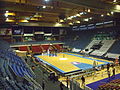
The Aleksandar Nikolić Hall (Serbian: Xала Александар Николић, romanizedHala Aleksandar Nikolić) is an indoor sports arena located in Palilula, Belgrade, Serbia. The official seating capacity of the arena is 8,000.

Key Information

Formerly known as Pionir Hall (Serbian: Xала Пионир, romanized: Hala Pionir), it was renamed in 2016 in honour of Serbian basketball player and coach Aleksandar Nikolić. The hall is well known for its frequent matches between different basketball clubs, especially Crvena Zvezda (Red Star Belgrade), Partizan, and foreign clubs. Projected by Ljiljana and Dragoljub Bakić, the hall has been described as the "architectural icon of the postmodernist Belgrade".[3]

History

[edit]

Constructed in 1973 by Ljiljana and Dragoljub Bakić under a tight deadline, the modernist building won the architects a "Grand Prix of the Belgrade Architecture Salon".[4] The structure was noted for its use of repeated elements and natural light.

The arena hosted the final round of EuroBasket 1975, the final of the EuroLeague's 1976–77 season (in which Maccabi Tel Aviv defeated Pallacanestro Varese), and the FIBA EuroCup's 1997–98 season final.[5] In October 1989, the 16th World Judo Championships took place in Pionir Hall.[6]

The arena hosted several preliminary round games of the EuroBasket 2005 and 2013 World Women's Handball Championship.

On 23 February 2016, the name of the arena was changed from Pionir Hall to Hall Aleksandar Nikolić, after the former basketball player and coach, Aleksandar "Aca" Nikolić.

In April 2017, the arena played host to the Davis Cup World Group Quarterfinal between Serbia and Spain, with Serbia winning the tie 4-1 to advance to the semifinals.[7]

In 2019, the hall was thoroughly renovated, at a cost of €2 million euros. The renovation included new seats, telescopic stands, a new hardwood court and screens, new lighting, modernization of the ventilation and air-conditioning systems, and an increased seating capacity.[8][9][10][11]

In October 2023, it was decided that the Israeli team Maccabi Tel Aviv will play its home international games in Aleksandar Nikolić Hall due to a security concerns because of an ongoing Gaza war.[12]

[edit]

Concerts

[edit]
List of Concerts
1970s
1970s
1980s
1980s
1990s
1990s
2000s
2000s
2010s
2010s

See also

[edit]

References

[edit]
[edit]
Revisions and contributorsEdit on WikipediaRead on Wikipedia
from Grokipedia

The Aleksandar Nikolić Hall is a multi-purpose indoor sports arena situated in the Palilula municipality of , , within the Tašmajdan Sports and Recreation Center. Opened on 24 May 1973 as Pionir Hall and renamed in 2016 to honor Aleksandar "Aca" Nikolić—the "father of Yugoslavian ," a pioneering coach who led the national team to European and world championships and was inducted into the Naismith Memorial Hall of Fame in 1998—it primarily hosts , , and competitions.
As the second-largest arena in after the , the venue features a of 5,878 and an adjacent , accommodating national championships, international tournaments such as the World Handball Championship and European Championship, and cultural events including concerts by acts like . It serves as a home court for prominent clubs including Crvena zvezda and Partizan, where it stages the fiercely contested Eternal Derby basketball matches that draw passionate local crowds. The hall has undergone reconstructions to modernize facilities, including a press center, while maintaining its role in fostering Serbia's sporting heritage amid the city's vibrant athletic scene.

History

Construction and Early Years

The Aleksandar Nikolić Hall, initially named Pionir Hall, was designed and constructed by architects Ljiljana Bakić and Dragoljub Bakić, with completion in 1973. The project's efficiency stemmed from a streamlined process where detailed designs were finalized in parallel with on-site building, enabling rapid realization while prioritizing functional layout for multi-sport use. Officially opened on May 24, 1973, as part of the Tašmajdan Sports and Recreation Center, the venue was named after the and primarily targeted programs for young athletes, reflecting Yugoslavia's emphasis on mass sports participation in the . Its 16,000 square meters of usable space included dedicated arenas totaling 2,500 square meters, supporting indoor training and competitions for emerging talents. From inception, Pionir Hall served as the home court for starting in 1973 and soon for , fostering intense local rivalries and elevating the facility's status as a pivotal site for professional within the Yugoslav . This foundational role solidified its integration into Belgrade's sports infrastructure, where it hosted early national and club-level events that underscored basketball's growing prominence in the region.

Renaming and Legacy of Namesake

On February 2016, the venue formerly known as Pionir Hall was officially renamed to commemorate the legacy of , a pioneering Serbian coach recognized as the foundational figure in Yugoslav development. This change replaced the original name, which evoked youth pioneering efforts, with one honoring specific individual contributions to the sport's growth in the region, aligning the hall's identity with empirical successes in competitive achievements rather than abstract branding. Nikolić coached the Yugoslav national team for 15 years in two periods (1951–1965 and 1977–1978), securing a at the in , a silver at the 1963 World Championship, and a at the 1977 in , alongside additional medals that demonstrated his direct influence on elevating team performance through structured player training and strategic preparation. His methods emphasized rigorous conditioning and tactical , fostering generations of players who achieved sustained international success, as evidenced by Yugoslavia's transition from emerging contender to dominant force in global during his eras. The renaming underscores Nikolić's causal impact on infrastructure and expertise in , where his professorial role at the University of Belgrade's Faculty of Sport further propagated coaching principles that prioritized measurable skill enhancement over less verifiable systemic factors, ensuring the hall serves as a tangible marker of his role in building a merit-based sporting heritage. This distinction highlights how venue can credibly reflect verifiable historical agency in evolution, distinct from prior generic associations.

Renovations and Recent Developments

In 2019, the hall underwent a comprehensive that included the installation of new seating with telescopic stands, a replacement hardwood court, updated basketball hoop systems, video screens, and scoreboards, along with enhancements to and ventilation systems to improve comfort and operational efficiency. These upgrades mitigated accumulated wear from prolonged high-intensity usage since the 1970s and restored the venue's functionality for contemporary sports and events. By late 2024, plans for additional reconstruction of the hall were announced as part of a wider initiative to modernize Belgrade's infrastructure, encompassing renovations to the —which had seen no major updates since its opening—and the construction of a new dedicated basketball center. Serbian basketball officials described the existing hall as outdated relative to growing demands for larger-scale competitions, prompting these proposals to extend its viability amid regional event expansions. In October 2024, both Partizan Belgrade and Crvena Zvezda relocated their domestic basketball home games to the hall temporarily, as the became unavailable from November 3 to 9 for the Belgrade Open tennis tournament. This shift demonstrated the venue's continued operational reliability as a contingency option during periods of arena congestion, bridging gaps until permanent upgrades to primary facilities are completed.

Architecture and Facilities

Design and Architectural Features

The Aleksandar Nikolić Hall features a sculptural structure designed by architects Ljiljana Bakić and Dragoljub Bakić, completed in 1973 as part of Belgrade's Tašmajdan . The design blends Brutalist massing with elements of and , prioritizing raw forms for structural integrity and aesthetic boldness over ornamental detail. This approach ensured durability against intensive use, with the material's inherent properties supporting acoustic performance in enclosed event spaces. Construction emphasized functional efficiency, achieved through rapid execution: the project met a nine-day competition deadline and was built within 11 months by Energoprojekt , allowing sequential planning of upper levels during lower-floor assembly. Such phased adaptability facilitated modular techniques, enabling versatile interior configurations for multiple sports without compromising . The hall's integration with adjacent facilities, including a nearby arena, reflects engineered synergy for complex-wide operations. Key engineering focused on sightline optimization via tiered, elevated spectator areas, enhancing visibility across the arena floor for diverse activities. Convertible systems, originally accommodating transitions between courts and other surfaces like ice rinks, underscore the design's emphasis on operational flexibility, as evidenced by sustained multi-purpose functionality over decades. These elements collectively prioritize causal utility—durability, acoustics, and adaptability—over stylistic excess, aligning with the era's socialist-era in Yugoslav .

Capacity and Technical Specifications

The Aleksandar Nikolić Hall has an official of 8,000. This figure represents the fixed seating designed for sports and events, with earlier configurations reporting around 5,878 seats prior to expansions. The venue's main supports FIBA-standard courts, measuring 28 meters in length by 15 meters in width, enabling compliance with international competition requirements. It features a solid wooden installed for durability and performance in high-level matches. Technical facilities include and scoring systems suitable for broadcast events, though specific limits for large-scale concerts constrain setups compared to larger arenas. Actual attendance often falls below maximum due to safety protocols and fire regulations.

Primary Usage

Basketball and Sports Events

The Aleksandar Nikolić Hall has served as the primary home venue for since its opening in 1974, hosting the club's domestic , , and regular-season games. The arena's configuration supports basketball with a court layout that facilitates high-intensity play, drawing consistent crowds for Partizan's matches against domestic and European opponents. Key historical basketball events include the final rounds of EuroBasket 1975, where the defeated in the championship game on May 31, 1975, before an audience reflecting the venue's early capacity of approximately 6,000 spectators. The hall also hosted the decisive third game of the 1976–77 European Champions Cup (predecessor to the modern ) final series on April 5, 1977, contributing to its reputation for staging continental competitions. In club play, Partizan secured the in 1989 by overcoming Buckler in a decisive home match on April 4, 1989, after an initial loss abroad. The venue regularly features the Eternal Derby rivalry between Partizan and Crvena zvezda, with multiple finals games contested there, such as Game 4 of the 2021–22 series on June 6, 2022, where Partizan defeated Crvena zvezda 83–63. These encounters underscore the hall's role in amplifying Serbia's fervor, often with attendance nearing the official capacity of 5,912 seated spectators. Partizan has utilized the facility for home fixtures, including victories like the 2016 Champions League game against on December 6, 2016, by a score of 92–74. Serbian national team preparations and qualifiers have also occurred at the hall, such as Olympic Qualifying Tournament group-stage matches in 2020, where Serbia advanced with wins including an 81–77 victory over . Attendance metrics for these events typically range from 1,500 to full capacity, reflecting the arena's acoustics and proximity to fans that enhance defensive pressure and home-court advantage, as evidenced by Partizan's historical win rates in domestic derbies exceeding 60% when hosted there.

Concerts and Entertainment Events

Aleksandar Nikolić Hall, formerly known as Hala Pionir, has hosted international concerts since the , establishing its role as a versatile venue for rock and pop performances in . Early examples include ' two-night stand on May 10 and 11, 1985, during their On Location Tour, drawing significant crowds to the arena's then-capacity setup. performed on September 10, 1986, as part of their , showcasing the hall's appeal for heavy metal acts amid Yugoslavia's growing rock scene. The venue continued attracting global artists through the 1990s and 2000s, with debuting "Breathe" live on December 8, 1995, marking a milestone in electronic music history at the site. played on April 5, 1987, further highlighting its suitability for new wave and pop-rock genres. In more recent years, headlined on April 1, 2010, followed by on November 22, 2015, with as openers, both events leveraging the hall's acoustics for high-energy rap and delivery. As a multi-purpose facility, the hall supports events through modular stage configurations and integrated sound systems, enabling efficient reconfiguration from basketball courts to concert platforms with minimal downtime. These adaptations have sustained ticket-based revenues from sold-out shows, distinguishing programming from sports events reliant on club subsidies and federations.

Other Uses and Adaptations

Temporary Medical and Emergency Roles

In April 2020, amid the , the rapidly converted Aleksandar Nikolić Hall into a temporary facility to accommodate patients with mild clinical presentations of the virus. The setup involved equipping the venue with approximately 100 beds, leveraging its spacious interior for partitioned wards and support areas, completed within days as part of broader national efforts to expand surge capacity. This repurposing highlighted the hall's architectural adaptability, with its open floor plan and existing infrastructure—such as ventilation and power systems—facilitating quick modifications without requiring major structural alterations. The facility operated as one of several improvised sites in , contributing to a combined capacity of around 2,500 beds across venues including the hall, Hala Sportova, and , to alleviate pressure on permanent hospitals. Medical staffing drew from military and civilian personnel, focusing on isolation and basic care for non-severe cases to prevent hospital overload. By mid-2020, as infection rates stabilized, the temporary was decommissioned, allowing the hall to revert to its primary sports functions for events like games in the 2020–21 season. No structural damage or long-term impairments to the venue's facilities were reported post-conversion, underscoring the reversible nature of the adaptation.

Non-Sporting and Cultural Events

The Aleksandar Nikolić Hall has hosted (MMA) events as part of its diversified usage beyond traditional team sports, reflecting Belgrade's expanding combat sports ecosystem. On November 4, 2023, it served as the venue for Fight Nation Championship (FNC) 13, where champion Nikola Joksović defended his title against Savo Lazić in the main event, drawing competitors and spectators to the facility's adaptable arena setup. This event marked FNC's inaugural major appearance at the hall, leveraging its central location and infrastructure for professional bouts in Serbia's burgeoning MMA promotion scene. Grappling and trials have also utilized the venue, underscoring its role in niche combat disciplines. The hall is scheduled to host the 2nd ADCC European, & African Trials in 2026, organized by ADCC Europe, which qualifies athletes for the ADCC World Championships and attracts international participants to . Such events capitalize on the hall's modular flooring and spectator capacity, typically accommodating hundreds of attendees for these specialized competitions, though specific attendance figures for prior similar gatherings remain undocumented in . While primarily known for athletic functions, the facility's layout supports occasional non-athletic adaptations, though verifiable records of trade shows, exhibitions, or broad cultural assemblies are sparse, indicating limited diversification into community or commercial expositions compared to larger venues like the . No comprehensive data on event frequency or attendance metrics for these uses is available, but hosting patterns suggest episodic rather than routine engagement for non-elite purposes.

Notable Incidents

During Game 2 of the 2022 ABA League Finals on May 29 between Crvena zvezda and Partizan, held at Aleksandar Nikolić Hall, Crvena zvezda supporters threw multiple objects including glasses and bottles onto the court toward Partizan players, prompting a by Partizan center Lessort with the crowd and causing a game delay of several minutes. The disturbance stemmed from the heightened tensions of the Eternal Derby rivalry between the clubs' groups, and , where organized hooligan elements have historically escalated conflicts through coordinated disruptions. Contributing factors included alcohol consumption among subsets of fans and insufficient real-time enforcement of venue protocols, allowing projectiles to reach the playing area despite security presence. Such events reflect a recurring pattern of in Serbian derbies at venues like Aleksandar Nikolić Hall, where high-stakes matches between Crvena zvezda and Partizan have repeatedly involved fan incursions onto the court or object-throwing, as seen in the 2013 Serbian Cup final interruption due to similar spilling from stands. These incidents are causally tied to entrenched ultra-group dynamics, overcrowding during sold-out games exceeding the hall's 5,000 capacity, and delayed responses from stewards, rather than mere expressions of competitive fervor, which fail to account for the deliberate endangerment of players and officials. In response, the imposed disciplinary fines on Crvena zvezda totaling €62,500 for fan misconduct across the finals series, including €35,000 specifically for Game 2 violations such as object-throwing and improper organization, alongside mandates for three subsequent home games with reduced to limit crowd density. These measures aimed to enforce accountability on clubs for supporter behavior, prompting subsequent enhancements in stewarding protocols at Serbian arenas, including stricter pre-entry screenings and alcohol restrictions during derbies to mitigate recurrence.

Security and Operational Challenges

The Aleksandar Nikolić Hall, originally constructed in 1973, has encountered operational challenges attributable to its aging , including the need for extensive renovations to sustain usability for high-attendance events. A major reconstruction project commenced on June 21, 2019, valued at €2 million, which replaced worn seating throughout the venue, installed telescopic stands on the lower levels to increase organized capacity, and upgraded the parquet floor and basketball hoops to meet standards. These works, scheduled post-basketball season to minimize disruptions, highlighted deferred maintenance on core facilities after prolonged heavy usage. Persistent issues, such as inadequate roof drainage, have continued to affect the structure despite interventions, contributing to potential water ingress and related wear during adverse weather. In July 2025, Crvena Zvezda initiated further adaptations to leased spaces within the hall, including full interior refits over two months, underscoring ongoing requirements for modernization amid operational demands. Such efforts reflect a pattern of reactive upgrades rather than proactive overhauls, with the 2019 project expanding seated capacity to 8,000 while prioritizing compliance for international competitions. Comparisons with contemporary venues like the , operational since 2004 with advanced structural and logistical features, have underscored perceived lags in investment at Nikolić Hall prior to these reforms, potentially exacerbating inefficiencies in event throughput and upkeep. Reforms post-2019 have implicitly bolstered operational resilience through standardized facilities, though specific enhancements to surveillance or evacuation systems remain undocumented in public reports.

Cultural and Sporting Impact

Role in Serbian Basketball Culture

Aleksandar Nikolić Hall, as the home arena of since 1973, has been central to the Eternal Derby rivalry with Partizan , hosting matches that exemplify intense competition and fan passion in Serbian . These derbies, often drawing capacity crowds of around 5,000 to 8,000, have fostered a competitive environment that honed skills of players contributing to Serbia's strong showings in European competitions, including multiple participations by Crvena zvezda. The venue has supported national team activities, serving as a training and match site for Serbia's senior and youth squads over decades, aiding preparation for events like tournaments. Crvena zvezda's youth academy, utilizing the hall for development, has produced talents such as Vladimir Stepanov and , who advanced to professional levels in . This infrastructure has helped sustain Serbia's pipeline of NBA-caliber players, with over 20 Serbs reaching the league, many tracing roots to club systems. Players and observers highlight the hall's atmospheric superiority for intensity over larger modern arenas, attributing it to proximity of fans to the court and acoustic design amplifying chants. For instance, following a 2022 win, Crvena zvezda guard described the packed environment as creating unmatched pressure on opponents. Such testimonials underscore its role in cultivating , evidenced by Crvena zvezda's home record in recent ABA League seasons exceeding 60% wins.

Influence on Regional Sports Infrastructure

As the second-largest indoor arena in Belgrade with an official capacity of 8,000 seats, Aleksandar Nikolić Hall functions as a vital secondary venue complementing the Belgrade Arena, enabling the hosting of major sports events amid scheduling conflicts at the primary facility. This role became evident in 2024, when Crvena Zvezda and Partizan relocated their domestic basketball home games to the hall due to the Belgrade Arena's occupation by the Belgrade Open tennis tournament from November 3 to 9. Similarly, the Serbian Davis Cup team used the venue for its World Group I tie against Greece on September 14–15, 2024, demonstrating how the hall mitigates disruptions in regional competitive calendars. The hall's utilization for high-stakes competitions, including Crvena Zvezda's hosting of finals games in May 2024 and select matches, reveals infrastructural constraints in , where reliance on two principal venues strains capacity during peak periods of activity. Such reallocations influence broader venue management strategies, underscoring the competitive necessity for diversified facilities to sustain 's prominence in European without compromising event quality or attendance. These dynamics have spurred discussions on enhancing Belgrade's sports infrastructure, with recent proposals including expansions to halls in New Belgrade to incorporate approximately 5,000-seat capacities alongside training gyms and multi-sport amenities, addressing observed gaps in accommodating regional growth. In contrast to more antiquated arenas prevalent across other Balkan states, which often feature limited modernizations and smaller scales, the operational interplay between Belgrade's key halls highlights a pragmatic model while pressing for targeted upgrades to align with empirical demands rather than deferrals.

References

Add your contribution
Related Hubs
User Avatar
No comments yet.