Hubbry Logo
GirlschoolGirlschoolMain
Open search
Girlschool
Community hub
Girlschool
logo
8 pages, 0 posts
0 subscribers
Be the first to start a discussion here.
Girlschool
Girlschool
from Wikipedia

Girlschool are a British rock band that formed in the new wave of British heavy metal scene in 1978. Frequently associated with contemporaries Motörhead, they are the longest-running all-female rock band, still active after more than 40 years.[3][4] Formed from a school band called Painted Lady, Girlschool enjoyed strong media exposure and commercial success in the UK in the early 1980s with three albums of "punk-tinged metal"[5] and a few singles, but lost their momentum in the following years.[6]

Key Information

In the 1990s and 2000s, Girlschool focused on shows and tours and made few studio albums. During their career they travelled the world, playing in many rock and metal festivals and co-headlining with or supporting important hard rock and heavy metal bands. They maintain a worldwide cult following, and are an inspiration for many female rock musicians.[7] Despite frequent changes of line-up, all original members who are still alive—Kim McAuliffe, Enid Williams and Denise Dufort—had been in the band until 2019, when Willams quit. Original lead guitarist and singer Kelly Johnson died of cancer in 2007.[8]

History

[edit]

1975–1978: Painted Lady

[edit]

In 1975, school friends and neighbours from Wandsworth, South London, Kim McAuliffe (rhythm guitar, vocals) and Dinah Enid Williams (bass, vocals) formed an all-girl rock cover band called Painted Lady, together with Tina Gayle on drums. Deirdre Cartwright joined the new band on lead guitar, Val Lloyd replaced Gayle on drums and they started playing the local pub scene.[9][10] "The reason we were all girls was we couldn’t find any blokes who wanted to play with us! This was the natural thing to do", McAuliffe explained to Gary Graff in 1997 about the all-female composition of the band.[7]

Cartwright, who was older and more musically experienced than the other members,[9] left in 1977 to form the band Tour De Force[10] and then followed different professional opportunities in the music business; she is now a renowned jazz guitarist.[11] Her place in the band was briefly taken by visiting American Kathy Valentine, who approached the band through an advertisement in the British music newspaper Melody Maker.[9] When Valentine returned to the United States in 1978 to form the Textones and later join The Go-Go's as bass player, Painted Lady broke up. However, McAuliffe and Williams were still willing to pursue a musical career to escape their day jobs in a bank and a bakery; they reformed the band,[12] recruiting lead guitarist Kelly Johnson and drummer Denise Dufort in April 1978.[13] The new line-up changed their name to Girlschool—taking it from "Girls' School", the B-side of the hit single "Mull of Kintyre" (1977) by Paul McCartney and Wings[14] and immediately hit the road, touring small venues in France, Ireland and Great Britain.[4]

1978–1982: N.W.O.B.H.M.

[edit]
Girlschool original line-up: Kim McAuliffe, Enid Williams, Kelly Johnson, Denise Dufort (1981)

In December 1978, Girlschool released their first single, "Take It All Away", on the independent record label City Records, owned by Phil Scott, a friend of the band.[5][9] The single had some radio airplay[9] and circulated in the underground scene; it came to the hearing of Ian Kilmister, commonly known as Lemmy, leader of the British rock band Motörhead, who wanted to meet the band. He, together with Motörhead and Hawkwind manager Doug Smith, went to see the band performing live and offered them a support slot on Motörhead's Overkill tour in the spring of 1979.[15][16] This was the start of an enduring relationship between the two bands.[17] After the tour and a few other shows supporting Welsh band Budgie, Doug Smith became the manager of Girlschool and obtained an audition with the British label Bronze Records, at the time home of Uriah Heep, Motörhead and Juicy Lucy. Bronze's owner Gerry Bron himself attended the audition; he was impressed by Girlschool's stage presence and musicianship, offering them a contract with his label in December 1979.[13]

I went to an early rehearsal and was surprised how well (Girlschool) played their instruments – how terribly chauvinistic of me. None of them were particularly good looking, although from a distance Kelly Johnson looked like that Charlie's Angels' actress, Farrah Fawcett, but there was something about them...

–Gerry Bron[18]

The British rock movement known as the new wave of British heavy metal (frequently abbreviated as NWOBHM), which started in the late 1970s and broke in the mainstream in the early 1980s,[19] was just exploding in the United Kingdom and the band gained the support of a strong label at exactly the right time to exploit the moment and form a solid fan base.[20]

The band entered the recording studio with experienced producer Vic Maile in April 1980.[21] Vic Maile had been working as live sound engineer for many important acts, like The Who, Led Zeppelin, The Kinks and Jimi Hendrix,[22] producing also the first two seminal albums of Dr. Feelgood and a few punk bands in the late 1970s.[23] He captured the raw but powerful sound of Girlschool in ten short songs, with lead vocals shared by Williams, McAuliffe and Johnson. Girlschool released their debut album, Demolition, in June 1980,[24] alongside the singles "Emergency", "Nothing to Lose" and "Race with the Devil". Demolition reached No.28 in the UK Album Chart in July 1980.[25]

In the same period, albums and singles from Judas Priest,[26] Saxon,[27] Def Leppard,[28] Iron Maiden,[29] Motörhead[30] and other bands of the NWOBHM reached high positions in the UK charts, while the same bands did tours and concerts all over Europe.[31][32][33][34] Girlschool participated in this frenzied touring activity, travelling in Great Britain and visiting Europe both as headliner act and as support to label mates Uriah Heep and Motörhead.[35] On 20 August, Girlschool and Motörhead were filmed performing live at the Nottingham Theatre Royal for the Rockstage programme, broadcast by the ATV station on 4 April 1981.[36] In this period, the band was subjected to intense media coverage by music magazines, radio and TV, interested in the novelty of a successful British all-female metal band.[37] The barrage of interviews and promotion did not stop the production of songs and the girls released the new single "Yeah Right" in November 1980.[24]

In December 1980, Girlschool officially started recording the follow-up to Demolition, again with producer Vic Maile, who had meanwhile produced Motörhead's classic album Ace of Spades. During the sessions, Maile suggested a studio recording team-up with Motörhead, resulting in the release of the EP St. Valentine's Day Massacre.[38] The EP contains the cover of Johnny Kidd & The Pirates’ song "Please Don't Touch" and two self-covers, with Motörhead performing Girlschool's "Emergency", and Girlschool playing Motörhead's "Bomber". Dufort played drums on all songs, because Motörhead's drummer Phil "Philthy Animal" Taylor was recovering from a neck injury. She also played the drums during the BBC One Top of the Pops TV show of 19 February 1981, where the two bands performed "Please Don’t Touch" under the moniker Headgirl.[39] The EP reached No.5 in the UK Single Chart in February 1981[40] and was certified silver in December 1981,[41] the best sale performance for both bands at the time.

The album Hit and Run was released in April 1981,[24] soon followed by the eponymous single. Both releases were very successful in the UK, with the album reaching position No.5 and the single position No.33 in the respective charts.[25] The album charted also in New Zealand and in Canada,[42][43] where it went gold.[44] Hit and Run was not released in the USA until 1982, with a different track listing including songs from Demolition. The success of their second album made Girlschool a rising attraction in the boiling British hard rock and heavy metal scene, ensuring headliner slots in medium-sized arenas in their sold-out UK tour[45] or guest slots in stadium size concerts of major attractions like Black Sabbath and Rush.[12] No dates in the USA were arranged, but Girlschool visited Canada in July. Their 1981 tour culminated on 28 August, headlining the Friday night of the three-day Reading Festival.[46] The Friday Rock Show on BBC Radio 1 would later broadcast the Reading set, but the recording has not received an official release.[12]

Headlining the Friday night of the 1981 Reading Festival was the highlight of Girlschool's career

At the beginning of 1982, Girlschool did a European tour and, at the last Danish date in Copenhagen with supporting act Mercyful Fate, McAuliffe received a potentially-fatal electric shock from her microphone.[47] She recovered fast enough to complete a Japanese tour, to do other European shows supporting Rainbow on their Difficult to Cure tour and to start working on new material for the next album. However, the gruelling schedule of recordings, promotional work and concerts had started to take its toll on the group, with bassist Enid Williams the first to give up, right after the release of Wildlife in March 1982, an EP designed to launch the upcoming album.[48][49] On the recommendation of Lemmy, Williams was replaced by Ghislaine 'Gil' Weston,[7] former bassist of the punk band The Killjoys.[50]

Girlschool's third album Screaming Blue Murder was recorded in February and March 1982 under the direction of Nigel Gray, the successful producer of The Police and The Professionals.[51] The album had a worldwide release in June 1982[24] but, despite the strong promotion, it reached only No.27 in the UK Album Chart.[25] Critics generally considered Screaming Blue Murder a weaker offering in comparison with the preceding two albums.[49][52]

Girlschool remained anyway a strong live attraction and their 1982 world tour led the band for the first time in the US to play in stadiums, supporting Iron Maiden and Scorpions.[53] NWOBHM acts like Judas Priest and Def Leppard started to be very popular in America and the girls and their record label had no intention to fall back in the conquest of that large market.[48]

1983–1985: American sirens

[edit]

Back in England, the continuous succession of recording sessions, gigs and promotional work started again, but the strain of this routine was wearing out Kelly Johnson,[54] who was also tired of the music the band had been playing for four years without a break.[7][55] The other members struggled to convince her to stay and the chance to record with British celebrities Noddy Holder and Jim Lea as producers persuaded the guitarist to carry on with Girlschool.[55] Holder and Lea, who had returned in those years to great success and popularity in Great Britain with the 70s rock band Slade,[56] were hired to produce only a single,[57] with the following album already scheduled to be recorded in Los Angeles with Quiet Riot producer Spencer Proffer.[10][12] However, the good chemistry found with the two Slade members led the band to decide to record not a single, but their whole fourth studio album in North London with Lea and Holder, giving up the trip to the USA.[9] This time the group changed sensibly both their appearance and their musical style in order to appeal to a large American audience, which Bronze considered more oriented toward AOR and glam rock than to the 'biker metal'[58] Girlschool had produced before.[55] Play Dirty, released in October 1983,[24] is an album with a very polished sound, filled with keyboards, choruses and melodies, but it lacks much of the aggression and power of the preceding works.[59] The album contains covers of the Slade songs "High & Dry" and "Burning in the Heat" and of T.Rex’s "20th Century Boy", which was also released as a single. Play Dirty failed to enter the top 50 chart in the UK and had a lukewarm reception by fans and critics at home.[60] A struggle between Bronze and PolyGram for the worldwide contract of the band resulted also in poor promotion for the album in the USA.[55] Moreover, a disastrous performance at Wembley Arena supporting ZZ Top did not help Girlschool's already degraded image in Great Britain.[55]

Girlschool upgraded their look in 1983 to appeal to the US market

Girlschool embarked in a long US tour to promote the album, sometimes as support to Quiet Riot and Blue Öyster Cult, but more often as headliner in small venues after uncomfortable travels.[55] Johnson, unable to tolerate the unhealthy life on the road,[61] quit the band before completing the US tour, hurting the promotion of the album in America. She went to live in Los Angeles with Vicki Blue, former bassist of The Runaways.[61] With the departure of Kelly Johnson, who was often considered the visual[62] and musical focal point of the band, the almost bankrupt Bronze Records failed to extend the band's recording contract for a follow-up album.[5][55]

At the beginning of 1984, Girlschool were in need of a new lead guitar player and singer, of a new recording contract and chart success but, despite the difficult situation, the band did not give up.[55] The search for new members ended with the arrival of guitarist Cris Bonacci and singer and keyboard player Jackie Bodimead, both from the all-female hard rock band She.[63] She were playing in London clubs at the time, trying to get a record contract and attract the attention of the British music press.[64]

The new Girlschool, now a five-piece group, signed with the PolyGram American subsidiary Mercury Records, once home of the American all-girls rock band The Runaways.[13] The label saw in the band an opportunity to produce a rival for chart-winning female-fronted bands like Heart and Lita Ford and pushed the music of the band even more towards FM friendly American hard rock.[65] The band was paired with producer Nick Tauber, who had produced the first albums of Thin Lizzy and the most successful albums of Toyah and Marillion, contributing also to the launch of the British glam metal act Girl.[66] The resulting album Running Wild, sported ten keyboard-laden tracks much different from Girlschool's most successful music. The record label decided to release the album only in the US in February 1985,[24] but actually gave little support to its marketing.[5] The review of the magazine Kerrang![67] reflects the opinions of Dufort and McAuliffe, which described years later the album as rubbish or even worse.[16][65] Running Wild had insignificant sales on the US market, not representing the breakthrough the band and the label had hoped for.[48] A live performance of Girlschool as a quintet at Camden Palace in London was taped for the VHS Play Dirty Live,[68] which was released in 1985 and reissued on DVD with the title Live from London in 2005.[69]

The band did some shows supporting the glam rock band Hanoi Rocks in Great Britain,[70] before joining Deep Purple's comeback world tour, where Girschool played in a supporting role all over the USA.[71] A tour of India and the Far East completed their live activities for 1985.[72] Vocal duties were shared on stage between McAuliffe and Bodimead, who also played keyboards. At the end of the tour, Jackie Bodimead left the band to pursue a solo career.[65]

1986–1990: 'back to square one'

[edit]

After the bad commercial results of Running Wild, Mercury broke the contract with Girlschool,[48] leaving the band without financial backup and with a career in dire straits.[65] "Back to square one again", McAuliffe said at the time.[65] The band decided to go back to their roots, remaining a quartet with only McAuliffe on vocals and going on a UK tour in November – December 1985 supporting Blue Öyster Cult; their immediate goal was to play as much as they could and regain some of their fan base.[65] In early 1986, thanks again to Lemmy's suggestion, they eventually signed for Doug Smith's new label GWR Records, which also included in their roster Motörhead.[13] The girls immediately started working on a new album with their old producer Vic Maile at Jackson's Studio in Rickmansworth.[65] The first output of their new work was a team-up with British glam rock singer Gary Glitter for the cover of his 1973 hit "I'm the Leader of the Gang (I Am)", which was released as a single in April 1986.[13][24] The album Nightmare at Maple Cross, released in July of the same year,[24] marked for the band the return to the sound of Hit and Run and to their trademark abrasive lyrics. The album received fairly good reviews,[73][74] but it did not enter the British charts and was released in North America only a year later.[75] The following European tour saw the girls supporting the Scottish hard rock band Nazareth.[76]

In January 1987, after five years with the group, bassist Gil Weston-Jones left Girlschool to spend more time with her American husband.[75] Her place was quickly taken by Tracey Lamb, who had been the bass player of the all-female NWOBHM band Rock Goddess and a bandmate of Cris Bonacci in She.[75] Girlschool spent the rest of the year promoting the album with a US tour and appearances in various TV shows across Europe, followed by a long European tour supporting usual label mates Motörhead.[72]

At the beginning of 1988, the band started rehearsing material for a new album with producer André Jacquemin, who had worked on all the Monty Python’s records.[72] The album Take a Bite was published by GWR in October 1988 and follows in the steps of Nightmare at Maple Cross, presenting powerful and melodic metal songs, tinged with the humour typical of the band.[77] To promote the album, Girlschool did a UK tour with Gary Glitter,[78] followed by a North American tour. In 1989, they travelled across Europe with Dio[13] and to the Soviet Union with Black Sabbath, until the end of the year.[79] After their return from Russia, GWR did not renew their contract and the band practically broke up.[5][48] Musical tastes were changing worldwide in favour of grunge and more extreme metal genres, compelling most acts originated from the new wave of British heavy metal to disband or to reduce their activities, and the same thing happened to Girlschool.[14]

1990–1991: She-Devils and Strange Girls

[edit]

Even if not officially disbanded, Girlschool had become "not a full-time thing anymore" for the members of the group.[7] In this period, Cris Bonacci joined British singer Toyah Willcox, for the promotion of the album Ophelia's Shadow.[80] A brief tour of Spain was Girlschool's only activity of 1990,[10] but in December, McAuliffe, Bonacci, Dufort and returning bass player Enid Williams, teamed up with Toyah Willcox under the name She-Devils for the first edition of the Women in Music festival at Shaw Theatre in London, performing both Girlschool and Toyah’s songs.[48][81] A few months later, the same musicians reunited again under the new name Strange Girls, with Lydie Gallais replacing Dufort on drums.[10] Strange Girls toured clubs in Great Britain in 1991 and 1992[4] and supported The Beach Boys in their German dates in the summer of 1991.[82] The band wrote a few songs and produced a demo,[4] but the only published track from this period is the song "Lust for Love", which can be found on Toyah's album Take the Leap! (1993).[83]

1992–2002: living on tour

[edit]
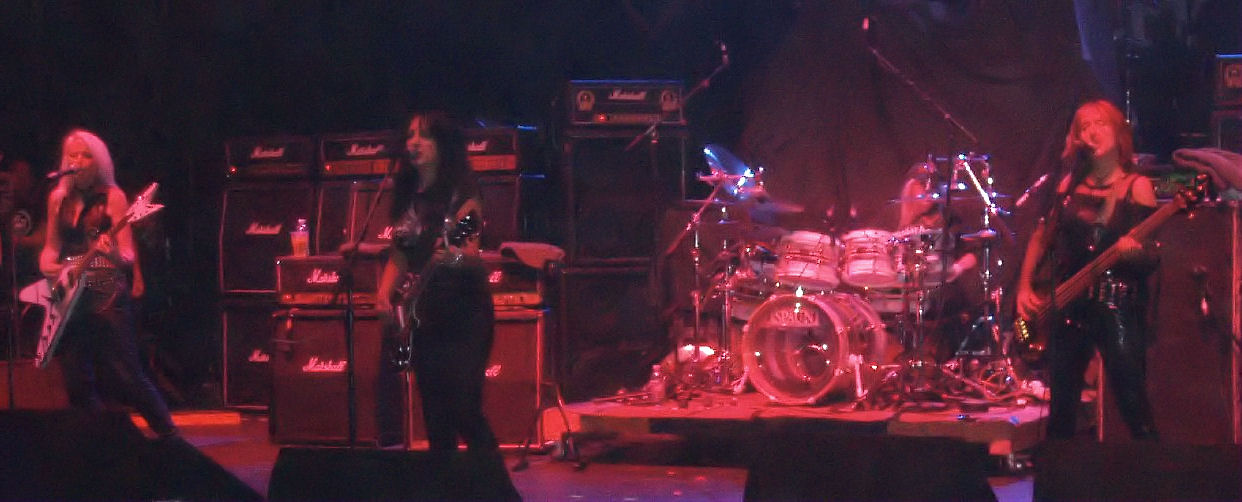
Lead guitarist Jackie 'Jax' Chambers playing live at Bloodstock Open Air 2009

Girlschool went back in action in 1992, recruiting Jackie Carrera on bass and recording Girlschool, their first self-produced album,[84] which was distributed worldwide by the British indie label Communiqué Records. The lower visibility of the album distributed by an indie label marked the definitive transition to cult status for the band, renouncing to many expectations of big sales. Girlschool were now their own managers, relying on their solid live show[85] and on their reputation with promoters and other artists to get gigs and work.[78] As stated in an interview to the British television show Raw Power, Girlschool would "play in every single toilet that we can find!"[84]

After a few European dates, returning bassist Tracey Lamb replaced Carrera before a new tour in the United States.[10] But more line-up changes were in store for the band because, at the end of 1992, Cris Bonacci left the band to become a touring musician and then a producer.[86] In 1993, her place as lead guitarist was taken back by Kelly Johnson,[87] who returned after nine years to England from LA, where she had played in a band with Kathy Valentine and written and produced her own music.[88][89] The plethora of compilations of old Girlschool material that had started to be released from 1989 kept the band alive on the CD market and guaranteed enough visibility to get a good number of gigs every year in every part of the world, often supporting other NWOBHM acts like Motörhead or Saxon.[89] In this period, the girls were also present at rock festivals all over Europe, both as Girlschool or separately in other outfits.[10] In 1995, Communiqué Records released Girlschool Live, a live album documenting the intense live shows of the band in that period and which included the new tracks "Knife" and "Little Green Men".[90] Girlschool continued their live activity in the 1990s, culminating with a participation to the Wacken Open Air festival on Friday, 6 August 1999.[91]

In all this time, the band had been writing new songs.[89] In September 1998, they began to record a new album;[5] however, touring commitments and new line-up changes prevented Girlschool from completing it. Johnson amicably quit Girlschool in 1999, followed by Lamb in 2000.[92] They were replaced by new lead guitarist Jackie 'Jax' Chambers and by Enid Williams, who finally rejoined the group after eighteen years. Johnson, who had been diagnosed with cancer,[8] and Lamb nevertheless remained closely associated with the other band members.[76][92]

21st Anniversary: Not That Innocent was finally released at the beginning of 2002 and co-produced by Girlschool and Tim Hamill. The album contains tracks recorded three years earlier by the previous line-up, with the addition of the songs "Coming Your Way" and "Innocent" recorded by the current one.[4]

2003–present: recent activities

[edit]

In 2003, the band was again in a recording studio for The Second Wave: 25 Years of NWOBHM, a split album conceived by the label Communiqué, comprising five songs each for Oliver/Dawson Saxon, Tygers of Pan Tang and Girlschool. A tour of the three aforementioned bands could not be organized and, in October 2004, Girlschool toured supporting the album with Tygers of Pan Tang and Paul Di'Anno.[93]

Lead vocalist Kim McAuliffe at Bloodstock Open Air 2009

Preceded by the publication of the re-mastered editions of their first four albums, Girlschool released the studio album Believe in July 2004.[94] The wish to explore new territories is obvious in some tracks of the album, which is the first one entirely composed by the new line-up at Chambers’ home studio.[95] The changed line-up brought a new balance in the band, with Chambers involved in the composition of all songs.[3] Moreover, the chance to use two lead singers again led to improvements in the vocal and choral parts.[85] Unfortunately, the album was poorly distributed and remained unknown to large parts of its potential audience.[96] In 2005, the band re-released Believe in a new package with a DVD containing footage taken from concerts of the 2000s and sold it through their official website.[96][97] A US and European tour followed Believe first release, but the project for releasing in 2004 a live DVD tentatively titled Girlschool Live at the Garage never materialised.[98] In June 2005, Girlschool did a UK tour with Vixen[85] and another one in November–December with old pals Motörhead, celebrating Lemmy's band 30th anniversary.[99] During the same year, they were also on stage at summer festivals in the Netherlands and England and opened for Alice Cooper in Spain.[95]

Rock and metal festivals have become a constant for the band, that performed both in large open air meetings in Germany (Headbangers Open Air 2006,[100] Bang Your Head!!! 2007,[101] Wacken Open Air 2008[102] and Wacken Rocks 2009[103]), France (Hellfest Summer Open Air 2009[104]), England (Hard Rock Hell 2007[105] and 2009,[106] Bloodstock Open Air 2009[107]) and the USA (Power Box Festival 2007[108]) and in smaller settings, like the Rock of Ages Fest in England in 2007[109] and the Metal Female Voices Fest in Belgium in 2008.[110] Girlschool were opening act for Heaven & Hell in 2007,[101] for Dio in 2008[111] and for Hawkwind and Motörhead in 2009.[9]

On 15 July 2007, Kelly Johnson died of spinal cancer, after six years of painful therapy and treatment of her illness.[8] At Kelly's memorial, Tracey Lamb read the eulogy she had written for her.[112] The band performed a tribute gig on 20 August 2007 at the Soho Revue Bar in London, with many of Johnson's friends and former Girlschool's members[113] and a concert for Cancer Research UK at Rock of Ages Fest in Tamworth on 8 September 2007.[109]

The new album Legacy, released in October 2008,[114] celebrates both the departed guitarist and the 30th anniversary of Girlschool, making them the so far longest-running female rock band in the world.[3][4] The recording was self-produced with the assistance of Tim Hamill and the compositions are more individual, revealing a large array of influences, going from NWOBHM, to punk, to West Coast alternative rock.[97] To emphasize the celebrative mood, the album features many guest musicians, with members of Heaven & Hell, Twisted Sister and Motörhead supplying vocals and guitars in many tracks.[106] Kelly Johnson's 'ghost' presence permeates the album[115] and the song "Legend" is especially dedicated to her.[116] The album received excellent reviews[117][118][119] and the German label SPV/Steamhammer guaranteed the worldwide distribution. Girlschool performed a special show celebrating their 30th anniversary on 16 December at the Astoria 2 in London.[120]

Girlschool were among the many female singers performing on veteran German hard rock singer Doro Pesch’s single "Celebrate", released in 2008.[121] Jackie Chambers and Enid Williams were also present on stage at Doro’s 25th anniversary celebration concert on 13 December 2008 in Düsseldorf.[122]

At the beginning of 2010, Girlschool contributed to the release of the cover of their single "Emergency" by Cornish youth music charity Livewire, in order to raise funds for the victims of the 2010 Haiti earthquake.[123] The band went on tour in Europe with the Canadian metal band Anvil in 2010.[124] The band spent time in studio re-recording their classic 1981 album Hit and Run, during 2011.[125] The new version of the LP, titled Hit and Run – Revisited, was released on 26 September 2011 to celebrate the original album's 30th anniversary.[126]

Girlschool continued to tour Europe and South America in 2011-12 and returned in Japan in 2013.[127] In early 2015, they recorded a new album titled Guilty as Sin with producer Chris Tsangarides,[128] which was released on 13 November 2015.[129] On 30 January 2019, it was announced on the band's website that "Girlschool have parted ways once again with bassist Enid Williams" and that Tracey Lamb would return to replace her.

On 27 February 2023 Girlschool's labelmates Alcatrazz released the single "Don't Get Mad... Get Even" which saw them contribute vocals.[130] On 25 April the band announced their first album in eight years WTFortyfive?, due to be released in July. The same day they released the first single "Are You Ready?" and its accompanying music video.[131]

Music and style

[edit]
Enid Williams and Lemmy singing "Please Don't Touch" live in 2009. The ties that bind Motörhead and Girlschool started in the 1980s and were still strong until Motörhead's dissolution in 2015

Revolver magazine editor Christopher Scapelliti aptly described Girlschool's music as a "punk-metal mix tough, but poppy enough for radio".[48] The influences of classic hard rock and heavy metal are present in the musical background of all the original band members[7][14] and they are particularly evident in the clean and sometimes bluesy solo guitar work of Kelly Johnson.[132] Artists like Led Zeppelin, Black Sabbath, David Bowie, T. Rex, Suzi Quatro have been influential on the Girlschool members.[133]

Punk rock had a direct influence in the birth of new wave and new wave of British heavy metal and that music was still popular when the band was formed.[134][135] Moreover, both Denise Dufort and Gil Weston had played in punk bands before joining Girlschool.[12][136][137] "We're both too heavy to be New Wave and too punk to be a heavy metal band", McAuliffe explained to Robbi Millar of Sounds in 1980.[35] The raw and almost live recording sound of their first two Vic Maile produced albums represents perfectly the core music of the band in the years from 1979 to 1982, which were the most successful for Girlschool. The combination of metal and punk was a large part of the sound which also propelled Motörhead to notoriety and chart success in the early 80s in the United Kingdom.[35] This sound, the tours and recordings made together with Lemmy's band, the girls’ denim and leather look, as much as their rowdy and alcohol driven off-stage behaviour soon gained Girlschool the moniker of 'sisters of Motörhead', which they were often identified with[89] until Motörhead became defunct at the end of 2015. Their close association with Motörhead at the beginning of Girlschool's career helped achieve their early success.[17]

The mounting pressure to appeal to a mainstream audience, the quick change of tastes in British rock fans with the decline of the NWOBHM phenomenon and the chance to have a breakthrough in the US market prompted Girlschool to change their music, starting with the album Screaming Blue Murder in 1982.[49] Their sound, following the success of Def Leppard's album Pyromania,[96] became more polished with the introduction of keyboards on Play Dirty and veered toward hard rock and glam metal, losing the raw edge of their early works.[138] "We were signed to an American label (...) there was a certain amount of pressure exerted on us to sound more American" was McAuliffe's explanation, speaking about the tame sound of the album Running Wild.[65] The band appearance also changed to a more feminine and sophisticated style, imitating the successful American glam metal bands of the time and generally following the direction of the market. However, the failed attempt to create a niche for Girlschool in the US and the rapidly changing record market behaviour made the band change their mind and go back to their original sound,[72] which they retain to this day. Girlschool's members themselves described their music in different ways, from "slapstick rock"[57] to "raucous (...) heavy metal rock 'n' roll",[84] and, even acknowledging the common origin of their music in the NWOBHM,[35][37] they sometimes found it difficult to associate their songs to a single genre or subgenre of rock music.[57][132]

Just like most punk songs, Girlschool's lyrics usually have short and direct texts, often reflecting the wild rock 'n' roll lifestyle and treating sex and romance as seen from a feminine point of view, with the use of reverse sexism and tongue-in-cheek sense of humour.[13][35] Although many of their songs revolve around these topics, the band members themselves never resorted to sex appeal gimmickry: as Creem noted appreciatively in 1982, "Girlschool doesn't pimp their gender".[139] Some of their songs deal also with more serious matters, such as exploitation and abuse of women,[35] murder, addiction, the destruction of the environment,[17] social and political issues.[97]

Reception

[edit]

The fact of being a band composed of girls, beside the obvious marketing gimmick based on sexuality,[20] has always been perceived as a handicap in the sexist and male-dominated heavy metal scene,[140] especially in the early 1980s, when metal was rapidly taking the place of punk music in the tastes of many young males in Great Britain.[37] However, Girlschool's musicianship and their aggressive but fun-loving attitude quickly won the NWOBHM audience, which treated them with respect, forming a loyal fan base.[35] In Kelly Johnson's word, Girlschool were so well accepted because "most of the audience is headbangers and they spend most of the time banging their heads and hardly look at us".[132]

We’re a bunch of fun-loving, ordinary people and that’s the image we always like to present.

–Kim McAuliffe[65]

In 1980, Girlschool's fondest fans formed a club called 'The Barmy Army', which followed and supported the band during every tour in Great Britain and Europe. The fan club did not survive the decline of the band and almost ceased its activities by the end of 1982.[37][76]

British specialized press took notice of the band and especially weekly magazines like Sounds and later Kerrang! dedicated covers to Girlschool and had frequent articles for either their stage performances[35][141][142] or for their off-stage drinking bouts[15] and 'no-nonsense attitude',[143] during their period of maximum media exposition and chart success.[89] In 1980, Sounds voted the band second 'Best Newcomer' and Kelly Johnson third 'Best Female Vocalist'.[5] Two years later, Kerrang! still voted Kelly Johnson second 'Best Female Vocalist' and best 'Female Pin-up'.[62] In that period, British radio stations gladly broadcast Girlschool's singles and the band was also guest of music TV shows, culminating with a performance at Top of the Pops in April 1981 to promote the single "Hit and Run".[144]

On the contrary, Girlschool's change of musical style in 1984 and their sudden predilection for the US market were not well received by the British press and by their fans at home.[78][138] The change of attitude and image, exemplified by the music video for "Running Wild" on rotation on MTV, which showed the girls playing with heavy make-up, combed hair and fancy costumes, imitating a trendy American glam outfit,[145] alienated the love of British fans, whose perception of the band was still that of roughneck companions to Motörhead, instead of competitors of Mötley Crüe and Ratt.[55] In the time span of two years, Girlschool passed from headliner act to having serious difficulty to find a gig in the UK: "Nobody seems to want us in Britain anymore", confessed McAuliffe to journalist Malcolm Dome in 1984.[55] The return of Girlschool to the sound of their beginnings came too late to win back the large fan base of their heyday and the band fell to cult status already in the late 1980s.[20]

Legacy

[edit]

Pete Makowski in an article of the August 1980 edition of Sounds defined Girlschool "the leading pioneers in the battle against sexism".[37] However, even if Enid Williams showed an interest in feminism,[97] the band never openly expressed opinions about female discrimination, happy of being appreciated simply as musicians instead of 'female musicians'.[14] Nonetheless, being a successful all-female group in the macho heavy metal scene was a statement of sexual equality, as many reviewers remarked,[35][37][146] arriving as far as to associate Girlschool with the American feminist Riot Grrrl movement.[7][147]

Reviewers and critics have also often associated the production of recent all-female metal acts to the sound and music of Girlschool,[148][149] identifying them as a band that, just like The Runaways before them, helped in paving the way to the presence of women in rock music.[5][7][150] However, Williams remembered in 2004 how, in her experience, Girlschool were more inspirational for young male musicians than for female ones in starting rock bands.[97] Moreover, important female metal bands of the 2000s, such as Crucified Barbara and Drain STH, denied even of knowing the music of Girlschool.[151][152] Only the American all-female rock band The Donnas publicly acknowledged the influence of Girlschool on their music.[153]

Band members

[edit]
Current
  • Kim McAuliffe – rhythm guitar, lead and backing vocals (1978–present)
  • Denise Dufort – drums (1978–present)
  • Jackie Chambers – lead guitar, backing vocals (2000–present)
  • Olivia Airey – bass guitar, backing vocals (2024–present)

Discography

[edit]

Videography

[edit]

See also

[edit]

References

[edit]
[edit]
Revisions and contributorsEdit on WikipediaRead on Wikipedia
from Grokipedia
Girlschool are a British heavy metal band formed in in 1978 as part of the New Wave of British Heavy Metal (NWOBHM) scene, widely regarded as one of the first successful all-female rock groups in the genre. Founded by Kim McAuliffe (rhythm guitar and vocals) and Enid Williams (bass) from an earlier band called Painted Lady, the lineup quickly solidified with lead guitarist Kelly Johnson and drummer Denise Dufort, delivering a raw, punk-infused sound that blended aggressive riffs, high-energy performances, and themes of rebellion. Frequently associated with contemporaries —sharing tours, producers, and even a collaborative EP—the band broke barriers for women in heavy metal during an era dominated by male acts. The band's early success came swiftly, with their debut single "" gaining airplay on 1's show in 1979, followed by the release of their debut album in 1980, which peaked at No. 28 on the . Their 1981 follow-up reached No. 5 in the UK, driven by the title track's infectious energy, while the split EP St. Massacre with also hit No. 5 on the singles chart, featuring punky covers like "". Subsequent albums such as Screaming Blue Murder (1982) and Play Dirty (1983) solidified their reputation for gritty, no-frills metal, though lineup shifts began, including Enid Williams' departure in 1982 and Kelly Johnson's in 1984 (she later rejoined periodically). Despite challenges like label changes and the glam metal shift in the mid-1980s, Girlschool toured extensively, including with Scorpions and , and released further records like Running Wild (1985) before a hiatus in 1989. After reuniting in the 1990s with new members including bassist Jackie Carrera and guitarist Cris Bonacci, the band continued recording and touring, though tragedy struck in 2007 with Kelly Johnson's death from spinal cancer at age 49. Original members McAuliffe and Dufort have remained constants, with Enid Williams returning until 2019; the current lineup features McAuliffe, Dufort, lead guitarist Jackie Chambers (who joined in 2000), and bassist Olivia Airey (who joined in 2024). Girlschool marked their 45th anniversary with the 2023 album WTFortyfive?!, blending classic NWOBHM vibes with modern production, and they continue to perform, including a final North American tour in 2024 and European dates in 2025 alongside Alcatrazz. Over nearly five decades, they have influenced generations of female-fronted metal acts, proving enduring resilience in a male-dominated field.

History

1975–1978: Formation as Painted Lady

Girlschool originated in , , in 1975, when school friends and neighbors Kim McAuliffe (, vocals) and Enid Williams (bass, vocals) formed a pub covers band named Painted Lady. Inspired by their local music scene and family influences—McAuliffe's cousin and Williams's brother were guitarists—the duo sought an all-female lineup after facing rejection from male musicians unwilling to join them. Initial members included Deirdre Cartwright on and Tina Gayle on , with the band rehearsing in McAuliffe's parents' shed using a second-hand purchased for £5. The lineup evolved through experimentation as Painted Lady began performing covers of 1970s rock staples in local pubs. Val Lloyd replaced Gayle on drums shortly after formation, stabilizing the rhythm section for live shows from 1975 onward. In 1977, joined on lead guitar following Cartwright's departure, bringing a punk edge before leaving in early 1978 to pursue other opportunities. The band secured residencies at venues like The Castle in and The Two Brewers in , gaining early exposure through a feature on Williams at age 16. These gigs honed their sound amid the vibrant pub rock circuit, emphasizing an all-female dynamic that set them apart. By late 1977, influenced by the punk movement's DIY ethos and 1970s rock acts like , , and glam bands, Painted Lady shifted toward original rock songs, moving beyond covers. In 1978, with Cartwright and Valentine out, the addition of Kelly Johnson (, vocals) and Denise Dufort () prompted a name change to Girlschool, signaling a commitment to original material and professional aspirations within London's emerging rock scene. This transition maintained the all-female ethos, driven by the members' determination to create on their terms.

1978–1982: NWOBHM breakthrough

In 1978, the band changed its name from Painted Lady to Girlschool following the addition of lead guitarist Kelly Johnson and drummer Denise Dufort to the lineup of rhythm guitarist Kim McAuliffe and bassist Enid Williams. This rebranding marked their shift toward a heavier sound aligned with the emerging New Wave of British Heavy Metal (NWOBHM) scene. Their breakthrough came after supporting on the Overkill tour in spring 1979, where frontman Kilmister's endorsement led to their signing with later that year. Girlschool's debut single, "Take It All Away," was released in 1979 on the independent City Records label, gaining initial traction in the UK underground rock circuit. Their first album, Demolition, arrived on Bronze Records on June 30, 1980, peaking at No. 28 on the UK Albums Chart and featuring standout tracks like "Demolition Boys," which became a NWOBHM staple for its raw, punk-infused energy. Follow-up singles such as "Emergency" and "Race with the Devil" (the latter reaching No. 49 on the UK Singles Chart) further solidified their presence, with the band earning media attention as one of the era's rare all-female heavy metal acts. The year 1981 brought peak commercial success with the release of Hit and Run on April 20, which climbed to No. 5 on the UK Albums Chart, their highest charting position. The title track single followed at No. 32, while a high-profile collaboration with Motörhead under the moniker Headgirl produced the EP St. Valentine's Day Massacre in February, featuring covers like Girlschool's take on "Bomber" and Motörhead's on "Emergency," which reached No. 5 on the UK Singles Chart. Extensive touring with major acts, including additional dates with Motörhead and slots alongside Black Sabbath and Ozzy Osbourne, amplified their visibility, positioning Girlschool as NWOBHM trailblazers amid a male-dominated landscape.

1983–1985: International expansion and early lineup shifts

Following the success of their NWOBHM-era albums, Girlschool bridged into a new phase with the release of Screaming Blue Murder in 1982 on , an album that experimented with a slightly more polished production while retaining heavy riffs and dual vocals. This set the stage for their fourth studio album, Play Dirty, issued in November 1983, also on in the UK, which incorporated AOR-style synth elements and covers like T. Rex's "" to appeal to broader audiences. Produced by members and Jim Lea, the record marked a deliberate shift toward a more commercial sound, peaking at No. 66 on the UK charts. In spring 1983, the band undertook their first major tour supporting Scorpions, expanding their international presence beyond the heavy metal scene and testing American audience reception. This momentum led to a distribution deal for Play Dirty via , signaling a pivot toward the lucrative American market. However, lineup instability soon emerged: founding lead guitarist Kelly Johnson departed in late 1984 to pursue a solo career in , citing a desire for new creative directions after achieving personal recording goals. Her exit, as the band's charismatic focal point, disrupted ongoing tour plans and prompted immediate restructuring. To fill the void, Girlschool recruited Australian guitarist , a session player from the all-female band She, who joined as lead guitarist and remained until 1992. Simultaneously, they expanded to a five-piece by adding vocalist and Jackie Bodimead, also from She, introducing glam-tinged elements like keyboards and layered harmonies to enhance their evolving stage presence and sound. Under this refreshed lineup—Kim McAuliffe on and vocals, Gil Weston-Jones on bass, Denise Dufort on , Bonacci on , and Bodimead on vocals and keys—the band signed a full deal with , targeting FM radio play. This culminated in the 1985 release of Running Wild, produced by Nick Tauber and issued exclusively in the , featuring upbeat tracks like the title song to align with American hard rock trends. The album supported extensive touring, including a US stint opening for in 1985, followed by shows in and the , further solidifying their global footprint despite internal shifts. Bodimead's tenure proved brief, as she left in 1986 due to the rigors of constant travel, reverting the band to a four-piece focused on guitar-driven energy. These changes reflected Girlschool's adaptation to major-label pressures and international demands, blending their raw roots with pop-metal accessibility.

1986–1991: Independent era and temporary disbandment

In 1986, Girlschool signed with the independent label GWR Records, marking a shift back to their heavier heavy metal roots after previous major-label experiences. The band reformed as a four-piece, with Jackie Bodimead departing due to differences in musical direction, leaving Kim McAuliffe to handle lead vocals alongside . Their sixth studio , Nightmare at Maple Cross, produced by longtime collaborator Vic Maile, was released that year and featured a raw, aggressive sound emphasizing guitar riffs and high-energy tracks like "All Day All Night" and "Play with Fire." Despite positive critical nods for recapturing their NWOBHM edge, the album achieved no chart success, reflecting the band's fading commercial momentum in the evolving metal landscape. The group maintained an intensive touring schedule to support the release, performing across Europe and the United States, including headline shows and festival appearances that showcased their live prowess. In early 1987, bassist Ghislaine "Gil" Weston departed after five years with the band to focus on her personal life and marriage. She was swiftly replaced by Tracey Lamb, formerly of Rock Goddess, who brought fresh energy to the rhythm section and contributed to subsequent recordings. This lineup—McAuliffe on vocals and rhythm guitar, Cris Bonacci on lead guitar, Lamb on bass, and Denise Dufort on drums—recorded their seventh album, Take a Bite, produced by Andre Jacquemin and released in November 1988 in Europe (with a U.S. delay into early 1989). The record leaned into hard rock territories with songs such as "We All Want to Be Famous" and "Don't Do It," but like its predecessor, it failed to chart, underscoring persistent sales challenges amid industry shifts toward glam and thrash metal. Extensive touring continued as a core strategy, with Girlschool supporting major acts like and on North American dates and a notable tour in 1989, where they played to enthusiastic crowds in and Leningrad despite logistical hurdles. European legs included sold-out UK venues and festival slots, but declining album sales and label support strained resources. By late 1989, following the tour, GWR declined to renew their contract, prompting the band to announce a temporary disbandment amid lineup instability and waning commitment from members pursuing other opportunities. In 1990, core members Kim McAuliffe and original bassist Enid Williams (returning briefly after her 1982 exit) collaborated with punk vocalist as She-Devils for the inaugural festival at London's Shaw Theatre, blending Girlschool tracks with Toyah's material in a one-off performance. This project highlighted the band's enduring network but did not lead to further commitments. The following summer, McAuliffe, Dufort, and new recruits including Lou Clark on bass and vocals toured the as Strange Girls, releasing a limited three-track demo and supporting acts like at German festivals before the group fully split to pursue individual paths.

1992–2002: Reformation and anniversary celebrations

Following a period of inactivity, Girlschool reformed in 1992 with founding members Kim McAuliffe on and vocals and Denise Dufort on drums, joined by lead guitarist and bassist Jackie Carrera. The band released their self-titled eighth studio album, Girlschool, on Communiqué Records that year, marking a return to a gritty heavy metal sound with tracks like "My Ambition" and "" that aimed to recapture their early energy. In 1993, original lead guitarist Kelly Johnson returned to the band after nearly a decade in the , replacing Bonacci, while Tracey Lamb also rejoined, restoring much of the classic lineup alongside McAuliffe and Dufort. This reunion spurred extensive touring across , including a notable 1993 trek that resulted in the live album Girlschool Live in 1995, capturing performances of staples like "" and new material. The band also ventured to the for shows, helping to sustain their dedicated fanbase amid the shifting rock landscape of the . Throughout the late 1990s, Girlschool maintained a rigorous schedule of European and occasional North American tours, emphasizing live performances to retain loyalty from NWOBHM enthusiasts and introduce their music to newer audiences. Lineup stability with Johnson and Lamb allowed for consistent sets blending their hits with covers and fresh songs, solidifying their reputation as enduring road warriors. By 2002, the band celebrated their legacy with the release of 21st Anniversary: Not That Innocent on Communiqué Records, featuring Johnson on guitar and vocals for most tracks, alongside contributions from McAuliffe, Dufort, and Lamb, which highlighted re-recorded classics and new compositions like "A Love Too Far." Johnson's active involvement with the band waned due to health challenges in the early 2000s, and she passed away on July 15, 2007, at age 49 after a six-year battle with spinal cancer, bringing a poignant close to this era of reformation and revival.

2003–present: Ongoing tours and recent releases

Following the band's reformation in the early 2000s, Girlschool maintained a steady output of recordings, beginning with the studio album Believe released in 2004 through Communiqué Records, which featured a mix of original tracks and re-recorded classics produced by engineer Shefield Major. This was followed by the live album Legacy, captured during performances in Japan and released in 2008 by Wacken Records, showcasing the band's enduring stage presence with founding members Kim McAuliffe and Denise Dufort alongside Jackie Chambers on lead guitar and Enid Williams on bass and vocals. The group then issued Guilty as Sin in 2015 via NoiseArt Records, a studio effort that highlighted their classic heavy metal sound with contributions from Enid Williams before her departure. In 2023, Girlschool celebrated their 45th anniversary with the studio album WTFortyfive? on Silver Lining Music, including the lead single "Are You Ready?" which received positive attention for its energetic riffing and anthemic chorus. Lineup stability marked much of this period, with Jackie Chambers solidifying her role as lead guitarist since joining in 2000, contributing to all releases from Believe onward and adding a dynamic edge to the band's dual-guitar attack. Enid Williams, who had rejoined in 2000, remained on bass until her departure in January 2019 due to health reasons, after which original Tracey Lamb returned for a third stint from 2019 to June 2024, appearing on WTFortyfive? and supporting the band's live commitments. In July 2024, Olivia Airey joined as the new and , debuting at summer festival shows and ensuring continuity for ongoing activities. Girlschool sustained an active touring schedule throughout the 2000s and 2010s, including European festival slots and co-headlining runs, before embarking on a "final full tour" of North America in March and April 2024 with Alcatrazz and Lillian Axe, starting at Hell's Heroes Festival in Houston and concluding in Sayreville, New Jersey. The band continued performing at major events into 2025, such as Rebellion Festival in Blackpool and various UK rock venues, demonstrating their resilience despite lineup shifts. Additionally, in 2023, frontwoman Kim McAuliffe provided guest backing vocals on Alcatrazz's single "Don’t Get Mad... Get Even" from their album Take A Bite, bridging their NWOBHM roots with contemporary collaborations. As of late 2025, the band remains active with scheduled shows, underscoring their commitment to live performances without major interruptions.

Musical style and influences

Evolution of sound

Girlschool's early sound in the late 1970s and early 1980s fused the raw energy of punk rock with the burgeoning heavy metal of the New Wave of British Heavy Metal (NWOBHM) scene. Their debut album Demolition (1980) exemplified this punk-metal hybrid through aggressive riffs and unpolished production, capturing a high-octane vibe influenced by contemporaries like Motörhead. Follow-up Hit and Run (1981) maintained this fusion, emphasizing dual lead vocals by guitarists Kim McAuliffe and Kelly Johnson, which added a distinctive, shared aggression to tracks like the swaggering title song. By the mid-1980s, the band's sound shifted toward a more commercial AOR and glam metal direction, incorporating pop hooks and keyboard elements to appeal to broader audiences, particularly in the U.S. market. Play Dirty (1983), produced by Slade's Noddy Holder and Jim Lea, introduced slicker production with synth-driven intros and glam rock flair, as heard in "Going Under," while still retaining some punk edge. This evolution continued on Running Wild (1985), which featured polished mainstream rock with hair metal clichés and AOR softness, including a cover of Kiss's "Do You Love Me" to emphasize its glam leanings. In the late 1980s and beyond, Girlschool returned to their heavy metal roots, stripping away much of the commercial gloss for a rawer, more powerful approach. Nightmare at Maple Cross (1986) marked this pivot with no-frills heavy rock, delivering loud, snotty anthems like "All Day, All Night" that echoed their early aggression. Later works, such as the 2008 album Legacy, blended this classic metal foundation with modern production techniques, resulting in solid, face-melting heavy rock enhanced by guest appearances from figures like Tony Iommi. Following Legacy, the band continued to refine their sound through re-recordings and new material, such as the 2011 album Hit and Run – Revisited, which updated their 1981 classic with contemporary polish while preserving the punk-metal energy, and the 2015 release Guilty as Sin, maintaining high-energy riffs and aggressive vocals. Their 2023 album WTFortyfive?! further exemplified this enduring style, combining NWOBHM aggression with modern production for uptempo rockers. Throughout these changes, core elements persisted: high-energy riffs, female-fronted vocal intensity, and a focus on uptempo rockers over ballads.

Key influences

Girlschool's music was profoundly shaped by their contemporaries in the New Wave of British Heavy Metal (NWOBHM), particularly Motörhead, whose raw power and relentless energy influenced the band's aggressive, no-frills approach to heavy rock. Founding member Kim McAuliffe has recounted early tours with Motörhead, including sharing a bus on their 1979 Overkill tour, which fostered a close bond and infused Girlschool's sound with Motörhead's high-octane intensity. Similarly, Iron Maiden's melodic guitar elements and epic song structures left an imprint, as evidenced by Girlschool's 1982 U.S. tour alongside them, which highlighted shared NWOBHM traits like intricate harmonies and driving rhythms. The band's 1970s rock roots drew heavily from pioneering all-female acts like The Runaways, who provided a crucial precedent for women in the male-dominated genre and inspired Girlschool's formation as an all-girl unit. McAuliffe recalled seeing The Runaways live and realizing, "Oh my God, we’re not the only girl band in the world," which validated their persistence amid skepticism. AC/DC's riff-driven style also factored into their hard rock foundation, contributing to the punchy, blues-inflected guitar work that defined early tracks, as noted in analyses of their enduring sound. Punk's rebellious attitude, exemplified by the Sex Pistols, impacted Girlschool's early phase, especially during their covers-heavy performances in punk clubs where accessibility trumped technical prowess. McAuliffe praised the Sex Pistols' Never Mind the Bollocks as "one of the best rock albums ever" for its raw energy, crediting punk's DIY ethos with enabling their breakthrough. Underpinning these artistic influences was the cultural tide of 1970s feminism in rock, which fueled Girlschool's commitment to an all-female lineup despite barriers. McAuliffe explained that they formed because "no boys wanted to play with us," transforming exclusion into empowerment and aligning with broader movements challenging gender norms in music. This ethos not only sustained the band through decades but also reinforced their raw, unapologetic style.

Critical reception

Early acclaim and commercial peak

Girlschool's collaboration with Motörhead on the 1981 EP St. Valentine's Day Massacre, released under the moniker Headgirl, marked a significant milestone, peaking at No. 5 on the UK Singles Chart and earning acclaim in UK music publications for highlighting the band's raw energy and role as pioneers in all-female heavy metal. The EP was praised as a bold fusion of the two acts' styles, positioning Girlschool as innovative contributors to the NWOBHM scene amid a male-dominated landscape. The band's second studio album, , released later in 1981, achieved their commercial peak by reaching No. 5 on the , with the title track single climbing to No. 32 on the UK Singles Chart. UK press coverage lauded the album's high-octane riffs and defiant attitude, cementing Girlschool's breakthrough as a formidable female-led metal outfit. While no major awards or nominations materialized during this period, the band secured prominent features in Kerrang! magazine from its inaugural 1981 issue onward, alongside regular airplay on 1's Friday Rock Show, including live sessions recorded in 1980 that broadcast tracks like "." Internationally, reviews from the early often commended Girlschool's vigorous performances and musicianship but highlighted persistent as a barrier to broader acceptance in the metal community. Their 1982 tour, opening for and Scorpions on the latter's Blackout trek, significantly elevated their visibility stateside, fostering a dedicated following through high-energy sets across major venues.

Later reviews and endurance

Following their shift to independent labels in the late 1980s, Girlschool's albums received mixed critical reception, often praised for their raw heaviness but critiqued for production shortcomings that diluted their edge. The 1988 release Take a Bite, for instance, was lauded by some reviewers for its energetic, party-oriented hard rock vibe and strong vocal delivery, capturing a sense of unpretentious fun without filler tracks. However, others faulted its glossy, LA-influenced production and glam leanings as a departure from the band's NWOBHM roots, rendering it "pretty poor" and unable to evolve convincingly. Similar sentiments marked the 1991 album Girlschool, where critics noted its heavier riffs but lamented thin mixing that failed to recapture earlier commercial highs. In the 2000s and 2010s, fan and critic reception warmed toward Girlschool's output, emphasizing their sustained vitality amid lineup changes and indie constraints. The 2015 album Guilty as Sin earned an 8/10 from Blabbermouth.net for its determined, high-energy riffs and unmistakable quartet sound, with reviewers highlighting tracks like "Come the Revolution" as evidence of cylinders firing strongly despite the loss of key members. Fan communities echoed this positivity, praising its punk-blues-infused NWOBHM revival as a "cracking" reminder of the band's raucous origins. Likewise, the 2023 release WTFortyfive? was celebrated for its impressive vigor after nearly a decade's gap, with critics noting Kim McAuliffe's driven vocals and groovy hooks that balanced hard rock with steely metal, delivering "instant classic" status akin to their 1980s peak. Commercially, Girlschool's later indie era saw modest album sales, reflecting a niche market post-major label support. Yet, this was offset by robust live attendance, as the band maintained packed venues on ongoing tours, including their final North American tour in 2024. As of November 2025, Girlschool continued to tour , including a Nordic run with and support slots for Saxon, sustaining strong fan engagement and high-energy performances. Critics occasionally labeled later works as "dated" for clinging to 1980s aesthetics amid evolving metal trends, yet this resilience solidified Girlschool's status as enduring cult favorites, with reviewers underscoring their overcoming of sexism, deaths, and shifts to remain a vital influence in heavy rock.

Legacy

Impact on women in heavy metal

Girlschool emerged as one of the pioneering all-female bands in the New Wave of British Heavy Metal (NWOBHM) during the late 1970s, challenging the male-dominated genre by demonstrating that women could perform with technical proficiency and raw energy. Their formation and early success helped establish a foundation for female representation in heavy metal, proving that all-women ensembles could thrive alongside contemporaries like Motörhead, with whom they frequently toured and collaborated. This visibility was particularly impactful in an era when female musicians were often sidelined or tokenized in metal circles. In the 1980s, Girlschool confronted pervasive within the heavy metal industry, where media coverage frequently emphasized the band's appearance over their musical abilities, reducing them to novelties rather than skilled performers. Despite such , they asserted their talent through rigorous live performances and recordings, with lead guitarist Kelly Johnson's versatile style—blending gritty blues tones, fierce rhythms, and precise solos—earning acclaim as a groundbreaking display of female technical prowess in the genre. Johnson's work on tracks like "C'mon Let's Go" exemplified this, shifting focus from aesthetics to instrumental command and inspiring aspiring female guitarists to pursue metal. Through extensive tours and collaborations, Girlschool provided to subsequent generations of metal musicians, fostering a network that encouraged women to enter the scene. Their joint outings with influential acts like not only validated their legitimacy but also created opportunities for knowledge-sharing and mutual support, normalizing all-female lineups in heavy metal. Live encounters with Girlschool often motivated young women to pick up instruments, reinforcing the band's role as enduring . Amid a landscape where all-female heavy metal bands were exceedingly rare in the —positioning Girlschool among the very few to achieve commercial and critical traction—their over 45-year career stands as a benchmark for longevity and resilience in the genre. This sustained presence has contributed to the broader proliferation of women-led metal acts today, underscoring Girlschool's lasting influence on gender dynamics within heavy metal.

Cultural and industry recognition

Girlschool has received notable recognition within the heavy metal community through features in documentaries that highlight women's contributions to rock and punk. The band appears in the 1980 documentary , which explores the female perspective on 1980s punk and scenes, including Girlschool's role alongside acts like and , and became available on in 2021. Additionally, they are profiled in the 2015 BBC documentary : Tales from the Rock'n'Roll Front Line, which discusses challenges faced by women in the music industry and credits Girlschool with breaking barriers in heavy metal. Following the death of founding guitarist Kelly Johnson on July 15, 2007, from spinal cancer, the band organized tributes that underscored her influence. A memorial concert took place on August 20, 2007, at the Bar in , featuring performances by Johnson's friends, former bandmates, and guest musicians. The band also released a video for the "LEGEND" in 2010, dedicated to Johnson, which has been shared widely in metal circles to honor her legacy. In 2023, Girlschool marked their 45th anniversary with the release of the album WTFortyfive?, their first studio record in eight years, celebrating their enduring presence as the longest-running all-female . This milestone album, issued via Cargo Records, included new tracks and re-recordings, reflecting on their career trajectory. The band's early association with Bronze Records, starting in 1979, established a lasting legacy in the NWOBHM era, with key releases like Demolition (1980) and Hit and Run (1981) contributing to the label's reputation for heavy metal output. This period is commemorated in the 2012 box set The Bronze Years, a four-CD collection compiling their Bronze-era material. Later, their 1986 signing to GWR Records led to albums such as Nightmare at Maple Cross and Take a Bite, further cementing ties to influential UK metal imprints. Girlschool's songs have been covered by other artists, demonstrating their impact; for instance, their track "Hit and Run" from the 1981 album was covered by the American metal band on their 2012 album Road to Hell. In print media, Girlschool is featured prominently in books chronicling women in metal. The 2012 book Wicked Woman: Women in Metal from the 1960s to Now by traces the genre's female pioneers, including detailed coverage of Girlschool's formation and breakthroughs. Their own 2023 publication, Girlschool: The School Report 1978-2008, a 5-CD book set released by , provides an in-depth retrospective with interviews, photos, and discography, affirming their historical significance. In 2024, the band completed a final North American tour, followed by European dates in 2025 alongside , highlighting their continued activity and influence.

Band members

Current lineup

The current lineup of Girlschool, as of 2025, consists of three longstanding members and one recent addition, maintaining the band's core heavy metal sound through a blend of original energy and new contributions. Kim McAuliffe serves as rhythm guitarist and vocalist, having co-founded the band in 1978 and remaining a constant presence ever since; she is recognized as a key songwriter, contributing to many of the group's signature tracks. Denise Dufort has been the since the band's in 1978, delivering a robust and driving style that underpins Girlschool's high-energy performances in the heavy metal genre. Jackie Chambers joined as lead guitarist and in 1999, bringing melodic and dynamic guitar work to following the original lead guitarist's departure and health challenges. Olivia Airey became the bassist and vocalist in July 2024, replacing Tracey Lamb who left in June of that year; as a younger musician and niece of keyboardist , she injects renewed vitality into the rhythm section.

Former members and contributions

Enid Williams served as bassist and vocalist for Girlschool from 1978 to 1982, with brief returns in 1990 and from 2000 to 2019, co-founding the band as one of its three original lead vocalists and contributing to its early songwriting and harmonic structure. Born on April 28, 1960, in , she left the group in 1982 to pursue but rejoined for select tours and recordings, providing continuity to the band's vocal dynamics during periods of lineup flux. Kelly Johnson was the lead guitarist and vocalist from 1978 to 1984 and again from 1993 to 2000, renowned for her distinctive solos and co-writing key tracks such as "Hit and Run" and "Kick It Down" that defined Girlschool's NWOBHM sound. Born on June 20, 1958, in London, she passed away on July 15, 2007, after a battle with spinal cancer, leaving a legacy as a pioneering female guitarist in heavy metal through her technical prowess on the band's debut albums. Tracey Lamb handled bass duties in multiple stints from 1987 to 1992, 1992 to 2000, and 2019 to 2024, offering rhythmic stability during the band's transitional and phases and contributing to albums like Take a Bite (1988). Born on June 17, 1963, in , , she brought experience from her prior work with Rock Goddess, helping maintain the band's groove amid frequent changes. Cris Bonacci joined as lead guitarist from 1984 to 1992, infusing an AOR-influenced style that expanded Girlschool's sound on releases like Running Wild (1985), and briefly returned in 2004 for select performances. Born on October 15, 1964, in , , she replaced Kelly Johnson and provided session guitar work that bridged the band's heavy metal roots with more melodic elements during its commercial peak. Ghislaine "Gil" Weston played bass from 1982 to 1987, stepping in as a replacement after Enid Williams' initial departure and supporting the band's live tours and recordings in the mid-1980s punk-metal crossover era. Born on February 15, 1958, in the UK, she drew from her punk background with The Killjoys to deliver a solid low-end foundation during Girlschool's expansion into European markets. Jackie Bodimead contributed lead vocals and keyboards from 1984 to 1985, adding a brief layer of keyboard textures and vocal variety to the lineup before the band shifted back to a guitar-focused . Born on November 13, 1962, in , her short tenure helped experiment with the band's arrangement during a period of creative experimentation post-Kelly Johnson's exit. Jackie Carrera served as bassist from 1992 to 1993, contributing to the album during a transitional period in the band's independent era. Deirdre Cartwright was an early guitarist in the precursor band Painted Lady from 1975 to 1977, influencing the group's initial formation before departing to start Tour De Force. Born on July 26, 1958, in , her involvement laid foundational riffs and energy in the pre-Girlschool covers phase, shaping the all-female rock ethos that carried forward.

Discography

Studio albums

Girlschool's studio discography spans over four decades, beginning with their debut in the new wave of British heavy metal era and continuing into the present day with consistent releases that showcase their enduring hard rock and heavy metal sound. The band's albums reflect shifts in lineup, production styles, and labels, from major imprints in the early 1980s to independent metal specialists later on. Early efforts achieved notable commercial success in the UK, while later works emphasize artistic continuity and fan appreciation without significant chart performance.
YearAlbumLabelUK Peak Position
1980DemolitionBronze Records#28
1981Hit and RunBronze Records#5
1982Screaming Blue MurderBronze Records#27
1983Play DirtyBronze Records#66
1985Running WildMercury Records
1986Nightmare at Maple CrossGWR Records
1988Take a BiteGWR Records
1992GirlschoolCommuniqué Records
200221st Anniversary: Not That InnocentCommuniqué Records
2004BelieveCommuniqué Records
2008LegacyWacken Records
2015Guilty as SinUDR Music
2023WTFortyfive?Silver Lining Music
Subsequent releases like WTFortyfive? feature collaborations, such as Joe Stump on the track "Are You Ready?", highlighting the band's ongoing connections within the metal community. In 2025, Cherry Red Records reissued Running Wild bundled with live recordings from the 1984 Camden Palace concert as Running Wild & Live in London (CD/DVD edition).

Live albums and EPs

Girlschool's live albums capture the band's high-energy performances from various stages of their career, often highlighting their raw heavy metal sound and audience interaction. These releases, primarily from the 1990s onward, draw from archival recordings of tours supporting key studio efforts, providing fans with documented evidence of their enduring stage presence. In addition to full-length live efforts, the band has issued several EPs, including collaborative works that underscore their ties to the NWOBHM scene, and compilations focused on singles that bridge their early hits with later material. The band's most notable collaborative EP, St. Valentine's Day (1981), was a joint release with under the moniker Headgirl, featuring covers and originals like "Please Don't Touch," "," and "." Issued on as a 10-inch EP on February 13, , it exemplifies the playful camaraderie between the two acts during their shared label era, achieving cult status for its gritty, punk-infused heavy metal vibe. Later EPs include Propaganda! (2015), a four-track limited edition CD release on UDR Music that revisited fan favorites with updated production, emphasizing the band's continued activity into the . Among live albums, Presents Girlschool (1997) stands out as a primary archival recording from a January 12, 1984, performance at The Brass in , during the Play Dirty tour. Released by King Biscuit Flower Hour Records, it features 15 tracks including "Hit and Run" and "Screaming Blue Murder," showcasing the lineup of Kim McAuliffe (rhythm guitar and vocals), Kelly Johnson (lead guitar and vocals), Jackie Bodimead (vocals), Gil Weston (bass and vocals), and Denise Dufort () in a polished yet aggressive set. Similarly, Girlschool Live (1995), issued on Communiqué Records and recorded live on March 22, 1995, at Wokingham Phoenix Plaza, features energetic renditions of songs from their catalog, such as "We Came" and "Future Flash," capturing the band's vitality in the mid-1990s. Archival live releases have filled out the catalog in recent years, including Live at Reading '81 (various bootleg and official excerpts, 1981 recording), drawn from their August 28, 1981, appearance at the Reading Festival on the Hit and Run tour. This performance, featuring tracks like "Demolition Boys" and "Nothing to Lose," highlights the original lineup's raw power amid the festival's iconic billing. Other notable live efforts encompass London 1980 (2015), a raw early recording from an October 1, 1980, gig at the Nashville Rooms, and Live From London (2016), which documents a 1984 Camden Palace show with songs from Running Wild. The 2025 Running Wild & Live in London reissue includes a full CD and DVD of the December 7, 1984, Camden Palace concert, marking the first official audio release of that performance. Key singles compilations include The Collection (1991), a double-CD set on that aggregates 47 tracks from their Bronze-era singles, such as "Take It All Away" and "Emergency," offering a retrospective of their chart successes without delving into full albums. No major Re-Mix It Up compilation emerged in the 2020s, though remastered singles have appeared in digital formats. Integrating videography, Girlschool's visual live output remains modest but impactful, with Live From London (DVD, 2005, Iguana Music) presenting the full 1984 Camden Palace concert in pro-shot footage, running approximately 59 minutes and emphasizing their stage dynamics. The 2002 21st Anniversary celebration included limited video clips in promotional releases, but no standalone major DVD followed until festival footage from 2010s events, like , surfaced in online archives and minor compilations, underscoring their ongoing touring legacy without dedicated post-2000 video albums.
ReleaseTypeYearLabelKey Notes
St. Valentine's Day MassacreEP (with as Headgirl)19813 tracks; collaborative covers and originals
Girlschool LiveLive album1995CommuniquéRecorded live March 22, 1995, at Wokingham Phoenix Plaza; 12 tracks
King Biscuit Flower Hour Presents GirlschoolLive album19971984 Nashville show; 15 tracks
The CollectionSingles compilation199147 tracks from early singles
Propaganda!EP2015UDR Music4 tracks; limited edition CD, fan favorites
Live at Reading '81Live album (archival)1981 (rec.), various releasesVariousReading Festival set; bootleg/official excerpts
London 1980Live album2015Early gig at Nashville Rooms
Live From LondonLive album20161984 Camden Palace; 14 tracks
Live From LondonDVD2005Iguana MusicFull 1984 concert video; 59 min.
Running Wild & Live in LondonLive album (with studio reissue)2025Cherry RedIncludes 1984 Camden Palace CD/DVD; extended edition

References

Add your contribution
Related Hubs
User Avatar
No comments yet.