Hubbry Logo
Pizzo (mafia)Pizzo (mafia)Main
Open search
Pizzo (mafia)
Community hub
Pizzo (mafia)
logo
8 pages, 0 posts
0 subscribers
Be the first to start a discussion here.
Pizzo (mafia)
Pizzo (mafia)
from Wikipedia

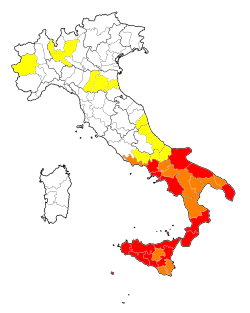
Incidence of organized crime's extortion in Italy by province in 2012
  High
  Mid
  Low
  Absent

The pizzo (Italian: [ˈpittso]) is protection money paid to the Mafia often in the form of a forced transfer of money resulting from extortion. The term is derived from the Sicilian pizzu ('beak'). To "let someone wet their beak" (Sicilian language fari vagnari u pizzu) is to pay protection money. The practice used to be widespread in Southern Italy,[citation needed] not only by the Sicilian Cosa Nostra but also by the 'Ndrangheta in Calabria and the Camorra in Campania. Another etymological explanation of the term is "beakerful", referring to the right of an overseer to scoop from the grain being threshed by peasants.[1]

Paying the pizzo may involve adding someone (often a member of a criminal organisation) to the payroll, provisioning of services by Mafia-controlled businesses or subcontracting to Mafia-controlled companies.[2] Businesses that refuse to pay the pizzo may be burned down. In return for paying the pizzo, businesses receive "protection" and can enlist neighbourhood Mafiosi to cut through bureaucracy or resolve disputes with other tradesmen. Collecting the pizzo keeps the Mafia in touch with the community and allows it to "control their territory".[3]

According to investigators, in 2008 the Mafia extorted more than 160 million euro a year from shops and businesses in the Palermo region, and they estimated that Sicily as a whole paid 10 times that figure.[4] Approximately 80% of Sicilian businesses pay a pizzo.[5] According to University of Palermo, the pizzo averages €457 (US$512) per month for retail traders and €578 for hotels and restaurants, but construction companies are asked to pay over €2,000 per month according to economic daily Il Sole 24 Ore.[6]

Among the first to refuse to pay protection money was Libero Grassi, a shopkeeper from Palermo. In January 1991, he wrote an open letter to the Giornale di Sicilia, the local newspaper. Published on the front page, it was addressed to an anonymous "Dear Extortionist". It caused an uproar and later that same year Grassi was murdered.[7]

In 2004, Addiopizzo (English: "Goodbye Pizzo"), a grassroots consumer movement frustrated with the Mafia's stranglehold on the local economy and political life, peppered Palermo with stickers stating: "An entire populace who pays pizzo is a mob without dignity". The group organise demonstrations wearing black T-shirts with the Addiopizzo logo, a broken circle with an X in the middle and the words "consumo critico" (critical consumption).[8]

References

[edit]

Bibliography

[edit]
[edit]
Revisions and contributorsEdit on WikipediaRead on Wikipedia
from Grokipedia
The pizzo is an racket central to the operations of the Sicilian , particularly Cosa Nostra, whereby criminal organizations demand regular payments—typically monthly—from businesses, shops, and professionals in mafia-controlled territories, ostensibly for "" against or disruption that the mafia itself orchestrates or threatens. This practice, equivalent to a parallel imposed through rather than voluntary exchange, has historically underpinned mafia economic power in by extracting resources without providing genuine security, often leading to distorted local markets and suppressed . Originating in post-feudal Sicilian social structures where private protection filled gaps left by weak state authority, the pizzo evolved into a sophisticated system by the , with demands calibrated to business revenues—ranging from tens to hundreds of euros monthly—and enforced through , , or physical harm for non-compliance. Empirical estimates indicate that in peak periods, such as the early 2000s in , up to 80% of businesses paid the pizzo, generating billions in illicit revenue annually and stifling legitimate economic activity by increasing costs and deterring . The racket's persistence reflects not only coercive control but also cultural normalization, where payment became a ingrained in mafia-dominated areas until challenged by initiatives. Notable resistance emerged with the movement in 2004, which mobilized consumers and businesses to boycott pizzo-payers, fostering a shift in norms and reducing compliance rates through collective defiance rather than reliance on state intervention alone. Despite legal crackdowns and declining overt in recent decades due to arrests and economic modernization, the pizzo endures in subtler forms, adapting to pressures while continuing to symbolize the mafia's parasitic influence on Sicilian society.

Definition and Terminology

Core Definition

Pizzo denotes the extortionate operated by the Sicilian , particularly clans affiliated with Cosa Nostra, whereby businesses, shops, and households in controlled territories are compelled to make regular payments—typically monthly—in , goods, or services to avert threats of violence, , or from the mafia itself. This practice imposes a parallel taxation system, enforced through and the credible demonstration of retaliatory capacity, distinguishing it from criminality by its systematic, institutionalized character. The payments vary by enterprise scale and location but often range from €60 upward for small operations, with collections yielding regressive returns: small firms generate approximately 40% of mafia extortion profits despite comprising the bulk of victims, while large corporations contribute minimally due to diversified protections or leverage. In , historical compliance rates reached 80% among local businesses as of 2017, underscoring pizzo's role as a core revenue mechanism funding broader illicit enterprises like drug trafficking and public contract manipulation. Causal to its persistence is the mafia's localized monopoly on credible , where non-payers face demonstrable reprisals—such as targeted fires or assaults—falsely attributed to rival threats, thereby perpetuating dependency on the extortionists for ostensible . This self-reinforcing , absent genuine market demand for , reveals pizzo as pure predation rather than symbiotic exchange, eroding legitimate economic activity through fear-induced compliance.

Etymology and Linguistic Origins

The term pizzo, referring to the extortionate protection payments demanded by the Sicilian Mafia, derives from the Sicilian dialect word pizzu, meaning "beak." This linguistic root stems from the idiomatic expression fari vagnari u pizzu ("to wet the beak"), which originally described a customary gesture of offering a sip of wine or a small gratuity as thanks for aid or safeguarding, akin to a bird dipping its beak in liquid. By the 19th century, amid Sicily's rural banditry and emerging organized crime, the phrase had shifted to connote sharing proceeds or yielding a portion to a protector, eventually crystallizing into the modern Mafia practice of mandatory tribute to prevent sabotage or violence. Linguists trace this evolution to pre-Mafia Sicilian customs of informal reciprocity, where "wetting the " symbolized minimal but obligatory reciprocity for security in insecure terrains, such as during merchant caravans vulnerable to brigands. The term's criminal adaptation reflects dialectal Sicilian's influence on Nostra's insular lexicon, distinguishing it from broader Italian usage. An links pizzo to capizzu (headboard or secure resting place), implying a "safe" repository for extorted funds, but this lacks the idiomatic depth of the beak and is less attested in dialectal studies. Distinct from standard Italian pizzo ("" or "edging," from Latin piceus via pointed fringes), the variant emerged squarely in 18th-19th century Sicilian , unconnected to sartorial meanings and emblematic of how local dialects encoded illicit economies. This etymological specificity underscores the embeddedness of in Sicilian cultural idioms, predating formalized structures yet enabling their persistence.

Historical Origins

Emergence in 19th-Century Sicily

The practice of pizzo, the Mafia's systematic disguised as payments, originated in 19th-century as mafiosi groups filled the void left by ineffective state in enforcing property rights and preventing disputes. Following the Bourbon monarchy's abolition of in 1812, large estates fragmented into smaller holdings managed by absentee landlords and gabellotti (intermediary leaseholders), who faced heightened risks of unrest, , and of high-value crops like fruits, which required constant guarding due to their perishability and vulnerability to . In this context, rural enforcers known as campieri—initially hired as private guards—evolved into proto-mafiosi networks offering "" services, often creating or amplifying threats to justify fees collected from landowners and merchants. These arrangements formalized in western , particularly around , where by the , such groups controlled local arbitration and security markets amid sparse policing. The in exacerbated conditions, as the new Piedmontese state's centralized bureaucracy struggled to extend control over Sicily's remote interiors, leading landowners to increasingly rely on mafiosi for and safeguarding against and emerging socialist agitation. Economic historian frames this as the Mafia's emergence as an "industry of private protection," where groups like early cosche (clans) monopolized enforcement in trust-scarce environments, extracting pizzo-like tributes—typically 5-10% of revenues from sulfur mines, orchards, and urban trades—as payment for averting self-inflicted harms or rival incursions. By the 1870s, parliamentary inquiries, such as those by Leopoldo Franchetti, documented widespread in agrarian economies, noting how mafiosi posed as indispensable mediators while undermining public order to sustain demand for their services. This system's entrenchment reflected causal factors like Sicily's geography—favoring isolated, defensible territories—and commodity-specific needs, such as protecting exports that comprised over 80% of Italy's supply by mid-century, where state courts proved too slow and corrupt for timely redress. Unlike voluntary insurance, pizzo operated regressively, preying on smallholders unable to self-defend, and by the late 1800s, it had normalized in provinces like and , where influence correlated with disruptions and weak governance metrics. Empirical analyses attribute this persistence not to inherent Sicilian criminality, but to state incapacity amplifying private alternatives, with mafiosi leveraging ties for credible threats and .

Ties to Early Cosa Nostra Structures

The practice of pizzo, or systematic extortion disguised as protection payments, was embedded in the foundational cosche (clans) of Cosa Nostra, which began forming in western Sicily during the 1830s amid a fragmented feudal economy lacking reliable state enforcement. Court records from 1837 first reference a cosca mafiosa, describing organized groups that offered private security to landowners against banditry, peasant revolts, and property disputes, often extracting fees in return. These early structures leveraged the roles of gabellotti—intermediaries managing vast latifundia for absentee nobles—who employed armed campieri to control labor and deter threats, evolving informal tributes into proto-racketeering as clans consolidated power post-1860 unification with Italy. By the mid-19th century, pizzo-like mechanisms became a core revenue stream for these nascent mafia networks, particularly in agrarian hubs like and , where protection against , , or was "sold" to sulfur miners, citrus growers, and estate managers in exchange for regular levies. Historian John Dickie notes that the mafia's primary function from its inception was vending such safeguards in state-vacant territories, with refusal risking escalated violence that reinforced clan authority. This symbiosis distinguished Cosa Nostra from mere banditry, as clans arbitrated disputes and monopolized enforcement, institutionalizing pizzo as a territorial that funded internal hierarchies and territorial expansion. These ties persisted into the late 1800s, with parliamentary inquiries like those led by Leopoldo Franchetti in documenting how mafia groups in province derived legitimacy from perceived protective roles, even as alienated victims and prompted early anti-mafia sentiments among elites. Unlike opportunistic crime, pizzo's integration into clan governance—enforced via oaths of loyalty and retaliatory codes—cemented its role in sustaining Cosa Nostra's vertical command, from rural capifamiglia to emerging urban syndicates.

Operational Mechanics

Collection and Enforcement Methods

The pizzo is collected primarily through direct monthly cash payments extorted from business owners by local mafia operatives, who approach targets with demands tailored to the enterprise's perceived revenue and vulnerability. Fees typically range from €60 for small retail outlets or bars to €10,000 for larger commercial operations, often calculated as a fixed sum or a of monthly turnover equivalent to 2-5% in controlled territories. These collections exploit the mafia's intimate knowledge of local economic activity, with payments sometimes disguised as inflated purchases of goods or services to evade detection. Enforcement mechanisms hinge on the Cosa Nostra's established territorial control and capacity for violence, beginning with implicit or explicit threats of harm to property or personnel if demands are unmet. Non-compliance escalates to targeted retaliation, including , attacks on premises, or explosive devices to instill fear without necessarily causing fatalities, as documented in numerous prosecuted cases. In extreme instances, physical assaults or murders have reinforced compliance, though such overt acts have declined since the due to heightened scrutiny. The mafia's strategy often involves creating or amplifying insecurity—such as rival intrusions or anonymous sabotage—that the extortionists then ostensibly resolve upon payment, perpetuating a cycle of dependency. Historically, up to 80% of Sicilian businesses acquiesced to these demands, generating estimated at €260 million annually in province alone during the early 2000s, based on average per-business extractions. Collection and enforcement are decentralized, delegated to family or representatives who maintain ledgers of payers to track adherence and identify defectors, minimizing internal disputes while maximizing territorial extraction.

Mafia's Rationale as "Protection"

The Sicilian Mafia, primarily through organizations like Nostra, frames the pizzo as a legitimate for providing essential services to businesses in environments where state enforcement is perceived as unreliable. This rationale positions the mafia as a private industry supplying guarantees against , , , and competitive by rival criminals, thereby enabling safe commercial operations and contract enforcement. Economist , drawing on confessions from eight mafiosi and historical records, argues that this model arose in post-unification (after ), where weak central authority and fragmented property rights created demand for credible third-party that the state could not reliably deliver. In this view, mafiosi act as "cartels of ," leveraging their reputation for retaliation to deter threats, much like insurers who must demonstrate capacity to punish claims against policyholders. Mafiosi often approach entrepreneurs subtly, emphasizing mutual benefit: payments—typically 2-10% of monthly turnover, adjusted for size and risk—secure not only physical safeguards but also in disputes, access to illicit networks for supplies or loans, and insulation from inter-gang conflicts. For instance, in during the late 20th century, Cosa Nostra bosses like those in the Corleonesi faction justified collections as preventing "accidents" such as fires or robberies that plagued non-compliant firms, with internal codes requiring mafiosi to actually intervene against external predators to maintain credibility. This self-reinforcing logic sustains the racket, as successful protections build trust, encouraging voluntary compliance over time, though initial via implied threats is common. Critically, this "protection" is inherently coercive, as the mafia's monopoly on local often generates the very risks it claims to mitigate, turning pizzo into a tax evaded at the peril of retaliation. Varese's analysis of dynamics distinguishes genuine (verifiable deterrence of third-party harm) from predation, noting that Sicilian mafias occasionally deliver on promises—e.g., repelling incursions from non-mafia thieves—but predominantly exploit their own capacity for harm, as evidenced by patterns where non-payers face escalated "signals" like traceable to the collectors. Empirical data from Sicilian cases (1987-2007) show that while mafias avoid total expropriation to preserve viability and long-term revenue, the rationale serves primarily to legitimize extraction rather than foster , with victims internalizing payments as a cost of doing amid institutional .

Economic and Societal Effects

Direct Financial Burdens

The pizzo extortion imposes a direct levy on businesses, typically structured as a of operating profits or a fixed monthly , which directly diminishes available capital for reinvestment or wages. Empirical analysis of Sicilian firms reveals an average pizzo rate of approximately 40% of operating profits for small enterprises, based on a of victimized businesses' balance sheets and reported payments. This rate reflects the mafia's appropriation of a substantial portion of generated value, often calibrated to avoid immediate while ensuring compliance through threats of or . Average monthly payments hover around 600 euros per affected , with variations by sector and location intensity. Prevalence amplifies the aggregate burden, with estimates indicating that 70-80% of Sicilian businesses, particularly in provinces like and , make regular pizzo payments. These direct extractions contribute to revenues from estimated at several billion euros annually in alone, representing a core funding stream that sustains operations without reliance on more volatile illicit activities. For individual proprietors, such payments equate to a , disproportionately straining micro-enterprises where profit margins are thin, often forcing owners to absorb losses through personal savings or reduced family consumption. Sector-specific data underscores uneven direct hits: and retail face higher fixed demands due to visible assets, while endures percentage-based cuts tied to seasonal revenues. Overall, these burdens manifest as immediate cash outflows—unreported to authorities in most cases to evade retaliation—eroding and elevating operational risks without any reciprocal service beyond coerced from further mafia predation.

Broader Market Distortions and Cultural Normalization

The extortion of pizzo imposes substantial barriers to market entry and competition in mafia-influenced regions of Sicily, where elevated costs deter new businesses and discourage expansion among incumbents, resulting in reduced firm density and suboptimal sectoral capital allocation. Empirical analysis reveals that the average pizzo rate—defined as the share of operating profits seized by mafias—averages around 40% for small firms, prompting these entities to curtail investments below efficient levels to limit expropriation risks, which in turn contracts aggregate output by a factor of three times the extorted sum. This dynamic favors mafia-connected enterprises, which may evade full payments or gain informal advantages like dispute resolution or access to illicit networks, thereby distorting competitive incentives and channeling resources into less productive, protected niches rather than high-growth opportunities. Such economic pressures exacerbate broader inefficiencies, including heightened informality and evasion of formal regulations, as firms absorb pizzo as a fixed overhead akin to taxes, stifling and legitimate in affected areas. Estimates indicate that up to 80% of Sicilian businesses have routinely paid pizzo, embedding it as a that warps pricing, supply chains, and investment decisions across industries like and retail. On the cultural front, pizzo's prevalence has historically normalized within Sicilian business norms, framing it as an inevitable "" premium against threats often originated by the same groups demanding payment, which perpetuates a cycle of dependency and diminishes reliance on state enforcement. This acceptance erodes civic trust, as non-payment risks not only retaliation but also competitive isolation in environments where compliance signals reliability to peers, thereby sustaining legitimacy through tacit social endorsement rather than overt alone. Over time, such normalization has hindered collective resistance, though initiatives challenging these norms have demonstrated potential to reframe pizzo as illegitimate, fostering antimafia .

Resistance and Countermeasures

Civil Society Initiatives like

, a anti- movement in , , originated on June 29, 2004, when anonymous activists plastered hundreds of stickers across the city bearing the message "Un popolo che paga il pizzo è un popolo senza dignità" ("A people that pays the pizzo is a people without dignity"), challenging businesses and consumers to reject demands for protection money. This initiative formalized in 2005 as Comitato Addiopizzo, founded by a group of young professionals who sought to establish Mafia-free enterprises amid widespread extortion affecting up to 80% of Palermo businesses by 2017. The movement operates through consumer-driven boycotts and incentives, encouraging shoppers to support "pizzo-free" businesses displaying stickers via the slogan "Pago chi non paga" ("I pay those who don't pay"), launched in 2006 with initial participation from about 100 enterprises. It introduced the "PizzoFree" certification label in 2010 for products from non-paying companies, alongside annual fairs starting in 2006 that drew over 10,000 attendees in the first event to promote ethical commerce. also provides free , psychological counseling, and business consulting to victims, including a 24/7 emergency line, and participates as a civil party in trials, as seen in its 2016 support for Bengali shop owners that contributed to convictions in 2019. By fostering collective refusal, has correlated with reduced Mafia intimidation, including fewer visits to affiliated shops and increased sales for participants, as reported by Palermo's anti-Mafia prosecutors, alongside a broader rise in denunciations that shifted social norms against passive compliance. Prior to 2004, payments were near-universal in rural and affected half of urban businesses; the initiative's growth to hundreds of affiliates has empowered victims and garnered recognition, such as the "Social Entrepreneur of the Year" award. Complementary efforts include collaborations with Libera, a nationwide anti-Mafia network founded in 1995 by priest Luigi Ciotti, which focuses on reclaiming confiscated Mafia assets for cooperatives and ethical tourism in , indirectly bolstering resistance to by promoting Mafia-free economic models and education campaigns. These initiatives emphasize individual and communal accountability, contributing to a cultural pivot where refusal of pizzo signals dignity and viability, though challenges persist due to Mafia adaptability. The Italian has implemented a series of anti-mafia laws targeting practices like pizzo, beginning with the 1982 Rognoni-La Torre law, which introduced Article 416-bis of the Penal Code criminalizing membership in mafia-type associations and enabling the preventive confiscation of assets linked to such crimes. This measure aimed to disrupt the financial foundations of groups like Cosa Nostra by seizing properties and businesses used to launder proceeds, with over 8,800 assets confiscated in alone between 1983 and 2015. Subsequent legislation focused on victim support to encourage reporting of pizzo demands. The 1991 Law 367 established a program for those denouncing mafia extortion, offering relocation and identity changes, while the 1992 Law 172 created a national Solidarity Fund to compensate victims of racket activities, covering damages from threats or . The 2011 Legislative Decree 159, known as the Anti-Mafia Code, consolidated these tools by streamlining investigations into mafia-linked extortion under Article 629 of the Penal Code (aggravated by mafia methods) and expanding asset freezes to include indirect beneficiaries of pizzo payments. Enforcement relies on specialized agencies, including the Direzione Investigativa Antimafia (DIA), established in 1991 to coordinate probes into territories where pizzo is collected, and the Direzione Nazionale Antimafia (DNA), which oversees prosecutors targeting high-level networks. A national anti-extortion commissioner facilitates inter-agency cooperation, integrating police operations with judicial actions. Recent examples include the February 11, 2025, operation in , where over 1,200 officers arrested 181 individuals affiliated with Cosa Nostra, dismantling clans involved in territorial control and rackets across Sicilian districts. Despite these efforts, challenges persist due to underreporting—only about 30% of affected entrepreneurs in file complaints, per ISTAT data—and mafia adaptations like subtler tactics. Confiscations and convictions have reduced overt violence, but judicial sources note that pizzo collection continues at rates of 40% or more of small firms' profits in high-risk areas, underscoring the need for sustained enforcement beyond legislative frameworks.

Contemporary Status

In recent years, extortion practices associated with the Sicilian Mafia, particularly Nostra, have evolved from overt, violence-backed demands to more subtle, collusive arrangements embedded within legitimate business operations. This shift, observed primarily in and surrounding areas, emphasizes low-profile collections—often described as "pay little to make everyone pay"—to minimize detection and institutional scrutiny while maintaining territorial control. Mafia groups have increasingly targeted selective sectors like and , integrating pizzo payments into supply chains, hiring practices, or services, thereby fostering victim complicity rather than coercion through threats. Reporting rates remain exceedingly low, reflecting this consensual dynamic: in , only 11 extortion denunciations were filed in 2024, comprising less than 2% of approximately 800 ascertained pizzo cases identified by police investigations over the prior year. In specifically, authorities tracked 50 incidents since 2023, but victims reported just a handful, as many payers actively participate in the ecosystem for mutual benefits such as or competitive advantages. Anti- prosecutor statements highlight that a significant portion of current payers maintain connivent relationships with Cosa Nostra, voluntarily seeking involvement rather than resisting it. These adaptations stem partly from intensified and , including the movement, which has deterred blanket extortions in supportive districts by increasing risks for mafiosi targeting non-compliant businesses. In response, clans have diversified revenue—shifting toward "taxes" on drug trafficking and —to offset declining pizzo yields, while avoiding high-visibility violence that could provoke backlash or arrests, as evidenced by operations dismantling restructuring efforts post the 2023 capture of . Non-payers are often tolerated to evade attention, further entrenching the practice's normalization in marginalized areas like Palermo's Zen and Brancaccio neighborhoods.

Measurable Declines and Persistent Challenges

Anti-mafia initiatives, including civil society campaigns like Addiopizzo and intensified law enforcement operations, have contributed to observable reductions in overt pizzo extortion in Sicily. By 2023, over 1,000 businesses in Palermo had joined Addiopizzo's network, committing to refuse payments and undergoing verification processes to confirm non-payment. In targeted Palermo neighborhoods, particularly in hospitality and fishing sectors, the prevalence of extortion has diminished following coordinated police actions, such as the February 2025 operation that resulted in nearly 150 arrests aimed at dismantling Cosa Nostra's extortion networks. Broader trends indicate a strategic shift away from traditional racketeering, with mafia-related murders dropping to just 17 across Italy in 2023, reflecting godfathers' aversion to high-risk violence that invites scrutiny. Official tracking by authorities has identified around 50 extortion cases in since 2023, signaling improved investigative capabilities, though convictions remain tied to these revelations rather than widespread victim reporting. The Direzione Investigativa Antimafia's 2023 assessments note clans adapting extortion tactics to lower profiles, such as reducing overt threats, which aligns with a reported evolution from coercive to more symbiotic arrangements. Despite these advances, persistent underreporting undermines precise measurement of declines, as victims often prioritize convenience or complicity over denunciation; in , only a handful of the tracked cases since 2023 were self-reported by victims. Estimates from earlier surveys indicate 70-80% of Sicilian es continue paying pizzo, with recent analyses suggesting many payers now view it as a pragmatic cost rather than pure , fostering entrenched economic ties. groups have responded by modernizing operations, infiltrating legitimate sectors like insolvencies and public contracts while de-emphasizing to evade detection, thereby sustaining influence amid weakened hierarchies from arrests. This adaptation, coupled with recruitment difficulties and cultural normalization in high-risk areas, poses ongoing challenges to eradication efforts.

References

Add your contribution
Related Hubs
User Avatar
No comments yet.