


Community hub
Recent from talks
Contribute something
Nothing was collected or created yet.
Wagonway
View on Wikipedia

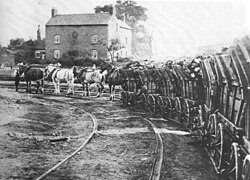
A wagonway (or waggonway; also known as a horse-drawn railway, or horse-drawn railroad) was a method of railway transportation that preceded the steam locomotive and used horses to haul wagons. The terms plateway and tramway were also used. The advantage of wagonways was that far bigger loads could be transported with the same power compared to horse haulage along roads.
Ancient systems
[edit]The earliest evidence is of the 6 to 8.5 km (3.7 to 5.3 mi) long Diolkos paved trackway, which transported boats across the Isthmus of Corinth in Greece from around 600 BC.[1][2][3][4][5] Wheeled vehicles pulled by men and animals ran in grooves in limestone, which provided the track element, preventing the wagons from leaving the intended route. The Diolkos was in use for over 650 years, until at least the 1st century AD.[5] Paved trackways were later built in Roman Egypt.[6]
Wooden rails
[edit]
Such an operation was illustrated in Germany in 1556 by Georgius Agricola (image left) in his work De re metallica.[7] This line used "Hund" carts with unflanged wheels running on wooden planks and a vertical pin on the truck fitting into the gap between the planks to keep it going the right way. The miners called the wagons Hunde ("dogs") from the noise they made on the tracks.[8]

Around 1568, German miners working in the Mines Royal near Keswick used such a system. Archaeological work at the Mines Royal site at Caldbeck in the English Lake District confirmed the use of "hunds".[9][10]
In 1604, Huntingdon Beaumont completed the Wollaton Wagonway, built to transport coal from the mines at Strelley to Wollaton Lane End, just west of Nottingham, England. Wagonways have been discovered between Broseley and Jackfield in Shropshire from 1605, used by James Clifford to transport coal from his mines in Broseley to the Severn River. It has been suggested that these are somewhat older than that at Wollaton.[10][11]
In 1610, Huntingdon introduced wooden waggonways as a form of coal transport in South East Northumberland, waggons with one horse were used to carry coals from the local pits to the port on the River Blyth. From 1692 to 1709, the Plessey Waggonway was constructed from Plessey to Blyth, following the route of Plessey Road, where it derives its name. It was constructed of a double-line of beech rails on oak sleepers. The waggons had wooden wheels with nails driven into them to reduce wear on the wheels.[12]
The Middleton Railway in Leeds, which was built in 1758 as a wagonway, later became the world's first operational railway (other than funiculars), albeit in an upgraded form. In 1764, the first railway in America was built in Lewiston, New York as a wagonway.[13]
At Bersham Ironworks records exist from 1757-1759 of contracts to lay a railroad from coal and iron pits to the works, and in 1991 40 m (130 ft) of track were excavated at the works including a set of points. The track was made with oak sleepers and ash rails, and was 4 ft 1 in (1,245 mm) gauge.[14]
Wagonways improved coal transport by allowing one horse to deliver between 10 and 13 long tons (10.2 and 13.2 t; 11.2 and 14.6 short tons) of coal per run— an approximate fourfold increase. Wagonways were usually designed to carry the fully loaded wagons downhill to a canal or boat dock and then return the empty wagons back to the mine.
Metal rails
[edit]Until the beginning of the Industrial Revolution, rails were made of wood, were a few inches wide and were fastened end to end, on logs of wood or "sleepers", placed crosswise at intervals of two or three feet. In time, it became common to cover them with a thin flat sheathing or "plating" of iron, in order to add to their life[15] and reduce friction. This caused more wear on the wooden rollers of the wagons and towards the middle of the 18th century, led to the introduction of iron wheels. However, the iron sheathing was not strong enough to resist buckling under the passage of the loaded wagons, so rails made wholly of iron were invented.[15]
In 1760, the Coalbrookdale Iron Works began to reinforce their wooden-railed tramway with iron bars,[16] which were found to facilitate passage and diminish expenses. As a result, in 1767, they began to make cast iron rails. These were probably 6 ft (1.829 m) long, with four projecting ears or lugs 3 in (75 mm) by 3+3⁄4 in (95 mm) to enable them to be fixed to the sleepers. The rails were 3+3⁄4 in (95 mm) wide and 1+1⁄4 in (30 mm) thick. Later, descriptions also refer to rails 3 ft (914 mm) long and only 2 in (50 mm) wide.[17]
Plateways, flangeways
[edit]
A later system involved L-shaped iron rails or plates, each 3 ft (914 mm) long and 4 in (102 mm) wide, having on the inner side an upright ledge or flange, 3 in (76 mm) high at the centre and tapering to 2 in (51 mm) at the ends, for the purpose of keeping the flat wheels on the track. Subsequently, to increase strength, a similar flange might be added below the rail.[15] Wooden sleepers continued to be used—the rails were secured by spikes passing through the extremities—but, circa 1793, stone blocks began to be used, an innovation associated with Benjamin Outram, although he was not the originator. This type of rail was known as the plate-rail, tramway-plate or way-plate, names that are preserved in the modern term "platelayer" applied to the workers who lay and maintain the permanent way.[15] The wheels of flangeway wagons were plain, but they could not operate on ordinary roads as the narrow rims would dig into the surface.
Edgeways
[edit]
Another form of rail, the edge rail, was first used by William Jessop on a line that was opened as part of the Charnwood Forest Canal between Loughborough and Nanpantan in Leicestershire in 1789.[15] This line was originally designed as a plateway on the Outram system, but objections were raised to laying rails with upstanding ledges or flanges on the turnpike. This difficulty was overcome by paving or "causewaying" the road up to the level of the top of the flanges.[15] In 1790, Jessop and his partner Outram began to manufacture edge-rails. Another example of the edge rail application was the Lake Lock Rail Road in the West Riding of Yorkshire (now West Yorkshire) used primarily for coal transport. The railway charged a toll and opened for traffic in 1798, making it the world's oldest public railway. The route started at Lake Lock, Stanley, on the Aire & Calder Navigation, running from Wakefield to Outwood, a distance of approximately 3 miles (4.8 km). Edge-rails (with a side rack) were used on the nearby Middleton-Leeds rack railway (a length of this rail is on display in Leeds City Museum). The wheels of an edgeway have flanges, like modern railways and tramways. Causewaying is also done on modern level crossings and tramways.
These two systems of constructing iron railways continued to exist until the early 19th century.[15] In most parts of England the plate-rail was preferred.[15] Plate-rails were used on the Surrey Iron Railway (SIR), from Wandsworth to West Croydon.[15] The SIR was sanctioned by Parliament in 1801 and finished in 1803.[15] Like the Lake Lock Rail Road, the SIR was available to the public on payment of tolls; previous lines had all been private and reserved exclusively for the use of their owners.[15] Since it was used by individual operators, vehicles would vary greatly in wheel spacing (gauge) and the plate rail coped better. In South Wales again, where in 1811 the railways were connected with canals, collieries, ironworks, and copper works, and had a total length of nearly 150 miles (241 km),[16] the plateway was almost universal.[15] But in the North of England and in Scotland the edge-rail was held in greater favor, and soon its superiority was generally established.[15] Wheels tended to bind against the flange of the plate rail and mud and stones would build up.

The manufacture of the rails themselves was gradually improved.[15] By making them in longer lengths, the number of joints per mile was reduced.[15] Joints were always the weakest part of the line.[15] Another advance was the substitution of wrought iron for cast iron, though that material did not gain wide adoption until after the patent for an improved method of rolling rails was granted in 1820 to John Birkinshaw, of the Bedlington Ironworks.[15] His rails were wedge-shaped in section, much wider at the top than at the bottom, with the intermediate portion or web thinner still. He recommended that they be made 18 ft (5.49 m) long, suggesting that several might be welded together end to end to form considerable lengths. They were supported on sleepers by chairs at intervals of 3 ft (914 mm), and were fish-bellied between the support points. As used by George Stephenson on the Stockton & Darlington, and Canterbury & Whitstable lines, they weighed 28 lb/yd (13.9 kg/m).[15] On the Liverpool and Manchester Railway they were usually 12 or 15 ft (3.66 or 4.57 m) long and weighed 35 lb/yd (17.4 kg/m) and were fastened by iron wedges to chairs weighing 15 or 17 lb (6.8 or 7.7 kg) each. The chairs were in turn fixed to the sleepers by two iron spikes, half-round wooden cross sleepers employed on embankments and stone blocks 20 in (508 mm) square by 10 in (254 mm) deep in cuttings. The fish-bellied rails were found to break near the chairs and starting in 1834, they were gradually replaced with parallel rails weighing 50 lb/yd (24.8 kg/m).[15]
Steam power
[edit]
In 1804, Richard Trevithick, in the first recorded use of steam power on a railway, ran a high-pressure steam locomotive with smooth wheels on an 'L' section plateway near Merthyr Tydfil, but it was more expensive than horses.[15] He made three trips from the iron mines at Penydarren to the Merthyr-Cardiff Canal and each time broke the rails that were designed for horse wagon loads. There was general doubt at the time that smooth wheels could obtain traction on smooth rails. This resulted in proposals using rack or other drive mechanisms.
.jpg)
Mr Blenkinsop of Middleton Colliery patented the use of cogged wheels in 1811 and in 1812, the Middleton Railway (edgeway, rack rail) successfully used twin cylinder steam locomotives made by Matthew Murray of Holbeck, Leeds. George Stephenson made his first steam locomotive in 1813 (patented 1815) for the Killingworth colliery,[16] and found smooth wheels on smooth rails provided adequate grip. Although he later recounted that they called this locomotive 'My Lord' as it was financed by Lord Ravensworth, it seems that it was known at the time as Blücher. In 1814 William Stewart was engaged by Parkend Coal Co in the Forest of Dean for the construction of a steam locomotive, which when trialled was reported to be successful.[16] Stewart did not receive his expected reward and the two parties parted on bad terms. Stewart was 'obliged to abandon the engine to that Company'.[18] In 1821 when a wagonway was proposed to connect the mines at West Durham, Darlington and the River Tees at Stockton, George Stephenson successfully argued that horse-drawn wagonways were obsolete and a steam-powered railway could carry 50 times as much coal. [citation needed] In 1825 he built the locomotive Locomotion for the Stockton and Darlington Railway in England's northeast, which became the world's first public steam railway in 1825, via both horse power and steam power on different runs.
Stationary steam engines for mining were generally available around the middle of the 18th century.[citation needed] Wagonways and steam-powered railways had steep uphill sections and would employ a cable powered by a stationary steam engine to work the inclined sections. British troops in Lewiston, New York used a cable wagonway to move supplies to bases before the American Revolutionary War. The Stockton and Darlington had two inclined sections powered by cable. The transition from a wagonway to a fully steam-powered railway was gradual. Railways up to the 1830s that were steam-powered often made runs with horses when the steam locomotives were unavailable. Even in the steam age, it was convenient to use horses in station yards to shunt wagons from one place to another. Horses do not need lengthy times to raise steam in the boiler, and can take shortcuts from one siding to another. At Hamley Bridge tenders were called for the supply of horses, in part because normal railway staff lacked horse handling skills.
Pole road
[edit]
Wooden rails continued to be used for temporary railroads into the twentieth century. Some timber harvesting companies in the southeastern United States created pole roads using unmarketable logs, which were effectively free, to create tracks at a cost of between $100 and $500 per mile. Permanence was not an issue, as the lumberjacks moved on to other stands of timber as each area was cleared.[19] At least one such pole road system reportedly extended some 20 miles (32 km).[20]
Typically the pole rails were logs of 8 to 12 inches (20 to 30 cm) diameter, laid parallel directly on the ground without sleepers, and joined end-to-end with lap joints and wooden pegs. Rolling stock typically had wheels either with concave rims that hugged the top of the pole rails, or un-flanged wheels with separate guide wheels running against the side of each rail. Steam traction engines and some purpose-built locomotives were successfully used for hauling trains of logs. For example, Perdido was built by Adams & Price Locomotive and Machinery Works of Nashville, Tennessee in 1885 for the Wallace, Sanford and Company sawmill at Williams Station, Alabama, where it hauled up to seven cars of 3 or 4 logs each. This was a geared engine (4.5 to 1 gear ratio), driving four individually-rotating concave-rim wheels on stationary axles via chain drives; powerful but running less than 5 miles per hour (8.0 km/h).[19] Still later, modified semitrailer tractors have been used.[21]
Decline
[edit]As steam power gradually replaced horse power throughout the 19th century, the term "wagonway" became obsolete and was superseded by the term "railway". As of 2025[update], very few horse or cable freight railways are operating, notable examples being the cable-hauled St Michael's Mount Tramway and the Reisszug, which has been in continuous operation since around 1900. A few passenger lines continue to operate, including the horse-hauled Douglas Bay Horse Tramway and the cable-hauled San Francisco cable cars.
See also
[edit]
- Barlow rail
- Granite Railway
- Guide rail
- Hay Railway
- Holy Island Waggonway
- Horsecar – Horse-powered tram or streetcar
- Mine railway
- Rail profile
- List of horse-drawn railways
- New Berlin horse-drawn tramway
References
[edit]- ^ Verdelis, Nikolaos (1957). "Le diolkos de L'Isthme". Bulletin de Correspondance Hellénique. 81: 526–529.
- ^ Cook, R.M. (1979). "Archaic Greek Trade: Three Conjectures 1. The Diolkos". The Journal of Hellenic Studies. 99: 152–155. doi:10.2307/630641. JSTOR 630641. S2CID 161378605.
- ^ Drijvers, J.W. (1992). "Strabo VIII 2,1 (C335): Porthmeia and the Diolkos". Mnemosyne. 45: 75–76.
- ^ Raepsaet, G.; Tolley, M. (1993). "Le Diolkos de l'Isthme à Corinthe: son tracé, son fonctionnement" (PDF). Bulletin de Correspondance Hellénique. 117: 233–261. doi:10.3406/bch.1993.1679.
- ^ a b Lewis, M.J.T. (2001). "Railways in the Greek and Roman world" (PDF). In Guy, A.; Rees, J. (eds.). Early Railways. A Selection of Papers from the First International Early Railways Conference. pp. 8–19. Archived from the original (PDF) on 21 July 2011.
- ^ Fraser, P. M. (1961). "The ΔΙΟΛΚΟΣ of Alexandria". The Journal of Egyptian Archaeology. 47: 134–138. doi:10.2307/3855873. JSTOR 3855873.
- ^ Agricola, Georgius (1913). De re metallica (Hoover translation ed.). p. 156.
- ^ Lee, Charles E. (1943). The Evolution of Railways (2 ed.). London: Railway Gazette. p. 16. OCLC 1591369.
- ^ Allison, Warren; Murphy, Samuel; Smith, Richard (2010). "An Early Railway in the German Mines of Caldbeck". In Boyes, G. (ed.). Early Railways 4: Papers from the 4th International Early Railways Conference 2008. Sudbury: Six Martlets. pp. 52–69.
- ^ a b "Time line for early railway developments & Wollaton Waggonway associated dates". Stephenson Locomotive Society & Waggonway Research Circle. 15 October 2007. Archived from the original on 19 August 2008. Retrieved 1 September 2009.
- ^ King, Peter (2010). "The First Shropshire Railways". In Boyes, G. (ed.). Early Railways 4: Papers from the 4th International Early Railways Conference 2008. Sudbury: Six Martlets. pp. 70–84.
- ^ THE STORY OF BLYTH: A SHORT HISTORY. Blyth, Northumberland: McCall's Bookshop. c. 1957.
- ^ Porter, Peter (1914). Landmarks of the Niagara Frontier. Privately printed. OCLC 1044424468.
- ^ Grenter, S (1993). "A Wooden Waggonway Complex at Bersham Ironworks, Wrexham". Industrial Archaeology Review. 15 (2): 195–207. Retrieved 10 May 2025.
- ^ a b c d e f g h i j k l m n o p q r s t Ross, Hugh Munro (1911). . In Chisholm, Hugh (ed.). Encyclopædia Britannica. Vol. 21 (11th ed.). Cambridge University Press. pp. 819–820.
- ^ a b c d "Historical Notes on Railways". The Practical Mechanic and Engineers Magazine. November 1844. pp. 57–60.
- ^ Lewis, Michael Jonathan Taunton (1970). Early Wooden Railways. London: Routledge & K. Paul. pp. 160–65. ISBN 0-7100-6674-0. OCLC 138270.
- ^ Stewart, William (October 1844). "Inventors and Capitalists". The Practical Mechanic and Engineer's Magazine. p. 24.
- ^ a b "Pole Road Locomotives of the Early Days". Trains. February 1948.
- ^ (untitled) [dead link]
- ^ A Pole Road in use: A logging engine moves on tracks made from logs of wood in A...HD Stock Footage. YouTube. CriticalPast. 21 June 2014. Archived from the original on 11 December 2021.
Bibliography
[edit]- Smiles, Samuel; Stephenson, George (1858). The life of George Stephenson, Railway Engineer (PDF). London: Ticknor and Fields. OCLC 162233825. Archived (PDF) from the original on 3 July 2015.
- Westwood, John Norton (1988). The Pictorial History of Railways. London: Bison Books. ISBN 0-86124-446-X. OCLC 34774624.
External links
[edit]Wagonway
View on GrokipediaHistorical Origins
Ancient trackways
The earliest precursors to wagonways appeared in antiquity as prepared trackways designed to facilitate the overland transport of heavy loads, bypassing challenging sea routes for economic efficiency. These systems relied on sledges, rollers, or basic wheeled carts guided along linear paths, laying foundational concepts for controlled haulage without the use of true flanged rails. Archaeological evidence, including rutted paths and paved surfaces, reveals their role in monumental construction and trade.[3] One of the most prominent examples is the Diolkos, a stone-paved trackway constructed across the Isthmus of Corinth in ancient Greece around 600 BC. Spanning 6 to 8.5 kilometers, it enabled the hauling of ships overland on rollers, avoiding the perilous circumnavigation of the Peloponnese peninsula. The pathway featured parallel grooves cut into the limestone pavement, spaced approximately 1.6 meters apart to guide the transport, and maintained a gentle incline of less than 1.5% for efficient movement. Operational for over 650 years until around 100 AD, the Diolkos supported military, commercial, and ceremonial voyages, with remnants identified through excavations revealing its durable construction.[4][5][3] In the Roman period, similar trackways emerged in Egypt during the 1st to 3rd centuries AD, particularly in the Eastern Desert quarries like Mons Claudianus, where parallel stone grooves guided wheeled vehicles for transporting obelisks, stone blocks, and columns to the Nile. These prepared roads formed extensive networks, often cleared and leveled for wagons pulled by draft animals, reflecting adaptations of earlier haulage techniques to support imperial building projects. Evidence from quarry sites shows these paths as critical infrastructure for moving heavy loads overland before river shipment.[6][7] Such ancient trackways influenced later European developments in linear transport infrastructure.[8]Early modern wooden wagonways
The earliest documented depictions of wooden wagonways appear in Georgius Agricola's De Re Metallica (1556), which illustrates German mining operations using "Hund" carts—small, four-wheeled vehicles—for hauling ore along L-shaped wooden planks or grooved timbers laid on sills. These setups featured two timbers, each about three-quarters of a foot thick and wide, with hollowed joints to guide an iron pin on the cart, reducing friction and enabling efficient underground transport in collieries. Agricola's woodcuts, prepared by Basilius Wefring, provide the first visual evidence of such guided rail systems, primarily employed in Saxony's silver and ore mines to move heavy loads over uneven terrain.[9] In England, the Wollaton Wagonway, constructed between 1603 and 1604 in Nottinghamshire by Huntingdon Beaumont in partnership with Sir Percival Willoughby, represents the earliest known above-ground wooden rail system. Stretching approximately 3 kilometers from Strelley coal pits to Wollaton Hall, it utilized oak rails laid on sleepers to support horse-drawn wagons carrying coal for urban markets. This innovation marked a shift from road-based haulage, with operations ceasing around 1620 after depleting accessible seams, but it demonstrated the practicality of wooden tracks for industrial transport.[10][11] By the mid-18th century, wooden wagonways had evolved into sustained operations, as exemplified by the Middleton Railway in Leeds, England, authorized by Parliament in 1758 and initially equipped with wooden rails to convey coal from Middleton collieries to the Aire and Calder Navigation. Spanning about 5.6 kilometers, it operated reliably for decades before transitioning to iron rails in 1799, highlighting the durability of early wooden designs in supporting colliery economies. These systems offered significant operational advantages: a single horse could haul 10-13 long tons per trip on rails—far exceeding the 1-2 tons possible on ordinary roads—due to reduced friction from grooved or L-shaped wooden beams, which typically lasted 5-10 years before requiring replacement.[12][13] The adoption of wooden wagonways spread primarily across England and Germany during the 16th to 18th centuries, centered on collieries and ore mines to streamline coal and mineral transport. In Germany, roots traced to Agricola's era expanded in regions like Saxony and the Ruhr, while England's northeast and midlands saw dense networks by the 1700s, integrating with emerging canals. A notable example is the 1.6-kilometer Hay Inclined Plane in Shropshire, operational from 1793, which used cast iron plate rails to elevate canal boats 64 meters between the Shropshire Canal and River Severn, facilitating coal shipment from Ironbridge Gorge forges.[14][2]Rail Designs and Materials
Wooden rail systems
Wooden rail systems in wagonways employed various designs to guide wagons and minimize friction, primarily consisting of flat planks laid as plateways, grooved rails that channeled plain wheels, or L-shaped ledges providing lateral support similar to early flanges.[15] These configurations were typically constructed with rails of rectangular cross-section, about 4 to 5 inches square, pegged to transverse sleepers to maintain alignment.[11] The standard gauge ranged from 4 to 5 feet, allowing compatibility with horse-drawn wagons while optimizing stability; rails were supported on wooden or stone sleepers embedded in ballast for drainage and load distribution.[16] Such systems, as seen in practical implementations like the Wollaton wagonway, demonstrated effective guidance without metal components.[17] Construction relied on hardwoods such as oak for sleepers and beech or elm for rails, selected for their density and initial resistance to compression under load.[11] These materials were often untreated or minimally seasoned, with occasional charring or soaking to mitigate splitting, though this provided limited protection against environmental factors.[16] Under heavy traffic, wooden rails exhibited an average lifespan of 4 to 7 years, frequently requiring resurfacing by planing or complete replacement due to groove formation from wheel wear.[17] Maintenance practices involved periodic inspection and repair, with costs estimated at £100 to £200 per mile for resurfacing or renewal, reflecting the labor-intensive nature of timber handling and the need for skilled carpenters.[11] The reduced rolling resistance of wooden rails—qualitatively lower than the high friction of unpaved roads—enabled significant efficiency gains, permitting a single horse to haul 5 to 10 times more cargo than on conventional cart paths, often up to 2 tons per wagon on level sections.[17] Load capacities varied by design, with broader-gauge systems supporting wagons of 37 to 50 hundredweight (approximately 1.85 to 2.5 tons), while narrower variants handled lighter loads around 14 to 60 hundredweight.[17] On inclines reaching gradients of 1:10, operations managed steeper ascents through additional horses or wooden brake blocks to control descent, maintaining overall throughput without mechanical aids.[11] Despite these advantages, wooden rail systems faced inherent challenges, including susceptibility to rot from moisture infiltration and fungal decay, which accelerated in damp climates and reduced structural integrity over time.[16] Weather exposure exacerbated wear, with frost causing expansion cracks and heavy rain leading to ballast washout, often halting operations during severe conditions.[17] Derailments were common due to uneven settling of sleepers or wheel flanges climbing edges on curves, compounded by the qualitative increase in friction compared to road transport's irregular surfaces, necessitating frequent realignment and check rails for mitigation.[11]Metal rail systems
The transition from wooden rails to metal-enhanced systems marked a pivotal advancement in wagonway durability during the mid-18th century. In the 1760s at Coalbrookdale, England, ironmaster Abraham Darby III oversaw the introduction of hybrid designs featuring cast iron plates affixed to the tops of wooden rails, which significantly prolonged track lifespan to approximately 10-15 years by mitigating wood's susceptibility to rot and wear.[18] These plates, cast at the Coalbrookdale Ironworks starting in 1767 under the direction of manager Richard Reynolds, were typically 5 feet long and 4 inches broad, providing a harder wearing surface for wagon wheels while retaining the lower cost of wooden substructures.[19] Further innovation came with the adoption of full cast iron rails, pioneered by colliery manager John Curr in the late 1780s near Sheffield, England. Curr's design, implemented around 1787 at the Duke of Norfolk's collieries, utilized L-shaped cast iron edge rails laid directly on stone supports, eliminating the wooden base entirely and enhancing load distribution.[20] However, these early cast iron rails proved brittle and prone to cracking under the impact of heavy wagons, leading to frequent fractures and necessitating careful wheel flange designs to prevent derailments. The limitations of cast iron spurred the development of wrought iron rails in the early 19th century. In 1820, John Birkinshaw, manager of the Bedlington Ironworks in Northumberland, England, patented a method for rolling continuous wrought iron edge rails, producing sections 15 to 18 feet in length with a distinctive fish-bellied profile that sagged in the center to maximize resistance to bending stresses.[21] These rails, first deployed on the Stockton and Darlington Railway in 1825, weighed between 30 and 40 pounds per yard and were fixed using iron chairs or laid on stone blocks spaced 2 to 3 feet apart, allowing for more stable and efficient track alignment.[22] Wrought iron rails offered substantial economic and operational advantages over predecessors. Construction costs for iron-equipped wagonways were estimated at around £1,000 per mile, higher than the £440 per mile for wooden tracks but offset by reduced long-term expenses due to superior wear resistance and service lives exceeding 20 years in moderate-traffic settings.[19] They supported loads of up to 8 tons for horse-drawn operations on level sections, allowing for greater efficiency than wooden systems—and permitted sustained speeds of 4 to 6 miles per hour for horse-drawn operations, minimizing joint wear and maintenance intervals while enabling greater throughput in industrial coal transport.[17]Plateway and flangeway designs
Plateway designs featured L-shaped cast iron rail profiles, where the flange extended upward from the inner edge of the rail to guide plain, unflanged wheels, providing both support and lateral containment for wagons on early metal wagonways. These rails, typically 4 to 6 inches wide and 3 to 4 feet long, were laid flat on stone blocks or wooden sleepers, with the vertical flange—often 1 to 2 inches high—preventing derailment, particularly on curves and uneven terrain. Flangeways, as narrower inner guide tracks or channels formed by the rail flanges, further enhanced stability by confining the wheel treads within the L-profile, allowing for simpler wheel construction without onboard flanges.[23][17][24] These designs became widespread in 18th-century English collieries, where they facilitated the transport of coal over short distances from mines to rivers or canals, with early examples like the Coalbrookdale Iron Works plateway of 1767 marking the shift to iron construction. By the 1780s, plateways were common in industrial regions such as the Midlands and Northeast, with gauges varying but often around 4 feet 2 inches to 4 feet 8 inches; the 4 feet 8.5-inch gauge began standardizing in the early 19th century as lines interconnected. The Surrey Iron Railway, opened in 1803 as the first public plateway authorized by Parliament, exemplified this application, using L-shaped rails to haul goods over 8.5 miles from Wandsworth to Croydon at a gauge of 4 feet 2 inches.[23][17][24] Plateway systems excelled in low-speed operations, typically 2 to 4 miles per hour with horse traction, supporting heavy loads—up to 5 to 8 tons per wagon—across undulating terrain without requiring precise wheel alignment, as the rail flanges provided inherent guidance. This made them ideal for colliery environments with irregular ground, where stability on curves reduced the risk of tipping overloaded vehicles. However, their flat-top design with raised inner flanges was prone to fouling from coal dust, mud, and debris accumulating in the flangeway, necessitating frequent cleaning to prevent wheel binding. Additionally, the need for wagons wider than the gauge—often 5 to 6 feet across—for lateral stability increased construction costs and limited adaptability to narrower paths.[17][23][24] The technical evolution of plateways began with wooden L-beams in the mid-18th century, transitioning to cast iron by the 1780s for greater durability under heavy use, as seen in Coalbrookdale's pioneering rails that supported loads previously limited by wood's wear. This iron adoption, driven by foundries like those in Shropshire, enabled longer lines and public ventures like the Surrey Iron Railway, where a single horse could pull up to 10-13 tons of coal over flat sections, though the design's debris vulnerability contributed to its eventual replacement by edgeway systems in the 1820s.[23][17]Edgeway designs
Edgeway designs utilized flat-topped edge rails, typically measuring around 3 to 4 inches in height with a head width of approximately 2.25 inches, paired with wheels featuring inner flanges for lateral guidance and stability.[25] These rails, cast in iron and laid in short sections of 3 to 6 feet, were elevated above the ground to minimize debris accumulation and wear, contrasting with earlier systems where rails lay flush.[16] William Jessop pioneered this configuration in 1789 on the horse-drawn line associated with the Charnwood Forest Canal between Loughborough and Nanpantan, where flanged wheels ran on the rail edges to provide precise tracking without the need for rail-side flanges.[](https://m Mosaicprojects.com.au/PDF_Papers/P207_The_first_railway_projects.pdf)[26] By the early 19th century, edgeway designs gained preference for public wagonways due to their efficiency and adaptability, notably on the Stockton and Darlington Railway, which opened in 1825 using wrought-iron edge rails standardized to a 4-foot-8.5-inch gauge.[27] This setup supported sharper curves with radii as tight as 100 to 200 feet, enabling more flexible routing through varied terrain compared to rigid plateway alternatives.[23] Performance advantages included reduced rail wear from smoother wheel contact and higher operational speeds reaching up to 8 miles per hour in horse-drawn service, though early implementations faced challenges like flange climb on steep inclines requiring careful wheel alignment.[28] Innovations in edgeway systems included the adoption of double-flanged wheels by the early 1800s, allowing bidirectional operation without repositioning and enhancing safety on shared tracks.[29] These designs proved cost-effective for long-distance haulage, as the elevated rails distributed loads more evenly and supported heavier coal wagons over extended routes, surpassing the limitations of plateways in scalability.[23]Propulsion Methods
Animal-powered operations
Animal-powered operations in wagonways primarily relied on horses, with oxen occasionally used in specific contexts, to haul coal and other goods along wooden or iron-plated tracks before the widespread adoption of steam power. Typically, a single horse pulled a chaldron—a standard coal wagon holding about 53 hundredweight—on level terrain, though teams of up to four horses were employed for heavier loads or steeper gradients.[11] These animals were harnessed using padded collar-and-hames designs, which distributed pulling force across the chest and shoulders via breast collars, enabling efficient heavy draft without straining the neck. Speeds averaged 2 to 5 miles per hour on flat sections, limited by the animals' gait and track conditions, with relays of fresh horses stationed at intervals for longer routes exceeding a few miles to maintain productivity.[30] On downhill stretches, horses were often tethered behind the wagons, while brakes operated by wagon men controlled descent to prevent runaway accidents.[11] Operational logistics involved coordinated teams, including one wagon man per horse to guide and manage the animals, alongside passing sidings on double-track sections to allow overtaking and avoid collisions.[11] In mining contexts, "hurriers"—often women or children—assisted by pushing or guiding wagons within collieries, linking underground extraction to surface haulage and enduring harsh conditions like low seams and dust. Safety measures included informal speed limits enforced by handlers to mitigate derailments, particularly in wet or frosty weather when rails became slippery, though accidents remained common, with historical records noting fatalities from runaways and collisions.[11] Animal welfare concerns arose from overwork, with horses facing fodder shortages and exhaustion; during the Napoleonic Wars, competition for mounts from the military drove up costs and scarcity, straining operations.[31] Economically, animal-powered wagonways revolutionized coal transport in 18th-century Britain, boosting output from collieries by enabling a single horse to haul up to 8 tons on rails compared to just 2 tons on macadamized roads, achieving roughly 10 times the efficiency of traditional cartage and reducing road wear.[32] This efficiency lowered delivery costs to waterways—averaging stable rates over distances of 5-6 miles—and contributed to an 18-fold increase in national coal production during the Industrial Revolution, fueling urban industries like metalworking and brewing while dropping real prices to London by 40 percent through improved logistics.[33] The Middleton Railway, which used horse power from 1758 until the introduction of steam locomotives in 1812, exemplifies this impact, transporting thousands of tons annually from Middleton Colliery to Leeds and undercutting coal prices to support regional growth.[31]Steam-powered adaptations
The integration of steam power into wagonways began with experimental adaptations of existing plateway and edgeway systems, transforming animal-powered infrastructure into the precursors of modern railways. In 1804, Richard Trevithick successfully tested the world's first steam locomotive on the Penydarren plateway in Merthyr Tydfil, Wales, where the unnamed engine hauled five wagons carrying 10 tons of iron and 70 passengers over 9.75 miles at a top speed of approximately 5 mph. This pioneering run demonstrated steam's potential but highlighted initial limitations, as the locomotive's unsprung weight frequently damaged the brittle cast-iron plates of the existing track. Trevithick's engine was soon repurposed as a stationary unit due to these structural issues, yet it proved that steam could replace animal traction on adapted wagonways. Further advancements came in 1812 with John Blenkinsop's rack-and-pinion system on the Middleton Railway near Leeds, England, where Matthew Murray built the first commercially successful steam locomotives. These twin-cylinder engines, weighing around 5 tons each, used a toothed pinion engaging an external rack rail alongside narrow-gauge edge rails to haul coal wagons reliably, operating until the early 1830s and validating steam for industrial transport on modified wagonway layouts. A landmark in steam adoption occurred in 1825 with George Stephenson's Locomotion No. 1 on the Stockton and Darlington Railway, the first public railway to use steam extensively on edge rails derived from wagonway designs. This 0-4-0 locomotive hauled a 90-ton train, including coal wagons and passenger carriages, at speeds up to 15-16 mph (with an average of 8 mph) over 8.5 miles on its opening run, marking the shift toward regular steam operations. Adaptations such as cogged wheels were employed on inclines to improve traction, building on earlier rack systems while favoring smooth adhesion on level sections. To accommodate steam locomotives weighing 10-20 tons, wagonway infrastructure underwent significant modifications, including strengthened cast-iron or early wrought-iron rails and reinforced bridges to prevent buckling under dynamic loads. Fuel efficiency improved with coal as the primary source—abundant in UK collieries—supplemented by wood in some regions, allowing sustained operation; however, boilers required water replenishment every 5-10 miles due to high consumption rates of 20-30 gallons per mile. These changes extended the range and capacity of former animal wagonways, enabling heavier freight hauls. Early steam adaptations faced substantial challenges, particularly in the UK where development concentrated. Poorly designed boilers, often operating at high pressures without safety valves, led to frequent explosions, with thousands recorded in the steam era due to overheating or material weaknesses. The added weight of locomotives also caused track damage, such as rail fractures and misalignment, necessitating ongoing reinforcements. In the United States, steam adaptations on wagonway-inspired lines emerged post-1830, with the first practical American-built locomotive, the Best Friend of Charleston, entering service in 1830 on the South Carolina Canal and Rail Road Company, adapting British designs to local wood-fueled operations and lighter infrastructure.Pole road variants
Pole roads represented a specialized variant of temporary wagonways, evolving as a conceptual predecessor to more structured wooden rail systems, where parallel peeled logs served as rails for narrow-gauge carts in the logging industry. These tracks typically consisted of logs approximately 6 to 8 inches in diameter, laid parallel and notched or pinned together without crossties to minimize construction effort, forming a gauge of around 5 feet. Common in the 19th and early 20th centuries across the United States, particularly in the lumber-rich regions of Maine and the Pacific Northwest, pole roads facilitated the transport of felled timber from remote forests to mills or waterways, with over 380 such lines totaling more than 2,200 miles operational by 1886.[34] Propulsion on pole roads relied primarily on animal power, such as horses, for shorter hauls, but early steam locomotives were adapted for efficiency on longer lines, exemplified by the Perdido engine built in 1885 for a Wallace & Sanford Company operation in Alabama. This 0-4-0T locomotive, with 7.5-inch by 12-inch cylinders and 20-inch drivers, hauled trains of seven log cars—each carrying five logs—at speeds of 4 to 5 miles per hour over lines typically spanning 5 to 10 miles. Such setups allowed for grades as steep as 1:20 (about 300 feet per mile), enabling access to challenging terrain in swampy or forested areas. The primary advantages of pole roads stemmed from their low construction costs, estimated at around $100 per mile using readily available waste timber, and their temporary nature, which permitted rapid assembly and disassembly after logging operations concluded in a given area. This made them ideal for short-term exploitation of timber stands, reducing the need for permanent infrastructure investment. However, limitations included high maintenance demands due to log rot, shifting under load, and vulnerability to fire, which often necessitated frequent repairs or relocations. By the 1920s, pole roads were largely phased out in favor of motor trucks, though rare non-U.S. examples appeared in colonial Africa for similar logging purposes.[35]Decline and Legacy
Transition to modern railways
The transition from traditional wagonways to modern steam-dominated railways was driven primarily by the superior efficiency of steam locomotives, which achieved average speeds of 12-15 miles per hour on early lines like the Stockton and Darlington Railway, compared to the 3-5 miles per hour typical of horse-drawn wagonways limited by animal stamina and terrain.[36][37] This speed advantage facilitated quicker goods movement, reducing transit times for coal and industrial materials from days to hours on key routes. Concurrently, massive network expansion underscored the shift, as seen in the United Kingdom where railway mileage grew from 27 miles in 1825 to 125 miles by 1830 and reached approximately 2,000 miles by 1840 through speculative investments in iron rails and permanent way infrastructure.[13] Capital from joint-stock companies and low interest rates in the early 1840s enabled this durable construction, outpacing the temporary wooden tracks of wagonways.[38] By the 1830s, steam adaptations began catalyzing widespread replacement of wagonways across Europe, with most industrial haulage routes converting to locomotive-hauled systems by the 1850s as iron rails proliferated and horse operations proved inadequate for growing volumes.[39] In the United States, however, horse-powered wagonways in remote logging areas persisted longer due to challenging terrain and limited capital, remaining in use until the 1920s in regions like northern Minnesota where steam locomotives were impractical for short-haul timber extraction.[40] Economic factors accelerated this obsolescence: steam railways eliminated ongoing costs for animal feed and maintenance while offering lower per-ton-mile rates after initial builds, making them viable substitutes for wagonways by around 1840. Higher upfront investments in locomotives and tracks were offset by scalability for national networks. The UK's Railway Mania of the 1840s exemplified these shifts, as relaxed parliamentary oversight and a post-recession economic recovery spurred 75 new railway acts in 1844, channeling investments into expansive infrastructure that marginalized remaining wagonways.[38] Regional variations marked the decline's pace; in Asia, horse tramways endured into the early 1900s, with Japan's Tokyo Horse-Drawn Railway operating until 1903 when electric streetcars addressed urban sanitation issues and rising demand.[41]Surviving examples and historical influence
One of the most notable surviving operational remnants of horse-drawn wagonways is the Douglas Bay Horse Tramway on the Isle of Man, established in 1876 and operating continuously to the present day as Europe's last horse-drawn street tramway on a 3-foot gauge track along the Douglas Promenade.[42][43] This 1.5-mile line, pulled by Shire horses, preserves the original method of animal propulsion and metal-railed transport for passenger service, demonstrating the endurance of low-maintenance, friction-reducing designs from 19th-century wagonways; as of 2025, it runs seasonally from April to November.[44] The Ffestiniog Railway in Wales originally featured short-lived cable-hauled inclines in 1836, with the northern incline powered by a water wheel and the southern using a gravity-balanced counterbalance system where descending loaded wagons hauled up empties via rope; these were replaced by a tunnel in 1842, but the heritage line preserves the broader horse- and gravity-worked slate transport system from its opening.[45][46] These early features highlight the engineering ingenuity of wagonway propulsion that minimized animal labor on steep gradients.[47] Preservation efforts have focused on reconstructing wooden wagonways to educate on their historical mechanics. At the Beamish Museum in the UK, the Pockerley Waggonway replica, based on 18th- and 19th-century colliery designs, features over 200 yards of wooden rails and sleepers laid on a crushed brick base, operational with horse-drawn or replica steam haulage to recreate low-friction coal transport.[48] In the United States, remnants of logging pole roads—temporary wooden tracks used for hauling timber—are preserved and demonstrated in national parks such as Redwood National and State Parks, where stabilized sections of these inclines illustrate 19th- and early 20th-century adaptations for rugged terrain.[49] The technical legacy of wagonways extends to foundational railway engineering, particularly in the adoption of the 4-foot-8.5-inch standard gauge, which originated from the wheel spacing of horse-drawn colliery wagons on edgeways in 18th-century England to optimize stability and reduce derailments on uneven wooden rails. This gauge became widespread in global networks due to its proven efficiency in minimizing friction between flanged wheels and rails, allowing heavier loads with less power—a principle that lowered operational costs and informed the transition to iron and steel permanent ways.[50] Early wagonway designs also influenced sleeper configurations and maintenance practices, as wooden cross-ties spaced to support longitudinal rails reduced track degradation and ballast wear, concepts that persist in modern railway infrastructure to control long-term costs through durable substructure alignment.[51] The low-friction transport principles of wagonways laid the groundwork for efficient rail networks worldwide, enabling economies of scale in freight haulage that transformed industrial logistics.[52] Today, wagonway legacies manifest in modern light rail systems emphasizing low-emission, guided urban transport and heritage tourism, where preserved examples like the Douglas Bay line attract visitors to experience sustainable, animal-powered mobility.[53]References
- https://en.wikisource.org/wiki/A_History_of_Inland_Transport_and_Communication_in_England/Chapter_18