Hubbry Logo
Polycarp PengoPolycarp PengoMain
Open search
Polycarp Pengo
Community hub
Polycarp Pengo
logo
8 pages, 0 posts
0 subscribers
Be the first to start a discussion here.
Polycarp Pengo
Polycarp Pengo
from Wikipedia

Key Information

Ordination history of
Polycarp Pengo
History
Priestly ordination
Ordained byCharles Msakila
Date20 June 1971
PlaceDiocese of Sumbawanga
Episcopal consecration
Principal consecratorJohn Paul II
Co-consecratorsEduardo Martínez Somalo,
Duraisamy Simon Lourdusamy
Date6 January 1984
PlaceSaint Peter's Basilica, Rome, Italy
Cardinalate
Elevated byJohn Paul II
Date21 February 1998
Episcopal succession
Bishops consecrated by Polycarp Pengo as principal consecrator
Anthony Mathias Banzi15 September 1994
Agapiti Ndorobo16 June 1995
Augustine Ndeliakyama Shao, C.S.Sp27 April 1997
Jude Thaddaeus Ruwa'ichi, O.F.M. Cap16 May 1999
Jacob Venance Koda30 May 1999
Desiderius M. Rwoma11 July 1999
Method Kilaini18 March 2000
Damian Denis Dallu30 July 2000
William Pascal Kikoti14 January 2001
Ludovick Joseph Minde, ALCP/OSS05 August 2001
Alfred Leonhard Maluma01 September 2002
Castor Paul Msemwa30 January 2005
Beatus Kinyaiya, O.F.M. Cap02 July 2006
Isaac Amani Massawe22 February 2008
Protase Rugambwa13 April 2008
Almachius Vincent Rweyongeza06 November 2008
Salutaris Melchior Libena19 March 2010
Eusebius Alfred Nzigilwa19 March 2010
Rogatus Kimaryo, C.S.Sp.13 June 2010
Renatus Leonard Nkwande20 February 2011
Bernardin Francis Mfumbusa15 May 2011
John Chrisostom Ndimbo05 June 2011
Titus Joseph Mdoe01 May 2013
Liberatus Sangu12 April 2015
Styles of
Polycarp Pengo
Reference styleHis Eminence
Spoken styleYour Eminence
Religious styleCardinal
Informal styleCardinal
SeeDar es Salaam

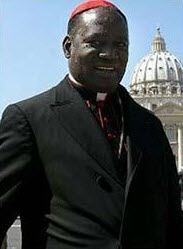
Polycarp Pengo (born 5 August 1944) is a Tanzanian prelate of the Catholic Church who was Archbishop of Dar-es-Salaam, from 1992 to 2019. A bishop since 1983, he was made a cardinal in 1998.

Biography

[edit]

Polycarp Pengo was born on 5 August 1944. He was ordained a priest in 1971 by Bishop Charles Msakila.[1] He studied Moral Theology in Rome at the Pontifical Lateran University, obtaining a doctorate in 1977. He taught Moral theology in Kipalapala Theological Seminary for a short time, and then became the first Rector of Segerea Theological Seminary in Dar-es-Salaam up to 1983.

He was made Bishop of Nachingwea (now Lindi) in 1983,[2] and of Tunduru-Masasi in 1985.

In 1990 he was named Coadjutor Archbishop of Dar es Salaam, and in 1992 he became Archbishop of Dar-es-Salaam, following the resignation of Cardinal Laurean Rugambwa.[2]

Pengo was proclaimed a cardinal by Pope John Paul II in the consistory of 21 February 1998. Pengo was one of the cardinal electors who participated in the 2005 papal conclave that elected Pope Benedict XVI and in the 2013 papal conclave that elected Pope Francis.[1]

He has the following Curial Memberships Evangelization of the Peoples, Doctrine of Faith (congregations). Interreligious Dialogue, Culture (councils) Special Council for Africa of the General of the Synod of Bishops.

Since 2007 he has been president of the SECAM (Symposium of Episcopal Conferences of Africa and Madagascar).[3]

On 18 September 2012, he was appointed by Pope Benedict XVI as a Synod Father for the October 2012 13th Ordinary General Assembly of the Synod of Bishops.[4]

Pope Francis accepted his retirement as archbishop on 15 August 2019.[5]

Views

[edit]

Homosexuality

[edit]

In 2000, Pengo hit out at the commission of homosexual acts, saying it was one of the most heinous sins on earth.[6]

Clashes in Tanzania

[edit]

In 2004, he lashed out at the perpetrators of clashes claiming to pursue a religious cause.[7]

Church teaching on AIDS

[edit]

Pengo has declared that the AIDS epidemic cannot be overcome by relying exclusively or primarily on the distribution of prophylactics, but only through a strategy based on education to individual responsibility in the framework of a moral view of human sexuality.[8]

References

[edit]
[edit]
Revisions and contributorsEdit on WikipediaRead on Wikipedia
from Grokipedia
Polycarp Pengo (5 August 1944 – 19 February 2026) was a Tanzanian prelate of the Catholic Church who served as Archbishop of Dar-es-Salaam from 1992 to 2019 and was created cardinal in 1998 by Pope John Paul II. Ordained a priest in 1971 after theological studies in Tanzania and earning a doctorate in moral theology from the Pontifical Lateran University in Rome, Pengo advanced through episcopal roles, including Bishop of Nachingwea (1983–1986) and Bishop of Tunduru-Masasi (1986–1990), before becoming coadjutor and then archbishop of Dar-es-Salaam. As a cardinal-priest with the titular church of Nostra Signora de La Salette, he participated in the 2005 and 2013 papal conclaves and held leadership positions such as president of the Symposium of Episcopal Conferences of Africa and Madagascar (SECAM) from 2007 to 2009, focusing on continental episcopal coordination amid challenges like secularization and family breakdown. Pengo was notable for his defense of traditional Catholic teachings on marriage and sexuality, urging African nations to reject foreign aid tied to the promotion of homosexuality, which he termed "ideological colonization," prioritizing moral integrity over economic dependency. His tenure emphasized pastoral care for families, opposition to secular influences eroding Christian values, and contributions to synodal discussions on faith and evangelization in Africa.

Early Life and Formation

Birth and Upbringing

Polycarp Pengo was born on August 5, 1944, in Mwazye, a rural within the of Sumbawanga in what was then the British-administered territory of Tanganyika (now ). Little is documented about his or precise socioeconomic circumstances, though his early exposure to Catholicism suggests a context influenced by activity in the region, where the Church had established presence amid colonial-era evangelization efforts. Pengo's upbringing occurred in a predominantly agrarian setting in western , where access to formal was limited outside mission schools. From 1959 to 1964, at age 15, he pursued higher secondary schooling at the minor in Kaengesa, marking his initial formal engagement with ecclesiastical formation and indicating an early vocational discernment toward priesthood amid a landscape of post-colonial transitions in Tanganyika, which gained independence in 1961. This period laid the groundwork for his subsequent entry into major , reflecting the structured pathway typical for aspiring in mid-20th-century African dioceses reliant on local and European networks.

Priestly Education and Ordination

Polycarp Pengo completed his higher secondary schooling at the minor in Kaengesa, , from 1959 to 1964. In 1965, he entered the major at Kipalapala, , where he studied for three years from 1965 to 1967, followed by four years of from 1968 to 1971. Pengo was ordained a on June 20, 1971, for the of Sumbawanga, .

Episcopal Career

Early Diocesan Leadership

Pengo's episcopal ministry commenced with his appointment as the inaugural of Nachingwea, a newly established diocese in southern , on November 11, 1983, by . He was ordained a on January 6, 1984, during the Feast of the Epiphany in , , with the Pope himself presiding over the consecration. This early posting placed him in a rural, characterized by sparse Catholic presence amid predominantly subsistence-farming communities. In Nachingwea, Pengo served for approximately three years, prioritizing foundational pastoral initiatives to consolidate the fledgling , including the erection of basic infrastructure and the nurturing of local and in an area with limited resources. His tenure emphasized evangelization efforts tailored to the region's socio-economic challenges, such as integrating Catholic teachings with amid Tanzania's post-independence rural dynamics. On October 17, 1986, he was transferred to lead the newly erected of Tunduru-Masasi, another southern Tanzanian see bordering , where he was installed on February 12, 1987. As of Tunduru-Masasi until 1990, Pengo continued building diocesan structures in a similarly underdeveloped locale, focusing on vocational formation and inter-diocesan collaboration to address priest shortages and expand access. These roles honed his administrative acumen, preparing him for higher responsibilities, as evidenced by his subsequent rapid ascent within the Tanzanian episcopate. His early leadership reflected a commitment to organic Church growth in peripheral regions, aligning with Vatican directives for and in African dioceses.

Archbishopric of Dar-es-Salaam

Polycarp Pengo succeeded as Archbishop of Dar es Salaam on 22 July 1992, following the resignation of Cardinal Laurean Rugambwa, after serving as coadjutor since 22 January 1990. His leadership spanned 27 years until his retirement on 15 August 2019, accepted by Pope Francis in accordance with canon law. During this period, Pengo focused on expanding the archdiocese's pastoral reach amid Tanzania's growing urban population and economic challenges. Under Pengo's administration, the Archdiocese of saw substantial institutional expansion. The number of parishes increased from 20 in 1990 to 114 by , while the Catholic population grew from approximately 440,000 to 1.79 million. numbers rose markedly, with total priests advancing from 48 to 302 over the same timeframe, reflecting intensified formation and ordinations. These developments enabled broader evangelization efforts, including the promotion of Small Christian Communities, which gained traction locally and influenced national initiatives by the . Pengo established the Pontifical Mission Society for Holy Childhood in the archdiocese in 1996, commissioning children for outreach to sustain transmission. He emphasized reconciliation, justice, and peace in pastoral addresses, aligning church activities with social needs in a multi-religious context. In 2018, Pengo urged Tanzanian authorities to reject foreign aid tied to ideological impositions, prioritizing cultural integrity over conditional assistance. Upon retirement, he was succeeded by Jude Thaddeus Ruwa'ichi, O.F.M.

Elevation and International Roles

Creation as Cardinal

Pope John Paul II announced the elevation of Polycarp Pengo to the cardinalate on 18 January 1998, as part of a group of 22 new cardinals intended to reflect the global nature of the . The formal creation occurred during a consistory held on 21 February 1998 in , where Pengo, serving as of , received the insignia of a cardinal-priest, including the red , ring, and . He was assigned the titular church of Nostra Signora de La Salette (), a in dedicated to the site in . This elevation marked Pengo as the second cardinal from , following Laurean Rugambwa, who had been created in 1960. The consistory of 1998 was John Paul II's seventh such gathering, aimed at bolstering representation from regions of Church growth, including , where the Catholic population was expanding rapidly amid post-colonial developments. Pengo's promotion underscored his prior episcopal experience, having led the Archdiocese of since 1992 after serving as Bishop of Nachingwea and . As one of only a handful of African cardinals at the time, his creation enhanced the voice of in the , which then numbered around 166 members eligible to participate in papal elections. Following his creation, Pengo assumed duties within the and international Church bodies, though his primary focus remained pastoral leadership in . He participated as a cardinal elector in the 2005 conclave that elected and the 2013 conclave that selected , exercising his voting rights until reaching the age limit in 2024.

Leadership in African Episcopal Conferences

Polycarp Pengo was elected president of the Symposium of Episcopal Conferences of and () in January 2007, succeeding as the head of this continental body representing Catholic bishops across and Madagascar. In this capacity, he served for six years until 2013, during which he chaired standing committee meetings to address pastoral and social challenges facing the Church in , including calls for a unified vision amid formidable issues like , conflict, and secular pressures. Under Pengo's leadership, issued key pastoral documents, such as the 2013 letter on governance emphasizing the , respect for , and good government as integral to message, which he presented in , . He also advocated for intensified evangelization efforts across African episcopal conferences, urging bishops in 2010 to demonstrate concrete commitment to proclaiming the faith amid growing populations and moral challenges. In his 2010 report to the of Bishops, Pengo highlighted SECAM's role in promoting , , and , positioning the African Church as a vital contributor to global . Pengo's influence extended to regional bodies like the Association of Member Episcopal Conferences in Eastern Africa (AMECEA), where his efforts in fostering solidarity among Eastern African bishops were acknowledged in 2021 for strengthening collaborative initiatives on evangelization and social issues. His tenure emphasized autonomy from external ideological influences, aligning with SECAM's focus on authentic African responses rooted in Catholic .

Pastoral Contributions

Evangelization and Institutional Development

As of from 1992 to 2019, Polycarp Pengo oversaw substantial institutional growth in the archdiocese, expanding the number of parishes from just over 20 to more than 110 by establishing over 90 new ones to accommodate population increases and evangelistic . He restructured diocesan administrative offices for improved governance and launched pastoral formation programs, including specialized training for catechists to bolster local leadership in faith instruction. Pengo emphasized evangelization through direct missionary initiatives, conducting journeys to underserved regions like to strengthen Christian communities where believers constituted a minority and faced social pressures. In October 2016, he commissioned children during a pastoral visit to the island, urging them to actively share and live their faith openly amid challenges. These efforts aligned with his advocacy for the in , highlighting small Christian communities as foundational units for sustaining and expanding the faith amid secular influences. Institutionally, Pengo supported broader Church infrastructure by laying the foundation stone for the Tanzania Episcopal Conference's new campus in June 2014, aimed at advancing theological and . His contributions extended to continental evangelization, earning recognition from in 2023 for enabling Africa's distinctive voice in the universal Church through sustained missionary work.

Social and Pro-Life Initiatives

Cardinal Pengo has led pro-life initiatives in the Archdiocese of , focusing on pastoral programs to protect human life from conception and promote traditional structures amid rising pressures from secular influences. These efforts included restructuring administrative offices to prioritize life-affirming education and the formation of catechists dedicated to moral teachings on and reproduction. As president of the Symposium of Episcopal Conferences of Africa and Madagascar () from 2007 onward, Pengo advocated continent-wide opposition to legalized , urging African leaders to reject provisions in the that permitted in cases of assault, , , or risks, arguing they undermined the intrinsic value of life as consecrated by God from its beginning, per Jeremiah 1:5. In a 2007 press briefing, he called for reexamination of these articles to safeguard African and women's roles as sources of life. Pengo's social initiatives emphasized integral human development, including directives to Catholic institutions to prioritize for the poor during economic challenges, as issued during a 2013 thanksgiving Mass where he stressed direct assistance over bureaucratic delays. He also critiqued conditional foreign that imposed Western ideological norms—such as acceptance of or —as a form of , advising Tanzania's government in 2018 to refuse such funding to preserve cultural and moral integrity, even if it meant economic hardship. This stance aligned with broader SECAM efforts to foster social unity by denouncing and as barriers to for the vulnerable.

Doctrinal Stances

Positions on Human Sexuality

Cardinal Polycarp Pengo has articulated positions on in alignment with the Catholic magisterium's emphasis on the unitive and procreative purposes of sexual acts confined to between one man and one . In a December 5, 2018, during the feast of in , he warned against "ideological colonization" through foreign aid tied to the promotion of and other Western views on sexuality, asserting that should prioritize moral integrity over material assistance. Pengo explicitly stated, "It is better to die of hunger than to receive aid attached to homosexual conditions," framing such conditional aid as an assault on African cultural values and that view deviations from in sexuality as incompatible with human dignity. His remarks underscore a defense of traditional marriage and family structures against external relativism, echoing concerns raised by African bishops at synods on the family, where pressures to accommodate irregular unions or redefine sexual complementarity were resisted in favor of doctrinal fidelity. Pengo's interventions highlight the Church's teaching that human sexuality is ordered toward the generation of life within stable, heterosexual matrimony, rejecting any normalization of homosexual acts as contrary to natural and divine law. This stance has been consistent with his broader pastoral leadership, where he has critiqued neocolonial influences seeking to impose secular ideologies on sexual morality, thereby preserving the intrinsic connection between sexuality, marriage, and societal stability in African contexts.

Teachings on HIV/AIDS and Moral Prevention

Cardinal Pengo has consistently advocated for prevention rooted in , emphasizing before and fidelity within it as the most effective strategies, rather than reliance on s. In line with Church doctrine, he has argued that promoting use undermines personal responsibility and fails to address the root causes of the , such as . In January 2006, as Archbishop of , Pengo led the Tanzania Episcopal Conference in rejecting a proposed that included instructions on condom use for prevention, describing it as "sinful" and a gateway to immoral behavior, particularly for children as young as 12. The bishops contended that such education contradicted efforts to instill moral values and could encourage early sexual activity. Pengo has cited scientific evidence of condom inefficacy to support his position, stating in 2002 that studies demonstrate do not reliably prevent transmission, with failure rates estimated at least 10 percent under typical use conditions. He maintained that the bears no responsibility for AIDS-related deaths among those abstaining from condoms, attributing the crisis instead to behavioral choices outside moral norms. Echoing Pope Benedict XVI's 2009 remarks en route to , Pengo affirmed in May 2009 that a "responsible and moral attitude toward sex"—including and marital fidelity—offers superior protection against than condoms, which he viewed as potentially exacerbating the problem by fostering a false sense of security. As president of the Symposium of Episcopal Conferences of and Madagascar (), he co-signed a 2009 message underscoring the Church's extensive role in HIV care, treatment, and moral prevention across the continent, where it operates numerous facilities despite limited international attention. Despite his opposition to condoms, Pengo has demonstrated pastoral compassion toward victims, notably visiting a in 2001 to wash the feet of 12 AIDS patients, symbolizing with the . Under his , the Archdiocese has supported initiatives like PASADA, a Catholic AIDS care organization providing counseling, testing, and support without endorsing barrier methods.

Resistance to Ideological Impositions

In December 2018, Cardinal Pengo publicly urged the Tanzanian government and faithful to reject foreign aid conditioned on the acceptance of Western cultural norms regarding sexuality, describing such pressures as a form of "ideological colonization." Speaking during a in , he emphasized that should prioritize fidelity to Christian moral teachings over economic assistance, stating, "It is better to die of hunger than to eat food that comes with poison," in reference to aid tied to the promotion of . This stance reflected his broader concern that external donors sought to impose ideologies incompatible with African cultural and religious values, potentially undermining local autonomy and ecclesiastical authority. Pengo's position aligned with recurring critiques from African Church leaders against conditional aid that advances agendas on and , viewing them as neocolonial tactics that prioritize donor preferences over recipient sovereignty. As former president of the Symposium of Episcopal Conferences of and (SECAM), he contributed to continental episcopal declarations reinforcing resistance to such impositions, arguing that they erode traditional family structures and moral education in African societies. His highlighted the tension between humanitarian assistance and ideological leverage, insisting that true development must respect indigenous ethical frameworks rather than subordinating them to foreign secular . Through these pronouncements, Pengo positioned the Tanzanian Church as a bulwark against with progressive Western norms, encouraging self-reliance and doctrinal integrity amid global pressures. He warned that yielding to such conditions could lead to spiritual compromise, advocating instead for evangelization that integrates values with authentic cultural preservation, free from external coercion.

Public Controversies

Conflicts in Tanzania

In 2006, Cardinal Pengo, on behalf of the , publicly condemned a new government-approved syllabus and accompanying that instructed pupils as young as 12 on usage for prevention, describing it as "unacceptable" and likely to foster immoral behavior by justifying . The bishops argued that such contradicted moral teachings on abstinence and fidelity, potentially exacerbating rather than curbing the epidemic, while government officials countered that , including promotion, was essential for in a country with high infection rates. Tensions escalated in 2009 over the Catholic Church's publication of a voter guidelines booklet ahead of general elections, which advised selecting leaders based on , stances, and promotion of , drawing criticism for perceived political interference. The Tanzanian government warned Muslim leaders against producing similar documents, implying the Catholic guide overstepped into partisan territory, while evangelical Zacharia Kakobe accused Pengo of and . Pengo defended the initiative as a civic to guide ethical voting, not endorsement of parties, amid broader debates on religious roles in democratic processes. Pengo repeatedly addressed rising , particularly attacks on by Islamist extremists, including church burnings and the 2013 beheading of an pastor, urging the government to enforce laws strictly to avert national chaos. In response to incidents like the 2021 Arusha bomb explosion and subsequent church arsons, he called for Christian restraint against retaliation to prevent escalation, while implicitly critiquing state inaction on sectarian breaches that fueled interfaith tensions between the Christian majority and Muslim minorities in regions like . These statements highlighted ongoing frictions over security and religious freedom, with Pengo advocating between and without excusing violent actors.

Critiques of Foreign Aid Conditions

Cardinal Polycarp Pengo has critiqued foreign aid from Western donors when conditioned on the promotion or acceptance of , describing such requirements as ideological colonization that undermines African and Christian moral teachings. In this view, aid serves as leverage to impose cultural norms incompatible with local values and , prioritizing donor agendas over genuine development needs. On November 25, 2018, during a harvest thanksgiving at St. Joseph's Cathedral in , Pengo explicitly urged the Tanzanian government to reject tied to homosexual , stating, "It is better to die of hunger than to receive and be compelled to do things that are contrary to God's desire." He warned that Western nations threaten to withhold support if opposes , which he deemed a denying God's creative plan, and affirmed that in fidelity to faith is preferable to compromising principles. Pengo's remarks occurred amid Tanzania's heavy reliance on external assistance—foreign financed 33% of as of 2011, with the country facing widespread food insecurity affecting 75% of its population—and echoed prior instances, such as the UK's 2011 threat to reduce aid over insufficient protections for homosexual rights. He framed acceptance of such conditions not merely as economic submission but as spiritual betrayal, aligning with papal concerns over "ideological colonization" that exports secular ideologies under the guise of humanitarian support. These critiques reflect Pengo's consistent emphasis on moral integrity over material gain, positioning the Church as a defender against neocolonial pressures that condition aid on shifts in , even as received substantial U.S. , including $626 million in 2016, much directed toward programs like PEPFAR.

Later Years and Legacy

Retirement and Succession

Cardinal Polycarp Pengo reached the canonical retirement age of 75 for diocesan bishops on August 5, 2019, and submitted his resignation as of to , who accepted it on August 15, 2019. This followed nearly 27 years in the role, during which Pengo had overseen significant growth in the archdiocese, including expansions in clergy and institutions. To ensure continuity, had appointed Jude Thaddaeus Ruwa'ichi as Coadjutor of with the right of succession on June 21, 2018. Ruwa'ichi, born January 30, 1954, in Tanzania's and ordained a in 1981, had previously served as of Mbulu (1994–2003), (2003–2009), and of (2009–2018). Upon Pengo's retirement, Ruwa'ichi automatically assumed the full responsibilities of of on August 15, 2019, without the need for a separate installation. Pengo's transition marked the end of his active episcopal leadership in after over 35 years as a , though he retained his status as a cardinal and titular of Nostra Signora de La Salette in . The succession process reflected standard Vatican procedures for aging prelates in large dioceses, prioritizing stability amid 's growing Catholic population.

Honors and Enduring Impact

Polycarp Pengo was elevated to the cardinalate by on February 21, 1998, receiving the title of Cardinal-Priest of Nostra Signora de La Salette. From 2007 to 2013, he served as president of the Symposium of Episcopal Conferences of Africa and Madagascar (SECAM), influencing episcopal coordination across the continent. In recognition of his 50th anniversary of priestly ordination, Tanzanian President awarded him a Certificate of Recognition on June 20, 2021, for promoting peace, unity, and interfaith relations. Pengo's enduring impact includes the significant expansion of the Archdiocese of under his leadership, growing from approximately 20 parishes to over 90 by 2019. He founded the Catholic Women in (WAWATA) in 1992, enhancing women's roles in Church activities and . His tenure emphasized evangelization and pastoral growth in and , earning commendation from in 2023 for contributions to the continent's Catholic mission during his as cardinal. Pengo's advocacy for doctrinal fidelity and social harmony continues to shape African episcopal responses to modern challenges.

References

Add your contribution
Related Hubs
User Avatar
No comments yet.