


Community hub
Predicate transformer semantics
View on Wikipedia| Semantics | ||||||||
|---|---|---|---|---|---|---|---|---|
|
||||||||
|
Semantics of programming languages | ||||||||
|
||||||||
Predicate transformer semantics were introduced by Edsger Dijkstra in his seminal paper "Guarded commands, nondeterminacy and formal derivation of programs". They define the semantics of an imperative programming paradigm by assigning to each statement in this language a corresponding predicate transformer: a total function between two predicates on the state space of the statement. In this sense, predicate transformer semantics are a kind of denotational semantics. Actually, in guarded commands, Dijkstra uses only one kind of predicate transformer: the well-known weakest preconditions (see below).
Moreover, predicate transformer semantics are a reformulation of Floyd–Hoare logic. Whereas Hoare logic is presented as a deductive system, predicate transformer semantics (either by weakest-preconditions or by strongest-postconditions see below) are complete strategies to build valid deductions of Hoare logic. In other words, they provide an effective algorithm to reduce the problem of verifying a Hoare triple to the problem of proving a first-order formula. Technically, predicate transformer semantics perform a kind of symbolic execution of statements into predicates: execution runs backward in the case of weakest-preconditions, or runs forward in the case of strongest-postconditions.
Weakest preconditions
[edit]Definition
[edit]For a statement S and a postcondition R, a weakest precondition is a predicate Q such that for any precondition P, if and only if . In other words, it is the "loosest" or least restrictive requirement needed to guarantee that R holds after S. Uniqueness follows easily from the definition: If both Q and Q' are weakest preconditions, then by the definition so and so , and thus . We often use to denote the weakest precondition for statement S with respect to a postcondition R.


Conventions
[edit]We use T to denote the predicate that is everywhere true and F to denote the one that is everywhere false. We shouldn't at least conceptually confuse ourselves with a Boolean expression defined by some language syntax, which might also contain true and false as Boolean scalars. For such scalars we need to do a type coercion such that we have T = predicate(true) and F = predicate(false). Such a promotion is carried out often casually, so people tend to take T as true and F as false.
Skip
[edit]
Abort
[edit]
Assignment
[edit]We give below two equivalent weakest-preconditions for the assignment statement. In these formulas, is a copy of R where free occurrences of x are replaced by E. Hence, here, expression E is implicitly coerced into a valid term of the underlying logic: it is thus a pure expression, totally defined, terminating and without side effect.
![{\displaystyle R[x\leftarrow E]}](https://wikimedia.org/api/rest_v1/media/math/render/svg/6e9c0283fa655af3e2ebb2eda6e4c340f01075c0)
- version 1:
|
where y is a fresh variable and not free in E and R (representing the final value of variable x) |
![{\displaystyle wp(x:=E,R)\ =\ (\forall y.y=E\Rightarrow R[x\leftarrow y])}](https://wikimedia.org/api/rest_v1/media/math/render/svg/b1da9e55b2a2f202e57593e3316096a65e76f265)
- version 2:
Provided that E is well defined, we just apply the so-called one-point rule on version 1. Then
![{\displaystyle wp(x:=E,R)\ =\ R[x\leftarrow E]}](https://wikimedia.org/api/rest_v1/media/math/render/svg/b52be4f0531f02f4829fcb0e71a394eae4c8a124)
The first version avoids a potential duplication of x in R, whereas the second version is simpler when there is at most a single occurrence of x in R. The first version also reveals a deep duality between weakest-precondition and strongest-postcondition (see below).
An example of a valid calculation of wp (using version 2) for assignments with integer valued variable x is:

This means that in order for the postcondition x > 10 to be true after the assignment, the precondition x > 15 must be true before the assignment. This is also the "weakest precondition", in that it is the "weakest" restriction on the value of x which makes x > 10 true after the assignment.
Sequence
[edit]
For example,

Conditional
[edit]
As example:

While loop
[edit]Partial correctness
[edit]Ignoring termination for a moment, we can define the rule for the weakest liberal precondition, denoted wlp, using a predicate INV, called the Loop INVariant, typically supplied by the programmer:

Total correctness
[edit]To show total correctness, we also have to show that the loop terminates. For this we define a well-founded relation on the state space denoted as (wfs, <) and define a variant function vf , such that we have:
|
where v is a fresh tuple of variables |

Informally, in the above conjunction of three formulas:
- the first one means that the variant must be part of the well-founded relation before entering the loop;
- the second one means that the body of the loop (i.e. statement S) must preserve the invariant and reduce the variant;
- the last one means that the loop postcondition R must be established when the loop finishes.
However, the conjunction of those three is not a necessary condition. Exactly, we have
![{\displaystyle wp({\texttt {while}}\ E\ {\texttt {do}}\ S\ {\texttt {done}},R)\ \ =\ \ {\text{the strongest solution of the recursive equation}}\ {\begin{array}{l}Z:[Z\equiv (E\wedge wp(S,Z))\vee (\neg E\wedge R)]\end{array}}}](https://wikimedia.org/api/rest_v1/media/math/render/svg/0f9dcc8e0a5bad63e37a8cffdf535aa7c2480f18)
Non-deterministic guarded commands
[edit]Actually, Dijkstra's Guarded Command Language (GCL) is an extension of the simple imperative language given until here with non-deterministic statements. Indeed, GCL aims to be a formal notation to define algorithms. Non-deterministic statements represent choices left to the actual implementation (in an effective programming language): properties proved on non-deterministic statements are ensured for all possible choices of implementation. In other words, weakest-preconditions of non-deterministic statements ensure
- that there exists a terminating execution (e.g. there exists an implementation),
- and, that the final state of all terminating execution satisfies the postcondition.
Notice that the definitions of weakest-precondition given above (in particular for while-loop) preserve this property.
Selection
[edit]Selection is a generalization of if statement:
![{\displaystyle wp({\texttt {if}}\ E_{1}\rightarrow S_{1}\ [\!]\ \ldots \ [\!]\ E_{n}\rightarrow S_{n}\ {\texttt {fi}},R)\ ={\begin{array}{l}(E_{1}\vee \ldots \vee E_{n})\\\wedge \ (E_{1}\Rightarrow wp(S_{1},R))\\\ldots \\\wedge \ (E_{n}\Rightarrow wp(S_{n},R))\\\end{array}}}](https://wikimedia.org/api/rest_v1/media/math/render/svg/d7d65ff65b413d7b2bf995773218a46acbc7b720)
Here, when two guards and are simultaneously true, then execution of this statement can run any of the associated statement or .


Repetition
[edit]Repetition is a generalization of while statement in a similar way.
Specification statement
[edit]Refinement calculus extends GCL with the notion of specification statement. Syntactically, we prefer to write a specification statement as
![{\displaystyle x:l[pre,post]}](https://wikimedia.org/api/rest_v1/media/math/render/svg/0047410e927d5b20c3135661e45feba120e7ef95)
which specifies a computation that starts in a state satisfying pre and is guaranteed to end in a state satisfying post by changing only x. We call a logical constant employed to aid in a specification. For example, we can specify a computation that increment x by 1 as

![{\displaystyle x:l[x=l,x=l+1]}](https://wikimedia.org/api/rest_v1/media/math/render/svg/ffd2b07a04dfcae9395e4c05a9823e36e45d7af3)
Another example is a computation of a square root of an integer.
![{\displaystyle x:l[x=l^{2},x=l]}](https://wikimedia.org/api/rest_v1/media/math/render/svg/7c9231bf8b7395e4acd035ef28a6753fa5584dfd)
The specification statement appears like a primitive in the sense that it does not contain other statements. However, it is very expressive, as pre and post are arbitrary predicates. Its weakest precondition is as follows.
|
where s is fresh. |
![{\displaystyle wp(x:l[pre,post],R)=(\exists l::pre)\wedge (\forall s:(\forall l:pre:post(x\leftarrow s)):R(x\leftarrow s))}](https://wikimedia.org/api/rest_v1/media/math/render/svg/06b02f111eedd9e0b06eeb4f3f9f3c08ec4dcca1)
It combines Morgan's syntactic idea with the sharpness idea by Bijlsma, Matthews and Wiltink.[1] The very advantage of this is its capability of defining wp of goto L and other jump statements. [2]
Goto statement
[edit]Formalization of jump statements like goto L takes a very long bumpy process. A common belief seems to indicate the goto statement could only be argued operationally. This is probably due to a failure to recognize that goto L is actually miraculous (i.e. non-strict) and does not follow Dijkstra's coined Law of Miracle Excluded, as stood in itself. But it enjoys an extremely simple operational view from the weakest precondition perspective, which was unexpected. We define
|
where wpL is the weakest precondition at label L. |

For goto L execution transfers control to label L at which the weakest precondition has to hold. The way that wpL is referred to in the rule should not be taken as a big surprise. It is just for some Q computed to that point. This is like any wp rules, using constituent statements to give wp definitions, even though goto L appears a primitive. The rule does not require the uniqueness for locations where wpL holds within a program, so theoretically it allows the same label to appear in multiple locations as long as the weakest precondition at each location is the same wpL. The goto statement can jump to any of such locations. This actually justifies that we could place the same labels at the same location multiple times, as , which is the same as . Also, it does not imply any scoping rule, thus allowing a jump into a loop body, for example. Let us calculate wp of the following program S, which has a jump into the loop body.
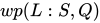
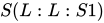

     wp(do x > 0 → L: x := x-1 od;  if x < 0 → x := -x; goto L ⫿ x ≥ 0 → skip fi,  post)
   =   { sequential composition and alternation rules }
     wp(do x > 0 → L: x := x-1 od, (x<0 ∧ wp(x := -x; goto L, post)) ∨ (x ≥  0 ∧ post)
   =   { sequential composition, goto, assignment rules }
     wp(do x > 0 → L: x := x-1 od, x<0 ∧ wpL(x ← -x) ∨ x≥0 ∧ post)
   =   { repetition rule }
     the strongest solution of
              Z: [ Z ≡ x > 0 ∧ wp(L: x := x-1, Z) ∨ x < 0 ∧ wpL(x ← -x) ∨ x=0 ∧ post ]
   =  { assignment rule, found wpL = Z(x ← x-1) }
     the strongest solution of
              Z: [ Z ≡ x > 0 ∧ Z(x ← x-1) ∨ x < 0 ∧ Z(x ← x-1) (x ← -x) ∨ x=0 ∧ post]
   =  { substitution }
     the strongest solution of
              Z:[ Z ≡ x > 0 ∧ Z(x ← x-1) ∨ x < 0 ∧ Z(x ← -x-1) ∨ x=0 ∧ post ]
   =  { solve the equation by approximation }
     post(x ← 0)
Therefore,
wp(S, post) = post(x ← 0).
Other predicate transformers
[edit]Weakest liberal precondition
[edit]An important variant of the weakest precondition is the weakest liberal precondition , which yields the weakest condition under which S either does not terminate or establishes R. It therefore differs from wp in not guaranteeing termination. Hence it corresponds to Hoare logic in partial correctness: for the statement language given above, wlp differs with wp only on while-loop, in not requiring a variant (see above).

Strongest postcondition
[edit]Given S a statement and R a precondition (a predicate on the initial state), then is their strongest-postcondition: it implies any postcondition satisfied by the final state of any execution of S, for any initial state satisfying R. In other words, a Hoare triple is provable in Hoare logic if and only if the predicate below hold:



Usually, strongest-postconditions are used in partial correctness. Hence, we have the following relation between weakest-liberal-preconditions and strongest-postconditions:

For example, on assignment we have:
|
where y is fresh |
![{\displaystyle sp(x:=E,R)\ =\ \exists y,x=E[x\leftarrow y]\wedge R[x\leftarrow y]}](https://wikimedia.org/api/rest_v1/media/math/render/svg/689a06cfb823e031f055bc54fc5af4366d198885)
Above, the logical variable y represents the initial value of variable x. Hence,

On sequence, it appears that sp runs forward (whereas wp runs backward):

Win and sin predicate transformers
[edit]Leslie Lamport has suggested win and sin as predicate transformers for concurrent programming.[3]
Predicate transformers properties
[edit]This section presents some characteristic properties of predicate transformers.[4] Below, S denotes a predicate transformer (a function between two predicates on the state space) and P a predicate. For instance, S(P) may denote wp(S,P) or sp(S,P). We keep x as the variable of the state space.
Monotonic
[edit]Predicate transformers of interest (wp, wlp, and sp) are monotonic. A predicate transformer S is monotonic if and only if:

This property is related to the consequence rule of Hoare logic.
Strict
[edit]A predicate transformer S is strict iff:

For instance, wp is artificially made strict, whereas wlp is generally not. In particular, if statement S may not terminate then is satisfiable. We have


Indeed, T is a valid invariant of that loop.
The non-strict but monotonic or conjunctive predicate transformers are called miraculous and can also be used to define a class of programming constructs, in particular, jump statements, which Dijkstra cared less about. Those jump statements include straight goto L, break and continue in a loop and return statements in a procedure body, exception handling, etc. It turns out that all jump statements are executable miracles,[5] i.e. they can be implemented but not strict.
Terminating
[edit]A predicate transformer S is terminating if:

Actually, this terminology makes sense only for strict predicate transformers: indeed, is the weakest-precondition ensuring termination of S.

It seems that naming this property non-aborting would be more appropriate: in total correctness, non-termination is abortion, whereas in partial correctness, it is not.
Conjunctive
[edit]A predicate transformer S is conjunctive iff:

This is the case for , even if statement S is non-deterministic as a selection statement or a specification statement.

Disjunctive
[edit]A predicate transformer S is disjunctive iff:

This is generally not the case of when S is non-deterministic. Indeed, consider a non-deterministic statement S choosing an arbitrary Boolean. This statement is given here as the following selection statement:
![{\displaystyle S\ =\ {\texttt {if}}\ {\texttt {true}}\rightarrow x:=0\ [\!]\ {\texttt {true}}\rightarrow x:=1\ {\texttt {fi}}}](https://wikimedia.org/api/rest_v1/media/math/render/svg/a414c3105bf801f6597322b4a76302184169340e)
Then, reduces to the formula .
![{\displaystyle R[x\leftarrow 0]\wedge R[x\leftarrow 1]}](https://wikimedia.org/api/rest_v1/media/math/render/svg/e1f2fb43618343ba2324d28aa1c6d6b8f6934761)
Hence, reduces to the tautology


Whereas, the formula reduces to the wrong proposition .


Applications
[edit]- Computations of weakest-preconditions are largely used to statically check assertions in programs using a theorem-prover (like SMT-solvers or proof assistants): see Frama-C or ESC/Java2.
- Unlike many other semantic formalisms, predicate transformer semantics was not designed as an investigation into foundations of computation. Rather, it was intended to provide programmers with a methodology to develop their programs as "correct by construction" in a "calculation style". This "top-down" style was advocated by Dijkstra[6] and N. Wirth.[7] It has been formalized further by R.-J. Back and others in the refinement calculus. Some tools like B-Method now provide automated reasoning in order to promote this methodology.
- In the meta-theory of Hoare logic, weakest-preconditions appear as a key notion in the proof of relative completeness.[8]
Beyond predicate transformers
[edit]Weakest-preconditions and strongest-postconditions of imperative expressions
[edit]In predicate transformers semantics, expressions are restricted to terms of the logic (see above). However, this restriction seems too strong for most existing programming languages, where expressions may have side effects (call to a function having a side effect), may not terminate or abort (like division by zero). There are many proposals to extend weakest-preconditions or strongest-postconditions for imperative expression languages and in particular for monads.
Among them, Hoare Type Theory combines Hoare logic for a Haskell-like language, separation logic and type theory.[9] This system is currently implemented as a Rocq library called Ynot.[10] In this language, evaluation of expressions corresponds to computations of strongest-postconditions.
Probabilistic Predicate Transformers
[edit]Probabilistic Predicate Transformers are an extension of predicate transformers for probabilistic programs. Indeed, such programs have many applications in cryptography (hiding of information using some randomized noise), distributed systems (symmetry breaking). [11]
See also
[edit]- Axiomatic semantics — includes predicate transformer semantics
- Dynamic logic — where predicate transformers appear as modalities
- Formal semantics of programming languages — an overview
Notes
[edit]- ^ Chen, Wei and Udding, Jan Tijmen, "The Specification Statement Refined" WUCS-89-37 (1989). https://openscholarship.wustl.edu/cse_research/749
- ^ Chen, Wei, "A wp Characterization of Jump Statements," 2021 International Symposium on Theoretical Aspects of Software Engineering (TASE), 2021, pp. 15-22. doi: 10.1109/TASE52547.2021.00019.
- ^ Lamport, Leslie (July 1990). "win and sin: Predicate Transformers for Concurrency". ACM Trans. Program. Lang. Syst. 12 (3): 396–428. CiteSeerX 10.1.1.33.90. doi:10.1145/78969.78970. S2CID 209901.
- ^ Back, Ralph-Johan; Wright, Joakim (2012) [1978]. Refinement Calculus: A Systematic Introduction. Texts in Computer Science. Springer. ISBN 978-1-4612-1674-2.
- ^ Chen, Wei, "Exit Statements are Executable Miracles" WUCS-91-53 (1991). https://openscholarship.wustl.edu/cse_research/671
- ^ Dijkstra, Edsger W. (1968). "A Constructive Approach to the Problem of Program Correctness". BIT Numerical Mathematics. 8 (3): 174–186. doi:10.1007/bf01933419. S2CID 62224342.
- ^ Wirth, N. (April 1971). "Program development by stepwise refinement" (PDF). Comm. ACM. 14 (4): 221–7. doi:10.1145/362575.362577. hdl:20.500.11850/80846. S2CID 13214445.
- ^ Tutorial on Hoare Logic: a Coq library, giving a simple but formal proof that Hoare logic is sound and complete with respect to an operational semantics.
- ^ Nanevski, Aleksandar; Morrisett, Greg; Birkedal, Lars (September 2008). "Hoare Type Theory, Polymorphism and Separation" (PDF). Journal of Functional Programming. 18 (5–6): 865–911. doi:10.1017/S0956796808006953. S2CID 6956622.
- ^ Ynot a Coq library implementing Hoare Type Theory.
- ^ Morgan, Carroll; McIver, Annabelle; Seidel, Karen (May 1996). "Probabilistic Predicate Transformers" (PDF). ACM Trans. Program. Lang. Syst. 18 (3): 325–353. CiteSeerX 10.1.1.41.9219. doi:10.1145/229542.229547. S2CID 5812195.
References
[edit]- de Bakker, J. W. (1980). Mathematical theory of program correctness. Prentice-Hall. ISBN 978-0-13-562132-5.
- Bonsangue, Marcello M.; Kok, Joost N. (November 1994). "The weakest precondition calculus: Recursion and duality". Formal Aspects of Computing. 6 (6): 788–800. CiteSeerX 10.1.1.27.8491. doi:10.1007/BF01213603. S2CID 40323488.
- Dijkstra, Edsger W. (August 1975). "Guarded Commands, Nondeterminacy and Formal Derivation of Programs". Comm. ACM. 18 (8): 453–7. doi:10.1145/360933.360975. S2CID 1679242.
- Dijkstra, Edsger W. (1976). A Discipline of Programming. Prentice Hall. ISBN 978-0-613-92411-5. — A systematic introduction to a version of the guarded command language with many worked examples
- Dijkstra, Edsger W.; Scholten, Carel S. (1990). Predicate Calculus and Program Semantics. Texts and Monographs in Computer Science. Springer-Verlag. ISBN 978-0-387-96957-2. — A more abstract, formal and definitive treatment
- Gries, David (1981). The Science of Programming. Springer-Verlag. ISBN 978-0-387-96480-5.


Predicate transformer semantics
View on GrokipediaIntroduction
Overview
Predicate transformer semantics is a formal framework for specifying and reasoning about the behavior of imperative programs using predicates over program states. At its core, this approach employs predicate transformers, which map a postcondition predicate to the corresponding precondition predicate, facilitating backward reasoning from desired outcomes to required initial conditions. This enables the verification of program correctness without needing to trace forward executions, instead abstracting program semantics in terms of logical predicates.[2] The primary semantic function in this framework is the weakest precondition, denoted $ \wp(S, Q) $, where $ S $ is a program statement and $ Q $ is a postcondition predicate; $ \wp(S, Q) $ yields the weakest precondition that guarantees $ Q $ holds after executing $ S $, assuming termination. Unlike operational semantics, which define program behavior through step-by-step transition rules simulating execution, predicate transformer semantics provides a denotational interpretation that abstracts away implementation details in favor of mathematical relations between predicates. Key advantages of this semantics include its compositional nature, allowing the semantics of compound statements to be derived from those of their components, and its support for proving both partial correctness (where the postcondition holds if termination occurs) and total correctness (ensuring both termination and postcondition satisfaction) through appropriate transformers, all without simulating program runs. For instance, for a simple assignment statement $ x := e $, the transformer applied to a postcondition $ Q $ substitutes the expression $ e $ for $ x $ in $ Q $, yielding $ Q[x/e] $ as the precondition, ensuring that after assignment, $ Q $ is satisfied regardless of the initial state of other variables.[2]Historical Development
Predicate transformer semantics originated with Edsger W. Dijkstra's development of the weakest precondition calculus in the early 1970s, building on his work in structured programming and formal verification. Dijkstra introduced the foundational ideas in a 1975 paper on guarded commands, where programs are modeled as non-deterministic constructs and their semantics are captured via predicate transformations that compute preconditions ensuring postconditions. This approach was influenced by advances in predicate calculus and C. A. R. Hoare's axiomatic method from 1969, which provided a framework for partial correctness but lacked a unified semantic model for program derivation. Dijkstra formalized the semantics in his 1976 book A Discipline of Programming, emphasizing weakest preconditions for reasoning about total correctness in structured imperative programs. The book established predicate transformers as monotonic functions from postconditions to preconditions, enabling calculational proofs for sequential composition and control structures. This was elaborated rigorously in the 1989 monograph Predicate Calculus and Program Semantics co-authored with Carel S. Scholten, which used first-order predicate logic to define properties like monotonicity, strictness, and continuity, along with key healthiness conditions for transformers.[3] David Gries extended this framework in his 1981 book The Science of Programming, popularizing the calculational style and applying it to a broader range of programming constructs while reinforcing its role in teaching formal methods. In the 1980s, the semantics evolved through contributions to the refinement calculus, notably by Carroll Morgan, whose 1988 technical report integrated weakest preconditions with stepwise refinement for deriving programs from specifications.[5] This period also saw a shift toward explicit handling of total correctness, distinguishing it from partial correctness models, and efforts to integrate predicate transformers with denotational semantics using domain theory for more expressive languages.[6] By the late 1980s and into the 1990s, extensions addressed limitations, such as non-determinism and recursion, but challenges persisted in concurrent settings, where interference complicates monotonicity and compositionality. Into the 21st century up to 2025, the core framework has remained stable and influential, with theoretical extensions in areas like hybrid systems and proof engineering in assistants such as Isabelle/HOL and Agda, alongside ongoing applications in verification tools like Why3, which employs weakest precondition calculi for multi-prover deductive verification, and Frama-C's WP plugin, dedicated to annotating and proving C programs via predicate transformer semantics. Critiques highlight its sequential bias, prompting hybrid approaches for concurrency rather than wholesale replacement.[7][8][9]Weakest Precondition Semantics
Definition
Predicate transformer semantics provides a foundational approach to specifying the meaning of programs through transformations on predicates over program states. The weakest precondition transformer, denoted $ \mathrm{wp} $, formally defines, for a program statement $ S $ and a postcondition predicate $ Q $ (a boolean-valued function over final states), the set of all initial states such that every execution of $ S $ starting from those states terminates in a final state satisfying $ Q $. This definition captures total correctness, guaranteeing both termination and satisfaction of the postcondition.[10] Key formal properties characterize this transformer: $ \mathrm{wp}(S, \top) $ is the set of all states from which $ S $ terminates, as the universally true postcondition $ \top $ is satisfied upon termination. Conversely, $ \mathrm{wp}(S, \bot) = \bot $, meaning the weakest precondition for the universally false postcondition $ \bot $ is impossible (the empty set), per the law of the excluded miracle, which precludes any program from establishing falsehood.[10] The weakest precondition exists as the greatest lower bound in the complete lattice of predicates, ordered by logical implication ($ P \leq R $ if $ P \Rightarrow R $); it is the infimum of all predicates $ P $ such that $ S $ terminates from $ P $ and establishes $ Q $. This lattice-theoretic justification ensures the transformer's well-definedness and monotonicity.[10] In contrast to the strongest postcondition transformer, which computes the minimal set of final states reachable while satisfying an initial condition, $ \mathrm{wp} $ yields the maximal (weakest) set of initial states, promoting conservative verification: any refinement of the precondition remains valid, aiding modular and scalable proofs.[10]Notation and Conventions
In predicate transformer semantics, programs operate over a state space consisting of states , where is the set of program variables and is the set of possible values, such as integers or other data types appropriate to the language. Predicates, denoted , , or , are either subsets of the state space or equivalent boolean-valued functions that hold for certain states; they form a complete distributive lattice under operations including conjunction (greatest lower bound, intersection of sets), disjunction (least upper bound, union of sets), and implication (relative complement). Substitution in predicates is denoted (or equivalently ), which replaces all free occurrences of variable in with expression , using capture-avoiding substitution to prevent unintended variable binding issues arising from scoping. Assertions include the constant predicates (true, holding for all states) and (false, holding for no states); special cases arise for the weakest precondition transformer , such as (indicating no initial state can ensure after non-termination) and (preserving the postcondition unchanged), where and represent miracle-like failure and no-op behaviors, respectively. The semantics emphasize backward reasoning, computing preconditions from postconditions via for command and postcondition ; expressions are assumed deterministic (yielding unique values from states) unless otherwise specified, and predicate transformers are total functions, defined for all predicates and commands.Semantics of Simple Statements
In predicate transformer semantics, the weakest precondition for the skip statement, which performs no operation and leaves the program state unchanged, is defined as the postcondition itself. Formally, , ensuring that any initial state satisfying will terminate satisfying after execution, as no changes occur.[10] The abort statement, also known as the miracle, represents a command that never terminates successfully, modeling non-termination or catastrophic failure. Its weakest precondition is the false predicate, , indicating that no initial state can guarantee the postcondition upon termination, since termination does not occur.[10] For the assignment statement , where is a side-effect-free expression, the weakest precondition substitutes the expression for all free occurrences of in the postcondition . This is expressed as , capturing the condition that must hold on the initial state so that after evaluating and assigning it to , the resulting state satisfies . For instance, consider the assignment with postcondition over integers; the weakest precondition is , as the increment ensures the postcondition holds if the initial value is non-negative. In edge cases, if the expression is undefined in the initial state, the weakest precondition becomes , treating the statement as non-terminating akin to abort. Similarly, assignments that do not terminate, such as those involving infinite computations, are semantically equivalent to abort with .[10][11]Semantics of Sequential Composition
In predicate transformer semantics, the weakest precondition for the sequential composition of two statements followed by , with respect to a postcondition , is defined by the chaining rule:Semantics of Conditionals and Loops
In predicate transformer semantics, the weakest precondition for a conditional statement if B then S₁ else S₂ with respect to a postcondition Q is defined as wp(if B then S₁ else S₂, Q) = (B ⇒ wp(S₁, Q)) ∧ (¬B ⇒ wp(S₂, Q)).[10] This formulation ensures that the precondition holds if, whenever the guard B is true, the weakest precondition of S₁ with respect to Q is satisfied (guaranteeing termination and Q), and similarly when B is false for S₂. The conditional thus branches the semantics based on the truth value of B, preserving the postcondition Q in either path.[14] For iterative constructs, the semantics of a while loop while B do S is given by the least fixed point of the equation wp(while B do S, Q) = (B ⇒ wp(S, wp(while B do S, Q))) ∧ (¬B ⇒ Q).[10] This equation captures the recursive nature of the loop: when the guard B is false, the postcondition Q must hold directly; when B is true, the body S must establish the same precondition recursively, ensuring termination after finite iterations. The least fixed point represents the weakest predicate satisfying this, corresponding to total correctness where all executions terminate satisfying Q. Termination for the while loop is proved using a variant function v that is bounded below and strictly decreases in each iteration when B holds (i.e., B ⇒ wp(S, v < v), where <> denotes strict decrease). For the while loop, this ensures the number of iterations is finite.[15] Consider the loop while x > 0 do x := x - 1 with postcondition x = 0. The weakest precondition is x ≥ 0, as states with x < 0 lead to immediate exit without satisfying x = 0, while x ≥ 0 ensures termination at x = 0. Termination is proved via the variant v = x, which is non-negative and decreases by 1 each iteration while x > 0.[15] The fixed-point characterization follows from Kleene's theorem adapted to predicate transformers: wp(while B do S, Q) is the least fixed point of the functional F(P) = (¬B ⇒ Q) ∧ (B ⇒ wp(S, P)).[10] This least fixed point is computed as the limit of the iterative approximation starting from and applying F until stabilization, yielding the weakest precondition under total correctness.Semantics of Non-Deterministic Commands
In predicate transformer semantics, non-deterministic commands introduce choices among multiple execution paths, where the weakest precondition ensures that the postcondition holds regardless of which path is selected, reflecting a demonic interpretation of nondeterminism in which an adversary chooses the branch to make satisfaction hardest.[16] This contrasts with angelic nondeterminism, but the classical framework adopts the demonic view to model worst-case behavior in program verification. Guarded selection, or the alternative construct in Dijkstra's guarded command language, allows nondeterministic choice among guarded statements. For a command of the formif <B₁ → S₁ [] … [] Bₙ → Sₙ>, the weakest precondition with respect to a postcondition Q is the disjunction over i of (Bᵢ ∧ wp(Sᵢ, Q)), meaning the initial state must satisfy at least one guard Bᵢ such that executing the corresponding statement Sᵢ terminates establishing Q.[16] If no guard holds, the command aborts, yielding the false predicate as the weakest precondition.[16] This formulation ensures compositional reasoning, as the overall precondition is derived directly from the preconditions of the individual branches without enumerating all possibilities.[16]
Guarded repetition, known as the do B → S od construct, extends nondeterminism to iterative selection among alternatives until no guards hold. The weakest precondition wp(do B₁ → S₁ [] … [] Bₙ → Sₙ od, Q) is the least fixed point of the predicate transformer equation Z = (∨ᵢ (Bᵢ ∧ wp(Sᵢ, Z))) ∧ (¬∨ᵢ Bᵢ ⇒ Q), ensuring that from the initial state, there exists a finite sequence of guard selections leading to a state where no guards are true and Q holds upon termination, while accounting for all possible nondeterministic paths under demonic choice.[16] This fixed-point characterization captures the total correctness of the loop, including termination.
Under demonic nondeterminism, the weakest precondition for an unguarded choice like x := 0 [] x := 1 with postcondition Q = "x is even" is the false predicate ⊥, because no initial state can guarantee Q holds after execution: the adversary can always choose the assignment that falsifies it (x := 1 yields odd).[17] More generally, for parallel nondeterministic assignment x := e₁ [] … [] x := eₙ, wp is ∧ᵢ (Q[eᵢ/x]), requiring Q to hold for every possible value assigned.[17]
Goto statements introduce non-local control flow, complicating compositional weakest precondition semantics. Their semantics can be defined using flow graphs, where wp(goto L, Q) propagates Q backward through the graph to the statement preceding the jump, solving a system of equations over labels; alternatively, auxiliary variables track control points to restore compositionality, though this increases expressiveness at the cost of simplicity. Such approaches ensure the weakest precondition accounts for all reachable paths from the goto, but they are less preferred in structured languages favoring guarded commands.[18]
Specification statements, denoted [R] where R is a relation between pre- and post-states, abstractly represent any command satisfying R. The weakest precondition is wp([R], Q) = ∃ post. R(pre, post) ∧ Q(post), asserting that there exists some terminating post-state satisfying both R and Q, without specifying the exact implementation.[19] This construct is useful for refinement and modular verification, allowing wp calculus to relate abstract specifications to concrete programs.[19]