


Community hub
Recent from talks
Contribute something
Nothing was collected or created yet.
Spheroid
View on Wikipedia

| ||
| oblate | prolate | |
|---|---|---|
A spheroid, also known as an ellipsoid of revolution or rotational ellipsoid, is a quadric surface obtained by rotating an ellipse about one of its principal axes; in other words, an ellipsoid with two equal semi-diameters. A spheroid has circular symmetry.
If the ellipse is rotated about its major axis, the result is a prolate spheroid, elongated like a rugby ball. The American football is similar but has a pointier end than a spheroid could. If the ellipse is rotated about its minor axis, the result is an oblate spheroid, flattened like a lentil or a plain M&M. If the generating ellipse is a circle, the result is a sphere.
Due to the combined effects of gravity and rotation, the figure of the Earth (and of all planets) is not quite a sphere, but instead is slightly flattened in the direction of its axis of rotation. For that reason, in cartography and geodesy the Earth is often approximated by an oblate spheroid, known as the reference ellipsoid, instead of a sphere. The current World Geodetic System model uses a spheroid whose radius is 6,378.137 km (3,963.191 mi) at the Equator and 6,356.752 km (3,949.903 mi) at the poles.
The word spheroid originally meant "an approximately spherical body", admitting irregularities even beyond the bi- or tri-axial ellipsoidal shape; that is how the term is used in some older papers on geodesy (for example, referring to truncated spherical harmonic expansions of the Earth's gravity geopotential model).[1]
Equation
[edit]
The equation of a tri-axial ellipsoid centred at the origin with semi-axes a, b and c aligned along the coordinate axes is
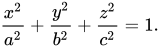
The equation of a spheroid with z as the symmetry axis is given by setting a = b:
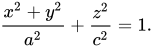
The semi-axis a is the equatorial radius of the spheroid, and c is the distance from centre to pole along the symmetry axis. There are two possible cases:
- c < a: oblate spheroid
- c > a: prolate spheroid
The case of a = c reduces to a sphere.
Properties
[edit]Circumference
[edit]The equatorial circumference of a spheroid is measured around its equator and is given as:

The meridional or polar circumference of a spheroid is measured through its poles and is given as: The volumetric circumference of a spheroid is the circumference of a sphere of equal volume as the spheroid and is given as:

![{\displaystyle C_{\text{v}}=2{\sqrt[{3}]{a^{2}c}}}](https://wikimedia.org/api/rest_v1/media/math/render/svg/271e21c03f9e1f8e341ed781367399f38cf3ec78)
Area
[edit]An oblate spheroid with c < a has surface area

where . A prolate spheroid with c > a has surface area


where In both cases, eo and ep may be identified as the eccentricity (see ellipse).[2][3]

These formulas are identical in the sense that the formula for So can be used to calculate the surface area of a prolate spheroid and vice versa. However, eo then becomes imaginary and can no longer directly be identified with the eccentricity. Both of these results may be cast into many other forms using standard mathematical identities and relations between parameters of the ellipse.
Volume
[edit]The volume inside a spheroid (of any kind) is

If A = 2a is the equatorial diameter, and C = 2c is the polar diameter, the volume is

Curvature
[edit]Let a spheroid be parameterized as

where β is the reduced latitude or parametric latitude and λ is the longitude, with domain −π/2 < β < +π/2 and −π < λ < +π, respectively. Then, the spheroid's Gaussian curvature is:

and its mean curvature is

Both of these curvatures are a function of latitude only and are always positive, so that every point on a spheroid is elliptic.
Aspect ratio
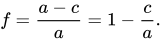
[edit]The aspect ratio of an oblate spheroid/ellipse, c : a, is the ratio of the polar to equatorial lengths, while the flattening (also called oblateness) f, is the ratio of the equatorial-polar length difference to the equatorial length:
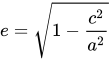
The first eccentricity (usually simply eccentricity, as above) is often used instead of flattening.[4] It is defined by:
The relations between eccentricity and flattening are:
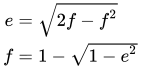
All modern geodetic ellipsoids are defined by the semi-major axis plus either the semi-minor axis (giving the aspect ratio), the flattening, or the first eccentricity. While these definitions are mathematically interchangeable, real-world calculations must lose some precision. To avoid confusion, an ellipsoidal definition considers its own values to be exact in the form it gives.
Occurrence and applications
[edit]The most common shapes for the density distribution of protons and neutrons in an atomic nucleus are spherical, prolate, and oblate spheroidal, where the polar axis is assumed to be the spin axis (or direction of the spin angular momentum vector). Deformed nuclear shapes occur as a result of the competition between electromagnetic repulsion between protons, surface tension and quantum shell effects.
Spheroids are common in 3D cell cultures. Rotating equilibrium spheroids include the Maclaurin spheroid and the Jacobi ellipsoid. Spheroid is also a shape of archaeological artifacts.
Oblate spheroids
[edit]
The oblate spheroid is the approximate shape of rotating planets and other celestial bodies, including Earth, Saturn, Jupiter, and the quickly spinning star Altair. Saturn is the most oblate planet in the Solar System, with a flattening of 0.09796.[5] See planetary flattening and equatorial bulge for details.
Enlightenment scientist Isaac Newton, working from Jean Richer's pendulum experiments and Christiaan Huygens's theories for their interpretation, reasoned that Jupiter and Earth are oblate spheroids owing to their centrifugal force.[6][7][8] Earth's diverse cartographic and geodetic systems are based on reference ellipsoids, all of which are oblate.
Prolate spheroids
[edit]
The prolate spheroid is the approximate shape of the ball used in American football and in rugby.
Several moons of the Solar System approximate prolate spheroids in shape, though they are closer to triaxial ellipsoids. Examples are Saturn's satellites Mimas, Enceladus, and Tethys and Uranus's satellite Miranda.
In contrast to being distorted into oblate spheroids via rapid rotation, celestial objects distort slightly into prolate spheroids via tidal forces when they orbit a massive body in a close orbit. The most extreme example is Jupiter's moon Io, which becomes slightly more or less prolate in its orbit due to a slight eccentricity, causing intense volcanism. The major axis of the prolate spheroid does not run through the satellite's poles in this case, but through the two points on its equator directly facing toward and away from the primary. This combines with the smaller oblate distortion from the synchronous rotation to cause the body to become triaxial.
The term is also used to describe the shape of some nebulae such as the Crab Nebula.[9] Fresnel zones, used to analyze wave propagation and interference in space, are a series of concentric prolate spheroids with principal axes aligned along the direct line-of-sight between a transmitter and a receiver.
The atomic nuclei of the actinide and lanthanide elements are shaped like prolate spheroids.[10] In anatomy, near-spheroid organs such as testis may be measured by their long and short axes.[11]
Many submarines have a shape which can be described as prolate spheroid.[12]
Dynamical properties
[edit]For a spheroid having uniform density, the moment of inertia is that of an ellipsoid with an additional axis of symmetry. Given a description of a spheroid as having a major axis c, and minor axes a = b, the moments of inertia along these principal axes are C, A, and B. However, in a spheroid the minor axes are symmetrical. Therefore, our inertial terms along the major axes are:[13]
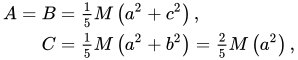
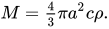
where M is the mass of the body defined as
See also
[edit]References
[edit]- ^ Torge, Wolfgang (2001). Geodesy (3rd ed.). Walter de Gruyter. p. 104. ISBN 9783110170726.
- ^ "Oblate Spheroid". Wolfram MathWorld. Retrieved 24 June 2014.
- ^ "Prolate Spheroid". Wolfram MathWorld. 7 October 2003. Retrieved 24 June 2014.
- ^ Brial P., Shaalan C.(2009), Introduction à la Géodésie et au geopositionnement par satellites, p.8
- ^ "Spheroid - Explanation, Applications, Shape, Example and FAQs". VEDANTU. Retrieved 26 November 2024.
- ^ Howse, Derek, ed. (1990). Background to Discovery: Pacific Exploration from Dampier to Cook. University of California Press. p. 91. ISBN 978-0-520-06208-5.
- ^ Greenburg, John L. (1995). "Isaac Newton and the Problem of the Earth's Shape". History of Exact Sciences. 49 (4). Springer: 371–391. doi:10.1007/BF00374704. JSTOR 41134011. S2CID 121268606.
- ^ Choi, Charles Q. (12 April 2007). "Strange but True: Earth Is Not Round". Scientific American. Retrieved 2 March 2025.
- ^ Trimble, Virginia Louise (October 1973), "The Distance to the Crab Nebula and NP 0532", Publications of the Astronomical Society of the Pacific, 85 (507): 579, Bibcode:1973PASP...85..579T, doi:10.1086/129507
- ^ "Nuclear fission - Fission theory". Encyclopedia Britannica.
- ^ Page 559 in: John Pellerito, Joseph F Polak (2012). Introduction to Vascular Ultrasonography (6 ed.). Elsevier Health Sciences. ISBN 9781455737666.
- ^ "What Do a Submarine, a Rocket and a Football Have in Common?". Scientific American. 8 November 2010. Retrieved 13 June 2015.
- ^ Weisstein, Eric W. "Spheroid". MathWorld--A Wolfram Web Resource. Retrieved 16 May 2018.
External links
[edit] Media related to Spheroids at Wikimedia Commons
- . Encyclopædia Britannica (11th ed.). 1911.

Spheroid
View on GrokipediaFundamentals
Definition
A spheroid is a quadric surface formed by rotating an ellipse about one of its principal axes, generating a surface of revolution that extends the two-dimensional ellipse into three dimensions.[8] This rotation preserves the elliptical cross-sections while creating a symmetric shape around the axis of rotation, distinguishing it from a general ellipsoid, which has three unequal axes, as a spheroid specifically has two equal semi-axes.[1] Visually, a spheroid resembles a sphere that has been stretched or compressed along one direction, resulting in a more flattened or elongated profile depending on the axis of rotation. For instance, rotating an ellipse about its minor axis produces a shape widened at the equator and narrowed at the poles, akin to spinning a flattened circle to form a disc-like solid.[1] The key dimensions are the equatorial radius , which measures the distance from the center to the equator along the plane perpendicular to the rotation axis, and the polar radius , which measures along the rotation axis itself.[9] Spheroids are classified into two types based on the relative sizes of these radii: an oblate spheroid occurs when the equatorial radius exceeds the polar radius (), creating a flattened appearance at the poles, while a prolate spheroid has a longer polar radius than equatorial (), resulting in an elongated, rugby-ball-like form.[9] A sphere represents the special case of a spheroid where the equatorial and polar radii are equal ().[1]Historical Context
The concept of the Earth's shape as a sphere was recognized by ancient Greek philosophers as early as the 5th century BCE, with Aristotle providing empirical evidence around 330 BCE through observations of lunar eclipses and the varying positions of stars, establishing a qualitative understanding of a rounded planet.[10] However, the notion of a spheroid—an ellipsoid of revolution deviated from a perfect sphere—emerged much later, with formal mathematical modeling beginning in the 17th century amid advances in mechanics and astronomy. In his Philosophiæ Naturalis Principia Mathematica published in 1687, Isaac Newton theorized that the Earth's rotation would cause centrifugal forces to flatten it at the poles and bulge it at the equator, predicting an oblate spheroid shape for a rotating fluid body in equilibrium.[11] This marked a pivotal shift from qualitative descriptions to quantitative predictions based on universal gravitation, influencing subsequent geodetic inquiries. During the 18th century, mathematicians refined Newton's model for practical geodetic applications. Colin Maclaurin provided a rigorous proof in 1740 for the equilibrium figure of a homogeneous rotating fluid, deriving the oblate spheroid as the stable form and enabling calculations of gravitational variations.[12] Independently, Alexis-Claude Clairaut developed a more general theory in his 1743 work Théorie de la figure de la Terre, accounting for density variations and confirming the oblate shape through differential equations that linked ellipticity to rotational effects, which supported expeditions measuring meridional arcs.[13] Advancements in the 19th and 20th centuries focused on precise ellipsoid approximations for global mapping and surveying, transitioning from theoretical models to standardized reference surfaces. Efforts culminated in the development of reference ellipsoids, such as the World Geodetic System 1984 (WGS84), adopted for international consistency in positioning and adopted by organizations like the U.S. Department of Defense.[14] This evolution in astronomy and geodesy progressed from Newton's qualitative insights to quantitative frameworks essential for accurate planetary modeling.Mathematical Formulation
Cartesian Equation
The Cartesian equation of a spheroid, which describes its surface in three-dimensional Cartesian coordinates, is where denotes the semi-axis length in the equatorial plane (spanned by the - and -axes) and denotes the semi-axis length along the polar -axis.[1] This equation represents the canonical form for a spheroid aligned with the coordinate axes, distinguishing it as a special case of a quadric surface defined by a second-degree polynomial equation in , , and ./04%3A_Coordinate_Geometry_in_Three_Dimensions/4.03%3A_The_Ellipsoid) This form arises from the rotation of a two-dimensional ellipse about its symmetry axis. Consider the ellipse equation in the -plane given by ; rotating this curve about the -axis generates the spheroid, replacing with to account for the circular symmetry in the equatorial plane./04%3A_Coordinate_Geometry_in_Three_Dimensions/4.03%3A_The_Ellipsoid)[15] The resulting surface is oblate if (flattened at the poles, like Earth) or prolate if (elongated along the polar axis, like a rugby ball).[1] In this convention, is the equatorial semi-axis, reflecting the radius of the circular cross-section in the -plane at , while is the polar semi-axis, corresponding to the extent along the axis of rotation.[16] This alignment ensures the equation captures the spheroid's rotational symmetry without loss of generality for axisymmetric cases.[15]Parametric Equations
The parametric equations provide an explicit representation of points on the surface of a spheroid, facilitating computations and visualizations in three-dimensional space. For a spheroid aligned with the z-axis, where is the equatorial semi-axis and is the polar semi-axis, the coordinates are given by with the polar angle ranging from 0 to and the azimuthal angle ranging from 0 to .[1] These parameters and parameterize the surface in a manner analogous to spherical coordinates for a sphere, but adjusted for the spheroid's eccentricity: measures the colatitude from the positive z-pole, while describes the longitude around the axis of rotation, ensuring full coverage of the surface without overlap except at the poles.[1] The equations derive from rotating a parametric ellipse in the xz-plane around the z-axis. The ellipse is parameterized as , for , and rotation by angle yields the x and y components via the cylindrical transformation , , with z unchanged.[1] This parameterization offers advantages in numerical methods, such as generating surface plots by evaluating at discrete and grids, or performing surface integrals by leveraging the metric tensor derived from partial derivatives with respect to and .[1]Geometric Properties
Surface Area
The surface area of a spheroid is obtained by evaluating the surface integral over its parametric representation. The parametric equations are given by where is the equatorial semi-axis, is the polar semi-axis, , and . The partial derivatives are and . The magnitude of their cross product is . Thus, the surface area is This integral evaluates to distinct closed-form expressions for oblate and prolate spheroids, derived by substitution and recognizing the resulting form as solvable via hyperbolic or trigonometric functions, equivalent to certain elliptic integrals that simplify for the axisymmetric case.[17][18] For an oblate spheroid (), the eccentricity is . The exact surface area is where . This can also be expressed using the complete elliptic integral of the second kind , though the elementary form is preferred for computation. An alternative closed-form expression using the Gauss hypergeometric function is [16] For a prolate spheroid (), the eccentricity is . The exact surface area is As with the oblate case, this arises from evaluating the parametric integral, reducing the elliptic form to elementary functions.[4] For small eccentricity (), applicable to near-spherical spheroids like Earth's oblate shape, the surface area approximates that of a sphere of radius with corrections: Higher-order terms include , but the term provides the primary deviation from sphericity. A similar expansion holds for prolate spheroids.[19]Volume
The volume of a spheroid, defined by the equation where is the equatorial semi-axis and is the polar semi-axis, is given by the formula This expression arises as a special case of the general ellipsoid volume when the intermediate axis equals the equatorial axis ().[20][1] A direct derivation can be obtained using the disk method, integrating the cross-sectional areas perpendicular to the polar (z) axis. At a fixed height between and , the cross-section is a disk with radius , so the area is . The volume is then the integral This approach works identically for both oblate () and prolate () spheroids. An alternative derivation employs triple integration in cylindrical coordinates or a change of variables scaling from the unit ball, yielding the same closed-form result.[21][22] When , the spheroid degenerates to a sphere, and the volume simplifies to the familiar . For a non-spherical spheroid, flattening (deviation of from ) scales the volume relative to a sphere of equivalent "average" radius by the factor , reducing it for oblate forms and increasing it for prolate ones compared to a sphere of radius or . Unlike the surface area, which requires elliptic integrals, the volume formula is elementary and does not involve special functions.[23]Circumference
The equatorial circumference of a spheroid, which lies in the plane perpendicular to the axis of rotation, forms a great circle of radius , the semi-major axis. Thus, its length is given by This expression follows directly from the geometry of a circle and applies to both oblate and prolate spheroids, where is the equatorial radius.[24] The meridional circumference traces a closed meridian ellipse in a plane containing the axis of rotation, with semi-axes (equatorial) and (polar). Its total length is the perimeter of this ellipse. For an oblate spheroid (), it is expressed as where is the eccentricity and denotes the complete elliptic integral of the second kind, defined by For a prolate spheroid (), where .This integral arises in geodesy for computing distances on ellipsoidal models of Earth. To derive the meridional circumference for the oblate case, consider the parametric equations of the meridian ellipse in the - plane: , , where is the parametric angle ranging from 0 to . The arc length element is . The quarter arc from equator to pole ( to ) is , so the full circumference is four times this value. This formulation holds for the reference ellipsoid in coordinate systems like WGS84.[24] Circumferences of parallels at other latitudes (measured from the equator) are circles parallel to the equator, with radius , where is the prime vertical radius of curvature for oblate spheroids. The length is thus For prolate spheroids, the formula requires adjustment using prolate coordinates. Unlike the meridian, this does not involve elliptic integrals, as each parallel is a true circle. For an oblate spheroid like Earth's, decreases from the equator toward the poles.[24]