



Community hub
Recent from talks
Contribute something
Nothing was collected or created yet.
Proper length
View on WikipediaProper length[1] or rest length[2] is the length of an object in the object's rest frame.
The measurement of lengths is more complicated in the theory of relativity than in classical mechanics. In classical mechanics, lengths are measured based on the assumption that the locations of all points involved are measured simultaneously. But in the theory of relativity, the notion of simultaneity is dependent on the observer.
A different term, proper distance, provides an invariant measure whose value is the same for all observers.
Proper distance is analogous to proper time. The difference is that the proper distance is defined between two spacelike-separated events (or along a spacelike path), while the proper time is defined between two timelike-separated events (or along a timelike path).
Proper length or rest length
[edit]The proper length[1] or rest length[2] of an object is the length of the object measured by an observer which is at rest relative to it, by applying standard measuring rods on the object. The measurement of the object's endpoints doesn't have to be simultaneous, since the endpoints are constantly at rest at the same positions in the object's rest frame, so it is independent of Δt. This length is thus given by:

However, in relatively moving frames the object's endpoints have to be measured simultaneously, since they are constantly changing their position. The resulting length is shorter than the rest length, and is given by the formula for length contraction (with γ being the Lorentz factor):

In comparison, the invariant proper distance between two arbitrary events happening at the endpoints of the same object is given by:

So Δσ depends on Δt, whereas (as explained above) the object's rest length L0 can be measured independently of Δt. It follows that Δσ and L0, measured at the endpoints of the same object, only agree with each other when the measurement events were simultaneous in the object's rest frame so that Δt is zero. As explained by Fayngold:[1]
- p. 407: "Note that the proper distance between two events is generally not the same as the proper length of an object whose end points happen to be respectively coincident with these events. Consider a solid rod of constant proper length l0. If you are in the rest frame K0 of the rod, and you want to measure its length, you can do it by first marking its endpoints. And it is not necessary that you mark them simultaneously in K0. You can mark one end now (at a moment t1) and the other end later (at a moment t2) in K0, and then quietly measure the distance between the marks. We can even consider such measurement as a possible operational definition of proper length. From the viewpoint of the experimental physics, the requirement that the marks be made simultaneously is redundant for a stationary object with constant shape and size, and can in this case be dropped from such definition. Since the rod is stationary in K0, the distance between the marks is the proper length of the rod regardless of the time lapse between the two markings. On the other hand, it is not the proper distance between the marking events if the marks are not made simultaneously in K0."
Proper distance between two events in flat space
[edit]In special relativity, the proper distance between two spacelike-separated events is the distance between the two events, as measured in an inertial frame of reference in which the events are simultaneous.[3][4] In such a specific frame, the distance is given by

where
- Δx, Δy, and Δz are differences in the linear, orthogonal, spatial coordinates of the two events.
The definition can be given equivalently with respect to any inertial frame of reference (without requiring the events to be simultaneous in that frame) by

where
- Δt is the difference in the temporal coordinates of the two events, and
- c is the speed of light.
The two formulae are equivalent because of the invariance of spacetime intervals, and since Δt = 0 exactly when the events are simultaneous in the given frame.
Two events are spacelike-separated if and only if the above formula gives a real, non-zero value for Δσ.
Proper distance along a path
[edit]The above formula for the proper distance between two events assumes that the spacetime in which the two events occur is flat. Hence, the above formula cannot in general be used in general relativity, in which curved spacetimes are considered. It is, however, possible to define the proper distance along a path in any spacetime, curved or flat. In a flat spacetime, the proper distance between two events is the proper distance along a straight path between the two events. In a curved spacetime, there may be more than one straight path (geodesic) between two events, so the proper distance along a straight path between two events would not uniquely define the proper distance between the two events.
Along an arbitrary spacelike path P, the proper distance is given in tensor syntax by the line integral
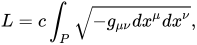
where
- gμν is the metric tensor for the current spacetime and coordinate mapping, and
- dxμ is the coordinate separation between neighboring events along the path P.
In the equation above, the metric tensor is assumed to use the +−−− metric signature, and is assumed to be normalized to return a time instead of a distance. The − sign in the equation should be dropped with a metric tensor that instead uses the −+++ metric signature. Also, the should be dropped with a metric tensor that is normalized to use a distance, or that uses geometrized units.

See also
[edit]References
[edit]- ^ a b c Moses Fayngold (2009). Special Relativity and How it Works. John Wiley & Sons. ISBN 978-3527406074.
{{cite book}}: CS1 maint: location missing publisher (link) - ^ a b Franklin, Jerrold (2010). "Lorentz contraction, Bell's spaceships, and rigid body motion in special relativity". European Journal of Physics. 31 (2): 291–298. arXiv:0906.1919. Bibcode:2010EJPh...31..291F. doi:10.1088/0143-0807/31/2/006. S2CID 18059490.
- ^ Poisson, Eric; Will, Clifford M. (2014). Gravity: Newtonian, Post-Newtonian, Relativistic (illustrated ed.). Cambridge University Press. p. 191. ISBN 978-1-107-03286-6. Extract of page 191
- ^ Kopeikin, Sergei; Efroimsky, Michael; Kaplan, George (2011). Relativistic Celestial Mechanics of the Solar System. John Wiley & Sons. p. 136. ISBN 978-3-527-63457-6. Extract of page 136
Proper length
View on GrokipediaCore Concepts in Special Relativity
Definition and Rest Length
In special relativity, the concept of proper length emerged as a fundamental resolution to paradoxes arising from classical notions of absolute space and time, particularly in reconciling measurements of moving objects across different inertial frames. Albert Einstein introduced this idea in his seminal 1905 paper, where he established that lengths measured in an object's rest frame provide an invariant basis for understanding spatial dimensions, free from the inconsistencies of ether-based theories.[3] The proper length, denoted and also called the rest length, of an object or spatial interval is defined as the distance between its endpoints as measured by an observer comoving with the object, in the instantaneous rest frame where the object is at rest relative to the measuring apparatus. This measurement involves placing rulers at rest in that frame along the object's extent and recording the positions of the endpoints at the same instant in that frame. Formally, in Cartesian coordinates within the rest frame , where ensures simultaneity of the endpoint measurements./28%3A_Special_Relativity/28.03%3A_Length_Contraction)[4] Proper length is a Lorentz invariant scalar quantity, retaining the same numerical value regardless of the inertial frame from which it is considered, unlike coordinate lengths that transform under Lorentz boosts and depend on the observer's relative velocity. This invariance underscores the spacetime symmetry of special relativity, where proper length serves as the intrinsic spatial measure analogous to proper time for temporal intervals. In moving frames, the apparent length contracts according to the Lorentz factor, but the proper length itself remains unaltered.[5] A simple illustration is a rigid rod with a proper length of 1 meter: when measured end-to-end by synchronized rulers at rest relative to the rod, the distance yields precisely 1 meter, independent of any external observer's motion./28%3A_Special_Relativity/28.03%3A_Length_Contraction)Relation to Lorentz Contraction
In special relativity, the proper length of an object, defined as the length measured in the frame where the object is at rest, transforms to a shorter observed length in another inertial frame in which the object moves with relative velocity parallel to its length.[2] This transformation is governed by the Lorentz factor , where is the speed of light, leading to the length contraction formula .[2] The derivation of length contraction relies on the relativity of simultaneity. To measure length in a given frame, the positions of the object's ends must be determined at the same time in that frame; however, events simultaneous in the rest frame (e.g., marking the ends of a rod) are not simultaneous in the moving frame due to the Lorentz transformation of time coordinates.[6] This desynchronization results in the observer in the moving frame recording a shorter distance between the ends when accounting for their positions at a common time in their frame.[6] Experimental confirmations of length contraction are typically indirect, as direct measurement of object lengths at relativistic speeds is challenging, but they arise equivalently from time dilation effects in complementary frames. The 1941 Rossi-Hall experiment observed cosmic-ray muons decaying after traversing greater distances than expected from their rest-frame lifetime, consistent with length contraction of the atmosphere from the muons' perspective (or time dilation from Earth's frame). Similarly, measurements in particle accelerators, such as at the Stanford Linear Accelerator Center (SLAC), verify the effect through interactions of relativistic electrons with detector coils, where the brief field exposure matches predictions of contracted bunch lengths.[6] A common misconception is that length contraction represents a physical compression or squeezing of the object due to motion; in reality, it is a frame-dependent geometric effect of spacetime, with no absolute shortening or stress on the object itself.[6]Proper Distance in Spacetime
Between Spacelike Separated Events
In Minkowski spacetime with the (-+++) metric signature, two events are classified as spacelike separated if the invariant spacetime interval between them satisfies , indicating that the spatial displacement dominates over the temporal one. This condition implies that no causal influence can propagate between the events, as they lie outside each other's light cones.[7] The proper distance between such spacelike separated events is the Lorentz-invariant measure of their spatial separation, defined as , where the spatial components dominate the interval. This quantity is frame-independent and is concretely calculated in the unique inertial frame where the events are simultaneous (), yielding In this frame, the proper distance corresponds directly to the Euclidean distance using rigid measuring rods.[7] This concept of proper distance is analogous to proper time for timelike separated events but applies to spatial intervals: whereas proper time is the time elapsed along a timelike worldline (the "length" of a timelike path), proper distance quantifies the invariant "width" of spacelike separations that cannot be bridged by light signals.[7] A representative example involves two firecrackers exploding simultaneously in one inertial frame, separated by a spatial distance of 1 meter; the proper distance between these events is 1 meter and remains unchanged under Lorentz transformations to other frames, even though simultaneity may not hold there.[8] The proper length of a rigid rod is a special case of this proper distance, taken between the simultaneous events at its endpoints in the rod's rest frame.Along a Worldline or Path
In Minkowski spacetime, the proper distance along a spacelike curve, parameterized by an affine parameter , is given by the invariant integral where is the Minkowski metric and the curve satisfies along its segments to ensure spacelike character.[9] This quantity represents the length measured by an observer for whom the entire path is simultaneous, analogous to proper time along timelike curves but for spatial extents.[9] In the rest frame of the path, where the curve lies entirely within a constant-time hypersurface (), the expression simplifies to the standard Euclidean arc length independent of the time coordinate, reflecting the invariance under Lorentz boosts when simultaneity is appropriately defined.[9] For extended objects following curved or bent configurations, such as a rigid rod deformed into a non-straight shape, the proper length is the integrated arc length of the worldlines' spatial projections measured simultaneously in the object's rest frame, ensuring all points are at rest relative to the measuring frame.[9] This accounts for the geometry of the object without Lorentz contraction effects in that frame. A representative numerical example arises in the context of hyperbolic motion for an extended object in flat spacetime. Consider a rocket with initial proper length light-years, composed of pointlike segments undergoing constant proper acceleration of . To maintain rigidity (constant proper length), the rear segments must experience higher proper acceleration than the front, with positions following distinct hyperbolic worldlines , where varies by segment. The proper distance between front and rear, integrated along the spacelike path of simultaneous events in the instantaneous comoving frame, remains light-years throughout the acceleration, contrasting with non-rigid cases where differential accelerations stretch the object to effective proper lengths exceeding ~1 light-year (the characteristic scale ).[10][11] In accelerated frames described by hyperbolic trajectories, proper distances along such paths tie briefly to rapidity differences, as the relative boost parameters between segments determine the integrated spatial separation without altering the invariant length in the rigid case.[10] This infinitesimal formulation aligns with proper distances between isolated spacelike-separated events as the limiting case for short paths.[9]Extensions and Applications
In General Relativity
In general relativity, spacetime geometry is described by the metric tensor , with the infinitesimal line element given byFor spacelike paths—those connecting events separated primarily in space rather than time—the proper distance along such a path is the integral
where is an affine parameter parameterizing the path.[12] This quantity represents the length measured by a rigid rod instantaneously at rest along the path, invariant under coordinate transformations.[12] Unlike in flat Minkowski spacetime, where shortest paths are straight lines, proper distances in curved spacetime are measured along geodesics, which are curves extremizing the path length and governed by the equation
with the Christoffel symbols encoding gravitational curvature.[13] Gravity warps these paths, making the geodesic the locally longest proper time for timelike trajectories or shortest proper distance for spacelike ones, depending on the metric signature.[13] In the local limit, this reduces to the flat-space proper distance, but globally, tidal forces and curvature distort measurements.[12] A key example is the Schwarzschild metric, describing the vacuum spacetime around a spherical, non-rotating mass :
The radial proper distance between coordinate radii and (with ) is
which exceeds the coordinate difference due to gravitational stretching, diverging as the integration approaches the event horizon at .[14] This illustrates how curvature lengthens spatial intervals near strong fields. In cosmological contexts, the Friedmann-Lemaître-Robertson-Walker (FLRW) metric models an expanding universe:
for flat space (), where is the scale factor. The proper distance to a distant galaxy at redshift today () is
with the present Hubble constant and incorporating matter, dark energy, and curvature densities.[15] The comoving distance relates via , capturing expansion's effect on distances.[15] However, in non-stationary spacetimes—such as those with time-dependent metrics like the expanding FLRW universe—global proper lengths are not fixed, as distances evolve with cosmic time, and no unique, time-independent spatial hypersurface may exist for measurement.[12]
Observational Examples
In particle physics experiments, the concept of proper length is verified through observations of unstable particles, such as muons, in high-speed accelerators. The proper lifetime of a muon, measured in its rest frame, is approximately 2.2 microseconds, corresponding to a proper decay length of about 660 meters. However, when accelerated to relativistic speeds in storage rings, muons travel much farther in the laboratory frame before decaying, consistent with time dilation and the invariance of proper length along their worldline. A seminal experiment at CERN's muon storage ring in 1977 measured the dilated lifetimes of positive and negative muons at γ ≈ 29.3, yielding τ⁺ = 64.419 ± 0.058 μs and τ⁻ = 64.406 ± 0.057 μs, which match predictions from special relativity to within 0.9 parts per thousand, confirming that the proper length of the muon's path remains frame-invariant.[16] In astronomy, proper distance provides a direct measure of the physical separation between objects in the universe, accounting for the geometry of spacetime. A notable example is the supernova SN 1987A in the Large Magellanic Cloud, whose proper distance from Earth is approximately 168,000 light-years (51.4 kiloparsecs), determined using standard candle methods like Cepheid variables and the supernova's light curve. This distance was refined through Hubble Space Telescope observations of the expanding ring nebula around the remnant, which calibrates the expansion velocity against the known proper distance, yielding a transverse size of about 0.85 parsecs at the time of explosion. The consistency of this proper distance with independent measurements from the Tip of the Red Giant Branch method underscores the reliability of relativistic distance metrics in extragalactic contexts. The Global Positioning System (GPS) incorporates relativistic corrections to ensure accurate determination of proper distances on Earth, bridging orbital frames to ground-based measurements. GPS satellites orbit at about 20,200 km altitude with velocities around 3.9 km/s, requiring adjustments for both special relativistic effects (due to velocity) and general relativistic effects (due to gravitational potential differences), which together shift satellite clock rates by about 38 microseconds per day relative to ground clocks. These corrections are applied to the pseudoranges—effective distances derived from signal travel times—ensuring positional accuracy to within meters; without them, errors would accumulate to kilometers daily. The framework uses the proper time along the signal's null geodesic in the Schwarzschild metric approximation, validating proper length calculations in weakly curved spacetime for practical navigation.[18] Post-2000 gravitational wave detections by LIGO have empirically confirmed proper distance calculations in curved spacetime, particularly through multi-messenger events. The binary neutron star merger GW170817, detected on August 17, 2017, yielded a luminosity distance of 40 ± 8 Mpc via the gravitational waveform amplitude, which corresponds to a proper distance of approximately 40 Mpc in the low-redshift (z ≈ 0.01) cosmological metric. This distance was independently verified by electromagnetic observations of the kilonova AT 2017gfo and gamma-ray burst GRB 170817A, with host galaxy NGC 4993 identified at 40.7 ± 1.6 Mpc using surface brightness fluctuations, confirming general relativity's predictions for wave propagation and distance in an expanding universe to within 10%. Subsequent events, like GW190521, further test these calculations by matching waveform distances with cosmological models, reinforcing the invariance of proper distances along null geodesics in curved spacetime.[19] The pole-in-barn paradox illustrates the consistency of proper length in resolving apparent contradictions between reference frames. In the paradox, a pole of proper length 20 m moves at 0.9c toward a barn of proper length 10 m with open doors; in the barn frame, the contracted pole (length ≈ 8.7 m) fits inside momentarily, but in the pole frame, the barn contracts to ≈ 4.4 m, suggesting the pole cannot fit. Resolution lies in the relativity of simultaneity: the proper length of the pole is always 20 m in its rest frame, and door-closing events are not simultaneous across frames, preventing any physical overlap violation. Kinematic analysis shows that the pole's ends experience different proper lengths relative to the barn's doors due to frame-dependent synchronization, upholding Lorentz invariance without causality issues.[20]References
- https://science.[nasa](/page/NASA).gov/asset/hubble/supernova-1987a-in-the-large-magellanic-cloud/