


Community hub
Recent from talks
Contribute something
Nothing was collected or created yet.
Pygmy goose
View on Wikipedia
| Pygmy geese | |
|---|---|

| |
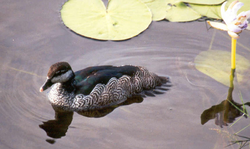
| Green pygmy goose | |
Scientific classification 
| |
| Kingdom: | Animalia |
| Phylum: | Chordata |
| Class: | Aves |
| Order: | Anseriformes |
| Suborder: | Anseres |
| Superfamily: | Anatoidea |
| Family: | Anatidae |
| Genus: | Nettapus Brandt, 1836 |
| Type species | |
| Anas madagascariensis[1] = Anas aurita Gmelin, 1789
| |
| Species | |

| |
| Distribution
N. auritus
N. c. coromandelianus
N. c. albipennis
N. pulchellus
| |
Pygmy geese are a group of very small "perching ducks" in the genus Nettapus which breed in the Old World tropics. They are the smallest of all wildfowl. As the "perching ducks" are a paraphyletic group,[2] they need to be placed elsewhere. The initially assumed relationship with the dabbling duck subfamily Anatinae[citation needed] has been questioned, and it appears they form a lineage in an ancient Gondwanan radiation of waterfowl, within which they are of unclear affinities.[3] An undescribed fossil species from the late Hemphillian (5.0–4.1 mya) of Jalisco, central Mexico, has also been identified from the distal end of a tarsometatarsus. It is only record of the genus in the New World.[4]
The genus Nettapus was erected by the German naturalist Johann Friedrich von Brandt in 1836.[5] The name is from Ancient Greek nētta meaning "duck" and pous meaning "foot". It was thought that the type species, the African pygmy goose (Nettapus auritus), possessed the feet and body of a duck and the neck of a goose.[6]
There are three extant species in the genus:[7]
| Image | Scientific name | Common name | Distribution |
|---|---|---|---|
.jpg) |
Nettapus auritus | African pygmy goose | Sub-Saharan Africa |
 |
Nettapus coromandelianus | Cotton pygmy goose | northern Australia and Southeast Asia |
 |
Nettapus pulchellus | Green pygmy goose | northern Australia and southern New Guinea |
Pygmy geese have short bills, rounded heads and short legs. They nest in tree holes.
See also
[edit]References
[edit]- ^ "Anatidae". aviansystematics.org. The Trust for Avian Systematics. Retrieved 2023-08-05.
- ^ Livezey, Bradley C. (1986). "A phylogenetic analysis of recent anseriform genera using morphological characters" (Full text). Auk. 103 (4): 737–754.
- ^ Sraml, M.; Christidis, L.; Easteal, S.; Horn, P.; Collet, C. (1996). "Molecular Relationships Within Australasian Waterfowl (Anseriformes)". Australian Journal of Zoology. 44 (1): 47–58. doi:10.1071/ZO9960047.
- ^ Steadman, D.; Carranza-Castaneda, O. (2006). "Early Pliocene to early Pleistocene birds from central Mexico". Universidad Nacional Autónoma de México, Instituto de Geología and Centro de Geociencias, Publicacion Especial. 4: 61–71. ISBN 970-32-3895-5.
- ^ Brandt, Johann Friedrich von (1836). Descriptiones et icones animalium rossicorum novorum vel minus rite cognitorum (in Latin). Vol. Fasciculus 1: Aves. Jussu et sumptibus Academiae Scientiarum. p. 5.
- ^ Jobling, James A. (2010). The Helm Dictionary of Scientific Bird Names. London: Christopher Helm. p. 269. ISBN 978-1-4081-2501-4.
- ^ Gill, Frank; Donsker, David, eds. (2017). "Screamers, ducks, geese & swans". World Bird List Version 7.3. International Ornithologists' Union. Retrieved 7 November 2017.
Further reading
[edit]- Madge, Steve; Burn, Hilary (1987). Wildfowl : an identification guide to the ducks, geese and swans of the world. London: Christopher Helm. pp. 190–193. ISBN 0-7470-2201-1.
External links
[edit] Media related to Nettapus at Wikimedia Commons

 Data related to Nettapus at Wikispecies
- Species text in The Atlas of Southern African Birds.

Genera of waterfowl and their extinct allies | |||||||||||||||||||||||||||||||||||||||
|---|---|---|---|---|---|---|---|---|---|---|---|---|---|---|---|---|---|---|---|---|---|---|---|---|---|---|---|---|---|---|---|---|---|---|---|---|---|---|---|
| |||||||||||||||||||||||||||||||||||||||
| |||||||||||||||||||||||||||||||||||||||


Pygmy goose
View on GrokipediaTaxonomy and systematics
Genus classification
The genus Nettapus was established in 1836 by the German naturalist Johann Friedrich von Brandt in his work Descriptiones et icones animalium Rossiae novi, aves.[9] The type species, designated by monotypy, is Nettapus auritus (African pygmy goose), originally described as Anas aurita by Pieter Boddaert in 1783 and later transferred to the new genus. Nettapus is classified within the family Anatidae of the order Anseriformes.[10] It is traditionally grouped in the tribe Cairinini, known as the perching ducks, a morphologically defined assemblage characterized by adaptations for perching in trees, such as stronger tarsi and feet.[11] However, molecular and morphological phylogenies indicate that Cairinini is paraphyletic, with Nettapus showing convergent similarities to other perching ducks rather than close monophyletic ties; its exact affinities within Anatidae remain unresolved, potentially basal to several lineages.[12] Currently, Nettapus comprises three extant species: N. auritus, N. coromandelianus, and N. pulchellus. No subspecies are recognized for N. auritus or N. pulchellus, while N. coromandelianus includes two: the nominate N. c. coromandelianus (widespread in Asia and New Guinea) and N. c. albipennis (Australia).[9]Species overview
The genus Nettapus includes three species of pygmy geese, small perching ducks distinguished by their compact size, vibrant plumage, and adaptation to tropical wetlands, though detailed morphology is addressed elsewhere. These species are the African pygmy goose (N. auritus), the cotton pygmy goose (N. coromandelianus, also known as the Asian pygmy goose), and the green pygmy goose (N. pulchellus). All belong to the family Anatidae and are characterized by short bills, rounded heads, and perching feet suited to arboreal resting, with the common name "pygmy" reflecting their status as the world's smallest waterfowl.[1][2][3] The African pygmy goose (N. auritus) is named for its restricted African distribution and diminutive form; the specific epithet auritus derives from Latin for "eared," alluding to prominent auricular patches. First described by Pieter Boddaert in 1783 under the protonym Anas aurita, it is monotypic with no recognized subspecies.[13][10] The cotton pygmy goose (N. coromandelianus) earns its common name from the fluffy white plumage resembling cotton; the epithet references the Coromandel Coast of India. Described by Johann Friedrich Gmelin in 1789 as Anas coromandeliana, it has two subspecies: the nominate N. c. coromandelianus across much of its Asian range and N. c. albipennis in Australia and nearby islands.[14][8][9] The green pygmy goose (N. pulchellus) is named for the iridescent green sheen on its upperparts; pulchellus is a diminutive of Latin pulcher, meaning "pretty." John Gould described it in 1842 under its current name, and it is monotypic, possessing the smallest geographic range of the genus.[15][6] All three species produce basic vocalizations consisting of soft, high-pitched whistles or twittering calls, often used in territorial defense or pair communication, though males tend to be more vocal. They are assessed as Least Concern by the IUCN, reflecting stable populations without immediate threats.[16][17]| Species | Length (cm) | Weight (g) | Vocalizations | IUCN Status (2023) |
|---|---|---|---|---|
| African pygmy goose (N. auritus) | 30–33 | 260–285 | High-pitched twittering whistles | Least Concern |
| Cotton pygmy goose (N. coromandelianus) | 30–37 | 255–312 | Rattling whistles and soft pe-ooo calls | Least Concern |
| Green pygmy goose (N. pulchellus) | 30–36 | 245–430 | Soft squeaking whistles | Least Concern |