


Community hub
Recent from talks
Contribute something
Nothing was collected or created yet.

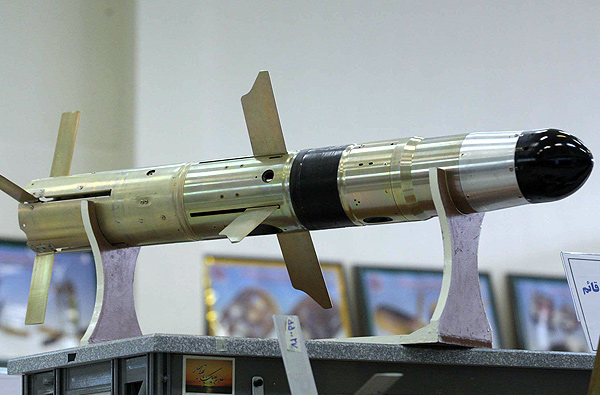
The Qaem (or Ghaem; Persian: قائم, lit. 'upright')[1] refers to two completely distinct Iranian weapons: an air-to-ground glide bomb and a surface-to-air missile. These two weapons are similarly sized and identically named, and are both developed from the Toophan missile, but are separate weapon systems.
Qaem surface-to-air missile
[edit]
This is an Iranian SACLOS beam-riding SHORAD surface-to-air missile.[2][3] With a range of six kilometers and a maximum altitude of two kilometers, the Qaem is intended for use against UAVs and low flying or stationary helicopters.[4] The Qaem is a development of the Toophan missile, itself an unlicensed copy of the American BGM-71 TOW missile, and entered mass production in 2010.[5][6]
The Qaem anti-aircraft missile uses a laser guidance system.[7] Iran also produces a variant, the Qaem-M, which adds a proximity fuse.[8] This weapon appears to be designed and manufactured based on the Toophan which is an anti-tank guided missile.[9]
North Korea may operate Qaem-114.[10]
The Islamic Republic of Iran mass-produces these missiles. This type of missile is capable of being fired from the surface as well as from helicopters. This anti-armor missile is capable of destroying low-speed, low-altitude targets. No information has been released about this missile's technical specifications, but according to published photos of it and its physical appearance, it is nearly 120 centimeters long, weighs 18 to 20 kilograms, and has a diameter of about 150 centimeters. Since the Toophan missile has a range of 3,850 meters, this missile will have the same range, too.[9][11] The vertical anti-helicopter-guided missile can be guided by laser beams and is resistant to electronic warfare and enemy disruption.[12]
Qaem air-to-ground bomb
[edit]_Army-2022_2022-08-20_2240.jpg)
A completely unrelated Iranian munition, but also named "Qaem," is carried by Qods Mohajer-6 UAVs[13] and Hamaseh UAVs.[14]
The Qaem is available in four variants: the Qaem 1, with a suspected infrared seeker; a variant simply named Qaem, with suspected laser guidance;[13] a larger variant named Qaem-5, with TV guidance; and an even larger variant named Qaem-9, also with TV guidance.[14]
The Qaem A2G glide bomb is related to the Sadid-345 glide bomb, but has different wings and size.[15]
References
[edit]- ^ Rastrow, A. A. (December 21, 2002). "Rahnama Turkish-English-Persian Dictionary". Alhoda UK – via Google Books.
- ^ ADAM RAWNSLEY (June 18, 2016). "Iranian TOW Missile Knockoffs Spread to War Zones".
- ^ Farzin Nadimi (August 17, 2015). "How Iran's Revived Weapons Exports Could Boost Its Proxies". www.washingtoninstitute.org.
- ^ tasnimnews. "Iran's Army Furnished with New Drones".
- ^ mashreghnews (15 January 2012). qaem missile, the Iranian solution to the problem of the US.
- ^ farsnewsws. ""Storm" in sky and earth". Archived from the original on 2013-08-03. Retrieved 2015-12-20.
- ^ "Iran says starts production of two new missiles". The Independent. 2010-02-06. Retrieved 2016-10-25.
- ^ Lyamin, Yuri (20 July 2017). "Иранская экспозиция на МАКС-2017. Часть.1" (in Russian).
- ^ a b "آشنایی با موشک قائم" [Introduction to the Qaem rocket] (in Persian). Retrieved 15 January 2025.
- ^ @DefenseIran (July 28, 2023). "تسلیحات آشنا در زیر بالهای پهپاد جدید کره شمالی" (Tweet) – via Twitter.
- ^ "آشنایی با چند موشک ضدبالگرد ایران" [Getting to know some of Iran's anti-helicopter missiles] (in Persian). Retrieved 15 January 2025.
- ^ "«طوفان» در آسمان و زمین/ نفوذ در قلب زرهپوشها" ["Toophan" in the sky and on earth/ Penetrating the hearts of the armored ones] (in Persian). Retrieved 15 January 2025.
- ^ a b Binnie, Jeremy (February 7, 2018). "Iran's Mohajer 6 armed UAV goes into production". Jane's Information Group.
Video footage was also released showing a Mohajer 6 using a Qaem 1 to accurately hit a target that was floating in the sea, apparently in the Indian Ocean off Konarak.
- ^ a b Jeremy Binnie (August 8, 2019). "Iran holds unveiling event for precision-guided bombs". Jane's Defence Weekly. London.
- ^ Taghvaee, Babak (February 6, 2018). "Key difference is the size, wings and its guidance system".

Surface-to-Air Missile Variant
Origins and Development
The Qaem surface-to-air missile was developed by Iran as an adaptation of the Toophan anti-tank guided missile, which itself derives from reverse-engineering the American BGM-71 TOW system acquired prior to the 1979 Islamic Revolution and during the Iran-Iraq War.[7] This modification shifted the wire-guided, semi-automatic command to line of sight (SACLOS) platform from ground targets to low-altitude aerial threats, such as helicopters and unmanned aerial vehicles (UAVs), utilizing laser beam-riding guidance for improved precision in short-range air defense roles.[8] Development emphasized cost-effective enhancements to existing technology, incorporating a boosted motor for vertical launch capability and a range extended to approximately 6 kilometers with a maximum engagement altitude of 2 kilometers.[8] In early February 2010, Iranian Defense Minister Ahmad Vahidi announced the initiation of production for the Qaem and its Qaem-2 variant, positioning them as dedicated anti-helicopter weapons to bolster tactical air defense against low- to medium-altitude rotorcraft.[9] Mass production commenced that year, reflecting Iran's broader strategy of indigenizing missile systems amid international sanctions limiting access to foreign arms.[8] Subsequent upgrades included the Qaem-M variant, featuring a proximity fuse for enhanced lethality against hovering or evasive targets.[8] By August 2019, Iran unveiled an updated precision-guided version of the Qaem alongside other air-to-air missiles, demonstrating ongoing refinements in guidance and warhead integration to address evolving threats like armed drones.[10] These developments occurred within the Islamic Revolutionary Guard Corps (IRGC) framework, prioritizing man-portable and vehicle-mounted systems for asymmetric defense.Technical Design and Specifications
The Qaem surface-to-air missile employs semi-automatic command to line-of-sight (SACLOS) guidance via laser beam-riding, enabling precise targeting of low-altitude threats such as helicopters and unmanned aerial vehicles (UAVs).[11][12] Developed indigenously by Iran as a short-range air defense (SHORAD) solution, it functions in a man-portable or vehicle-mounted configuration, emphasizing mobility for tactical engagements against slow-moving or hovering aerial targets.[11] Its operational range extends to 6 kilometers, with engagement suited for altitudes below typical medium-range systems, prioritizing close-in defense against asymmetric threats like drones.[11] The system was publicly displayed in April 2023 alongside other Iranian missile developments, underscoring its integration into layered air defense architectures.[13] Detailed parameters such as missile dimensions, propulsion type, maximum speed, and warhead yield remain undisclosed in open sources, reflecting limited transparency typical of Iranian military hardware.[14] Subsequent variants, including the truck-mounted Qaem-118, incorporate electro-optical or radar guidance options and achieve ranges up to 25 kilometers with multiple launchers per platform, enhancing coverage for point defense.[13] These evolutions maintain the core beam-riding heritage while adapting to broader threat envelopes, though independent verification of performance claims is constrained by reliance on state-affiliated disclosures.[12]Testing and Operational Deployment
The Qaem surface-to-air missile was publicly unveiled by Iran during a military parade on April 18, 2023, indicating prior successful developmental testing by the Ministry of Defense and Armed Forces Logistics.[15] This short-range system, designed for low-altitude interception, employs infrared or laser guidance for engaging aerial targets such as drones and low-flying aircraft.[16] A advanced variant, designated Qaem-118, was demonstrated during the second phase of the Great Prophet 19 military exercise conducted by the Islamic Revolutionary Guard Corps (IRGC) Ground Forces in southwest Iran in February 2025.[17] The exercise showcased the missile's 25 km engagement range and multi-sensor targeting capabilities, including radar, electro-optical, and thermal systems, simulating real-world air defense scenarios against unmanned aerial vehicles.[18] This deployment highlighted its integration into mobile tactical units for rapid response.[19] Following these demonstrations, the Qaem family of missiles has been incorporated into IRGC air defense batteries, enhancing layered short-range protection for ground forces and strategic assets.[20] Production evidence includes interdicted shipments of Qaem-118 components in mid-2025, suggesting scaled manufacturing for domestic operational use.[21] No confirmed combat engagements have been reported as of October 2025, with primary validation occurring through exercises like Great Prophet series rather than active warfare.[22]Variants and Recent Upgrades
The Qaem surface-to-air missile (SAM) features variants tailored for engaging low-altitude threats, primarily helicopters and drones. Early configurations include an infrared-homing variant for passive terminal guidance and a laser-guided model for enhanced precision against maneuvering targets. These adaptations reflect Iran's emphasis on cost-effective defenses against aerial incursions in asymmetric warfare scenarios.[23] In August 2019, Iran unveiled an expanded series of Qaem missiles, incorporating improvements in guidance and integration for air defense roles. This development aimed to bolster short-range capabilities amid regional tensions.[24] A significant recent upgrade is the Qaem-118, introduced by the Islamic Revolutionary Guard Corps (IRGC) Ground Forces on February 19, 2025, during military exercises. This variant extends the engagement envelope to 25 kilometers and employs versatile guidance options, including radar, electro-optical, and thermal imaging, allowing interception of low-flying aircraft and unmanned aerial vehicles (UAVs) in diverse conditions. Mounted on mobile platforms such as the Aras-3 tactical vehicle with five-launcher configurations, the Qaem-118 prioritizes rapid deployment and survivability on contested battlefields. Iranian officials claim it incorporates turbojet propulsion for improved speed and range over prior models.[25][26][27]Air-to-Ground Bomb Variant
Development History
The Qaem family of air-to-ground glide bombs represents the second generation of Iranian miniature precision-guided munitions, developed by the Ministry of Defense in collaboration with Defense Industries Organization and Iran Electronics Industries. This series evolved from the earlier Sadid family of smart bombs, which introduced Iran's initial efforts in small-diameter guided munitions with the Sadid-342 glide bomb showcased publicly in 2014, though the Sadid lineage traces back to developments around 2010.[1][28][14] The Qaem bombs draw conceptual inspiration from U.S. Small Diameter Bombs but incorporate indigenous guidance systems tailored for Iranian unmanned aerial vehicles (UAVs) and aircraft, emphasizing standoff ranges and electro-optical seekers to enhance accuracy in contested environments.[1] Initial public disclosure of the Qaem series occurred on February 5, 2018, during the unveiling and mass production announcement of the Mohajer-6 UAV, where the Qaem-1 variant—a lightweight, TV/thermal-guided bomb weighing approximately 12.5 kg—was demonstrated as compatible armament.[29][30][31] This marked the transition to operational integration, with mass production of Qaem-guided projectiles commencing alongside the Mohajer-6 platform to support Iran's asymmetric drone warfare doctrine.[30] The family expanded with the unveiling of Qaem-5 (20 kg class, featuring infrared and proximity fuse options) and Qaem-9 (30 kg class, suited for fighter jets) on August 6, 2019, in a Tehran ceremony presided over by then-Defense Minister Brigadier General Amir Hatami, who highlighted their precision within 50 cm and operational altitudes from 4,000 to 10,000 feet.[1][29][24] Subsequent developments included a larger-winged variant displayed on December 14, 2021, at an Iranian Navy self-sufficiency exhibition, indicating ongoing refinements for extended range and payload capacity.[1][29] By 2019, Qaem-5 production had begun, enabling exports such as television-guided units supplied to Russia for use in Ukraine.[32] These milestones reflect Iran's iterative approach to indigenizing guided bomb technology amid international sanctions, prioritizing UAV compatibility over manned platforms.[1]Guidance Systems and Specifications
The Qaem series of air-to-ground glide bombs incorporates multiple guidance options tailored for precision strikes from aircraft and unmanned aerial vehicles (UAVs). The standard Qaem variant relies on semi-active laser guidance, enabling operators to designate targets with ground-based or airborne lasers for terminal homing.[33] The Qaem-1 employs an infrared (IR) seeker, facilitating fire-and-forget engagements against thermal signatures in low-visibility conditions.[1][33] Higher-end models, such as the Qaem-5, integrate television (TV) guidance alongside optical and thermal imaging, allowing for real-time video feed adjustments and combined seeker modes to enhance accuracy across diverse weather scenarios.[34][33] Key specifications for the Qaem bombs include a lightweight design optimized for UAV carriage, with the Qaem-1 weighing approximately 12.5 kg, measuring 90 cm in length and 12.5 cm in diameter.[1] The Qaem-5, a larger variant, extends to about 108 cm in length and 15.2 cm in diameter.[35] These bombs feature a parachute deployment system to extend glide range, achieving standoff distances of 12 to 40 km depending on release altitude.[1] Minimum release altitude is 1,219 meters (4,000 feet), with operational ceilings up to 3,048 meters (10,000 feet).[1] Reported circular error probable (CEP) stands at 50 cm, supporting applications against bunkers, armored vehicles, and personnel.[36]| Variant | Guidance Type | Weight (kg) | Length (cm) | Diameter (cm) | Range (km) |
|---|---|---|---|---|---|
| Qaem | Laser | ~12.5 | 90 | 12.5 | 12-40 |
| Qaem-1 | IR | 12.5 | 90 | 12.5 | 12-40 |
| Qaem-5 | TV/Optical/Thermal/Laser | ~20-25 | 108 | 15.2 | Up to 40 |