



Community hub
Recent from talks
Contribute something
Nothing was collected or created yet.
Vector algebra relations
View on WikipediaThe following are important identities in vector algebra. Identities that only involve the magnitude of a vector and the dot product (scalar product) of two vectors A·B, apply to vectors in any dimension, while identities that use the cross product (vector product) A×B only apply in three dimensions, since the cross product is only defined there.[nb 1][1] Most of these relations can be dated to founder of vector calculus Josiah Willard Gibbs, if not earlier.[2]

Magnitudes
[edit]The magnitude of a vector A can be expressed using the dot product:

In three-dimensional Euclidean space, the magnitude of a vector is determined from its three components using Pythagoras' theorem:

Inequalities
[edit]


Angles
[edit]The vector product and the scalar product of two vectors define the angle between them, say θ:[1][3]

To satisfy the right-hand rule, for positive θ, vector B is counter-clockwise from A, and for negative θ it is clockwise.

The Pythagorean trigonometric identity then provides:

If a vector A = (Ax, Ay, Az) makes angles α, β, γ with an orthogonal set of x-, y- and z-axes, then:
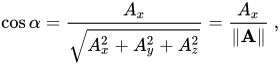
and analogously for angles β, γ. Consequently:

with unit vectors along the axis directions.

Areas and volumes
[edit]The area Σ of a parallelogram with sides A and B containing the angle θ is:

which will be recognized as the magnitude of the vector cross product of the vectors A and B lying along the sides of the parallelogram. That is:

(If A, B are two-dimensional vectors, this is equal to the determinant of the 2 × 2 matrix with rows A, B.) The square of this expression is:[4]

where Γ(A, B) is the Gram determinant of A and B defined by:
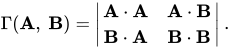
In a similar fashion, the squared volume V of a parallelepiped spanned by the three vectors A, B, C is given by the Gram determinant of the three vectors:[4]

Since A, B, C are three-dimensional vectors, this is equal to the square of the scalar triple product below.
![{\displaystyle \det[\mathbf {A} ,\mathbf {B} ,\mathbf {C} ]=|\mathbf {A} ,\mathbf {B} ,\mathbf {C} |}](https://wikimedia.org/api/rest_v1/media/math/render/svg/1dbfcf1712714fb56603c5bc2458d5c0daf27a24)
This process can be extended to n-dimensions.
Addition and multiplication of vectors
[edit]- Commutativity of addition: .
- Commutativity of scalar product: .
- Anticommutativity of cross product: .
- Distributivity of multiplication by a scalar over addition: .
- Distributivity of scalar product over addition: .
- Distributivity of vector product over addition: .
- Scalar triple product:
- Vector triple product: .
- Jacobi identity:
- Lagrange's identity: .










Quadruple product
[edit]The name "quadruple product" is used for two different products,[5] the scalar-valued scalar quadruple product and the vector-valued vector quadruple product or vector product of four vectors.
Scalar quadruple product
[edit]The scalar quadruple product is defined as the dot product of two cross products:

where a, b, c, d are vectors in three-dimensional Euclidean space.[6] It can be evaluated using the Binet-Cauchy identity:[6]

or using the determinant:

Vector quadruple product
[edit]The vector quadruple product is defined as the cross product of two cross products:

where a, b, c, d are vectors in three-dimensional Euclidean space.[2] It can be evaluated using the identity:[7]

Equivalent forms can be obtained using the identity:[8][9][10]

This identity can also be written using tensor notation and the Einstein summation convention as follows:

where εijk is the Levi-Civita symbol.
Related relationships:
- A consequence of the previous equation:[11]
- In 3 dimensions, a vector D can be expressed in terms of basis vectors {A,B,C} as:[12]


Applications
[edit]These relations are useful for deriving various formulas in spherical and Euclidean geometry. For example, if four points are chosen on the unit sphere, A, B, C, D, and unit vectors drawn from the center of the sphere to the four points, a, b, c, d respectively, the identity:

in conjunction with the relation for the magnitude of the cross product:

and the dot product:

where a = b = 1 for the unit sphere, results in the identity among the angles attributed to Gauss:

where x is the angle between a × b and c × d, or equivalently, between the planes defined by these vectors.[2]
See also
[edit]Notes
[edit]- ^ There is also a seven-dimensional cross product of vectors that relates to multiplication in the octonions, but it does not satisfy these three-dimensional identities.
References
[edit]- ^ a b Lyle Frederick Albright (2008). "§2.5.1 Vector algebra". Albright's chemical engineering handbook. CRC Press. p. 68. ISBN 978-0-8247-5362-7.
- ^ a b c Gibbs & Wilson 1901, pp. 77 ff
- ^ Francis Begnaud Hildebrand (1992). Methods of applied mathematics (Reprint of Prentice-Hall 1965 2nd ed.). Courier Dover Publications. p. 24. ISBN 0-486-67002-3.
- ^ a b Richard Courant, Fritz John (2000). "Areas of parallelograms and volumes of parallelepipeds in higher dimensions". Introduction to calculus and analysis, Volume II (Reprint of original 1974 Interscience ed.). Springer. pp. 190–195. ISBN 3-540-66569-2.
- ^ Gibbs & Wilson 1901, §42 of section "Direct and skew products of vectors", p.77
- ^ a b Gibbs & Wilson 1901, p. 76
- ^ Gibbs & Wilson 1901, p. 77
- ^ Gibbs & Wilson 1901, Equation 27, p. 77
- ^ Vidwan Singh Soni (2009). "§1.10.2 Vector quadruple product". Mechanics and relativity. PHI Learning Pvt. Ltd. pp. 11–12. ISBN 978-81-203-3713-8.
- ^ This formula is applied to spherical trigonometry by Edwin Bidwell Wilson, Josiah Willard Gibbs (1901). "§42 in Direct and skew products of vectors". Vector analysis: a text-book for the use of students of mathematics. Scribner. pp. 77ff.
- ^ "linear algebra - Cross-product identity". Mathematics Stack Exchange. Retrieved 2021-10-07.
- ^ Joseph George Coffin (1911). Vector analysis: an introduction to vector-methods and their various applications to physics and mathematics (2nd ed.). Wiley. p. 56.
Further reading
[edit]- Gibbs, Josiah Willard; Wilson, Edwin Bidwell (1901). Vector analysis: a text-book for the use of students of mathematics. Scribner.