


Community hub
Recent from talks
Contribute something
Nothing was collected or created yet.
R-390A
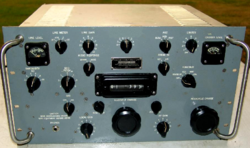
View on WikipediaThe R-390A /URR is a general coverage HF radio communications receiver designed by Collins Radio Company for the United States Armed Forces.

History
[edit]The R-390A military shortwave radio receiver was the result of a project undertaken by the United States Army Signal Corps in 1954 to replace the existing R-390 receiver then in use. The R-390 had done its job so well that the Corps decided continued use of this type of receiver necessitated an improved, reduced-cost version. There are many references to the R390A in the open literature during this period; a picture of the receiver appeared in the May 1959 issue of QST.[1]
The total production of the R-390A (as determined by the high serial numbers noted) is over 55,000 units. Initial production started in 1955 and ran through approximately 1970, and then was restarted in 1984 by Fowler Industries for Avondale Shipyards. Manufacturers and their approximate production numbers are:[1]
| Manufacturer | Approximate production numbers | Notes |
|---|---|---|
| Collins Radio Company | 6,363 | |
| Electronic Assistance Corp | 15,338 | Includes Dittmore Freimuth marked radios |
| Capehart | 4,242 | |
| Motorola | 14,873 | |
| Stewart-Warner | 6,631 | |
| Amelco/Teledyne/Imperial | 7,958 | These companies were related through acquisitions |
| Fowler Industries | 5 |
Companies which made spare modules, but not whole sets were Communications Systems Corp., Clavier Corp. and Hacking Labs.
Design
[edit]The R-390A is a general coverage radio receiver capable of receiving amplitude modulated, code, and frequency shift keying signals. Its tuning range is from 500 kHz to 32 MHz, in thirty-two 1 MHz bands. The circuit is the superheterodyne type, double conversion above 8 MHz, below which triple conversion is used. It employs 23 vacuum tubes, a larger than normal count for most general-coverage receivers.
| Quantity | Part number | Type |
|---|---|---|
| 3 | 6AK6 | Pentode |
| 2 | 5654 | Pentode |
| 4 | 12AU7/5814A | Triode |
| 2 | 26Z5W | Full-Wave Vacuum Rectifier |
| 1 | 3TF7 | Current Regulator |
| 6 | 6BA6/5749W | Pentode |
| 3 | 6C4/6100 | Triode (Medium-μ) |
| 1 | 6DC6 | Pentode |
| 1 | 0A2WA | Voltage Regulator |
The receiver weighs 85 pounds (39 kg) and can be operated on 120-volt or 240-volt supplies. It fits neatly into a 10.5-inch-tall (270 mm) standard 19-inch rack.[2]: 6 [3] Tuning of the R-390A's radio frequency and intermediate frequency front end is synchronized by means of an ingenious mechanical system of racks, gears, and cams. When the front panel tuning controls are rotated, this system raises and lowers ferrite slugs in and out of the receiver's tuning coils. This ensures that all front-end circuits are tracked, meaning all circuits are tuned to the correct frequency to maintain excellent selectivity and sensitivity. The receiver's construction is modular for easy servicing. Each major area of the receiver is contained in easily removable subassemblies, and these can be repaired or replaced as needs be. Though the R-390A is mechanically and electrically complex, alignment and servicing were designed to follow simplified procedures published by the Signal Corps.[2]
Use
[edit]The R-390A was deployed to most branches of the US military and remained in general use through the 1980s. The last major update to its documentation was in 1984. As the military procured newer receivers, many R-390As were released to surplus while others were destroyed. Some receivers were retained by the services, however, when they found that the R-390A's vacuum tube circuitry could easily survive an electromagnetic pulse. There are reports, possibly apocryphal, that R-390A receivers are still in use aboard U.S. Navy submarines since the receiver can withstand the strong radio frequency fields found aboard ship.[1]
Many of the R-390As that exist today are in the hands of vintage amateur radio collectors and amateur radio operators who contend that few modern solid state communications receivers can equal its performance. There is a wealth of information, both printed and electronic, devoted to R-390A restoration and maintenance, as the R-390A is widely considered an example of the best of vacuum tube technology.[1]
See also
[edit]References
[edit]- ^ a b c d Rippel, Chuck (24 December 2001). "The R390A home on the WWW". The R390A/URR. Archived from the original on 27 September 2007. Retrieved 10 December 2022.
- ^ a b TM 11-5820-358-10 — Operator's Manual: Radio Receiver R-390A/URR (4 ed.). Headquarters, Department of the Army. 7 April 1975 [16 January 1961]. p. 3. Retrieved 10 December 2022 – via Google Books.
- ^ TM-11-5820-358-35 — Field and Depot Maintenance Manual: Radio Receiver R-390A/URR (3 ed.). Headquarters, Department of the Army. 27 May 1980 [8 January 1961]. Retrieved 10 December 2022 – via Google Books.
Further reading
[edit]- Couillard, L. W. (15 January 1952). Cost Reduction Program For Radio Receivers, R-390/391( )/URR | Final Progress Report (PDF) (Technical report). Cedar Rapids, Iowa: Research And Development Laboratories | Collins Radio Company. Archived (PDF) from the original on 17 July 2022. Retrieved 12 December 2022 – via r-390a.net.
External links
[edit]- "Receiver Test Data | Collins R-390A". Sherwood Engineering Incorporated. Denver, Colorado. 23 October 2018. Archived from the original on 4 December 2022. Retrieved 12 December 2022.
R-390A
View on GrokipediaHistory and Development
Origins and Design Evolution
The R-390A receiver was developed in the early 1950s by the Collins Radio Company under a U.S. government contract to address the limitations of its predecessor, the R-390, which had entered production around 1951 but proved expensive to manufacture and maintain due to its complexity.[4][5] The R-390, a double- and triple-conversion superheterodyne design, utilized 33 vacuum tubes and was optimized for high-performance HF communications in fixed military installations during the escalating Cold War tensions.[6] By 1952-1953, the U.S. military requested a redesign to lower costs while preserving essential capabilities like sensitivity and overload resistance, leading Collins to initiate the R-390A project as a more economical alternative suitable for broader field deployment.[7][8] Key design goals for the R-390A emphasized improved reliability, reduced maintenance demands, and enhanced field maintainability to support diverse military HF communication needs amid Cold War demands for robust signal intelligence and voice reception.[4] Engineers achieved these by decreasing the tube count to 26, simplifying the power supply, and adopting a modular construction that facilitated easier repairs in operational environments.[6][9] The redesign preserved the high performance of the original while cutting production costs, with the first units completed under contract 14214-Phila-51 modifications (992 units in 1951), enabling mass production starting in 1954.[2][5][10] A pivotal evolution in the R-390A was the adoption of mechanical filters at the 455 kHz IF stage, replacing the R-390's LC tuned circuits to achieve superior selectivity across bandwidths of 0.1 to 16 kHz while retaining the multi-stage conversion (triple below 8 MHz and double above), addressing limitations in rejecting adjacent signals and improving image rejection for reliable operation in congested HF spectra.[11][12][13] Introduced in 1954, the R-390A thus represented a balanced advancement, maintaining military-grade performance while enhancing practicality for both stationary and mobile applications.[8]Production Timeline and Manufacturers
The production of the R-390A receiver commenced in 1954 under U.S. military contracts, primarily through the Signal Corps, with initial deliveries designated as the R-390A/URR model. Collins Radio Company handled the initial prototypes and early small-batch production, delivering 992 units in 1951 under contract 14214-PH-51, 310 units in 1954 under contract 375-PH-54, and 4,982 units in 1955 under contract 08719-PH-55. The primary manufacturing run extended through 1967, encompassing multiple contracts and subcontractors, during which over 50,000 units were produced to meet demands from the U.S. Army, Navy, and Air Force. Smaller contracts followed in 1968, with final limited production occurring in 1984 by Fowler Industries under contract N00024-84-C-2027, yielding just five units for Avondale Shipyards.[2][10] Key manufacturers included a mix of prime contractors and subcontractors, each contributing distinct variants with minor cosmetic and assembly differences but adhering to standardized specifications. Motorola produced the largest early volume, totaling 14,873 units across contracts from 1954 to 1958, including 3,427 in 1954 (contract 63-PH-54), 4,909 in 1956 (contract 14-PH-56), and 6,537 in 1958 (contract 14385-PH-58). The Electronic Assistance Corporation (EAC) led later production with 4,255 units in 1960 (contract 23137-PC-60), 10,717 units in 1967 (contract DAAB05-67-C-0115), 151 consumer units in 1968, and 215 units in 1968 (contract DAAB05-68-C-0040, made by EAC for Dittmore-Freimuth), for a total of approximately 15,338 units, marking the peak of cost-reduction efforts that introduced simplified chassis designs to lower expenses without compromising performance. Other notable producers were Stewart-Warner (6,631 units, 1959–1960), Capehart Corporation (4,237 units in 1961), and Amelco/Teledyne/Imperial Electronics (7,958 units combined in 1962–1963). Additional subcontractors, such as Communications Systems Inc. in 1966 and Dittmore-Freimuth in 1968, handled smaller runs under EAC oversight.[2][10][5]| Manufacturer | Key Production Years | Approximate Quantity | Notable Contracts |
|---|---|---|---|
| Collins Radio Company | 1951–1955 | 6,284 | 14214-PH-51, 375-PH-54, 08719-PH-55 |
| Motorola Inc. | 1954–1958 | 14,873 | 63-PH-54, 14-PH-56, 14385-PH-58 |
| Stewart-Warner Corp. | 1959–1960 | 6,631 | 42428-PC-59, 20139-PC-60 |
| Electronic Assistance Corp. (EAC) | 1960–1968 | 15,338 | 23137-PC-60, DAAB05-67-C-0115, DAAB05-68-C-0040 |
| Capehart Corp. | 1961 | 4,237 | 21582-PC-61 |
| Amelco/Teledyne/Imperial | 1962–1963 | 7,958 | 35064-PC-62, 37856-PC-63 |
| Fowler Industries | 1984 | 5 | N00024-84-C-2027 |