Hubbry Logo
Rajendra IIIRajendra IIIMain
Open search
Rajendra III
Community hub
Rajendra III
logo
8 pages, 0 posts
0 subscribers
Be the first to start a discussion here.
Rajendra III
Rajendra III
from Wikipedia

Key Information

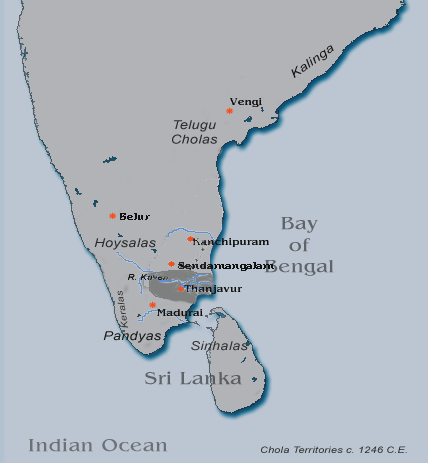
Rajendra Chola III (reigned 1246–1279) was the last Chola emperor, who reigned from 1246 until his death in 1279. Rajendra began to take effective control over the administration, and epigraphs of Rajendra Chola III indicate there was civil war ending with the death of Rajaraja Chola III.[1] Rajendra's inscriptions laud him as the "cunning hero, who killed Rajaraja after making him wear the double crown for three years".[2]

Northern expeditions

[edit]

Rajendra Chola III took bold steps to revive the Chola fortunes. He led successful expeditions to the north as attested by his epigraphs found as far as Cuddappah.[3]

Initial success against the Pandyas

[edit]

The king also defeated two Pandya princes, one of whom was Maravarman Sundara Pandyan II, and briefly made the Pandyas submit to the Chola overlordship. The Hoysalas, under Vira Someswara, sided with the Pandyas and repulsed the Cholas.[4]

Hostility with the Hoysalas

[edit]

The Hoysalas played a divisive role in the politics of the Tamil country during this period. Exploiting the lack of unity among the Tamil kingdoms, they supported one Tamil kingdom against the other to prevent both the Cholas and Pandyas from rising to their full potential. During the period of Rajaraja III, the Hoysalas sided with the Cholas and defeated the Kadava chieftain Kopperunjinga and the Pandyas and established a presence in the Tamil country.[5]

War with Jatavarman Sundara Pandya

[edit]

Jatavarman Sundara Pandya I ascended the Pandya throne in 1251. In the ensuing wars for supremacy, he emerged as the most victorious ruler and the Pandya kingdom reached its zenith in the 13th century during his reign. Jatavarman Sundara Pandya first put an end to Hoysala interference by expelling them from the Kaveri delta and subsequently killed their king Vira Someswara in 1262 AD near Srirangam. He then defeated Kopperunjinga, the Kadava chieftain, and turned him into a vassal. He then defeated Rajendra III and made him acknowledge the Pandya suzerainty. The Pandya then turned his attention to the north and annexed Kanchi by killing the Telugu Chola chief Vijaya Gandagopala of Nellore Cholas. He then marched up to Nellore and celebrated his victories there by doing the virabisheka(anointment of heroes) after defeating the Kakatiya ruler, Ganapati. Meanwhile, his lieutenant Vira Pandya defeated the king of Lanka and obtained the submission of the island nation.[6]

Aftermath the Pandya war

[edit]

There are no confirmed reports of Rajendra Chola III having been killed in the battle so he lived in obscurity in Pazhayarai up to 1279, after which there are no inscriptions found of the Cholas. This war marks the end of Cholas reign in Tamil Nadu and the Chola territories were completely absorbed by the Pandyan empire.

Fate of Cholas

[edit]

After the war, the remaining Chola royal bloods were ceased to exist by the Pandyan forces as a retribution for the enslaving the Pandyans for three centuries in their capital city Madurai. One such branch was the Chola/Cholaganar chiefs of Pichavaram. [citation needed] The Pandyas who were vassals of the Vijayanagar Empire wasted no time and appealed to Krishnadevaraya. The latter then sent his general Nagama Nayak who defeated the Chola but then usurped the throne of Madurai instead of restoring the Pandyas.[7]

Notes

[edit]

References

[edit]
Revisions and contributorsEdit on WikipediaRead on Wikipedia
from Grokipedia
Rajendra III (c. 1246–1279), also known as Koparakesarivarman, was the last king of the , which had ruled much of from its base in the Kaveri River delta for over four centuries. Ascending amid a severely diminished kingdom reduced primarily to the fertile delta region following losses to neighboring powers, his rule involved defensive campaigns against Hoysala incursions and Sambuvaraya feudatories, including claims of victory over Hoysala king Vira Somesvara. He briefly supported efforts to reclaim Pandya territories earlier in the dynasty's waning phase, but faced decisive setbacks, such as the loss of to Jatavarman Sundara Pandya around 1257–1258. Rajendra III's reign ended with the Pandya conquest under Maravarman Kulasekhara I in 1279, after which the final Chola inscriptions cease, marking the effective collapse of the empire to rising Pandya dominance. No major architectural or expansive achievements are recorded under his direct patronage, reflecting the dynasty's terminal decline rather than renewal.

Background and Ascension to the Throne

Lineage and Early Life

Rajendra III, formally known as Rajendra Deva III or Koparakesarivarman, belonged to the Later , which traced its lineage from (r. 1070–1122 CE) through successive monarchs including and . He was the son and successor of (r. 1216–1256 CE), ascending as a direct heir in the imperial Chola line amid a period of territorial contraction and feudal challenges. Inscriptions describe him as a "proper scion of the Chola stock," emphasizing continuity with the dynasty's ancient Tamil heritage rooted in the River valley. Specific details of Rajendra III's birth date and childhood remain undocumented in surviving epigraphic or literary sources, which prioritize royal titles and campaigns over personal during the late 12th and early 13th centuries. As , he likely received training in warfare, administration, and Shaivite traditions customary for Chola heirs, preparing him for governance in a realm weakened by Hoysala incursions and Pandya resurgence. By 1240 CE, while still a prince, he led military efforts to reclaim lost territories and bolster his father's authority, demonstrating early involvement in restoring Chola prestige six years before his formal coronation in 1246 CE. This co-regency arrangement, evidenced in prasasti records, allowed him to consolidate power amid ongoing dynastic decline.

Political Context of Late Chola Decline

The late experienced accelerating political decline from the early onward, characterized by the fragmentation of imperial authority amid rising feudatory autonomy and external encroachments. Following the relatively stable reign of Kulottunga III (r. 1178–1218), his successor (r. 1216–c. 1256) inherited a realm where local chieftains, such as the Kadavas under Kopperunjinga I, increasingly defied central control, capturing key territories including parts of modern-day by the 1240s. This internal disloyalty stemmed from weakened enforcement of feudal obligations, as Chola kings struggled to reward or suppress ambitious vassals, leading to a patchwork of semi-independent polities that undermined unified governance. Feudatories like the Sambuvarayas and Telugu Choda branches further exacerbated instability by alternating between nominal allegiance and outright rebellion, often exploiting succession uncertainties to expand their domains. Rajaraja III's rule was marred by such revolts, compounded by invasions from the under Vira Narasimha II, who seized northern Chola territories around 1220–1230, diverting resources and prestige from the core Tamil heartland. By the mid-1240s, these pressures had reduced the Chola domain to a fraction of its earlier extent, with the crown reliant on fragile alliances rather than direct administration. The revival of Pandya power under kings like Maravarman Sundara Pandya (r. c. 1216–1238) added a decisive external dimension, as Pandyas methodically reconquered southern territories long subordinated to Chola overlordship, including portions of Kongu and by the 1250s. This resurgence, fueled by Pandya military reorganization and exploitation of Chola vulnerabilities, shifted the regional balance irreversibly, rendering the Chola monarchy a nominal amid pervasive strife by the time of Rajendra III's ascension around 1256. Internal records, such as inscriptions, reflect this era's chaos through frequent references to restored grants and quelled uprisings, underscoring a causal chain from administrative overextension to feudal devolution and predatory neighbors.

Ascension and Consolidation of Power

Rajendra III, also known as Koparakesarivarman or Rajendra Deva III, ascended the Chola throne in 1246 CE upon the death of his father and predecessor, , who had reigned since 1216 CE amid intensifying regional threats from the Pandyas and Hoysalas. Prior to his formal accession, Rajendra served as co-regent, with records indicating joint rule extending until at least 1256 CE, as evidenced by inscriptions (e.g., Nos. 39, 85, and 88 in the B and VC series). This transitional phase occurred during a period of Chola decline, characterized by fragmented authority, rebellions, and encroachment by neighboring powers, which limited the new king's initial resources to core territories around the delta. To consolidate power, Rajendra launched aggressive military campaigns starting around 1240 CE, even before his full accession, targeting Pandya forces to reclaim lost prestige and territory. He defeated Maravarman Sundara Pandya II (r. ca. 1238–1251 CE) in key engagements, including an assault that enabled to briefly assume the Pandya crown and rule dually over Chola and Pandya domains for approximately three years, as proclaimed in prasastis (eulogies) and a 15th-regnal-year inscription from Tripurantakam. These victories facilitated the capture of Kana Nadu and the sacking of between 1240 and 1245 CE, temporarily restoring Chola control over southern fringes. An inscription at the Ranganatha temple in , dated 25 December 1252 CE (Epigraphia Indica, Vol. VII, No. 24), details these successes against two Pandya princes and underscores Rajendra's role in repelling invasions. Rajendra also pursued strategic alliances to bolster his position, forging ties with the Telugu Chodas, whose leader Gandagopala recaptured from Hoysala forces in 1234 CE, and initially cooperating with Hoysala ruler Someshvara (r. 1234–1263 CE) against mutual threats, culminating in a 1252 CE peace agreement. However, these pacts proved fragile; Rajendra later defeated Someshvara, expelling Hoysala garrisons from Kannanur, as recorded in the same Srirangam inscription, reflecting pragmatic shifts to counter immediate encroachments on Chola heartlands. Despite these maneuvers, consolidation efforts yielded only short-term gains— was lost again by 1245 CE, and the kingdom's effective domain contracted, foreshadowing further erosion under mounting Pandya pressure. Primary evidence for these actions derives from temple inscriptions and copper plates, which, while celebratory in tone, align with the archaeological and epigraphic record of transient Chola resurgence amid systemic weakening.

Early Military Campaigns

Northern Expeditions

Upon ascending the throne in 1246 CE following the death of , Rajendra III initiated military expeditions northward to counter Hoysala encroachments and restore Chola authority over peripheral territories amid the dynasty's decline. These efforts focused on securing and adjacent regions, which had been contested by Hoysala king Vira Somesvara, who launched an attack on the city in 1246 CE shortly after Rajendra's coronation. Rajendra III leveraged alliances with Telugu Choda chiefs, such as Gandagopala, whose forces had previously captured from the Hoysalas in 1234 CE by defeating and killing Vira Narasimha II, thereby extending Chola influence into Andhra territories. Epigraphs from Rajendra's reign, including records at Tripurantakam dated to his 15th (1261 CE), attest to these northern successes, though detailed battle accounts remain sparse and primarily prasasti (eulogistic) in nature. Further campaigns targeted local northern feudatories, notably the Sambuvaraya chiefs in the region (modern Villupuram district), where Rajendra achieved victories post-1246 CE, earning the epithet "Rama who conquered Vira Rakshasas" in inscriptions for subduing these adversaries. These expeditions temporarily bolstered Chola control over northern frontiers but were limited by ongoing resource strains and rival pressures, setting the stage for later conflicts.

Initial Victories Against the Pandyas

Upon ascending to the Chola throne around 1246 CE following the death of his father , Rajendra III initiated military campaigns to counter Pandya encroachments and reassert Chola authority in southern . These efforts culminated in a over Maravarman Sundara Pandya II, a Pandya active circa 1238–1239 CE who had previously launched invasions into Chola heartlands, including raids on the . The defeat avenged these aggressions and temporarily subdued Pandya forces, enabling the Cholas to impose overlordship and extract submissions from . In the wake of this success, Chola prasastis record that —likely honored posthumously or through transitional regency claims—wore both the Chola and Pandya crowns for a period of three years, symbolizing restored imperial prestige. Rajendra III's forces also captured the strategic Pandya territory of Kana Nadu and sacked the coastal temple town of between approximately 1240 and 1245 CE, disrupting Pandya naval and trade capabilities while securing tribute and fealty from local . These operations, evidenced primarily through temple inscriptions, marked a brief resurgence of Chola influence over Pandya domains, though they relied on exploiting internal Pandya divisions rather than total conquest. The victories provided Rajendra III with early legitimacy amid the dynasty's decline, but their fragility was evident as Pandya resurgence under Jatavarman Sundara Pandya I, who ascended in 1251 CE, soon eroded these gains through counteroffensives. By the mid-1250s, Chola control had contracted, limiting effective dominion to the River delta, underscoring the campaigns' role as a temporary check on Pandya expansion rather than a structural reversal of Chola weaknesses.

Conflicts with Regional Powers

Hostilities with the Hoysalas

During the early phase of Rajendra III's reign, which began around A.D. 1246 following the death of his father , hostilities with the under Vira Somesvara (r. 1234–1263) emerged as the grappled with internal fragmentation and external pressures. The Hoysalas, having previously allied with the Cholas through matrimonial ties and joint campaigns against the Pandyas, shifted toward opportunistic expansion into weakened Chola territories in the northern districts, including incursions into the Kanchi region. This aggression reflected the Hoysalas' strategic aim to consolidate control over the fertile plains bordering their plateau core, exploiting Chola vulnerabilities amid ongoing Pandya threats. A notable escalation occurred in A.D. 1246 when Vira Somesvara launched an attack on , a key Chola stronghold and , though the immediate military outcome remains unclear from surviving inscriptions. Rajendra III reportedly suffered a defeat at the hands of Vira Somesvara, underscoring the Hoysalas' tactical superiority in regional skirmishes and contributing to the further erosion of Chola authority in the north. Hoysala influence manifested in demands for subservience from Chola feudatories, which Rajendra III resisted, viewing such subordination as incompatible with imperial sovereignty; this tension prompted internal Chola maneuvers to counter Hoysala overreach, including the elimination of overly compliant officials. Despite these clashes, pragmatic considerations against the rising Pandya power under Jatavarman Sundara Pandya led to a temporary Hoysala-Chola alignment by the 1250s, as evidenced by joint resistance efforts that delayed Pandya advances until the Hoysalas' own defeat at Kannanur Koppam around A.D. 1257. However, the underlying hostilities persisted, with Hoysala encroachments accelerating Chola territorial losses outside the core delta by A.D. 1261, as inscriptions from Telugu Choda allies highlight the strain on Rajendra's northern frontiers. These conflicts, rooted in power vacuums rather than ideological enmity, exemplified the causal dynamics of feudal opportunism in late medieval , where shifting alliances masked enduring rivalries over arable lands and trade routes.

Engagements with Other Feudatories and Challengers

Upon ascending the throne in 1246 CE following the civil war that ended his uncle Rajaraja III's reign, Rajendra III prioritized suppressing rebellious local chieftains to consolidate power in the fragmented Chola territories. Key among these were the Kadava chieftains, particularly Kopperunjinga II of Sendamangalam, who had initially supported Rajendra's claim by aiding his rise against rivals but soon asserted greater independence, capturing Chola strongholds like Kanchipuram and challenging central authority through raids and alliances with external powers. Between approximately 1250 and 1253 CE, Rajendra launched campaigns to curb Kadava incursions, achieving temporary subjugation of Kopperunjinga and restoring nominal Chola overlordship in northern districts, though the chieftain's forces remained a persistent threat due to their fortified positions and mercenary levies. To counterbalance these internal threats and bolster military resources amid the empire's decline, Rajendra forged alliances with the Telugu Chola branches, notably the and Pottapi lineages under chiefs like Vijaya Gandagopala, who provided troops and served as a buffer against northern incursions from powers like the Kakatiyas. These Telugu feudatories, tracing descent from earlier Chola stock and ruling semi-autonomously from Andhra territories, supplied and for joint expeditions, enabling Rajendra to project strength eastward and delay further encroachments until the Pandyas overran in the 1270s by defeating and killing Gandagopala. Such engagements underscored the Chola court's reliance on peripheral vassals, whose loyalty was pragmatic rather than absolute, often shifting with battlefield fortunes. Minor challengers, including Sambuvarayan and other provincial nayaks in the Arcot region, also tested Rajendra's authority through localized revolts, prompting punitive raids that yielded inscriptions attesting to restored flows but failed to eliminate underlying fissiparous tendencies fueled by weak central finances and rival from Hoysalas. These scattered conflicts, while not existential on their own, eroded administrative cohesion, paving the way for the Pandyas' decisive intervention by diverting resources from core defenses.

Major War with Jatavarman Sundara Pandya

Outbreak of Hostilities

In the aftermath of Rajendra III's temporary assertion of Chola overlordship over the Pandyas following his victory against Maravarman Sundara Pandya II around 1248–1250 CE, internal Pandya strife enabled Jatavarman Sundara Pandya to emerge as a unifying force by 1251 CE, defeating rival claimants and consolidating control over and surrounding regions. This resurgence directly challenged lingering Chola influence in Pandya territories, setting the stage for renewed conflict as Jatavarman pursued aggressive expansion to restore Pandya prestige diminished by prior Chola interventions. Hostilities erupted prominently in 1257–1258 CE when Jatavarman, fresh from subduing the Telugu Choda ruler Gandagopala, redirected his armies northward and captured , a strategic Chola stronghold north of the delta. This incursion violated Chola and prompted retaliatory measures from Rajendra III, whose forces were already strained by feudatory revolts and Hoysala encroachments. Inscriptions from the period, including prasastis at Tripurantakam, record Jatavarman's digvijaya (conquest campaign) explicitly targeting Chola domains as part of a broader bid for . Emboldened by successes against the Hoysalas and Kakatiyas, Jatavarman pressed deeper into Chola heartlands by the early 1260s, marching on Urayur, Kaveripattinam, and —core administrative and economic centers—thereby initiating sustained invasions that exposed the Cholas' military vulnerabilities amid administrative decay and resource shortages. Rajendra III's responses, hampered by unreliable feudatories, failed to halt this momentum, marking the outbreak as a Pandya-initiated offensive driven by opportunistic expansion rather than a defensive Chola provocation. By 1261 CE, Chola control had contracted to the delta, underscoring the rapid escalation from border skirmishes to existential threat.

Key Battles and Strategic Decisions

The primary military engagements in the war with Jatavarman Sundara Pandya centered on the Pandya ruler's aggressive northern expansion into Chola heartlands during the late 1250s. In 1257–58, Sundara Pandya's armies captured , a vital Chola stronghold serving as a political and economic hub near the northern frontier, after overcoming local defenses. This breakthrough exposed Rajendra III's strategic oversight in prioritizing internal consolidation over bolstering frontier garrisons, allowing Pandya forces to penetrate deep into Chola territory without decisive interception. Rajendra III responded by mobilizing Chola troops for counteroffensives, but these efforts faltered amid divided loyalties among feudatories and limited reinforcements. By 1258–1260, Sundara Pandya's campaigns extended to subduing core Chola regions, culminating in Rajendra's effective capitulation and payment of tribute, which preserved nominal Chola rule under Pandya overlordship. This outcome reflected Rajendra's tactical choice to engage in prolonged resistance—rooted in Chola imperial precedents—rather than immediate submission or alliance-building with powers like the Hoysalas, whose shifting allegiances further isolated the Cholas. Pandya inscriptions from the period, such as those at Tirukkalukkunram, corroborate these victories, emphasizing Sundara's orchestration of coordinated assaults on multiple fronts to overwhelm Chola logistics. Strategic decisions by Rajendra III, including reliance on traditional elephant and infantry formations suited to riverine terrain, proved inadequate against the Pandyas' more mobile cavalry-supported incursions, as evidenced by the rapid loss of control over the delta trade routes. Attempts to rally vassals like the Kadavas yielded temporary respite but failed to reverse territorial gains, underscoring a broader failure to adapt to the Pandyas' unified command under Sundara, who integrated conquests with administrative overhauls to consolidate holdings.

Defeat, Capture, and Immediate Consequences

In 1279 CE, Maravarman Kulasekhara Pandya I, successor to Jatavarman Sundara Pandya I, conducted a final of the Chola domain, defeating Rajendra III's forces in a campaign that targeted the weakened kingdom's core territories. This offensive followed earlier Pandya encroachments and Hoysala-Chola alliances that had failed to stem the tide, culminating in the overrunning of key Chola strongholds such as and the fertile delta. The Chola military, hampered by internal fragmentation and prior losses, could not mount an effective resistance, leading to the sack of administrative centers and the disruption of royal authority. Rajendra III's personal fate remains uncertain in historical records; while later traditions suggest he was captured by Pandya forces during the collapse of resistance, no contemporary inscriptions or chronicles explicitly confirm his imprisonment or execution. The absence of dated Chola epigraphs beyond 1279 CE indicates a sharp termination of royal activities, with Rajendra likely retreating into obscurity in regions like , devoid of further political agency. The immediate aftermath saw the rapid incorporation of Chola lands into the expanding Pandya realm, marking the effective end of independent Chola sovereignty. No subsequent Chola coins or inscriptions appear, signaling the halt of minting, temple endowments, and administrative functions centered in . Pandya records from the period depict former Chola feudatories as subordinates, with Tamil country governance shifting decisively to , paving the way for further Pandya consolidation before their own encounters with northern incursions.

Aftermath, Final Years, and Dynasty's Fall

Release and Attempts at Recovery

Following the defeat and capture of by Jatavarman Sundara Pandya I in 1257–1258 CE, Rajendra III acknowledged Pandya overlordship, effectively subordinating Chola sovereignty while retaining nominal rule over reduced territories. This arrangement confined Chola control primarily to the River delta region by 1261 CE, as evidenced by contemporary prasasti inscriptions and records from sites like Tripurantakam and Nandalur. In subsequent recovery efforts, Rajendra III sought alliances with neighboring powers, notably partnering with Hoysala king Vira Ramanatha to resist further Pandya encroachments. These military collaborations, however, yielded no significant territorial gains or reversal of Pandya dominance, hampered by the Cholas' weakened military capacity and internal fragmentation among feudatories. Epigraphic evidence, including a 1279 CE inscription from Tiruchchorrutturai, attests to Rajendra III's continued administration in core Chola areas until that year, but without indications of broader reconquest or restoration of imperial . The absence of subsequent Chola inscriptions underscores the failure of these attempts, paving the way for full Pandya consolidation over former Chola domains.

Internal Disintegration and External Encroachments

Following his release from Pandya captivity around 1258, Rajendra III's authority eroded rapidly due to the defection of key feudatories and the breakdown of centralized control over provincial governors. Telugu Choda chiefs, such as Gandagopala, who had previously allied with the Cholas, shifted loyalties amid Pandya advances, allowing regions like to slip from Chola grasp by 1245. Similarly, the Kadava ruler Kopperunjinga operated with increasing autonomy, contributing to the fragmentation of Chola administrative oversight beyond the delta. By 1261, the final Chola inscription outside the delta core at Tiruchchorrutturai underscores this territorial contraction, reflecting a loss of fiscal and military cohesion that left the dynasty reliant on depleted local levies. External pressures intensified as Pandya forces under successors to Jatavarman Sundara Pandya methodically encroached on remaining Chola holdings. Hoysala interventions further strained resources, with their armies exploiting Chola vulnerabilities to seize border districts in the north, while Telugu Choda territories fell to Pandya subjugation post-1258. Maravarman Kulasekara Pandya I capitalized on this disarray, launching campaigns that culminated in the sack of Chola strongholds and the imposition of tributary status by the mid-1270s. These encroachments reduced the Chola domain to isolated pockets around , devoid of effective naval or infantry mobilization, as evidenced by the absence of defensive inscriptions after 1270. The interplay of internal autonomy among feudatories and relentless Pandya-Hoysala incursions precipitated total collapse by 1279, when Maravarman Kulasekara's forces decisively defeated , extinguishing Chola sovereignty without recorded resistance. No Chola coins or epigraphs appear post-1279, confirming the dynasty's absorption into Pandya domains and the erasure of its institutional framework.

Ultimate Collapse of Chola Rule

Following the decisive defeat by Jatavarman Sundara Pandya in 1257–1258, which resulted in the capture of key Chola commander Gandagopala and the loss of , Rajendra III's authority contracted sharply to the core territories around the River delta. Despite temporary alliances with the Hoysalas and campaigns against local chieftains like the Sambuvarayas, these efforts failed to reverse the momentum of Pandya expansion, as the Cholas faced simultaneous encroachments from Kakatiya forces in the north and resurgent Kadava feudatories under Kopperunjinga, who asserted independence. By 1261, inscriptions record Chola control limited to isolated pockets, such as references at Tripurantakam, reflecting a kingdom reduced to defensive survival amid fiscal exhaustion and military overextension. Internal disintegration accelerated the collapse, with feudatories withholding tribute and local assemblies (nadu) prioritizing self-governance over loyalty to the weakened crown, as evidenced by the scarcity of royal grants in later . Pandya armies systematically annexed Chola heartlands, including and Gangaikondacholapuram, by the late 1270s, while Hoysala incursions further eroded northern flanks. The final dated inscription of Rajendra III, from his 33rd , appears in 1279 at sites like Tiruchchorrutturai, after which no further Chola records emerge, signaling the dynasty's effective termination around 1279–1280. Pandya consolidation under Maravarman Kulasekara absorbed remaining Chola domains, ending imperial rule without a named successor or restoration attempt.

Administration, Economy, and Cultural Role

Governance and Administrative Measures

Rajendra III's governance operated within the established Chola framework of a , where the king held supreme authority over executive, judicial, military, and religious affairs, supported by a (periyanattar) and appointed officials such as the adhikaris for provincial oversight. Revenue administration relied on officials tasked with surveys, collection (including shares from produce and ), and maintenance, as documented in numerous inscriptions from the later Chola period exceeding 500 revenue-related terms. Local persisted through village assemblies: the sabha in (Brahmin endowment) villages handled temple endowments, water disputes, and communal decisions via elected committees, while the ur assemblies managed similar functions in non-endowed villages. Faced with escalating challenges from feudatories, Rajendra III implemented diplomatic measures to bolster administrative stability, forging alliances with Telugu Chola chieftains to offset Hoysala encroachments and internal dissent. These efforts aimed to reinforce central control over provinces (valanadus) divided into subunits (nadus and kurrams), but weakening oversight allowed local chiefs greater autonomy, contributing to fragmented enforcement of royal edicts on and land grants. Judicial administration, typically dispensed by the king or delegates at the capital and through assemblies at lower levels, increasingly devolved to feudatory courts amid royal preoccupation with defense. Military administration under Rajendra III emphasized mobilization of standing forces (kaikkolai) and feudal levies from vassals, integral to governance for quelling rebellions and securing frontiers, though fiscal strains from prolonged conflicts limited recruitment and upkeep. Inscriptions from his early reign indicate continuity in temple-based welfare measures, with royal grants supporting irrigation tanks and alms distribution to sustain agrarian productivity central to administrative revenue. Overall, these measures reflected adaptive continuity rather than innovation, undermined by systemic decline in central cohesion post-1250.

Economic Policies and Infrastructure

During Rajendra III's reign (c. 1246–1279 CE), the Chola economy remained fundamentally agrarian, with land revenue from wet rice cultivation in the delta serving as the primary fiscal base, typically assessed at one-sixth of produce under traditional and devadana grants. Inscriptions indicate continuity in temple-centered economic activities, where religious institutions managed endowments, labor, and local trade, buffering against central fiscal strains from feudal fragmentation and autonomy. Infrastructure maintenance focused on to sustain agricultural output, critical amid territorial encroachments by Pandyas and Hoysalas that disrupted flows. A notable epigraph from , dated to his third regnal year (c. 1251 CE), records a local official, Manasaya Dandanayakar, excavating an irrigation channel, exemplifying decentralized efforts to repair and expand water management systems essential for deltaic farming. Such initiatives echoed earlier Chola precedents but occurred under duress, as prolonged warfare diverted resources from broader economic reforms or maritime trade revival, contributing to fiscal exhaustion evident in the dynasty's by 1279 CE.

Patronage of Arts, Temples, and Religion

Rajendra III, reigning from approximately 1246 to 1279 CE amid escalating threats from the Pandya and Hoysala kingdoms, sustained the Chola tradition of temple patronage primarily through endowments, land grants, and administrative oversight rather than initiating large-scale constructions, reflecting the dynasty's fiscal and territorial constraints. His support focused on Shaivite institutions, consistent with longstanding Chola devotion to and the Nayanar saints, as evidenced by inscriptions recording provisions for rituals, lamps, and shrine expansions. In his second regnal year, Rajendra III authorized a gift of 90 sheep to fund a perpetual lamp at the Vedanathasvarar Temple in Tiruvottur, ensuring ongoing . By the fourth year, expansions at the Mantrapurisvarar Temple in Kovilur included the addition of a Bhuvanapati Nachchiyar , with further shrines dedicated to the Appar and Sambandar constructed in the tenth year, highlighting continuity in devotional architecture. In the fifth and sixth years, tax-exempt land was granted to the Somanathesvarar Temple at Achyutamangalam for a , tank maintenance, and oil supplies derived from local taxes, supporting floral offerings and perpetual lamps. Administrative involvement extended to temples like the Kailasanathar Temple in Kallaperumbur, where in the twelfth year, Rajendra III ordered the dismissal of an for , demonstrating direct intervention in temple finances to preserve endowments. Grants continued into later years, including tax-free land for a (monastic residence) at the Thyagarajasvamin Temple in Tiruvoymur in the eleventh year, and additional provisions for guards and processions in the twentieth year; a land gift for a lamp at Tiruvalakkoyil occurred in the twenty-sixth year. Support also reached sites such as the Tiru Anaikka Udaiya Nayanar Temple in Narttamalai (seventh year), Kailasanathasvamin Temple in (eighteenth year), and others including Channakesava in Chennur and Siddhesvara in . These actions, documented in epigraphs like those in the Annual Reports on (e.g., ARE 393-395 of 1925, ARE 583 of 1962-63), underscore a pragmatic focus on sustaining religious amid decline. While direct patronage of secular arts is sparsely recorded, temple-related activities under Rajendra III implicitly fostered and , as seen in Nataraja shrine additions at Oppilamanisvarar Temple in Arakandanallur around 1273 CE. No evidence indicates shifts toward or other sects; his reign reinforced Shaivite primacy through these targeted, inscription-verified measures.

Legacy and Historiographical Assessment

Achievements and Limitations

Rajendra III demonstrated martial prowess in countering early Pandya incursions, defeating two Pandya princes—including Maravarman Sundara Pandya II—in campaigns around 1238 or 1239 CE, which briefly stabilized Chola frontiers before his formal accession. He also forged a tactical with Hoysala Someshvara, leveraging external support to mitigate threats from rival kingdoms and temporarily bolstering Chola defenses against Hoysala incursions in the delta. These successes, however, proved ephemeral amid the dynasty's structural frailties. Jointly ruling with from 1244 CE and assuming sole authority by 1256 CE, Rajendra III faced persistent challenges from resurgent Pandyas under Jatavarman Sundara Pandya, who captured key Chola territories like by 1257–1258 CE. Internal fragmentation, including the rise of autonomous local chieftains and weakened central fiscal control, eroded his capacity to mobilize sustained resistance, as evidenced by the increasing influence of feudatories such as the Telugu Cholas. The limitations of his reign were starkly revealed in the decisive defeat by Jatavarman Kulasekhara Pandya in 1279 CE, which extinguished Chola sovereignty and integrated core territories—including and —into the Pandya domain. No subsequent Chola inscriptions or coinage appear after this event, underscoring the irreversible collapse of imperial administration and the failure to adapt inherited institutions to 13th-century geopolitical shifts dominated by aggressive southern rivals.

Causal Factors in Chola Decline

The later Chola rulers, including (r. 1216–1256) and his successor (r. 1246–1279), exhibited diminished administrative competence compared to their imperial predecessors, fostering a gradual erosion of central authority. Epigraphic evidence points to succession disputes and civil wars that fragmented loyalty among key feudatories, such as the Telugu Cholas who seized and the Vettarpiraiyars who asserted independence in the south. This internal disintegration was exacerbated by the devolution of power to local , who increasingly prioritized regional over allegiance to the throne, undermining the revenue and military mobilization systems that had sustained earlier expansions. Externally, the resurgence of the Pandya kingdom under dynamic leaders like Jatavarman Sundara Pandya I (r. 1251–1268) capitalized on Chola vulnerabilities, launching invasions that captured core territories including by around 1257. Rajendra III mounted a brief counteroffensive, defeating two Pandya princes including Maravarman Sundara Pandya II and temporarily reasserting control over parts of the south, but this recovery proved ephemeral amid ongoing Hoysala interventions and northern pressures from the Kakatiyas. The decisive blow came in 1279 when Maravarman Kulasekara Pandya I (r. 1268–1310) overwhelmed Chola forces, capturing Rajendra III and annexing the remaining domains, thereby extinguishing independent Chola rule after nearly four centuries. Underlying these events, the Cholas' overextended imperial structure—once propped by naval prowess and overseas trade—strained under sustained warfare and loss of peripheral holdings like by the early 13th century, depleting resources without commensurate administrative reforms. Historians attribute the dynasty's fall primarily to leadership failures that failed to adapt to shifting power dynamics, allowing opportunistic neighbors to dismantle the empire piecemeal rather than through a singular cataclysm.

Modern Interpretations and Scholarly Debates

Historians such as have portrayed Rajendra III as a more capable ruler than his predecessor , noting his installation as yuvaraja in 1246 and efforts to revive Chola authority through military campaigns against resurgent feudatories. Sastri emphasizes that Rajendra's inscriptions reflect audacious strategies to reclaim lost territories, including temporary successes against the Pandyas and Hoysalas, but ultimate defeat by Maravarman Kulasekara Pandya I in 1279 marked the dynasty's end. Scholarly debates center on the relative weight of internal structural weaknesses versus external invasions in the late Chola collapse under Rajendra III. Traditional interpretations, following Sastri, attribute decline to the erosion of centralized authority after (1070–1120), with rising among nattars (local chiefs) and velalas undermining fiscal and military cohesion, exacerbated by Rajendra's inability to fully suppress rebellious provinces like . Later analyses, such as in studies of segmentary state models, argue that the Cholas' imperial framework failed to adapt to post-1200 shifts, where hereditary chieftains prioritized local autonomy over royal levies, leading to fragmented loyalties during Rajendra's reign. External factors, including coordinated incursions by Pandyas, Hoysalas, and Kakatiyas, feature prominently in revisionist views, with some scholars contending these opportunistic alliances overwhelmed even Rajendra's revitalization attempts rather than stemming from inherent Chola decay. For instance, Pandya resurgence under Sundara Pandya (c. 1216–1238) and subsequent leaders exploited Chola interregnums, but debates persist on whether Rajendra's ephemeral victories—such as repelling Hoysala incursions in 1257—indicate tactical competence thwarted by numerical superiority or symptomatic of deeper logistical failures in mobilizing the nadu assemblies. Economic strains from prolonged warfare and disrupted trade routes to , once a Chola strength, further fuel discussions on causal primacy, though from inscriptions prioritizes military reversals as the proximate trigger for 1279's fall. Contemporary increasingly incorporates epigraphic data to reassess Rajendra III's agency, challenging earlier narratives of passive victimhood by highlighting his of temples like the Kampaharesvara at Tribhuvanam (completed c. 1260) as bids for legitimacy amid crisis. Yet, consensus holds that systemic overreliance on hereditary feudatories, evident in Rajendra's era, precluded sustainable recovery, with Pandya dominance post-1279 reshaping South Indian geopolitics until Vijayanagara's rise.

References

Add your contribution
Related Hubs
User Avatar
No comments yet.