
Hubbry Logo
Ramsey problemRamsey problemMain
Open search
Ramsey problem
Community hub
Ramsey problem
logo
7 pages, 0 posts
0 subscribers
Be the first to start a discussion here.
Ramsey problem
Ramsey problem
from Wikipedia

The Ramsey problem, or Ramsey pricing, or Ramsey–Boiteux pricing, is a second-best policy problem concerning what prices a public monopoly should charge for the various products it sells in order to maximize social welfare (the sum of producer and consumer surplus) while earning enough revenue to cover its fixed costs.

Under Ramsey pricing, the price markup over marginal cost is inversely related to the price elasticity of demand and the Price elasticity of supply: the more elastic the product's demand or supply, the smaller the markup. Frank P. Ramsey discovered this principle in 1927 in the context of Optimal taxation: the more elastic the demand or supply, the smaller the optimal tax.[1][2] The rule was later applied by Marcel Boiteux (1956) to natural monopolies (industries with decreasing average cost). A natural monopoly earns negative profits if it sets prices equal to marginal cost, so it must set prices for some or all of the products it sells above marginal cost if it is to remain viable without government subsidies. Ramsey pricing indicates that goods with the least elastic (that is, least price-sensitive) demand or supply should receive the highest markup.

Description

[edit]

In a first-best world, without the need to earn enough revenue to cover fixed costs, the optimal solution would be to set the price for each product equal to its marginal cost. If the average cost curve is declining where the demand curve crosses it however, as happens when the fixed cost is large, this would result in a price less than average cost, and the firm could not survive without subsidy. The Ramsey problem is to decide exactly how much to raise each product's price above its marginal cost so the firm's revenue equals its total cost. If there is just one product, the problem is simple: raise the price to where it equals average cost. If there are two products, there is leeway to raise one product's price more and the other's less, so long as the firm can break even overall.

The principle is applicable to pricing of goods that the government is the sole supplier of (public utilities) or regulation of natural monopolies, such as telecommunications firms, where it is efficient for only one firm to operate but the government regulates its prices so it does not earn above-market profits.

In practice, government regulators are concerned with more than maximizing the sum of producer and consumer surplus. They may wish to put more weight on the surplus of politically powerful consumers, or they may wish to help the poor by putting more weight on their surplus. Moreover, many people will see Ramsey pricing as unfair, especially if they do not understand why it maximizes total surplus. In some contexts, Ramsey pricing is a form of price discrimination because the two products with different elasticities of demand are one physically identical product sold to two different groups of customers, e.g., electricity to residential customers and to commercial customers. Ramsey pricing says to charge whichever group has less elastic demand a higher price in order to maximize overall social welfare. Customers sometimes object to it on that basis, since they care about their own individual welfare, not social welfare. Customers who are charged more may consider unfair, especially they, with less elastic demand, would say they "need" the good more. In such situations regulators may further limit an operator's ability to adopt Ramsey prices.[3]

Formal presentation and solution

[edit]

Consider the problem of a regulator seeking to set prices for a multiproduct monopolist with costs where is the output of good i and is the price.[4] Suppose that the products are sold in separate markets so demands are independent, and demand for good i is with inverse demand function Total revenue is


Total welfare is given by
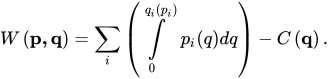
The problem is to maximize by choice of the subject to the requirement that profit equal some fixed value . Typically, the fixed value is zero, which is to say that the regulator wants to maximize welfare subject to the constraint that the firm not lose money. The constraint can be stated generally as:

This problem may be solved using the Lagrange multiplier technique to yield the optimal output values, and backing out the optimal prices. The first order conditions on are

where is a Lagrange multiplier, Ci(q) is the partial derivative of C(q) with respect to qi, evaluated at q, and is the elasticity of demand for good

Dividing by and rearranging yields

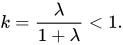
where . That is, the price margin compared to marginal cost for good is again inversely proportional to the elasticity of demand. Note that the Ramsey mark-up is smaller than the ordinary monopoly markup of the Lerner Rule which has , since (the fixed-profit requirement, is non-binding). The Ramsey-price setting monopoly is in a second-best equilibrium, between ordinary monopoly and perfect competition.
Ramsey condition

[edit]

An easier way to solve this problem in a two-output context is the Ramsey condition. According to Ramsey, in order to minimize deadweight losses, one must increase prices to rigid and elastic demands/supplies in the same proportion, in relation to the prices that would be charged at the first-best solution (price equal to marginal cost).

See also

[edit]

References

[edit]
Revisions and contributorsEdit on WikipediaRead on Wikipedia
from Grokipedia
The Ramsey problem, originally formulated by British economist Frank Ramsey in 1927, concerns the optimal design of commodity taxes to raise a fixed amount of while minimizing the resulting to . In this second-best setting, where lump-sum taxation is unavailable, Ramsey demonstrated through first-principles optimization that tax rates should be set inversely proportional to the price elasticities of demand, ensuring greater burdens on inelastic goods to reduce overall distortion. This inverse elasticity rule emerged from solving a constrained welfare maximization problem, balancing needs against consumer surplus losses. The framework has profoundly influenced theory, providing a benchmark for analyzing taxation's efficiency costs and informing policy debates on taxes, such as those on or , where low elasticities justify higher rates to limit substitution effects. Beyond taxation, the Ramsey problem extends to pricing strategies for natural monopolies, such as utilities, where regulators apply Ramsey-Boiteux pricing to set markups over marginal costs inversely to elasticities, allowing recovery of fixed expenses without subsidies while approximating welfare-maximizing outcomes. This application underscores the model's versatility in addressing market failures under decreasing average costs, though implementation challenges arise from estimating elasticities and ensuring for firms. Key characteristics include its reliance on empirical parameters and the assumption of preferences, with extensions incorporating heterogeneity or dynamic elements yielding more nuanced . The rule's enduring significance lies in highlighting trade-offs between equity and , often privileging distortion-minimizing structures over rates, despite critiques that real-world asymmetries, like political constraints, may deviate from pure Ramsey prescriptions.

Historical Context

Frank Ramsey's Original Contributions

In 1927, Frank Plumpton Ramsey, then a 24-year-old fellow of , published "A Contribution to the Theory of Taxation" in The Economic Journal, formulating the foundational problem of optimal commodity taxation under a fixed requirement. Ramsey addressed a government's need to raise a specified sum of without access to lump-sum taxes, seeking to minimize the aggregate welfare loss—conceptualized as the reduction in total from consumers' consumption bundles—imposed by distortive taxes on multiple commodities. He modeled consumers as identical maximizers with quasi-concave functions exhibiting diminishing , incorporating both substitution and effects, and assumed competitive producers facing constant marginal costs unaffected by taxation. The optimization involved maximizing a utilitarian (the sum of individual utilities) subject to the constraint, solved via the method of Lagrange multipliers, yielding a condition that equalizes the marginal per unit of across taxed goods. Ramsey's core insight derived from this setup is the "inverse elasticity rule": optimal tax rates should impose price increases inversely proportional to the own-price elasticities of for each , ensuring that taxes fall more heavily on goods with inelastic to minimize while meeting the target. Mathematically, for the i-th good, the ad valorem tax rate t_i satisfies (p_i (1 + t_i) - c_i)/p_i (1 + t_i) ≈ 1/ε_i (scaled by a constant reflecting the revenue need), where p_i is the consumer price, c_i the marginal production cost, and ε_i the of the elasticity; this holds approximately under small taxes and extends to the exact condition that the weighted sum of marginal utility derivatives equals a times the shortfall. Ramsey demonstrated this through variational , showing that deviations from uniform marginal excess burdens would allow reallocations reducing total sacrifice without violating the constraint. He further noted that if production costs vary or lump-sum taxes are infeasible due to equity or administrative reasons, the rule adapts to account for supply-side distortions, though his primary focus remained demand-side efficiency. This framework anticipated modern second-best theory by explicitly trading off efficiency losses under binding constraints, influencing subsequent developments in despite Ramsey's early death in 1930 at age 26. Ramsey's analysis assumed a static, partial-equilibrium setting with no general equilibrium feedbacks or heterogeneous agents, limitations later addressed but which underscored his pioneering use of for policy design. Empirical applications have validated the rule's directional predictions, such as higher taxes on necessities with low elasticities, though real-world deviations arise from political and informational constraints not modeled by Ramsey.

Development by Marcel Boiteux and Others

Marcel Boiteux, a French economist and president of (EDF), extended Frank Ramsey's 1927 optimal taxation framework to the pricing decisions of regulated public monopolies in the 1950s. Facing industries with decreasing average costs—such as —Boiteux recognized that uniform pricing would generate persistent deficits, as average costs exceed marginal costs. To achieve financial sustainability while minimizing distortions to consumer welfare, he derived a second-best pricing rule where markups over vary inversely with the for each product or service. This adaptation, formalized in Boiteux's 1956 analysis, prioritized welfare maximization subject to a zero-profit constraint, effectively generalizing Ramsey's inverse-elasticity formula from taxation to multi-product monopoly pricing. Boiteux applied these principles directly to EDF's tariff structure, redesigning to balance and needs amid post-World War II reconstruction and efforts. His approach emphasized that deviations from should be smallest for goods with the most elastic demand, thereby concentrating deadweight losses on inelastic segments to approximate first-best outcomes under constraint. This Ramsey-Boiteux rule gained prominence for addressing challenges, influencing regulatory policies in utilities worldwide. Subsequent economists built on Boiteux's framework, incorporating additional constraints like peak-load demand and capacity limits. For instance, Boiteux himself later distinguished peak and off-peak tariffs to optimize intertemporal , laying groundwork for time-of-use rates in sectors. Extensions by William J. Baumol and David F. Bradford in 1970 further refined departures from under conditions, integrating economies of scope and multi-period dynamics. These developments solidified the Ramsey-Boiteux approach as a cornerstone of second-best , emphasizing empirical estimation of elasticities for practical implementation.

Core Concepts

Second-Best Policy Framework

The second-best framework underlying the Ramsey problem arises in scenarios where a public monopoly or regulated firm cannot implement first-best pricing due to decreasing costs, which would generate insufficient to cover total expenses. In such cases, the objective shifts to maximizing social welfare—typically measured as plus surplus—subject to a binding requiring total to equal or exceed total costs. This yields prices that exceed s, with the degree of markup allocated to minimize aggregate across markets. The framework formalizes the trade-off between efficiency and fiscal viability: uniform marginal cost pricing (p_i = MC_i for all i) achieves allocative efficiency by equating marginal benefit to marginal resource cost but incurs losses when average costs exceed marginal costs, as in natural monopolies with high fixed costs. To enforce revenue adequacy, ∑ p_i q_i (p) ≥ C(q), the second-best solution distorts prices inversely to demand elasticities, imposing larger markups on inelastic goods to extract revenue with smaller quantity reductions. This rule, derived from Lagrangian optimization, ensures that the welfare loss per unit of revenue raised is equalized across markets, as proportional deviations from marginal cost weighted by market size sum to a constant determined by the shadow price of the constraint. Empirical implementation in regulatory contexts, such as utilities or transportation, often approximates this by estimating elasticities and setting (p_i - MC_i)/p_i = k / |ε_i|, where k < 1 reflects the constraint's stringency (k=0 under no constraint, k=1 under profit maximization). For instance, in electricity distribution or rail pricing, regulators apply Ramsey principles to balance cross-subsidization across user classes while approximating welfare gains over average cost pricing, though data limitations on elasticities can lead to deviations yielding 10-20% higher welfare losses in simulations. Critics note that assuming separable demands and constant marginal costs oversimplifies real interdependencies, potentially understating risks of Ramsey pricing exacerbating inequality if inelastic demands correlate with low-income groups.

Welfare Maximization Under Constraints

In the Ramsey problem, social welfare is defined as the aggregate consumer surplus across multiple goods or services minus the total production costs, where consumer surplus for each good ii is the integral of the inverse demand function from zero to the quantity consumed qiq_i. This formulation captures the total economic value derived by consumers net of costs, assuming no producer profits under the break-even condition. The core challenge arises in industries with decreasing average costs, such as natural monopolies in utilities or transport, where setting prices equal to marginal costs fails to cover total costs, leading to financial deficits without external subsidies. To address this, the welfare maximization problem incorporates a binding budget constraint requiring total revenue to equal total costs, precluding lump-sum transfers or subsidies. This second-best approach deviates from first-best marginal cost pricing to minimize deadweight losses while ensuring financial viability. Optimization under this constraint yields prices where the markup over marginal cost for each good is inversely proportional to its own-price elasticity of demand: specifically, piMCipi=kϵi\frac{p_i - MC_i}{p_i} = \frac{k}{|\epsilon_i|}, with kk a uniform constant less than 1 across goods, ensuring equalized marginal welfare losses per unit of revenue raised. Less elastic demands bear higher relative markups, as quantity reductions (and thus deadweight losses) are smaller there compared to elastic markets. This rule, derived from Lagrangian conditions, balances the trade-off between allocative efficiency and revenue recovery. Empirical applications in regulated sectors, such as electricity or railways, implement this by grouping services into baskets and applying elasticity-based differentials, though practical challenges include data requirements for elasticities and potential equity concerns from price discrimination. Regulators often constrain full Ramsey implementation to competitive subsets to avoid excessive distortions.

Formal Model

Model Assumptions and Setup

The Ramsey-Boiteux model, as applied to optimal pricing, considers a multiproduct firm producing NN commodities, where the firm faces downward-sloping demand curves for each good i=1,,Ni = 1, \dots, N. Demand is typically modeled as qi=qi(pi)q_i = q_i(p_i), assuming independence across goods (i.e., zero cross-price elasticities) to simplify analysis and focus on own-price effects, though extensions allow for interdependence. The firm operates under a budget constraint requiring revenues to cover total costs, reflecting scenarios like natural monopolies with decreasing average costs where marginal cost pricing yields losses. Total costs are captured by a function C(q)=C(q1,q2,,qN)C(\mathbf{q}) = C(q_1, q_2, \dots, q_N), which may exhibit economies of scale or scope due to fixed or joint production costs. Revenues are given by R(p,q)=i=1Npiqi(pi)R(\mathbf{p}, \mathbf{q}) = \sum_{i=1}^N p_i q_i(p_i), with p=(p1,,pN)\mathbf{p} = (p_1, \dots, p_N) denoting the price vector. The model assumes a static, single-period framework with full information about demands and costs, and no entry by competitors, justifying the focus on second-best pricing to balance efficiency and financial viability. Social welfare is defined as the sum of consumer surpluses minus total costs, W(p,q)=i(0qi(pi)pi(q)dq)C(q)W(\mathbf{p}, \mathbf{q}) = \sum_i \left( \int_0^{q_i(p_i)} p_i(q) \, dq \right) - C(\mathbf{q}), where pi(q)p_i(q) is the inverse demand function. The firm (or regulator) maximizes WW subject to the break-even constraint R(p,q)=C(q)R(\mathbf{p}, \mathbf{q}) = C(\mathbf{q}), prioritizing goods with lower demand elasticities for higher markups to minimize deadweight loss. This setup abstracts from dynamic considerations, income effects, or evasion, assuming quasi-linear preferences to ensure welfare additivity across consumers.

Optimization Problem Formulation

The Ramsey pricing problem is formulated as an optimization task for a multi-product firm facing decreasing average costs, where marginal cost pricing fails to generate sufficient revenue to cover total costs. The objective is to select prices p=(p1,,pN)\mathbf{p} = (p_1, \dots, p_N) that maximize total social welfare, defined as the sum of consumer surplus across commodities plus producer surplus net of production costs. Consumer surplus for commodity ii is captured by the integral of the inverse demand function from zero to the chosen quantity qiq_i, yielding the welfare function W(p,q)=i(0qi(pi)pi(q)dq)C(q)W(\mathbf{p}, \mathbf{q}) = \sum_i \left( \int_0^{q_i(p_i)} p_i(q) \, dq \right) - C(\mathbf{q}), where qi(pi)q_i(p_i) denotes the demand for commodity ii as a function of its own price pip_i, pi(q)p_i(q) is the inverse demand, and C(q)C(\mathbf{q}) is the total cost function depending on the vector of quantities q=(q1,,qN)\mathbf{q} = (q_1, \dots, q_N). This maximization is subject to the break-even constraint that total revenue equals total cost: R(p,q)=ipiqi(pi)=C(q)R(\mathbf{p}, \mathbf{q}) = \sum_i p_i q_i(p_i) = C(\mathbf{q}), ensuring financial viability without subsidies or cross-subsidization beyond what is necessary to recover fixed and common costs. The standard setup assumes independent demands across commodities (qiq_i depends only on pip_i), separable or additively joint costs, and convex demand functions to guarantee interior solutions and uniqueness. These assumptions simplify the second-best problem arising from the inability to achieve first-best marginal cost pricing, focusing welfare losses on distortions inversely related to demand elasticities. The Lagrangian incorporates a multiplier λ0\lambda \geq 0 for the revenue constraint, leading to first-order conditions that equate the marginal welfare gain from price adjustments to the shadow cost of the budget restriction. This setup, originally analogous to Ramsey's 1927 taxation problem and extended to pricing by Boiteux in 1956, prioritizes minimizing deadweight loss under the binding financial constraint rather than profit maximization. Empirical implementations require estimating demand elasticities and cost structures, with deviations from uniformity in markups reflecting elasticity differences.

Solution and Key Results

Derivation of the Ramsey Rule

The Ramsey rule emerges from the optimization of social welfare subject to a binding revenue constraint that ensures costs are covered, typically in the context of a multiproduct firm with non-constant marginal costs or fixed costs. Consider a firm producing NN goods with independent demands qi=qi(pi)q_i = q_i(p_i) and a total cost function C(q)C(\mathbf{q}), where q=(q1,,qN)\mathbf{q} = (q_1, \dots, q_N). Social welfare is the aggregate consumer surplus net of production costs:

Revenue is R(p,q)=ipiqi(pi)R(\mathbf{p}, \mathbf{q}) = \sum_i p_i q_i(p_i). The problem maximizes WW subject to RC0R - C \geq 0, with the constraint binding at the optimum due to subadditivity of costs in natural monopoly settings.
The Lagrangian is L=W+λ(RC)\mathcal{L} = W + \lambda (R - C), where λ>0\lambda > 0 is the shadow price of the constraint. First-order conditions with respect to each qiq_i (treating inverse demands pi(qi)p_i(q_i)) yield:
Lqi=piMCi+λ(RqiMCi)=0,\frac{\partial \mathcal{L}}{\partial q_i} = p_i - MC_i + \lambda \left( \frac{\partial R}{\partial q_i} - MC_i \right) = 0,
where MCi=C/qiMC_i = \partial C / \partial q_i. The derivative is R/qi=pi(11/εi)\partial R / \partial q_i = p_i (1 - 1/\varepsilon_i), with own-price elasticity εi=(qi/pi)(pi/qi)<0\varepsilon_i = - (\partial q_i / \partial p_i) (p_i / q_i) < 0. Substituting gives:

This equates the welfare gain from expanded output (piMCip_i - MC_i) to the shadow cost adjusted for effects.
Rearranging the condition:
piMCi=λ[pi(11εi)MCi].p_i - MC_i = -\lambda \left[ p_i \left(1 - \frac{1}{\varepsilon_i}\right) - MC_i \right].
Solving for the markup:
(piMCi)(1+λ)=λpiεi,(p_i - MC_i)(1 + \lambda) = \lambda \frac{p_i}{|\varepsilon_i|},
piMCipi=λ/(1+λ)εi.\frac{p_i - MC_i}{p_i} = \frac{\lambda /(1 + \lambda)}{|\varepsilon_i|}.
Let k=λ/(1+λ)(0,1)k = \lambda / (1 + \lambda) \in (0,1), yielding the Ramsey rule: prices exceed marginal cost inversely with demand elasticity, with uniform kk across goods to minimize deadweight loss for given revenue needs. As λ\lambda \to \infty (strong constraint), k1k \to 1, recovering the unregulated monopoly (piMCi)/pi=1/εi(p_i - MC_i)/p_i = 1/|\varepsilon_i|.

This form parallels Ramsey's 1927 optimal taxation result, where excise taxes distort less elastic goods more to raise revenue efficiently; Boiteux (1956) adapted it to peak-load pricing for utilities, emphasizing welfare under capacity constraints.

Interpretation of the Ramsey Condition

The Ramsey condition specifies that, in the optimal second-best pricing solution, the relative markup over marginal cost for each product ii is inversely proportional to the absolute value of its own-price elasticity of demand ϵi\epsilon_i, expressed as piCi(q)pi=kϵi\frac{p_i - C_i(\mathbf{q})}{p_i} = \frac{k}{|\epsilon_i|}, where k=λ1+λ<1k = \frac{\lambda}{1+\lambda} < 1 and λ\lambda is the Lagrange multiplier reflecting the stringency of the revenue or profit constraint. This formulation arises from the welfare-maximizing optimization under the constraint that total revenue must cover costs, ensuring that deviations from marginal cost pricing are calibrated to minimize aggregate deadweight loss. Economically, this implies that prices should exceed marginal costs by larger margins for goods with more inelastic demand, as consumers of such goods are less responsive to price increases, resulting in smaller reductions in quantity demanded and thus lower efficiency losses compared to distorting elastic markets. For instance, in a multi-product firm facing a break-even requirement, the condition allocates the burden of fixed cost recovery primarily to inelastic demand segments, preserving allocative efficiency in competitive or elastic areas where price sensitivity is high. The constant kk scales the markups uniformly across products, with kk approaching zero under relaxed constraints (yielding marginal cost pricing) and kk approaching one under tight constraints akin to unconstrained monopoly pricing, where λ\lambda \to \infty. This interpretation underscores the Ramsey rule's role in balancing revenue needs against welfare costs in constrained environments, such as regulated natural monopolies, by exploiting differences in demand elasticities to approximate first-best outcomes without lump-sum transfers. Empirical applications, like utility regulation, demonstrate that implementing higher markups on inelastic services (e.g., basic residential electricity) relative to elastic ones (e.g., industrial off-peak usage) reduces overall distortion, though measurement of elasticities remains challenging and influences practical outcomes. The rule's derivation from Pareto second-best theory highlights its focus on minimizing the marginal welfare loss per unit of revenue raised, prioritizing causal impacts on surplus over uniform pricing.

Applications and Empirical Relevance

Public Utility Regulation

The Ramsey pricing framework addresses the challenge of regulating natural monopolies in public utilities, such as electricity, natural gas, and telecommunications, where decreasing average costs make marginal cost pricing unsustainable without subsidies, as it fails to recover fixed infrastructure expenses. By maximizing consumer surplus subject to a zero-profit constraint, Ramsey prices set markups over marginal cost inversely proportional to the absolute value of demand elasticity, ensuring efficient resource allocation while enabling cost recovery: higher markups apply to inelastic markets (e.g., essential residential services) and lower ones to elastic markets (e.g., large industrial users). This second-best approach minimizes deadweight loss compared to uniform pricing or average cost pricing, which can exacerbate inefficiencies. The methodology originated from Ramsey's 1927 taxation analysis but was adapted for utilities by Marcel Boiteux in 1956, who applied it to optimize pricing for amid post-war capacity constraints and the need to balance welfare with financial viability. Boiteux demonstrated that under decreasing costs, optimal prices satisfy the condition where the relative deviation from marginal cost equals a constant divided by elasticity: piMCipi=kϵi\frac{p_i - MC_i}{p_i} = \frac{k}{|\epsilon_i|}, with k<1k < 1 scaling the uniform markup factor across products to meet the revenue requirement. This rule has informed regulatory practices globally, including U.S. state public utility commissions for electric rate design and peak-load pricing to reflect capacity costs without explicit subsidies. Empirical applications reveal mixed adherence, often constrained by data limitations on elasticities and costs, as well as political pressures favoring equity over pure efficiency. In U.S. electric utilities, studies of residential, commercial, and industrial classes found prices partially aligning with inverse elasticity weighting, though deviations occur due to cross-subsidies or regulatory capture favoring large customers. Japanese electric utilities, analyzed via translog cost and demand functions from 1965–1978 data, showed pricing closer to Ramsey optima than simple average cost rules, supporting welfare gains from elasticity-based discrimination. A 1982 test across U.S. utilities compared Ramsey predictions to Stigler-Peltzman's capture theory, finding modest empirical support for efficiency motives over interest-group influence, with elasticities explaining about 20–30% of price variance in some sectors. Implementation challenges include estimating multi-product cost functions and elasticities accurately, as regulators rely on utility-provided data prone to strategic bias, and the rule assumes no arbitrage or entry, which deregulation (e.g., U.S. telecom post-1996) has undermined. Nonetheless, Ramsey principles underpin modern tools like revenue decoupling in utility ratemaking, decoupling fixed cost recovery from sales volumes to encourage efficiency, as adopted by over 20 U.S. states by 2015 for electric and gas providers. In practice, hybrids with Ramsey elements balance efficiency against affordability mandates, such as California's 1980s experiments with time-of-use rates reflecting peak elasticities.

Transportation and Infrastructure Pricing

Ramsey pricing principles have been applied to transportation sectors characterized by high fixed costs and natural monopoly elements, such as railways, airports, and public transit systems, where marginal cost pricing alone fails to cover total expenses. In these contexts, regulators or operators set prices to maximize social welfare subject to a breakeven constraint, resulting in markups over marginal costs that are inversely proportional to demand elasticities—higher for inelastic segments like peak-hour travel to minimize deadweight loss. In railway passenger transport, empirical studies of European systems reveal that peak-hour pricing often approximates Ramsey optimality, with fares incorporating markups to recover infrastructure costs while off-peak prices remain closer to marginal costs due to higher elasticities. For example, analysis of fare structures post-deregulation in countries like the UK and France shows ex post Ramsey coefficients confirming welfare-maximizing intent during peaks, though practical deviations occur due to competitive pressures and political constraints. In the United States, Interstate Commerce Commission decisions on coal rail transport in the 1980s referenced Ramsey-like rules to balance revenue needs across routes, though full implementation was limited by legal and operational challenges. Airport infrastructure pricing provides another application, particularly for aeronautical charges at uncongested facilities. Research on German airports from 2000–2010 found that landing fees and passenger charges partially followed Ramsey patterns, with lower markups on elastic cargo traffic and higher on inelastic short-haul passenger segments to meet revenue requirements without excessive welfare loss. Extensions incorporating environmental externalities, such as CO2 emissions, adjust Ramsey weights to internalize costs, as modeled for airport networks where emissions elasticity influences differential pricing across flight types. For public urban transit, Ramsey pricing informs peak-load strategies to allocate capacity costs efficiently. An empirical model for urban systems, calibrated with data from U.S. cities, demonstrates that optimal Ramsey prices reduce peak fares relative to uniform pricing but still exceed marginal costs by amounts scaled to elasticities, yielding welfare gains of 10–20% over average-cost pricing in simulations. In Stockholm's congestion-charging and transit system, post-2006 implementation data indicate that variable transit fares align with Ramsey logic by imposing higher peak penalties on inelastic commuters, contributing to reduced peak demand by up to 15% while funding infrastructure expansions. Road and highway infrastructure applications are more nuanced, often blending Ramsey with congestion externalities. Where revenue constraints bind, as in toll-financed highways, the Ramsey rule supports time- or route-differentiated tolls with markups on inelastic long-haul traffic to subsidize elastic short trips, deviating from pure marginal social cost pricing. However, empirical implementations, such as U.S. interstate toll proposals in the 1990s, rarely achieve full Ramsey efficiency due to equity concerns and administrative costs, with studies showing hybrid schemes recovering 70–90% of optimal welfare under budget limits. Overall, while theoretical appeal persists, real-world adoption in transportation infrastructure is tempered by data limitations on elasticities and institutional biases toward uniform pricing.

Modern Policy Implementations

In regulated freight rail markets, Ramsey pricing principles have informed rate-setting to balance revenue recovery with allocative efficiency. A 2024 study of Canadian interswitching rates—short-haul access fees mandated by the Canadian Transportation Agency to foster competition—found these rates closely approximate Ramsey-optimal levels, with markups inversely related to estimated demand elasticities for captive versus competitive shipments, yielding potential welfare gains from reduced distortions. This approach aligns with the inverse elasticity rule by imposing higher charges on less elastic shippers, such as bulk commodity haulers, while lowering barriers for elastic traffic. In U.S. telecommunications regulation, the (FCC) has applied Ramsey analysis to interconnection and access pricing under revenue constraints. For instance, in 2001 proceedings on non-price cap services, the FCC invoked Ramsey rules to justify deviations from marginal cost pricing, setting uniform percentage markups above costs proportional to inverse elasticities to minimize deadweight loss while meeting universal service obligations. Similar considerations appear in later FCC orders on special access rates, where elasticity-based adjustments ensure second-best efficiency in bottleneck facilities like local loops. Energy sector implementations often blend Ramsey elements with competitive mechanisms, as pure application requires monopoly conditions rarely present post-liberalization. In Italy's day-ahead electricity market, zonal pricing since the early 2000s incorporates elasticity estimates to set higher tariffs in low-elasticity peak hours and regions, approximating Ramsey outcomes for transmission-constrained systems while recovering fixed infrastructure costs. However, empirical deviations arise from incomplete elasticity data and political pressures favoring uniform rates, limiting full adherence. Challenges in modern adoption include data demands and equity concerns, as Ramsey markups burden inelastic users (e.g., residential or essential services) disproportionately, prompting regulators to hybridize with subsidies or caps. Despite this, revenue-cap regimes in the EU and UK utilities indirectly emulate inverse elasticity pricing by constraining baskets of services, fostering Ramsey-like incentives under profit constraints.

Criticisms and Limitations

Theoretical Assumptions and Their Implications

The Ramsey pricing model rests on the premise of a multiproduct firm operating as a natural monopoly, where subadditive costs imply that average costs decline over the relevant output range, precluding efficient competition and necessitating regulation to prevent monopoly exploitation. The core optimization assumes the regulator maximizes total social welfare—defined as the sum of consumer surplus across markets and producer surplus—subject to a zero-profit constraint, requiring revenues to exactly cover total costs without external subsidies. This second-best framework arises because first-best marginal cost pricing would yield losses due to fixed or common costs, rendering it infeasible absent lump-sum transfers, which are politically or administratively constrained. Key simplifying assumptions include downward-sloping, independent demand functions across products (zero cross-price elasticities), ensuring distortions in one market do not directly spill over, and a differentiable, convex cost function exhibiting natural monopoly characteristics. The model is static, ignoring intertemporal dynamics, uncertainty, or entry incentives, and presumes perfect information with no agency problems between regulator and firm. These elements facilitate derivation of the Ramsey rule via Lagrangian optimization, yielding prices where the markup over marginal cost, expressed as (piMCi)/pi=k/ϵi(p_i - MC_i)/p_i = k / |\epsilon_i| with k<1k < 1 as a uniform markup factor and ϵi\epsilon_i the own-price elasticity, inversely proportional to demand elasticity. The implications underscore efficiency trade-offs: inelastic goods bear higher markups to recover infra-marginal rents with minimal deadweight loss, as quantity reductions are smaller relative to elastic goods, where prices stay closer to marginal cost to preserve allocative efficiency. This rule minimizes aggregate welfare loss under the budget constraint but introduces systematic distortions, with total deadweight loss scaling with the fixed cost burden and elasticity dispersion—greater uniformity in elasticities reduces inefficiency. Relaxing independence yields generalized Ramsey-Boiteux conditions involving cross-elasticity adjustments, potentially amplifying distortions if complements or substitutes exist, as seen in multi-market utilities. The no-subsidy assumption implies inherent second-best inefficiency versus Pareto optimality, vulnerable to regulatory capture or misestimation of elasticities, while the static setup overlooks dynamic incentives like capacity investment or technological adaptation. Empirical applications, such as telecommunications or electricity, often approximate these under data constraints, but violations (e.g., unobserved cross-effects) can lead to suboptimal pricing, as evidenced in regulatory disputes over cost allocation.

Empirical and Practical Challenges

One major empirical challenge in applying Ramsey pricing lies in the accurate estimation of demand elasticities, particularly cross-price elasticities across multiple products, which demands extensive and high-quality data that is often unavailable or unreliable in regulated industries. Econometric estimation is complicated by multicollinearity, endogeneity from historical pricing distortions, and the need for dynamic models to capture intertemporal substitution, leading to sensitivity in computed optimal prices to small parametric changes. Robust estimation techniques have been proposed to address this fragility, but they still require assumptions about firm cost structures and consumer behavior that may not hold empirically. Equity considerations pose significant practical barriers, as Ramsey optimal prices typically impose larger markups on services with inelastic demand—often necessities like basic utilities consumed more heavily by lower-income groups—potentially exacerbating affordability issues and conflicting with social welfare objectives beyond pure efficiency. Regulators frequently mitigate this by capping prices on essential services or phasing in adjustments gradually, deviating from the theoretical rule and reducing deadweight loss minimization benefits. Public perception of such differential pricing as unfair discrimination further hinders adoption, prompting reliance on simpler uniform or average-cost approaches despite their inefficiency. Implementation is further complicated in partially competitive markets, where firms may not adhere to Ramsey prices unless all product markets exhibit uniform competitive intensity; otherwise, profit maximizers discriminate against less contestable segments, necessitating regulatory segmentation into comparable baskets for selective application. In sectors like telecommunications, authorities such as have cited practical and conceptual difficulties, including challenges in modeling joint cost allocation and ensuring incentive compatibility, leading to avoidance of full Ramsey rules for charges like mobile termination rates. Empirical tests, such as analyses of electric utilities in Japan, reveal mixed alignment between observed prices and Ramsey predictions, underscoring data limitations and institutional constraints in verification. Applications to railroads have similarly demonstrated impractical rate structures due to volatility and regulatory infeasibility.

Alternative Approaches and Debates

One prominent alternative to Ramsey pricing is marginal cost pricing, which sets prices equal to the marginal cost of production for each good or service, achieving first-best allocative efficiency by eliminating deadweight loss but typically failing to recover fixed costs in natural monopolies, necessitating subsidies or alternative revenue sources. In contrast, fully distributed cost (FDC) pricing allocates fixed and variable costs across services based on historical or embedded costs, often resulting in higher prices for all users and greater deadweight loss compared to Ramsey methods, though it ensures cost recovery without requiring precise elasticity estimates. Two-part tariffs represent another approach, combining a fixed access fee to cover fixed costs with variable usage fees at marginal cost, which can approximate first-best outcomes under uniform demand but requires knowledge of consumer participation and may exclude low-usage or low-income users if the fixed fee is too high. Nonlinear pricing schemes, such as menu-based tariffs offering quantity discounts, extend this by allowing self-selection among consumer types, potentially improving efficiency over uniform Ramsey prices when demand heterogeneity is significant. Debates surrounding Ramsey pricing center on its theoretical optimality under strict assumptions—such as perfect information on demand elasticities, no income effects, and static conditions—versus practical limitations in regulatory settings. Critics argue that the inverse elasticity rule, by imposing higher markups on inelastic demands (often essential services for vulnerable populations), exacerbates inequities, prioritizing efficiency over distributional concerns absent explicit equity weights in the social welfare function. Empirical challenges include the difficulty of accurately estimating elasticities, leading to proposals for "robust" Ramsey variants that incorporate uncertainty or discrete choice models to mitigate sensitivity to parameter errors, as demonstrated in applications to postal services where small elasticity changes significantly alter prices. In multi-product firms with competitive segments, debates question whether Ramsey remains viable, with some advocating hybrid rules like efficient pricing with marketable units (EPMU) to avoid cross-subsidization distortions when unregulated rivals erode market share. Further contention arises in dynamic contexts, such as bypass threats from alternative providers, where strategic Ramsey adjustments may invite regulatory capture or inefficient infrastructure duplication, underscoring the rule's vulnerability to incomplete contracting and enforcement issues.

Multi-Product and Dynamic Extensions

The Ramsey pricing framework extends to multi-product firms producing N goods under a single budget constraint, such as covering fixed costs in a natural monopoly. In this generalization, the firm maximizes social welfare—defined as consumer surplus plus producer surplus—subject to the constraint that total revenue equals total costs, R(\mathbf{p}, \mathbf{q}) = C(\mathbf{q}), where \mathbf{p} and \mathbf{q} are vectors of prices and quantities, demands are q_i = q_i(p_i, \mathbf{p}_{-i}), and marginal costs C_i(\mathbf{q}) may reflect joint production. The first-order conditions yield the multi-product Ramsey rule: for each good i, where k = \lambda / (1 + \lambda) < 1, \lambda > 0 is the shadow price of the budget constraint, and Elasticity_i = -\frac{\partial q_i}{\partial p_i} \frac{p_i}{q_i} is the own-price elasticity of demand (absolute value). This implies markups are inversely proportional to elasticities, with less elastic goods bearing higher markups to minimize aggregate while satisfying the constraint. When demands exhibit cross-price effects or costs are strongly , the rule incorporates interaction terms: the full condition is p_i - C_i(\mathbf{q}) = -\lambda \left( p_i \left(1 - \frac{1}{Elasticity_i}\right) - C_i(\mathbf{q}) \right), derived from Lagrangian optimization, ensuring deviations from pricing are uniform in welfare impact across products. Empirical implementations, such as in , approximate this by estimating elasticities and allocating common s proportionally, though challenges arise from unobservable joint cost derivatives and strategic firm behavior under asymmetric . Dynamic extensions incorporate time, treating periods as "products" with intertemporal linkages, such as capacity investments or lagged responses. In peak-load pricing, a Boiteux-inspired model for utilities, prices vary by time to ration fixed capacity: off-peak prices approximate , while peak prices include rents scaled by relative elasticities, maximizing welfare under capacity constraints across periods. More general dynamic Ramsey models use , where the effective markup parameter can fall below the static Ramsey number (unity for welfare maximization), allowing prices closer to in profit-maximizing settings due to forward-looking and . For instance, (1985) shows that for a monopolist with dynamic , observed -based Ramsey indices may be less than one, reflecting intertemporal substitution. Applications include time-of-use tariffs in markets, where dynamic rules balance short-run with long-run investment incentives.

Connections to Optimal Taxation and Growth Models

The Ramsey pricing framework, originally derived for welfare maximization under a in regulated industries, shares a direct mathematical with optimal commodity taxation as formulated by Frank Ramsey in 1927. In the taxation context, the government seeks to raise a fixed amount while minimizing to consumer surplus; the solution prescribes that rates on commodities should be inversely proportional to the absolute value of their elasticities, ensuring that distortions are concentrated on goods with more elastic demands to preserve efficiency. This inverse elasticity rule emerges from the first-order conditions of the Lagrangian, where the marginal excess burden per unit of is equalized across taxed goods. Similarly, in Ramsey pricing, a multiproduct monopolist (or regulator) sets prices above marginal costs such that the markup (pici)/pi(p_i - c_i)/p_i equals a constant divided by the elasticity for good ii, as depicted in the pricing optimality condition. The holds because both problems involve : taxation treats taxes as wedges minimizing welfare loss for given , while pricing treats price markups as analogous wedges maximizing welfare (or producer surplus) subject to covering fixed costs. Empirical applications in taxation, such as design in developing economies, have invoked this rule to justify differentiating rates by elasticity estimates, though real-world deviations arise from administrative constraints and equity considerations not central to the pure Ramsey setup. Extensions of the Ramsey problem to dynamic settings further link it to optimal growth models, particularly the Ramsey-Cass-Koopmans (RCK) framework, which applies Ramsey's calculus-of-variations method to intertemporal . In the RCK model, a representative agent optimizes consumption and over infinite horizons to maximize subject to a constraint with exogenous technological progress, yielding Euler equations that determine the steady-state capital stock and growth path. This mirrors dynamic Ramsey in multi-period , where prices are set over time to balance current welfare against future capacity investments, effectively incorporating growth-like capital dynamics under uncertainty. For instance, in models with endogenous , the Ramsey rule generalizes to time-varying markups that account for intertemporal elasticities, akin to how RCK adjusts savings rates endogenously rather than assuming exogenous ones as in Solow growth. Such connections have informed analyses, like optimal tolling on growing transportation networks, where long-run growth rates influence the shadow value of constraints, though empirical reveals sensitivity to discount rates and elasticity assumptions derived from historical data. Critics note that both taxation and growth applications assume lump-sum feasibility for certain distortions, which real fiscal systems undermine through evasion or factors.

References

Add your contribution
Related Hubs
User Avatar
No comments yet.
