


Community hub
Recent from talks
Contribute something
Nothing was collected or created yet.
Ravenala
View on Wikipedia
| Ravenala | |
|---|---|

| |
| Ravenala madagascariensis | |
Scientific classification 
| |
| Kingdom: | Plantae |
| Clade: | Tracheophytes |
| Clade: | Angiosperms |
| Clade: | Monocots |
| Clade: | Commelinids |
| Order: | Zingiberales |
| Family: | Strelitziaceae |
| Genus: | Ravenala Adans. |
| Synonyms | |
| |
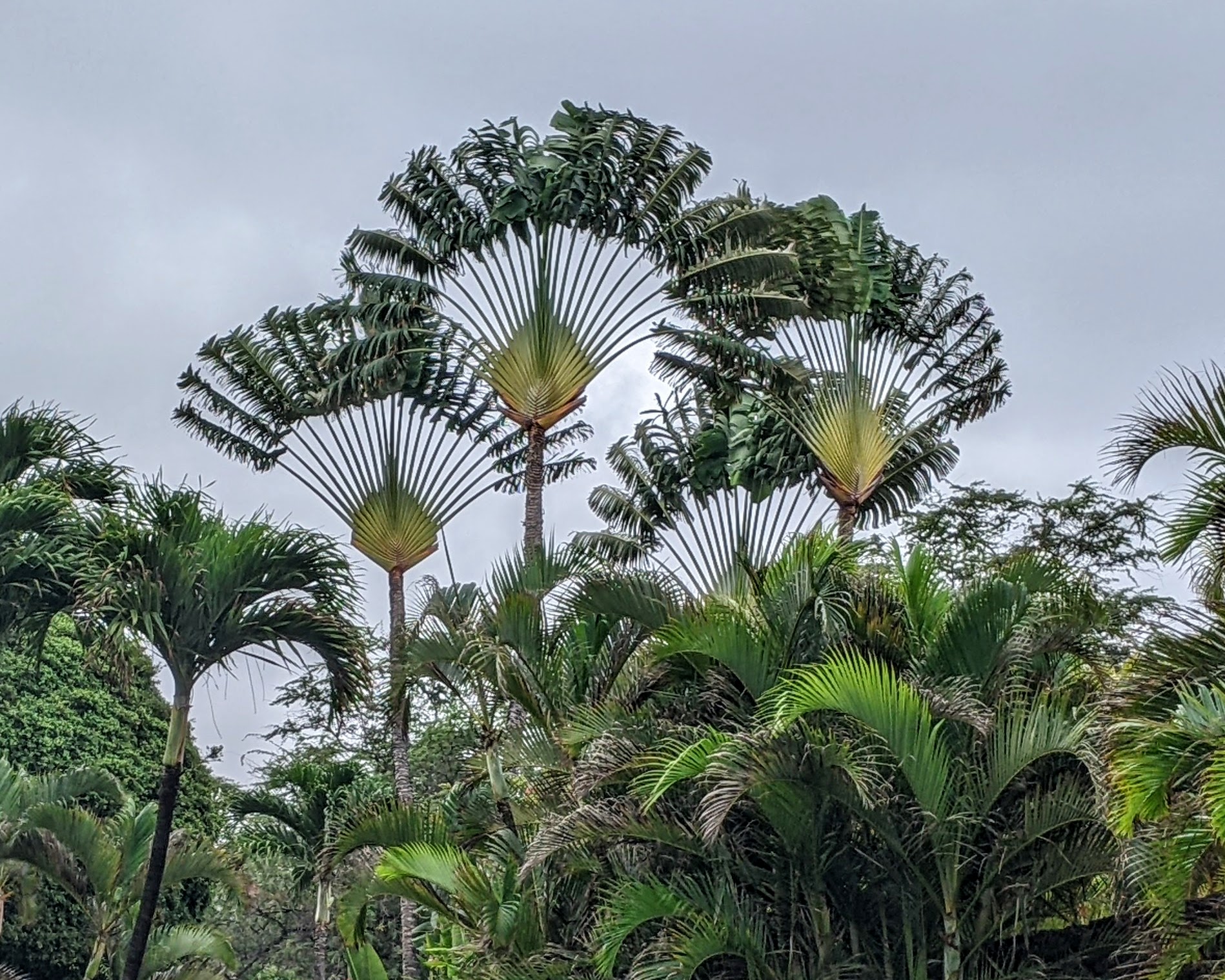
Ravenala is a genus of monocotyledonous flowering plants in the Strelitziaceae plant family.[1] Classically, the genus was considered to include a single species, Ravenala madagascariensis from Madagascar.
Taxonomy
[edit]Species of the genus Ravenala are not true palms (family Arecaceae) but members of the family Strelitziaceae. The genus is closely related to the southern African genus Strelitzia and the South American genus Phenakospermum. Some older classifications include these genera in the banana family (Musaceae).
Etymology
[edit]The scientific name Ravenala comes from Malagasy ravinala or ravina ala meaning "forest leaves".[2][3]
Species
[edit]Although formerly considered to be monotypic, four different forms have been distinguished.[4][5] Five new species were described in 2021, all from Madagascar.[6] The following species are currently recognised in the genus Ravenala:[7]
- Ravenala agatheae Haev. & Razanats.
- Ravenala blancii Haev., Jeannoda & Hladik
- Ravenala grandis Haev., Razanats., Hladik & P.Blanc
- Ravenala hladikorum Haev., Razanats., Jeannoda & P.Blanc
- Ravenala madagascariensis Sonn.
- Ravenala menahirana Haev. & Razanats.
References
[edit]- ^ "Ravenala Adans. | Plants of the World Online | Kew Science". Plants of the World Online. Retrieved 2025-10-20.
- ^ Boiteau, Pierre (1997). "reniala". Dictionnaire des noms malgaches de végétaux (in French). Vol. III. Editions Alzieu. Archived from the original on 2022-09-20. Retrieved 2022-09-17 – via Malagasy Dictionary and Encyclopedia of Madagascar.
de ravina : feuille, et ala : forêt...
- ^ Sargent, Charles Sprague (July 19, 1893). "Musa and Allied Genera". Garden and Forest: A Journal of Horticulture, Landscape Art and Forestry. 6 (282). Garden and Forest Publishing Company: 306.
- ^ Patrick Blanc; Nelson Rabenandrianina; Annette Hladik & Claude Marcel Hladik (1999). "Les formes sympatriques et allopatriques du genre Ravenala dans les forêts et les milieux ouverts de l'est de Madagascar". Revue d'Écologie, Terre et Vie. 54 (3): 201–223. doi:10.3406/revec.1999.2292. S2CID 163071446.
- ^ P. Blanc; A. Hladik; N. Rabenandrianina; J.S. Robert; C.M. Hladik (2003). "Strelitziaceae: The variants of Ravenala in natural and anthropogenic habitats". In Goodman, S.M.; Benstead, J. (eds.). The Natural History of Madagascar (PDF). The University of Chicago Press, Chicago & London. pp. 472–476.
- ^ Haevermans, Thomas; Hladik, Annette; Hladik, Claude-Marcel; Razanatsoa, Jacqueline; Haevermans, Agathe; Jeannoda, Vololoniaina; Blanc, Patrick (2021-11-09). "Description of five new species of the Madagascan flagship plant genus Ravenala (Strelitziaceae)". Scientific Reports. 11 (1). Springer Science and Business Media LLC: 21965. Bibcode:2021NatSR..1121965H. doi:10.1038/s41598-021-01161-1. ISSN 2045-2322. PMC 8578647. PMID 34753985.

- ^ "Ravenala Adans. | Plants of the World Online | Kew Science". Plants of the World Online. Retrieved 2024-02-22.

External links
[edit]
Ravenala
View on GrokipediaTaxonomy and Classification
Etymology
The genus name Ravenala derives from the Malagasy word ravinala (or ravenala), meaning "forest leaves," a reference to the plant's prominent, expansive foliage resembling that of forest trees.[5] This name was established by the French botanist Michel Adanson in his 1763 publication Familles des Plantes, where he described the taxon based on specimens from Madagascar, though the description was later deemed invalid under modern nomenclatural rules due to its brevity and lack of formal diagnosis.[6] Adanson's initial classification reflected confusion with true palms (family Arecaceae), stemming from the plant's tall, unbranched trunk and fan-like leaf arrangement, despite its actual placement in the unrelated family Strelitziaceae.[7] Common names such as "traveller's palm" or "traveller's tree" arose from a longstanding notion among explorers and colonists that rainwater accumulating in the leaf sheaths could provide an emergency drinking source for wayfarers in Madagascar's forests.[2] These vernacular names persist in horticultural and popular contexts, emphasizing the plant's iconic, utilitarian image rather than botanical accuracy.[8]Phylogenetic Relationships
Ravenala is classified within the kingdom Plantae, phylum Tracheophyta, class Magnoliopsida, superorder Lilianae (monocots), order Zingiberales, and family Strelitziaceae.[9] This placement reflects its monocotyledonous nature and shared characteristics with other tropical flowering plants in the Zingiberales, such as large, banana-like leaves and bird-pollinated flowers.[10] The genus Ravenala is closely related to Strelitzia (bird-of-paradise plants, native to southern Africa) and Phenakospermum (a monotypic genus from tropical South America east of the Andes), forming the core of the Strelitziaceae family. Phylogenetic analyses indicate equivocal relationships among these genera, with two main hypotheses: either Strelitzia as sister to a clade of Ravenala + Phenakospermum, or Ravenala basal to the remaining Strelitziaceae.[11] This disjunct distribution across Madagascar, Africa, and South America suggests a Gondwanan origin for the family, though molecular dating points to post-Gondwanan dispersal events shaping its current pantropical pattern.[12] Historically, Ravenala has been subject to classification debates, with early synonyms including Urania Schreb. (e.g., Urania madagascariensis) and alternative names like Heliconia ravenala, reflecting uncertainties in distinguishing it from related genera in Musaceae or Heliconiaceae.[10] These debates centered on nomenclatural validity, ultimately resolved in favor of Adanson's Ravenala over Scopoli's Ravenalla, and on its familial placement, now firmly established in Strelitziaceae based on morphological and molecular distinctions from banana relatives like Musa.[6][13] Molecular evidence from plastid and nuclear sequence data supports the monophyly of Ravenala within Strelitziaceae, particularly following the recent recognition of multiple species from a previously monotypic genus, with stable morphological synapomorphies like distichous leaf arrangement and suckering habits reinforcing clade integrity.[11] A 2021 morphological revision confirmed this monophyly across the expanded species complex, aligning with broader Zingiberales phylogenies that highlight Ravenala's basal position in the family.[6]Accepted Species
The genus Ravenala was long considered monotypic, comprising only R. madagascariensis, until a 2021 taxonomic revision by Haevermans et al. based on morphological and genetic analyses recognized six distinct species, all endemic to Madagascar.[6] This revision delimited R. madagascariensis to coastal populations and described five new species differentiated by traits such as growth habit (suckering versus solitary), petiole coloration, leaf arrangement, flowering phenology, and fruit morphology.[6] The accepted species are as follows:- Ravenala madagascariensis (type species): Reaches 6–12 m in height, features suckering habit with greenish-yellow petioles and lax infructescences, and flowers year-round; distributed along the eastern coast at sea level in swampy areas.[6]
- Ravenala agatheae: Grows to 6–10 m, suckering with tricolored petioles (including purple bract stripes) and compact infructescences, flowering at year's end; found in northwestern Madagascar at low elevations.[6]
- Ravenala blancii: Attains 10–15 m, solitary with toroidal juvenile laminae and decurrent bases (indicating asymmetric venation), flowering in October/November; occurs in eastern Madagascar at 600–1,100 m elevation.[6]
- Ravenala grandis: The tallest species at 20–30 m, solitary with thick leathery laminae and truncate fruit apices, featuring reddish-pink bracteole stripes; endemic to eastern montane areas at 200–500 m.[6]
- Ravenala hladikorum: 10–15 m tall, solitary with alternate laminae and purple stripes on bracts/bracteoles, flowering in November/December; restricted to eastern Madagascar at 600–1,100 m.[6]
- Ravenala menahirana: 6–10 m in height, solitary with dark red petioles and truncate mucronate fruit apices in an irregular fan arrangement; inhabits the eastern coast at low elevations.[6]