


Community hub
Recent from talks
Contribute something
Nothing was collected or created yet.
Ray-Ban Wayfarer
View on Wikipedia
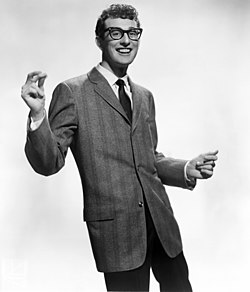
Ray-Ban Wayfarer sunglasses and eyeglasses have been manufactured by Ray-Ban since 1952. Made popular in the 1950s and 1960s by music and film icons such as Buddy Holly, Roy Orbison and James Dean, Wayfarers almost became discontinued in the 1970s, before a major resurgence was created in the 1980s through massive product placements.
The Ray-Ban brand was sold to Italian Luxottica Group in 1999,[1] who created a second revival in the mid 2000s.[2][3]
Design and early popularity
[edit]
.jpg)
Wayfarers were designed in 1952 by American optical designer Raymond Stegeman,[4][5][6] who worked for Bausch & Lomb, Ray-Ban's parent company at that time.[7] The design was inspired by, "a mid-century classic to rival Eames chairs and Cadillac tail fins."[5] According to design critic Stephen Bayley, the "distinctive trapezoidal frame spoke a non-verbal language that hinted at unstable dangerousness, but one nicely tempered by the sturdy arms which, according to the advertising, gave the frames a 'masculine look'."[5] The sunglasses also featured a new plastic molding technology.[2][5]
1970s and 1980s
[edit]
After Wayfarers' heyday in the 1950s and 1960s, sales declined.[5] Though Wayfarers' cultural popularity was aided in 1980 by the film The Blues Brothers,[8] only 18,000 pairs were sold in 1981,[9] and Wayfarers were on the verge of discontinuation.[10] In 1982 Ray-Ban signed a $50,000-a-year deal with Unique Product Placement of Burbank, California, to place Ray-Bans in movies and television shows.[9] Between 1982 and 1987, Ray-Ban sunglasses appeared in over 60 movies and television shows per year,[9] continuing through 2007.[11] Tom Cruise's wearing of Wayfarers in the 1983 movie Risky Business was one of the key placements,[8] and that year 360,000 pairs were sold.[9] Additional appearances in movies like The Breakfast Club, and series like Miami Vice and Moonlighting, led to sales of 1.5 million annually.[9]
Wayfarers were also worn by various musicians, including Roy Orbison, Michael Jackson, George Michael, Rick Astley, Billy Joel, Johnny Marr,[12] Blondie's Debbie Harry,[12] Madonna, Depeche Mode, Elvis Costello,[12] and members of U2[12] and Queen, as well as public figures such as Max Headroom, Jack Nicholson,[13] and Anna Wintour.[14]
The novels of Bret Easton Ellis often contain references to Wayfarers.[15] Lyrics that mentioned the style of glasses included Don Henley's 1984 song "The Boys of Summer", which contained the lyric "You got that hair slicked back and those Wayfarers on, baby". Corey Hart's music video “Sunglasses at Night” shows the artists wearing Wayfarers in darkness. In response to these placements, Ray-Ban's Wayfarer expanded from two models in 1981 to about 40 models by 1989.[16][17]
1990s
[edit]As the 1990s began, the frames again became unpopular.[18] The 1950s revival that fueled the glasses' popularity in the 1980s lost momentum, and Wayfarers were outcompeted by wraparound frames.[18] During the slump of the 1990s, Ray-Ban's parent company, Bausch & Lomb was facing pressure from competitors like Oakley. In 1999, Bausch & Lomb sold Ray-Ban to Luxottica Group S.p.A. of Italy for $640 million.[19] In 2001, the Wayfarer underwent a significant redesign (RB2132), with the frames made smaller and less angular, and changed from acetate to a lighter injected plastic.[18] The changes were intended to update the frames' style during a period of unpopularity and to make them easier to wear (the frames' previous tilt made them impossible to perch on top of one's head, for instance).[18]
2000s
[edit]
Wayfarers were brought back into fashion in the late 2000s when public figures including Chloë Sevigny and Mary-Kate Olsen began wearing vintage frames.[20][21] When Ray-Ban noticed that vintage Wayfarers were selling for significant prices on eBay,[18] a 2007 re-introduction of the original Wayfarer (RB2140) design was initiated.[12][18][22] The RB2140 model is identical to the original B&L5022 model, except the metal "studs" on the temple arms were replaced with the Ray-Ban logo and the right lens now bears the logo as well. (As of 2007, Wayfarers were available in Original Wayfarer, New Wayfarer, and Wayfarer Folding styles.)[23] Ray-Ban's marketing strategy was threefold: a return to the sunglasses' original, rebellious design, an "edgy" advertising campaign and "high-profile PR events", and the use of new media like MySpace to connect with consumers.[24] Sales in 2007 were 231% greater than in 2006 at Selfridge's London;[6] as of October 2007, the Wayfarer was the Luxottica Group's third-best-selling style.[25]
2020s
[edit]In September 2021, Ray-Ban and Facebook Reality Labs announced a collaboration for smart glasses including Wayfarers with built in cameras called Ray-Ban Stories.[26]
Similar designs and mistaken identity
[edit]
During the 2000s Wayfarer revival, many sunglasses designs inspired by the original Wayfarers were produced by designers unaffiliated with Ray-Ban. Grey Ant's Grant Krajecki designed a larger, cartoonish version of the glasses "so extreme that [they] are best worn by those with a good sense of humor".[28]
Other Wayfarer-inspired sunglasses included Oliver Peoples' Hollis, REM Eyewear's Converse, and various designs in Juicy Couture, Hugo Boss, Kate Spade, Marc Jacobs's and Kaenon Polarized 2008 lines.[25] Between July and September 2008, retailers began selling frameless Wayfarers.[29]
Gallery
[edit]-
 Signpost near the Clear Lake crash site where Buddy Holly died.
 -
 Ray-Ban logo on the Classic Wayfarer (RB5121)
 -
 Actor Corey Feldman wearing Wayfarers at the Academy Awards, 1989


References
[edit]- ^ "Company News: Bausch & Lomb Selling Sunglass Business to Luxottica". NY Times. April 29, 1999. Retrieved September 5, 2010.
- ^ a b Delap, Leanne. "I wear my sunglasses at night". The Globe and Mail (July 12, 2008).
- ^ Derrick, Gabrielle. "The world's favorite shades turn 40". The Age (October 3, 1993).
- ^ Stegeman, Raymond F. E. Front for Spectacle Frames. US Patent #169,995.
- ^ a b c d e Bayley, Stephen (2006-06-18). "NOTES & THEORIES: Through a pair of glasses darkly". Find Articles. The Independent on Sunday. Archived from the original on 2007-03-11. Retrieved 2025-11-04.
- ^ a b Walker, Esther. "Geeky but chic". Independent Extra (July 3, 2008).
- ^ Google patent search for Raymond Stegeman. 70 of 72 patents issued to Stegeman were assigned to Bausch and Lomb.
- ^ a b Bland, Simon (3 August 2020). "Dan Aykroyd and John Landis: how we made The Blues Brothers". The Guardian. Retrieved 20 September 2023.
- ^ a b c d e Leinster, Colin. "A Tale of Mice and Lens." Fortune (September 28, 1987).
- ^ August, Melissa et al. "Through A Glass Darkly." Time (July 12, 1999).
- ^ Passariello, Christina. "Return of the Wayfarers: Luxottica revamps once-cool Ray-Bans with an eye to women." The Wall Street Journal Europe (October 27, 2006).
- ^ a b c d e Hirschlag, Jennifer. "Ray-Ban Tunes in to a New Generation." Women's Wear Daily (November 13, 2006).
- ^ Spade, Kate. Style. Simon and Schuster (2004), p66. ISBN 0-7432-5067-2.
- ^ Oppenheimer, Jerry. Front Row: Anna Wintour, the Cool Life and Hot Times of Vogue's Editor-in-Chief. St. Martin's Press (2005): p215. ISBN 0-312-32310-7.
- ^ Ellis, Bret Easton. Less than Zero. Vintage Contemporaries (1998) (originally published 1984): p121, 122, 203. ISBN 0-679-78149-8.
Ellis, Bret Easton. The Rules of Attraction. Simon & Schuster (1987): p25, 40, 122. ISBN 0-671-62234-X.
Ellis, Bret Easton. American Psycho. Vintage (1991): p70, 71, 81, 224, 242, 257, 394. ISBN 0-679-73577-1. - ^ Norris, Scott. "Boosting the Hottest Shades Under the Sun." Rochester Business Journal (Oct. 9, 1989), section 1, p10.
- ^ MJ. "Style Spy."[permanent dead link] GQ.com (October 2007).
- ^ a b c d e f Rushton, Susie. "Ray Ban Wayfarer spec-tacular revival" The New Zealand Herald. (May 06, 2007.)
- ^ "COMPANY NEWS; BAUSCH & LOMB SELLING SUNGLASS BUSINESS TO LUXOTTICA". The New York Times. April 29, 1999. Retrieved 2014-10-27.
- ^ Brown, Laura. "Mary-Kate Olsen's Singular Style". Harper's Bazaar (September 23, 2007).
- ^ Toulin, Alana. "The 'IT' list for 2008". The Ottawa Citizen (December 29, 2007).
- ^ "Ray-Ban Wayfarer Relaunch." Wallpaper (January 25, 2007).
- ^ Ray-Ban. Official website Archived 2007-05-18 at the Wayback Machine (2007). Accessed October 7, 2007.
- ^ Brunelli, Richard. "Ray-Ban Wayfarers: Made in the Shade" Adweek (October 1, 2007).
- ^ a b Brown, Rachel. "A Blast from the Past at Vision Expo West" Women's Wear Daily (October 8, 2007).
- ^ "RAY-BAN STORIES".
- ^ Campbell, Craig (5 May 2017). "80 years of Ray-Bans: Shades don't come much cooler than these! - Sunday Post". Sunday Post. Retrieved 12 July 2017.
- ^ Magsaysay, Melissa. "New riffs on the Wayfarer". Los Angeles Times (November 4, 2007).
- ^ Demasi, Laura. "Sunny outlook". The Sun-Herald (Sydney, Australia) (July 6, 2008).
External links
[edit]
Ray-Ban Wayfarer
View on GrokipediaOrigins and Design
Development and Introduction
The Ray-Ban Wayfarer sunglasses were developed in the early 1950s by Bausch & Lomb, the parent company of the Ray-Ban brand, as part of a shift toward more fashionable eyewear following World War II. At the time, sunglasses like the 1937 Aviator model had been primarily functional, designed for military pilots to reduce glare during high-altitude flights. In contrast, the Wayfarer aimed to appeal to civilian consumers seeking stylish, versatile accessories that reflected the era's optimistic and mobile lifestyle.[1][5] Optical designer Raymond Stegeman, employed by Bausch & Lomb, created the Wayfarer's prototype in 1952, drawing inspiration from mid-century modern architecture and the sleek lines of 1950s automobiles to craft its distinctive trapezoidal shape. The design featured bold, acetate plastic frames—thicker and more sculptural than the thin metal wires common in eyewear—enabled by recent advancements in injection-molding technology that allowed for durable, lightweight construction. Stegeman filed a U.S. patent (No. 2,646,298) for the frame's unique geometry in 1952, issued on July 7, 1953, emphasizing its forward-tilting lenses and wraparound fit for enhanced comfort and style.[6][7][8][9] Introduced commercially in 1952, the Wayfarer quickly distinguished itself from competitors with its casual yet sophisticated appeal. Early marketing positioned it as an everyday essential for travelers and urban dwellers, aligning with the name's connotation of wandering and exploration.[10][5]Original Design Features
The Ray-Ban Wayfarer sunglasses were originally designed in 1952 by American optical designer Raymond Stegeman, who was employed by Bausch & Lomb, the parent company of the Ray-Ban brand at the time.[1][2] Stegeman's design marked a significant departure from the prevailing metal-framed styles, such as the Aviator, by introducing a bold, full-coverage acetate frame constructed from durable cellulose acetate plastic, which provided a more casual and versatile aesthetic suitable for everyday wear.[11][12] The frame featured a distinctive square shape with rounded corners and a subtle forward tilt, known as pantoscopic tilt, to enhance fit and comfort on the face while evoking a sense of mid-century American minimalism through clean lines and understated curves.[5][13] The lenses adopted Ray-Ban's signature G-15 glass technology, characterized by a dark green tint that absorbs 85% of visible light while maintaining natural color perception and offering 100% UV protection, paired with the trapezoidal lens shape that widened slightly at the top for improved peripheral vision and a bold, masculine profile.[14][6] The temples, or arms, were robust and slightly curved for secure placement behind the ears, contributing to the overall sturdy yet lightweight construction. This combination of materials and geometry not only prioritized functionality—such as glare reduction and durability for outdoor activities—but also established the Wayfarer as a unisex icon blending sporty utility with fashion-forward appeal, influencing subsequent eyewear trends.[11][15]Historical Popularity
Early Adoption (1950s-1960s)
The Ray-Ban Wayfarer sunglasses were introduced in 1952 by Bausch & Lomb, marking a significant departure from the brand's earlier metal-framed Aviator models with their innovative acetate plastic construction and wraparound browline design.[1] This new style featured trapezoidal lenses and a sturdy, angular frame intended for both men and women, appealing to a post-World War II audience seeking versatile, everyday eyewear that blended functionality with emerging fashion trends.[11] Initial sales were promising, as the Wayfarer quickly gained traction among the general public for its comfort and modern aesthetic, positioning it as an accessible alternative to more utilitarian military-inspired designs.[2] In the mid-1950s, the Wayfarer's adoption surged following its prominent appearance in the 1955 film Rebel Without a Cause, where James Dean wore the model, cementing its association with youthful rebellion and cool nonconformity.[10] Dean's portrayal of a troubled teenager amplified the sunglasses' cultural resonance, transforming them from a practical accessory into a symbol of the era's emerging countercultural ethos, particularly among young Americans navigating social changes.[16] This Hollywood endorsement drove widespread popularity, with the style becoming a staple in casual wardrobes and contributing to Ray-Ban's growing dominance in the eyewear market during the decade.[17] By the 1960s, the Wayfarer had evolved into an icon of the decade's free-spirited movements, adopted by artists, musicians, and intellectuals who embodied the shift toward individualism and artistic expression.[2] Figures such as Bob Dylan frequently sported the model during his folk-to-rock transition in the mid-1960s, enhancing its mystique and aligning it with the rock revolution and broader cultural upheavals.[18] Similarly, counterculture icons like Andy Warhol integrated the Wayfarer into their personas, further embedding it in the art and music scenes of the era.[16] Sales reflected this momentum, with Ray-Ban reaching approximately 3 million pairs annually by the late 1960s, underscoring the model's status as the brand's bestseller and a defining element of 1960s style.[19]Decline and Resurgence (1970s-1980s)
Following the peak popularity of the Ray-Ban Wayfarer in the 1950s and 1960s, the model experienced a significant decline during the 1970s as fashion trends shifted toward oversized and more flamboyant eyewear styles influenced by the disco era. Sales plummeted, with only around 18,000 pairs sold annually by 1981, prompting Bausch & Lomb, Ray-Ban's parent company at the time, to consider discontinuing production altogether. This downturn reflected broader changes in consumer preferences for bolder, less structured frames that aligned with the era's cultural emphasis on excess and experimentation.[11] The resurgence began in the early 1980s through a deliberate product placement strategy by Ray-Ban, which invested approximately $50,000 in Hollywood films and television shows to revive interest. A pivotal moment came with the 1980 release of The Blues Brothers, where stars John Belushi and Dan Aykroyd prominently wore Wayfarers, helping to boost visibility and contribute to the 1981 sales figure of 18,000 pairs. This was followed by Tom Cruise's iconic portrayal in the 1983 film Risky Business, where the sunglasses became a signature accessory for his character, driving sales to 360,000 pairs that year—a dramatic 20-fold increase.[11][20] The momentum continued with extensive media exposure, including appearances in over 60 films and TV episodes annually from 1982 to 1987, such as the television series Miami Vice starting in 1984, where Don Johnson frequently donned the style, doubling sales to 720,000 pairs in 1984.[11][1] By 1986, Wayfarer sales had soared to 1.8 million pairs globally, solidifying its status as a fashion staple of the decade and restoring Ray-Ban's market dominance. This revival not only saved the model from obsolescence but also highlighted the power of cinematic endorsement in reshaping consumer trends.[11]Redesign and Revival (1990s-2000s)
Following the peak popularity of the 1980s, Ray-Ban Wayfarer sales experienced a sharp decline in the 1990s due to increased competition from cheaper imitation sunglasses and a shifting fashion landscape that favored more aviator-style and metal-framed designs.[11] By the late 1990s, the brand's overall market position had weakened significantly, with Wayfarers seen as outdated amid broader economic pressures on parent company Bausch & Lomb.[21] In 1999, Italian eyewear conglomerate Luxottica Group acquired Ray-Ban from Bausch & Lomb for approximately $640 million, marking a pivotal shift aimed at revitalizing the brand's heritage lines, including the Wayfarer.[6] Under Luxottica's ownership, initial efforts focused on consolidating production in Italy and repositioning Ray-Ban as a premium product, exiting low-end retail channels like gas stations to target upscale outlets such as Neiman Marcus by 2004.[22] A key redesign occurred in 2001 with the launch of the New Wayfarer (model RB2132), featuring smaller, less angular frames made from lighter injection-molded plastic instead of traditional acetate to appeal to a younger, fashion-forward demographic.[23] This update aimed to modernize the silhouette while retaining the iconic trapezoidal shape, though it initially met mixed reception for deviating from the original's bold proportions.[1] The mid-2000s saw a deliberate revival strategy emphasizing nostalgia without overt retro marketing, including the 2007 reissue of the Original Wayfarer (model RB2140) in its classic acetate form to capitalize on emerging vintage trends.[23] Luxottica supported this through the global "Never Hide" campaign, launched in 2007, which promoted authenticity via subtle product placements and celebrity endorsements from figures like Chloë Sevigny and Kanye West, helping to restore cultural relevance.[23] These efforts contributed to substantial growth, with Ray-Ban overall sales rising from 252 million euros in 2000 (10% of Luxottica's total), driven by expanded lens options like polarized variants and a focus on quality materials that justified price increases from $79 to $129.[22] The Wayfarer's resurgence solidified its status as a timeless style, blending updated accessibility with enduring design appeal.Modern Era (2010s-2020s)
In the 2010s, the Ray-Ban Wayfarer experienced a significant resurgence, aligning with the rise of hipster fashion and vintage-inspired aesthetics. Colorful variants became particularly sought after, embodying the era's emphasis on retro cool and individuality, as seen in the popularity among music festival-goers and urban street style enthusiasts.[24] This period also marked the introduction of innovative features, such as the Remix platform, Ray-Ban's first customizable model, which allowed users to personalize frames and lenses online, capitalizing on the digital selfie culture and boosting accessibility.[2] The Wayfarer II variant was launched, updating the classic design with modern twists while preserving its acetate frame heritage, further solidifying its status as a staple in everyday celebrity wardrobes and festival fashion.[25] Entering the 2020s, the Wayfarer's enduring appeal persisted amid shifting trends, reinforced by its timeless design and cultural adaptability. It remained one of Ray-Ban's top-selling models globally, driven by consistent demand for classic styles and its integration into contemporary wardrobes.[26] The resurgence of "indie sleaze" aesthetics—a nod to 2010s grunge and effortless cool—revived interest in bold, colorful Wayfarers, with influencers and younger consumers embracing them as symbols of nostalgic rebellion.[27] High-profile collaborations, such as the 2025 Wayfarer Puffer collection with rapper A$AP Rocky, reinterpreted the silhouette with experimental elements like puffer textures in seven colors, blending heritage craftsmanship with streetwear innovation and appealing to Gen Z audiences.[28] This era underscored the Wayfarer's role in bridging decades of pop culture, maintaining its position as an icon of versatile, boundary-pushing style.[2]Variations and Innovations
Frame and Lens Options
The Ray-Ban Wayfarer is available in several frame variations, each maintaining the iconic trapezoidal shape while offering differences in size, material, and functionality. The Original Wayfarer (model RB2140), introduced in 1952, uses a classic acetate frame, often in polished black or tortoise (Havana) finishes, with a standard lens width of 50mm for a medium fit.[29] The New Wayfarer (RB2132) updates this design with a larger, more rectangular lens shape (available in 52mm, 55mm, or 58mm widths) and a lightweight nylon frame, available in colors like black rubber or light Havana. Other variations include the Folding Wayfarer (RB4105), which collapses for portability using acetate; the State Street, a slimmer metal-accented acetate version; and the Nomad, featuring a bio-based acetate for sustainability.[3] Frame colors span classic neutrals like black and tortoise to vibrant options such as cosmic blue, red, and white, with some models offering transparent or striped acetate for a modern twist. Lens options for Wayfarer sunglasses emphasize versatility and protection, with the brand's signature G-15 green tint—providing 85% light absorption while preserving color balance—as the original standard since 1937.[30] Other solid lens colors include B-15 brown for enhanced contrast, crystal grey for neutral vision, blue for a cooler tone, and specialized shades like yellow for low-light conditions or pink for fashion-forward appeal.[31] Treatments enhance performance: polarized versions reduce glare from reflective surfaces, ideal for driving or water activities; gradient tints darken progressively from top to bottom for balanced overhead and horizon visibility; and mirror coatings reflect light for added UV protection and style.[29] Chromance lenses boost color contrast and clarity, while photochromic options automatically adjust tint based on light exposure.[30] Prescription compatibility is available across models, with single-vision, progressive, or transition lenses in materials ranging from standard plastic to high-index for thinner profiles.[32] For the Ray-Ban | Meta Wayfarer smart glasses variant, frames use durable injected plastic in matte black or silver, paired with lenses optimized for tech integration, such as clear or transition grey for indoor/outdoor use with 100% UV protection. All Wayfarer lenses meet ANSI Z80.3 standards for impact resistance and provide 100% UVA/UVB protection.[30]Smart Glasses Integration
The partnership between EssilorLuxottica, Ray-Ban's parent company, and Meta (formerly Facebook) marked the entry of smart technology into the Wayfarer design with the launch of Ray-Ban Stories on September 9, 2021.[33] These first-generation smart glasses adapted the classic Wayfarer frame—alongside Round and Meteor styles—by embedding dual 5-megapixel cameras in the front for hands-free photo and 30-second video capture, open-ear speakers in the temples for audio playback, and a three-microphone array for calls and voice commands via the Facebook View app.[33] The integration prioritized minimal disruption to the Wayfarer's aesthetic, with components housed in a lightweight injected plastic frame and a portable charging case providing up to three additional full charges.[33] In September 2023, Meta and Ray-Ban released an updated second generation under the Ray-Ban Meta branding, available starting October 17, 2023, which significantly enhanced the Wayfarer model's capabilities while retaining its signature trapezoidal acetate frame.[34] Key upgrades included a 12-megapixel ultra-wide camera supporting 3K video recording up to three minutes, five microphones for improved noise cancellation during calls, and 50% louder open-ear speakers with enhanced bass for music and podcasts.[35] Battery life was up to four hours of typical use, powered by the Qualcomm Snapdragon AR1 Gen 1 platform, and the glasses integrated Meta's Llama AI model for voice-activated assistance, such as answering questions or controlling media via the command "Hey Meta."[35] Over 150 frame and lens combinations, including polarized and transition options, ensured the smart Wayfarer remained versatile for everyday wear.[35] Subsequent updates in September 2024 introduced advanced AI functionalities to the Ray-Ban Meta Wayfarer, focusing on practical assistance without altering the core design.[36] These included real-time speech translation for languages like Spanish, French, and Italian delivered through the open-ear speakers, a "smart memory" feature to recall details such as parking locations or set timed reminders, and hands-free voice messaging on platforms like WhatsApp and Messenger.[36] Video-based AI support enabled contextual help, such as identifying objects during navigation or suggesting recipes from grocery scans.[36] Partnerships expanded accessibility, with integration to Be My Eyes allowing blind or low-vision users to request live visual descriptions via the glasses' camera.[36] Audio integrations with Spotify, Amazon Music, Audible, and iHeart enabled seamless content control.[36] In September 2025, at Meta Connect, the Ray-Ban Meta lineup received further enhancements, including a second-generation update doubling battery life to up to eight hours of typical use (from four hours) with a 42% capacity increase, improved 3K video capture, and expanded AI features powered by updated Llama models.[37] These updates apply across Wayfarer, Headliner, and Skyler styles, maintaining over 150 customization options. By September 2025, the lineup evolved further with the introduction of Ray-Ban Meta Display glasses in Wayfarer form, announced on September 17, 2025, and available starting September 30, 2025, at a starting price of $799.[38] This model added a discreet heads-up display (HUD) in the right lens for viewing notifications, directions, and AI responses, powered by the Qualcomm Snapdragon AR1 Gen 1 platform, while featuring a slightly heavier 69-gram build due to the integrated display and preserving the classic styling.[39] The display supports interaction with digital content, such as live captions or maps, without obstructing the field of view, and includes a capture LED for privacy during recording. The $799 price includes the Meta Neural Band, an EMG-enabled wristband for gesture-based controls like pinching to capture photos or swiping for notifications.[40] These advancements position the smart Wayfarer as a bridge between fashion and augmented reality, with ongoing software updates via the Meta View app ensuring compatibility with evolving AI models.[41]Cultural Impact
In Film and Music
The Ray-Ban Wayfarer sunglasses have been a staple in cinematic portrayals of cool, rebellious, and stylish characters since the mid-20th century. Similarly, in the 1980 comedy The Blues Brothers, stars John Belushi and Dan Aykroyd donned Wayfarers as part of their signature look, blending humor with rock 'n' roll attitude and amplifying the sunglasses' visibility in ensemble casts.[42] The 1983 teen drama Risky Business featured Tom Cruise sliding across the floor in Wayfarers, an image that became emblematic of 1980s youth culture and drove a notable increase in the model's popularity.[43] In the 1985 coming-of-age film The Breakfast Club, Anthony Michael Hall's character wore Wayfarers, reinforcing their role as a symbol of adolescent rebellion and conformity in John Hughes' teen cinema.[44] In music, the Wayfarer has been embraced by artists across genres as an extension of their personas, often appearing in performances, album art, and videos. Rock pioneer Roy Orbison frequently sported black Wayfarers during his 1950s and 1960s concerts, pairing them with his dramatic stage presence to create an enigmatic, bespectacled icon.[8] Folk legend Bob Dylan adopted the style in the 1960s, wearing tortoiseshell Wayfarers that complemented his countercultural image and appeared in promotional photos and live shows.[45] Punk poet Patti Smith integrated Wayfarers into her androgynous aesthetic, as seen in her album covers and performances, where the frames underscored her raw, minimalist rock ethos.[46] By the 1980s, pop icons Michael Jackson and Madonna popularized the Wayfarer in music videos and tours, enhancing their thriller-era edge and bold femininity tied to MTV-era glamour.[47] More recently, country artist Eric Church has made the New Wayfarer a fixture of his stage outfits, reflecting its enduring appeal in contemporary music scenes.[48]Celebrity and Fashion Influence
The Ray-Ban Wayfarer sunglasses gained early prominence through associations with Hollywood rebels and musicians in the 1950s and 1960s. James Dean's portrayal of Jim Stark in the 1955 film Rebel Without a Cause featured the Wayfarer, cementing its image as a symbol of youthful defiance and cool nonconformity, which propelled sales and cultural cachet.[17] Similarly, musicians like Bob Dylan and John Lennon adopted the style during the folk and rock eras, with Dylan often photographed in them during his 1960s performances, enhancing their appeal among counterculture youth.[49] A significant resurgence occurred in the 1980s, driven by film placements that transformed the Wayfarer into a mainstream fashion staple. In the 1980 comedy The Blues Brothers, stars Dan Aykroyd and John Belushi wore black Wayfarers throughout, contributing to the early 1980s sales resurgence as audiences emulated the look.[49] Tom Cruise further amplified this in the 1983 film Risky Business, where his character sported the sunglasses in key scenes, contributing to Ray-Ban's recovery from near-discontinuation and boosting annual sales to around 1.5 million pairs by 1985.[50][1] Icons like Madonna and Debbie Harry of Blondie also popularized the Wayfarer in music videos and tours, blending it with punk and pop aesthetics to influence women's fashion wardrobes.[49] In the late 2000s and 2010s, the Wayfarer solidified its status in high fashion through celebrity endorsements and street style. British musicians and actors such as Lily Allen, Mark Ronson, and Johnny Borrell were frequently seen in colorful variants at events like Glastonbury Festival, aligning the design with festival and indie fashion trends.[49] Hollywood figures including Sienna Miller, Scarlett Johansson, and Anne Hathaway adopted vibrant hues—red, blue, and pink—elevating the Wayfarer from casual accessory to red-carpet essential during the 2008 summer season.[49] Princess Diana's choice of classic black Wayfarers in 1990 public appearances added a layer of royal elegance, inspiring enduring minimalist styles.[51] Contemporary influence spans music, film, and luxury collaborations, maintaining the Wayfarer's relevance in 2020s fashion. Rapper A$AP Rocky, appointed Ray-Ban's first creative director in 2025, launched the Wayfarer Puffer collection, featuring puffy frames and crystal-embellished editions priced up to $7,400, which merged hip-hop edge with high-end couture and debuted at Milan Fashion Week.[52] Models and actors like Hailey Bieber, Kristen Stewart, and Sophie Turner have styled oversized or mega Wayfarers in streetwear looks, as seen in Vogue editorials and paparazzi shots, reinforcing their versatility in blending casual and experimental aesthetics.[53][54][55] This ongoing celebrity affinity has sustained the Wayfarer's position as a timeless icon, with annual global sales exceeding millions and frequent appearances in fashion weeks worldwide.Similar Styles and Imitations
Predecessors and Competitors
The Ray-Ban Wayfarer, introduced in 1952, marked a shift from the brand's earlier metal-framed designs, particularly the iconic Aviator model launched in 1930. The Aviator, originally developed for U.S. Army Air Corps pilots to combat glare at high altitudes using green-tinted crystal lenses, featured a distinctive teardrop shape and lightweight metal construction that prioritized functionality over fashion.[2] This predecessor dominated Ray-Ban's lineup through the 1940s, adapting military technology for civilian use among police and outdoor enthusiasts, but its rigid metal frames limited versatility for everyday wear.[2] Broader stylistic predecessors to the Wayfarer's trapezoidal plastic frame emerged in the late 1920s and 1930s, when mass-produced sunglasses transitioned from niche protective eyewear to fashionable accessories. Sam Foster's Foster Grant company pioneered affordable plastic frames in 1929, selling the first factory-made sunglasses on the Atlantic City boardwalk and popularizing colorful, molded acetate designs that contrasted with prevailing metal wire rims.[56] These innovations laid the groundwork for the Wayfarer's bold, non-military aesthetic, emphasizing comfort and style for broader audiences. Similarly, the American Optical Saratoga, introduced in the 1960s, featured a comparable plastic browline shape with silver accents and slimmer temples, drawing from post-war optical trends and gaining fame through wear by figures like John F. Kennedy.[57] In the competitive landscape of the 1950s, Foster Grant emerged as Ray-Ban's primary rival, capturing market share with vibrant plastic frames marketed aggressively to celebrities and the public. By the mid-1950s, Foster Grant's innovations in injection-molded acetate allowed for diverse colors and shapes, challenging Ray-Ban's dominance and contributing to the era's sunglasses boom.[58] American Optical also competed directly through styles like the Saratoga, which offered a more refined, American-made alternative to the Wayfarer's chunkier profile, appealing to those seeking subtle elegance over bold statement-making.[57] Other contemporaries, such as Polaroid's early sunglass lines focused on lens technology rather than frames, indirectly pressured Ray-Ban to innovate, but plastic frame specialists like Foster Grant and American Optical defined the key rivalry in casual eyewear design.[56]Common Confusions
One of the most prevalent confusions surrounding Ray-Ban Wayfarer sunglasses involves distinguishing authentic models from counterfeits, which flood online marketplaces and street vendors. Counterfeit Wayfarers often mimic the iconic trapezoidal frame but lack the quality craftsmanship and detailing of genuine products, leading consumers to unknowingly purchase fakes that compromise durability and UV protection.[59] Authentic Ray-Ban Wayfarers feature high-quality acetate frames that feel substantial and smooth to the touch, whereas fakes typically use cheaper plastic that feels flimsy or overly lightweight. The lenses on genuine pairs have a laser-etched "RB" logo on the left lens and a crisp, cursive Ray-Ban inscription on the right lens near the top; counterfeit lenses often display painted, glued, or jagged lettering that can be felt or peels over time.[59][11] The temple arms provide further clues: the left arm of an authentic model includes the model number (e.g., RB2140) and size etched clearly, while the right arm bears "WAYFARER®" and "Hand Made in Italy" with a raised Ray-Ban logo; fakes may have blurry printing, misspellings, or omit "Hand Made." Hinges on originals are metal with a distinctive seven-prong design (four on one side, three on the other) secured by two studs, contrasting with the plastic or low-grade metal hinges common in counterfeits. Packaging for genuine Wayfarers includes a sturdy box with matching barcodes, a Luxottica label, and accessories like a leather case with gold lettering and a cleaning cloth; discrepancies such as typos or mismatched details signal fakes.[59][11] Another frequent source of confusion arises from the various Wayfarer iterations, such as the Original Wayfarer (RB2140), New Wayfarer (RB2132), and Wayfarer II, which share the signature style but differ in fit and design, often leading buyers to select the wrong variant for their face shape. The Original Wayfarer, introduced in 1952, has a pronounced pantoscopic tilt (forward angle) for a retro look, larger lens height (41mm in size 50), and a wider frame (135mm), making it suitable for broader faces but potentially less comfortable for overhead sun exposure.[60][11] In contrast, the New Wayfarer, launched in 2001, eliminates the tilt for a straighter, more modern profile, features a smaller lens height (38mm in size 52), and a narrower frame (130mm), accommodating smaller or oval faces better while offering improved all-around light blockage. The Wayfarer II introduces subtle updates like softer edges and enhanced comfort over the New Wayfarer, but its similarities in silhouette cause mix-ups, especially since all models retain the riveted corners and logo placement. These variants are often conflated due to their shared aesthetic, with consumers overlooking size charts or tilt differences when shopping online.[60][11] Wayfarers are sometimes confused with other Ray-Ban styles like the Clubmaster (RB3016), which shares a retro vibe but features a browline design with a metal top bar and plastic bottom, unlike the full acetate frame of the Wayfarer; this leads to erroneous purchases by those seeking the bolder, uniform trapezoid shape. Additionally, myths persist about all Wayfarers being identical to vintage 1950s models, which used compression-molded cellulose acetate; while some modern variants like the 2002 redesign employed injection-molded plastic, current reissues of the Original primarily use acetate, affecting weight and flexibility.[61][11]References
- https://commons.wikimedia.org/wiki/File:Wayfarerpatent.jpg