Hubbry Logo
UltisolUltisolMain
Open search
Ultisol
Community hub
Ultisol
logo
8 pages, 0 posts
0 subscribers
Be the first to start a discussion here.
Ultisol
Ultisol
from Wikipedia

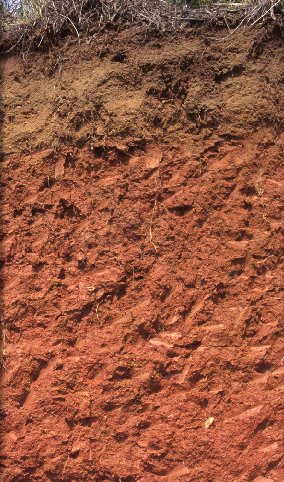
Ultisol, commonly known as red clay soil, is one of twelve soil orders in the United States Department of Agriculture soil taxonomy. The word "Ultisol" is derived from "ultimate", because Ultisols were seen as the ultimate product of continuous weathering of minerals in a humid, temperate climate without new soil formation via glaciation. They are defined as mineral soils which contain no calcareous (calcium carbonate containing) material anywhere within the soil, have less than 10% weatherable minerals in the extreme top layer of soil, and have less than 35% base saturation throughout the soil. Ultisols occur in humid temperate or tropical regions. While the term is usually applied to the red clay soils of the Southern United States, Ultisols are also found in regions of Africa, Asia, Australia and South America.

Key Information

In the World Reference Base for Soil Resources (WRB), most Ultisols are known as Acrisols and Alisols. Some belong to the Retisols or to the Nitisols. Aquults are typically Stagnosols or Planosols. Humults may be Umbrisols.[1]

Introduction

[edit]

Ultisols vary in color from purplish-red, to a bright reddish-orange, to pale yellowish-orange and (in cooler areas such as Pennsylvania) even some subdued yellowish-brown or grayish-brown tones. They are typically quite acidic, often having a pH of less than 5. The red and yellow colors result from the accumulation of iron oxide (rust), which is highly insoluble in water. Major nutrients, such as calcium and potassium, are typically deficient in Ultisols,[2] which means they generally cannot be used for sedentary agriculture without the aid of lime and other fertilizers, such as superphosphate. They can be easily exhausted, and require more careful management than Alfisols or Mollisols. However, they can be cultivated over a relatively wide range of moisture conditions. Where the organic matter content is high, as in Humults like the Olympic series, the soil is relatively fertile.

Ultisols can have a variety of clay minerals, but in many cases the dominant mineral is kaolinite. This clay has good bearing capacity and no shrink–swell property. Consequently, well-drained kaolinitic Ultisols such as the Cecil series are suitable for urban development.

Ultisols are the dominant soils in the Southern United States (where the Cecil series is most famous), southeastern China, Southeast Asia, and some other subtropical and tropical areas. Their northern limit (except fossil soils) is very sharply defined in North America by the limits of maximum glaciation during the Pleistocene, because Ultisols typically take hundreds of thousands of years to form—far longer than the length of an interglacial period today.

The oldest fossil Ultisols are known from the Carboniferous period when forests first developed. Though known from far north of their present range as recently as the Miocene, Ultisols are surprisingly rare as fossils overall, since they would have been expected to be very common in the warm Mesozoic and Tertiary paleoclimates.

Gardening in Ultisol

[edit]

The lack of organic matter in Ultisol makes it difficult for plants to grow without proper care and considerations. Soil amendments are generally required each year in order to sustain flourishing plant life in regions with primarily Ultisol soil.[3] The use of soil tests, coupled with the corresponding provisions, can alleviate issues of nutrition and irrigation that can result from non porous Ultisol.[4] Soil tests help indicate the pH, and red clay soil typically has a low pH.[5] The addition of lime is used to help to increase the pH in soil and can help increase the pH in Ultisol as well.[6]

Mulch can be used to help improve Ultisol

Possible solutions

[edit]

Generally, gardeners aim to have 45% mineral, 5% organic matter and 50% pore space in their soil.[7] The composition of Ultisol in North Carolina, for reference, is approximately 16% pore space, 2% organic matter and 82% mineral.[8] The use of mulch is widespread in the Piedmont region of the United States as a solution to the high temperatures and saturation of the soil.[9] The addition of mulch helps to make the soil more porous.[10]

Adding manure and compost can help boost the amount of organic material present in the soil, which in turn helps add essential nutrients. Specifically, adding a 2- to 3-inch layer of compost and manure should be mixed into the soil to match a shovel's depth.[11] The addition of organic material also helps to improve the drainage, while decreasing the overall weight of the soil.[12]

A garden planted in a raised bed

However, microorganisms in the soil consume the same nutrients that plants use to grow so certain nutrients will remain unavailable to plants until the microorganisms completely break down the organic material and release nutrients.[13] Living organisms within the soil use, and subsequently convert, organic material into usable humus.[14] To avoid the delay presented by this process, adding manure in the fall is advisable.[15]

Some gardeners who live in areas with large amounts of red clay soil use raised beds or Hügelkultur to avoid having to amend the soil.[16] By using raised beds, gardeners avoid having to deal with Ultisols altogether.

Planting in Ultisol

[edit]

Plants found native to regions with high amounts of Ultisol can thrive. Generally, these species adapt to poorly drained, damp soils.[17] The Missouri Botanical Garden recommends tickweed, spotted jewelweed, mealycup sage, Camassia, spring starflower, ostrich fern, sideoats grama, Bouteloua curtipendula, and prairie dropseed.[18]

Suborders

[edit]
  • Aquults: Ultisols with a water table at or near the surface for much of the year
  • Humults: well-drained Ultisols that have high organic matter content
  • Udults: Ultisols of humid climates
  • Ustults: Ultisols of semiarid and subhumid climates
  • Xerults: temperate Ultisols with arid summers and moist winters

See also

[edit]

References

[edit]
Revisions and contributorsEdit on WikipediaRead on Wikipedia
from Grokipedia
Ultisols are a major soil order in the United States Department of Agriculture (USDA) soil taxonomy, characterized by the presence of a kandic or argillic horizon—a subsurface layer with significant clay accumulation—and low base saturation of less than 35% (by sum of cations) within 125 cm of the surface or throughout the profile if shallower. These soils result from intensive weathering under warm, humid climates, where prolonged leaching removes bases such as calcium, magnesium, and potassium, as well as silica, leaving behind low-activity clays like kaolinite and iron oxides that impart reddish or yellowish hues. Globally, Ultisols occupy approximately 8.1% of ice-free land, predominantly in humid subtropical and tropical regions between the Tropics of Cancer and Capricorn, including parts of , , , and , while in the United States they cover about 9.2% of the land area, mainly in the southeastern states such as the and , with limited occurrences in , , and scattered western areas like the Sierra Nevada. Their properties include high acidity (often below 5.5), low , and nutrient concentrations primarily in the surface horizons, making them naturally infertile and prone to aluminum without management. Despite these limitations, Ultisols support productive forests—such as and in the southeastern U.S.—and can be suitable for agriculture, including crops like , , and corn, when amended with lime and fertilizers to raise and replenish nutrients. They are subdivided into suborders like Aquults (wet), Humults (organic-rich), Udults (humid), Ustults (subhumid), and Xerults (Mediterranean), reflecting variations in moisture regimes and other features.

Taxonomy and Classification

Defining Characteristics

Ultisols represent one of the twelve orders in the USDA soil taxonomy system, named from the Latin "ultimus," meaning "last," to signify their position as soils at an advanced stage of weathering and development. These soils are characterized by extensive leaching of bases and silica, resulting in acidic conditions and low natural fertility, with a typical profile consisting of an A horizon (organic-rich topsoil), an optional E horizon (eluvial zone of leaching), a Bt horizon (illuvial subsoil enriched with clay), and a C horizon (weathered parent material). The order emphasizes mineral soils that lack permafrost, histic epipedons, or other features defining other orders, focusing instead on subsurface horizon development indicative of prolonged pedogenesis in humid environments. The core diagnostic criteria for Ultisols include the presence of an argillic or kandic horizon, with the upper boundary typically within 100 to 125 cm of the mineral surface or the top of an overlying organic layer with andic , whichever is shallower. These horizons feature clay accumulation or enrichment, where the clay content in the subsoil is at least 1.2 times that of the overlying eluvial horizon, often with evidence of illuviation such as oriented clay skins. Additionally, Ultisols contain no significant material, meaning they are not within 100 cm of the surface or throughout the control section, and lack calcic or petrocalcic horizons within 150 cm of the surface. A critical requirement is a low content of weatherable minerals, typically less than 10% in the fine-earth fraction (or the 50- to 200-micron fraction) of the control section, reflecting extreme that leaves primarily , iron, and aluminum oxides. Base saturation is a defining chemical criterion, requiring less than 35% (by at 7.0 or sum of cations) in some part of the between 25 cm and 125 cm from the surface, or to a lithic or paralithic contact if shallower, or within 180 cm of the surface in the control section. This low saturation, often decreasing with depth, distinguishes Ultisols from Alfisols, which maintain 35% or greater base saturation in the same depth range despite sharing similar argillic or kandic horizons. In contrast to , Ultisols lack an oxic horizon within 150 cm of the surface and retain more weatherable minerals, indicating a less extreme degree of without the diffuse, highly stable oxide-dominated structure of oxic horizons.

Suborders

Ultisols are classified into five suborders within the U.S. Department of Agriculture's Soil Taxonomy system, primarily differentiated by regimes, characteristics, and specific horizon features such as organic carbon content or saturation periods. These suborders reflect adaptations to varying climatic conditions, from perpetually wet tropical environments to seasonally dry Mediterranean-like settings, while all maintain the order's core traits of low base saturation below 35% and the presence of an argillic or kandic horizon. Aquults are characterized by aquic moisture regimes, featuring saturation and reducing conditions for at least 20 consecutive days or 30 cumulative days within 100 cm of the surface, often resulting in poor drainage and redoximorphic features like grayish mottles in the subsoil. They require an argillic or kandic horizon and are prevalent in low-lying, wet areas such as coastal plains along the Atlantic and in the . Humults exhibit udic or perudic moisture regimes in humid environments, distinguished by high organic carbon content—either at least 0.9% in the upper 15 cm of the argillic or kandic horizon or a total of 12 kg/m² or more to 100 cm depth—often with an umbric epipedon. These soils form in mountainous regions with elevated rainfall, such as parts of , Washington, and , where organic accumulation enhances fertility relative to other Ultisols. Udults, the most widespread suborder, occur under udic moisture regimes in humid climates without prolonged saturation or excessive organic matter, typically well-drained and humus-poor. They dominate the , including series like the (a Typic Kandiudult) in landscapes of the and Georgia. Ustults are defined by ustic moisture regimes in subhumid to semiarid conditions, with seasonal dry periods but adequate moisture during the , lacking aquic features or high organic carbon. These soils are limited in extent within the , occurring sporadically in and , but more common globally in transitional humid-dry zones. Xerults feature xeric moisture regimes typical of Mediterranean climates, with cool, moist winters and warm, dry summers, and low content. They are found in the foothills and mountains of , such as the Sierra Nevada, where examples include Haploxerults with pronounced seasonal moisture contrasts.

Physical and Chemical Properties

Physical Attributes

Ultisols exhibit distinctive physical textures that vary by horizon, with surface layers often consisting of sandy or loamy materials forming an ochric epipedon, while subsoils feature clayey textures in the argillic (Bt) horizon due to illuvial clay accumulation, typically containing more than 35% clay. This clay enrichment contributes to a blocky or prismatic structure in the subsoil, particularly in B horizons where clay films are evident, enhancing stability but impeding root penetration in compacted areas. The colors of Ultisols are predominantly red, yellow, or brown, resulting from the presence of iron oxides such as hematite, which imparts reddish hues (e.g., 5YR to 2.5YR), and goethite, responsible for yellowish or brownish tones (e.g., 7.5YR to 10YR). Mottling occurs in poorly drained suborders like Aquults, where redoximorphic features indicate periodic water saturation. Hydrologically, most Ultisols are well-drained with moderate permeability, though suborders such as Aquults experience seasonal high water tables within 50 cm of the surface, leading to reduced drainage. These soils generally have low content, often 1-2% in surface horizons, which decreases with depth due to leaching and results in limited water-holding capacity. is moderate, reflecting influenced by clay content and structure, though subsoil compaction can elevate values. Ultisols are often deep, exceeding 1.5 m unless restricted by , with well-defined horizonation including A or Ap surface horizons, optional E horizons, and thick Bt subsoils extending to 150 cm or more; on slopes, they are prone to due to their texture and low cohesion.

Chemical Composition

Ultisols exhibit a mineralogy dominated by low-activity clays, primarily , a 1:1 layer characterized by its low and limited nutrient retention potential, alongside sesquioxides such as iron oxides (e.g., , ) and aluminum oxides (e.g., ). These components contribute to an overall low (CEC) in the soil, typically less than 16 cmol/kg clay in the argillic horizon, which restricts the soil's ability to hold essential cations. Due to advanced , weatherable minerals such as and feldspars are reduced, often comprising less than 10% of the fine sand fraction in highly weathered subgroups with oxic-like horizons, reflecting moderate desilication and a predominance of stable, low-weathering residues. The inherent acidity of Ultisols, with values typically ranging from 4.5 to 5.5, stems from the intensive leaching of base cations including calcium (Ca²⁺), magnesium (Mg²⁺), (K⁺), and sodium (Na⁺), which depletes nutrient reserves and exacerbates infertility. This low fosters high concentrations of exchangeable Al³⁺, often exceeding 1 cmol/kg in subsoil horizons, leading to aluminum that inhibits elongation and nutrient uptake by damaging cell membranes and disrupting metabolic processes. Base saturation is correspondingly low at less than 35% (measured at 8.2), further limiting the availability of essential bases and contributing to overall infertility. Nutrient status in Ultisols is generally poor, marked by deficiencies in and low content, which together reduce microbial activity and nitrogen mineralization rates. availability is particularly constrained due to strong fixation by Fe and Al oxides, which form insoluble phosphates and render applied fertilizers less effective in the short term. These chemical constraints, driven by the soil's mineralogical composition, underscore the challenges of managing Ultisols for productive land use.

Distribution and Formation

Global Occurrence

Ultisols cover approximately 8.1% of Earth's ice-free land area and are particularly dominant in humid subtropical and tropical regions. These soils are widespread across various continents, with significant occurrences in the , including the and regions; ; parts of Brazil and other areas of ; ; ; and eastern Australia. They are notably limited or absent in northern glaciated areas, such as those affected by Pleistocene ice sheets, where soil development has been reset to younger orders due to recent geological activity. The global distribution of Ultisols is closely tied to humid temperate to tropical climates with high rainfall and warm temperatures. These conditions support the udic (perudic) or ustic regimes typical of Ultisols, facilitating intense leaching and clay illuviation. Suborder variations, such as udults in consistently moist environments versus ustults in seasonally drier ones, further reflect these climatic influences. Ultisols typically form from the weathering of parent materials including igneous and metamorphic rocks, as well as unconsolidated sediments, often on ancient, stable landscapes such as continental shields. These old geomorphic surfaces allow for prolonged pedogenesis, contributing to the characteristic low base saturation and clay accumulation in these soils.

Pedogenic Processes

The formation of Ultisols is governed by the five soil-forming factors known as CLORPT: climate, organisms, relief, parent material, and time. Climate plays a dominant role, with warm, humid conditions—typically in subtropical or tropical regions where annual precipitation exceeds evapotranspiration—driving intense chemical weathering through high rainfall that promotes leaching of base cations such as calcium, magnesium, potassium, and sodium. Organisms, particularly deciduous or coniferous forest vegetation, contribute organic acids from decaying litter, which further acidify the soil and accelerate mineral breakdown. Relief influences development by favoring well-drained upland slopes or stable landscapes that prevent waterlogging and allow percolating water to facilitate downward translocation of materials. Parent material consists of silicate-rich rocks like granite, weathered sediments, or crystalline materials containing weatherable minerals such as feldspars, which provide the substrates for prolonged alteration. Time is essential, requiring hundreds of thousands to millions of years for the advanced weathering characteristic of Ultisols to occur, often on pre-Pleistocene or older geomorphic surfaces. Key pedogenic processes in Ultisol development include intense , which breaks down primary minerals into secondary clays like , and leaching (eluviation), which removes soluble bases and silica (desilication) from upper horizons, resulting in low base saturation below 35% and acidic conditions ( often 4.0–5.5). Illuviation follows, as suspended clay particles and sesquioxides (iron and oxides) are translocated downward to form the diagnostic argillic horizon, a clay-enriched subsoil layer at least 7.5 cm thick with visible clay films or bridges. Oxidation of iron and produces reddish or yellowish hues from sesquioxides like and , sometimes forming plinthite—indurated, iron-rich nodules that harden upon exposure. These processes occur under humid, udic moisture regimes, where excess water mobilizes ions and particulates, leading to nutrient impoverishment in the solum. Ultisols represent an advanced stage in the of soils in humid environments, evolving from less weathered Alfisols (with higher base saturation) through prolonged leaching and desilication, and potentially progressing to under even more intense tropical conditions with low-activity clays dominating. The oldest known Ultisols date to the early (Pennsylvanian) period, such as a from the Lykens Valley formation exhibiting argillic features and low base saturation, though fossils are rare due to al destruction of ancient profiles over geological time. Many modern Ultisols formed during the Tertiary era on stable, unglaciated landscapes, preserving deep profiles unaffected by Pleistocene ice advances. Human activities, such as and , can accelerate , exposing and degrading these ancient soils faster than natural rates.

Agricultural and Environmental Management

Soil Fertility and Amendments

Ultisols present significant fertility challenges for agricultural production due to their inherent low nutrient availability, high aluminum (Al) toxicity, and phosphorus (P) fixation, which limit crop growth in these acidic soils. These issues stem from intense and leaching in humid environments, resulting in low (CEC) and base saturation, often with below 5.5. Despite these constraints, Ultisols can support crops such as , , and plantations when properly amended, as these species tolerate moderate acidity and respond well to targeted interventions. To address acidity and Al toxicity, liming is a primary amendment, typically applying 2-4 tons per acre of calcium carbonate (CaCO₃) to raise soil pH to 6.0-6.5, thereby neutralizing Al³⁺ ions and improving nutrient uptake. This practice enhances base saturation and reduces P fixation by decreasing the formation of insoluble Al-P compounds, allowing better availability of essential elements like calcium and magnesium. Fertilization complements liming through balanced applications of nitrogen (N), phosphorus (P), and potassium (K)—for example, 90 kg N, 36 kg P, and 60 kg K per hectare—along with micronutrients such as zinc (Zn) to correct common deficiencies in these low-fertility soils. Superphosphate is particularly effective for P supplementation, as it provides readily available forms that counteract fixation. Incorporating organic matter, such as manure at 10 tons per hectare or cover crops, further boosts soil organic carbon, CEC, and microbial activity, leading to sustained nutrient release and reduced erosion. Sustainable management practices are essential for long-term productivity on Ultisols, including to preserve and , crop rotation with to fix atmospheric and break pest cycles, and for targeted application. These approaches minimize input costs while enhancing ; for instance, legume rotations can supply 50-100 kg N per , reducing synthetic needs. In the , where Ultisols are prevalent, such practices have proven effective for row crops like and . Economically, Ultisols underpin a substantial portion of , with and Ultisols together covering about 43% of tropical lands and supporting key food and cash crops in regions like and . Proper management, including liming and fertilization, can increase crop yields by 50-100% or more, as demonstrated in and trials where liming alone boosted production significantly compared to unamended controls. Modern advancements include the use of to enhance CEC and nutrient retention in Ultisols, with applications improving and reducing leaching losses over time. Additionally, adopting climate-resilient crop varieties, such as drought-tolerant or disease-resistant , integrates with amendments to bolster resilience against variable tropical conditions.

Gardening and Land Use

Gardening in Ultisols is complicated by their inherent acidity (often pH below 5.5), low levels, and susceptibility to compaction, which restrict root growth and impede drainage, especially in the clay-rich subsoil layers. These properties result from intensive and leaching in humid environments, leading to nutrient deficiencies in essential elements like calcium, magnesium, and . To mitigate these issues, raised beds filled with amended mixes are recommended, as they elevate planting areas above the compacted native and facilitate better and water . Organic amendments play a crucial role in improving and fertility for home gardens. Incorporating or well-rotted at 20-30% by volume into the top 6-12 inches of enhances water retention, reduces , and boosts microbial activity without overwhelming the existing profile. Mulching with 2-4 inches of organic materials, such as pine bark fines or shredded leaves, further aids by conserving , moderating , and preventing crust formation on the surface, while slowly releasing nutrients as it breaks down. In clayey Ultisols, these practices counteract poor internal drainage by promoting aggregation and . Soil testing is essential prior to planting, revealing pH and nutrient status to guide targeted amendments like slow-release fertilizers formulated for acidic conditions, avoiding over-application that could exacerbate aluminum toxicity. Native or acid-tolerant plants thrive with minimal inputs; examples include azaleas (Rhododendron spp.), blueberries (Vaccinium spp.), and fescue grasses (Festuca spp.), which have adapted to low-fertility, acidic environments. Shallow-rooted ornamentals, such as annual flowers, should be avoided or grown in containers unless heavy amendments are used, as they struggle with the restrictive subsoil. Beyond gardening, Ultisols support various land uses when managed appropriately. In , they are well-suited to pine plantations, particularly longleaf (Pinus palustris) and loblolly () pines, which tolerate acidity and clayey textures while stabilizing slopes through extensive root systems. Urban development is feasible on well-drained Ultisols, providing stable foundations for buildings and , though site preparation often includes grading to prevent waterlogging. measures, such as terracing on slopes greater than 5%, are vital for non-agricultural uses to minimize runoff and soil loss during construction or landscaping. In the , where Ultisols dominate landscapes, home gardeners commonly use locally sourced pine bark mulch in raised beds for and ornamental plots, achieving improved yields of acid-loving crops like tomatoes and hydrangeas with reduced needs. Native approaches, incorporating like wiregrass (Aristida stricta) and saw palmetto (Serenoa repens), further minimize maintenance by leveraging the soil's natural acidity and promoting in residential settings.

Ecological Significance

Ultisols play a vital role in supporting diverse ecosystems, particularly in humid subtropical and tropical regions where they underlie deciduous forests, savannas, and mixed coniferous-hardwood woodlands. These soils provide stable habitats for acid-tolerant plant species, such as oaks (Quercus spp.), ferns, ericaceous shrubs like rhododendrons (Rhododendron spp.) and blueberries (Vaccinium spp.), and trees including tulip poplars (Liriodendron tulipifera) and pines (Pinus spp.), which thrive in their low-pH, aluminum-rich profiles. Additionally, Ultisols contribute to carbon sequestration through their clay-enriched subsoils, which stabilize organic matter against decomposition, though their sequestration potential is lower than in less weathered soils due to intense leaching. Biodiversity in Ultisol-dominated ecosystems is moderate, shaped by adaptations to acidity and aluminum , with and exhibiting tolerance mechanisms that enhance resilience in nutrient-poor environments. biota, including , earthworms, nematodes, and fungi, drive nutrient cycling and habitat maintenance, fostering diverse communities in tropical forests and savannas. However, Ultisols are prone to on slopes, acting as hotspots that deliver sediments and nutrients to watersheds, thereby influencing downstream aquatic ecosystems. Environmental challenges for Ultisols include heightened susceptibility to acidification from and atmospheric nitrogen deposition, which exacerbate base cation leaching and aluminum mobilization, altering dynamics. amplifies these issues through increased rainfall intensity, promoting greater leaching of nutrients and , while warming in tropical areas may accelerate , potentially transitioning some Ultisols toward more highly oxidized over time. In ustic regimes, recent observations indicate growing vulnerability to stress, reducing availability and impacting vegetation productivity. Conservation efforts emphasize the ecological value of Ultisols in , particularly Aquults, where high tables support hydric and habitats critical for and flood mitigation. Restoration strategies often involve to rebuild and carbon stocks, leveraging natural plant- feedbacks to reverse degradation from historical clearing. These approaches prioritize protecting unaltered Ultisol profiles to sustain services like water filtration. Ultisols interact with groundwater by filtering pollutants through their low-base, iron oxide-rich layers, which sorb metals, herbicides, and emerging contaminants, thereby mitigating impacts on aquifer quality in humid watersheds. Their clayey subsoils also influence recharge dynamics, stabilizing water flow in forested settings and providing insights into paleoclimatic conditions via preserved organic profiles.

References

Add your contribution
Related Hubs
User Avatar
No comments yet.