


Community hub
Recent from talks
Contribute something
Nothing was collected or created yet.
Return to Base
View on Wikipedia
| Return to Base | ||||
|---|---|---|---|---|
 | ||||
| Studio album by | ||||
| Released | 1 October 1979 | |||
| Recorded | 1979 | |||
| Genre | Hard rock | |||
| Length | 33:48 | |||
| Label | Barn | |||
| Producer | Slade | |||
| Slade chronology | ||||
| ||||
| Singles from Return to Base | ||||
| ||||
Return to Base is the eighth studio album by the British rock group Slade. It was released on 1 October 1979 by Barn Records, and did not enter any national album charts. At the time of the album's release, the band's success had waned and were receiving little fortune. Forced to play at small halls and clubs around the UK, the only income they were reliant on was Noddy Holder and Jim Lea's songwriting royalties. Their recent singles had sold poorly and they were no longer drawing in large audiences. Prior to their last-minute call up for the 1980 Reading Festival, they were on the verge of disbanding.
The band's previous album, Whatever Happened to Slade (1977), featured a "straight" hard rock sound, dropping the band's glam rock image, and despite critical acclaim, had brought the band little commercial fortune. Return to Base was conceived as a continuation of the band's sound, and an attempt to raise the band's fortune. The band aimed to record twenty songs, with the best eleven being put onto the album. In the 1979 July–August fan club magazine, drummer Don Powell confirmed that seventeen tracks had been recorded at the time.[1] However, while the critical reaction to the album was generally positive, the album sold poorly, something partially blamed on Barn Records, who only pressed a total 3,500 copies of the album's lead single "Ginny, Ginny", virtually guaranteeing its failure to enter the charts. Even the single that followed, "Sign of the Times", failed to chart and most copies which were left were melted down.
Some of the tracks from Return to Base re-appeared on Slade's 1981 album We'll Bring the House Down, released following their successful appearance at the Reading Festival in 1980. The remainder tracks from Return to Base were included as bonus tracks on the 2007 "Feel the Noize" remaster of We'll Bring The House Down. As such, the album was the band's only album not to be included in the series of remastered releases.
Background
[edit]
Having returned to the UK from the United States in August 1976, Slade found themselves out-of-favour at the time of the UK's Punk rock explosion. The band's 1977 album Whatever Happened to Slade proved a commercial failure while their tour that spring had shown that they could no longer fill large venues. Slade's waning success soon led to the band taking any gig they could. They found themselves playing small venues, mainly universities and clubs. The band's tours often ran at a loss, with the band having to bring their own PA and lightshow. Bassist Jim Lea, however, was unfazed. "I still thought the band was great," he told Chris Charlesworth in 1983, "We were playing as well if not better than we ever had... now we had something to prove again."[2]
Despite being successful at filling small venues for their live performances, the band's new records were barely selling. With the band's new output no longer being released on Polydor Records but instead on manager Chas Chandlers' label Barn records, singles such as "Burning in the Heat of Love", "Give Us a Goal", "Rock 'n' Roll Bolero" and "Ginny, Ginny" were all chart failures. Even the band's second live album Slade Alive, Vol. 2 (1978), the sequel to their critically acclaimed and commercially successful Slade Alive! (1972), was a commercial failure.[2]
Recording
[edit]The album was recorded over a period of six weeks in 1979.[3] The album saw the band produce together for the first time. In a 1979 fan club interview, Hill said: "We each took it in turn to produce certain parts ourselves – which makes it the first album we have solely produced ourselves."
"Jim was becoming more and more involved in that side of things. He wanted to produce the group and he didn't think that Chas was coming up with the goods."
Disagreements between the group – especially Lea and their producer/manager Chas Chandler – had been brewing since the recording of Whatever Happened to Slade, and, having continued throughout 1978, came to a head during the recording sessions for Return to Base. "Jim was becoming more and more involved in that side of things," lead vocalist Noddy Holder told Chris Charlesworth. "He wanted to produce the group and he didn't think that Chas was coming up with the goods." Chandler, for his part, was unimpressed with the group's current material: "They felt that a great sound was the all important thing," he told Charlesworth. "I've always felt that the song comes first and you craft your sound to suit the song... not the other way round." Although Chandler offered to end his association with Slade altogether, the band asked him to remain as manager while they produced themselves. Chandler said: "I agreed to this because if I refused I felt I would have been kicking them when they were down."
Asked in 1979 for his thoughts on the album, Hill said: "I'm very satisfied with it. It's got a mixture of different types of songs on it, all of which adds up to it being a good album! My favourites are the rock 'n' roll one "I'm a Rocker" and the instrumental one "Lemme Love into Ya" – probably because of the way that they come over on stage more than anything else."[5][1]
In a 1980 fan club interview, Holder spoke of the album. "Over the last couple of years me and Jim have been writing a lot of songs, but we haven't known which way to approach them really. With Return to Base we were really pleased with the album, we thought that it turned out really well, but it didn't sell. Everyone around the band was saying to us that we weren't coming up with as good songs as we used to, but me and Jim knew that we were, we knew that we were coming up with strong songs. Some of the songs on Return to Base we thought were some of the best songs that we'd ever written. There only seemed to be me and Jim that had confidence in the songs; people like Chas, Dave and Don said that they didn't think our songs were as strong, some of them they did but some of them they didn't. But we ourselves thought that they were. Thus it was a case of getting the album down; and in our minds it turned out to be a great album."[6][7]
During the recording of Return to Base, Slade were persuaded by engineer Andy Miller to record a song he had co-wrote with Bernie Frost. The song, "Another Win", recorded by Slade but was not released.[8][9] In 2011, the song emerged on the internet through the Slade in England website.[10]
Music
[edit]
As the album title suggested, the album continues the "back to basics" sound of their previous album Whatever Happened to Slade (1977). AllMusic stated that "the sound of this record harkens back to the hit single sound, a bit less overdriven and heavy, and a bit more hook-filled and light. Acoustic guitars even appear at times."[11]
Side one
[edit]"Wheels Ain't Coming Down" tells the tale of a near-death flying experience suffered by Holder and Lea when travelling to Los Angeles. The track was later released as a single in 1981 and peaked at No. 60.[12] "Hold on to Your Hats" is a mid-tempo track influenced by a more rock 'n' roll sound. The track uses backward reverb effects and features a question and answer technique between Holder and the other band members Hill and Lea during the chorus. "Chakeeta" is a more commercial sounding track on the album. "Don't Waste Your Time (Back Seat Star)" is an acoustic-based ballad, described by Holder in 1988 as a "surrealistic social comment".[13][14] "Sign of the Times" is a ballad based on technological revolution. Released as a single in its own right, which did not chart, it was later featured as the B-Side to Slade's 1981 hit single "Lock Up Your Daughters".[15]
Side two
[edit]"I'm a Rocker" is a cover of the Chuck Berry track. To promote the album in Belgium, a Belgian film crew recorded the band performing the song at Portland Studios in London.[16] The song was released as a single in Belgium in 1980, peaking at number one there.[17] The song originally came to Holder's attention when it was played on Radio One by DJ Annie Nightingale. In a 1980 interview, Holder said: "I really liked it [and] mentioned to the others in the band that I'd heard a really great Chuck Berry number". After spending time trying to get hold of a copy of the song, Holder obtained the album of the same name from an import shop. Holder revealed: "After listening to it, we started to play it live on stage, first of all just as a jam at the end of the set. Then one night we went into the studio, we'd been all over the pub, and we had half an hour left at the end of a session, and we decided to record it, and we got it down in one take. The feel is there in that song, it's us, Slade – it's what we are all about."[7][18]
"Nuts Bolts and Screws" is another rock-based track which AllMusic states ranks among the band's best work.[12] "My Baby's Got It", is a track influenced by rock 'n' roll and boogie rock.[19] "I'm Mad" is an acoustic-based track which portrays a man who is in thrall with his fantasies and dreams. Record Mirror stated that the song "is the nearest thing to a hit single with its jump along beat and pure sixties chord changes." "Lemme Love into Ya" is a minor-key ballad which became a regular inclusion in the band's live set-list. Record Mirror noted the song's "backwards tremeloed guitar intro" and "very ambient sound". The song was later re-worked into the song "Poland", which Lea recorded as a solo venture under the name Greenfields of Tong. His version was released as a single in 1982.[20] "Lemme Love into Ya" was voted number two of the top three Slade album tracks in the Slade Fan Club Poll of 1979.[21][22]
"Ginny, Ginny" was released in May of that year, vaguely feted as the lead single from the album (despite coming out five months in advance of the album itself). The single failed to chart; however, according to the official Slade fan club newsletter of the time, the track had entered the UK best sellers Top 200 chart.[23] The song was originally named "Jeanie Jeanie" and was issued on a yellow vinyl as a single in hope of interesting buyers.[24] Lea also recorded his own version of the song with his brother Frank as part of his side-project The Dummies. Recorded during 1979–80, it was later released in 1991 on A Day in the Life of the Dummies, an album that gathered The Dummies' recordings.[25]
Title and packaging
[edit]The album title is a line from the album's song "Sign of the Times". In response to how the album's title was decided, Hill said the band "had a whole list of suggestions for the title, and Return To Base is from one of the lines in the song "Sign of the Times".[1] In the November–December 1979 fan club magazine, it was stated that the album's title also described the band's actions of the time. Both Lea and Hill lived in Wolverhampton while Holder and Powell lived in London. By the album's release, all members were living in Wolverhampton.[1]
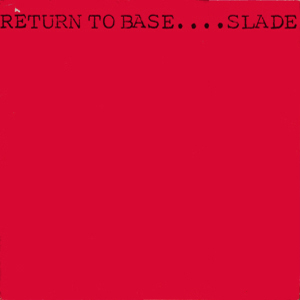
Dressed in a plain red sleeve with the stark black title in a battered typeface, the album cover was intended to reflect a no-nonsense, back-to-basics, "never-say-die" attitude, although it was noted that "it ended up looking as threadbare as much of the public assumed Slade to be." Upon asking if the album's artwork had been designed, Hill replied "It's still being done, but I understand that it is going to have a photo of a ticker-tape message on the front saying "Return To Base", in computer-like lettering. But it should be a very basic cover – so that it ties in with the "basic" reference in the title."[5]
Release
[edit]The album was released on their manager Chas Chandlers' label Barn Records on 1 October 1979 in the United Kingdom, over two and a half years since their previous studio release, Whatever Happened to Slade, which was their first album on the label.
Commercial performance
[edit]In the United Kingdom, the album continued the band's commercial failures, and found no audience other than the band's already existing fan base. As with their previous album Whatever Happened to Slade, the album did not enter the UK Albums Chart. Their seasonal party single "Okey Cokey", released in December 1979, also failed to enter the UK Singles Chart. A similar fate greeted the 12-inch extended play, Six of the Best, released in June 1980. The EP, priced at the cheap price of £1.49, contained three tracks from Return to Base and three new tracks.
The album saw success in Belgium in 1980, reaching No. 1 on the albums chart. As the album was not available in Belgium, fans in the country originally had to buy the album as an import. The album soon climbed to No. 1 on the Telemoustique chart, a weekly rock chart compiled by public votes. It also topped the Belgian radio station Impedance's daily chart on several occasions. As a result of the interest in the album, the album was released in the country by Warner Bros. in 1980.[6][26] The album climbed to number one there, as did the Belgian-only single "I'm a Rocker.[18]
In a 1980 fan club interview, Noddy Holder spoke of the success in Belgium: "What happened in Belgium was that Return to Base was available on import, and it started to climb the import charts. I don't know why, it was as much a surprise to us as it was to anybody. Warner Bros. Records then said to us, due to it starting to show some action, would we want to release it over there as a major release. We thought "why not?" – and now it's the number one album over there!"[7][18] Speaking of "I'm a Rocker", Holder said: "That was the track getting the most airplay from the album. But it's not just a case of that applying in Belgium – we've had so many people writing to us asking why we've not released it as a single. "I'm a Rocker" is not even one of our songs though – it's a Chuck Berry number."[18][26]
Initial critical reception
[edit]| Review scores | |
|---|---|
| Source | Rating |
| Record Mirror |   [27] [27] |
| Sounds | [28] |
Shortly before the release of the album, the Slade fan club newsletter editor Dave Kemp stated how he felt on the rough copy he had heard. "Having heard the rough copy of it, all I can say is that it's amazing, totally different to anything Slade have done before, you'll love it."[1][29]
At the time of release, professional reviews were overall mixed. Record Mirror stated: "Assuming that the title should be taken to mean that the group are trying to visit the territorial war grounds of their golden years in the singles charts I reckon they are in for a shock. I expect a little more than references to Big Brother, Stereo, Radio etc, in the otherwise catchy "Sign of the Times" and the reflection of "Born to Run" in "Wheels Ain't Coming Down". On "Nuts Bolts & Screws" and "My Baby's Got It" Slade start to rock, but there's nothing here to distinguish them from any other rocking combo. I wasn't expecting another "Cum On Feel the Noize" or "My Friend Stan" but just something a little more inspired. From a new band this would be a fairly good debut, from Slade I want more."[15][28] Sounds were similar in their reception, writing: "Slade have managed to pull a fair to impressive performance out of the bag with this one. Sure to new wave lugs it sounds dated, but Return to Base still rocks like a good un', utilising standard rock 'n' roll/hard rock foundations for commendable displays of tightness and old time rock bite. Noddy's got one of the all time classic rock voices as he belts through ten steamy originals and one Chuck Berry cover. Slade may have stood still, but their own brand of rock shout clout still sounds good to these biased ears."[28] Max Bell of NME was negative in his review, remarking: "Slade always were a poor man's hard rock band, appealing to the worst boys-night-out instincts. In the days when bad glam rock was the British norm this sort of muck might have fitted the bill a treat, but in 1979 who wants to hear a bunch of pathetic old has-been Flash Harrys reiterating the limitations of their puerile sordid imaginations?"[30]
A more positive review came from Wolverhampton Express and Star: "Slade haven't had a big hit for some time now, but it would be silly to write them off just yet, to judge by their new album Return to Base. There is definitely a Sixties feel to some of the songs, though others are vintage Slade. Most striking thing about the album is its variety, for Slade have loosened up a bit for this one and included much more variety of mood. It certainly pays off. Another striking factor is the guitar playing of Dave Hill, who has really been allowed to branch out on this disc. In all, it's an album which will please Slade's still huge army of fans, both for its fidelity to the Slade sound and for its inventiveness and freshness."[1] In May 1980, Jon Young of New York magazine Trouser Press reviewed the album and stated: "On Return to Base, seven of the eleven cuts connect in every possible way, for a batting average of .636. If it had been released in 1973, the classic "Nuts, Bolts and Screws" would've easily topped the UK charts. Okay, there's nothing here quite as wonderful as "Cum On Feel the Noize". But whose fault is that? This kind of music isn't meant for a vacuum! It's meant to be enjoyed! Give Slade some encouragement! You will be glad that you did!!"[31]
The album was voted No. 2 of the top three Slade albums in the Slade Fan Club Poll of 1979.[21][22]
Legacy and later reviews
[edit].jpg)
| Review scores | |
|---|---|
| Source | Rating |
| AllMusic | [32] |
| The Encyclopedia of Popular Music | [33] |
In mid-1980, by which point the band were on the verge of disbanding, the band were offered to appear at Reading Festival in August 1980 in a last minute call-up. The band only had a couple of their road crew to help them on the day. Jim Lea recalled "We had to pay to park in the public area. With no roadies, we had to carry our own gear and there was even trouble getting into the backstage area." Despite the failure of Return to Base and the band's lack of success, the performance at the festival was a success and the band became popular once again.[2] As a result of this success, several tracks from the album which the band considered the strongest reappeared on the band's next album, We'll Bring the House Down (1981), which successfully rejuvenated the band's successes, both critically and commercially.
A retrospective review from AllMusic noted that Return to Base "marks Slade's low ebb in terms of popularity and morale", and were mixed in their reception to the album, rating it two stars out of five and noting the album was "certainly not a high point for the band, but they kept on keepin' on, no matter how bad things got. Secure in the knowledge that practically no one had ever heard the thing, Slade eventually redid the record as We'll Bring the House Down, a fully realized project."[11] In early 2010, Classic Rock considered the album "superior, reputation cementing" and wrote: "We'll Bring the House Down was cobbled together quickly after the band's Reading triumph, largely from the contents of their previous (overlooked) album, Return to Base."[citation needed] Colin Harper of Record Collector said: "Searching for the UK zeitgeist, 1979's now abjectly obscure Return to Base ironically had a pleasingly diverse, reinvigorated musical palette."[34]
The album was re-released on CD in Germany in 1997 by RCA and BMG,[35] and was remastered for another CD release in Japan in 2006 by Air Mail Recordings in their Archive series as part of the band's band catalogue remasters there from the label.[36] However, the album was not remastered for its own album release in 2007 for the UK "Feel the Noize: Slade Remastered" series unlike the rest of their studio albums. Instead, the songs from the album which did not also appear on We'll Bring This House Down (1981) were remastered as bonus tracks for that album's remaster.[36] Thus Return to Base remains the only Slade album never released in the UK on CD, or re-released on any other format.
Track listing
[edit]All tracks are written by Noddy Holder and Jim Lea, except "I'm a Rocker" by Chuck Berry.
| No. | Title | Length |
|---|---|---|
| 1. | "Wheels Ain't Coming Down" | 3:40 |
| 2. | "Hold on to Your Hats" | 2:32 |
| 3. | "Chakeeta" | 2:26 |
| 4. | "Don't Waste Your Time (Back Seat Star)" | 3:28 |
| 5. | "Sign of the Times" | 3:57 |
| No. | Title | Length |
|---|---|---|
| 6. | "I'm a Rocker" | 2:46 |
| 7. | "Nuts Bolts and Screws" | 2:30 |
| 8. | "My Baby's Got It" | 2:34 |
| 9. | "I'm Mad" | 2:46 |
| 10. | "Lemme Love into Ya" | 3:26 |
| 11. | "Ginny, Ginny" | 3:38 |
Charts
[edit]| Chart (1980) | Peak position |
|---|---|
| Belgium Telemoustique Albums Chart[37] | 1 |
Personnel
[edit]- Slade
- Noddy Holder – lead vocals, rhythm guitar, producer
- Dave Hill – lead guitar, backing vocals, producer
- Jim Lea – bass, piano, synthesizer, backing vocals, producer
- Don Powell – drums, percussion, backing vocals, producer
- Additional personnel
- Andy Miller – engineer
- Dave Garland, Mark O'Donoughue – assistant engineers
- George Peckham – cutting engineer
- Eric Massey – art direction
References
[edit]- ^ a b c d e f "1979 - Slade Fan Club www.sladefanclub.com". Sladefanclub.com. Archived from the original on 21 August 2021. Retrieved 10 July 2017.
- ^ a b c We'll Bring the House Down - 2007 Salvo remaster booklet liner notes
- ^ November–December 1979 Slade News magazine.
- ^ Noddy Holder interview with Chris Charlesworth, 1983
- ^ a b Slade Fan Club Newsletter Nov–Dec 1979
- ^ a b "1980 - Slade Fan Club www.sladefanclub.com". Sladefanclub.com. Archived from the original on 21 August 2021. Retrieved 10 July 2017.
- ^ a b c Slade Fan Club Newsletter November–December 1980
- ^ "6119927_orig.jpg (546x800 pixels)". Archive.is. 14 July 2012. Archived from the original on 14 July 2012. Retrieved 18 October 2017.
- ^ Slade Supporters Club Newsletter May – June 1981
- ^ Mickey P. (26 February 2004). "From Roots To Boots!: Another Win". Sladestory.blogspot.com. Retrieved 10 August 2011.
- ^ a b Geoff Ginsberg. "Return to Base – Slade". AllMusic. Retrieved 24 December 2015.
- ^ a b Ginsberg, Geoff. "Return to Base – Slade". AllMusic. Retrieved 10 August 2011.
- ^ "1988 - Slade Fan Club www.sladefanclub.com". Sladefanclub.com. Archived from the original on 21 August 2021. Retrieved 10 July 2017.
- ^ Slade International Fan Club newsletter October – November – December 1988
- ^ a b "Slade Scrapbook Website – Cuttings 1979". Sladescrapbook.com. 27 October 1979. Archived from the original on 16 July 2011. Retrieved 10 August 2011.
- ^ "Slade – I'm a Rocker". YouTube. Archived from the original on 15 December 2021. Retrieved 10 August 2011.
- ^ "3275309_orig.jpg (561x800 pixels)". Archive.is. 15 July 2012. Archived from the original on 15 July 2012. Retrieved 18 October 2017.
- ^ a b c d "1980 - Slade Fan Club www.sladefanclub.com". Sladefanclub.com. Archived from the original on 21 August 2021. Retrieved 10 July 2017.
- ^ "SLADE". Crazeeworld.plus.com. Archived from the original on 20 October 2011. Retrieved 10 August 2011.
- ^ "Greenfields of Tong – Poland / (Instrumental) – Speed Records Ltd. – UK – FIRED 2". 45cat. Retrieved 10 August 2011.
- ^ a b "7869225_orig.jpg (544x800 pixels)". Archive.is. 14 July 2012. Archived from the original on 14 July 2012. Retrieved 18 October 2017.
- ^ a b Slade Fan Club Magazine, January–February 1980
- ^ Mickey P. (10 September 1950). "From Roots To Boots!: Slade News Issue 4". Sladestory.blogspot.com. Retrieved 10 August 2011.
- ^ "SLADE". Crazeeworld.plus.com. Archived from the original on 20 October 2011. Retrieved 10 August 2011.
- ^ "The Dummies (3) - a day in the life of The Dummies (Vinyl, LP, Album) at Discogs". Discogs. Retrieved 12 July 2017.
- ^ a b Slade Fan Club Newsletter September–October 1980
- ^ "1979 Press Cuttings". Slade Scrapbook. Archived from the original on 5 October 2021. Retrieved 10 July 2017.
- ^ a b c "SLADE Return to base". Sladeinengland.co.uk. Retrieved 10 August 2011.
- ^ Slade News – Issue 6 – November–December 1979
- ^ Bell, Max (1 December 1979). "Albums". New Musical Express. p. 41. ISSN 0028-6362.
- ^ "1979 - Slade Fan Club www.sladefanclub.com". Sladefanclub.com. Archived from the original on 21 August 2021. Retrieved 10 July 2017.
- ^ Ginsberg, Geoff. "Return to Base – Slade". AllMusic. Retrieved 10 August 2011.
- ^ Larkin, Colin (2011). The Encyclopedia of Popular Music. Omnibus Press.
- ^ "Whatever Happened To Slade? / We'll Bring The House / Till Deaf Do Us Part - Record Collector Magazine". Recordcollectormag.com. 26 May 2011. Retrieved 18 October 2017.
- ^ "Slade – Return To Base (CD) at Discogs". Discogs. Retrieved 24 December 2015.
- ^ a b "Slade – Return To Base (CD, Album) at Discogs". Discogs. 27 December 2006. Retrieved 24 December 2015.
- ^ "Hot Top 20". 26 August 1980. Archived from the original on 16 July 2011. Retrieved 24 August 2023.


Return to Base
View on GrokipediaDevelopment
Background
Following their peak in the glam rock era during the early 1970s, Slade experienced a significant decline in popularity after 1974, as the rise of punk rock shifted musical tastes away from their established style. The band's chart success in the UK, which had included six number-one singles between 1971 and 1974, began to wane, with subsequent releases failing to replicate earlier commercial triumphs. This downturn was exacerbated by unsuccessful attempts to break into the American market, including extensive tours in 1975 and 1976 that yielded little recognition and financial strain, ultimately leading the group to return to the UK in late 1976 amid low morale and internal frustrations.[4] As part of their reinvention, Slade distanced themselves from the skinhead image that had defined their early years and the glittery glam aesthetics of their mid-1970s output, opting instead for a more straightforward hard rock presentation to align with the contemporary punk-influenced energy. Internally, frontman Noddy Holder advocated strongly for a return to the band's rock roots, emphasizing high-energy performances and simpler song structures to recapture their initial appeal, while bassist Jim Lea played a central role in songwriting, contributing melodic and structural ideas that shaped their evolving sound during 1978 and 1979.[4][5] In response to their challenges with major labels, Slade parted ways with Polydor Records after their 1976 album Nobody's Fools and signed with the newly formed independent Barn Records in 1977, which was established by their manager Chas Chandler to provide greater creative control and financial flexibility. This move marked a key turning point, allowing the band to produce material on their own terms without the constraints of a major label's expectations. By early 1979, with Barn Records fully operational as their outlet, Slade prepared for what would become Return to Base, an album intended to signal their artistic reset and determination to persist despite earlier setbacks. However, the album's release did not immediately revive their fortunes, as they continued to play small venues and faced poor single sales, nearly leading to the band's disbandment before a pivotal performance at the 1980 Reading Festival.[6][5]Recording
The recording of Return to Base took place primarily at Portland Recording Studios in London during 1979, ahead of the album's October release on the band's independent label Barn Records.[7] This marked Slade's first self-produced effort, with the band members—Noddy Holder, Dave Hill, Jim Lea, and Don Powell—handling production duties collectively after deciding to self-produce while retaining longtime associate Chas Chandler as manager.[8] The sessions, which lasted about six weeks and originally aimed to record 20 songs before selecting 11, emphasized capturing the group's live performance energy, utilizing 24-track recording technology typical of the era to achieve a raw, band-centric sound with limited overdubs.[9] Engineering was led by Andy "Pugwash" Miller, who had previously worked with acts like Status Quo, assisted by Dave Garland and Mark O'Donoghue.[7] The production operated under budget constraints inherent to Barn Records' independent status, which influenced decisions to minimize external costs and leverage the studio's in-house facilities for both recording and mixing.[6] During the process, tensions arose over song selection as the band sought to blend new material with efforts to recapture their earlier commercial appeal, while Holder reworked several vocal takes to match the album's high-energy demands.[10]Musical content
Style and influences
Return to Base represents Slade's shift toward a more straightforward hard rock sound, moving away from the glam rock elements that defined their early 1970s success toward a tougher, rock-oriented approach similar to their 1977 album Whatever Happened to Slade?[11] The album draws influences from 1950s rock 'n' roll, incorporating covers such as Chuck Berry's "I'm a Rocker" and originals that evoke the era's energetic boogie style, emphasizing simple chord progressions and frantic rhythms.[12][13] Key characteristics include crunchy, effects-heavy guitar riffs and double-tracked vocals that contribute to a barroom boogie feel, with the rhythm section—particularly Don Powell's driving drumming—providing a solid foundation for the band's raw energy.[13][11] Thematically, the album reflects a nostalgia for rock's origins, with lyrics centered on dancing, everyday struggles, and high-spirited rebellion, contrasting the more commercial pop hooks of prior releases by prioritizing unpolished, live-like intensity over polished production.[13] This raw approach, less reliant on elaborate hooks, underscores Slade's return to their working-class rock roots amid a period of commercial decline.[11]Side one
Side one of Return to Base consists of five tracks that establish the album's energetic hard rock tone, drawing on Slade's established sound of driving rhythms and anthemic choruses to signal a return to their rock foundations following a period of commercial challenges. The sequencing builds momentum from the opener's tense narrative to the side's closing ballad-like closer, emphasizing themes of urgency, romance, and rebellion that align with the band's revival of straightforward, no-frills rock 'n' roll. The opening track, "Wheels Ain't Coming Down", is a high-octane rocker written by Noddy Holder and Jim Lea, clocking in at 3:40. It follows a verse-chorus structure with urgent verses building to a powerful, repetitive chorus that captures the panic of a near-disaster during a flight landing. Lyrically, the song recounts a real-life scare experienced by the band, with lines like "The wheels ain't coming down, the wheels ain't coming down" evoking the chaos of a malfunctioning 1950s prop plane from LA airport to a radio station appearance, based on an incident involving Holder and Lea. Instrumentation features Dave Hill's gritty guitar riffs and Lea's propulsive bass, underscoring the song's raw energy and contributing to the album's rock revival by prioritizing adrenaline-fueled storytelling over glam excess.[14][15] Next, "Hold On to Your Hats" (2:33), also penned by Holder and Lea, shifts to a party anthem vibe in a compact verse-chorus format. The lyrics celebrate a wild night out, urging listeners to "hold on to your hats now" amid promises of staying "all night" with infectious enthusiasm. The track's upbeat tempo is driven by Powell's steady drumming and Hill's choppy guitar work, creating a sense of exhilarating chaos that fits the album's theme of recapturing Slade's live-wire rock spirit. This song exemplifies the band's focus on fun, foot-stomping rockers to re-engage fans.[16] "Chakeeta" (2:28) maintains the side's momentum with a playful, riff-heavy number co-written by the band, structured around simple verses leading into a chant-like chorus. Lyrical themes revolve around infatuation and flirtation, with nonsensical, catchy phrases like the title evoking a lighthearted crush. Hill's lead guitar provides the central hook, supported by Lea's multi-instrumental touches on piano and synthesizer, blending rock drive with subtle pop flair to reinforce the album's revival of Slade's accessible, hook-filled hard rock style.[12] The fourth track, "Don't Waste Your Time (Back Seat Star)" (3:28), explores romantic regret in a mid-tempo verse-chorus arrangement, written by Holder and Lea. The lyrics lament a fleeting encounter in a car, warning against "wasting time" on superficial love with lines like "Don't waste your time on a back seat star." Instrumentation highlights Holder's raspy delivery over a steady groove from Lea on bass and Powell on drums, with Hill's guitar adding emotional bite; this track contributes to the album's rock theme by grounding personal narratives in gritty, relatable rock balladry.[12] Closing side one, "Sign of the Times" (3:57) slows to a more reflective hard rock ballad, structured with extended verses building to an anthemic chorus, and was released as a single in October 1979. Co-written by the band, its lyrics address disillusionment with modern life and a call for change, using the title as a metaphor for societal shifts. The arrangement features prominent guitar solos from Hill and atmospheric keys from Lea, culminating in a soaring vocal performance by Holder that ties into the album's revival ethos by blending introspection with powerful rock dynamics. Record Mirror described it as "the nearest thing to a hit single" on the album, praising its commercial potential.Side two
Side two of Return to Base shifts the album's energy from the introspective A-side, incorporating a mix of originals and a notable cover to culminate in a raw, roots-rock finale that echoes the band's early glam influences with added maturity. The five tracks build a narrative arc of redemption and intensity, starting with a rock 'n' roll cover and escalating to high-energy anthems before closing on a seductive ballad. This side emphasizes boogie rhythms and guitar effects, reinforcing the album's motif of returning to foundational rock elements amid evolving production.[12] The side opens with "I'm a Rocker", a cover of Chuck Berry's 1973 song clocking in at 3:28, reinterpreted in a hard rock style with driving rhythms and anthemic choruses. Lyrically, it celebrates the rebellious spirit of rock music, with Holder's energetic vocals and Hill's crunchy riffs capturing Berry's original boogie essence while adding Slade's raw power. The track's fast-paced structure and Powell's pounding drums highlight the album's 1950s influences, and it became a fan favorite, topping charts in Belgium in 1980.[12] Next, "Nuts Bolts and Screws" (3:35), an original by Holder and Lea, delivers a mid-tempo rocker with verse-chorus form and themes of mechanical fixation and everyday ingenuity. The lyrics use hardware metaphors for relationships, delivered with Holder's gritty shout over Lea's bass groove and Hill's riff-heavy guitars, creating a sturdy, no-nonsense hard rock vibe that AllMusic ranks among Slade's strongest tracks for its hooky simplicity.[12] "Rocks 'n' Roll Preacher" is not on the album; instead, "My Baby's Got It" (3:19) injects upbeat energy in a boogie rock style, written by the band with a verse-bridge-chorus structure. Lyrical themes focus on romantic possession and excitement, with handclaps, Powell's shuffling drums, and Hill's twangy guitar evoking 1950s rock 'n' roll revivalism, serving as the side's energetic pivot toward the album's rootsy core.[12] The fourth track, "I'm Mad" (3:06), another original by Holder and Lea, adopts an acoustic-driven mid-tempo groove with sixties-style chord changes, exploring themes of fantasy and frustration in a verse-chorus arrangement. Holder's emotive vocals pair with Lea's piano accents and subtle percussion, providing emotional contrast to the album's harder moments through its introspective, folk-tinged rock approach.[12] Closing side two, "Lemme Love into Ya" (3:12) is a minor-key hard rock ballad co-written by the band, featuring backwards tremolo guitar effects and a seductive verse-chorus build. Lyrically, it pleads for romantic intimacy amid tension, with Holder's passionate delivery, Hill's atmospheric solos, and a steady rhythm section creating a sultry intensity; a staple in live sets, it ranked second in the 1979 Slade fan club poll.[12] Collectively, these tracks escalate from classic rock homage to personal expression, with boogie motifs and guitar dynamics building momentum toward the closing ballad, underscoring the album's return-to-roots motif through a blend of covers, originals, and homage that distinguishes side two from the more narrative-driven A-side.[12]Title and artwork
Title origin
The title Return to Base derives from a line in the album's track "Sign of the Times": "Returning to base from a day out in space will be easy I know". The phrase "return to base" originates from military and aviation slang, where it denotes an order for aircraft or personnel to proceed back to their home base after completing a mission or sortie. In the context of Slade's album, the title symbolizes the band's metaphorical homecoming to their British rock roots and Wolverhampton origins following a period of commercial setbacks, particularly their failed attempts to establish a foothold in the US market during the mid-1970s. After extended time abroad with little success, Slade returned to the UK in 1976, and by the release of Return to Base in 1979, all four members had resettled in their hometown of Wolverhampton. Noddy Holder and Jim Lea, who produced the album, selected the title to evoke a sense of simplicity and reconnection with their foundational sound, moving away from the glam excesses of their earlier hits toward a rawer, hard rock approach.Cover art and packaging
Released on 1 October 1979 by Barn Records, the cover art for Return to Base consists of a black-and-white photograph of the band members standing against a brick wall with the album title rendered in graffiti-style white lettering, conveying a raw, gritty rock 'n' roll aesthetic that underscores the album's back-to-basics ethos.[9] The image is framed on a plain red sleeve with the album title also in stark black lettering using a distressed, battered typeface on the spine and back, creating a no-frills visual that aligns with the record's independent production.[17] The LP edition features a gatefold format, with the inner sleeve providing full lyrics for all tracks alongside the Barn Records logo printed on both the sleeve and vinyl labels.[7] This packaging reflects the album's indie status through its simple, utilitarian design, eschewing elaborate graphics in favor of straightforward presentation; some early UK pressings include handwritten production notes on the sleeve edges for added authenticity.[9] International releases exhibit variations in packaging, such as the UK version's glossy red sleeve contrasting with the Netherlands edition's standard WEA branding on a similar red cover, while cassette versions in Belgium omit the gatefold but retain the core artwork and lyrics insert.[9] These differences highlight regional distribution adaptations without altering the core visual identity.Release
Release details
Return to Base was released on 1 October 1979 in the United Kingdom by the independent label Barn Records under catalogue number NARB 003.[18] The album was issued in the standard vinyl LP format, marking Slade's eighth studio album and their first full-length release following the completion of recording sessions earlier that year.[9] Internationally, the album saw limited distribution, with a release in the Netherlands in 1980 through WEA Records under catalogue number 58192, also in LP format.[19] In Belgium, Barn Records issued a cassette version the same year, catalogued as WEAN 458192 and featuring stereo audio.[7] These editions maintained the original UK track listing without alterations or bonus content.[9] Barn Records handled primary distribution during this period, primarily through UK-based independent networks such as Pinnacle.[20]Promotion and singles
To promote Return to Base, Slade released two singles ahead of and coinciding with the album's launch on Barn Records. The lead single, "Ginny, Ginny", was issued on 18 May 1979 as a 7-inch vinyl single with the B-side "Dizzy Mama". Written by Noddy Holder and Jim Lea, it was produced by the band and engineered at Portland Studios. A second single, "Sign of the Times", followed on 26 October 1979, also on 7-inch vinyl, backed with the non-album track "Not Tonight Josephine". Like the lead single, it was self-produced by Slade and aimed to capture a punk-influenced energy reflective of the late 1970s rock scene. Both singles were distributed through Pinnacle in the UK, available in standard and limited yellow vinyl editions for "Ginny, Ginny".[21][22] Promotional efforts emphasized rebuilding the band's domestic audience after years of international touring and declining chart success. Slade undertook a 14-date UK tour in October 1979, kicking off on 5 October at the University of Southampton Students' Union and including stops at venues like the Music Machine in London on 20 October. The tour focused on high-energy live performances of new material from Return to Base alongside fan favorites, with ticket prices set at £3.00 to encourage attendance. This strategy highlighted the band's raw stage presence as a core draw, positioning the shows as a "return to base" for their British roots.[23][24][25] Television exposure was limited but targeted key music programs to showcase the album's tracks. In 1979, Slade appeared on the UK show Get It Together, performing songs including "Okey Cokey" from Return to Base and older hits like "My Baby's Got It". These appearances aimed to leverage the band's visual flair and charisma for broader visibility. Radio promotion relied on grassroots efforts, with the band and label urging fans to request the singles on BBC Radio One and local stations to build airplay momentum.[26] Marketing tactics centered on cost-effective grassroots and press outreach due to Barn Records' independent status. Advertisements appeared in music publications like NME and Melody Maker, featuring tour dates and single plugs to target rock enthusiasts. Posters and flyers promoted the UK tour, emphasizing Slade's comeback narrative to re-engage lapsed fans. However, the label's constrained resources restricted international promotion, confining efforts primarily to domestic markets with no major overseas campaigns or additional formats like picture sleeves for singles beyond the UK.[27]Commercial performance
Chart positions
Return to Base failed to enter the UK Albums Chart Top 75, despite associated singles like "Ginny, Ginny" and "Sign of the Times" not appearing in the official Top 75. This marked Slade's worst commercial performance for a studio album at the time, a sharp decline from their dominant 1970s era, during which they achieved six Top 10 albums including three number-one releases such as Slayed? (1972), Old New Borrowed and Blue (1974), and Slade in Flame (1974).[28] Internationally, the album saw limited success, failing to register on major charts such as the US Billboard 200, as it received no release in the United States. It did, however, reach number 1 on the Belgium (Flemish) Telemoustique Albums Chart in 1980. The underwhelming chart results were influenced by the album's issuance on the independent Barn Records label, which provided minimal promotional backing compared to Slade's prior major-label deals with Polydor, and by the broader music industry's pivot toward punk and new wave in the late 1970s, which diminished appetite for established glam rock acts.[29]Sales and certifications
Return to Base achieved limited commercial success upon its release, selling very few copies in the initial months and failing to generate substantial revenue for the band or their independent label, Barn Records. The album's poor market reception was compounded by the band's waning popularity in the late 1970s. This underwhelming performance highlighted the challenges faced by independent releases during a period dominated by major label acts and shifting musical tastes away from glam rock. The album received no official certifications from industry organizations such as the British Phonographic Industry (BPI) or the Recording Industry Association of America (RIAA), which typically award gold or platinum status for sales thresholds of 100,000 and 500,000 units, respectively, in their respective markets. The absence of such accolades further underscored Return to Base's status as a commercial disappointment, distinguishing it from Slade's earlier certified successes like Sladest (silver by BPI) and Old New Borrowed and Blue (gold by BPI). Over the long term, the album's visibility and modest additional sales were supported by its inclusion in subsequent Slade compilations and fan-oriented reissues, though these did not elevate it to broader commercial viability.Reception
Initial reviews
Upon its release in October 1979, Return to Base received mixed initial reviews in UK music publications, reflecting Slade's effort to recapture their rock energy amid the punk explosion, though coverage was sparse due to the album's independent issuance on Barn Records.[30] Sounds magazine offered positive praise, awarding three stars and commending the album's raw energy and return to form, stating that Slade had "managed to pull a fair to impressive performance out of the bag with this one" and that, while the band "may have stood still," their "own brand of rock shout clout still sounds good to these biased ears."[31] Conversely, negative critiques highlighted the album's perceived outdatedness in the rising punk era; NME described Slade as a "poor man's hard rock band" lacking innovation, questioning "in 1979 who wants to hear a bunch of pathetic old has-been Flash Harrys reiterating the limitations of their puerile sordid imaginations?"[32] Record Mirror echoed some disappointment with a three-star rating, calling it "a fairly good debut" for a new band but insufficient for Slade, as "from Slade I want more."[30]Retrospective assessments
In the decades following its release, Return to Base has been reassessed as a marker of Slade's resilience during a career nadir, transitioning from commercial disappointment to a valued entry in their discography for its unpolished rock ethos. By the 2010s, reissues and compilations prompted further positive reevaluations. Critic aggregates reflect this shift: Fan-driven sites like RateYourMusic average 3.2 out of 5 from over 220 ratings, with reviewers frequently praising the album's consistency for dedicated listeners.[20] The album's perception has evolved in glam rock retrospectives from a "flop" that nearly ended Slade's run—prompting breakup considerations before their Reading Festival breakthrough—to a cult favorite appreciated for its straightforward rock revival and live-ready anthems. In a Trouser Press interview, drummer Don Powell reflected on citing "I'm a Rocker" as a timeless stage staple, while sharing the real-life aviation scare inspiring "Wheels Ain't Coming Down."[11]Legacy
Reissues and remastering
Following its theatrical release, R2B: Return to Base received several home video releases but no notable remastering efforts as of November 2025. A Blu-ray edition was issued in Hong Kong on December 21, 2012, by Vicol Entertainment, featuring the film in its original aspect ratio with Korean audio and English subtitles.[33] In South Korea, a Blu-ray DigiPack version was released by CJ Entertainment in 2012, including special features such as behind-the-scenes footage of the aerial sequences.[34] For North American markets, the film was retitled Black Eagle and released on DVD by Phase 4 Films on January 29, 2013, with English dubbing and subtitles, targeting aviation enthusiasts.[35] This edition became available for purchase on platforms like Amazon, where it remains in print as of 2025.[36] The film has also appeared on streaming services, including a full English-subtitled version uploaded to Bilibili in December 2022, contributing to its accessibility in Southeast Asia.[37] No 4K UHD or official remastered editions have been announced, though the original production's high-quality aerial footage shot with Republic of Korea Air Force F-15K jets continues to be praised for its realism without digital enhancements.Cultural impact and reappraisal
R2B: Return to Base holds a niche place in South Korean cinema as one of the few military aviation films, often dubbed the "Korean Top Gun" for its loose inspiration from the 1986 American film and its emphasis on high-stakes dogfights and pilot camaraderie.[2] Produced with direct cooperation from the Republic of Korea Air Force, it highlighted modern tensions on the Korean Peninsula, blending action with themes of duty and redemption, and was released to coincide with the 60th anniversary of the Korean War armistice. Despite underperforming at the box office with approximately 1.2 million admissions domestically against an $8 million budget, grossing $7.3 million worldwide, it sold to 30 countries, expanding its international footprint.[38] In retrospective assessments, the film has garnered cult status among aviation and military film enthusiasts for its authentic F-15K sequences, which utilized real aircraft rather than extensive CGI. A 2020 reaction video by fighter pilot reviewer "Mover" on YouTube praised its technical accuracy, boosting online visibility.[39] The 2022 release of Top Gun: Maverick sparked renewed interest, with online discussions on platforms like Reddit in 2023–2024 recommending R2B as a comparable non-Hollywood alternative.[40] As of 2025, it is occasionally featured in lists of anti-communist Korean films and retrospectives on Rain's pre-military career, though critics continue to note its clichéd narrative as a limitation.[41] No major awards followed its release, but its production marked a milestone in Korean Air Force-media collaborations.Credits
Cast
- Rain as Captain Jung Tae-yoon
- Shin Se-kyung as Technical Sergeant Yoo Se-young
- Yoo Jun-sang as Major Lee Cheol-hee
- Lee Ha-na as Captain Oh Yoo-jin
- Kim Sung-soo as Major Park Dae-suh
- Lee Jong-suk as First Lieutenant Ji Seok-hyun
- Jung Kyung-ho as Captain Jo Tae-bong
- Jung Suk-won as Technical Sergeant Choi Min-ho
- Jo Sung-ha as Brigadier General Choi Byeong-gil
- Oh Dal-su as Master Sergeant Min Dong-phil
Production
- Directed by Kim Dong-won
- Written by Kim Dong-won
- Produced by Jang Tae-gon, Kim Dong-won
- Cinematography by Kim Hyo-jin
- Edited by Shin Min-kyung
- Music by Lee Jae-hak
- Production companies: Red Muffler Film, CJ Entertainment, Zoomoney Entertainment
- Distributed by CJ Entertainment