Hubbry Logo
Richard AdamsRichard AdamsMain
Open search
Richard Adams
Community hub
Richard Adams
logo
8 pages, 0 posts
0 subscribers
Be the first to start a discussion here.
Richard Adams
Richard Adams
from Wikipedia

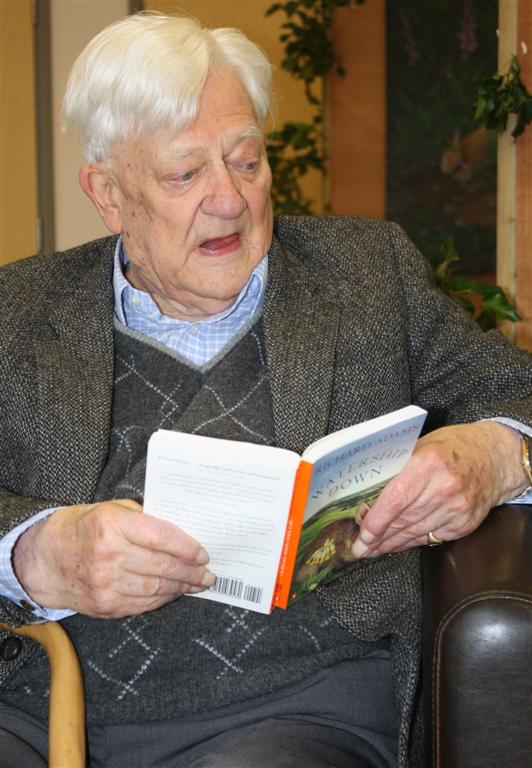
Richard George Adams FRSL (10 May 1920[a] – 24 December 2016) was an English novelist. He is best known for his debut novel Watership Down which achieved international acclaim. His other works included Maia, Shardik and The Plague Dogs. He studied Modern History at Worcester College, Oxford, before serving in the British Army during World War II. After completing his studies, he joined the British Civil Service. In 1974, two years after Watership Down was published, Adams became a full-time author.[3][4]

Key Information

Early life and education

[edit]

Richard Adams was born on 10 May 1920 in Newbury, Berkshire, the son of Lillian Rosa (née Button) and Evelyn George Beadon Adams, a doctor.[1] He attended Horris Hill School from 1926 to 1933 and Bradfield College from 1933 to 1938. In 1938, he went to Worcester College, Oxford, to read Modern History. In July 1940, Adams was called up to join the British Army. He was commissioned into the Royal Army Service Corps[5] and was selected for the Airborne Company, where he worked as a brigade liaison. He served in Palestine, Europe, and East Asia but saw no direct action against either the Germans or the Japanese.[6]

After leaving the army in 1946, Adams returned to Worcester College to continue his studies for a further two years. He received a bachelor's degree in 1948, proceeding MA in 1953.[7]

Civil Service career

[edit]

After graduating in 1948, Adams joined the Civil Service, rising to the rank of Assistant Secretary to the Ministry of Housing and Local Government, later part of the Department of the Environment. He began to write his own stories in his spare time, reading them to his children and later on, to his grandchildren.[8]

Writing career

[edit]

Adams originally began telling the story that would become Watership Down to his two daughters on a car trip.[9] They eventually insisted that he publish it as a book. He began writing in 1966, taking two years to complete it.[9] In 1972, after four publishers and three writers' agencies turned down the manuscript, Rex Collings agreed to publish the work.[8] The book gained international acclaim almost immediately for reinvigorating anthropomorphic fiction with naturalism.[9][10]

Over the next few years Watership Down sold over a million copies worldwide. Adams won both of the most prestigious British children's book awards, one of six authors to do so: the Carnegie Medal and the Guardian Children's Fiction Prize.[11][12][b] In 1974, following publication of his second novel, Shardik, he left the Civil Service to become a full-time author. He was elected a Fellow of the Royal Society of Literature in 1975.[13]

At one point, Adams served as writer-in-residence at the University of Florida[14] and at Hollins University in Virginia.[3] Adams was the recipient of the inaugural Whitchurch Arts Award for inspiration in January 2010, presented at the Watership Down pub in Freefolk, Hampshire.[15][16] In 2015 he was awarded an honorary doctorate by the University of Winchester.[17]

Animal welfare

[edit]

Adams was a strong advocate of animal welfare.[18] In 1980, Adams served two years as president of the RSPCA.[19][20][21] He resigned in 1982, commenting that the Society "seemed to be more concerned with each other than with the animals".[18][20] Adams was involved with Cruelty Free International.[22] He was also a patron of Animal Aid.[23]

Besides campaigning against fur, Adams wrote The Plague Dogs to satirise animal experimentation (as well as government and the tabloid press).[24] He also made a voyage through the Antarctic in the company of the ornithologist Ronald Lockley.[25] Just before his 90th birthday, he wrote a new story for a charity book, Gentle Footprints, to raise funds for the Born Free Foundation.[8]

Personal life

[edit]

In 1949, Adams married Barbara Elizabeth, daughter of RAF Squadron-Leader Edward Fox Dyke Acland, son of the barrister and judge Sir Reginald Brodie Dyke Acland, whose father, the scientist Henry Wentworth Dyke Acland (himself created a baronet of St Mary Magdalen, Oxford) descended from the Acland baronets of Columb John[26][27] in Devon.

Until his death, Adams lived with his wife in Church Street, Whitchurch, Hampshire, within 10 miles (16 km) of his birthplace. Their daughters, to whom Adams originally related the tales that became Watership Down, are Juliet and Rosamond.[8][28] Adams celebrated his 90th birthday in 2010 with a party at the White Hart in Whitchurch, where Sir George Young presented him with a painting by a local artist. Adams wrote a poetic piece celebrating his home of the past 28 years.[29][30]

Adams died on 24 December 2016 at the age of 96 in Oxford, from complications of heart failure and a blood disorder.[1][31][32][33][34]

Works

[edit]

Notes

[edit]

References

[edit]
[edit]
Revisions and contributorsEdit on WikipediaRead on Wikipedia
from Grokipedia

Richard George Adams (9 May 1920 – 24 December 2016) was an English novelist renowned for his debut work (1972), an anthropomorphic adventure novel depicting a group of s fleeing their warren in search of a new home, which became a global bestseller with over 50 million copies sold. Born in , to a physician father, Adams developed an early affinity for the English countryside that informed his writing, drawing on personal observations of during family car trips to invent the rabbit protagonists for his young daughters.
After serving in the during the Second with the Royal Army Service Corps and airborne units, Adams pursued a degree in history at Oxford University before entering the , where he rose to assistant secretary in the Department of the Environment by 1974. The success of , initially rejected by major publishers but championed by a , enabled him to resign from government work and write full-time; the novel earned the Carnegie Medal and was adapted into an animated film in 1978. Adams produced subsequent works including (1974), a fantasy epic, and The Plague Dogs (1977), a critique of animal experimentation, though these received more mixed critical reception. A committed advocate for , Adams served briefly as president of the Royal Society for the Prevention of Cruelty to Animals () in 1980–1982, resigning amid internal disputes over policy, and campaigned against practices like and the fur trade. His oeuvre, blending mythic storytelling with naturalist detail, reinvigorated anthropomorphic fiction while reflecting his firsthand military experiences and environmental concerns, though some later novels incorporated controversial erotic elements that drew criticism.

Early Life and Education

Childhood and Family Background

Richard George Adams was born on 9 May 1920 in , , the youngest of three children to Evelyn George Beadon Adams, a country doctor and surgeon, and his wife Lilian Rosa (née Button), a homemaker. The family belonged to the , residing in a rural outside Newbury where Adams experienced an isolated yet exploratory childhood amid the rolling countryside. His father's medical profession and the family's countryside setting exposed him from an early age to the rhythms of rural life, including interactions with local and domestic animals. One formative early memory involved witnessing a local man pushing a handcart laden with down the street, an incident that occurred while Adams walked hand-in-hand with his mother and profoundly impressed upon him the reality of through direct . This event, recounted in his The Day Gone By, highlighted the unvarnished aspects of rural existence, fostering Adams's keen interest in world and the behaviors of s unfiltered by abstract theories. Such experiences in the bucolic landscape encouraged solitary wanderings and a disciplined attentiveness to empirical details of , , and seasonal changes, shaping his foundational rooted in firsthand encounters rather than mediated narratives.

Formal Education

Richard Adams attended Horris Hill preparatory school from 1926 to 1933 before proceeding to , a public in , for his secondary education from 1933 to 1938. At , the curriculum emphasized traditional subjects including languages and history, laying a foundation in disciplined scholarship that informed his later analytical approach to narrative construction. In 1938, Adams secured a to , where he commenced studies in Modern History. The program focused on archival evidence and chronological causation, training students in source-critical evaluation over speculative reinterpretations. Wartime circumstances delayed completion, but Adams resumed and obtained his degree in Modern History in 1948. This rigorous historical training cultivated his preference for grounded realism in storytelling, prioritizing observable patterns and consequences drawn from primary accounts.

World War II Military Service

Richard Adams enlisted in the British Army in 1940, interrupting his studies at Worcester College, Oxford, following the outbreak of World War II. Commissioned as a second lieutenant in the Royal Army Service Corps (RASC), he initially served in a petrol supply company in Northern Ireland before transferring to airborne duties. Adams petitioned for assignment to the 1st Airborne Division despite a self-described nervous disposition and was posted to the 250th (Airborne) Light Composite Company, RASC, where he commanded C Platoon under Major John Gifford. His service spanned multiple theaters, including Palestine and the Western Desert in the Middle East, Europe, and the Far East, with logistical responsibilities critical to airborne operations amid harsh combat conditions. Adams completed parachute training (Course 147) at RAF Ringway from December 1944 to January 1945, equipping him for potential drops, though his unit focused on supply and support roles rather than direct assault at events like the Battle of Arnhem. Exposure to frontline realities—such as the chaos of desert warfare, the discipline required for airborne logistics, and the high stakes of hierarchical command in defeating Axis forces—instilled a keen awareness of mortality, rapid decision-making, and the fragility of ordered structures under threat. Demobilized in 1946 after six years of service, Adams returned to civilian life with a grounded perspective on human (and animal) survival, prioritizing practical agency and natural hierarchies over abstract ideologies. These wartime encounters, including observations of camaraderie and leadership amid totalitarian aggression, later informed the realistic depictions of threat evasion, , and resilient authority figures in Watership Down, with specific rabbit protagonists modeled on fellow officers and soldiers he encountered.

Civil Service Career

Entry and Key Positions

Richard Adams joined the British in 1948, initially working in the Ministry of Housing and , where he managed administrative tasks related to housing policy and local governance. His entry-level role as an assistant principal involved routine bureaucratic duties, such as drafting reports and coordinating departmental operations, without involvement in high-level policymaking. Over the next two decades, Adams progressed to principal and higher administrative grades within the same ministry, gaining experience in areas like pollution control and environmental administration, including oversight of clean air programs aimed at mitigating coal-related . In 1968, following departmental reorganization, he advanced to in the newly formed Department of the Environment, a mid-senior position focused on implementing policies rather than originating them. This career trajectory provided Adams with prolonged exposure to governmental procedures, revealing operational inefficiencies such as inter-departmental delays and rigid hierarchies, while developing skills in precise and of human interactions under constraint—attributes evident in his methodical approach to later endeavors. His stable tenure until 1974 offered financial reliability amid post-war economic recovery, yet underscored the conformity inherent in culture, where innovation often yielded to procedural adherence.

Responsibilities and Experiences

Adams entered the British Civil Service in 1948, following his graduation from Oxford University, and initially served in the Ministry of Housing and Local Government. Over the next two decades, he held a variety of administrative roles within the ministry, which focused on , housing policy, and local governance initiatives. By 1968, after the ministry's reorganization into the Department of the Environment, Adams had advanced to the position of , overseeing policy implementation in environmental matters. A key aspect of his responsibilities involved managing the clean air programme, which targeted reduction, particularly from combustion in households and industry—a response to events like the 1952 Great Smog of that caused thousands of deaths. Adams contributed to the development and enforcement of air quality standards for , helping to advance legislation such as the Clean Air Act of 1956, which restricted smoke emissions and promoted smokeless fuels. His work extended to infrastructure projects, including planning for the Thames Barrage to mitigate flooding risks in , demonstrating a practical approach to challenges grounded in observable causal factors like tidal surges and urban development pressures. Throughout his 26-year tenure, Adams navigated the procedural demands of , where policy formulation often prioritized regulatory frameworks over direct field observations of natural systems. These experiences highlighted the tensions between centralized directives and localized realities, such as balancing housing expansion with pollution controls amid post-war reconstruction. He retired in 1974 at age 54, shortly after the commercial breakthrough of in 1972 provided financial independence, enabling a full transition to literary pursuits without economic compulsion.

Literary Career

Origins of Writing and Watership Down

In 1970, Richard Adams, then a civil servant, began improvising tales about a group of rabbits fleeing their warren to entertain his daughters, Juliet and Rosamond, during long car drives across . The stories originated spontaneously on a trip to their grandmother's house, drawing initial inspiration from a report on a development threatening a nearby colony, which sparked Adams' interest in animal displacement. The girls' enthusiasm prompted him to expand the narrative over subsequent journeys, incorporating elements of adventure and peril, before committing it to paper at their urging; the resulting manuscript, drafted primarily in evenings and weekends from late 1970 to early 1971, totaled around 500 pages. The completed work faced rejection from thirteen publishers, who deemed it overly lengthy, mismatched in tone—mature language ill-suited to animal protagonists—and unappealing for lacking cuddly, anthropomorphic rabbits typical of . Persistence led to acceptance by Rex Collings, a small London-based independent publisher operating from a one-man operation, who issued the first edition in November 1972 with an initial print run of 2,500 copies and no advance payment to Adams. Grounded in empirical research—Adams consulted naturalists on rabbit , , and predators, as well as drawing on British folklore for the mythic rabbit figure El-ahrairah—the eschewed fantasy whimsy for a realist depiction of survival amid environmental threats and inter-warren conflicts. Watership Down's breakthrough came rapidly post-publication, with Macmillan acquiring U.S. rights and sales surging to over 50 million copies worldwide across translations into more than 18 languages by the late , fueled by word-of-mouth acclaim rather than . A later dispute over rights, involving U.S. producer Martin Rosen who had directed the 1978 animated version under a 1976 contract limited to motion pictures, culminated in a 2020 English victory for Adams' estate; the ruling invalidated Rosen's broader claims, restoring full control to the family and preventing unauthorized "trivial" adaptations, thus preserving the work's integrity amid commercial exploitation attempts.

Subsequent Novels and Themes

Adams's second novel, Shardik, published in 1974, is a fantasy set in the fictional Beklan Empire, centering on a hunter named Kelderek who encounters a gigantic, injured emerging from a forest fire. The bear is interpreted by locals as the reincarnation of their god , sparking a messianic movement that escalates into religious wars, , and political upheaval as Kelderek becomes its . The narrative critiques the human tendency to project divine meaning onto natural phenomena, exploring how belief systems drive conflict and distort reality, with the bear's ambiguous status—never confirmed as —highlighting themes of , , and the perils of . Reception was mixed, praised for its serious examination of religion's sway over behavior and its vivid depiction of war and power dynamics, though some critics noted its dense, unrelenting grimness. In The Plague Dogs (1977), Adams depicts two dogs—Rowf, a black mongrel subjected to repeated experiments in a research facility, and Snitter, a altered by —escaping into the English countryside where they scavenge and evade capture. Falsely rumored to carry due to the lab's secretive experiments, the dogs face a nationwide hunt, exposing the brutal realities of and institutional indifference to animal suffering. The story underscores documented cruelties in scientific testing, such as survival drownings and cerebral modifications, framing them as evidence-based indictments of needless torment rather than abstract ethical appeals. Critics lauded its emotional impact and critique of human-animal relations but faulted occasional whimsy and sentimentality for diluting the horror. Later novels included (1984), a lengthy epic returning to the Beklan Empire, following a teenage peasant girl sold into who rises through sexual intrigue, warfare, and imperial , marked by explicit portrayals of exploitation and power. Its reception highlighted the novel's ambitious scope and detailed world-building but noted controversy over graphic sexuality, with sales falling short of earlier successes. Traveller (1988), narrated from the viewpoint of Confederate General Robert E. Lee's horse, recounts the American Civil War's battles and logistics through equine observations of human folly and loyalty. Reviewers commended its inventive historical fidelity and Southern dialect authenticity, though it achieved modest commercial impact compared to Adams's debut. These works blended anthropomorphic elements with realism, often prioritizing adventure and critique over broad acclaim.

Literary Style and Influences

Adams' literary style featured anthropomorphic depictions of animals that prioritized ecological realism and behavioral authenticity over sentimental or idealized portrayals, drawing on detailed observations of to construct narratives driven by necessities, territorial instincts, and environmental pressures. In works like (1972), rabbit protagonists exhibit hierarchies, leadership struggles, and adaptive strategies reflective of real-world lagomorph , such as tharn-induced under threat or oestrous-driven social dynamics, eschewing Disney-esque for a framework where animal agency emerges from causal mechanisms like predation risks and scarcity rather than introspective . This approach critiqued modern literary trends favoring subjective character depth by instead emphasizing objective determinism, where outcomes hinge on fidelity to natural laws over egalitarian ideals or emotional soliloquies. Key influences shaped this mythic realism, including Rudyard Kipling's Jungle Books, which modeled balanced blending animal instincts with fable-like moral structures, and J.R.R. Tolkien's epic quests, infusing Adams' tales with heroic odysseys and invented mythologies like the and El-ahrairah lore to evoke primordial struggles against chaos. Adams also integrated and Joseph Campbell's monomyth framework, using archetypal motifs—such as prophetic visions and figures—to underscore themes of cyclical renewal and the perils of against inexorable natural orders. These elements extended to his short fiction, as in The Iron Wolf and Other Stories (1980), a compilation of nineteen global folk tales featuring animals like wolves, birds, and crabs in narratives that portray enchanted disruptions to equilibrium—often resolved through restoration of innate hierarchies or ecological balance—highlighting Adams' preference for tales where artificial interventions yield sombre or fateful consequences.

Animal Welfare Advocacy

Motivations and Key Campaigns

Adams developed a profound aversion to animal cruelty early in life, stemming from a childhood memory around age five of witnessing a man pushing a handcart loaded with dozens of through a street in , where his father served in the ; this sight of senseless slaughter left an indelible impression, fostering his lifelong commitment to preventing such wanton destruction. His experiences during , including participation in the on 6 June 1944 and subsequent combat in as a captain in the Airborne Division, exposed him to widespread human-inflicted suffering, which he later described as reinforcing a broader rejection of gratuitous against both people and animals, though he distinguished necessary wartime exigencies from peacetime excesses. Adams critiqued factory farming and laboratory experimentation as artificial impositions that grossly distorted animals' natural behaviors and lifespans, arguing that intensive confinement systems and inflicted verifiable physiological and psychological harm without adequate justification, such as shortened lifespans in battery cages or induced diseases in labs that bore little resemblance to wild equilibria. In public statements, he emphasized of —drawing on reports of animals in agony from procedures like drowning simulations or prolonged in tests—while rejecting anthropocentric rationales that dismissed animal as insignificant due to differences, insisting instead on observable causal chains where interventions directly amplified distress beyond predation in . Regarding blood sports, Adams opposed practices like with hounds for their ritualistic prolongation of terror, campaigning selectively against them as inefficient and cruel compared to quicker dispatch methods, yet he declined absolutist positions, refusing to denounce practical culls such as gassing rabbits afflicted with on farms when evidence showed it minimized broader ecological damage from . He prioritized welfare reforms grounded in observable outcomes over blanket bans or vegan mandates, critiquing ideological extremes that ignored trade-offs in food production or , and in speeches highlighted how blood sports exemplified indulgence exacerbating fear responses without survival benefits.

Founded Organizations and Initiatives

Adams served as president of the Royal Society for the Prevention of Cruelty to Animals from 1980 to 1982, during which he pushed for expanded anti-hunting policies, including opposition to and with dogs, but resigned in protest after the organization declined to endorse a formal ban on such practices. He spearheaded a campaign against the commercial clubbing of seal pups in , traveling there in the early 1980s under RSPCA auspices to deliver lectures highlighting the brutality of the hunt, which involved the killing of approximately 200,000 harp seals annually at the time for pelts and oil. Proceeds from The Plague Dogs (1977), a depicting the cruelties of animal experimentation, were donated to the League Against Cruel Sports to fund opposition to blood sports, with the book raising awareness of practices involving over 3 million animals in labs yearly during the 1970s. Adams advocated for otter conservation amid their near-extinction in by the 1970s, attributing declines to habitat loss from river pollution and dredging alongside hunting, and directed royalties from (1972)—which sold over 50 million copies—to habitat protection and anti- groups like the Fauna Preservation Society, emphasizing direct interventions over politicized .

Personal Life

Marriage and Family Dynamics

Richard Adams married Barbara Elizabeth Acland, daughter of RAF Squadron-Leader Edward Fox Dyke Acland, on October 29, 1949, in . The couple resided primarily in , for over three decades, where they maintained a rural household reflective of Adams's preference for countryside existence. They had two daughters, Juliet (born 1957) and Rosamond (born 1958), after nine childless years of marriage. Adams often entertained Juliet and Rosamond with improvised tales during long car journeys, such as trips to their dormitory school, fostering close familial bonds through shared storytelling. The marriage endured until Adams's death in 2016, spanning 67 years, with Barbara surviving him alongside daughters Juliet Johnson and Rosamond Mahony.

Religious Beliefs and Personal Conduct

Richard Adams identified as an Orthodox Christian, emphasizing a traditional adherence to Christian doctrine without extensive moral agonizing, as evidenced by his statement that he could not compose narratives centered on explicit delineations of right and wrong, instead embracing the concept of felix culpa—the fortunate fall that enables redemption. This perspective aligned with a view of scripture as a foundational guide to natural order, , and ethical conduct, informing his broader framework. Despite his professed commitment to Christian principles, Adams acknowledged personal deviations, including extramarital affairs with during his marriage, which contrasted with his public condemnation of sexual , particularly among women. This admission underscored a recognition of human fallibility inherent in orthodox , prioritizing empirical acknowledgment of personal shortcomings over idealized conformity. Adams exhibited restraint in daily habits, maintaining a disciplined routine shaped by his background and , though specific details on abstention from excesses like heavy or remain undocumented in primary accounts. His conduct reflected a derived from biblical precepts, focusing on rather than performative .

Political Views

Conservative Leanings and Critiques of Modernity

Richard Adams displayed conservative leanings through his traditionalist worldview and direct political involvement. In the , he contested the Newbury constituency as an Independent Conservative candidate, signaling alignment with right-leaning positions on and . His background as a career civil servant in the and Department of the Environment, spanning over two decades until his retirement in 1974, informed a pragmatic approach that favored empirical decision-making over ideological abstraction. Adams expressed a profound for pre-modern , embodying a that societal conditions had deteriorated since earlier eras. Described as "a traditional Englishman with a of the countryside," he held that "things were better in the past," critiquing the erosion of rural traditions and cohesion amid urbanization and cultural shifts. This perspective aligned with conservative emphases on natural hierarchies, individual agency, and skepticism toward utopian reforms that disregarded practical realities, as seen in his advocacy for evidence-driven policies in environmental and domains rather than expansive state interventions. In literary matters, Adams voiced disdain for contemporary fiction's preoccupation with personal and , favoring instead classic adventure tales that promoted resilience and heroism. Influenced by Victorian authors like , he rejected navel-gazing narratives, stating he "can't write about real people" and identifying as a "" whose strengths lay in mythic, action-oriented over modern psychological realism. This preference underscored his broader critique of modernity's inward focus, prioritizing tales of collective endeavor and order over individualistic malaise.

Interpretations of Works as Political Allegory

Despite Richard Adams' explicit denial of intentional allegory in Watership Down, stating it was "just a story about rabbits," scholars and critics have frequently interpreted the novel as a cautionary tale against totalitarianism, drawing parallels between its warrens and historical political failures. Adams' daughters reinforced this view post-publication, rejecting readings as direct symbols for communism or other ideologies, yet the text's depiction of societal collapse and resistance invites such analysis grounded in its narrative structure. The destruction of the Sandleford warren serves as an anti-totalitarian founding myth, where rabbits' complacency and dismissal of prophetic warnings from Fiver mirror the of failed states ignoring existential threats, such as environmental or external incursions that precipitate downfall. This exodus establishes a new order emphasizing individual agency and merit-based leadership under , contrasting with the chaos of unchecked or seen in the Cowslip warren, where unnatural abundance fosters dependency and moral decay. Such elements evoke empirical patterns of state failure, akin to historical precedents where internal amplified vulnerabilities, rather than allegorizing abstract . Efrafa, under General Woundwort, embodies a rigid with its militarized enforcers, marking system for does, and suppression of , paralleling real tyrannies through enforced collectivism that prioritizes survival over individual flourishing. Adams, drawing from his World War II service, infused these dynamics with causal realism—Woundwort's totalitarian control leads to stagnation and rebellion, underscoring how authoritarian hierarchies devolve into brutality without rational adaptation, distinct from leftist framings that recast the narrative as anti-capitalist. The protagonists' guerrilla infiltration and against Efrafa highlight resistance to such systems, reinforcing themes of ordered over coercive uniformity. Recent conservative analyses, such as Graham Hillard's 2025 National Review essay, interpret these motifs as enduring lessons for , portraying the rabbits' rational coalition against Efrafa's as a model for combating ideological overreach and promoting hierarchical amid liberal disorders. This reading privileges the text's emphasis on natural leadership and vigilance, critiquing collectivist flaws through Woundwort's failed , while acknowledging Adams' aversion to overt symbolism but affirming the story's implicit warnings against chaos-inducing ideologies.

Controversies

Personal Scandals and Hypocrisies

Adams was reported to have engaged in , despite his self-identification as an Anglican Christian whose personal conduct was expected to align with traditional marital fidelity. This revelation, drawn from posthumous biographical scrutiny, highlighted a discrepancy between his professed values and private actions, though no public admissions of were recorded from Adams himself. In addition to personal indiscretions, Adams faced accusations of , described in exposés as deliberate dodging of fiscal obligations, which contrasted with his image as a responsible and philanthropist. These claims, while not resulting in criminal charges, underscored lapses in financial integrity during his lifetime. Adams authored an unpublished erotic novel depicting the of a 15-year-old by her , a work characterized as shocking in its explicit content and themes of underage exploitation. This private writing, referenced in investigative reports rather than released publicly, raised questions about consistency with his advocacy for moral storytelling in and animal welfare ethics rooted in . No evidence suggests these elements involved illegality, but they illustrate human fallibility amid a curated .

Criticisms of Literary Works

Watership Down faced initial rejections from seven publishers prior to its 1972 release, largely due to its unflinching depictions of among rabbits, which deviated from expectations of sanitized for children. The novel was subsequently banned in , with authorities citing its anthropomorphic portrayal of animals engaging in human-like conflict as contrary to socialist principles emphasizing collective harmony over individualistic survival struggles. Critics such as lambasted the work in his 1978 essay "Epic Pooh" for embodying conservative sentimentality and , arguing its prose fostered a nursery-like that masked underlying reactionary views on and nature. Accusations of sexism have also targeted Watership Down, particularly for the limited agency of female rabbits (does), who are depicted as primarily reproductive and less involved in leadership or combat compared to males (bucks). Ursula K. Le Guin, in her critiques, described this as "egregious sexism" that distorted animal behavior to reinforce patriarchal norms, a view echoed in ecofeminist analyses of the novel's gender dynamics. However, such portrayals align with observed rabbit ethology, where dominant bucks defend territories and does focus on nesting and offspring protection, as Adams drew from real biological observations rather than fabricating hierarchies for ideological ends. The violence in Watership Down—including predation, territorial battles, and mass deaths—has been faulted for traumatizing young readers, yet it underscores causal realities of prey survival, critiquing anthropomorphic tendencies in that impose human moralities on animal instincts and thereby sanitize ecological necessities. This realism extends to warnings against utopian complacency, as seen in the dystopian Efrafa warren, reflecting Adams' intent to highlight environmental threats like over idealistic animal fables. In The Plague Dogs (1977), detractors highlighted its graphic realism in depicting and experimentation as excessively bleak and propagandistic, with scenes of canine suffering and human indifference drawing charges of one-sided anti-science . review characterized it as a "savage snarl of a satire" prioritizing perspectives to indict institutional , which some viewed as unsubtle rather than balanced . Nonetheless, Adams grounded these elements in documented practices of mid-20th-century labs, aiming to expose empirical horrors of procedural testing without exaggeration, countering narratives that downplay such causal harms in pursuit of progressive scientific exceptionalism.

Legacy and Reception

Awards, Honors, and Commercial Success

Adams received the Carnegie Medal in 1972 for Watership Down, recognizing it as an outstanding work of children's literature. He also won the Guardian Children's Fiction Prize that same year, one of only a handful of authors to secure both major British awards for children's books. In 1975, Adams was elected a Fellow of the Royal Society of Literature, affirming his standing among Britain's literary elite. He later received the inaugural Whitchurch Arts Award in 2010 for his inspirational contributions to literature. Watership Down achieved massive commercial success, selling over 50 million copies worldwide since its 1972 publication. The novel has been translated into more than 20 languages, broadening its global reach and generating sustained royalties that supported Adams after his 1974 retirement from . His overall book sales exceeded 50 million units, driven primarily by Watership Down's enduring popularity. Adaptations further amplified the work's commercial impact, including the 1978 animated feature film produced by Nepenthe Productions, which grossed significantly at the box office. A 1999 animated television series aired on and YTV, extending the franchise to episodic formats. The 2018 miniseries, co-produced with , reached millions via streaming, with Adams's estate regaining full rights to the property in 2020 to oversee future ventures.

Cultural and Intellectual Impact

Watership Down reshaped perceptions in by integrating empirical observations of rabbit ecology—such as burrowing patterns, territorial hierarchies, and predator-prey dynamics—over sanitized, moralistic narratives that anthropomorphize animals as egalitarian innocents. This approach underscored survival driven by innate instincts and environmental causality, influencing subsequent works to prioritize biological realism amid habitat disruption without invoking progressive utopianism. The novel's portrayal of warrens as stratified societies, where emerges from competence rather than consensus, challenged cuddly myths, fostering reader appreciation for unromanticized natural order. Intellectually, Adams's narrative has sustained readings as a critique of , with the oppressive Efrafa warren exemplifying rigid control and , contrasted against the protagonists' adaptive, resilient founding of a new community grounded in pragmatic . Such interpretations affirm conservative emphases on agency, cultural continuity, and resistance to ideological conformity, as seen in analyses framing the rabbits' exodus as a model for political renewal amid societal decay. These elements have permeated discussions of and , inspiring examinations of real-world failures and ecological interdependence without alarmist overtones. Adams died on December 24, 2016, at age 96 from complications of a progressive illness, leaving a body of work whose unaltered texts continue to convey these themes through estate oversight by his family, ensuring fidelity to their original, unfiltered ecological and societal realism. His influence persists in conservation advocacy, where the novel's matter-of-fact depiction of habitat loss spurred practical wildlife protection efforts, detached from politicized .

References

Add your contribution
Related Hubs
User Avatar
No comments yet.