


Community hub
Recent from talks
Contribute something
Nothing was collected or created yet.
Shinagawa
View on Wikipedia
Shinagawa (品川区, Shinagawa-ku) is a special ward in the Tokyo Metropolis in Japan. The ward refers to itself as Shinagawa City in English. It is home to ten embassies.
Key Information


As of 1 April 2016[update], Shinagawa had an estimated population of 380,293 and a population density of 16,510 persons per km2. The total area is 22.84 km2.[2]
Shinagawa is also commonly used to refer to the business district around Shinagawa Station, which is not in Shinagawa Ward. This Shinagawa is in the Takanawa and Konan neighborhoods of Minato Ward, directly north of Kita-Shinagawa.
Geography
[edit]Shinagawa Ward includes natural uplands and lowlands, as well as reclaimed land. The uplands are the eastern end of the Musashino Terrace. They include Shiba-Shirokanedai north of the Meguro River, Megurodai between the Meguro and Tachiai Rivers, and Ebaradai south of the Tachiai River.
The Ward lies on Tokyo Bay. Its neighbors on land are all special wards of Tokyo: Kōtō to the east, Minato to the north, Meguro to the west, and Ōta to the south.
Districts and neighborhoods
[edit]Shinagawa Ward consists of five areas, each consisting of multiple districts and neighborhoods:
- Shinagawa District, including the former Shinagawa-juku on the Tōkaidō.
- Ōsaki (大崎) District, formerly a town of that name, stretching from Ōsaki Station to Gotanda and Meguro Stations.
- Ebara (荏原) District, formerly a town of that name.
- Ōi (大井) District, formerly a town of that name.
- Yashio (八潮) District, consisting of reclaimed land, including Higashiyashio on Odaiba.
|
|
History
[edit]
Most of Tokyo east of the Imperial Palace is on reclaimed land. A large proportion of the reclamation took place during the Edo period, when Shinagawa-juku was the first shukuba (post town) in the "53 Stations of the Tōkaidō" that a traveler would reach after setting out from Nihonbashi to Kyoto on the Tōkaidō. The Tokugawa shogunate maintained the Suzugamori execution grounds in Shinagawa.
Following the Meiji Restoration and the abolition of the han system, Shinagawa Prefecture was instituted in 1869. The prefectural administration was to be set up in the Ebara District, but in 1871 Shinagawa Prefecture was integrated into Tokyo Prefecture. In 1932, during the reorganisation of the municipal boundaries of Tokyo City following the 1923 Great Kantō earthquake, a smaller version of Shinagawa Ward was created. On March 15, 1947, this was merged with the neighboring Ebara Ward to create the present Shinagawa Ward.
The Ward's historic post-town function is retained today with several large hotels near the train station offering 6,000 rooms, the largest concentration in Tokyo.
The Tōkaidō Shinkansen high-speed rail line began serving Shinagawa Station in 2003.
Politics and government
[edit]Shinagawa is run by an assembly of 40 elected members.
Embassies in Shinagawa
[edit]


Economy
[edit]Corporate headquarters
[edit]

Many companies are headquartered in Shinagawa Ward. Isuzu, a diesel engine and commercial truck manufacturer;[12] JTB Corporation, a major travel agency;[13] Nippon Light Metal, an aluminum and chemical products company;[14] MOS Burger (in the ThinkPark Tower, Ōsaki);[15] Lawson (East Tower of Gate City Ohsaki in Ōsaki),[16] Namco Bandai Holdings;[17] Namco Bandai Games;[18] Banpresto;[19] Rakuten,[20][21] Honda brand Acura;[22][citation needed] Toyo Seikan, a packaging manufacturer;[23] NSK Ltd., a bearing maker;[24] Fuji Electric, an electrical equipment manufacturer;[25] Imagica, a media post-production company;[26] Nippon Chemi-Con, an electronic components manufacturer;[27] Topy Industries, a machinery and automotive components company;[28] Gakken, a publishing and educational services company;[29] Comsys, a telecommunications construction and engineering company;[30] and Pola Cosmetics[31] all have their headquarters within Shinagawa Ward. Marza Animation Planet also has its headquarters in Shinagawa on the 18th floor of the Tennoz Ocean Square near Tennōzu Isle Station.[32][33] Since August 2018, Sega Sammy, best known for its Sonic the Hedgehog franchise, and also the parent company of Marza Animation Planet and TMS Entertainment, has its headquarters in Shinagawa at the Sumitomo Fudosan Osaki Garden Tower, near Ōsaki Station.
Japan Airlines (JAL), the head office of its subsidiary JAL Hotels, and registered offices of JAL Express and JALways are located in the Tennōzu Isle area.[34][35][36][37][38] In addition, Jalux, a subsidiary, has its head office in the I·S Building.[39] One group of employees moved into the building on July 26, 2010, and one on August 2, 2010.[40]
On July 8, 2022, Nikon announced they have begun construction on a new headquarters adjacent to their Ōi Plan.[41] The Nikon HQ is supposed to be completed in 2024 and its address is: 5480-1, Nishioi 1-chome, Shinagawa-ku, Tokyo
Other offices
[edit]Other companies maintain branch offices or research facilities in Shinagawa Ward. Sony operates the Gotenyama Technology Center and the Osaki East Technology Center in Shinagawa.[42] Sony used to have its headquarters in Shinagawa.[43] Sony moved to Minato, Tokyo around the end of 2006 and closed the Osaki West Technology Center in Shinagawa around 2007.[44][45] Adobe Systems maintains its Japan headquarters on the 19th Floor of Gate City Ohsaki near Ōsaki Station,[46] while Siemens AG has its Japan offices in Takanawa Park Tower.[47] Phoenix Technologies operates its Japan office on the 8th floor of the Gotanda NN Building in Gotanda.[48] Siemens Japan and Philips also have offices in Shinagawa.[citation needed] Microsoft and ExxonMobil have their Japanese headquarters in Konan, Minato, near Shinagawa.[49] Kojima Productions offices are also located in Shinagawa.[50][51]
Former economic operations
[edit]A JAL subsidiary, Japan Asia Airways, was also headquartered in the JAL Building until JAL dissolved it.[52] GEOS, an English language school company, once had its headquarters in Shinagawa.[53] At one time Air Nippon had its headquarters in Shinagawa.[54]
Places
[edit]


- Museums
- O Art Museum
- Kume Museum of Art
- Shinagawa Historical Museum[55]
- The Museum of Maritime Science
- Sugino Costume Museum
- ARCHI-DEPOT Museum[56]
- SHINAGAWA AQUARIUM[57]
- The Galaxy Theatre
- Ohi Racecourse
- Site of Suzugamori execution grounds
- Site of Hamakawa Gun Battery[58]
- Togoshi Ginza Shopping District[59]
- Musashi Koyama Shopping District "PALM"[60]
- Parks
- Ōmori Shell Mounds Park[61]
- Rinshi-no-mori Park[62]
- Shinagawa Kumin Park[63]
- Ikedayama Park[64] – site of a daimyō's villa
- Togoshi Park[65] – site of a daimyō's villa
- Ebara Shichi-Fuku-Jin (Seven Lucky Gods in Ebara area)
- Buddhist temples
- Shintō shrines
- Churches
- Meguro Catholic Church (St. Anselm's Church)[66]
- St. Stephen's Church,[67] Tokyo St. Mary's Church[68] – Anglican churches
- Christ Shinagawa Church[69] – Presbyterian church
- Shinagawa Baptist Church,[70] Oi Baptist Church[71]
Education
[edit]
Higher education
[edit]- Hoshi University
- Rissho University
- Seisen University
- Showa University
- Tokyo Health Care University
- Sugino Fashion College
- Advanced Institute of Industrial Technology – graduate school
- Tokyo Metropolitan College of Industrial Technology[72] – college of technology (kōsen)
Primary and secondary education
[edit]Public elementary and junior high schools are operated by the Shinagawa Ward Board of Education. Public high schools are operated by the Tokyo Metropolitan Government Board of Education.
- Metropolitan high schools
- Private high schools
- The Junior High and Senior High School affiliated to the Bunkyo University
- Hoyu-Gakuin High School
- Kogyokusha Junior High and Senior High School
- Nihon Ongaku High School (plans to become coeducational in 2023, with the new name Shinagawa Gakugei High School (品川学藝高等学校))[73]
- St. Hilda's School (Kōran Jogakkō Junior High and Senior High School)
- Shinagawa Etoile Girls' High School
- Shinagawa Joshi Gakuin Junior High and Senior High School
- Shinagawa Shouei Junior and Senior High School, formerly Ono Gakuen Girls' Junior High and Senior High School (小野学園女子中学・高等学校)
- Seiryo Junior High and Senior High School
- International schools
- Special education schools
- Tokyo Metropolitan Shinagawa Special Needs Education School[75] – public school for intellectually disabled children
- Meisei Gakuen – private deaf school
Municipal combined elementary and junior high schools:[76]
- Ebara Hiratsuka Gakuen (荏原平塚学園)
- Hino Gakuen (日野学園)
- Houyou no Mori Gakuen (豊葉の杜学園)
- Ito Gakuen (伊藤学園)
- Shinagawa Gakuen (品川学園)
- Yashio Gakuen (八潮学園)
Municipal junior high schools:[76]
- Ebara No. 1 Junior High School (荏原第一中学校)
- Ebara No. 5 Junior High School (荏原第五中学校)
- Ebara No. 6 Junior High School (荏原第六中学校)
- Fujimidai Junior High School (冨士見台中学校)
- Hamakawa Junior High School (浜川中学校)
- Osaki Junior High School (大崎中学校)
- Suzugamori Junior High School (鈴ヶ森中学校)
- Togoshidai Junior High School (戸越台中学校)
- Tokai Junior High School (東海中学校)
Municipal elementary schools:[76]
- No. 2 Enzan Elementary School (第二延山小学校)
- No. 1 Hino Elementary School (第一日野小学校)
- No. 3 Hino Elementary School (第三日野小学校)
- No. 4 Hino Elementary School (第四日野小学校)
- Asamadai Elementary School (浅間台小学校)
- Daiba Elementary School (台場小学校)
- Enzan Elementary School (延山小学校)
- Genjimae Elementary School (源氏前小学校)
- Gotenyama Elementary School (御殿山小学校)
- Hamakawa Elementary School (浜川小学校)
- Hatanodai Elementary School (旗台小学校)
- Hosui Elementary School (芳水小学校)
- Ito Elementary School (伊藤小学校)
- Jonan Elementary School (城南小学校)
- Jonan No. 2 Elementary School (城南第二小学校)
- Kamishinmei Elementary School (上神明小学校)
- Keiyo Elementary School (京陽小学校)
- Koyama Elementary School (小山小学校)
- Koyamadai Elementary School (小山台小学校)
- Mitsugi Elementary School (三木小学校)
- Miyamae Elementary School (宮前小学校)
- Nakanobu Elementary School (中延小学校)
- Ōhara Elementary School (大原小学校)
- Ōi No. 1 Elementary School (大井第一小学校)
- Samehama Elementary School (鮫浜小学校)
- Shimizudai Elementary School (清水台小学校)
- Suzugamori Elementary School (鈴ヶ森小学校)
- Tachiai Elementary School (立会小学校)
- Togoshi Elementary School (戸越小学校)
- Ushiroji Elementary School (後地小学校)
- Yamanaka Elementary School (山中小学校)
Transport
[edit]Important railway stations
[edit]

Shinagawa Station is in fact located in neighboring Minato but also serves the northern part of Shinagawa, and is a stop on the high-speed Tōkaidō Shinkansen line.
Rail
[edit]- East Japan Railway Company (JR East)
- Yamanote Line: Ōsaki, Gotanda and Meguro Stations
- Keihin-Tōhoku Line: Ōimachi Station
- Saikyō Line: Ōsaki Station
- Tōkaidō Main Line: does not stop at the stations in Shinagawa
- Yokosuka Line: Nishi-Ōi Station
- Shōnan-Shinjuku Line: Ōsaki and Nishi-Ōi Stations
- Tokyu Corporation (Tōkyū)
- Tōkyū Meguro Line: Meguro, Fudō-mae, Musashi-Koyama and Nishi-Koyama Stations
- Tōkyū Ōimachi Line: Shimo-Shinmei and Togoshi-kōen, Nakanobu, Ebaramachi and Hatanodai Stations
- Tōkyū Ikegami Line: Gotanda, Ōsaki-Hirokōji, Togoshi-Ginza, Ebara-Nakanobu and Hatanodai Stations
- Tokyo Waterfront Area Rapid Transit (Rinkai Line): Tennōzu Isle, Shinagawa Seaside, Ōimachi and Ōsaki Stations
- Tokyo Monorail: Tennōzu Isle and Ōi Keibajō Mae Stations
- Keikyu Corporation (Keikyū)
- Tokyo Metro
- Namboku Line: Meguro Station
- Tokyo Metropolitan Bureau of Transportation (Toei)
- Mita Line: Meguro Station
- Asakusa Line: Gotanda, Togoshi and Nakanobu Stations
Road
[edit]- Shuto Expressway (Shutokō)
- National highways
Shinagawa is also home to the main motor vehicle registration facility for central Tokyo (located east of Samezu Station). As a result, many license plates in Tokyo are labeled with the name "Shinagawa."
Major incidents / accidents
[edit]Sister cities
[edit]Shinagawa has sister-city relationships with Auckland in New Zealand, Geneva in Switzerland, and Portland, Maine, in the United States.[77]
 Auckland, New Zealand[78]
 Geneva, Switzerland
 Portland, Maine, United States


Others
[edit]Shinagawa has an educational exchange city (教育交流都市) relationship with Harbin in China,[79] and has concluded "hometown exchange agreements" (ふるさと交流協定) with Hayakawa in Yamanashi Prefecture and Yamakita in Kanagawa Prefecture.[80]
 Harbin, China
 Hayakawa, Yamanashi, Japan
- Yamakita, Kanagawa, Japan


Notable people from Shinagawa
[edit]- Tadasuke Akiyama, Japanese photographer
- Shizuka Arakawa, Japanese figure skater
- Nobutoshi Canna (Real Name: Nobutoshi Hayashi, Nihongo: 林 延年, Hayashi Nobutoshi), Japanese actor, voice actor, singer and narrator
- Char (Real Name: Hisato Takenaka, Nihongo: 竹中 尚人, Takenaka Hisato), Japanese musician, singer-songwriter and record producer
- Osamu Dezaki, Japanese anime director and screenwriter
- Renji Ishibashi (Real Name: Renji Ishida, Nihongo: 石田 蓮司, Ishida Renji), Japanese actor
- Kenji Kawai, Japanese composer and arranger
- Momoko Kikuchi, Japanese actress, entertainer, singer, and scholar
- Yun Kōga (Real Name: Risa Kimura, Nihongo: 木村 理沙, Kimura Risa), Japanese manga artist
- Akira Kurosawa, Japanese film director, screenwriter, and producer
- Taiki Matsuno (Real Name: Tatsuya Matsuno, Nihongo: 松野 達也, Matsuno Tatsuya), Japanese actor and voice actor
- Takeshi Mori, December 2, 1959, in Shinagawa, Tokyo, Japan), Japanese television announcer and tarento
- Keiji Nishikawa, Japanese professional shogi player ranked 8-dan
- Riho (Real Name Unknown), Japanese professional wrestler and idol
- Yuki Sato, Japanese actor
- Chiyoko Shimakura, enka singer and TV presenter
- Tetsuo Suda, Japanese TV presenter and news anchor
- Issei Tamura, Japanese mixed martial artist
- Taeko Watanabe, Japanese manga artist
- Miki Yamada, Japanese politician, member of the House of Representatives and member of the Liberal Democratic Party
- Masamoto Yashiro, Japanese businessman
- Masayoshi Takanaka (高中 正義, Takanaka Masayoshi), Japanese guitarist, composer, and producer.
Gallery
[edit]-
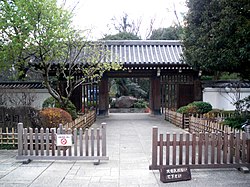 Togoshi Park
 -
 Cherry blossoms at Goten-yama Hill in Kita-Shinagawa
 -
 Cherry blossoms at Goten-yama Hill by Hokusai
 -
 Harbor in Kita-Shinagawa
 -
 Harbor in Kita-Shinagawa by Hiroshige
 -
 Night view of Higashi-Shinagawa


References
[edit]- ^ "Population by District". Tokyo Statistical Yearbook. Retrieved July 15, 2022.
- ^ "Statistics of Shinagawa City". Shinagawa City Government. Retrieved April 14, 2016.
- ^ 「ベラルーシの風」在日ベラルーシ共和国大使館. 在日ベラルーシ共和国大使館. Retrieved April 12, 2016.
- ^ "Embassy Staff". Embassy of Brunei Darussalam in Tokyo. November 18, 2011. Retrieved April 12, 2016.
- ^ "Embajada de Colombia en Japón". Embajada de Colombia en Japón. Retrieved April 12, 2016.
- ^ "KBRI Tokyo – Official Embassy of Republic of Indonesia in Tokyo". Official KBRI Tokyo, Japan. Retrieved April 12, 2016.
- ^ "Location of Mauritanian Embassy". Embassy of the Islamic Republic of Mauritania – Tokyo. Retrieved April 12, 2016.
- ^ "Welcome to the Myanmar Embassy, Tokyo". Embassy of the Republic of the Union of Myanmar. Retrieved April 12, 2016.
- ^ マケドニア駐日大使館・総領事館. 在日大使館ポータルサイト. Retrieved April 12, 2016.
- ^ "Contact the Royal Thai Embassy". Royal Thai Embassy, Tokyo. Retrieved April 12, 2016.
- ^ "Welcome to the Zambia Embassy, Tokyo". Zambia Embassy, Tokyo. Retrieved April 12, 2016.
- ^ "Corporate Profile." Isuzu. Retrieved on December 8, 2008.
- ^ "Company Profile Archived April 17, 2010, at the Wayback Machine." JTB Corporation. Retrieved on September 16, 2009.
- ^ "Corporate Profile." Nippon Light metal. Retrieved on March 9, 2014.
- ^ "Corporate Profile Archived September 28, 2013, at the Wayback Machine." MOS Burger. Retrieved on January 6, 2011. "Address of Headquarters 4F ThinkPark Tower, 2-1-1 Osaki, Shinagawa-ku, Tokyo 141-6004 JAPAN" – Address in Japanese: "〒141-6004 東京都品川区大崎2-1-1 ThinkPark Tower 4階 "
- ^ "Corporate Profile." Lawson. Retrieved on July 4, 2011. "East Tower, Gate City Ohsaki 11-2, Osaki 1-chome, Shinagawa-ku, Tokyo 141-8643 Japan"
- ^ "Corporate Data." Namco Bandai Holdings. Retrieved on December 8, 2008. "Head Office NamcoBandai Miraikenkyusho 4-5-15, Higashi-Shinagawa, Shinagawa-ku, Tokyo 140-8590, Japan"
- ^ "Corporate Overview." Namco Bandai Games. Retrieved on March 16, 2010.
- ^ "Company Outline." Banpresto. February 18, 2008. Retrieved on March 16, 2010.
- ^ "Company Overview Archived July 10, 2012, at archive.today." Rakuten. Retrieved on February 3, 2011. ""Rakuten Tower" (Headquarters) Shinagawa Seaside Rakuten Tower, 4-12-3 Higashishinagawa, Shinagawa-ku, Tokyo, 140-0002 (MAP)."
- ^ "Rakuten Tower Archived September 15, 2010, at the Wayback Machine." (Direct map image link[permanent dead link]) Rakuten. Retrieved on February 3, 2011.
- ^ "China's Fosun Buys Second Tokyo Office Tower in Five Months". Mingtiandi. December 21, 2014. Retrieved July 7, 2020.
- ^ "Company Profile Archived August 30, 2017, at the Wayback Machine." Toyo Seikan. Retrieved on April 6, 2014.
- ^ "Corporate Data." NSK Ltd.. Retrieved on December 12, 2009.
- ^ "Corporate Data." Fuji Electric. Retrieved on April 2, 2015.
- ^ "Access." Imagica. Retrieved on April 6, 2014.
- ^ "Offices and plants guide." Nippon Chemi-Con. Retrieved on August 29, 2017.
- ^ "Offices." Topy Industries. Retrieved on March 22, 2018.
- ^ "Overview." Gakken. Retrieved on February 27, 2019.
- ^ "Corporate Data." Gakken. Retrieved on May 14, 2019.
- ^ "Corporate Outline." Pola Cosmetics. Retrieved on April 6, 2014.
- ^ "Company Profile." Marza Animation Planet. Retrieved on October 17, 2011. "NYK Tennoz Bldg., 18F, 2-2-20, Higashi-Shinagawa, Shinagawa-ku, Tokyo, 140-0002 JAPAN"
- ^ "会社概要 Archived August 18, 2011, at the Wayback Machine." Marza Animation Planet. Retrieved on October 17, 2011. "所在地 〒140–0002 東京都品川区東品川2-2-20 天王洲郵船ビル18階"
- ^ "Information & Reservations." Japan Airlines. Retrieved on December 8, 2008.
- ^ "Company Profile Archived September 6, 2012, at the Wayback Machine." Japan Airlines. Retrieved on December 8, 2008.
- ^ "Company Profile." JALways. Retrieved on May 19, 2009.
- ^ "会社案内." JAL Express. Retrieved on May 19, 2009.
- ^ "会社概要 Archived January 7, 2010, at the Wayback Machine." JAL Hotels. Retrieved on February 5, 2010. "本社 : 〒140–0002 東京都品川区東品川2-4-11 JALビル13F."
- ^ "Corporate Profile Archived March 21, 2006, at the Wayback Machine." Jalux. Retrieved on December 6, 2011. "Head Office I·S Building, 3-32-42 Higashi Shinagawa, Shinagawa-ku, Tokyo"
- ^ "Notice of Office Relocation." Jalux. Retrieved on December 6, 2011.
- ^ admin, NR] (July 8, 2022). "Nikon announced the start of construction for their new head office in Tokyo". Nikon Rumors. Retrieved July 10, 2022.
- ^ "Access & Map." Sony. Retrieved on January 19, 2009.
- ^ "Corporate Data." Sony. September 9, 2008. Retrieved on January 19, 2009.
- ^ Suzuki, Kyoko. "Sony Considers Sale of Properties Including Former Headquarters." Bloomberg. August 3, 2006. Retrieved on January 19, 2009.
- ^ "Sony to close symbol of TV business.." Kyodo News International. February 1, 2007. Retrieved on January 19, 2009.
- ^ "Locations." Adobe Systems. Retrieved on December 8, 2008.
- ^ " About us: Locations." Siemens K.K.. Retrieved on December 8, 2008.
- ^ "Worldwide Corporate Offices Archived May 1, 2009, at the Wayback Machine." Phoenix Technologies. Retrieved on May 6, 2009.
- ^ "Our Office Locations Archived March 15, 2011, at the Wayback Machine."Retrieved on March 6, 2011.
- ^ Sliva, Marty (January 25, 2017). "Hideo Kojima, Death Stranding, and Building the Studio". IGN. Archived from the original on April 3, 2020. Retrieved January 26, 2017.
- ^ Hansen, Steven (December 16, 2015). "Metal Gear creator starts Kojima Productions to work on PS4 exclusive". Destructoid. Archived from the original on July 25, 2019. Retrieved December 16, 2015.
- ^ "会社概要." Japan Asia Airways. October 25, 2005. Retrieved on May 20, 2009.
- ^ "会社概要." GEOS. February 23, 2009. Retrieved on July 16, 2011. "〒141–0032 東京都品川区大崎1丁目6番4号 新大崎勧業ビルディング4F"
- ^ "World Airline Directory." Flight International. April 1–7, 1998. "All Nippon Airways" 45.
- ^ "Shinagawa Historical Museum". Shinagawa Historical Museum. Retrieved July 4, 2016.
- ^ "ARCHI-DEPOT". ARCHI-DEPOT Museum. Retrieved August 2, 2018.
- ^ "There's plenty to see and do in the waters of Shinagawa!". SHINAGAWA AQUARIUM. Retrieved July 4, 2016.
- ^ "SITE OF HAMAKAWA HŌDAI (GUN BATTERY) AND SAKAMOTO, RYOMA". Shinagawa Tourism Association. Retrieved July 3, 2016.
- ^ "Togoshi Ginza Shopping District". Tokyo Convention & Visitors Bureau. Retrieved July 4, 2016.
- ^ "PALM GUIDE". Musashikoyama Shotengai Promotion Association. Retrieved July 4, 2016.
- ^ "Shell-mound of Ohmori". Shinagawa Historical Museum. Retrieved July 3, 2016.
- ^ "RINSHI-NO-MORI PARK". Shinagawa Tourism Association. Retrieved July 5, 2016.
- ^ "Shinagawa Kumin Park". Tokyo Convention & Visitors Bureau. Retrieved July 4, 2016.
- ^ "IKEDAYAMA PARK". Shinagawa Tourism Association. Retrieved July 5, 2016.
- ^ "TOGOSHI PARK". Shinagawa Tourism Association. Retrieved July 5, 2016.
- ^ "ご案内." カトリック目黒教会. February 8, 2016. Retrieved on April 8, 2016.
- ^ "三光教会 St.Stephen's Church". Nippon Sei Ko Kai. Retrieved July 3, 2016.
- ^ "東京聖マリア教会". Nippon Sei Ko Kai. Retrieved July 3, 2016.
- ^ "品川教会の信仰." キリスト品川教会. 2014. Retrieved on April 8, 2016.
- ^ "教会の案内." 品川バプテスト教会. Retrieved on April 8, 2016.
- ^ "TOP." 大井バプテスト教会. 2016. Retrieved on April 8, 2016.
- ^ "Tokyo Metropolitan College of Industrial Technology". Tokyo Metropolitan College of Industrial Technology. Retrieved July 14, 2016.
- ^ "2023年度より校名を「品川学藝高等学校」とし、男女共学化をスタートします。(東京都届出予定)". Nihon Ongaku High School. Retrieved November 8, 2022.
- ^ "Access." Canadian International School in Tokyo. Retrieved on October 29, 2014. "〒141–0001 5-8-20, Kitashinagawa, Shinagawa-ku, Tokyo"
- ^ 東京都立品川特別支援学校. Tokyo Metropolitan Shinagawa Special Needs Education School. Retrieved July 16, 2016.
- ^ a b c "小学校・中学校・義務教育学校ホームページ". Shinagawa. Retrieved November 7, 2022.
- ^ 国際交流事業の紹介 | 品川区 [Introduction to International Relations | Shinagawa]. Archived from the original on May 11, 2013. Retrieved March 10, 2009.
- ^ "Sister Cities". Consulate-General of Japan in Auckland. Embassy of Japan. Archived from the original on February 16, 2007. Retrieved December 9, 2008.
- ^ 姉妹都市・友好都市の概要. Shinagawa ward. March 31, 2015. Archived from the original on December 21, 2016. Retrieved October 13, 2015.
- ^ 市町村交流. Shinagawa ward. Retrieved October 13, 2015.
External links
[edit]


- Shinagawa City Official Website (in Japanese)
| Districts |
|  | ||||||||||
|---|---|---|---|---|---|---|---|---|---|---|---|---|
| Major stations | ||||||||||||
| Education | ||||||||||||
| International | |
|---|---|
| National | |
| Geographic | |
| Academics | |
| Other | |


Shinagawa
View on GrokipediaGeography
Administrative divisions and neighborhoods
Shinagawa Ward is administratively organized into multiple chō, serving as fundamental units for governance, planning, and resident services, with key neighborhoods such as Gotanda, Ōsaki, the Shinagawa Station vicinity, and Tennozu Isle defining its urban structure.[6] These divisions enable targeted management of the ward's compact 18.11 square kilometers, accommodating over 400,000 residents through differentiated zoning that balances residential and mixed-use areas.[7] Ōsaki and Gotanda represent northern clusters, with Ōsaki situated south of the Meguro River and Gotanda to its north, both aligned along the Yamanote Line for efficient spatial organization.[8] West of Shinagawa Station, subdivisions prioritize residential-oriented mixed-use zoning to handle density, while eastern sectors emphasize commercial zoning to support transit-oriented development.[9] This zoning framework promotes orderly land use, mitigating overcrowding in high-density zones near major stations. Eastern expansion incorporates reclaimed land from Tokyo Bay, notably Tennozu Isle, an artificial island developed from post-war reclamation efforts completed by the 1990s, adding structured waterfront neighborhoods to the ward's layout.[10][11] Such integrations have extended administrative boundaries eastward, enhancing connectivity and providing zoned spaces for contemporary urban planning without encroaching on core residential chō.[12]Physical geography and climate
Shinagawa lies on the flat expanse of the Kantō Plain in southeastern Tokyo Metropolis, featuring low elevations averaging 14 meters above sea level, with maximum heights rarely exceeding 20 meters. This topography, formed by sedimentary deposits from ancient river systems, facilitates dense urban development but constrains natural drainage and heightens susceptibility to water accumulation during heavy rains.[13][14] The ward's southern boundary abuts Tokyo Bay, exposing coastal areas to diurnal tidal ranges of up to 1.8 meters and amplifying risks from storm surges, which can propagate inland due to the shallow bathymetry and limited topographic barriers. As part of the tectonically active Kantō region, Shinagawa endures ongoing seismic hazards, with the area registering at least six earthquakes exceeding magnitude 7 since 1900, underscoring its position on convergent plate boundaries prone to megathrust events.[15][16] Shinagawa experiences a humid subtropical climate, with annual precipitation totaling approximately 1,531 mm based on 1991–2020 normals from nearby Tokyo observatories, predominantly during the June–July rainy season (tsuyu) and autumn typhoons that bring intense downpours exceeding 100 mm per day. Mean annual temperatures hover around 15.4°C, featuring hot summers often surpassing 30°C and mild winters rarely dropping below 0°C. Urban heat island effects, driven by concrete surfaces and anthropogenic heat, elevate local microclimates by 2–3°C compared to rural benchmarks, as documented in analyses of Tokyo's metropolitan warming trends.[17][18]Demographics
Population dynamics and trends
As of the 2020 national census, Shinagawa-ku recorded a population of 422,488, resulting in a density of 18,498 persons per square kilometer over its fixed area of 22.84 km².[19] This reflects sustained urbanization pressures in one of Tokyo's core special wards, where high-density residential and commercial development accommodates commuters and workers tied to major transport hubs.[20] Population trends show modest growth, with an average annual increase of 1.8% from 2015 to 2020, primarily fueled by net inbound domestic migration to business-oriented districts rather than natural increase.[19] Projections through 2025 anticipate continued slight expansion, as working-age inflows offset broader Japanese depopulation patterns, supported by economic revitalization in areas like the Shinagawa Station vicinity.[21] Aging remains a countervailing force, with those aged 65 and over comprising approximately 20% of residents—lower than the national figure of 29%—due to the ward's appeal to younger professionals in tech and corporate sectors.[19][22] Post-2011 Great East Japan Earthquake dynamics included net migration gains in Shinagawa as part of Tokyo's core-periphery inflows, where displaced individuals from Tōhoku prioritized proximity to employment over rural relocation, contributing to stabilized growth amid national outflows from disaster zones.[23] More recently, 2024-2025 real estate surges, with Tokyo residential prices rising 8.14% year-over-year and foreign capital inflows exceeding ¥940 billion, have intensified housing demand in Shinagawa, attracting young migrants despite elevated rents averaging ¥32,400 per square meter monthly near key stations.[24][25][26]Socioeconomic characteristics
Shinagawa exhibits elevated income levels relative to broader Tokyo metrics, with the ward's average annual taxable income at ¥9,277,190, exceeding the Tokyo average of ¥6,912,000.[27] [28] This affluence stems partly from a commuter-heavy workforce, where professionals influx daily to the ward's commercial hubs, sustaining low local unemployment aligned with Japan's national rate of 2.6% in August 2025.[29] Educational attainment among residents supports this professional demographic, though ward-specific metrics mirror Tokyo's urban emphasis on higher education, with over 90% of adults aged 15 and older holding at least a high school diploma nationally, concentrated in skilled sectors.[30] Foreign residents account for approximately 5% of the population, augmented by diplomatic personnel and expatriates in business roles, contributing to socioeconomic diversity.[31] Income distribution shows moderate inequality, with Japan's Gini coefficient at around 0.33, indicative of relative evenness amid prosperity, though urban pressures persist.[32] Housing affordability has strained, as used condominium prices in southern wards including Shinagawa rose 22% year-over-year to roughly $600,000 by September 2025, driven by demand in redeveloped areas.[33]History
Pre-modern and Edo periods
Prior to the Edo period, the Shinagawa area served as a coastal fishing village along Edo Bay, supporting local communities through maritime activities such as net fishing and shellfish gathering.[34] The region's proximity to the bay facilitated early settlement, with fisheries forming the economic backbone before centralized governance expanded infrastructure.[35] In the early Edo period, following Tokugawa Ieyasu's consolidation of power after the 1600 Battle of Sekigahara, Shinagawa was designated as the first post station, Shinagawa-shuku, on the Tōkaidō highway in 1601.[36] This establishment aimed to regulate and support travel between Edo and Kyoto, providing essential services including lodging, porters, and packhorses for daimyo fulfilling sankin-kōtai obligations to the shogunate.[37] Initially comprising Kita-Shinagawa and Minami-Shinagawa stations, it expanded in 1722 with the addition of Kachi-shinshuku to handle increased traffic.[38] The post station's operations generated revenue through tolls and services, complementing the area's persistent reliance on fisheries, which drew migrant fishermen from regions like Osaka under shogunal encouragement to supply Edo's growing population.[34] Shinagawa-shuku typically furnished around 100 porters and 100 horses daily, underscoring its logistical role in sustaining the shogunate's control over inter-domain movement and commerce.[35] As foreign pressures mounted in the mid-19th century, Shinagawa assumed defensive significance; following Commodore Matthew Perry's arrival with U.S. warships in Edo Bay on July 8, 1853, the shogunate initiated construction of coastal batteries known as Shinagawa Daiba to fortify Tokyo Bay against potential Western incursions.[39] These earthwork forts, planned as 11 structures from Minami-Shinagawa to Fukagawa, represented a reactive bolstering of defenses modeled on Western fortifications, though completed primarily after Perry's initial visit.[40]Meiji era to post-war reconstruction
Following the Meiji Restoration in 1868, Shinagawa transitioned from a post town along the Tōkaidō road to a hub of early industrialization, driven by transportation infrastructure development. The opening of Shinagawa Station on June 12, 1872, initiated provisional rail service on Japan's first railway line between Shinbashi in Tokyo and Yokohama, facilitating the movement of goods and passengers and spurring factory establishment in the vicinity.[41] By the 1870s, this connectivity supported nascent industrial activities, including railway-related operations and initial manufacturing, as part of broader national efforts to modernize transport networks.[42] In the Taishō (1912–1926) and early Shōwa (1926–1945) periods, land reclamation projects along Tokyo Bay significantly altered Shinagawa's geography, creating new coastal areas such as Tennozu and Konan for industrial and port use. These efforts expanded available land for factories and maritime facilities, enhancing Shinagawa's role in regional trade and production amid Japan's interwar economic expansion.[43] During World War II, Shinagawa endured severe destruction from Allied air raids, including the March 9–10, 1945, firebombing of Tokyo, which razed over half the city's built-up areas through incendiary attacks targeting industrial and transport nodes. Factories, rail infrastructure, and residential structures in Shinagawa were heavily impacted, contributing to the broader devastation that left approximately one million Tokyo residents homeless. Postwar reconstruction from 1945 into the 1950s prioritized infrastructure restoration amid resource shortages, with Shinagawa benefiting from repairs to railway lines and port facilities to support economic recovery. The Korean War boom (1950–1953) provided indirect stimulus through increased demand for Japanese manufacturing, enabling rebuilding of damaged industrial sites and transport hubs essential for national logistics.[44][45]Late 20th century to present
The burst of Japan's asset price bubble in the early 1990s triggered widespread economic stagnation, with land prices in urban areas like Tokyo plummeting by over 50% from peak levels by 1992 and contributing to a decade-long period of low growth and banking sector distress.[46] In Shinagawa, these effects manifested in slowed local development and reduced commercial activity, yet the ward's recovery was aided by its established role as a transportation nexus, fostering growth in logistics facilities and early tech-related enterprises amid national efforts to diversify beyond overheated real estate.[47] By the late 1990s, policy measures such as infrastructure investments around Shinagawa Station began to attract distribution and manufacturing operations, mitigating sharper declines seen in more residential wards.[48] Population trends in Shinagawa reflected broader Tokyo dynamics, with numbers holding relatively steady through the 1990s at around 350,000 before modest increases in the 2010s, reaching 394,700 by 2019 and 422,488 in the 2020 census, driven by inbound migration to business areas rather than natural growth.[8][19] This stabilization contrasted with national depopulation pressures, attributable to Shinagawa's integration into Tokyo's extended central business functions and targeted urban policies emphasizing connectivity over suburban expansion. The COVID-19 pandemic disrupted these patterns from 2020, accelerating remote work and temporarily depressing office demand, though Shinagawa's proximity to major rail lines supported essential logistics continuity.[49] By mid-2025, Tokyo's overall office vacancy rate had declined to 2.6%, with Grade A spaces at 3.6%, signaling a robust post-pandemic rebound fueled by return-to-office mandates and limited new supply, benefits that extended to Shinagawa's submarkets like Shinagawa/Tamachi where availability remained constrained.[50][51] Preparations for the delayed 2020 Tokyo Olympics, including rail capacity upgrades at key stations, further enhanced the ward's infrastructure resilience despite the event's limited direct venue ties.Government and Administration
Local governance structure
Shinagawa-ku functions as one of Tokyo Metropolis's 23 special wards, a status granted under Japan's Local Autonomy Law enacted in 1947, which restructured the wards to operate with municipal-level independence equivalent to cities. This designation enables Shinagawa to manage its own local administration, including urban planning, public welfare, education, and sanitation services, separate from direct oversight by the Tokyo Metropolitan Government for most day-to-day operations.[52][53][54] The ward's governance is led by an elected mayor and a 48-member assembly, with both positions filled through direct elections held every four years. The current mayor, Kyoko Morisawa, assumed office following a rerun election on December 4, 2022, after the previous result was annulled due to irregularities; she secured victory with support from multiple parties including the Liberal Democratic Party and Komeito. The assembly, which deliberates ordinances, budgets, and policy, convenes regularly to oversee executive actions and represent resident interests.[55][56] Fiscal operations are sustained through local revenue sources, predominantly fixed asset taxes levied at a standard rate of 1.4% on assessed property values, supplemented by resident taxes, national grants, and metropolitan allocations. These funds support autonomous budgeting for ward-specific priorities, such as zoning regulations and infrastructure upkeep, while adhering to national legal frameworks that delineate responsibilities between wards and higher authorities.[57][58]Political dynamics and representation
The Shinagawa Ward Assembly, consisting of 40 members, has historically seen strong Liberal Democratic Party (LDP) influence, though recent elections reflect a fragmented landscape with independents and smaller parties holding sway. In the April 23, 2023, election, the LDP won 7 seats, allying with independents to form a caucus of 8 members focused on pro-development agendas such as infrastructure expansion and business-friendly zoning adjustments.[59][60] This distribution underscores a tilt toward policies supporting urban growth, contrasting with opposition voices emphasizing community preservation amid rapid redevelopment.[61] Key debates in the 2020s assemblies have centered on zoning reforms to enable high-rise developments, particularly in response to the Shinagawa Station district's transformation into an international business hub. Proponents argue these changes, including relaxed height restrictions and mixed-use zoning, drive economic vitality by attracting corporate headquarters and improving connectivity, as seen in the Takanawa Gateway area projects initiated post-2020.[62] Critics, however, highlight strains on local infrastructure and residential quality, though assembly majorities have advanced approvals aligned with national urban renewal goals.[63] Shinagawa's representation extends to the Tokyo Metropolitan Assembly via its district, where members have echoed ward-level priorities on transit-oriented growth. At the national level, the ward forms part of Tokyo's 3rd district in the House of Representatives, held by LDP incumbent Hirotaka Ishihara since his initial election in 2005, with re-elections including a sixth term in recent cycles; Ishihara has prioritized economic policies fostering high-tech industries and large-scale redevelopment to bolster Japan's competitiveness.Diplomatic facilities
Shinagawa hosts the embassies of approximately ten foreign nations, primarily located in the Kitashinagawa, Kami-Ōsaki, and Higashigotanda districts, which benefit from proximity to major transportation hubs like Shinagawa Station.[64] These facilities underscore the ward's integration into Tokyo's diplomatic landscape, distinct from the more centralized embassy clusters in Minato-ku.[65] Key embassies include:- Embassy of Brunei Darussalam, at 6-5-2 Kitashinagawa, established to advance bilateral ties following Brunei's independence in 1984.[64]
- Embassy of the Republic of Indonesia, relocated to 5-2-9 Higashigotanda on December 1, 2023, facilitating trade in commodities like palm oil and minerals valued at over ¥3 trillion annually between Japan and Indonesia as of 2023.[66][67]
- Royal Thai Embassy, at 3-14-6 Kami-Ōsaki, supporting economic exchanges including automotive and electronics sectors with bilateral trade exceeding ¥2.5 trillion in 2023.[65]
- Embassy of the Republic of the Union of Myanmar, at 4-8-26 Kita-Shinagawa, operational since Myanmar's diplomatic recognition post-independence.[68]
- Embassy of the Republic of Djibouti, at 5-13-1 Kitashinagawa, focusing on strategic maritime and logistics cooperation given Djibouti's port significance.[69]
- Embassy of Colombia, at 3-10-53 Kami-Ōsaki, promoting trade in agriculture and energy, with bilateral agreements enhancing coffee and resource exports.[70]
- Embassy of the Republic of Belarus, at 5-6-32 Higashigotanda, handling consular and economic diplomacy amid geopolitical constraints.[64]
- Embassy of Tajikistan, at 1-5-42 Kami-Ōsaki, aiding mineral and energy trade links.[71]
| Country | District | Key Economic Focus |
|---|---|---|
| Brunei Darussalam | Kitashinagawa | Energy and halal trade |
| Indonesia | Higashigotanda | Commodities and manufacturing |
| Thailand | Kami-Ōsaki | Automotive and tourism |
| Myanmar | Kita-Shinagawa | Resources and textiles |
| Djibouti | Kitashinagawa | Logistics and ports |
| Colombia | Kami-Ōsaki | Agriculture and mining |
| Belarus | Higashigotanda | Machinery and agriculture |
| Tajikistan | Kami-Ōsaki | Minerals and hydropower |
Economy
Sectoral composition and growth metrics
Shinagawa's economy is predominantly driven by the services sector, encompassing professional, business, and information-communication services, which form the core of its commercial and office-based activities around major transportation nodes. Logistics benefits from the ward's strategic position as a rail and road hub, while technology and research & development contribute through clusters of related enterprises. Traditional manufacturing persists in pockets, but services overwhelmingly dominate local output, aligning with broader Tokyo trends where professional services lead employment composition.[73][74] Key growth indicators reflect robust demand in real estate and office space. Used condominium prices in southern Tokyo wards, including Shinagawa, rose approximately 22% year-over-year to an average of around 600,000 USD as of September 2025, driven by limited supply and investor interest. Office vacancy rates in Shinagawa and adjacent Tamachi areas have historically averaged below 4%, with Tokyo's central Grade A offices maintaining rates under 2% into 2025 amid strong absorption.[33][75][76] Employment metrics underscore expansion, with a daytime population surpassing nighttime residents by a significant margin—estimated over 500,000 workers commuting in for services and logistics roles—supporting sustained economic activity despite modest overall prefectural growth rates of 1-2% annually pre-2025. Low office vacancies under 6% signal tight capacity and ongoing demand, bolstering sectoral resilience.[77][73]Corporate presence and headquarters
Shinagawa serves as a key location for headquarters of prominent Japanese firms, particularly in technology, entertainment, and aviation sectors, driving local employment and specialized innovation clusters. Sega Sammy Holdings, a major player in video games and pachinko machines, maintains its primary headquarters at Sumitomo Fudosan Osaki Garden Tower in Nishi-Shinagawa, where it coordinates global development of interactive media and employs professionals in software engineering and content creation.[78] This concentration supports creative industries by centralizing R&D for digital entertainment platforms, with the company's operations post-1990s emphasizing software innovation over hardware manufacturing amid Japan's economic restructuring.[79] Japan Airlines Co., Ltd. (JAL), Japan's second-largest carrier, is headquartered at the Nomura Real Estate Building in Higashishinagawa, overseeing flight operations, maintenance, and strategic planning for a workforce exceeding 38,000 employees nationwide.[80] The presence bolsters job opportunities in administrative, engineering, and logistics roles tied to air transport, fostering ancillary innovation in aviation safety and efficiency technologies. Similarly, Nikon Corporation's headquarters in Nishioi focuses on precision optics and semiconductor lithography equipment, shifting from traditional camera production to high-tech R&D since the late 1990s, which sustains specialized employment in engineering and contributes to Japan's advanced manufacturing ecosystem.[81] These headquarters reflect a broader transition in Shinagawa from industrial to knowledge-based activities, with firms leveraging the ward's rail connectivity for talent attraction and collaborative hubs; for instance, Sega's facilities integrate game design labs that promote cross-industry tech synergies.[82] LIXIL Group Corporation, specializing in building materials, also bases its operations in Shinagawa-ku, supporting over 100,000 global employees through product innovation in sustainable infrastructure.[83] Collectively, such entities enhance the ward's economic fabric by prioritizing high-skill jobs in R&D, estimated to align with Tokyo's emphasis on value-added sectors per Ministry of Economy, Trade and Industry analyses of metropolitan industrial shifts.[84]