Hubbry Logo
Walker (mobility)Walker (mobility)Main
Open search
Walker (mobility)
Community hub
Walker (mobility)
logo
8 pages, 0 posts
0 subscribers
Be the first to start a discussion here.
Walker (mobility)
Walker (mobility)
from Wikipedia
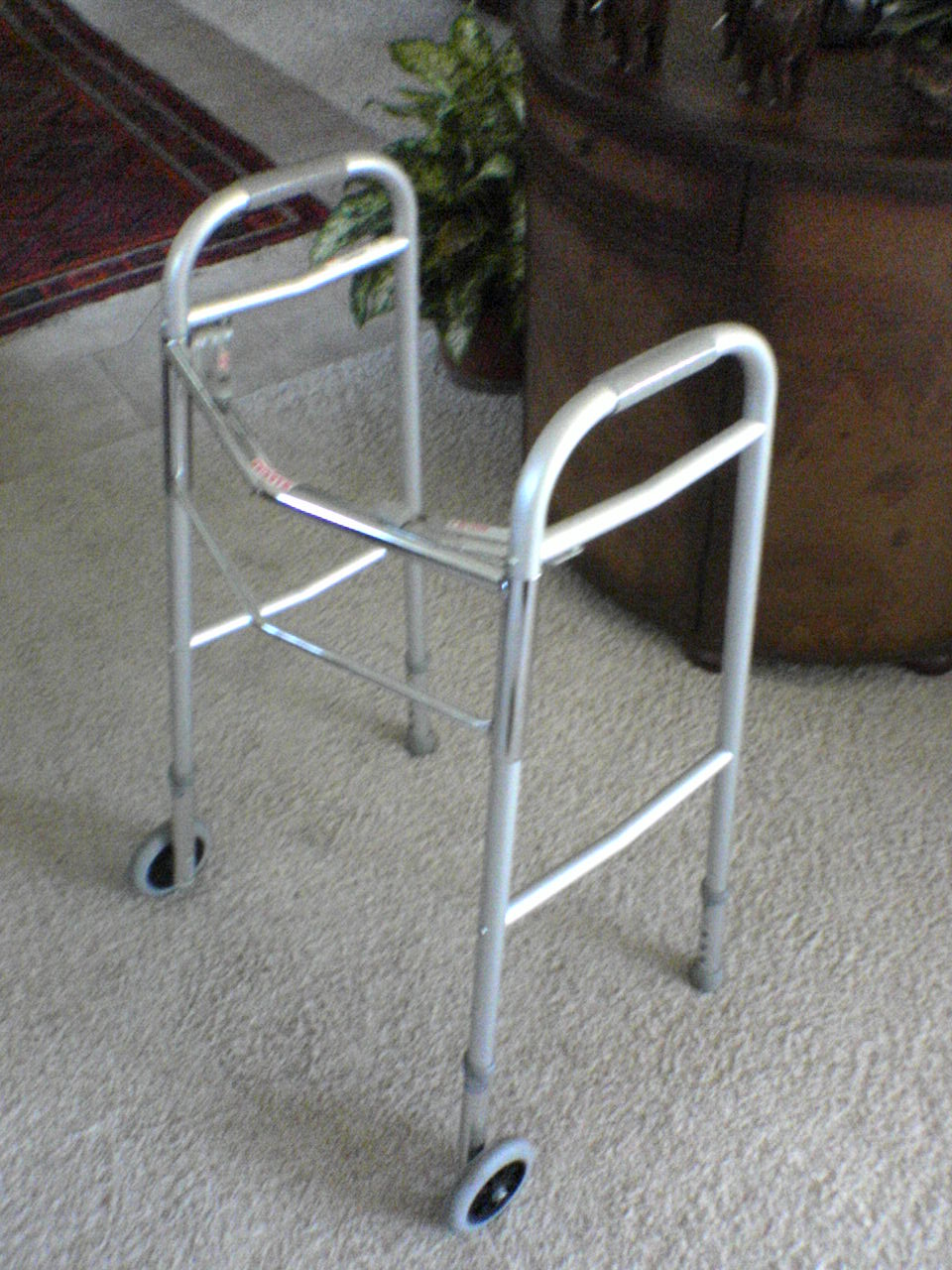
Front-wheeled walker

A walker (North American English) or walking frame (British English) is a device that gives support to maintain balance or stability while walking, most commonly due to age-related mobility disability, including frailty. Another common equivalent term for a walker is a Zimmer (frame), a genericised trademark from Zimmer Biomet, a major manufacturer of such devices and joint replacement parts. Walking frames have two front wheels, and there are also wheeled walkers available having three or four wheels, also known as rollators.

Walkers started appearing in the early 1950s. The first US patent was awarded in 1953 to William Cribbes Robb, of Stretford, UK, for a device called "walking aid", which had been filed with the British patent office in August 1949.[1] Two variants with wheels were both awarded US patents in May 1957,[2][3] and the first non-wheeled design that was called a "walker" was patented in 1965 by Elmer F. Ries of Cincinnati, Ohio.[4] The first walker to resemble modern walkers was patented in 1970 by Alfred A. Smith of Van Nuys, California.[5]

Design

[edit]

The basic design consists of a lightweight frame that is about waist high, approximately 12 inches (30 cm) deep and slightly wider than the user. Walkers are also available in other sizes such as pediatric (for children) or bariatric (for obese persons). Modern walkers are height adjustable and should be set at a height that is comfortable for the user, but will allow the user to maintain a slight bend in their arms. This bend is needed to allow for proper blood circulation through the arms as the walker is used. The front two legs of the walker may or may not have wheels attached, depending on the strength and abilities of the person using it. It is also common to see caster wheels or glides on the back legs of a walker with wheels on the front; additionally felt products adapted to glide with the legs such as adhesive feet, along with tennis balls with holes cut into them to place them onto the legs are also utilized on surfaces such as hardwood, epoxy and linoleum flooring common to institutions.[6]

Use

[edit]
A woman supporting her weight using a walking frame without wheels

The person walks with the frame surrounding their front and sides and their hands provide additional support by holding on to the top of the sides of the frame. Traditionally, a walker is picked up and placed a short distance ahead of the user. The user then walks to it and repeats the process. With the use of wheels and glides, the user may push the walker ahead as opposed to picking it up. This makes for easier use of the walker, as it does not require the user to use their arms to lift the walker. This is beneficial for those with little arm strength.

A walker is often used by those who are recuperating from leg or back injuries. It is also commonly used by persons having problems with walking or with mild balance problems.

Also related is a hemi-walker, a walker about half the size of a traditional walker which is intended for use by persons whose dexterity is limited or non-existent in one hand or arm. These walkers are more stable than a quad cane (a cane with four points that touch the ground, as opposed to one), but are not recommended as highly as a traditional walker for those who can use it.

Walker cane hybrid

[edit]
A walker cane hybrid adjusted to four configurations

A walker cane hybrid[7] was introduced in 2012 designed to bridge the gap between an assistive cane and a walker. The hybrid has two legs which provide lateral (side-to-side) support which a cane does not. It can be used with two hands in front of the user, similar to a walker, and provides an increased level of support compared with a cane. It can be adjusted for use with either one or two hands, at the front and at the side, as well as a stair climbing assistant. The hybrid is not designed to replace a walker which normally has four legs and provides four-way support using both hands.

Rollators

[edit]

A different approach to the walker is the rollator, also called wheeled walker, invented by the Swede Aina Wifalk in 1978. Wifalk had polio.[8][9] Although originally a brand name, "rollator" has become a genericized trademark for wheeled walkers in many countries, and is also the most common type of walker in several European countries.

The rollator consists of a frame with three or four large wheels, handlebars and a built-in seat, which allows the user to stop and rest when needed. Rollators are also often equipped with a shopping basket. Rollators are typically more sophisticated than conventional walkers with wheels. They are adjustable in height and are light-weight, yet sturdier than conventional walkers. The handlebars are equipped with hand brakes that can be lifted or pushed downward to instantly stop the rollator. The brakes can also be used in maneuvering the rollator; by braking one side while turning the rollator towards that side a much tighter turning radius can be achieved.

A study in the 2000s found an increase in the use of rollators by young people "usually in their thirties who are setting a new standard for walking among young people". The researchers conclude that this might be helpful in alleviating the stigma that using a rollator currently carries.[10]

A Norwegian-made version of Wifalk's rollator won the 2011 Red Dot Design Award in the "Life science and medicine" class.[9] The European norm for walking aids EN ISO 11199-2:2005 applies to rollators and walking frames.

Disabled dog walker

[edit]

This type of walker provides support and stability to the dogs, while allowing them to rely partly on their hind legs and continue using them. It is suitable for dogs with mobility problems with hind legs (or unstable). It also helps them to exercise their back legs and can help maintain any partial mobility they may have left or, in some cases, help to improve it.[citation needed]

See also

[edit]

References

[edit]
[edit]
Revisions and contributorsEdit on WikipediaRead on Wikipedia
from Grokipedia
A walker, also known as a walking frame, is an assistive mobility device consisting of a aluminum or with four adjustable legs and ergonomic handgrips, designed to provide stability, balance, and partial weight-bearing support for individuals with impaired due to age-related frailty, , neurological conditions, or musculoskeletal disorders. Walkers function by allowing users to lift and advance the frame in a reciprocal motion while bearing weight on the hands, thereby reducing load on the lower extremities and minimizing fall risk through enhanced proprioceptive feedback and postural control. Modern walkers originated in the mid-20th century, with the first U.S. granted in 1953 to William Cribbes Robb for a wheeled support device, evolving from rudimentary frames to include variants like two-wheeled models for smoother and four-wheeled rollators featuring hand brakes, seats, and storage baskets for greater versatility. In the United States, approximately 24% of adults aged 65 or older utilize mobility aids including walkers, reflecting their widespread adoption to promote independence amid rising prevalence of conditions like and post-surgical recovery needs. While empirically effective in offloading joint stress and enabling ambulatory activity, walkers require proper fitting and technique to avoid paradoxical increases in fall incidence from misuse, such as inadequate height adjustment or overloading. The global market for walkers and rollators underscores their causal role in sustaining functional mobility, projected to expand from USD 1.96 billion in 2024 due to demographic aging and technological refinements like ergonomic designs.

History

Origins and Early Development

The modern mobility walker, also known as a walking frame, originated in the during the late as a response to the need for stable ambulation support among the elderly and those recovering from injuries or illnesses. Prior to this, ambulation assistance primarily relied on simpler devices such as canes, crutches, and walking sticks, which provided limited weight-bearing stability and were prone to tipping. These precursors date back centuries, with rudimentary frames appearing in 15th-century depictions of wheeled chairs for the disabled, though they lacked the lightweight, adjustable structure of later designs. The pivotal invention is credited to William Cribbes Robb, an engineer from , , who developed a basic tubular metal frame to offer four-point support for users with impaired balance or . Robb's emphasized portability and ease of use, featuring that allowed users to lift and reposition the frame with each step. This addressed gaps in existing aids by distributing weight more evenly and reducing fall risks compared to bipedal crutches. The device gained traction amid post-World War II demographic shifts, including an aging population and increased rehabilitation needs for veterans and civilians affected by and other conditions. Robb filed for patent protection in the UK before securing U.S. US2656874A for his "walking aid" on December 21, 1949, with the patent granted on October 27, 1953, and assigned to Limited of , . The patented frame consisted of paired side structures connected by crossbars, providing rear and front support points for secure gripping and weight transfer. Early models were manufactured from tubing, prioritizing durability over weight reduction. Commercial production began in the early , coinciding with broader adoption in hospitals and homes, though initial designs lacked wheels or folding mechanisms that would emerge later. American firm Zimmer Holdings later refined and popularized the frame in the U.S., leading to its colloquial name "Zimmer frame" in some regions. By the mid-1950s, these devices were increasingly prescribed for conditions like , , and frailty, marking the transition from supports to standardized medical aids.

Mid-20th Century Innovations

In 1953, the first patent for a modern mobility walker, termed a "walking aid," was granted to William Cribbes Robb of , , under US Patent 2,656,874. This device consisted of a , adjustable tubular metal frame with four legs and rubber-tipped feet, designed to provide stable support for individuals with impaired balance or leg strength, marking a shift from single-point aids like canes toward broader structural assistance. Robb's invention, originally filed in Britain in 1949, emphasized portability and height adjustability via telescoping legs, facilitating use by elderly or post-injury patients in rehabilitation settings. By 1957, innovations introduced wheels to walker designs, with two United States patents awarded in May for wheeled variants that enhanced forward mobility while retaining frame stability. These early wheeled models typically featured two front wheels and rear skid tips or additional wheels, reducing and allowing smoother progression for users with limited stride power, though they lacked brakes or seats found in later iterations. Such adaptations addressed causal limitations in non-wheeled frames, where lifting the device per step increased energy expenditure, as evidenced by biomechanical analyses of assistance. Commercial refinement followed, with the Zimmer Manufacturing Company—known for orthopedic implants—adapting Robb's frame into the "Zimmer frame," a more robust version with improved and durability for institutional use in hospitals and homes during the and . This model gained prevalence in geriatric care, supporting empirical needs for amid rising post-World War II elderly populations, though adoption varied by region due to manufacturing costs and physician recommendations. These mid-century developments laid foundational principles for subsequent mobility aids, prioritizing load distribution and user independence over prior rudimentary supports.

Design and Components

Core Structural Elements

The core structural elements of a standard mobility walker include the tubular frame, four adjustable legs, handgrips, and crossbars for stability. The frame forms an open, rectangular structure typically constructed from extruded anodized aluminum tubing, which offers a favorable strength-to-weight , enabling users to lift the device repeatedly during ambulation without excessive . This material resists and supports loads up to 300 pounds in many models, prioritizing alongside portability. The four legs provide the base of support, with front legs often equipped with handgrip mounts and rear legs positioned for posterior stability; legs are height-adjustable via push-pin or collar mechanisms, typically in 1-inch increments from 29 to 39 inches to accommodate user stature. Each leg ends in a rubber tip or , which enhances traction on indoor surfaces and absorbs minor impacts, though these require periodic replacement to maintain grip efficacy. Handgrips, affixed to the upper front legs, feature ergonomic or contours to distribute pressure across the palms and reduce shear forces during , which can constitute 15-30% of body weight in assisted . Positioned at height with arms extended, they facilitate tripedal or quadrupedal support patterns. Crossbars, including anterior and posterior horizontal members, interconnect the legs to prevent torsional deformation under load, ensuring the frame maintains its and base width—usually 17-20 inches—for optimal balance without impeding stride. These elements collectively yield a device weighing 5-7 pounds, foldable for storage in some designs.

Materials, Ergonomics, and Adjustability

Walkers are predominantly constructed from aluminum alloys due to their low , which facilitates portability and ease of use for users with limited strength, typically weighing 5-10 pounds for standard models. Aluminum provides sufficient structural integrity for weight capacities up to 300 pounds while resisting in typical indoor and outdoor environments. Steel frames, by contrast, offer greater durability and support higher loads exceeding 350 pounds but increase device weight to around 19 pounds, potentially exacerbating fatigue in frail individuals. Selection between these materials depends on user weight, intended , and frequency of , with aluminum preferred for most elderly to minimize physical burden. Ergonomic design in walkers emphasizes handle positioning at wrist height when arms are extended, promoting neutral posture and distributing 5-6% of body weight through grips to reduce shoulder and back strain during ambulation. Padded or contoured grips made from or rubber enhance comfort and prevent slippage, particularly for users with arthritic hands, while some models incorporate rests in upright variants to offload extension. Seats in rollator-style walkers, often ergonomic arcs with backrests, allow brief rests without full weight transfer, supporting prolonged mobility sessions. These features align with biomechanical principles to minimize joint torque and , as evidenced by reduced fall risks in properly fitted devices. Adjustability is integral, with telescoping leg mechanisms enabling height customization in 1-inch increments to match user stature, ensuring flexion of 15-30 degrees for optimal leverage. Many models fold compactly for storage or transport, and wheeled variants include adjustments for stability on inclines. Such versatility accommodates diverse body types and environments, though improper adjustment can increase instability, underscoring the need for professional fitting.

Types and Variants

Rigid and Non-Wheeled Walkers

Rigid and non-wheeled walkers, also known as standard walkers, consist of a lightweight aluminum frame with four rubber-tipped legs and ergonomic handgrips positioned at height for optimal support. These devices provide the widest base of support—typically 18 to 24 inches wide—among walker types, distributing weight evenly across fixed points of contact with the ground. Users operate them by lifting the entire frame forward approximately one step length before advancing, ensuring no rolling motion occurs during stance phase. Medically, they are prescribed for patients exhibiting severe balance deficits, bilateral lower limb weakness, or inability to safely manage dynamic devices like canes or wheeled aids. Common indications include , post-hip or knee surgery recovery, stroke-related , , and general frailty in older adults where maximal static stability is prioritized over ease of propulsion. Height adjustability in one-inch increments accommodates users from 4'3" to 6'3", with weight capacities often up to 300 pounds in standard models and higher in heavy-duty variants coded as E0148 under HCPCS. The fixed-leg design confers inherent advantages in stability, as it eliminates risks associated with wheel-induced forward drift, making it suitable for environments requiring precise control or for individuals with cognitive impairments who may lack the coordination to wheeled frames. This configuration supports full partial or full weight-bearing without slippage on varied indoor surfaces, outperforming wheeled options in scenarios demanding unyielding ground contact. Drawbacks include the physical effort required to repeatedly lift the device—typically weighing 5 to 7 pounds—which can accelerate during extended use and limit suitability for those with upper extremity . Maneuverability is reduced in confined spaces compared to wheeled models, and observational evidence suggests non-wheeled walkers yield slower speeds and higher energy demands, as measured by physiological cost index (2.01 vs. 1.23 for wheeled in geriatric cohorts). In patients with freezing, standard walkers increased freezing duration and frequency relative to unassisted walking, while wheeled variants showed neutral effects, though both reduced overall speed. Folding mechanisms in many models allow independent side collapse for storage or , distinguishing them from fully rigid non-folding frames, though the latter offer enhanced structural for bariatric users. Empirical data on remains limited to low-quality studies, with no high-level randomized trials isolating non-wheeled efficacy, underscoring the need for individualized fitting by clinicians to match user strength and environment.

Wheeled Walkers and Rollators

Wheeled walkers, also termed rolling walkers, incorporate wheels—typically two on the front legs—to facilitate forward propulsion without the need to lift the frame, promoting a smoother and more natural pattern than rigid walkers. These devices enhance maneuverability across varied surfaces and are classified under Medicare codes such as E0141 for models with two, three, or four wheels, which may include adjustable height and glide features. Four-wheeled variants offer greater stability but require user caution to prevent unintended rolling, particularly on inclines. Rollators constitute an evolved subtype of wheeled walker, distinguished by four swivel wheels, loop hand akin to mechanisms, an integrated fold-down seat for resting, and frequently a storage basket. Originating from a 1978 invention by Swedish survivor Aina Wifalk, rollators were engineered to support extended mobility while mitigating fatigue through seated breaks and load-bearing capacity. Unlike basic wheeled walkers, rollators demand active engagement for stationary support during weight shifts, such as standing or sitting, which can improve postural control if used proficiently. Empirical assessments reveal wheeled walkers yield superior gait metrics, including increased velocity and stride length, relative to non-wheeled frames in populations with mobility impairments like . For rollators specifically, systematic reviews of older adults demonstrate enhancements in forward speed, step width reduction, and walk-ratio optimization during assisted ambulation, though backwards walking benefits remain inconsistent. These aids, however, weigh more substantially—often around 25 pounds versus 8 pounds for lighter walkers—potentially complicating or storage. Selection between wheeled walkers and rollators hinges on user needs: basic models suffice for short-distance stability with minimal encumbrance, while rollators suit prolonged outings requiring rest and cargo capacity, provided proficiency is assured to avert forward slips. Professional fitting remains essential, as mismatched or adjustment can exacerbate fall risks despite overall efficacy in preserving independence.

Hybrid and Specialized Models

Hybrid mobility walkers integrate features from multiple aid types to address transitional or multifaceted user needs, offering greater versatility than standard models. Walker-cane hybrids, for instance, feature a compact frame with two legs rather than a full structure, enabling use with one or both hands for enhanced stability over a single cane while remaining less cumbersome than traditional walkers. These devices typically include adjustable heights and ergonomic grips, supporting users during rehabilitation or partial activities. Walker-wheelchair hybrids further expand functionality by combining rollator elements with a foldable seat or transport chair configuration, allowing seamless switching between walking support and seated mobility. Examples include the Rollz Motion, which supports up to 275 pounds and accommodates users from 4'11" to 6'3", and motorized variants like the Wheelator for powered assistance. Two-wheeled hybrid rollators blend rigid walker stability with partial wheeling for easier forward propulsion, differing from full-wheel models by requiring occasional lifting. Specialized walkers target distinct physiological or pathological requirements, incorporating targeted modifications for efficacy. Bariatric models, such as folding variants with 500-pound capacities and supports, accommodate higher body weights while promoting upright posture. Neurological-specific designs like the U-Step Walker 2 include backrests, central braking mechanisms, and curved frames to counter gait freezing common in . walkers, resembling scooters with padded knee platforms, facilitate non-weight-bearing mobility for lower leg injuries, often featuring adjustable heights and steering for maneuverability. Pediatric and gait-training walkers, used for conditions like , provide anterior or posterior support to develop weight-bearing and ambulatory skills in children or adults with neuromuscular deficits. Forearm or elbow-support variants address upper extremity weaknesses, distributing load to reduce fall risks in users with balance impairments from strokes or . These adaptations prioritize alignment and user-specific , though selection requires professional assessment to match individual and prevent compensatory injuries.

Indications and Usage

Targeted Medical Conditions

Walkers are primarily prescribed for individuals with mobility impairments stemming from conditions that compromise balance, lower limb strength, or gait stability, enabling safer ambulation by providing external support. Common indications include neurological disorders such as , , and , where motor control deficits lead to instability and fall risk. Orthopedic conditions like , hip or knee fractures, and post-surgical recovery from joint replacements also necessitate walkers to offload weight and reduce joint stress during healing. In elderly populations, walkers address age-related sarcopenia, generalized weakness, or bilateral lower extremity involvement that prevents reliable use of less supportive devices like canes. Balance disorders and a of falls, often exacerbated by vestibular or sensory impairments, further justify prescription, as walkers enlarge the base of support to mitigate postural sway. Debilitating chronic conditions, including or severe deconditioning, qualify when they impair , per criteria requiring documented medical necessity. Prescription guidelines emphasize evaluating the underlying diagnosis alongside functional assessments, such as , to ensure the device improves mobility without compensating for cognitive deficits that could lead to misuse. For instance, wheeled variants may be indicated for those with profound neurological involvement unable to manage standard non-wheeled models. Empirical data from clinical observations link walker use to reduced fall incidence in these cohorts, though efficacy depends on proper fitting and adherence.

Fitting, Training, and Daily Application

Proper fitting of a walker ensures optimal support, balance, and reduced risk of strain or falls. To adjust height, the user stands upright with arms relaxed at their sides; the handgrips should align with the wrist crease, resulting in 20-30 degrees of flexion when gripping, with shoulders remaining level and not elevated. For wheeled walkers, grips are set slightly lower, near height, to accommodate forward lean during propulsion. A healthcare provider or physical therapist should verify fit, as improper height—too high causing shoulder hike or too low forcing forward bend—can exacerbate stress or instability. Training typically occurs under supervision to instill correct patterns and build confidence. The standard three-point involves advancing the walker 6-12 inches forward with all legs firmly on the ground, transferring weight through the arms, then stepping the weaker leg forward inside the frame, followed by the stronger leg, while maintaining an upright posture and gazing ahead to prevent forward head tilt. Patients practice on flat surfaces first, progressing to turns and stairs—ascending with the stronger leg first ("good leg up and over") and descending with the weaker leg first—often using for initial support. Sessions emphasize limits per medical indication, such as partial for fractures or full for balance issues, with reinforcement of safety cues like avoiding loose rugs. In daily application, users integrate walkers into routines by clearing pathways of obstacles, using them for short-distance stability rather than prolonged reliance to avoid muscle weakening, and applying on rollators before sitting. For outdoor use, select models with terrain-appropriate wheels and test on uneven surfaces to ensure traction. Maintenance involves weekly visual inspections for loose screws, worn rubber tips, or frame cracks, with monthly deep cleaning using mild soap on frames and grips, avoiding submerging wheeled components. Replace tips or showing deformation after 3-6 months of regular use, as wear correlates with usage intensity and surface type. Users should report instability promptly to providers, as unaddressed wear contributes to 10-15% of mobility aid-related falls in older adults.

Benefits and Efficacy

Empirical Evidence from Studies

A of observational studies found that wheeled walkers, compared to non-wheeled variants, enable older adults to cover longer distances with lower energy expenditure (physiological cost index of 1.23 versus 2.01) and achieve faster speeds in functional tests such as the Timed Up and Go and 10-meter walk, particularly in patients with who experienced less oxygen desaturation. However, these findings derive from low-quality cohort and case-control studies prone to selection and measurement biases, with no randomized trials available, limiting conclusions on broader . In a synthesis of 18 studies examining parameters among older adults using rollators, frequent users demonstrated improvements in walking speed, stride length, and relative to unassisted , while first-time users showed no change or reductions in these metrics, underscoring the role of . Variability persisted in swing time and double support phases, with overall evidence constrained by heterogeneous methodologies and small sample sizes, though rollators generally supported spatiotemporal enhancements for experienced individuals without addressing comprehensively. Evidence on fall prevention remains inconclusive; while assistive devices like walkers are prescribed to enhance stability and offload lower limbs, longitudinal analyses indicate their use correlates with higher fall incidence and among frail community-dwelling elders, potentially due to compensatory behaviors or inadequate fitting. One reported that professional prescription of four-wheeled walkers improved parameters such as step length and velocity in users, suggesting targeted intervention mitigates some risks. Improper walker use, observed in up to 84% of support periods for pick-up models and 16-29% for front-wheeled types during activities, significantly compromises stability, reducing minimum stability margins by 12-49% and thereby elevating fall risk through mechanisms like unintended frame lift-off or environmental interactions such as carpets. These patterns highlight that while walkers can reduce and boost in higher-functioning users, paradoxical associations with falls arise from misuse, with consensus recommending proper assessment to realize potential benefits in balance and mobility.

Impacts on Independence and Mobility

Walkers enable users with gait instability or lower extremity weakness to maintain ambulatory independence, facilitating engagement in activities of daily living such as household navigation and community outings without full reliance on caregivers. Empirical data from observational studies indicate that proper walker use correlates with sustained home-based living, reducing the need for relocation to assisted facilities among older adults with chronic mobility limitations. This preservation of autonomy stems from the device's capacity to distribute weight load and provide postural stability, allowing prolonged upright activity that would otherwise be untenable. In terms of mobility enhancement, clinical assessments demonstrate that walkers improve gait parameters including speed and endurance; for instance, wheeled variants have been associated with significant increases in six-minute walk distances compared to unassisted walking in patients with respiratory or orthopedic impairments. Systematic reviews of walking frames report consistent evidence of better stride length and reduced double-support phases during ambulation, contributing to overall functional mobility in frail elderly populations. These outcomes support greater participation in physical activities, with users exhibiting higher confidence levels and lower fall apprehension, which in turn reinforces habitual use and long-term adherence. However, impacts vary by device type and user compliance; non-wheeled walkers offer superior stability for those with severe balance deficits but may limit speed and maneuverability, potentially constraining in dynamic environments like uneven . Wheeled walkers, while promoting fluidity in movement, require adequate upper body strength to control, and improper height adjustment can diminish benefits or exacerbate fatigue, underscoring the causal role of individualized fitting in realizing mobility gains. Longitudinal analyses suggest that while short-term mobility improvements are evident, over-reliance without complementary exercise may contribute to progressive muscle weakening, though direct causal links remain understudied in controlled trials.

Risks and Criticisms

Associated Safety Hazards

The primary safety hazard associated with mobility walkers is falls, which account for nearly two-thirds of reported injuries among older adults using such devices. Paradoxically, while walkers are prescribed to enhance stability and prevent falls, their use has been identified in multiple studies as a for falling, particularly when improperly fitted or maintained. data indicate frequent unintentional fall injuries linked to walkers, with higher rates of admissions in vulnerable populations. For rigid, non-wheeled walkers, common mechanisms include tripping over the device's legs or forward collapse if the user overreaches, exacerbated by unlevel surfaces or household obstacles that cause the frame to catch. Wheeled walkers and rollators introduce additional risks from unintended movement, such as wheels slipping, sliding, or rolling away during transfers, alongside backward and sideways falls due to brake failure or loss of control on inclines. Trip hazards are notably high for both walker types, with rates of 15 incidents per 10,000 user reviews, often stemming from design elements like protruding wheels or inadequate clearance. Device maintenance failures amplify these dangers; worn rubber caps, loose grips, or malfunctioning on rollators can lead to and subsequent falls, as that are either too loose or overly tight impair controlled stopping. User-related factors, including severe balance deficits or incorrect height adjustment, further heighten injury potential, particularly in rollators where reliance on hand assumes sufficient upper body strength. Structural weaknesses, such as frame in low-quality models, have been reported to cause shaking or tipping, increasing fall likelihood during dynamic use. Older adults requiring walkers face elevated overall fall risks compared to non-users, underscoring the need for professional assessment to mitigate these hazards.

Limitations and Potential for Misuse

Wheeled walkers and rollators, while beneficial for many users, exhibit limitations in stability and maneuverability, particularly on uneven or rough surfaces, where wheels can catch or slip, increasing the of tipping or falls. These devices demand a baseline of upper body strength and balance from users; individuals with significant weakness or poor postural control may find them unsuitable, as they provide less support compared to non-wheeled walkers. Additionally, rollators can promote forward-leaning postures over time, potentially exacerbating or reducing natural efficiency without compensatory exercises. Potential for misuse arises primarily from inadequate user training and improper device adjustment, with studies indicating that over 80% of wheeled frame users receive no guidance on safe operation, correlating with higher fall rates during turns or acceleration. Common errors include failing to engage fully, setting incorrect handle heights that strain shoulders or alter balance, or navigating tight indoor spaces where the device's width causes collisions or . Overreliance on the device may also foster physical dependency, diminishing muscle use and self-perceived functioning, as evidenced in assisted-living populations where walker users reported greater role limitations due to physical issues. In settings, sideways falls during turning with rollators remain prevalent, often linked to velocity mismanagement or cognitive impairments that hinder adaptive responses. These limitations underscore the need for professional fitting and periodic maintenance, as worn components like rubber grips or loose brakes amplify hazards; empirical data from injury surveillance highlights wheeled walkers' involvement in visits, particularly among frail elderly, when not tailored to individual capabilities. Misuse extends to overloading storage baskets, which shifts the center of and heightens tipping risks on slopes, though manufacturer weight limits (typically 5-10 kg) are often exceeded without consequence awareness. For users with , the added of monitoring brakes and terrain further elevates fall probabilities, suggesting rollators as a suboptimal without supervised .

Recent Developments

Technological and Material Advancements

Modern walkers increasingly incorporate lightweight materials such as aluminum alloys and composites, which enhance portability and durability while reducing overall device weight to as low as 4-6 kilograms for standard rollator models. rods, in particular, provide high strength-to-weight ratios, resistance, and flexibility, allowing for slimmer frames that maintain structural integrity under loads up to 135 kilograms without the of traditional metals. These material shifts, evident in designs from 2020 onward, address user complaints about cumbersome walkers by prioritizing ease of maneuverability and foldability for storage and . Technological integrations have advanced walker functionality through sensor-equipped "smart walkers," which employ inertial measurement units, accelerometers, and gyroscopes to monitor patterns, detect falls, and provide real-time feedback via vibrations or audio cues. For instance, devices like the Rollz Fit, introduced with hub-mounted sensors by February 2025, track metrics such as steps and distance to encourage consistent use and integrate data with apps for health monitoring. Motorized variants, such as the 2025 Wheellator model, feature electric assistance for propulsion and braking, with updates including improved battery life exceeding 10 kilometers per charge and adaptive speed controls based on terrain sensors. Connectivity features, including and GPS modules, enable integration with smartphones for aids and caregiver alerts, as seen in prototypes evaluated in 2024 studies on smart walker abandonment rates. AI-driven in powered walkers, emerging prominently by 2025, uses algorithms to predict instability and adjust support dynamically, potentially reducing fall risks by up to 30% in clinical simulations. These developments, however, remain constrained by battery dependencies and higher costs, with peer-reviewed reviews noting the need for standardized designs to prevent flaws in early commercial models carrying over from basic rollators. The global market for walkers and rollators, key subtypes of mobility walkers, was valued at USD 1.96 billion in 2024 and is projected to reach USD 3.23 billion by 2033, reflecting a (CAGR) of approximately 5.7%. This expansion is primarily driven by the aging global population, with the number of individuals aged 65 and older expected to double by 2050, increasing demand for mobility aids to address conditions like , , and post-surgical recovery. In parallel, the elderly walker segment alone was estimated at USD 1.6 billion in 2024, forecasted to grow to USD 2.2 billion by 2030 at a CAGR of 4.8%, fueled by rising chronic prevalence and preferences for , foldable designs. Regional trends highlight stronger growth in , where the rollator walker market is anticipated to expand at a CAGR of 5.22% from 2024 to 2029, supported by advanced healthcare and higher adoption of wheeled variants over traditional rigid walkers. plays a pivotal role, with increasing integration of smart features such as sensors for fall detection and adjustable , contributing to market segmentation shifts toward premium products; for instance, rollators with built-in seats and brakes now dominate sales over basic four-legged models due to enhanced user comfort and versatility. Supply chain data indicates major manufacturers like Drive Medical and holding significant shares, with platforms accelerating distribution and customization options. Accessibility remains uneven globally, with cost identified as the primary barrier; basic walkers retail for USD 50–200 in developed markets, but premiums for advanced rollators can exceed USD 300, often unaffordable without subsidies. In the United States, Medicare Part B covers up to 80% of approved costs for prescribed walkers following a physician's assessment, improving uptake among seniors, though out-of-pocket deductibles persist. Conversely, in low- and middle-income countries, over 2.5 billion people require assistive devices yet face denial due to high upfront prices, limited product availability, and inadequate training on proper use, exacerbating unmet needs for an estimated 1 billion individuals with disabilities or mobility impairments. Efforts to enhance include refurbished programs offering devices at 50–70% discounts and WHO initiatives promoting affordable, locally manufactured aids, though socioeconomic factors like rural location and gender disparities—women reporting higher barriers despite greater need—continue to hinder equitable distribution.

References

Add your contribution
Related Hubs
User Avatar
No comments yet.