Hubbry Logo
SS CanberraSS CanberraMain
Open search
SS Canberra
Community hub
SS Canberra
logo
8 pages, 0 posts
0 subscribers
Be the first to start a discussion here.
SS Canberra
SS Canberra
from Wikipedia

SS Canberra
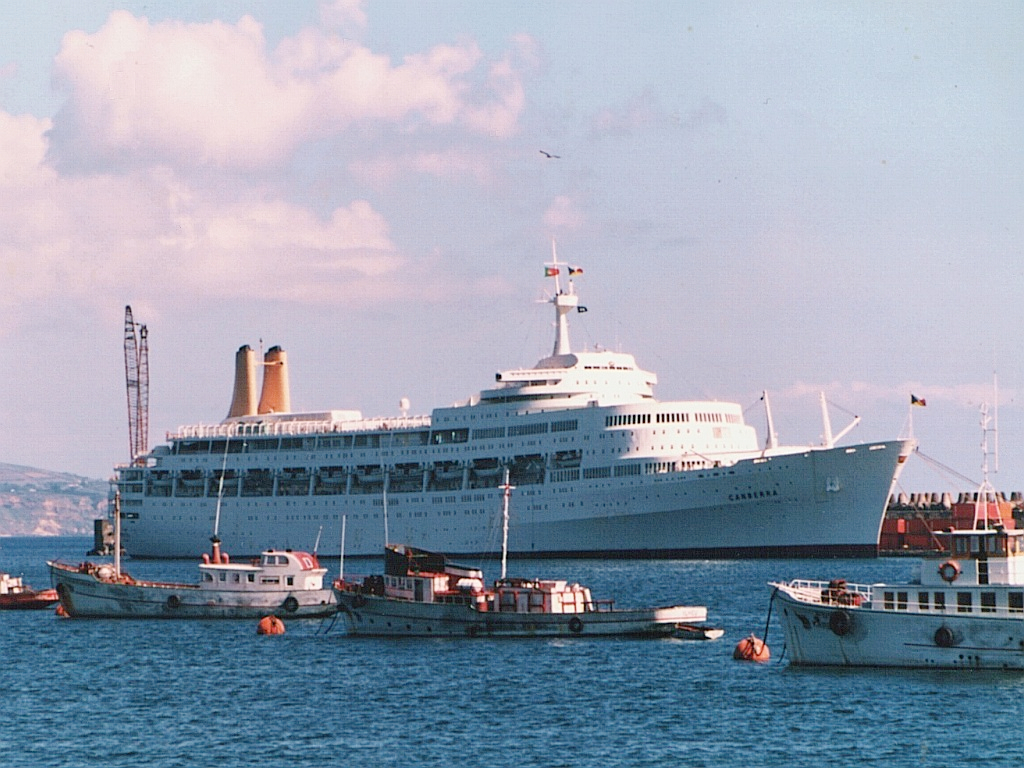
Canberra in 1984
History
United Kingdom
NameCanberra
NamesakeCity of Canberra, Australia
Owner
  • 1961–88: Peninsular & Oriental Steam Navigation Co.
  • 1988–91: P&O Lines (Shipowners) Ltd.
  • 1991–97: Abbey National March Leasing (1) Ltd. (leased back by P&O)
Operator
  • 1961–66: P&O–Orient Lines
  • 1966–71: P&O Lines
  • 1971–86: P&O Passenger Division
  • 1986–92: Canberra Cruises Ltd.
  • 1992–94: P&O Cruise Fleets Services Ltd.
  • 1994–97: P&O Cruises (UK) Ltd.
Port of registryUnited Kingdom London
RouteSouthamptonSydney via Suez, thence SydneyVancouver (1973, Cruising)
Ordered20 December 1956
BuilderHarland and Wolff, Belfast
Cost‹See Tfd›£17 million (1956) (equivalent to £482 million in 2023)[1]
Yard number1621
Laid down23 September 1957
Launched16 March 1960
Sponsored byDame Pattie Menzies, GBE
CompletedMay 1961
Maiden voyage2 June 1961
Out of service10–31 October 1997 (final voyage)
Identification
Nickname(s)The Great White Whale
Honours &
awards
Falklands War
FateScrapped at Gadani ship-breaking yard, Pakistan, 1997–98
General characteristics
TypeOcean liner
Tonnage
  • 1961: 45,270 gross register tons
  • 1962: 45,733 gross register tons
  • 1968: 44,807 gross register tons
  • 1994: 49,073 gross tons
Length820 feet (250 m)
Beam103 feet (31 m)
Draught35.5 feet (10.8 m)
Propulsion
  • Main: Two British Thomson-Houston (AEI) synchronous three-phase, 6,000-volt air-cooled electric motors providing 85,000 hp (63,000 kW); power supplied by two 43,180 hp (32,200 kW) steam turbine-driven alternators; twin screws
  • Auxiliary: Four steam turbines, each driving a 1,500 kW, 440 V, 3 Phase, 60 Hz alternator and a tandem-driven 300 kW exciter for the propulsion alternators
Speed
  • Trials: 29.27 kn (54.2 km/h; 33.7 mph)
  • 1961–73: 27.5 kn (50.9 km/h; 31.6 mph)
  • 1973–97: 23.50 kn (43.5 km/h; 27.0 mph)
Capacity150,000 square feet (14,000 m2) of cargo
Complement1961–73: 548 first class, 1,690 tourist class, 1973–97: 1,500 one class
Crew1961–73: 900, 1973–97: 795

SS Canberra was an ocean liner, which later operated on cruises, in the P&O fleet from 1961 to 1997. She was built at the Harland and Wolff shipyard in Belfast, Northern Ireland at a cost of £17 million. The ship was named on 17 March 1958, after the federal capital of Australia, Canberra. She was launched on 16 March 1960, sponsored by Dame Pattie Menzies, wife of the then Prime Minister of Australia, Robert Menzies. She entered service in May 1961, and made her maiden voyage starting in June. In the 1982 Falklands War she served as a troopship. In 1997 the singer and songwriter Gerard Kenny released the single "Farewell Canberra" which was specially composed for the last voyage.

History

[edit]

Construction

[edit]

P&O had placed an order for plans for two new ocean liners, one with Harland and Wolff for £17 Million in 1956.[2] On September 23, 1957, on Queen's Island, Belfast, the first keel plates of yard no.1621 were laid on slipway 14.[3] She had a gross tonnage of 45,733 GRT and dimensions of 819 feet (250 m) by 103 feet (31 m).[4]

Dame Pattie Menzies, wife of the Australian Prime Minister had been given the honor of christening the liner.[5] Canberra left the slipway at Harland and Wolff's Belfast shipyard on 17 March 1960, with the cheers from the dockers and shipyard workers, as well as 11,000 onlookers watching her leave.[6] She began sea trials before taking up her maiden voyage in June 1961.[7]

The SS Canberra was the last ocean liner built by Harland and Wolff shipyard.[8] It was also the shipyard's largest ship built since the White Star Line's HMHS Britannic.[9]

Ocean liner

[edit]

P&O commissioned Canberra to operate the combined P&O–Orient Line service between the United Kingdom and Australasia and designed her to carry 548 first-class passengers and 1,650 tourist class. Too big for Tilbury she was based at Southampton. Her first voyage set out on 2 June 1961 through the Suez Canal and called at Colombo, Fremantle, Melbourne, Sydney, Auckland, Suva, Honolulu, San Francisco and Los Angeles returning to Southampton by the same ports. By mid-1963 she had spent many months in dry dock in Southampton and in the builder's yard for repairs to her electrical and mechanical systems.[10]

The era of mass air travel had begun by the time the Canberra was laid down and air travel prices fell relentlessly in the early 1960s to challenge P&O's lowest fares. In the second half of 1962 Canberra made a short cruise from Southampton followed by two more to New York. More cruises followed but nevertheless most of the ship's first decade was spent on the Australia run.[10]

Cruises

[edit]
Canberra in Sydney, Australia in 1974

At the end of 1972 she was withdrawn and refitted to carry 1,500 single-class passengers on cruises.[10] Unusually, this transition from an early life as a purpose-built ocean liner to a long and successful career in cruising, occurred without any major external alterations, and with only minimal internal and mechanical changes over the years. One of her public rooms included a 'Cricketers Tavern', which contained a collection of bats and ties from cricket clubs all over the world; she also had the William Fawcett reading/writing room, named for the first P&O ship.[11]

In 1961, while still a student at the Royal College in London, the now famous British artist David Hockney (born 1937) was commissioned to create a mural for the 'Pop Inn', a special lounge for teenagers onboard. Hockney graffitied and drew on the walls for five days and the fee earned assisted him to travel to New York for the first time.[citation needed]

Engineering

[edit]

Like RMS Strathnaver and RMS Strathaird that she replaced on the TilburyBrisbane route, Canberra had turbo-electric transmission. Instead of being mechanically coupled to her propeller shafts, Canberra's steam turbines drove large electric alternators that provided current for electric motors that, in turn, drove the vessel's twin propellers. They were the most powerful steam turbo-electric units ever installed in a passenger ship; at 42,500 hp (31,700 kW) per shaft, they surpassed SS Normandie's 40,000 hp (30,000 kW) on each of her four shafts. This would give her a speed of about 27.25 knots (50.47 km/h). She also had a bow propeller for manoeuvring in port and docking manoeuvres. She was also the first British passenger liner to use alternating current as power.[12]

There are several operational and economical advantages to such electrical de-coupling of a ship's propulsion system, and it became a standard element of cruise ship design in the 1990s, over 30 years after Canberra entered service. However, diesel engine- and gas turbine-driven alternators are the primary power source for most modern electrically propelled ships.

Canberra had a bulbous bow, two sets of stabilizers, and two funnels side-by-side. The lifeboats, which were made from glass fibre, were placed three decks lower than usual for ships of her type, and were recessed into the hull to allow improved view from the passenger decks.

The iconic spiral staircase and entrance halls in Australian walnut were designed by Hugh Casson and created by H.H. Martyn & Co.[13]

Falklands War

[edit]
HMS Andromeda and Canberra off Port Stanley, Falkland Islands, just after the surrender of Argentine forces on 14 June 1982

On 2 April 1982, the Argentinian military junta declared possession of the Islas Malvinas and invaded the British Falkland Islands. At the time, Canberra was cruising in the Mediterranean. The next day, her captain Dennis Scott-Masson received a message asking his time of arrival at Gibraltar, which was not on his itinerary. When he called at Gibraltar, he learnt that the Ministry of Defence (MoD) had requisitioned Canberra for use as a troopship. Canberra sailed to Southampton, Hampshire where she was quickly refitted, sailing on 9 April for the South Atlantic.[14]

Nicknamed the Great White Whale, Canberra proved vital in transporting 3 Commando Brigade to the islands more than 9,000 nautical miles (17,000 km) from the United Kingdom.[14] Canberra was sent to the heart of the conflict.[14]

Canberra anchored in San Carlos Water on 21 May as part of the landings by British forces to retake the islands.[15] Although her size and white colour made her an unmissable target for the Argentine Air Force, Canberra, if sunk, would not have been completely submerged in the shallow waters at San Carlos. However, the liner was not badly hit in the landings as the Argentine pilots tended to attack the warships instead of the supply and troop ships. After the war, Argentine pilots said they were told not to hit Canberra, as they mistook her for a hospital ship.[16] Hospital ships must be painted white, as Canberra always had been, but must also fly a Red Cross flag.[17]

A painting of SS Canberra's return to Southampton from the Falklands

Canberra then sailed to South Georgia, where 3,000 troops were transferred from Queen Elizabeth 2. They were landed at San Carlos on 2 June. When the war ended, Canberra was used as a cartel to repatriate captured Argentine soldiers, landing them at Puerto Madryn, before returning to Southampton to a rapturous welcome on 11 July. Captain Scott-Masson, who had started his apprenticeship on the Shaw, Savill & Albion Line troopship Empire Deben in the late 1940s, was awarded a CBE and made an aide-de-camp to Queen Elizabeth II.[14]

Final years

[edit]
SS Canberra docked at Southampton in August 1994, three years before her retirement

After a lengthy refit, Canberra returned to civilian service as a cruise ship. Her role in the Falklands War made her very popular with the British public, and ticket sales after her return were elevated for many years as a result. In March 1986, the Golden Cockerel trophy was transferred from the old Oriana to the Canberra due to Oriana's retirement. Age and high running costs eventually caught up with the Canberra though, as she had much higher fuel consumption than most modern cruise ships. As refitting her to meet the new 1997 SOLAS regulations would have been very expensive, P&O opted to retire the old vessel.[18]

On 25 June 1996 P&O Cruises announced that the Canberra would be retired at the end of 1997. Although Premier Cruise Line had made a bid for the old ship, P&O had already decided that they did not want Canberra to operate under a different flag and refused to sell her to Premier, as a result, Premier bought the similar looking Rotterdam. As a replacement for the Canberra, the 1988-built Star Princess was transferred to P&O Cruises and was renamed Arcadia. On 25 September 1997 the Golden Cockerel trophy was transferred from Canberra to the new Oriana while both ships were docked at Cannes, France.[18]

Canberra was withdrawn from P&O service on 30 September 1997 and sold to ship breakers for scrapping on 10 October 1997, leaving for Gadani ship-breaking yard, Pakistan on 31 October 1997. Her deep draft meant that she could not be beached as far as most ships, and due to her solid construction the scrapping process took nearly a year instead of the estimated three months, being totally scrapped by the end of 1998.[18]

[edit]

Media

[edit]

Statistics

[edit]
  • Launched by Dame Pattie Menzies 16 March 1960
  • Sailed from Belfast to Southampton 28 April 1961
  • Entered P&O service 19 May 1961
  • Fuel consumption; about 250–300 tonnes/day at sea
  • Water consumption, engines; 200 tonnes/day
  • Water consumption, domestic; 600 tonnes/day
  • Water production capacity; 450 tonnes/day
  • The top section of her radar mast was designed to cantilever astern to clear the Sydney Harbour Bridge

Canberra Bar

[edit]

A bar, known as the "Canberra Bar", was located at the corner of Scrabo Street and Station Street, in Queen's Quay, Belfast.[21] It served the nearby shipyard workers and dockers from the coal quay.[22] A large glass mural picturing the SS Canberra was located behind the bar.[23] Due to redevelopments in the area, the Canberra Bar was demolished in the 1990s.[24]

References

[edit]

Further reading

[edit]
[edit]
Revisions and contributorsEdit on WikipediaRead on Wikipedia
from Grokipedia
SS Canberra was a British ocean liner constructed for the Peninsular and Oriental Steam Navigation Company (P&O) by Harland and Wolff in Belfast, Northern Ireland, launched on 16 March 1960 and commencing her maiden voyage from Southampton to Sydney on 2 June 1961. Measuring 818 feet (249.9 m) in length with a gross tonnage of 45,733 and powered by steam turbo-electric engines driving twin propellers at a service speed of 27.5 knots, she initially plied the UK-Australia route as one of the final purpose-built ocean liners of her era before transitioning to cruising duties in the 1970s. Her most prominent role came during the 1982 Falklands War, when requisitioned by the British government as the lead troop transport, departing Southampton on 9 April carrying units including 40 and 42 Commando Royal Marines and the 3rd Parachute Regiment over 8,000 nautical miles to the South Atlantic, later facilitating the repatriation of Argentine prisoners of war following the conflict's conclusion. Nicknamed the "Great White Whale" for her white hull and vital logistical contributions without sustaining damage despite operating in contested waters, Canberra returned triumphantly to Southampton on 11 July 1982 amid widespread public acclaim. Withdrawn from service in September 1997 after 36 years, she was sold for scrapping in Pakistan, marking the end of a storied career that epitomized the transition from transoceanic liners to modern cruise operations and wartime exigency.

Design and Construction

Building Process and Launch

In response to the post-World War II shift toward faster transoceanic air travel eroding traditional liner passenger volumes, particularly on the UK-Australia route, sought a versatile newbuild capable of serving as both a scheduled and a potential . The company approved preliminary plans in and formalized a £17 million contract with on December 20 of that year for at the shipyard, which had a storied legacy of fabricating large-scale passenger vessels including the Olympic-class liners. Keel plates for yard number 1621 were laid on 14 at Queen's Island, , , on September 23, 1957, marking the commencement of assembly for what would become the largest British-built passenger liner since the . Harland & Wolff's engineering teams integrated contemporary innovations such as enhanced gyroscopic stabilizers for improved and modular interior fittings to optimize passenger comfort across multiple classes, reflecting the yard's expertise in balancing commercial viability with naval-grade durability amid Britain's contracting shipbuilding sector. The ship's name, —honoring Australia's capital—was publicly announced on March 17, 1958. Construction progressed through 1959, with the hull reaching completion for launching. On March 16, 1960, the 45,270 GRT vessel slid down the ways in a ceremony presided over by Dame Pattie Menzies, wife of Australian , symbolizing the Anglo-Australian ties the ship was designed to sustain. Following the launch, intensive fitting-out ensued at the yard, incorporating advanced propulsion systems and accommodations for up to 2,236 passengers in a configuration blending one-, two-, and three-class berths to adapt to varying demand. The Canberra was delivered to in May 1961 after sea trials in validated her performance, including twin-screw machinery delivering 22 knots service speed, underscoring Harland & Wolff's role in preserving British maritime engineering prowess during a period of industrial transition. This handover positioned the liner for her intended commissioning on the Southampton-Sydney service, though subsequent operational details fall outside the build phase.

Technical Specifications and Innovations

The SS Canberra measured 45,270 gross register tons, with an overall length of 820 feet (250 meters), a beam of 103 feet (31 meters), and a draught of 32 feet (9.8 meters). These dimensions enabled her to navigate major trade routes while providing ample internal volume for passenger accommodations and operational spaces. Propulsion was provided by a turbo-electric system featuring driving alternators that supplied power to two synchronous electric motors, delivering a total of 85,000 shaft horsepower (42,500 horsepower per shaft). This configuration achieved a service speed of approximately 23 knots, sufficient for transoceanic liner voyages, with twin screws enhancing maneuverability. Key innovations included a , which reduced and improved hydrodynamic efficiency, contributing to lower fuel demands at cruising speeds compared to traditional hull forms. The vessel also incorporated two sets of fin stabilizers to mitigate rolling in rough seas, promoting passenger comfort on extended voyages without compromising structural integrity. Her power plant represented the most potent steam turbo-electric installation in a at the time, surpassing the per-shaft output of earlier vessels like the SS Normandie, which underscored the engineering emphasis on reliable, high-output electricity generation for propulsion and auxiliary systems. Safety features encompassed glass-fiber lifeboats housed in recessed positions three decks above the waterline, allowing for quicker launch and reduced risk of swamping in emergencies. Fire suppression relied on comprehensive sprinkler systems and compartmentalized steel construction, aligned with post-war maritime standards prioritizing rapid containment over wooden elements common in pre-1940s liners. In passenger capacity, Canberra accommodated 2,238 travelers—548 in first class and 1,690 in tourist class—supported by a crew of 938, reflecting a design optimized for dual liner-cruise roles with efficient space utilization. Relative to contemporaries like the RMS Queen Mary, which employed direct geared steam turbines for 160,000 total horsepower but lacked electric drive's flexibility for variable loads, Canberra's system favored sustained reliability on long-haul routes, a causal factor in her operational endurance.

Operational History as Civilian Vessel

Maiden Voyage and Early Liner Service

The SS Canberra departed at approximately 17:00 on 2 June 1961 for her maiden voyage to via the , carrying 2,238 passengers in a fully booked configuration that included emigrants, tourists, and assisted migrants bound for . The eastward route called at ports including , , , , and before arriving in , with the overall passage emphasizing the vessel's design for speed and reliability on the traditional P&O-Orient Line service, which had shortened Southampton- transit times by up to a week relative to pre-1960s liners when paired with her running mate . Returning westward, she arrived back in on 4 September 1961, having demonstrated empirical performance in maintaining schedules despite minor technical adjustments en route. In her initial years of liner operations through the mid-1960s, Canberra sustained high occupancy rates on the Sydney-Southampton route, often exceeding 90% for migrant and tourist traffic, as sea voyages of around five weeks via remained viable for families relocating amid Britain's post-war emigration waves to destinations like . The ship's amenities, including two outdoor swimming pools, an indoor theater for films and stage shows, and multi-course cuisine served in class-segregated dining saloons, supported P&O's economic model by differentiating the experience from emerging air competition through extended comfort and social facilities tailored to long-haul passengers. This service bolstered P&O's share of the assisted migration trade, which peaked in the early with tens of thousands of British subjects annually opting for subsidized sea passages over faster but costlier flights. Rising jet airliner adoption from 1963 onward, exemplified by Boeing 707 services halving transcontinental travel times, began eroding liner viability, with Canberra's bookings showing initial resilience but gradual declines as airfares democratized long-distance mobility. The 1967 triggered Suez Canal closure until 1975, forcing Canberra onto the longer route and adding 10-14 days per crossing, which inflated fuel and provisioning costs while further disadvantaging sea travel economically against aviation's efficiency gains. These disruptions underscored the route's vulnerability to geopolitical factors, prompting to reassess liner sustainability amid shrinking migrant quotas and passenger preferences.

Transition to Cruise Operations

As commercial proliferated in the late , drastically reducing transoceanic travel times and costs, demand for traditional passages to plummeted, prompting to pivot the SS Canberra towards leisure-oriented voyages. The 1967 closure of the further exacerbated this by forcing longer routings, rendering the Southampton-Sydney service uneconomical without subsidies. Consequently, by the end of the decade, Canberra's schedule increasingly incorporated world cruises and short-haul leisure trips to destinations including the , Mediterranean, and Pacific islands, capitalizing on her spacious design originally suited for long-haul endurance. Her final regular liner voyage concluded in December 1973, after which P&O withdrew her for a major refit to optimize for dedicated cruise service. Completed in , this 10-week overhaul converted the vessel to single-class configuration for 1,500 passengers, featuring expanded open decks, upgraded venues, and recreational enhancements to appeal to vacationers rather than migrants or subsidized travelers. These modifications preserved the ship's operational viability amid the jet age's disruption of point-to-point sea travel, transforming potential into sustained utility through market-responsive adaptation. Post-refit operations emphasized profitable cruise itineraries—such as annual Mediterranean summer sailings and winter Caribbean escapes—yielding higher margins than the government-assisted liner runs, which had relied on mail contracts and immigrant fares increasingly displaced by air competition. This strategic shift not only extended Canberra's commercial lifespan but underscored the causal link between aviation advancements and the evolution of large liners into floating resorts, leveraging inherent stability and capacity for leisure rather than transport.

Engineering Challenges and Maintenance

During her maiden voyage departing on June 2, 1961, SS Canberra encountered issues with the condenser linked to the portside turbo-alternator, which reduced speed and necessitated repairs in port, including where engineers addressed a minor engine problem causing a one-hour delay. These early teething problems highlighted integration challenges in the electrical systems, common in new-build ocean liners of the era requiring on-the-fly adjustments to maintain propulsion reliability. A more severe incident occurred on January 4, 1963, when a erupted in the , destroying the main electrical switchboard and resulting in complete loss of power; the vessel limped to at four knots for temporary repairs before undergoing extensive overhaul. This event sidelined the ship for approximately four months in drydock at facilities, where mechanical and electrical systems were comprehensively addressed to resolve underlying vibration and propulsion wear issues. Subsequent refits focused on mitigating these vulnerabilities, including regular overhauls at and other British yards to sustain the steam plant's operational integrity. Maintenance demands escalated with age, exemplified by a 1994 propulsion failure off the Isle of Wight due to a supply change causing steam loss from , investigated by the Marine Accident Investigation Branch as a procedural lapse in . Despite such incidents, empirical records demonstrate resilience: the vessel endured over 36 years of service with periodic downtime for overhauls, averaging targeted interventions rather than chronic unreliability, underscoring turbines' capacity for high-power output in sustained transoceanic roles where diesel alternatives of the 1960s might have compromised speed-to-weight ratios. propulsion traded higher maintenance complexity and demands for superior continuous power delivery—critical for 22-knot liner schedules—but by the faced criticism for inefficiency relative to diesel-electric systems, though proven durable under variable loads without fundamental redesign.

Military Service in the Falklands War

Rapid Conversion to Troopship

Following the Argentine invasion of the on 2 April 1982, the British government requisitioned the P&O SS Canberra under the Ships Taken Up From Trade (STUFT) program to serve as a , recalling her from a Mediterranean cruise en route to . The refit, conducted urgently at 's docks, transformed the vessel's civilian accommodations into military configuration within approximately one week, enabling her departure on 9 April with initial contingents including 40 and and elements of the 3rd Parachute Regiment. Key modifications included the installation of tiered bunks to increase berthing capacity beyond 3,000 personnel—far exceeding her peacetime complement of around 2,000 passengers—along with enhanced facilities to function as a primary casualty receiving ship and the addition of two flight decks for operations. These alterations leveraged the ship's existing structural robustness, spacious internal volume from her construction as a transoceanic liner (44,807 gross tons, 23-knot service speed), and modular passenger areas, allowing efficient civilian-to-military adaptation without major hull alterations. The P&O crew, comprising approximately 650 mostly civilian volunteers who opted to remain aboard rather than disembark, underwent basic orientation for wartime protocols, including damage control and coordination with embarked military units, underscoring the merchant marine's operational readiness honed through peacetime drills and STUFT contingency planning. This rapid integration highlighted systemic preparedness in the British shipping sector, countering any implication of ad hoc improvisation by evidencing pre-existing vessel versatility and personnel adaptability for national defense roles.

Deployment and Logistical Role

SS Canberra departed on 9 April 1982, carrying elements of the 3rd Commando Brigade, including 40 and 42 Commandos of the Royal Marines and the 3rd Parachute Regiment, along with supporting units. The vessel transported approximately 2,000 troops to the as part of the British amphibious force. After resupplying at on 6 May, Canberra proceeded to the exclusion zone around the Falklands. The ship anchored in San Carlos Water on 21 May 1982, where it commenced offloading troops onto and helicopters amid intense Argentine air attacks during the Battle of San Carlos. Despite its large white silhouette earning the nickname "Great White Whale" and making it a prominent target, sustained no damage from enemy action and completed the disembarkation without losses to the vessel, crew, or embarked personnel. Its stability facilitated efficient transfers, supporting the rapid buildup of British ground forces ashore. Beyond initial troop delivery, functioned as the Primary Casualty Receiving Ship (PCRS), receiving wounded personnel via boat and helicopter from forward units and regimental aid posts. This role extended logistical support by providing immediate medical care capacity, including and stabilization, which alleviated pressure on frontline medical assets and enabled sustained operations. The ship's civilian crew, operating without combat losses, contributed to these functions until the conflict's resolution.

Key Contributions and Risks Faced

During its deployment in the , SS Canberra, nicknamed the "Great White Whale" for its large size and white hull, played a critical logistical role by transporting reinforcements including the Welsh and from after linking with the RMS Queen Elizabeth 2. This rapid reinforcement capability, leveraging the ship's capacity for over 2,000 troops and high speed of up to 23 knots, enabled swift buildup of British forces near the combat zone without reliance on slower military vessels alone. The vessel also served as a key platform, receiving the first casualties on 12 May 1982 and treating survivors from the sinking of HMS Ardent on 21 May, where 22 crew were lost. On board, medical teams administered 81 general anaesthetics, with 68 for battle casualties including 34 Argentinians, demonstrating the ship's adaptation for emergency surgical support amid limited forward facilities. These efforts contributed to high survival rates for evacuees, underscoring the efficacy of civilian-operated platforms in supplementing military medical chains under combat conditions. SS Canberra faced significant risks as a liner in the , particularly during sustained Argentine air attacks in San Carlos Water on 21 May 1982, where its prominent profile invited targeting. Survival was achieved through evasive maneuvers, high-speed repositioning outside primary landing zones, and operational luck, with no hits sustained despite proximity to intense bombing runs. Post-surrender on 14 June 1982, the ship repatriated nearly 4,000 Argentine prisoners of war from Port Stanley to , , in July, under Red Cross protection, highlighting its versatility in humanitarian roles while exposing it to potential post-hostility threats. These hazards were empirically mitigated by the vessel's design advantages and tactical employment, resulting in zero losses among its crew or passengers, which validated the strategic use of requisitioned commercial assets in high-risk defense operations.

Final Years and Demise

Post-War Cruises and Decline

Following her return to Southampton on 11 July 1982, SS Canberra underwent a refit at Vosper Shiprepairers to restore her for civilian cruise operations, resuming service on 11 September 1982 with voyages primarily from to Mediterranean and Northern European destinations. The vessel initially enjoyed sustained popularity, with bookings bolstered by her reputation, enabling themed cruises such as the 16-night "Venetian Romance" itinerary in September 1993 visiting ports including , , and . However, by the mid-1990s, her 36-year age, machinery, and higher fuel consumption relative to diesel-powered contemporaries contributed to escalating maintenance and operational expenses, diminishing economic viability amid a cruise market shifting toward larger, more efficient ships. P&O's fleet modernization, exemplified by the April 1995 debut of the 69,000-gross-ton MV Oriana—a purpose-built flagship with enhanced passenger capacity and amenities—intensified competitive pressures, as newer vessels offered lower per-passenger costs and compliance with impending SOLAS safety regulations without prohibitive refits. On 25 June 1996, P&O announced Canberra's withdrawal, citing her obsolescence against cost-efficient fleet alternatives, prioritizing economic realism over preservation despite external acquisition bids.

Withdrawal from Service and Scrapping

P&O withdrew SS Canberra from service on 30 September 1997, marking the end of her commercial cruises after 36 years. The vessel's age, combined with high fuel consumption and maintenance demands from her propulsion, had made operations increasingly unprofitable amid competition from more efficient modern cruise ships. A refit to extend her life would have exceeded her scrap value, estimated at around £600,000, rendering preservation uneconomical for the owner. Despite public campaigns by loyal passengers and maritime enthusiasts urging to donate or sell her intact for use, the company prioritized scrapping over transfer to another flag, citing her deep draft as a barrier to alternative berths. On 10 October , she was sold to Pakistani breakers and undertook her final voyage, departing under her own power on 31 October bound for Gadani Beach. At Gadani, one of the world's largest shipbreaking sites, Canberra's 28-foot draft prevented beaching as far ashore as shallower vessels, requiring extended offshore positioning before dismantling began. Workers employed manual cutting with torches and , progressing section by section; the process, initially projected for three months, stretched over a year into due to the ship's robust construction and size. Dismantling yielded recyclable materials including over 20,000 tons of plating, non-ferrous metals, and machinery components, aligning with industry norms where up to 95% of a vessel's mass is repurposed. The operation reflected standard practices at Gadani, where laborers face routine risks such as falls from heights, toxic fume inhalation from and oil residues, and explosions from volatile substances, though no unique incidents were reported for . Economically, the yard's low labor costs facilitated recovery of value from the , underscoring the global incentives driving such sites despite their inherent dangers.

Legacy and Cultural Significance

Recognition for Wartime Heroism

Crew members of SS Canberra who served within the operational area qualified for the 1982, a instituted to recognize participation in the Falklands conflict, including personnel. Dennis Scott-Masson, the ship's master, received the Commander of the Order of the British Empire (CBE) for his leadership in converting the liner to a troopship and navigating it unescorted through hostile waters as a high-visibility target, earning the nickname "Great White Whale." He was additionally appointed an to Queen Elizabeth II in acknowledgment of this service. SS Canberra's empirical contributions to British victory included transporting approximately 3,000 troops of 3 Commando Brigade—encompassing 40 and and —from on 9 April 1982 over 8,000 nautical miles to and then to San Carlos Water, where it landed more than 2,000 soldiers under artillery fire without casualties. This surge capacity exceeded military transport limitations, enabling the rapid buildup of ground forces necessary for the amphibious assaults that recaptured key positions and compelled Argentine surrender on 14 June 1982. Crew initiatives, such as en-route blood donations to supplement theater supplies, further sustained operational readiness. The vessel's role exemplified the merchant marine's tradition of supporting sovereignty defense, countering assessments that minimize civilian logistical multipliers by demonstrating causal links: without Canberra's timely delivery of combat-effective units, delays could have prolonged the campaign amid deteriorating weather and supply constraints. Initial overcrowding concerns—stemming from hasty conversion—were resolved through adaptive bunking and provisioning, yielding no substantive operational deficits as evidenced by successful debarkations and subsequent of nearly 4,000 Argentine prisoners without incident. This performance bolstered troop morale, reinforcing national resolve against unprovoked territorial aggression.

Depictions in Media and Public Memory

The SS Canberra features prominently in media portrayals centered on its Falklands War service, often highlighted for its logistical contributions amid the 1982 conflict to reclaim British territories from Argentine invasion. Andrew Vine's 2022 book The Canberra in the Falklands War: A Very Strange Way to Go to War details the ship's hurried troop transport role, drawing on crew and passenger accounts to depict its adaptation from peacetime cruises to wartime exigencies without major breakdowns. William H. Miller's SS Canberra (2007) similarly chronicles this episode, underscoring the vessel's endurance under threat, which cemented its reputation among participants. Archival footage of the Canberra appears in Falklands War documentaries, including Imperial War Museums' compilations showing its embarkation of and paratroopers en route to the South Atlantic on April 5, 1982, and its evacuation of wounded personnel. Recent video retrospectives, such as those produced in 2024 and 2025, reinforce this narrative by contrasting its pre-war luxury with wartime utility, emphasizing factual operational successes over speculative risks. Public memory preserves the Canberra through the enduring "Great White Whale" nickname, evoked in veteran testimonies for its distinctive white silhouette and steadfast performance in hostile waters. Commemorative items like postal covers marking its June 26, 1982, arrival at Port Stanley and stamps depicting the liner contribute to this legacy. Scale models and museum artifacts, including a detailed line drawing at the Maritime Museum, enable ongoing appreciation of its design and historical pivot to military support. These elements collectively frame the ship as a durable asset in a defensive campaign, with 2020s accounts prioritizing empirical accounts of its reliability.

References

Add your contribution
Related Hubs
User Avatar
No comments yet.