

_and_INS_Vikramaditya_(R33)_during_joint_exercise.jpg/250px-INS_Vikrant_(R11)_and_INS_Vikramaditya_(R33)_during_joint_exercise.jpg)

STOBAR
View on Wikipedia
_and_INS_Vikramaditya_(R33)_during_joint_exercise.jpg)
STOBAR (acronym for short take-off but arrested recovery or short take-off, barrier-arrested recovery) is a naval aviation system used for the takeoff and landing of fixed-wing aircraft from the flight deck of an aircraft carrier, where aircraft take off under their own engine power like a conventionally launched aircraft, often via a bow ski-jump to assist takeoff, but use arresting gears at the aft-deck to decelerate the aircraft upon landing. The STOBAR system can launch and recover ordinary fixed-wing navalised aircraft unlike the more specialized short take-off and vertical landing (STOVL) systems, and is simpler and less expensive to build than the more sophisticated catapult-assisted takeoff but arrested recovery (CATOBAR) systems, which use catapults to help accelerate aircraft, but cannot launch heavier aircraft like the latter. As of 2018[update], STOBAR aircraft carriers have been used widely on Russian, Chinese and Indian Navy aircraft carriers.
Advantages
[edit]Compared to CATOBAR, STOBAR is less expensive to develop. It is easier to operate than a CATOBAR configuration, which requires large number of operators to launch the aircraft. The lack of any moving parts in a ski-jump makes it less expensive to maintain than a catapult.[1][2] It does not require any additional system to generate force required to launch the aircraft, unlike CATOBAR where an external force is needed to be generated either from steam catapult[3] or Electromagnetic Aircraft Launch System (EMALS)[4] to launch the aircraft.
Limitations
[edit]
One major limitation of STOBAR configuration is that it only works with fighter aircraft that have a high thrust-to-weight ratio such as Su-33 or MiG-29K and thus limits the kind of aircraft that can be operated from the carrier. It is not known[who?] what restrictions ski-jump takeoff implies on maximal aircraft weight. According to some sources, in order to become airborne, the aircraft may be required to limit its weaponry and fuel package in order to reduce the launch weight of the aircraft.[1][5] However, according to other sources,[6] the Super Hornet can take-off from a ski-jump with a significant weapons load. Using ski-jump can limit the ability to conduct sorties faster on STOBAR aircraft carrier.[7] STOBAR carriers must maintain a speed of 20–30 kn (37–56 km/h) in order to generate wind speed required on deck which is essential for conducting aircraft launch operations.[8]
List of STOBAR aircraft
[edit]- HAL Tejas – two naval variants are being developed for the Indian Navy; a prototype (NP-1) is currently undergoing flight testing.[9][10][11]
- Mikoyan MiG-29K – currently active with the Indian Navy and the Russian Navy.
- Shenyang J-15 – partially based on the Su-33, operated by the People's Liberation Army Navy on Liaoning.[12]
- Sukhoi Su-33 – developed from Su-27 and only operated by the Russian Navy.
Users
[edit]As of March 2026, three countries currently operate STOBAR-type carriers; Russia, India and China have built a STOBAR ship for operation, while both India and China have procured STOBAR ships that were built by Russia and have had them converted for their own use.
Active STOBAR aircraft carriers
[edit]| Class | Image | Origin | No. of ships | Propulsion | Displacement | Operator | Aircraft carried | Notes |
|---|---|---|---|---|---|---|---|---|
| Kuznetsov | 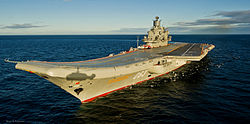
|
Soviet Union | 1 | Steam turbine | 58,000 tons | Russian Navy | ||
| 1 | People's Liberation Army Navy | |||||||
| Kiev (INS Vikramaditya) | 
|
Soviet Union | 1 | Steam turbine | 45,500 tons | Indian Navy | Built as STOVL carrier and converted to STOBAR | |
| Shandong | 
|
China | 1 | Steam turbine | 70,000 tons | People's Liberation Army Navy |
|
Upgraded Kuznetsov type design, first aircraft carrier built in China |
| Vikrant | 
|
India | 1 | Gas turbine | 45,000 tonnes | Indian Navy | First aircraft carrier built in India[13] |
References
[edit]- ^ a b Head, Jeff (7 April 2014). "What are the carriers?". World-Wide Aircraft Carriers. Retrieved 26 July 2019 – via Freewebs.
- ^ Li, Nan; Weuve, Christopher (2010). "China's Aircraft Carrier Ambitions". Naval War College Review. 63 (1): 20. Archived from the original on 27 July 2010.
- ^ "Chapter 4. Steam-Powered Catapults" (PDF). Aviation Boatswain's. Mate E. NAVEDTRA 14310 (Nonresident Training Course). Naval Education and Training Professional Development and Technology Center. July 2001 – via GlobalSecurity.org.
- ^ "EMALS: Next Gen Catapult". Defense Tech. 5 April 2007. Archived from the original on 20 June 2010.
- ^ "How Effective Will China's Carrier-Based Fighters Be?". Defense Tech. 25 April 2012. Archived from the original on 27 April 2012.
- ^ Singh, Rahul (14 May 2008). "Now Navy wants Super Hornets too". Hindustan Times. Retrieved 3 December 2018.
In our simulation, we discovered that not only could the Super Hornet take-off from a ski-jump, but could do so with a significant weapons load.
- ^ Ankit, Panda (24 April 2015). "US-India Collaboration on Aircraft Carriers: A Good Idea?". The Diplomat. Retrieved 26 July 2019.
- ^ "Indian Navy seeks EMALS system for second Vikrant-class aircraft carrier". Naval Technology. 29 May 2013. Retrieved 26 July 2019.
- ^ Kumar, Chethan (25 April 2012). "LCA naval variant's first flight on Friday". Deccan Herald. Archived from the original on 2 February 2014. Retrieved 26 July 2019.
- ^ "Maiden flight by 2nd prototype of LCA Tejas' naval variant". The Economic Times. Press Trust of India. 7 February 2015. Archived from the original on 11 February 2015. Retrieved 26 July 2019.
- ^ "Naval Version of Light Combat Aircraft Rolls out a Defining and Memorable Occasion for the Nation – Antony". Press Information Bureau. 6 July 2010. Archived from the original on 5 August 2011. Retrieved 26 July 2019.
- ^ "J-15 successfully landed on China's carrier Liaoning: Navy". Sina English. Xinhua News Agency. 25 November 2012. Archived from the original on 28 November 2012. Retrieved 26 July 2019.
- ^ "India's first indigenous aircraft carrier INS VIKRANT(IAC1) is out for trials". Defence Aviation Post. 17 October 2020. Archived from the original on 18 October 2020. Retrieved 18 October 2020.
STOBAR
View on GrokipediaDefinition and Technical Principles
Core Mechanism
The core mechanism of STOBAR centers on a ski-jump ramp for aircraft launches and arrestor wires for recoveries. During take-off, fixed-wing aircraft positioned on the carrier's flight deck accelerate using engine thrust alone over a run of approximately 200 meters before ascending a curved bow ramp angled at 12-14 degrees. This ramp imparts an upward vector to the aircraft's momentum, increasing its angle of attack and generating additional lift to enable departure without catapults, though typically with reduced maximum takeoff weight compared to catapult systems.[5][6] For recoveries, aircraft approach the angled deck at speeds around 240-260 km/h and deploy a tailhook to engage one of three to four transverse arrestor wires. The captured wire unreels, transmitting force to hydraulic absorbers or water brakes that dissipate the aircraft's kinetic energy, halting it within 90-150 meters to prevent overrun into the forward barrier or ramp. This arrested landing process mirrors that of CATOBAR systems but operates on shorter decks, requiring precise pilot control due to the absence of catapult precision aids for launch.[7][1] STOBAR's integration of these elements allows conventional carrier operations without steam or electromagnetic catapults, prioritizing simplicity and lower complexity in propulsion systems. Aircraft must possess sufficient thrust-to-weight ratios and reinforced undercarriages to handle the ramp's stresses, with operational limits influenced by wind-over-deck conditions enhancing effective lift during launches.[8]Key Components
![Admiral Kuznetsov showing STOBAR ski-jump][float-right] The ski-jump ramp constitutes the primary launch component of a STOBAR system, featuring an upward-curving extension at the bow of the flight deck, typically inclined at 12 to 15 degrees over a length of approximately 50 meters. This ramp converts the aircraft's forward momentum into vertical lift, enabling short take-offs without catapults for compatible fixed-wing jets possessing high thrust-to-weight ratios. For instance, the Russian carrier Admiral Kuznetsov employs a 12-degree ramp, while the modified INS Vikramaditya uses a 14.3-degree ski-jump to facilitate launches of MiG-29K fighters.[9][1] Arresting gear forms the essential recovery mechanism, comprising multiple transverse steel cables stretched across the angled flight deck, which engage the aircraft's tailhook to initiate rapid deceleration. These wires connect to hydraulic engines or water brake systems below deck that absorb kinetic energy, halting the aircraft within 100-150 meters. STOBAR carriers generally equip three to four such wire sets, supplemented by safety barriers for bolter or failed engagements, mirroring CATOBAR recovery but adapted to shorter effective deck lengths.[9][10] The flight deck infrastructure integrates an angled layout, usually at 8-10 degrees, to permit simultaneous approach and launch operations while providing space for parked aircraft and munitions handling. Supporting elements include aircraft elevators for hangar access, deck edge lifts, and optical landing systems such as the Officer of the Deck's mirror or Fresnel lens equivalents for glide slope guidance, ensuring precise arrested landings in varying sea states.[11]Historical Development
Origins in Soviet Design
The Soviet Union developed the STOBAR configuration in the late 1970s and early 1980s to enable operations of conventional fixed-wing aircraft from carriers, building on prior experience with vertical/short take-off and landing (V/STOL) aircraft like the Yakovlev Yak-38 on Kiev-class vessels.[12][3] These earlier ships, commissioned starting in 1975, demonstrated the limitations of V/STOL jets in payload and range, prompting designs for heavier fighters such as the Sukhoi Su-33.[13] The STOBAR system integrated a bow-mounted ski-jump ramp—typically at a 12-degree angle—with arresting gear to facilitate short take-offs via increased aircraft angle-of-attack and controlled recoveries, avoiding the complexity of catapults.[14] The first operational STOBAR carrier was the lead ship of the Kuznetsov class, Project 1143.5, with Admiral Kuznetsov laid down on 1 September 1982 at the Black Sea Shipyard (now Mykolaiv Shipyard) in Ukrainian SSR.[14][15] This design evolved from the Kiev class's partial angled flight deck but shifted to a full-length deck optimized for STOBAR, allowing launches of up to 24 Su-33 interceptors and supporting Ka-27 helicopters.[16] The ski-jump, influenced by earlier land-based trials and Western experiments, provided the necessary lift vector for ski-jump-assisted take-offs without requiring steam or electromagnetic catapults, aligning with Soviet emphasis on robust, missile-armed "heavy aviation cruisers" for fleet defense rather than long-range strike.[14][12] Subsequent designs, such as the nuclear-powered Ulyanovsk (Project 1143.7), laid down on 25 November 1988, retained STOBAR principles despite ambitions for greater capacity, reflecting the system's adaptation to Soviet industrial and doctrinal constraints before the USSR's dissolution halted further construction.[17] The configuration prioritized interoperability with land-based naval aviation assets, enabling carriers to deploy fighters comparable to shore-based Su-27 variants while operating in contested waters.[16]Post-Cold War Adaptations
Following the Soviet Union's dissolution in 1991, Russia retained the Admiral Kuznetsov, implementing limited STOBAR upgrades amid fiscal constraints and supply chain disruptions from the post-Soviet breakup. A planned refit announced in 2010 targeted hangar expansion for increased aircraft capacity and propulsion modernization, but chronic issues including boiler failures and structural wear have hampered full operational restoration, with the carrier undergoing extended repairs into the 2020s.[18][19] India pursued STOBAR adaptation by acquiring the decommissioned Kiev-class carrier Admiral Gorshkov from Russia in 2004 for $974 million, followed by a $1.2 billion refit at Sevmash Shipyard to transform it into the INS Vikramaditya, commissioned on November 16, 2013. Modifications included removing anti-ship missiles to enlarge the flight deck, installing three arrestor wires, upgrading the 14-degree ski-jump ramp, and integrating systems for MiG-29K fixed-wing operations, enabling short take-off but arrested recovery for up to 26 aircraft.[9][20] China advanced STOBAR through acquisition of the unfinished Kuznetsov-class Varyag in 1998 for $20 million, completing hull and systems work to commission it as Liaoning on September 25, 2012, with adaptations for J-15 fighters including flight deck reinforcements and electromagnetic arresting enhancements. Leveraging this, China constructed the indigenous Type 001 Shandong, launched April 26, 2017, and commissioned December 17, 2019, featuring an enlarged 12-degree ski-jump, extended hangar, and STOBAR refinements for 32-36 aircraft to address Liaoning's sortie rate limitations.[21][22] These efforts by India and China demonstrated STOBAR's adaptability for emerging naval powers, prioritizing affordability and rapid deployment over catapult-equipped alternatives, while Russia's experience underscored maintenance challenges in sustaining legacy designs without robust industrial support.[23]Operational Advantages and Limitations
Performance Strengths
STOBAR configurations provide notable economic and operational efficiencies compared to catapult-assisted systems, primarily due to the elimination of complex catapult mechanisms, which lowers both initial construction costs and ongoing maintenance requirements.[11] For instance, carriers like India's INS Vikramaditya, refitted with STOBAR in 2013, avoided the expense of installing catapults, enabling faster commissioning at a reduced overall budget.[24] This simplicity also translates to fewer crew members needed for launch operations, as pilots rely on the aircraft's engines and the ski-jump ramp rather than ground-based propulsion systems.[11] The ski-jump ramp, typically angled at 12-14 degrees, imparts an initial upward velocity to departing aircraft, effectively shortening the required takeoff roll and providing additional lift through the generated angle of attack.[25] This design reduces the g-forces experienced by pilots and airframes during launch—often below 2g versus over 4g in catapult shots—potentially extending service life and allowing for more frequent sorties without excessive wear.[26] In practice, STOBAR-equipped vessels such as Russia's Admiral Kuznetsov have demonstrated reliable launches of heavy fighters like the Su-33, achieving takeoff speeds with payloads that conventional flat-deck short takeoffs could not match as efficiently.[24] Furthermore, STOBAR's compact deck layout permits shorter carrier hulls, optimizing space for hangar storage and potentially increasing the number of embarked aircraft relative to deck length.[24] This has proven advantageous for nations building medium-sized carriers, as seen with India's INS Vikrant, commissioned in 2022, which leverages STOBAR to operate MiG-29K fighters effectively within a 40,000-ton displacement.[11] The system's reliance on arrested recovery for landings maintains high precision and safety, comparable to CATOBAR, while avoiding the mechanical vulnerabilities of catapults exposed to saltwater environments.[11]Inherent Constraints
The STOBAR system's reliance on a ski-jump ramp for aircraft launches imposes fundamental restrictions on take-off performance, necessitating aircraft with high thrust-to-weight ratios, such as the MiG-29K or Su-33, to generate sufficient lift without catapult assistance.[1] This design precludes the effective operation of heavier or less agile fixed-wing aircraft, including those optimized for airborne early warning or electronic warfare roles, limiting the carrier's air wing composition to primarily fighter types.[27] Launch weights are inherently capped, as the short take-off distance and ramp angle restrict fuel and ordnance loads, often requiring aircraft to operate at 50-70% of maximum take-off weight to achieve viable climb rates and mission radii.[11] Consequently, sorties demand multiple cycles of aerial refueling or reduced combat endurance, diminishing overall strike effectiveness compared to catapult-equipped systems.[28] Operational tempo suffers from lower sortie generation rates, typically 20-30 per day under optimal conditions, due to the sequential nature of unassisted launches and dependencies on wind-over-deck for enhanced ramp lift.[29] Adverse weather exacerbates these issues, as insufficient headwinds can ground operations entirely, a vulnerability evident in the Russian carrier Admiral Kuznetsov's limited deployments where STOBAR constraints contributed to inconsistent air operations.[15] Maintenance demands on the ski-jump structure and arresting gear further compound reliability challenges, with structural wear from repeated high-impact recoveries accelerating deck fatigue absent the distributed stresses of catapults.[30] These factors collectively position STOBAR as a cost-effective but capability-constrained alternative, suitable for regional power projection yet inadequate for sustained high-intensity carrier warfare.[31]Comparison to Alternative Systems
STOBAR Versus CATOBAR
CATOBAR (Catapult-Assisted Take-Off But Arrested Recovery) systems employ steam or electromagnetic catapults to accelerate aircraft to takeoff speed from a flat deck, enabling launches with maximum fuel and ordnance loads, while arrested recovery uses wires to halt landings.[24] In contrast, STOBAR (Short Take-Off But Arrested Recovery) relies on a ski-jump ramp at the bow to provide additional lift via upward trajectory, necessitating reduced payloads for sufficient acceleration on the shorter effective deck.[11] This fundamental difference results in CATOBAR carriers achieving higher sortie generation rates—typically 120-150 per day for U.S. Nimitz-class vessels—versus STOBAR's 30-50 sorties, as the latter's dependence on aircraft thrust and ramp angle limits operational tempo.[24][32] CATOBAR offers superior flexibility for aircraft operations, accommodating heavier fixed-wing platforms like the E-2 Hawkeye airborne early warning aircraft or C-2 Greyhound transports, which STOBAR configurations cannot reliably launch due to weight constraints and ramp-induced airframe stress.[33] STOBAR, however, imposes greater structural demands on airframes during ski-jump launches, potentially accelerating fatigue compared to the even thrust of catapults.[34] Weather sensitivity further disadvantages STOBAR, as calm winds reduce ramp effectiveness, whereas CATOBAR maintains consistency via powered acceleration.[35]| Aspect | CATOBAR Advantages/Limitations | STOBAR Advantages/Limitations |
|---|---|---|
| Cost and Complexity | Higher construction and maintenance costs due to catapults and larger crews (e.g., U.S. carriers require specialized catapult technicians); electromagnetic variants like EMALS add technological risks but reduce steam dependency.[24][11] | Lower development and operational expenses, simpler design with fewer crew needs, enabling smaller displacement carriers (e.g., India's 40,000-ton Vikrant vs. U.S. 100,000-ton Ford-class).[11] |
| Payload and Range | Full combat loads extend mission radius; supports buddy tanking and surveillance assets for sustained power projection.[32] | Reduced fuel/weapons for takeoff shortens effective range and loiter time; incompatible with many support aircraft.[33] |
| Sortie Rate | Elevated throughput for surge operations, critical in peer conflicts.[24] | Constrained by deck cycle times and launch physics, yielding lower daily outputs.[36] |
STOBAR Versus STOVL
STOBAR systems employ a ski-jump ramp to impart additional vertical velocity during short takeoffs, paired with arrested recovery using wires to decelerate landing aircraft, enabling the use of modified conventional takeoff and landing (CTOL) fighters such as the MiG-29K and Su-33 on carriers like Russia's Admiral Kuznetsov.[37] This approach allows for potentially higher takeoff weights under optimal wind-over-deck conditions, supporting payloads closer to land-based norms, though typically reduced by 20-30% due to the ramp's angle and deck run limitations, restricting combat radius and ordnance loads in adverse weather or high temperatures.[30] In contrast, STOVL relies on aircraft like the F-35B, which use lift fans or directed engine thrust for short takeoffs and vertical landings, eliminating the need for arrestor gear and enabling operations from smaller or amphibious vessels without specialized deck equipment.[38] Operationally, STOBAR offers advantages in landing heavier aircraft with full fuel and weapons after missions, as arrested recovery handles weights up to the carrier's design limits without vertical thrust penalties, but takeoffs remain sensitive to environmental factors, potentially halving effective payload in calm conditions.[1] STOVL provides greater flexibility in recovery, operable in higher sea states and without reliance on precise wire engagements, which can fail in rough weather, and supports dispersed operations across multiple platforms.[38] However, STOVL aircraft incur inherent design compromises, with the F-35B's internal fuel capacity of approximately 6,125 kg yielding a combat radius of about 450 nautical miles, compared to over 600 nautical miles for CTOL variants like the F-35A, alongside a maximum weapons payload of 6.8 tonnes versus 8 tonnes for carrier-optimized CTOL models.[38] These trade-offs stem from the added weight of vertical propulsion systems, reducing overall range and loiter time by up to 50% in bomb-truck configurations relative to conventional counterparts.[30] Notably, while STOVL operations are often associated with flat decks, the ski-jump ramp on STOBAR-configured carriers can benefit F-35B operations by enabling increased takeoff weights, payloads, or fuel compared to flat decks, as the ramp imparts additional lift. This hybrid approach is technically feasible with significant modifications, including specialized heat-resistant deck coatings to withstand the exhaust heat from vertical landings. Precedents include the Spanish Juan Carlos I-class carriers, which operated AV-8B Harriers using the ski-jump for STOVL missions, and the UK's Queen Elizabeth-class carriers, which conduct F-35B short takeoffs from the ski-jump followed by vertical recoveries.[39][40][41][42] In terms of sortie generation, STOVL may achieve higher rates due to simplified deck cycles—lacking the need for wire resets or catapult cycles—potentially exceeding 100 sorties per day on large carriers like the UK's Queen Elizabeth class, though real-world factors like vertical engine wear and hot-gas exhaust management limit sustained output.[38] STOBAR, while requiring arrestor maintenance, leverages conventional jet simplicity for quicker turnarounds in favorable conditions but faces bottlenecks from ramp-dependent launches and fewer compatible aircraft types, often resulting in lower overall flexibility for non-fighter roles.[30] Cost-wise, STOBAR carriers and aircraft are generally less expensive to procure and maintain, as seen in Russian and Indian implementations using adapted land-based airframes, avoiding the specialized engineering premiums of STOVL jets, which command higher unit prices and lifecycle costs due to complexity.[2] Adoption trends reflect these dynamics: STOBAR suits budget-constrained navies prioritizing volume over versatility, while STOVL appeals to forces emphasizing operational dispersal and alliance interoperability, such as NATO partners sharing F-35B logistics.[38]Implementations and Users
STOBAR-Equipped Aircraft Carriers
STOBAR-equipped aircraft carriers are operated by Russia, India, and China, featuring ski-jump ramps for short take-offs combined with arrested landings via wires and barriers. These vessels enable fixed-wing aircraft operations without catapults, prioritizing lighter payloads and operational simplicity over full-load launches. As of 2025, five such carriers remain in active service, reflecting adaptations of Soviet-era designs and indigenous developments tailored to regional naval strategies.[9] Russia's Admiral Kuznetsov, the lead ship of the Kuznetsov-class, was commissioned on 4 December 1991 after launching in 1985. This 55,000-ton carrier employs a 12-degree ski-jump bow ramp and three arrestor wires, supporting up to 24 fixed-wing aircraft alongside helicopters. Designed during the late Soviet period for multi-role operations including anti-submarine warfare, it integrates heavy cruiser armament such as P-700 Granit missiles, limiting pure carrier functionality.[16][14] India operates two STOBAR carriers: INS Vikramaditya, a refurbished Kiev-class vessel originally laid down in 1970 and recommissioned on 16 November 2013 following extensive modernization at Sevmash Shipyard. Displacing 45,400 tons, it features a 14-degree ski-jump and accommodates 26 aircraft, primarily MiG-29K fighters, enhancing India's blue-water capabilities in the Indian Ocean. The indigenous INS Vikrant, commissioned on 2 September 2022, displaces 45,000 tons and uses a similar STOBAR configuration with a 12-degree ramp, designed for 30 aircraft including MiG-29K and future platforms; it marks India's first domestically built carrier, constructed by Cochin Shipyard.[9][43][44] China's People's Liberation Army Navy fields Liaoning (Type 001), commissioned on 25 September 2012 after refitting the ex-Soviet Varyag. This 60,900-ton carrier utilizes a 12-degree ski-jump for J-15 fighter operations, carrying up to 40 aircraft and serving as a training platform before operational deployment. Its successor, Shandong (Type 002), commissioned on 17 December 2019, incorporates design refinements on a similar 66,000-ton hull, including an enlarged flight deck and improved STOBAR performance for 36-44 aircraft, enabling more sustained South China Sea patrols.[22][45]| Carrier | Operator | Commissioned | Displacement (tons) | Air Wing Capacity | Ski-Jump Angle |
|---|---|---|---|---|---|
| Admiral Kuznetsov | Russia | 4 December 1991 | 55,000 | 24 fixed-wing + helicopters | 12° |
| INS Vikramaditya | India | 16 November 2013 | 45,400 | 26 aircraft | 14° |
| INS Vikrant | India | 2 September 2022 | 45,000 | 30 aircraft | 12° |
| Liaoning (Type 001) | China | 25 September 2012 | 60,900 | Up to 40 aircraft | 12° |
| Shandong (Type 002) | China | 17 December 2019 | 66,000 | 36-44 aircraft | 12° |
Compatible Aircraft Types
STOBAR operations necessitate fixed-wing aircraft with high thrust-to-weight ratios, typically exceeding 1.0 under combat loads, to generate sufficient lift during short-deck ski-jump launches, alongside reinforced undercarriages for arrested recoveries and folding wings for storage efficiency.[1] These requirements limit compatibility primarily to agile multirole fighters rather than heavier bombers or transports, emphasizing lightweight designs optimized for carrier constraints.[46] The core operational types are Russian and Chinese carrier-based Flanker derivatives, including the Mikoyan MiG-29K, Sukhoi Su-33, and Shenyang J-15, which have logged thousands of deck cycles on active STOBAR platforms.[45] Helicopters such as the Kamov Ka-27 or Changhe Z-18 provide ASW and utility roles but are not constrained by fixed-wing takeoff dynamics.[46] Mikoyan MiG-29KDeveloped in the 1980s and upgraded with AL-31F engines yielding a thrust-to-weight ratio of approximately 1.1, the MiG-29K supports air-to-air and strike missions from STOBAR decks. The Indian Navy operates 45 units across INS Vikramaditya and INS Vikrant, achieving initial carrier landings in 2012, while Russia has tested it on Admiral Kuznetsov as a lighter complement to heavier Flankers.[47] Its ski-jump launches typically require 150-200 meters of deck run at full afterburner.[48] Sukhoi Su-33
The Su-33, entering Russian service in 1998, features canard foreplanes and a thrust-to-weight ratio near 1.05 for STOBAR takeoffs from Admiral Kuznetsov, where it conducted initial operations in 1995. With a maximum takeoff weight of 33 tons, it prioritizes air superiority but carries reduced payloads—up to 6 tons externally—compared to land-based Su-27 variants due to ramp-induced lift limitations.[48] Production totaled 24 airframes before program curtailment in 1992.[48] Shenyang J-15
China's J-15, reverse-engineered from a Su-33 prototype and operational since 2013 on Liaoning, employs WS-10 engines for STOBAR compatibility on Type 001 and 002 carriers, with over 50 units built by 2020. It achieves launches with 4-6 tons of ordnance but faces payload-range tradeoffs similar to the Su-33, prompting variants like the J-15T for hybrid CATOBAR transitions while retaining ramp operations.[45] Emerging compatibility extends to Western designs via trials: the F/A-18E/F Super Hornet completed ski-jump takeoffs in 2022 at weights up to 30 tons, validating STOBAR feasibility for export markets like India.[49] Saab's Gripen E/F, with a 1.1+ thrust-to-weight ratio, is certified for STOBAR via simulations and structural reinforcements.[50]