



Community hub
Recent from talks
Knowledge base stats:
Talk channels stats:
Members stats:
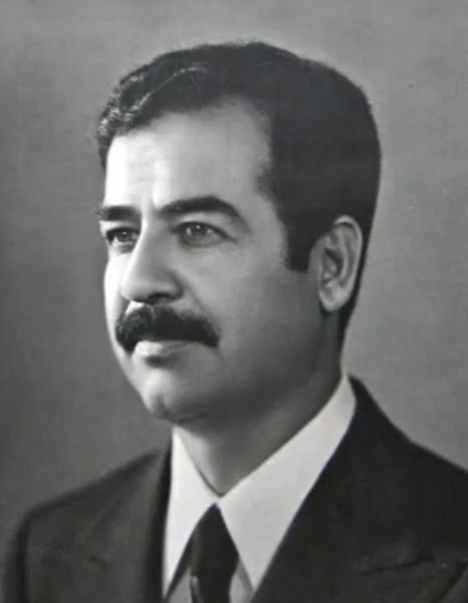
Saddam Hussein
Saddam Hussein (28 April 1937 – 30 December 2006) was an Iraqi politician and revolutionary who served as the president of Iraq from 1979 until he was overthrown in 2003 during the U.S. invasion of Iraq. He previously served as the vice president from 1968 to 1979 and also as the prime minister from 1979 to 1991 and later from 1994 to 2003. A leading member of the Arab Socialist Ba'ath Party, he was a proponent of Ba'athism, a mix of Arab nationalism and Arab socialism. The policies and political ideas he championed are collectively known as Saddamism.
Born near the city of Tikrit to a Sunni Arab family, Saddam Hussein joined the revolutionary Ba'ath Party in 1957. He played a key role in the 17 July Revolution that brought the Ba'athists to power in Iraq and made him vice president under Ahmed Hassan al-Bakr. During his tenure as vice president, Saddam nationalized the Iraq Petroleum Company, diversified the economy, introduced free healthcare and education, and supported women's rights. He also presided over the defeat of the Kurdish insurgency in the Second Iraqi–Kurdish War and signed the Algiers Agreement with Iran in 1975, thereby settling territorial disputes along the Iran–Iraq border. Following al-Bakr's resignation in 1979, Saddam formally took power. During his presidency, positions of power in the country were mostly filled with Sunni Arabs, a minority that made up only about a fifth of the Iraqi population.
Upon taking office as president in 1979, Saddam purged rivals within his party. In 1980, he ordered the invasion of Iran, purportedly to capture Iran's Arab-majority Khuzestan province, and end Iranian attempts to export its Islamic Revolution to the Arab world. In 1988, as the war with Iran ended in a stalemate, he ordered the Anfal campaign against Kurdish rebels who had sided with Iran. Later, he accused his former ally Kuwait of slant-drilling Iraq's oil reserves and subsequently invaded the country in 1990. This ultimately led to the Gulf War in 1991, which ended in Iraq's defeat by a United States-led coalition. In the war's aftermath, Saddam's forces suppressed the 1991 Iraqi uprisings launched by Kurds and Shi'as seeking regime change, as well as further uprisings in 1999. After reconsolidating his hold on power, Saddam pursued an Islamist agenda for Iraq through the Faith Campaign. In 2003, a US-led coalition invaded Iraq, incorrectly accusing him of developing weapons of mass destruction and of having ties with al-Qaeda. Coalition forces toppled Saddam's regime and captured him. During his trial, Saddam was convicted by the Iraqi High Tribunal of crimes against humanity and sentenced to death by hanging. He was executed on 30 December 2006.
A polarizing and controversial figure, Saddam dominated Iraqi politics for 35 years and was the subject of a cult of personality. Many Arabs regard Saddam as a resolute leader who challenged Western imperialism, opposed the Israeli occupation of Palestine, and resisted foreign intervention in the region. Conversely, many Iraqis, particularly Shi'as and Kurds, perceive him as a tyrant responsible for acts of repression, mass killing and other injustices. Human Rights Watch estimated that Saddam's regime was responsible for the murder or disappearance of 250,000 to 290,000 Iraqis. Saddam's government has been described by several analysts as authoritarian and totalitarian, and by some as fascist, although the applicability of those labels has been contested.
Saddam Hussein Al-Majid Al-Tikriti was born on 28 April 1937, in al-Awja, a small village near Tikrit, to a Sunni Arab family from the Al-Bejat clan of the Bedouin Al-Bu Nasir tribe. His father, Hussein Abd al-Majid, was from the Al-Majid branch of the Al-Bejat clan, while his mother Subha Tulfah al-Mussalat was granddaughter of Mussallat bin Omar Al-Nasiri, a tribal leader of the Al-Bu Nasir tribe and an opponent of the Ottoman rule in Iraq.
Saddam's name means "the fighter who stands steadfast". His father died before his birth. This made Saddam's mother, Subha, so depressed that she unsuccessfully attempted to abort her pregnancy and commit suicide. Saddam's mother did not want anything to do with him, and Saddam was eventually taken in by an uncle. His stepfather, Ibrahim al-Hassan, treated Saddam harshly after his return, and (according to a psychological profile created by the CIA) beat him regularly, sometimes to wake him up. At around the age of 10, Saddam fled the family and returned to live in Baghdad with his uncle Khairallah Talfah, who became a fatherly figure to Saddam. Talfah, the father of Saddam's future wife, was a devout Sunni Muslim and a veteran of the 1941 Anglo-Iraqi War between Iraqi nationalists and the United Kingdom, which remained a major colonial power in the region. Talfah was appointed the mayor of Baghdad during Saddam's time in power, until his notorious corruption compelled Saddam to force him out of office.
Later in his life, relatives from his native city became some of his closest advisors and supporters. Under the guidance of his uncle, he attended a nationalistic high school in Baghdad. After secondary school, Saddam studied at an Iraqi law school for three years, dropping out in 1957 at the age of 20 to join the revolutionary pan-Arab Ba'ath Party, of which his uncle was a supporter. During this time, Saddam apparently saw himself as a secondary school teacher. Ba'athist ideology originated in Syria and the Ba'ath Party had a large following in Syria at the time, but in 1955 there were fewer than 300 Ba'ath Party members in Iraq, and it is believed that Saddam's primary reason for joining the party as opposed to the more established Iraqi nationalist parties was his familial connection to Ahmed Hassan al-Bakr and other leading Ba'athists through his uncle. The pan-Arab nationalism of Gamal Abdel Nasser in Egypt profoundly influenced young Ba'athists like Saddam. The rise of Nasser foreshadowed a wave of revolutions throughout the Middle East in the 1950s and 1960s, with the collapse of the monarchies of Iraq, Egypt, and Libya. Nasser inspired nationalists throughout the Middle East by fighting the British and the French during the Suez Crisis of 1956, modernizing Egypt, and uniting the Arab world politically. Saddam's father-in-law, Khairallah Talfah, was reported to have served five years in prison for his role in fighting against Great Britain in the 1941 Iraqi coup d'état and Anglo-Iraqi War, and often mentored and told tales of his exploits to the young Saddam.
The Ba'ath Party was originally represented in Qasim's cabinet; however, Qasim—reluctant to join Nasser's newly formed union between Egypt and Syria—sided with various groups within Iraq (notably the social democrats and the Iraqi Communist Party) that told him such an action would be dangerous. Instead, Qasim adopted a wataniyah policy of "Iraq First". To strengthen his own position within the government, Qasim also had an alliance with the Iraqi Communist Party (ICP), which was opposed to the notion of pan-Arabism. His policies angered several pan-Arab organizations, including the Ba'ath Party, which later began plotting to assassinate Qasim at Al-Rashid Street on 7 October 1959 and take power. Saddam was recruited to the assassination conspiracy by its ring-leader, Abdul Karim al-Shaikhly, after one of the would-be assassins left. During the ambush, Saddam (who was only supposed to provide cover) began shooting prematurely, which disorganised the whole operation. Qasim's chauffeur was killed and Qasim was hit in the arm and shoulder. The assassins thought they had killed Qasim and quickly retreated to their headquarters, but Qasim survived. Saddam himself is not believed to have received any training outside of Iraq, as he was a late addition to the assassination team.
Hub AI
Saddam Hussein AI simulator
(@Saddam Hussein_simulator)
Saddam Hussein
Saddam Hussein (28 April 1937 – 30 December 2006) was an Iraqi politician and revolutionary who served as the president of Iraq from 1979 until he was overthrown in 2003 during the U.S. invasion of Iraq. He previously served as the vice president from 1968 to 1979 and also as the prime minister from 1979 to 1991 and later from 1994 to 2003. A leading member of the Arab Socialist Ba'ath Party, he was a proponent of Ba'athism, a mix of Arab nationalism and Arab socialism. The policies and political ideas he championed are collectively known as Saddamism.
Born near the city of Tikrit to a Sunni Arab family, Saddam Hussein joined the revolutionary Ba'ath Party in 1957. He played a key role in the 17 July Revolution that brought the Ba'athists to power in Iraq and made him vice president under Ahmed Hassan al-Bakr. During his tenure as vice president, Saddam nationalized the Iraq Petroleum Company, diversified the economy, introduced free healthcare and education, and supported women's rights. He also presided over the defeat of the Kurdish insurgency in the Second Iraqi–Kurdish War and signed the Algiers Agreement with Iran in 1975, thereby settling territorial disputes along the Iran–Iraq border. Following al-Bakr's resignation in 1979, Saddam formally took power. During his presidency, positions of power in the country were mostly filled with Sunni Arabs, a minority that made up only about a fifth of the Iraqi population.
Upon taking office as president in 1979, Saddam purged rivals within his party. In 1980, he ordered the invasion of Iran, purportedly to capture Iran's Arab-majority Khuzestan province, and end Iranian attempts to export its Islamic Revolution to the Arab world. In 1988, as the war with Iran ended in a stalemate, he ordered the Anfal campaign against Kurdish rebels who had sided with Iran. Later, he accused his former ally Kuwait of slant-drilling Iraq's oil reserves and subsequently invaded the country in 1990. This ultimately led to the Gulf War in 1991, which ended in Iraq's defeat by a United States-led coalition. In the war's aftermath, Saddam's forces suppressed the 1991 Iraqi uprisings launched by Kurds and Shi'as seeking regime change, as well as further uprisings in 1999. After reconsolidating his hold on power, Saddam pursued an Islamist agenda for Iraq through the Faith Campaign. In 2003, a US-led coalition invaded Iraq, incorrectly accusing him of developing weapons of mass destruction and of having ties with al-Qaeda. Coalition forces toppled Saddam's regime and captured him. During his trial, Saddam was convicted by the Iraqi High Tribunal of crimes against humanity and sentenced to death by hanging. He was executed on 30 December 2006.
A polarizing and controversial figure, Saddam dominated Iraqi politics for 35 years and was the subject of a cult of personality. Many Arabs regard Saddam as a resolute leader who challenged Western imperialism, opposed the Israeli occupation of Palestine, and resisted foreign intervention in the region. Conversely, many Iraqis, particularly Shi'as and Kurds, perceive him as a tyrant responsible for acts of repression, mass killing and other injustices. Human Rights Watch estimated that Saddam's regime was responsible for the murder or disappearance of 250,000 to 290,000 Iraqis. Saddam's government has been described by several analysts as authoritarian and totalitarian, and by some as fascist, although the applicability of those labels has been contested.
Saddam Hussein Al-Majid Al-Tikriti was born on 28 April 1937, in al-Awja, a small village near Tikrit, to a Sunni Arab family from the Al-Bejat clan of the Bedouin Al-Bu Nasir tribe. His father, Hussein Abd al-Majid, was from the Al-Majid branch of the Al-Bejat clan, while his mother Subha Tulfah al-Mussalat was granddaughter of Mussallat bin Omar Al-Nasiri, a tribal leader of the Al-Bu Nasir tribe and an opponent of the Ottoman rule in Iraq.
Saddam's name means "the fighter who stands steadfast". His father died before his birth. This made Saddam's mother, Subha, so depressed that she unsuccessfully attempted to abort her pregnancy and commit suicide. Saddam's mother did not want anything to do with him, and Saddam was eventually taken in by an uncle. His stepfather, Ibrahim al-Hassan, treated Saddam harshly after his return, and (according to a psychological profile created by the CIA) beat him regularly, sometimes to wake him up. At around the age of 10, Saddam fled the family and returned to live in Baghdad with his uncle Khairallah Talfah, who became a fatherly figure to Saddam. Talfah, the father of Saddam's future wife, was a devout Sunni Muslim and a veteran of the 1941 Anglo-Iraqi War between Iraqi nationalists and the United Kingdom, which remained a major colonial power in the region. Talfah was appointed the mayor of Baghdad during Saddam's time in power, until his notorious corruption compelled Saddam to force him out of office.
Later in his life, relatives from his native city became some of his closest advisors and supporters. Under the guidance of his uncle, he attended a nationalistic high school in Baghdad. After secondary school, Saddam studied at an Iraqi law school for three years, dropping out in 1957 at the age of 20 to join the revolutionary pan-Arab Ba'ath Party, of which his uncle was a supporter. During this time, Saddam apparently saw himself as a secondary school teacher. Ba'athist ideology originated in Syria and the Ba'ath Party had a large following in Syria at the time, but in 1955 there were fewer than 300 Ba'ath Party members in Iraq, and it is believed that Saddam's primary reason for joining the party as opposed to the more established Iraqi nationalist parties was his familial connection to Ahmed Hassan al-Bakr and other leading Ba'athists through his uncle. The pan-Arab nationalism of Gamal Abdel Nasser in Egypt profoundly influenced young Ba'athists like Saddam. The rise of Nasser foreshadowed a wave of revolutions throughout the Middle East in the 1950s and 1960s, with the collapse of the monarchies of Iraq, Egypt, and Libya. Nasser inspired nationalists throughout the Middle East by fighting the British and the French during the Suez Crisis of 1956, modernizing Egypt, and uniting the Arab world politically. Saddam's father-in-law, Khairallah Talfah, was reported to have served five years in prison for his role in fighting against Great Britain in the 1941 Iraqi coup d'état and Anglo-Iraqi War, and often mentored and told tales of his exploits to the young Saddam.
The Ba'ath Party was originally represented in Qasim's cabinet; however, Qasim—reluctant to join Nasser's newly formed union between Egypt and Syria—sided with various groups within Iraq (notably the social democrats and the Iraqi Communist Party) that told him such an action would be dangerous. Instead, Qasim adopted a wataniyah policy of "Iraq First". To strengthen his own position within the government, Qasim also had an alliance with the Iraqi Communist Party (ICP), which was opposed to the notion of pan-Arabism. His policies angered several pan-Arab organizations, including the Ba'ath Party, which later began plotting to assassinate Qasim at Al-Rashid Street on 7 October 1959 and take power. Saddam was recruited to the assassination conspiracy by its ring-leader, Abdul Karim al-Shaikhly, after one of the would-be assassins left. During the ambush, Saddam (who was only supposed to provide cover) began shooting prematurely, which disorganised the whole operation. Qasim's chauffeur was killed and Qasim was hit in the arm and shoulder. The assassins thought they had killed Qasim and quickly retreated to their headquarters, but Qasim survived. Saddam himself is not believed to have received any training outside of Iraq, as he was a late addition to the assassination team.