Hubbry Logo
Sahibganj loopSahibganj loopMain
Open search
Sahibganj loop
Community hub
Sahibganj loop
logo
8 pages, 0 posts
0 subscribers
Be the first to start a discussion here.
Sahibganj loop
Sahibganj loop
from Wikipedia

Sahibganj loop
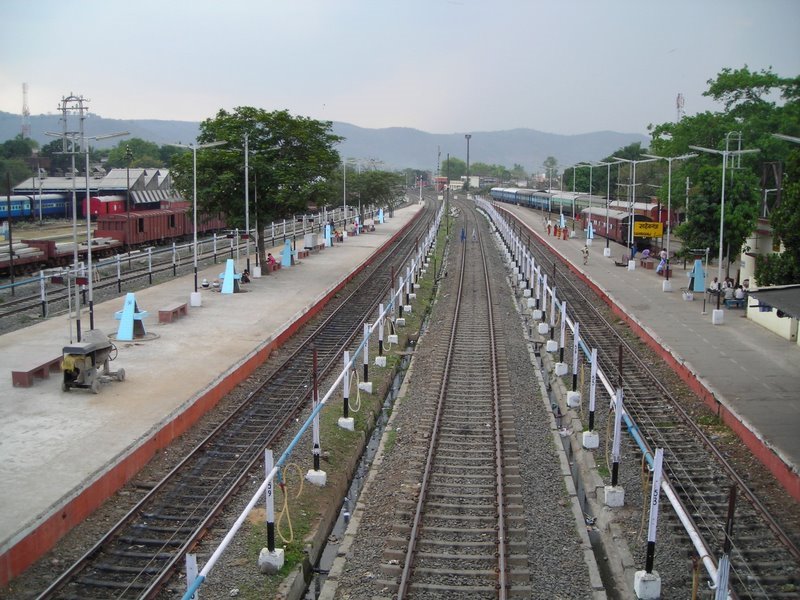
Sahibganj railway station, after which the loop line is named as Sahibganj loop
Overview
StatusOperational
OwnerIndian Railways
LocaleWest Bengal, Jharkhand, Bihar
Termini
Service
Operator(s)Eastern Railway
History
Opened1866
Technical
Line length403.8 km (251 mi)
Number of tracks1/ 2
Track gauge5 ft 6 in (1,676 mm) broad gauge
ElectrificationYes
Operating speed130 km/h
Route map
Sahibganj loop
km
km
km
Up arrow
301
Kiul Junction
427
Down arrow
Rampur Halt
424
Dhanauri
421
Pawai Brohmasthan
Halt
418
Up arrow
Uren
415
Kajra
411
Down arrow
Ghogi Bariarpur
406
394
Sabdalpur
Abhaipur
404
Masudan
400
387
Munger
Dharhara
394
386
Purab Sarai
Dasharathpur
388
385
Sandalpur
Sarobag Halt
387
384
Hatkarota Halt
Jamalpur Junction
382
383
Safiasarai
Jamalpur rail tunnel
Patam Halt
378
376
Ratanpur
373
Rishikund Halt
to Mananpur (planned)
Left arrow
371
Bariarpur
367
Kalyanpur Road
364
Ghorghat Halt
362
Khariapipra Halt
360
Ganganiyan
357
Kamarganj
Left arrow
352
Sultanganj
Left arrow
350
Abjuganj
347
Maheshi
342
Akbarnagar
339
Chhit Makhanpur
337
Murarpur
332
Nathnagar
328
Bhagalpur Junction
Left arrow
to Dumka & Rampurhat
 
321
Sabaur
314
Lailakh Mamalkha
308
Ghogha
302
Ekchari
Down arrow
to NTPC Farakka
 
298
Kahalgaon
290
Bikramshila
287
Shivanarayanpur
284
Lakshmipur Bhorang
Left arrow
to Godda
(under construction)
278
Pirpainti
273
Ammapali
269
Mirza Cheuki
263
Karamtola
254
Sahibganj Junction
Sakrigali
246
Maharajpur
240
247
Sakrigali Ghat
Karanpurato
233
Taljhari
226
228
Rajmahal
Kalian Chak
221
220
Murli Halt
Tinpahar Junction
216
Dhamdhamia
211
Bakudi
207
179
Barharwa Junction
Right arrow
172
Gumani
Right arrow
165
Kotalpokhar
157
Tilbhita
Left arrow
to Godda (planned)
 
153
Pakur
PANEM coal depot
147
Nagarnabi
136
Rajgram
130
Banshlai Bridge
125
Murarai
117
Chatra
Right arrow
to Azimganj
 
108
Nalhati Junction
101
Swadinpur
Left arrow
94
Rampurhat Junction
87
Tarapith Road
81
Mallarpur
78
Gadadharpur
Right arrow
to Chowrigacha
(planned)
71
Sainthia Junction
Siuri
LowerLeft arrow
63
Bataspur
Purandarpur
58
Ahmadpur Junction
Abinashpur
Right arrow
Mongoldihi
Salan
49
Kopai
Kasba
Bolpur-Prantik-Siuri line
(planned)
43
Prantik
39
Bolpur Shantiniketan
31
Bhedia
26
Pichkurir Dhal
20
Guskara
Up arrow
15
Noadar Dhal
Left arrow
10
Banpas
102
Sitarampur
4
Jhapater Dhal
0
Khana Junction
Down arrow
km
km
km

The Sahibganj loop is a railway line connecting Khana Junction and Kiul Junction. Originally a part of the Howrah–Delhi main line, it was opened to traffic in 1866. With the construction of a shorter railway line for a part of the route, the 403.8 kilometres (250.9 mi) stretch was assigned a separate identity.

History

[edit]

Railway transportation was introduced in India within 30 years of its maiden run in England.

The East Indian Railway Company which was formed on 1 June 1845, completed its survey for a railway line from Kolkata, then called Calcutta, to Delhi via Mirzapur in 1846. The company initially became defunct on refusal of government guarantee, which was given in 1849. Thereafter, an agreement was signed between East Indian Railway Company and the East India Company, for the construction and operation of an "experimental" line between Kolkata and Rajmahal, which would later be extended to Delhi via Mirzapur. Construction began in 1851.

On 15 August 1854, the first passenger train in the eastern section was operated up to Hooghly, 39 kilometres (24 mi) away. On 1 February 1855 the first train ran from Hooghly to Raniganj, 195 kilometres (121 mi) from Howrah. The priority accorded to the Raniganj section was because of the assurance of coal transportation.

The Khana Junction-Rajmahal section was complete in October 1859, crossing Ajay River on the way. The first train ran from Howrah to Rajmahal via Khana on 4 July 1860.[1][2] The Loop from Khana Junction to Kiul via Jamalpur, including the Monghyr branch, was ready in February 1862.[2]

From Rajmahal, construction progressed rapidly, moving westward along the banks of the Ganges, reaching Bhagalpur in 1861, Munger in February 1862, and opposite Varanasi (across the Ganges) in December 1862 and then on to Naini on the bank of the Yamuna. The work included EIR's first tunnel at Jamalpur and first major bridge across the Son River at Arrah.

During 1863–64, work progressed rapidly on the Allahabad–Kanpur–Tundla and Aligarh–Ghaziabad sections. The Yamuna bridge near Delhi was completed in 1864 and EIR established the Delhi terminus. The Yamuna bridge at Allahabad opened on 15 August 1865 and in 1866 Kolkata and Delhi were directly linked. The 1 Dn/ 2 Up Mail started running.

With the completion of the 300.8-kilometre (186.9 mi) long line from Khana Junction connecting Durgapur, Asansole with Kiul Junction in 1871, a "shorter main line" was in position. Initially, it was called the chord line. However, as it attracted more traffic it was designated the main line and the original line became the Sahibganj loop.

After approx 150 years of operation, Sahibganj loop is converted in double line on 14-05-2019 except Ratanpur–Jamalpur section as construction of tunnel near Jamalpur is in progress. Train operation with Electric Loco in Kiul–Bhagalpur section is started on 03-06-2019.

In the Rail Budget 2008, Bhagalpur was announced to be converted to as Railway Division but decision withdrawn by ER in 2009. The new rail lines from Sultanganj to Deoghar announced and the construction yet to start . Bhagalpur to Rampurhat via Dumka 184.9-kilometre (114.9 mi) section is operational. Bhagalpur to Deoghar via Banka 107.1-kilometre (66.5 mi) section is operational. Bhagalpur to Godda via Hansdiha is operational.

Route

[edit]

Branch lines

[edit]

In 1863, the Indian Branch Railway Company, a private company opened the Nalhati–Azimganj branch line. The 50 kilometres (31 mi) track was initially a 4' gauge line. The track was subsequently converted to 5' 6" broad gauge. The Indian Branch Railway Company was purchased by the Government of India in 1872 and the line was renamed Nalhati State Railway. It became a part of the East Indian Railway Company in 1892.[3]

In 1913, the Hooghly–Katwa Railway constructed a 105-kilometre (65 mi)line from Bandel to Katwa, and the Barharwa–Azimganj–Katwa railway constructed the 171.9-kilometre (106.8 mi) Barharwa–Azimganj–Katwa loop line. The 73.3-kilometre (45.5 mi) Andal–Sainthia branch line was built in 1913.

The 105-kilometre (65 mi)-long Ahmedpur–Katwa Light Railway connecting Ahmadpur Junction and Katwa Junction and Katwa Junction to Barddhaman Junction, built on 760 millimetres (30 in), was opened to traffic on 29 September 1917.[4]

184.9-kilometre (114.9 mi) Bhagalpur to Rampurhat via Dumka section is operational. 107.1-kilometre (66.5 mi) Bhagalpur to Deoghar section via Banka is operational.

72.9-kilometre (45.3 mi) Mirza Cheoki–Godda and 67.6-kilometre (42.0 mi) Godda–Hansdiha is operational. Trains are running between Bhagalpur and Godda via Hansdiha.

Developments

[edit]

Only Ratanpur to Jamalpur of the Sahibganj loop is still operating on single track. Work of construction of second tunnel near Janalpur is in progress. Second tunnel work near Jamalpur is likely to be completed by 2021. Twenty-one pairs of trains ply between Bhagalpur and Sahibganj.

New rail line from Pakur–Godda and Bashukinath Dham–Chatra is proposed. Work for doubling the 111-kilometre-long (69 mi) stretch started in 2010 (announced in 1996).[5]

Work on the new 130-kilometre-long (81 mi) Rampurhat–Dumka–Mander Hill broad-gauge line completed and Kavi Guru Express BhagalpurJn to Howrah is running on this route.[6]

Jamalpur Workshop

[edit]

Jamalpur Workshop, the first full-fledged railway workshop facility in India, was opened on 8 February 1862, at a time when the Howrah–Delhi main line, passing through Jamalpur was under construction. It was felt that communities of gunsmiths and other craftsmen in the area handling mechanical engineering jobs could pick up the skills required in a railway workshop. It undertook repairs of wagons, coaches, cranes and tower cars, and locomotives, as well as manufacture of some tower cars, break-down cranes and various kinds of heavy-duty lifting jacks. They also produced their own locomotives, starting with the CA 764 Lady Curzon in 1899. It has also produced ticket printers and other ticket machines (slitting, counting, and chopping). With fairly extensive workshop facilities, it was a fairly self-contained.[7]

Electrification

[edit]

Electrification of the Khana–Rampurhat–Sainthia–Pakur section was announced in the rail budget for 2010–11.[8] The electrification of Ahmedpur–Khana–Sainthia–Rampurhat–Pakur–Bonidanga section was completed in 2016. The first electric train service started from 29 September 2016 through running of Howrah – Rampurhat Express by Electric Locomotive.

The electrification of Bonidanga Link Cabin–Barharwa–Sahibganj–Kiul section including the Tinpahar – Rajmahal section (Announced by Prime Minister Package in Bihar) has been started from September 2017 and was expected to be completed by the end of March 2020 but got delayed due to COVID-19 pandemic and was completed on 30 June 2020.

After approximately 150 years of operation of Kiul–Bhagalpur section of Sahibganj loop, Vikramshila Express became the first train to be hauled by an electric locomotive on 2 June 2019.

After the electrification between Bhagalpur to Kiul, first train with electric locomotive on this loop was started with Vikramshila Express between Anand Vihar Terminal to Bhagalpur hauled by WAP-5 of Ghaziabad Shed. The next day it departed and ran with the same electric loco from Bhagalpur Junction till Anand Vihar Terminal. By then almost 8 pairs of express trains originated from Bhagalpur begun its operations by electric locomotives.

The electrification of the further loop line between Bhagalpur to Bonidanga Link Cabin was delayed due to doubling work between Sahibganj–Bhagalpur section which was completed in the month of April 2019.

After the electrification of Bhagalpur Kiul section, the remaining electrification work was resumed between Bhagalpur to Bonidanga in 4 stages which began from both sides, As the Bonidanga–Barharwa section was electrified within a month in the 1st phase.

The remaining work continued between Barharwa–Tinpahar which was completed within two months in its 2nd phase.

Within that time, doubling work between Bhagalpur to Kahalgaon section was completed but, it was again delayed due to the ongoing Route-Relay Interlocking (RRI) work. So, the remaining electrification work from Bhagalpur side was paused due to RRI work.

After the electrification of Barharwa–Tinpahar section, Tinpahar–Sahibganj section was electrified in its third phase and its CRS Inspection was completed between Sahibganj to Barharwa.

The 4th last phase of remaining electrification work was done between Sahibganj to Bhagalpur into two parts.

  1. Sahibganj–Shivnarayanpur (33 km) – was completed in February 2020
  2. Shivnarayanpur–Bhagalpur (42 km) – was completed in March 2020, CRS Inspection was done on 30 June 2020.

With the completion of electrification of Sahibganj loop from (Bonidanga Link Cabin to Kiul) distance of total 247 rkm, it became a history by becoming 100% fully electrified. The Howrah–New Delhi oldest rail route was constructed in the late 1880s by the British Government (East India Company) and thus, it ended the longest running era of diesel locomotives.

After this section was fully electrified between Bhagalpur – Shivnarayanpur remaining portion which is under Eastern Railways’ Malda division, Train number - 05956/05955 Delhi–Dibrugarh-Delhi Special Brahmaputra Mail was the first express train from Delhi to reach up to New Jalpaiguri with an Electric Locomotive. According to the NFR zone, the national transporter will save an amount of around Rs 20.4 crore per annum in its fuel cost, for running this train on electric traction between Pandit Deen Dayal Upadhyaya Jn (formerly Mughalsarai Junction) and New Jalpaiguri Jn railway stations.

Finally, the whole Sahibganj loop route has been electrified and the last CRS inspection was done on 30 June 2020 between Bhagalpur and Shivnarayanpur. Electric Trains are fully operational now in this route.

Route map

[edit]

See also

[edit]

References

[edit]
Revisions and contributorsEdit on WikipediaRead on Wikipedia
from Grokipedia
The Sahibganj Loop is a 404-kilometre railway line in eastern India that connects Khana Junction in West Bengal to Kiul Junction in Bihar, serving as an alternative route parallel to the shorter Grand Chord. Originally constructed as the primary segment of the East Indian Railway's Howrah–Delhi main line in the early 1860s, it was opened to traffic in stages starting from 1860 and fully operational by 1866, facilitating the transport of passengers and goods along the Ganges River valley. Following the completion of the First Chord line in 1871, which provided a more direct path from Khana to Luckeesarai near Kiul, the longer original route was redesignated as the Sahibganj Loop to accommodate growing traffic demands. The route traverses diverse terrains across three states—West Bengal, Jharkhand, and Bihar—passing through culturally significant areas such as the Santiniketan region near Bolpur and the temple town of Deoghar via a branch line. Key stations include Bolpur Shantiniketan (38 km from Khana), Rampurhat Junction (99 km), Sahibganj (232 km), and Bhagalpur (306 km), with the line historically featuring river ferries like those at Sakrigali Ghat before full bridging. Today, it supports numerous express and local trains, including connections to major cities like Howrah, Patna, and Delhi, while handling freight such as coal and construction materials from regional quarries. Historically, the Sahibganj Loop played a pivotal role in colonial India's connectivity, with construction beginning in 1860 from Panduah to Rajmahal and extending to Bhagalpur by 1861, amid the East Indian Railway's expansion under British administration. The Jamalpur Locomotive Workshop, established in 1862 along the route, became Asia's oldest railway workshop, underscoring the line's engineering importance. As of 2020, the route is fully electrified, and track doubling has been substantially completed, including the historic Kiul–Sahibganj section, enhancing its capacity and ongoing relevance in India's rail network alongside upgrades on parallel corridors.

Overview

Description

The Sahibganj loop is a 404 km broad gauge (1,676 mm) railway loop connecting Khana Junction in West Bengal to Kiul Junction in Bihar. It is owned and operated by Indian Railways, primarily under the Eastern Railway zone, with the Kiul end under the East Central Railway zone. The line supports a maximum speed of up to 110 km/h, with upgrades to 130 km/h in progress as of 2025, and functions as an alternative route to the Howrah–Delhi main line via the Grand Chord. Historically, it constituted the original Howrah–Delhi main line prior to the 1871 rerouting via the chord line, which shortened the primary path and relegated this section to loop status. The route traverses the states of West Bengal, Jharkhand, and Bihar. The entire line has been electrified since 2020.

Geographical Extent

The Sahibganj loop railway line spans 404 kilometers, connecting Khana Junction in West Bengal to Kiul Junction in Bihar while passing through Jharkhand. This route traverses three states: starting in West Bengal from Khana through areas like Bolpur and Rampur Hat, entering Jharkhand near the Sahibganj district, and continuing into Bihar via Bhagalpur before reaching Kiul. The line predominantly follows the Ganges River valley, meandering through a mix of landscapes that reflect the region's diverse topography. In Jharkhand, it crosses the undulating hilly terrains of the Rajmahal hills, part of the Chhotanagpur Plateau embedded within the Ganges floodplains, while in Bihar, it navigates the low-lying, flood-prone alluvial plains susceptible to seasonal inundation from the river and its distributaries. Significant geographical challenges along the route include the construction and maintenance of bridges over major tributaries, such as the , , and Kiul River, as well as a at Jamalpur to accommodate variations in the central sections amid varying . By linking remote interiors with urban centers, the Sahibganj loop plays a crucial role in improving connectivity for rural and tribal populations, particularly in Jharkhand's Santhal region, enabling better access to economic opportunities, healthcare, and education in otherwise isolated areas. This infrastructure supports the socioeconomic integration of these communities into the broader Howrah–Delhi rail network.

History

Construction Phase

The construction of the Sahibganj loop began in the 1850s as part of the East Indian Railway (EIR) Company's ambitious project to link Calcutta (now Kolkata) with northern India via a line along the Ganges River. Formed in 1845 with initial capital of £4,000,000 raised primarily in London through British investment, the EIR undertook surveys and groundwork starting around 1851 for an experimental line from Howrah to Rajmahal, incorporating what would become the core of the Sahibganj loop. The first significant section from Khana Junction to Rajmahal, spanning approximately 190 kilometers along the southern bank of the , opened to traffic on July 4, 1860, marking the initial operational segment of the loop and enabling the first through train from to powered by steam locomotives. This phase involved extensive earthworks and single-track alignment to navigate the riverine terrain, with engineering challenges including flood-prone soils and the need for stable embankments to prevent erosion from the . relied on British colonial funding guaranteed at 5% return by the , supplemented by private investors, while mobilizing thousands of Indian laborers for manual tasks such as track laying, quarrying, and bridge building over tributaries. Subsequent extensions progressed northward, connecting Rajmahal to Bhagalpur in 1861 and further to Kiul Junction by the mid-1860s, rendering the full 403.8-kilometer loop operational by 1866 as a vital artery for passenger and goods traffic using steam-powered services. Key engineering feats included the single-track configuration with minimal gradients to suit the undulating Gangetic plain and the strategic placement of modest girder bridges over local rivers, though the route avoided a direct crossing of the Ganges itself at Sahibganj, relying instead on its parallel alignment for efficient connectivity. The project exemplified Victorian-era railway engineering adapted to tropical conditions, with British oversight ensuring adherence to broad-gauge standards (5 ft 6 in) throughout.

Operational Evolution

Upon its completion in 1866, the Sahibganj loop functioned as the primary segment of the main line under the East Indian Railway (), facilitating direct connectivity between eastern and northern . This role persisted until 1871, when the shorter First Chord line—providing a more direct path from Khana to Luckeesarai near Kiul and completed by the —diverted long-distance main line traffic, relegating the Sahibganj route to secondary status and earning it the designation of a "loop" line. Following this shift, the Sahibganj loop primarily handled local passenger services, freight movements between and regions, and occasional diversions for main line maintenance or blockages, thereby supporting regional connectivity while the First Chord bore the bulk of express and through traffic. Its operational focus evolved to emphasize shorter-haul operations, including goods handling at key yards like Sahibganj, where shunting and pilot services managed quarry and local freight demands. In 1880, the British government took over the working of the , though the company retained ownership until . The of in 1951 integrated the , including the Sahibganj loop, into a unified state-owned network, standardizing operations and administration across former private companies. Throughout the 20th century, the line transitioned from predominant steam traction—reliant on coal-fired locomotives—to diesel and later electric systems, mirroring ' broader modernization to enhance efficiency and reduce operational costs, with diesel introductions accelerating post-1950s and gaining momentum from the onward. A pivotal reorganization occurred on April 14, 1952, when the Sahibganj loop was incorporated into the newly formed , which amalgamated the 's divisions for improved regional oversight.

Route and Infrastructure

Route Alignment

The Sahibganj Loop is a 404 km railway line that originates at Khana Junction, situated near Burdwan in West Bengal, and extends to Kiul Junction in Bihar, forming a secondary route parallel to the primary Howrah–Delhi main line. This alignment begins by departing Khana Junction and traversing westward through the district of Birbhum, passing key intermediate stations including Bolpur (at approximately 38 km) and Rampurhat (at 99 km), before reaching Pakur (at 152 km), which marks the border between West Bengal and Jharkhand. The path in this initial segment winds through fertile plains and forested areas, avoiding steeper terrains to the north. Entering , the route continues to Sahibganj (at 232 km), where it turns northeastward along the southern bank of the River for the central segment to (at 306 km) in , characterized by meandering alignments that parallel the river's course and include several loops to navigate around its tributaries and flood-prone zones. From , the line proceeds inland via Jamalpur (at 359 km), crossing varied topography with gentle gradients, before culminating at Kiul Junction. This configuration intentionally diverts from the more direct route to , incorporating circuitous paths around riverine obstacles for operational feasibility during its construction era. At both termini, the Sahibganj Loop integrates seamlessly with the Howrah–Delhi main line: Khana Junction serves as a critical interchange point on the eastern end, facilitating connectivity from Howrah, while Kiul Junction links to the western segments toward Gaya and beyond, enabling through services across the broader network.

Major Stations and Facilities

The Sahibganj loop includes several key stations that facilitate both passenger and freight operations, with facilities tailored to their roles as junctions and hubs. Sahibganj Junction serves as an important interchange point with historical connections to river port activities, including a former large steam locomotive shed and marine operations setup featuring a dedicated jetty and steamers. The station has three platforms, sidings for freight handling such as coal and goods via its public siding, and basic passenger amenities including waiting areas. Bhagalpur Junction stands as a primary hub on the route, categorized as an A-1 station with high daily footfall of approximately 50,000 passengers (as of 2024), supported by multiple platforms, waiting rooms, computerized ticketing, and refreshment facilities. Jamalpur Junction functions as a critical stop linked to the locomotive workshop, offering four platforms, eight tracks, signaling systems for efficient routing, and passenger amenities like waiting halls and parking. Kiul Junction acts as a major interchange for connections to the broader network, equipped with waiting rooms, computerized reservation counters, vehicle parking, and platforms handling diverse traffic flows.

Jamalpur Locomotive Workshop

The Jamalpur Locomotive Workshop, located at Jamalpur station, was established on 8 February 1862 as the locomotive workshop for the East India Railway, earning it the distinction of being the oldest locomotive workshop in . Initially focused on repairing and assembling imported , it quickly expanded to support the growing demands of the railway network during the British colonial era. The workshop's functions encompass comprehensive locomotive repair and periodic overhauling of diesel and electric locomotives, as well as manufacturing specialized equipment such as 140-ton breakdown cranes, high-capacity Jamalpur jacks, broad-gauge wagons, and tower wagons. It was the first facility in India to build broad-gauge steam locomotives, with the inaugural one, CA 764 "Lady Curzon," completed in 1899 at a cost of Rs. 33,000, which operated for 33 years. Additionally, it serves as a key training center for railway personnel through the Indian Railways Institute of Mechanical and Electrical Engineering (IRIMEE), which provides professional courses for mechanical officers, supervisors, and probationers in mechanical engineering. Historically, the workshop played a pivotal role in sustaining operations along the Sahibganj loop and the broader East Indian Railway system by handling repairs and producing components during the steam era. Today, as part of the , it focuses on maintenance for electric and diesel locomotives, contributing to the modernization of rail services. The facility employs approximately 10,000 workers and remains essential for overhauling electric locomotives to support ongoing initiatives.

Developments

Track Doubling Projects

The track doubling project for the Sahibganj loop was initiated in 2017, when the Railway Board approved the conversion of the historic single-track line into a double line to accommodate growing traffic demands. The initial phase focused on a 111 km stretch between Bhagalpur and Sahibganj, divided into four segments: Tinpahar-Sahibganj (32 km), Sahibganj-Pirpainty (28 km), Pirpainty-Kahalgaon (21 km), and Kahalgaon-Bhagalpur (30 km), with an estimated cost of ₹200 crore for this section. This effort addressed long-standing delays caused by the single track, exacerbated by increased rail movement following the construction of the Farakka Barrage in the 1970s. Progress on the doubling continued in subsequent years, with key sections such as Kiul-Bhagalpur and Pirpainty-Sahibganj completed by 2017. The Ratanpur-Jamalpur segment continues to pose engineering challenges due to the need for a parallel second tunnel at Kali Pahari, adjacent to the 157-year-old Bariakol tunnel. As of 2025, construction of this new tunnel remains in progress. The project incorporated new bridges and realignments in flood-prone areas along the Ganga river basin to enhance resilience against seasonal flooding. These engineering measures, combined with the expanded track capacity, have enabled higher train frequencies and improved operational efficiency on the loop. The doubling facilitates greater integration with ongoing electrification initiatives, supporting higher speeds for both passenger and freight services. Most of the Sahibganj loop now operates as a double line, though the Ratanpur-Jamalpur section remains single-tracked.

Electrification Efforts

The electrification of the Sahibganj loop was initiated in 2017 as part of ' Mission Electrification, a strategic program launched to accelerate the conversion of the broad gauge network to electric traction and reduce reliance on imported . This effort aligned with the broader goal of electrifying approximately 41,000 route kilometers by 2025, emphasizing energy efficiency and environmental . The project progressed in phases, with the Khana–Sahibganj section completed in 2018, followed by the Sahibganj–Kiul section spanning 2019 to 2020, culminating in full of the 403.8 km route by June 2020 using standard 25 kV AC overhead lines. The final stretch between Shivnarayanpur and underwent commissioning in March 2020, with statutory safety inspections (CRS) conducted on June 30, 2020, marking the loop's complete transition to electric operation. Challenges during implementation included installing overhead wiring in riverine and flood-prone areas along the , requiring specialized engineering to ensure stability over bridges and embankments. This electrification has significantly reduced diesel dependency, lowering operational costs and carbon emissions by an estimated 20-35% per passenger kilometer compared to diesel traction, while enabling higher acceleration and speeds for trains. It has facilitated the integration of the Sahibganj loop into premium electric-hauled services, such as routes, supporting faster long-distance connectivity between eastern and northern . The total investment for the project was approximately ₹1,500 crore, contributing to ' overall savings of over ₹5,600 crore in energy costs from 2015 to 2017 alone through similar initiatives.

Branch Lines and Extensions

The Sahibganj loop has seen significant expansion through branch lines and extensions primarily originating from Bhagalpur Junction, a key station on the loop, to improve regional connectivity in Bihar and Jharkhand. These developments have added over 300 km of new rail infrastructure, facilitating access to previously underserved areas and supporting economic growth. One major branch is the Bhagalpur–Rampurhat line, spanning approximately 184.9 km through Bihar, Jharkhand, and West Bengal. This line, connecting Bhagalpur on the Sahibganj loop to Rampurhat via Dumka, became fully operational for passenger services in 2018 following the completion of the Bhagalpur-Dumka section, completing the route's integration. The project aims to enhance connectivity to pilgrimage sites like Tarapith in West Bengal and boost freight movement of coal and minerals from Jharkhand's resource-rich regions. The Bhagalpur–Deoghar line, measuring about 107.1 km, extends from via Banka to in and was completed for full operations in 2022. This branch primarily serves to improve access to the religious center of (Baidyanath Dham), a major site, while also enabling efficient transport of minerals and agricultural goods from interior districts to the main loop. New stations such as Banka Junction have been upgraded along this route to handle increased traffic. Another key extension is the Bhagalpur–Godda line, covering roughly 106 km via Hansdiha, which achieved operational status in 2021 following the inauguration of the 32 km Hansdiha–Godda section. This branch targets connectivity to district's coal fields and power projects, promoting freight haulage of minerals to the Sahibganj loop for onward distribution, alongside passenger services to remote areas. Several new halts and intermediate stations, including Poreyahat, have been established to support local communities. Recent developments on these branches include the of additional stations and ongoing track doubling initiatives; for instance, in 2025, the Cabinet approved doubling of the 177 km Bhagalpur–Dumka–Rampurhat section at a cost of ₹3,169 to increase capacity for both passenger and freight traffic. These extensions integrate seamlessly with the Sahibganj loop, enabling through-running trains from major hubs like or directly to , , and without needing to detour via longer routes.

Operations

Passenger Services

The Sahibganj loop facilitates extensive passenger services, with over 50 trains operating daily along its route, including key express services such as the –Gaya Express (13023/13024) and the –Sahibganj (13235/13236). These trains connect major cities in , , and , providing vital connectivity for commuters and long-distance travelers. In October 2024, the daily Sahibganj– Intercity Express (13427/13428) was introduced, further improving regional links. Passenger services on the loop are primarily divided into mail/express categories, with more than 20 such trains running daily, alongside local passenger trains concentrated in the sections between Kiul and . Local services, such as the Sahibganj–Bhagalpur Passenger (53037), operate frequently to serve short-distance needs. Trains typically halt at major stations including Kiul Junction, Jamalpur Junction, Junction, and Sahibganj Junction to facilitate boarding and alighting. Halt patterns vary by train type, with express services stopping at 10–15 intermediate stations for efficiency. Amenities on these trains include both air-conditioned (AC) and non-AC coaches, along with onboard catering services through the Indian Railway Catering and Tourism Corporation (IRCTC). Following the completion of electrification across the entire loop in 2020, passenger trains now operate at improved maximum speeds of up to 110 km/h, enhancing travel times and service reliability.

Freight and Strategic Role

The Sahibganj loop serves as a vital corridor for freight transportation in eastern India, facilitating the movement of coal from Jharkhand mines to power plants and ports in West Bengal, such as the route from Lalmatia in Godda to NTPC Farakka. This route supports the transport of essential commodities including coal, cement, and food grains, contributing to the overall freight loading in the Eastern Railway zone, which reached over 100 million tonnes in FY 2024-25. As an alternative to the congested Grand Chord line, the loop alleviates pressure on the primary Howrah-Delhi main line, enhancing capacity for industrial growth in Bihar, Jharkhand, and West Bengal by providing parallel routing for bulk cargo. In August 2025, a third railway line was approved between Jamalpur and Bhagalpur to further boost freight and passenger capacity. Key facilities along the loop include yards at major junctions like Sahibganj and , which aid in efficient sorting and assembly of freight trains. Following the completion of electrification in June 2020, electric locomotives now haul freight services across the 247 km stretch from Kiul to Malda via Bhagalpur-Sahibganj-Barharwa, improving energy efficiency and operational speeds. Economically, the loop connects agricultural heartlands in Bihar and Jharkhand to industrial hubs and ports in Bengal, fostering regional development by enabling reliable bulk commodity flows. It reduces transit times for certain eastern routes through congestion avoidance, supporting faster delivery of goods like coal and cement to end-users.

Incidents

Historical Accidents

The Sahibganj loop, traversing flood-prone terrain along the Ganges River, has been susceptible to railway incidents influenced by natural hazards throughout its history. Although detailed records of major pre-2000 accidents are limited, the district's disaster management documentation acknowledges that railway accidents have occurred in the area, often linked to environmental challenges such as flooding that weaken infrastructure. These historical vulnerabilities underscore the route's exposure to seasonal monsoons, which have periodically disrupted rail services and prompted early engineering responses to mitigate risks. Overall, the loop's geography contributed to operational hazards, leading to incremental safety enhancements over the decades.

Recent Derailments

A more recent collision occurred on July 3, 2025, at the Barharwa railway yard in Sahibganj district, where a stone-laden freight train traveling at high speed collided with a stationary goods train, causing 14 wagons to derail and pile up. No casualties were reported, but the event caused significant disruption to freight operations on the loop, with tracks blocked for several hours and requiring heavy machinery for clearance. Preliminary investigations attributed the accident to excessive speed and a possible lapse in signaling protocols, leading to an inquiry by the Eastern Railway. On April 1, 2025, two NTPC-operated goods trains collided head-on near Bhognadih in Sahibganj district on a railway line connected to the Sahibganj loop, killing two loco pilots and injuring four others. The accident was attributed to an operational error. Following these incidents, implemented enhanced track patrols in flood-prone areas and advanced systems, including the indigenous Kavach technology on key corridors such as Delhi-Howrah, to prevent signal passing errors and overspeeding. These measures have contributed to a broader decline in consequential accidents, with accidents per million train kilometers dropping significantly in recent years. The route's historical susceptibility to floods continues to inform ongoing safety protocols.

Route Visualization

Detailed Route Map

The Detailed Route Map of the Sahibganj loop illustrates the linear progression of the 404-kilometre railway line from Khana Junction at 0 km to Kiul Junction at 404 km, serving as a key alternative to the Grand Chord for northbound traffic from eastern India. This map typically depicts the route in a schematic or scaled format, highlighting major stations at regular intervals to facilitate navigation and operational planning, with the line traversing parts of West Bengal, Jharkhand, and Bihar. Prominent stations marked on the map include Bolpur Shantiniketan at 38 km, at 99 km, Barharwa Junction at 178 km, Sahibganj at 232 km, at 306 km, Jamalpur at 359 km, and Kiul at 404 km, among over 70 halts that provide connectivity to regional towns and rural areas. Junctions such as (51 km), (71 km), and Jamalpur are emphasized as points where multiple lines converge, enabling route diversification for passenger and freight services. The map incorporates branch divergences for comprehensive visualization, notably the 106 km line to branching from Junction, which supports local connectivity in and . River crossings are distinctly shown with bridge symbols, including the between Bolpur and Ahmadpur (around 31-38 km), the near (71-78 km), and other major bridges over tributaries such as the Dwaraka, Brahmani, Bansloi, and Kiul rivers, underscoring the engineering challenges of the terrain. The Ganga crossing is located near the end of the route, between Ratanpur and Jamalpur via the (approx. 370 km). Track configurations are often color-coded on such maps to reflect infrastructure upgrades, with solid lines for double-track sections—as of November 2025, nearly the entire route is doubled except the remaining single-track portion between Ratanpur and Jamalpur (approx. 20 km)—and dashed lines for any single-track segments, aiding in understanding capacity enhancements. For digital access, interactive versions are available on platforms like the India Rail Info atlas, where users can zoom into the Sahibganj loop route, toggle layers for stations and branches, and trace alignments interactively, including recent updates to doubling projects.

Elevation and Terrain Profile

The Sahibganj loop traverses predominantly low-lying terrain across the Gangetic plains of West Bengal and Bihar, with elevations generally ranging from 36 meters above mean sea level (MSL) at Barharwa Junction to modest rises in the Jharkhand section amid undulating hills near the Rajmahal hills (up to approx. 100-120 m MSL). Starting from Khana Junction at approximately 39 meters MSL, the route maintains near-flat profiles through stations like Rampurhat (42 meters MSL) and Nalhati Junction (46 meters MSL), before descending slightly toward Sahibganj at 34 meters MSL and rising modestly to Bhagalpur (43 meters MSL) and Jamalpur Junction (39 meters MSL). This elevation profile underscores the line's alignment through alluvial floodplains, transitioning to more varied topography near the Rajmahal hills, where short climbs introduce minor undulations up to 1 in 100 ruling gradients typical of the region's secondary main lines. The terrain shifts from expansive, flat Gangetic plains in the West Bengal and northern Bihar segments—characterized by fertile lowlands prone to seasonal flooding—to gently rolling and undulating landscapes in the Jharkhand portion, particularly around Sahibganj and extending toward Bhagalpur. These undulations, influenced by the proximity to the Rajmahal hills, impose occasional steeper sections with gradients not exceeding 1%, but they contribute to a more challenging alignment compared to the broader Howrah-Delhi main line. The route's passage through this transitional zone demands careful engineering to manage soil stability and water flow, with the overall profile facilitating freight and passenger movement at average speeds while highlighting the loop's role as a vital alternative corridor. Key topographical challenges include numerous river crossings and a historic tunnel, exacerbating vulnerability to erosion in the flood-susceptible Ganga basin. The line features several major bridges over tributaries such as the Ajay, Mayurakshi, Dwaraka, Brahmani, Bansloi, and Kiul rivers, which are susceptible to scour and sediment deposition during monsoons, necessitating regular reinforcements to prevent breaches, including the Munger Ganga Bridge crossing near Jamalpur. Additionally, the Jamalpur Tunnel—measuring 275 meters in length, 7 meters in height, and 8 meters in width—pierces the Jamalpur hills between Ratanpur and Jamalpur, addressing the route's most pronounced elevation shift in this segment; originally constructed in the 1860s, it remains operational, though doubling efforts include a parallel 276-meter tunnel completed for enhanced capacity. Flood mitigation measures, including embankments along vulnerable stretches, have been implemented to protect the alignment, as outlined in regional disaster management plans that emphasize strengthening against Ganga overflows affecting up to 20,000 people in nearby areas during high-water events. As of November 2025, ongoing doubling projects, such as the approved Bhagalpur–Dumka–Rampurhat section, further enhance resilience and capacity. These features directly influence operations, imposing speed restrictions in the approximately 50-kilometer undulating stretch through 's hilly terrain to ensure safety amid curves and minor gradients, limiting maximum speeds to around 100-110 km/h in affected sections. Embankments and bridge protections further mitigate flood risks, reducing downtime from erosion-related disruptions, though periodic maintenance remains essential for maintaining reliability on this 404-kilometer loop.

References

Add your contribution
Related Hubs
User Avatar
No comments yet.