


Community hub
Recent from talks
Contribute something
Nothing was collected or created yet.
Rajdhani Express
View on Wikipedia
| Rajdhani Express | |
|---|---|
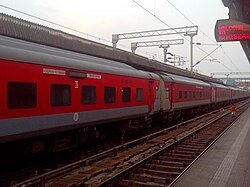
 Thiruvananthapuram Rajdhani Express at Thiruvananthapuram Central. | |
| Overview | |
| Service type | Connecting various state capitals with Delhi |
| Status | Active |
| First service | 1 March 1969 |
| Current operator | Indian Railways |
| Website | indianrail |
| Route | |
| Line used | 26 |
| On-board services | |
| Classes | AC 3 tier; AC 2 tier; AC First Class |
| Seating arrangements | Yes |
| Sleeping arrangements | Yes |
| Catering facilities | On-board catering services |
| Observation facilities | Large windows, reading light |
| Entertainment facilities | Electric outlets Reading Lights |
| Baggage facilities | Underseat |
| Technical | |
| Rolling stock | LHB coachs |
| Track gauge | 5 ft 6 in (1,676 mm) broad gauge |
| Operating speed | 110–130 km/h (68–81 mph) |
| Track owner | Indian Railways |
| Rake maintenance | Indian Railways |

The Rajdhani Express (lit. 'Capital Express') is a series of passenger train services in India operated by Indian Railways connecting the national capital New Delhi with the capitals or the largest cities of various states. The Sanskrit word Rajdhani means "capital". Introduced in 1969, the trains are amongst the premium services operated by Indian Railways and regularly get a higher priority on the railway network.
History
[edit]In 1960, the Railway Board of India commissioned a study to increase the speed of its trains, which was restricted to 96 km/h (60 mph) on the existent broad gauge lines.[1] A target of 160 km/h (99 mph) with an intermediate stage of 120 km/h (75 mph) was set for passenger trains. Research Design and Standards Organisation (RDSO) started work on the same in 1962 with field trials commencing in 1967.[1] The coaches were manufactured by the Integral Coach Factory at Madras and hauled by diesel locomotives.[1]

On 19 February 1969, the Government of India introduced a new express train capable of reaching speeds of up to 120 km/h (75 mph) as announced in the railway budget.[3] On 1 March 1969, the first Rajdhani Express with nine coaches was flagged off from New Delhi to Howrah with the return journey commencing on 3 March.[4] The train completed the 1,450 km (900 mi) trip in 17 hours 20 minutes and was the only such train in operation till 1972, when the second Rajdhani was introduced from Mumbai.[1]
Rajdhani, derived from the Sanskrit means "capital" and later, with subsequent up-gradation of the tracks, new Rajdhani expresses were introduced connecting major cities with the capital New Delhi.[5]
Rake
[edit]Rajdhani trains have fully air-conditioned coaches that have to be reserved in advance. While the trains initially had chair car coaches, now the trains exclusively have sleeper coaches in three configurations: first class, two-tier and three-tier.[1] The first class has dedicated coupes, two-tier has open bays containing six berths per bay (four berths in two tiers and two on the side of the aisle) with curtains and three-tier has open bays containing eight berths per bay (six berths in two tiers and two berths on the side of the aisle).[6] The coaches were exclusively manufactured by Integral Coach Factory at Chennai till 2006, when LHB coaches manufactured by Rail Coach Factory, Kapurthala were introduced.[1] As of 2018[update], each train-set costs ₹75 crore (US$8.9 million).[7] While the trains are capable of running at higher speeds, the maximum speed is often limited to 130 km/h (81 mph) with the fastest Rajdhani permitted to reach a maximum speed of 130 km/h (81 mph) and average speeds being much lesser due to traffic congestion and lack of supporting tracks.[8] The Rajdhani express trains are usually hauled by WAP-7 electric locomotives.[9]
Tejas-Rajdhani express
[edit]In July 2021, Indian railways started upgrading the coaches of Rajdhani express to new Tejas coaches with enhanced features.[10][11] These coaches are equipped with newer air suspensions, bio-toilets, Wi-Fi, fire alarms, CCTVs, reading lights, dedicated power sockets, automatic doors, passenger information system, improved interior and designed exterior.[12] The trains which are equipped with all new coaches are known as "Tejas Rajdhani" express.[13] Indian Railways plans to introduce Tejas coaches across all Rajdhani trains in a phased manner.[14]
Facilities
[edit]The trains are amongst the premium services operated by Indian Railways and regularly gets a higher priority on the railway network.[15][16] Passengers are served optional meals by Indian Railway Catering and Tourism Corporation (IRCTC), the menu of which could include morning tea, breakfast, lunch, high tea and dinner depending on the duration and timing.[17] These trains have fewer halts than other express trains with stoppages only at prominent stations. Dynamic pricing is applicable on fares across all Rajdhani trains.[18]
Services
[edit]As of 13 September, 2025, there are currently 26 operational pairs (excluding special services) of Rajdhani Express, including seven with Tejas rakes:[19][20]
| S.No. | Train name | Tr.No. | Rake | Origin station | Terminal station | Zone | Halts | Freq. | Distance | Travel time | Speed | Inaugural run | Ref | |
|---|---|---|---|---|---|---|---|---|---|---|---|---|---|---|
| Max | Avg | |||||||||||||
| 1 | Howrah Rajdhani Express (via Gaya) | 12301/ 12302 | LHB | Howrah | New Delhi | ER | 7 | 6 days/wk | 1,451 km (902 mi) | 17h 15m | 130 km/h (81 mph) | 84 km/h (52 mph) | 3 March 1969 | [21] |
| 2 | Mumbai Tejas Rajdhani Express | 12951/ 12952 | Tejas | Mumbai Central | New Delhi | WR | 6 | Daily | 1,386 km (861 mi) | 15h 32m | 130 km/h (81 mph) | 89 km/h (55 mph) | 17 May 1972 | [22] |
| 3 | August Kranti Tejas Rajdhani Express | 12953/ 12954 | Tejas | Mumbai Central | Hazrat Nizamuddin | WR | 10 | Daily | 1,378 km (856 mi) | 16h 33m | 130 km/h (81 mph) | 83 km/h (52 mph) | 1 January 1992 | [23] |
| 4 | Bangalore Rajdhani Express | 22691/ 22692 | LHB | KSR Bengaluru | Hazrat Nizamuddin | SWR | 13 | Daily | 2,367 km (1,471 mi) | 33h 30m | 130 km/h (81 mph) | 71 km/h (44 mph) | 1 November 1992 | [24] |
| 5 | Thiruvananthapuram Rajdhani Express | 12431/ 12432 | LHB | Thiruvananthapuram Central | Hazrat Nizamuddin | NR | 19 | Tri-weekly | 2,844 km (1,767 mi) | 41h 15m | 130 km/h (81 mph) | 69 km/h (43 mph) | 3 July 1993 | [25] |
| 6 | Chennai Rajdhani Express | 12433/ 12434 | LHB | MGR Chennai Central | Hazrat Nizamuddin | NR | 8 | Bi-weekly | 2,175 km (1,351 mi) | 28h 25m | 130 km/h (81 mph) | 77 km/h (48 mph) | 3 July 1993 | [26] |
| 7 | Howrah Rajdhani Express (via Patna) | 12305/ 12306 | LHB | Howrah | New Delhi | ER | 7 | Weekly | 1,531 km (951 mi) | 20h 00m | 130 km/h (81 mph) | 77 km/h (48 mph) | 3 July 1993 | [27] |
| 8 | Bhubaneswar Rajdhani Express (via Adra) | 22811/ 22812 | Tejas | Bhubaneswar | New Delhi | ECoR | 13 | Bi-weekly | 1,730 km (1,070 mi) | 23h 20m | 130 km/h (81 mph) | 74 km/h (46 mph) | 1 April 1994 | [28] |
| 9 | Bhubaneswar Tejas Rajdhani Express (via Tatanagar) | 22824/ 22823 | Tejas | Bhubaneswar | New Delhi | ECoR | 13 | 4 days/wk | 1,801 km (1,119 mi) | 24h 30m | 130 km/h (81 mph) | 74 km/h (46 mph) | 1 April 1994 | [29] |
| 10 | Dibrugarh - New Delhi Rajdhani Express | 12423/ 12424 | LHB | Dibrugarh | New Delhi | NR | 9 | Daily | 2,432 km (1,511 mi) | 37h 55m | 130 km/h (81 mph) | 65 km/h (40 mph) | 6 July 1994 | [30] |
| 11 | Jammu Tawi Rajdhani Express | 12425/ 12426 | LHB | Jammu Tawi | New Delhi | NR | 3 | Daily | 577 km (359 mi) | 8h 20m | 130 km/h (81 mph) | 69 km/h (43 mph) | 10 July 1994 | [31] |
| 12 | Patna Tejas Rajdhani Express | 12309/ 12310 | Tejas | Rajendra Nagar Terminal | New Delhi | ECR | 4 | Daily | 1,001 km (622 mi) | 12h 30m | 130 km/h (81 mph) | 80 km/h (50 mph) | 1 September 1996 | [32] |
| 13 | Swarna Jayanti Rajdhani Express | 12957/ 12958 | LHB | Sabarmati Jn. | New Delhi | WR | 9 | Daily | 929 km (577 mi) | 12h 10m | 130 km/h (81 mph) | 77 km/h (48 mph) | 1 January 1998 | [33] |
| 14 | Secunderabad Rajdhani Express | 12437/ 12438 | LHB | Secunderabad Jn. | Hazrat Nizamuddin | NR | 5 | Weekly | 1,661 km (1,032 mi) | 21h 40m | 130 km/h (81 mph) | 77 km/h (48 mph) | 21 January 1998 | [34] |
| 15 | Diburgarh Rajdhani Express (via Bogibeel) | 20505/ 20506 | LHB | Dibrugarh | New Delhi | NFR | 23 | Bi-weekly | 2,294 km (1,425 mi) | 39h 38m | 110 km/h (68 mph) | 58 km/h (36 mph) | 11 January 1999 | [35] |
| 16 | Sealdah Rajdhani Express | 12313/ 12314 | LHB | Sealdah | New Delhi | ER | 6 | Daily | 1,458 km (906 mi) | 18h 00m | 130 km/h (81 mph) | 81 km/h (50 mph) | 1 July 2000 | [36] |
| 17 | Ranchi Rajdhani Express (via Bokaro) | 20839/ 20840 | LHB | Ranchi | New Delhi | SER | 6 | Bi-weekly | 1,307 km (812 mi) | 17h 00m | 130 km/h (81 mph) | 77 km/h (48 mph) | 17 October 2001 | [37] |
| 18 | Bilaspur Rajdhani Express | 12441/ 12442 | LHB | Bilaspur Jn. | New Delhi | NR | 8 | Bi-weekly | 1,505 km (935 mi) | 20h 40m | 130 km/h (81 mph) | 73 km/h (45 mph) | 28 October 2001 | [38] |
| 19 | Ranchi Rajdhani Express (via Japla) | 20407/ 20408 | LHB | Ranchi | New Delhi | NR | 6 | Weekly | 1,251 km (777 mi) | 16h 45m | 130 km/h (81 mph) | 75 km/h (47 mph) | 11 June 2006 | [39] |
| 20 | Ranchi Rajdhani Express (via Chopan) | 12453/ 12454 | LHB | Ranchi | New Delhi | NR | 7 | Weekly | 1,244 km (773 mi) | 17h 55m | 130 km/h (81 mph) | 69 km/h (43 mph) | 11 June 2006 | [40] |
| 21 | Dibrugarh Rajdhani Express (via Moranhat) | 20504/ 20503 | LHB | Dibrugarh | New Delhi | NFR | 22 | 5 days/wk | 2,471 km (1,535 mi) | 41h 15m | 110 km/h (68 mph) | 59 km/h (37 mph) | 6 March 2010 | [41] |
| 22 | Madgaon Rajdhani Express | 22414/ 22413 | LHB | Madgaon Jn. | Hazrat Nizamuddin | NR | 9 | Bi-weekly | 1,909 km (1,186 mi) | 24h 54m | 130 km/h (81 mph) | 77 km/h (48 mph) | 20 November 2015 | [42] |
| 23 | Agartala Tejas Rajdhani Express | 20501/ 20502 | Tejas | Agartala | Anand Vihar Terminal | NFR | 14 | Weekly | 2,594 km (1,612 mi) | 43h 15m | 130 km/h (81 mph) | 59 km/h (37 mph) | 28 October 2017 | [43] |
| 24 | Bhubaneswar Tejas Rajdhani Express (via Sambalpur) | 20817/ 20818 | Tejas | Bhubaneswar | New Delhi | ECoR | 14 | Weekly | 1,914 km (1,189 mi) | 26h 40m | 130 km/h (81 mph) | 72 km/h (45 mph) | 10 February 2018 | [44] |
| 25 | Mumbai CSMT Rajdhani Express | 22221/ 22222 | LHB | Mumbai CSMT | Hazrat Nizamuddin | CR | 8 | Daily | 1,537 km (955 mi) | 17h 55m | 130 km/h (81 mph) | 86 km/h (53 mph) | 19 January 2019 | [45] |
| 26 | Sairang Rajdhani Express | 20507/ 20508 | LHB | Sairang (Aizawl, Mizoram) | Anand Vihar Terminal | NFR | 18 | Weekly | 2,510 km (1,560 mi) | 42h 15m | 130 km/h (81 mph) | 59.41 km/h (36.92 mph) | 13 September 2025 | [46][47] |
Trivia
[edit]- The Bilaspur Rajdhani Express is the First Rajdhani Express in India that undergoes loco reversal, which happens at Nagpur Junction railway station.
- The First Rajdhani Express to operate from Anand Vihar Terminal railway station is Agartala Tejas Rajdhani Express.
- Anand Vihar Terminal railway station to get its Second Rajdhani Express, the 20507/20508 Mizoram Rajdhani Express. This will also be the Second Rajdhani Express in India that will undergo loco reversal, which will happen at Badarpur Railway Station at Assam.
- 12301/12302 Howrah Rajdhani used to take 16 hrs 50 mins to cover the 1,451 kilometres (902 mi) distance running at 86.22 kilometres per hour (53.57 mph) speed in period from 2006-2016. The train was slowed down by 20 mins due to safety and operational reasons.
- 12951/52 Mumbai Rajdhani is the First Rajdhani Express in India which received LHB coach in late 2003.
- Only Kolkata, Mumbai, Bhubaneswar, Ranchi, Dibrugarh currently has 3 pairs of End to End (E2E) Rajdhani Express Service.
Gallery
[edit]

Accidents and incidents
[edit]- On 9 September 2002, At least 140 people were killed when the Howrah–New Delhi Rajdhani Express derailed near Rafiganj, Bihar due to sabotage by Naxalites.[48]
- On 27 October 2009, Bhubaneswar Rajdhani Express was hijacked by hundreds of armed activists of the Maoist-backed People's Committee against Police Atrocities (PCPA) who forced the train to stop at Banshtala near Jhargram in West Midnapore district of West Bengal and demanded the release of Chhatradhar Mahato. The Maoists fled on the arrival of Central Reserve Police Force and all passengers were rescued without any casualties.[49]
- On 18 April 2011, three coaches of Mumbai Rajdhani Express caught fire, including the pantry car 2:20 hrs at Thuriya near Ratlam in Madhya Pradesh. Three coaches were written off but there were no casualties.[50]
- On 25 June 2014, at least four passengers were killed and eight injured when the Dibrugarh Rajdhani Express derailed at Goldin Ganj near Chhapra, Bihar in suspected sabotage by Maoists.[51]
- On 7 September 2017, Ranchi Rajdhani Express derailed at New Delhi railway station and no one was injured in the incident.[52]
- On 14 September 2017, Jammu Tawi Rajdhani Express derailed at the New Delhi railway station when entering the platform and no one was injured.[53]
- On 18 October 2018, two coaches of Thiruvananthapuram Rajdhani Express derailed at the staffed level crossing near Ratlam in Madhya Pradesh when a speeding truck collided with train due to brake failure. There were no injuries to the passengers in the train but the truck driver was killed due to the collision and the train continued the journey after delay of seven hours.[54]
- On 3 April 2019, two coaches of Bhubaneswar Rajdhani Express uncoupled on the Kathajodi river bridge near Cuttack in Odisha. The train was halted and there was no casualties.[55]
- On 11 May 2019, a fire broke out at the generator car of Bhubaneswar Rajdhani near Balasore in Odisha. There were no casualties and the train continued its journey after a delay of two hours.[56]
In popular culture
[edit]Being one of the most popular trains in India, the train's name featured as a title of a Bollywood movie, Rajdhani Express.[57] Bollywood movie titled The Burning Train featuring Dharmendra, Jeetendra & Vinod Khanna related The Main Theme of the Movie, The Super Express based on Rajdhani Express. Co-incidentally, the 2011 Ratlam incident of the Mumbai Rajdhani Express matched the movie plot of The Burning Train in an eerily manner.
References
[edit]- ^ a b c d e f "Railways golden girl: 50 years of the Rajdhani story". Hindustan Times. 9 March 2019. Retrieved 1 December 2023.
- ^ "The Giant Leap of". Eastrailindia. Retrieved 30 December 2023.
- ^ Railway Budget of 1969–70 (PDF) (Report). Indian Railways. Retrieved 1 December 2023.
- ^ "Kolkata loses last connect to first Rajdhani". The Times of India. 22 May 2016. Retrieved 1 December 2023.
- ^ "How did Rajdhani, Shatabdi, Duronto Express get their names? Know here". Business Standard. 26 May 2023. Retrieved 1 December 2023.
- ^ "Accommodation Classes in Indian Railways". Indian Railways. Archived from the original on 26 April 2017. Retrieved 26 April 2017.
- ^ "At the cost of one bullet train, India can afford to have 800 Rajdhani trains". ABP News. 5 June 2018. Retrieved 1 December 2023.
- ^ "Fastest trains of Indian railways". The Economic Times. Retrieved 1 December 2023.
- ^ "Rajdhani, Shatabdi and Duronto trains to get faster! Railways rolls out semi high-speed locomotive WAP-7HS". Times Now. 7 March 2019. Retrieved 1 December 2023.
- ^ "Rajdhani runs with new Tejas rakes". Deccan Herald. 19 July 2021. Retrieved 1 December 2023.
- ^ Tyagi, Harshita (19 July 2021). "Western Railway runs Mumbai–New Delhi Rajdhani Express with new Tejas-like smart sleeper coaches". Times Now. Retrieved 1 December 2023.
- ^ "Western Railway starts to run Rajdhani Express with New Upgraded Tejas Rakes" (Press release). Indian Railways. 19 July 2021. Retrieved 1 December 2023.
- ^ "All the rakes of Rajdhani will run with Tejas coaches" (Press release). Indian Railways. August 2023. Retrieved 1 December 2023.
- ^ "How Railways is giving Rajdhani express a makeover with modern Tejas coaches". Mint. 4 July 2023. Retrieved 1 December 2023.
- ^ "These are high-priority trains in India. All other trains are bound to give them the pass. Know what is so special about them". Zee news. 17 April 2023. Retrieved 1 December 2023.
- ^ "Rajdhani Express and Duronto Express Trains". MakeMyTrip. Retrieved 4 September 2012.
- ^ "IRCTC menu for Rajdhani". Financial Express. 22 November 2019. Retrieved 1 December 2023.
- ^ "New fare scheme for Rajdhani". Mint. 20 November 2018. Retrieved 1 December 2023.
- ^ "List of Rajdhani Express trains". etrain.info. Retrieved 1 December 2023.
- ^ "Rajdhani Express Trains - Railway Enquiry". Indiarailinfo. Retrieved 1 December 2023.
- ^ "Howrah Rajdhani Express (via Gaya)". Indiarailinfo. Retrieved 1 December 2023.
- ^ "Mumbai Tejas Rajdhani Express". Indiarailinfo. Retrieved 1 December 2023.
- ^ "August Kranti Rajdhani Express". Indiarailinfo. Retrieved 1 December 2023.
- ^ "Bangalore Rajdhani Express". Indiarailinfo. Retrieved 1 December 2023.
- ^ "Thiruvananthapuram Rajdhani Express". Indiarailinfo. Retrieved 1 December 2023.
- ^ "Chennai Rajdhani Express". Indiarailinfo. Retrieved 1 December 2023.
- ^ "Howrah Rajdhani Express (via Patna)". Indiarailinfo. Retrieved 1 December 2023.
- ^ "Bhubaneswar Rajdhani Express (via Adra)". Indiarailinfo. Retrieved 1 December 2023.
- ^ "Bhubaneswar Tejas Rajdhani Express (via Tatanagar)". Indiarailinfo. Retrieved 1 December 2023.
- ^ "Swarna Jayanti Rajdhani Express". Indiarailinfo. Retrieved 1 December 2023.
- ^ "Jammu Tawi–New Delhi Rajdhani Express". Indiarailinfo. Retrieved 1 December 2023.
- ^ "Patna Rajdhani Express". Indiarailinfo. Retrieved 1 December 2023.
- ^ "Swarna Jayanti Rajdhani Express". Indiarailinfo. Retrieved 1 December 2023.
- ^ "Secunderabad Rajdhani Express". Indiarailinfo. Retrieved 1 December 2023.
- ^ "Dibrugarh–New Delhi Rajdhani Express (via Bogibeel)". Indiarailinfo. Retrieved 1 December 2023.
- ^ "Sealdah Rajdhani Express". Indiarailinfo. Retrieved 1 December 2023.
- ^ "Ranchi Rajdhani Express (via Bokaro)". Indiarailinfo. Retrieved 1 December 2023.
- ^ "Bilaspur Rajdhani Express". Indiarailinfo. Retrieved 1 December 2023.
- ^ "Ranchi Rajdhani Express (via Japla)". Indiarailinfo. Retrieved 1 December 2023.
- ^ "Ranchi Rajdhani Express (via Chopan)". Indiarailinfo. Retrieved 1 December 2023.
- ^ "Dibrugarh Rajdhani Express (via Moranhat)". Indiarailinfo. Retrieved 1 December 2023.
- ^ "Madgaon Rajdhani Express". Indiarailinfo. Retrieved 1 December 2023.
- ^ "Agartala Tejas Rajdhani Express". Indiarailinfo. Retrieved 1 December 2023.
- ^ "Bhubaneswar Tejas Rajdhani Express (via Sambalpur City)". Indiarailinfo. Retrieved 1 December 2023.
- ^ "Mumbai CSMT Rajdhani Express". Indiarailinfo. Retrieved 1 December 2023.
- ^ "Mizoram gets its Rajdhani Express".
- ^ "Mizoram to get its first ever Rajdhani express; Railway line set for inauguration by PM Modi, says CM Lalduhoma". The Times of India. 30 June 2025. Retrieved 8 September 2025.
- ^ "Odisha Train Accident:Deadliest train crashes in the history of Indian Railways". The Economic Times. 3 June 2023. Retrieved 1 December 2023.
- ^ "West Bengal: NIA files chargesheet in 2009 Bhubaneswar-Rajdhani hijacking". The Times of India. 23 September 2021. Retrieved 1 December 2023.
- ^ "Fire on Mumbai Delhi Rajdhani". NDTV. 18 April 2011. Retrieved 1 December 2023.
- ^ "Rajdhani Express derails near Chhapra in Bihar; Railway suspects 'sabotage'". The Economic Times. 25 June 2014. Archived from the original on 27 June 2014. Retrieved 28 March 2015.
- ^ "Rajdhani Express coach derails at New Delhi Railway Station". The Times of India. 14 September 2017. Retrieved 14 September 2017.
- ^ "Coach of Rajdhani Express derails at New Delhi Railway Station". The Times of India. 28 September 2017. Retrieved 1 September 2023.
- ^ "Truck rams into Trivandrum Rajdhani Express, 1 killed, 2 coaches derailed". India Today. 18 October 2018. Retrieved 1 December 2023.
- ^ "Coaches of Rajdhani Express separated while passing Kathajodi river". The Times of India. 3 April 2019. Retrieved 1 September 2023.
- ^ "Bhubaneswar: Rajdhani Express catches fire in Odisha's Balasore". The Times of India. 11 May 2019. Retrieved 1 September 2023.
- ^ "Leander Paes takes to the Bollywood court". Indian Express. 14 August 2010. Retrieved 5 January 2013.
External links
[edit]


Tejas Rajdhani Express trains are also listed here | |||||
| |||||
