Hubbry Logo
search
logo
1894340

Saltimbocca

logo
Community Hub0 Subscribers
Read side by side
from Wikipedia

Saltimbocca
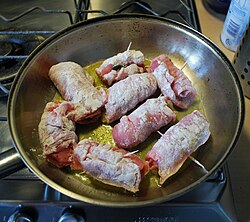
Saltimbocca (cooked)
CourseSecondo (Italian course)
Place of originItaly
Region or stateRome
Main ingredientsVeal, prosciutto, sage
  •  Wikimedia Commons logo Media: Saltimbocca

Saltimbocca (UK: /ˌsæltɪmˈbɒkə, -ˈbkə/, US: /ˌsɔːl-/, Italian: [ˌsaltimˈbokka]; lit.'[it] jump[s] in the mouth') is an Italian dish (also popular in southern Switzerland). It consists of veal that has been wrapped (lined) with prosciutto and sage and then marinated in wine, oil or salt water, depending on the region or one's own taste.

The original version of this dish is saltimbocca alla romana (lit.'Roman-style saltimbocca'),[1] which consists of veal, prosciutto and sage, rolled up and cooked in dry white wine and butter. Marsala is sometimes used. Also, sometimes the veal and prosciutto are not rolled up but left flat. An American variation replaces the veal with chicken or pork.[2][3]

See also

[edit]

References

[edit]

Further reading

[edit]
[edit]
Revisions and contributorsEdit on WikipediaRead on Wikipedia
from Grokipedia
Saltimbocca alla Romana is a classic Italian dish featuring thin veal escalopes, each topped with a slice of prosciutto crudo and a fresh sage leaf, secured together with a toothpick, then sautéed in a combination of butter and olive oil, deglazed with white wine to create a flavorful sauce.[1] The name saltimbocca, translating from Italian as "jump in the mouth," alludes to the dish's quick preparation and its bold, savory taste that is said to leap onto the palate.[1] This Roman specialty traces its documented roots to the late 19th century, with the first written recipe appearing as No. 222 in Pellegrino Artusi's influential 1891 cookbook La scienza in cucina e l'arte di mangiar bene, where he described enjoying it at a Roman trattoria.[2] Although some sources suggest possible earlier origins in the northern city of Brescia, the dish is firmly associated with Lazio region's culinary tradition, particularly Rome, and has been a staple at historic establishments like Checchino dal 1887 since its founding in that year.[1][3] Supposedly centuries old in oral tradition, saltimbocca exemplifies Roman cuisine's emphasis on simplicity and high-quality ingredients, often served with sides like spinach or potatoes.[2] Preparation is straightforward and rapid, typically taking under 30 minutes: the veal is lightly pounded to about 5 mm thick, seasoned with salt and pepper, assembled with prosciutto and sage, then pan-fried briefly on both sides before the wine is added and the pan covered to finish cooking gently.[1] Key ingredients include 150-gram veal escalopes (four for a standard serving), four slices of prosciutto, four sage leaves, 80 grams of butter, 100 ml of white wine, olive oil, and minimal water for the sauce, with the prosciutto's saltiness obviating additional seasoning.[1] While traditionally made with veal, modern variations substitute chicken or pork, but the authentic version highlights the tender veal's harmony with the salty prosciutto and aromatic sage.[3]

Overview

Description

Saltimbocca is a Roman-originated Italian dish consisting of thin slices of veal topped with prosciutto and sage leaves, which are secured together with toothpicks before being pan-fried.[2][4] Classified as a secondo piatto, it serves as the main protein course in the traditional structure of an Italian meal, following antipasti, primi, and often accompanied by a contorno of vegetables.[5][6] The dish offers a tender texture from the veal, complemented by the salty umami of prosciutto and the aromatic freshness of sage, yielding a harmonious and lusty flavor profile that exemplifies Roman simplicity.[4][7] In its authentic form, saltimbocca is presented flat in an escalope style rather than rolled, and the name, translating to "jump in the mouth," underscores its quick and irresistible appeal.[8][2]

Etymology

The term saltimbocca originates from the Italian phrase salta in bocca, literally translating to "jumps in the mouth," a whimsical expression that evokes the dish's irresistible flavor and the urge to devour it quickly. This etymology breaks down into saltare (to jump or leap), in (in or into), and bocca (mouth), highlighting the sensory delight intended by the name.[9][10] In English pronunciation, saltimbocca is typically rendered as /ˌsæltɪmˈbɒkə/ in British English and /ˌsɔːltɪmˈbɑːkə/ in American English, reflecting adaptations of the original Italian sounds. In Italian, it is pronounced /sal timˈbɔk.ka/, with slight regional variations; in Roman dialect, it often appears as salt'im bocca, emphasizing the local colloquial flair.[11][12] The name underscores the dish's simplicity and bold taste profile, emerging in 19th-century Roman culinary circles as documented by Pellegrino Artusi in his 1891 cookbook La scienza in cucina e l'arte di mangiar bene, where he described savoring it at a Roman trattoria. This playful etymology distinguishes it from cooking techniques like saltare in padella (jump in the pan), which refers to sautéing, by shifting the "jump" metaphor from the method to the mouthwatering appeal.[13][14]

History

Origins

Saltimbocca is primarily associated with Roman cuisine, where it emerged as a quick and affordable dish served in 19th-century taverns and trattorias, such as the historic Le Venete, catering to workers and locals seeking simple, flavorful meals.[2][15] The origins of saltimbocca remain controversial, with some culinary historians attributing its creation to Brescia in northern Italy as early as the 18th century, predating its adoption in Rome during the 1800s, though it is often attributed to the early 19th century in Brescia, with the first written recipe appearing in Pellegrino Artusi's 1891 cookbook.[2][15][16] A key historical reference appears in Ada Boni's 1929 cookbook La Cucina Romana, where she presents saltimbocca as a traditional Roman recipe while noting its likely importation from northern Italy, emphasizing its established place in local gastronomy by the early 20th century.[17][4] In its socioeconomic context, saltimbocca developed as an economical preparation utilizing thin veal cutlets—often scraps from butchery—and preserved prosciutto, making it accessible to working-class diners in urban settings through minimal ingredients and rapid cooking.[2][18]

Historical Development

In the 19th century, saltimbocca underwent refinement in Rome, where it became standardized with the combination of veal slices topped with prosciutto and sage leaves, often secured and pan-fried in butter and white wine. This version gained prominence amid Italy's unification in 1861, as the new national identity encouraged the documentation and elevation of regional specialties in urban centers like Rome, where trattorias proliferated to serve a growing middle class and tourists. Pellegrino Artusi's seminal 1891 cookbook La Scienza in Cucina e l'Arte di Mangiar Bene played a pivotal role by including a detailed recipe for saltimbocca alla romana, based on his experience at the Roman trattoria Le Venete, helping to codify it as a cornerstone of emerging Italian culinary unity.[19][20][2] Throughout the 20th century, saltimbocca's preparation adapted to changes in ingredient availability, with wild sage foraging giving way to cultivated varieties that ensured consistent supply for home and restaurant use, while expanded Italian wine production—particularly white wines from Lazio and neighboring regions—enhanced the sauce's role in balancing the dish's richness. Artusi's work, reprinted multiple times, reinforced saltimbocca's place in post-World War II Italian culinary identity, symbolizing resilience and tradition as the nation rebuilt through familiar, comforting recipes that evoked pre-war simplicity and regional pride.[21][13][22]

Preparation

Ingredients

The core ingredients of authentic saltimbocca alla Romana consist of thin veal escalopes, prosciutto crudo, and fresh sage leaves, which are assembled and cooked simply to highlight their natural flavors.[23][4] Primary Ingredients:
  • Veal escalopes: These are thin scallops cut from the hind leg (typically top round), pounded to about 5 mm thick for tenderness and quick cooking; high-quality, young veal is essential to prevent toughness.[24][23] For a standard recipe serving 4, use 4 slices totaling 600 g (about 150 g per serving).[1]
  • Prosciutto crudo: Thinly sliced unsmoked ham, preferably from San Daniele (sweeter and less salty) or Parma, providing a balance of saltiness and fat that enhances the veal without overpowering it.[4][25] Use one slice per escalope, about 100 g total for 4 pieces.[1]
  • Fresh sage leaves: Aromatic herbs that add earthy notes; use 1 medium leaf per escalope (or 4 large leaves total), selected for vibrant green color and strong fragrance.[23][26]
Supporting Elements:
  • Unsalted butter: Essential for sautéing to achieve a rich, golden sear; about 80 g for a standard recipe.[1][27]
  • Dry white wine: Used for deglazing the pan to create a light sauce; Frascati is a traditional Roman choice, with 100 ml sufficient for 4 servings.[28][1]
  • Olive oil: A small amount (about 20 ml) combined with butter for sautéing.[1]
Sourcing high-quality veal ensures even cooking and tenderness, while selecting prosciutto with adequate fat content contributes to the dish's signature moistness and flavor depth.[23][4]

Cooking Method

The traditional cooking method for saltimbocca alla Romana begins with preparing the veal escalopes, which are gently pounded to a thinness of about 5 mm using a meat mallet to ensure tenderness, often between sheets of parchment or wax paper to prevent sticking.[25][4][1] Each escalope is lightly seasoned with pepper on the plain side (minimal or no salt due to the prosciutto's saltiness), then topped with a thin slice of prosciutto crudo and one fresh sage leaf, placed toward one end.[25][29] The layers are secured with a wooden toothpick to hold them together during cooking; while some variations roll the assembly into involtini, the classic Roman style keeps it flat for quick searing.[4][29][27] For the cooking process, a large skillet—preferably cast-iron or stainless steel to develop flavorful fond—is heated over medium-high heat with a combination of 40 g butter and 20 ml olive oil until the butter foams and begins to brown slightly.[4][29] The veal is added prosciutto-side down first and seared for 2 minutes until the prosciutto crisps and turns golden, then flipped to cook the plain veal side for 1-2 minutes more, ensuring the meat remains pink and juicy in the center.[25][29][27] After removing the veal to a warm plate, the pan is deglazed with 100 ml of dry white wine, scraping up the browned bits as it reduces by half into a light sauce, often enriched with the remaining 40 g of butter for glossiness.[25][1] Toothpicks are removed before plating to prevent injury, and the sauce is spooned over the veal.[4] Precise timing and heat control are essential, with the total cooking time kept to 5-7 minutes to preserve the veal's tenderness and prevent dryness; the internal temperature should reach about 145°F (63°C) for medium-rare doneness.[25][29] The dish rests briefly for 1-2 minutes after cooking to allow juices to redistribute, then is served immediately to maintain its signature "jump in the mouth" lightness.[4] For authenticity, a non-stick pan can be used if stainless steel is unavailable, but it may yield less flavorful pan juices; fresh, high-quality ingredients like unsmoked prosciutto crudo are crucial to avoid altering the delicate balance of flavors.[25][29] Common pitfalls include using smoked prosciutto, which introduces an unwanted robust smokiness that overwhelms the subtle sage and wine notes, and cutting the veal with the grain instead of against it, which can lead to curling and chewiness during cooking.[4][25]

Variations

Regional Variations

Saltimbocca alla Romana, the classic version from the Lazio region, features thin veal scallops laid flat and topped with prosciutto and sage leaves, secured with toothpicks, then quickly sautéed in butter and deglazed with a minimal white wine sauce to emphasize the dish's inherent flavors without overwhelming additions.[4] This preparation highlights Roman cuisine's focus on simplicity and high-quality ingredients. In northern Italy, particularly around Brescia in Lombardy, the dish's possible origins are noted, and some variations involve rolling the ingredients into involtini for a different texture.[30] A traditional Lombard recipe, known as saltimbocca alla lombarda, uses pork loin rolled with slices of cooked ham and fontina cheese, then breaded and fried, diverging from the classic prosciutto and sage elements.[31] Southern adaptations, such as saltimbocca alla sorrentina from Sorrento in Campania, top the sautéed veal with tomato sauce and mozzarella before a quick gratinée under the broiler, diverging from the Roman minimalism to embrace Mediterranean vibrancy.[32] In the Alto Adige region, Speck Alto Adige IGP—a smoked, cured ham—replaces prosciutto, infusing the dish with alpine smokiness while keeping the sage and white wine elements, showcasing the area's Germanic-Italian fusion.[33] These regional differences underscore Italy's culinary diversity, where local produce and traditions adapt the core veal-prosciutto-sage triad.[34]

Modern Adaptations

In contemporary cuisine, saltimbocca has seen protein substitutions to offer lighter or plant-based alternatives to the traditional veal. Chicken breast cutlets, pounded thin and topped with prosciutto and sage, provide a leaner option that maintains the dish's quick cooking time and savory profile, as popularized in recipes from chefs like Lidia Bastianich.[35] Pork, such as butterflied chops stuffed or topped with prosciutto and sage, offers a hearty yet accessible variant while reducing costs compared to veal.[36] For a vegetable-forward twist, zucchini slices layered with prosciutto and sage can be grilled or sautéed to mimic the meat's texture.[37] Flavor innovations have expanded saltimbocca's appeal by incorporating complementary elements. Some versions integrate gorgonzola cheese, which melts over the prosciutto-topped protein during cooking, adding a creamy, tangy depth to the white wine sauce.[38] Balsamic reduction serves as a modern glaze, drizzled post-cooking to introduce sweet-acidic notes that balance the saltiness of prosciutto.[39] Gluten-free preparations achieve this by skipping the traditional flour dredging, relying instead on direct pan-searing in olive oil to develop flavor.[40] Presentation updates reflect fine dining and casual trends. Mini saltimbocca bites, using small chicken or pork pieces wrapped in prosciutto and sage, function as elegant appetizers, often skewered or served with toothpicks for easy eating.[41] In upscale settings, deconstructed plates separate components like seared protein, crispy prosciutto shards, and sage-infused elements, arranged artistically with foams or purees for visual impact.[42] Health-focused adaptations align with 21st-century wellness trends by emphasizing reduced fats and leaner ingredients. Substituting butter with olive oil in the pan sauce lowers saturated fat content while enhancing Mediterranean authenticity, as seen in lighter chicken versions.[43] Leaner cuts like chicken breasts further decrease overall fat, making the dish suitable for calorie-conscious diets without sacrificing tenderness.[44] Examples from American-Italian restaurants illustrate these evolutions. Pork chops, butterflied and treated like veal with prosciutto and sage, appear in U.S. menus as a hearty yet accessible variant, often paired with simple sides.[36] Vegan interpretations use seitan slices as a prosciutto alternative, wrapped around tofu or eggplant with sage, then simmered in a plant-based wine sauce to replicate the umami.[45]

Cultural Significance

In Italian Cuisine

In Italian cuisine, saltimbocca holds a prominent place as a classic secondo, or second course, typically following a primo such as pasta or risotto in the traditional multi-course Roman meal structure. This positioning allows it to serve as the main protein element, providing a satisfying yet light conclusion to the savory portion of the meal before any dolci. It is a staple in Roman osterias, where it embodies the straightforward, flavor-forward ethos of cucina romana, often enjoyed in casual family or social settings.[46][47][48] Traditional accompaniments emphasize simplicity to complement the dish's delicate flavors, with sautéed spinach known as spinaci al salto—wilted in butter and lightly crisped—being a particularly iconic pairing in Roman tradition, alongside artichokes prepared alla romana or other seasonal greens like chicory. These contorni, or side dishes, highlight the veal's tenderness without overpowering it, reflecting the Roman preference for balanced, ingredient-driven plates. Roasted potatoes or peas may also appear, ensuring the meal remains unpretentious and rooted in local produce.[49][50][51] Saltimbocca is commonly prepared in spring, leveraging fresh sage leaves at their peak availability and aroma, which enhances the dish's herbaceous profile during a season abundant with Roman greens and vegetables. It frequently graces family gatherings, underscoring its role in everyday celebrations of Roman hospitality, though it lacks direct ties to specific festivals like Carnival. Symbolically, saltimbocca exemplifies cucina romana's masterful balance of humble ingredients—thin veal slices, prosciutto, and sage—transformed into an elegant, irresistible preparation that "jumps in the mouth," as its name suggests, representing the tradition's ingenuity in elevating simplicity to sophistication. This aligns with the broader Italian gastronomic heritage, recognized by UNESCO in 2010 as the Mediterranean diet, an intangible cultural asset that encompasses such regional staples.[4][14][52] In terms of dining etiquette, saltimbocca is traditionally eaten with fork and knife to maintain its composed form, allowing diners to appreciate the layered textures of veal, prosciutto, and sage. The resulting pan sauce, enriched with white wine and butter, invites the Italian ritual of fare la scarpetta, where bits of crusty bread are used to sop up every drop, a gesture of appreciation for the cook's efforts and a hallmark of convivial Roman meals.[48][53]

International Reception

Saltimbocca has found significant adoption in southern Switzerland, particularly in the Italian-speaking region of Ticino, where it integrates into local cuisine as a quintessential northern Italian import often paired with risotto.[54][55] The dish's popularity there dates back to cross-border culinary exchanges, with pre-prepared versions even available in Swiss supermarkets, reflecting its everyday appeal in the region.[56] In the United States, saltimbocca gained traction within Italian-American communities through immigration waves, becoming a staple in traditional red-sauce restaurants that popularized Roman classics for broader audiences.[57] These establishments, often found in urban enclaves like Pittsburgh's Little Italy, served it as a simple yet elegant veal dish, cementing its place in the American-Italian dining scene by the mid-20th century.[58] Globally, saltimbocca appears in prominent international cookbooks and recipes, such as those published by The New York Times, which feature variations using veal, turkey, or chicken to suit diverse palates.[59] Its influence extends to fusion adaptations in Europe and Australia, where Australian publications like RecipeTin Eats and SBS Food present accessible versions, sometimes substituting veal for chicken or pork to align with local tastes.[18][60] Abroad, challenges arise from veal's limited availability and higher cost, prompting widespread substitutions with more accessible proteins like chicken or pork tenderloin, which maintain the dish's tender texture and quick preparation.[61][4] In non-Mediterranean countries, it is often positioned as an "exotic Italian" specialty, enhancing its allure in fusion contexts.[62] Modern exposure includes its feature in Rome's enogastronomic events and food tours, which draw international visitors seeking authentic Roman fare.[63]

References

User Avatar
No comments yet.