Hubbry Logo
SandvikenSandvikenMain
Open search
Sandviken
Community hub
Sandviken
logo
8 pages, 0 posts
0 subscribers
Be the first to start a discussion here.
Sandviken
Sandviken
from Wikipedia

Sandviken is a locality and the seat of Sandviken Municipality in Gävleborg County, Sweden with 26,438 inhabitants in 2023.[2] It is situated about 25 km west of Gävle and lies approximately 190 km north of Stockholm. The rail journey to Stockholm takes about 1.5 hours and to Arlanda, Sweden's main international airport, around an hour.

Key Information

Sandviken is the home town of the major high-technology Swedish engineering concern Sandvik and the main office of the company was located in Sandviken until January 2012 when it was moved to Stockholm.

Culture and recreation

[edit]

Sandviken is home to a number of cultural activities: Kulturskolan means "the culture school" (extramural music, dance and drama training), Sandviken Big Band, Sandviken Symphonic Orchestra and many musicians in the region. Sandvikens Art Gallery shows throughout the year various interesting exhibitions. Amongst the many popular tourist attractions in the municipality, the following merit special mention: the attractive old, carefully restored industrial villages in Gysinge and Högbo Bruk with their forges and smithies, handicraft, manor houses and possibilities they offer for outdoor recreation. During the winter months the downhill skiing facilities and the Snowpark at Kungsberget attract many visitors.

Sweden's first Mandaean place of worship, or mandi, was consecrated in Sandviken in 2003.[3]

Sandviken hosted the 2023 Women World Curling Championship, being the first Swedish city to host it since Gävle in 2004.[4]

History

[edit]

Sandviken was founded in 1862 in connection with the construction of the Sandvik AB ironworks. In 1900, Sandviken was one of Sweden's three largest ironworks, and had around 2,000 employees.[5]

Sports

[edit]
Jernvallen was a venue for the 1958 FIFA World Cup
Göransson Arena

Sandvikens AIK have become Swedish bandy champions several times. From the season 2009-10, they play indoors in Göransson Arena. This arena was the Division A venue for the 2017 Bandy World Championship.[6] Sandviken also hosts the World Cup, in which the home team in 2017 won for the first time on home ice (and the first time at all ever since 2002).

Football clubs located in Sandviken are Sandvikens IF who play in Division 1 Norra and Sandvikens AIK FK who play in Division 3 Södra Norrland. Their Jernvallen stadium was a venue of the 1958 FIFA World Cup, making Sandviken the northernmost city to host the tournament.

Sandviken is the birthplace of footballer Kim Källström and alpine ski racer Sara Hector.

Transportation

[edit]
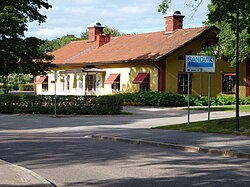
Sandviken resecentrum as seen from the east.

There are multiple buses running in Sandviken, the main ones being the 11 (Säljan), 13 (Vallhov-Norrsätra) and 14 (Björksätra). The buses, with the exception of 11, run on a half-hourly traffic schedule on the weekdays, and on an hourly traffic schedule during holidays and weekends. Bus 11 always runs on an hourly traffic schedule.

Sandviken used to be connected to Gävle via Route 80 (riksväg 80), but has since been replaced with the European route E16. Route 68 (riksväg 68) connects Sandviken with the city of Örebro and Gävle, and Route 272 (länsväg 272), colloquially known as "Högbovägen", connects Sandviken to the smaller village of Högbo. The city extends to the south along Route 272 until it meets Storsjön, where the road creates a causeway across the lake. Sandviken airport, although closer to the town of Valbo, serves the air travel needs for Sandviken, as well nearby Gävle.

References

[edit]
Revisions and contributorsEdit on WikipediaRead on Wikipedia
from Grokipedia
Sandviken is a locality and the administrative seat of Sandviken Municipality in , east-central , situated approximately 25 km west of and 190 km north of along the northern shore of Storsjön lake. With a of 25,045 as of 2024, it serves as the second-largest urban center in the province of and is defined by its strong industrial heritage, particularly in steel production. The town covers an area of 17.65 km², with a of 1,419 inhabitants per km², reflecting a balanced demographic structure where 53.4% of residents are of working age (20–64 years). Founded in 1862 by industrialist Göran Fredrik Göransson, Sandviken emerged as a key player in Sweden's steel industry following the successful implementation of the for steel production at nearby Högbo Bruk in 1858, marking the world's first commercial use of this method. The establishment of AB, a global engineering company specializing in mining, metal-cutting tools, and materials technology, propelled the town's growth; by 1900, Sandviken had become one of Sweden's three largest iron and steel production centers. Today, the economy remains anchored in advanced manufacturing and innovation, with AB as a major employer, alongside emerging sectors in and , supported by proximity to the E16 and rail connections to (about 2 hours away). Beyond industry, Sandviken offers a blend of cultural and recreational amenities, including the preserved industrial heritage sites of Högbo and Gysinge Bruk—former villages now serving as popular areas for , accommodations, and cultural experiences. The town is also a hub for sports, notably , with Sandvikens AIK competing at an elite level in the Swedish top division, and hosts the annual Sandviken exhibitions showcasing local and regional artists. Outdoor pursuits are prominent year-round, highlighted by Kungsberget, a popular in the region, which features slopes for in winter and mountain biking trails in summer.

Geography

Location and Topography

Sandviken is located in in east-central , within the historical province of . The urban locality is centered at coordinates 60°37′N 16°46′E. It lies approximately 25 km west of the city of and about 190 km north of , positioned along the highway and in close proximity to the E4 motorway, facilitating regional connectivity. The encompasses an area of 1,165 km², while the urban locality covers 17.65 km². Sandviken is situated in a predominantly forested where southern temperate forests transition into northern boreal forests, characterized by heaths, lakes, swamps, and rolling hills. The area features a sandy bay along the northern shore of Lake Storsjön, from which the Gavleån River originates and flows eastward through the locality toward Gävle Bay in the . Topographically, Sandviken blends industrial zones with natural landscapes, including nearby hills that rise to elevations supporting recreational trails with gains of up to 500 meters. The locality is proximate to preserved industrial heritage sites, such as Högbo Bruk to the north, an early area with historic forges and forested surroundings, and Gysinge to the east, a restored 17th-century industrial village amid similar natural terrain.

Climate

Sandviken has a classified as Dfb in the Köppen-Geiger system, featuring cold, snowy winters and mild, relatively short summers. The average temperature in , the coldest month, reaches lows of around -5°C (23°F), while highs average 16–17°C (61–63°F). Annual totals approximately 600 mm, with the majority falling as rain in summer months, though snowfall contributes significantly during winter. The proximity to the moderates temperatures somewhat, providing a coastal influence that prevents extremes seen farther inland. Snow cover is typical from to , with an average of about 52 snowfall days per year and total accumulation around mm. Extreme cold snaps occasionally drop temperatures below -20°C (-4°F), as evidenced by the record low of -35.6°C (-32.1°F) recorded in Sandviken on December 31, 1978. Recent trends indicate milder winters overall, with experiencing warmer-than-average s since the late due to global warming.

History

Founding and Early Development

Sandviken's origins trace back to the mid-19th century, when the region was part of the iron-producing area of in central . A pivotal event occurred on July 18, 1858, when Göran Fredrik Göransson achieved the first successful production of in the world at the nearby Högbo Bruk, demonstrating the viability of the for large-scale manufacturing. This breakthrough, which involved converting into using a converter to remove impurities through oxidation, marked the beginning of modern production in and attracted attention to the area's industrial potential. Building on this success, Sandviken was formally established in 1862 as a centered around the newly founded Högbo Stål & Jernwerks AB (later known as Sandvikens Jernverk), initiated by Göran Fredrik Göransson and his associates on January 31 of that year. However, the company faced early financial difficulties, declaring in 1866. It was restructured and restarted in March 1868 under the leadership of Göransson's son, Anders Henrik Göransson, and renamed Sandvikens Jernverk. Göransson, born in 1819 into a prominent shipping family in , invested in the venture to capitalize on the Bessemer innovation, constructing the on the site of a former small village to leverage local resources and water power from the Storån river. The facility quickly became a hub for high-quality steel production, initially focusing on drill steel for and , and introduced to industrialized methods that emphasized and export-oriented operations. The settlement grew rapidly from its humble beginnings as a sparse rural outpost into a burgeoning industrial locality, driven by the influx of workers to the . By the 1880s, basic had emerged, including worker , a , and rudimentary roads and rail connections to support operations and daily life, transforming the area into a self-contained . This expansion reflected Göransson's vision of integrating social welfare with industry, providing amenities to foster worker stability and loyalty. By 1900, the employed approximately 1,930 people, contributing to a local population of around 6,000 residents and solidifying Sandviken's role as one of Sweden's leading sites. The legacy of these early continues to underpin Sandviken's prominence in the global steel sector today.

Industrial Expansion and Modern Era

In the early , Sandvik AB, originating from the ironworks established in Sandviken in 1862, rapidly expanded into one of Sweden's largest , employing approximately 1,930 workers by 1900 and driving significant in the area. This growth was fueled by demand for armaments, with annual sales increasing by 6% and necessitating two major steel capacity expansions, though post-war competition posed challenges. The company shifted focus to high-quality niche products under leadership like Anders Henrik Göransson, establishing international subsidiaries—such as in the United States in 1919 and in 1923—to support exports and solidify its position in steel and drill production. Following , Sandviken's industrial landscape evolved through 's advancements in metalworking and tool manufacturing, particularly with the introduction of cemented-carbide technologies in the 1940s. Innovations like the Coromant rock drills, developed in partnership with Atlas Diesel, and the establishment of dedicated production facilities, such as the Gimo plant expanded to 65,000 square meters by the , positioned Sandvik as a global leader in rock drilling and cutting tools. Key developments included the T-Max tool system in 1958 and Gamma Coating in 1969, which enhanced productivity in metal cutting, with cemented-carbide products comprising 40% of sales by 1970 and acquisitions like Seco Tools in 1973 further broadening capabilities. A pivotal change occurred in 2012 when Sandvik relocated its group headquarters from Sandviken to Stockholm to improve access to global talent and align with international operations, while retaining major production sites and steel operations in Sandviken. In 2022, Sandvik spun off its stainless steel and special alloys business as Alleima AB, which continues operations in Sandviken and maintains the town's industrial heritage. This move reflected the company's maturation into a multinational entity. In recent years, Sandviken has repurposed its industrial heritage, exemplified by hosting the 2023 LGT World Women's Curling Championship at the Göransson Arena—named after founder Göran Fredrik Göransson—showcasing the community's transition from heavy manufacturing to versatile event hosting. However, post-2000 economic shifts, including the 2008 global financial crisis, brought challenges to heavy industry, with Sandvik experiencing a 31% drop in order intake and a SEK 3,472 million loss in 2009, leading to staff reductions and strategic restructurings.

Demographics

The population of Sandviken municipality has evolved significantly since the late , driven initially by industrial opportunities. In , the locality recorded 1,943 inhabitants, largely attracted by employment at the Sandviken ironworks, which employed around 2,000 workers at the time. This marked the beginning of rapid growth through migration to support the expanding and sectors during the 19th and 20th centuries. By the mid-20th century, the municipality had reached its historical peak of 43,667 residents in 1970, reflecting sustained industrial expansion and postwar economic prosperity. In recent decades, growth has stagnated and reversed, with the municipality's declining from 39,290 in to 38,360 as of December 31, 2024. This represents an average annual change of approximately -0.60% between and 2024, attributed to an aging , higher mortality rates than births, and net out-migration. The urban locality of Sandviken itself had 25,344 inhabitants in , increasing to 26,438 by 2023. The municipality spans 1,165 km², yielding a low of 32.91 inhabitants per km² in 2024. As of September 2025 (Q3), the population stood at 38,098, indicating continued slight decline in line with broader national demographic trends of aging and urban concentration elsewhere. Projections suggest the figure will remain between 38,000 and 38,500 through the end of 2025, with potential for further modest decreases if out-migration persists.

Ethnic and Social Composition

The gender distribution in Sandviken is nearly balanced, with females accounting for 49.2% of the and males 50.8% as of 2024. The age structure reflects an aging , with a age of 44.8 years as of 2024, higher than the national , and a growing proportion of residents aged 65 and over, comprising about 24% of the total. This trend is driven by low birth rates and longer life expectancies, contributing to demographic pressures on local services. Ethnically, Sandviken's population is predominantly Swedish-born, but foreign-born make up approximately 18.7%, or about 7,170 individuals, as of 2024. A distinctive feature is the presence of a Mandaean community, originating primarily from , which established Sweden's first Mandaean in the in 2003, marking a significant hub for this in . Social indicators include around 18,800 family units or households, supporting a mix of nuclear families and single-person dwellings amid the 's total of about 38,000. The urban-rural split shows a concentration in the central town of Sandviken, home to over 26,000 , while smaller localities and rural areas account for the rest, influencing community dynamics and access to services. Migration patterns feature inflows from the , including refugees from conflict zones like , and from countries for labor opportunities, reflecting broader Swedish trends since the . In this industrial town, integration challenges persist, particularly in aligning migrant skills with local and service sectors, though community initiatives aid social cohesion.

Economy

Major Industries

Sandviken's economy is predominantly driven by manufacturing, particularly in metals, tools, and , with roots tracing back to the establishment of the Sandvikens Jernverk ironworks in 1862 by Göran Fredrik Göransson, who pioneered the Bessemer steel production method. This legacy has positioned the municipality as a key industrial hub in , where production focuses on high-tech solutions for sectors like , , and . The dominant player is Sandvik AB, a global group headquartered in Sandviken, which employs over 6,000 people at its local site and maintains extensive production, research, and development operations there. Sandvik's innovations in tools and machinery contribute significantly to the region's export-oriented economy, with the company generating revenues of approximately SEK 123 billion in 2024. Complementing Sandvik is Alleima, a specialist in advanced stainless steels, special alloys, and products for demanding applications in industries such as , , and medical devices. Formed as a spin-off from Sandvik Materials Technology in 2022 and headquartered in Sandviken, Alleima continues the site's tradition of steel production, including seamless tubes and high-performance materials, with operations spanning multiple facilities in the area. The municipality hosts Sweden's second-largest industrial estate, covering nearly 3 million square meters, which supports a cluster of firms focused on metals and tools, fostering and supply chain integration. While forms the core, the service sector is expanding, particularly in and , exemplified by Microsoft's development of sustainable data centers in Sandviken as part of its Swedish region launched in . These facilities, powered by , support cloud and AI services, enhancing the area's diversification beyond traditional industry.

Employment and Recent Developments

Sandviken's employment landscape mirrors broader Swedish trends, where the national rate averaged 8.5% in 2024 and fluctuated between 8.2% and 9.6% in 2025 (as of October 2025 at 8.3%). Local in the has been similar to the national rate, reflecting stability in the industrial base amid national fluctuations. The workforce in Sandviken totals approximately 20,000 employed individuals, with the Group's operations serving as a cornerstone employer; while the company maintains about 41,000 employees globally, its headquarters and key facilities in Sandviken support thousands of local jobs in and . Recent developments underscore a shift toward sustainable technologies, enhancing job opportunities in green sectors. In October 2024, GreenIron H2 AB signed a significant agreement with Norwegian Hydrogen to supply green hydrogen for its fossil-free iron production plant in Sandviken, paving the way for commercial operations starting in 2025 and creating roles in advanced manufacturing and energy. In August 2025, the companies expanded their collaboration to co-locate and build green hydrogen production plants at the facility, scaling fossil-free metal production. Complementing this, Alleima launched a strategic research initiative in Sandviken in May 2025, investing in thermal spray technology to advance green hydrogen production and sustainable energy components, which aims to foster innovation-driven employment in materials science. Technological infrastructure expansions are also driving growth in the tech sector. A 40 MW hyperscale data center, constructed by Winthrop Technologies, was completed in Sandviken in early 2025, bolstering digital capabilities and generating construction and operations jobs. Microsoft's investments in and AI infrastructure at its Sandviken data center, including deployment of over 20,000 GPUs announced in 2024, are expected to create additional tech and support positions, with the facilities employing around 230 staff regionally as of 2025 and supporting broader community training programs. Despite these advancements, Sandviken grapples with demographic pressures from an aging population, which is elevating municipal healthcare and social service costs while straining the labor supply. The ongoing transition to sustainable industries presents both opportunities and challenges, requiring workforce reskilling to move from traditional toward hydrogen-based and digital economies.

Government and Administration

Municipal Structure

Sandviken serves as the administrative seat of Sandviken Municipality, located in in east-central . The municipality was established in 1971 through the amalgamation of the City of Sandviken—instituted in 1943—with several surrounding rural municipalities, including Järbo, Overskräddarsbo, Storklittbo, and Årsunda. The governance of Sandviken Municipality is led by the municipal council (kommunfullmäktige), the highest decision-making body, which consists of 51 elected members. These members are elected every four years, with the current composition resulting from the 2022 elections and remaining in effect through 2025: Socialdemokraterna (S) holds 17 seats, Sverigedemokraterna (SD) 12 seats, Moderaterna (M) 10 seats, Vänsterpartiet (V) 4 seats, Centerpartiet (C) 3 seats, Liberalerna (L) 2 seats, Kristdemokraterna (KD) 2 seats, and Miljöpartiet de gröna (MP) 1 seat. The council sets policies, approves budgets, and determines the municipal tax rate. Executive leadership is provided by the municipal board (kommunstyrelsen), chaired by the (kommunalråd), currently Maria Persson of the Centerpartiet, who took office in 2022. The ruling coalition comprises Socialdemokraterna, Liberalerna, and Centerpartiet, maintaining a narrow majority. The municipality is responsible for a range of essential public services, including from through upper secondary levels, elderly and care, , and maintenance such as roads, , and . In , priorities include improving attendance and providing support like free for high school students; healthcare and focus on staffing development and new facilities for vulnerable groups; and efforts emphasize and facility upgrades. The 2025 budget totals 2,874.3 million kronor (Mkr), with 344.85 Mkr allocated for investments across these areas, including 74.9 Mkr for educational facilities and 139.4 Mkr for projects like a new football arena and developments. This budget was adopted by the municipal council on November 11, 2024, and includes measures to address economic challenges by drawing 20 Mkr from reserves. Key administrative offices are housed in Stadshuset at Odengatan 37 in central Sandviken, serving as the main hub for municipal operations. The primary contact for citizen services is 026-24 00 00, with additional support available through email at [email protected]. The is divided into urban and rural areas, with the core locality of Sandviken encompassing the majority of the population, while broader administrative areas include rural parishes such as Årsunda and Storvik, managed through various committees and departments under the .

Twin Towns and Partnerships

Sandviken participates in a twin town chain with three Nordic municipalities: in , in , and in . These partnerships, established in 1947, emphasize cultural exchanges, school programs, sports activities, and youth initiatives to strengthen regional ties and mutual understanding. Early collaborations included biennial and later triennial Nordendagarna events starting in 1950, featuring study visits, excursions, exhibitions, and public cultural evenings to promote and intercultural . By 2025, regular exchanges have evolved into targeted, project-based efforts addressing contemporary challenges like , coordinated historically by organizations such as Föreningen Norden. Beyond traditional twinning, Sandviken engages in modern international partnerships through EU-funded initiatives. The ZHyRON project, focused on steel by-products via processes, convened its first review meeting with the in Sandviken on January 17–18, 2025, and hosted a mid-term meeting there in September 2025, hosted by local firm GreenIron. These agreements bolster economic connections in the green sector. For instance, in August 2025, GreenIron signed a strategic pact with Norwegian Hydrogen to integrate from Norway's facility with operations in Sandviken, advancing fossil-free metal manufacturing and sustainable industry growth. As of 2025, Sandviken sustains approximately three active twin towns alongside several collaborative projects.

Culture

Arts and Cultural Institutions

Sandviken's arts scene is anchored by several key institutions that foster creative and performance. Kulturskolan, the municipal culture school, provides extracurricular training in , dance, drama, theater, circus, writing, visual , and more for children and youth aged 3 to 19, serving as a central hub for artistic development in the community. The Sandviken Big Band, established in 1968, is recognized as one of Sweden's leading big bands, specializing in performances and collaborations with guest soloists, with notable recordings and concerts including live albums from regional venues. Complementing this, the Sandviken Symphonic Orchestra delivers classical repertoire, featuring works like live performances of pieces by composers such as , and contributes to the region's vibrant musical talent pool. Prominent venues support these institutions through diverse programming. The Sandvikens Konsthall, housed in the Kulturcentrum, hosts a year-round schedule of contemporary art exhibitions, including vernissages, guided tours, concerts, and lectures, drawing on both local and international artists to engage the public. Cultural events also extend to industrial heritage sites, where performances and installations blend artistic expression with Sandviken's manufacturing legacy, such as occasional music series in restored bruksmiljö environments. Annual festivals enrich the cultural calendar, often connecting music to local traditions. The Sandviken Chamber Music Festival, founded in 1986, occurs each summer—such as July 31 to August 2 in 2025—featuring emerging and established musicians in venues like the Musikverket concert hall, promoting classical chamber works. Similarly, the Virrvarr Festival hosts workshops and live concerts annually, highlighting traditional Swedish folk elements tied to regional heritage. Since the early 2000s, community arts in Sandviken have seen expanded participation, driven by municipal investments in facilities like the Kulturcentrum, which has broadened access to programs and events for diverse audiences. A distinctive feature of local exhibits is the incorporation of industrial motifs, as seen in shows at the Konsthall and artist-run spaces like Galleri Lars Palm, which repurpose former worker housing to explore themes of labor and machinery in .

Religious and Community Life

Sandviken's religious landscape is dominated by the , an Evangelical Lutheran denomination that serves as the primary faith community for the majority of residents. The local Sandvikens pastorat oversees several congregations, including Sandvikens kyrka, a prominent basilica-style church built in 1930–1931 that hosts regular worship services, community gatherings, and life-cycle events such as baptisms and weddings. This institution reflects Sweden's historical state church tradition, though membership has declined nationally, with the Church emphasizing social welfare and ecumenical outreach in modern times. Immigrant populations have introduced growing diversity in faiths, particularly among refugees from the and beyond. A notable example is the Mandaean community, an ancient originating from and , which established Sweden's—and Europe's—first mandi () in Sandviken in 2003 through the Mandaean Sabi Society. This facility supports essential rituals like baptisms in flowing water and serves as a cultural hub for approximately 10,000 nationwide, many of whom settled in post-2003 due to in . Other immigrant faiths, including and Orthodox , maintain informal prayer spaces and associations, contributing to a multicultural religious fabric. Community life in Sandviken is shaped by active integration programs tailored to its diverse population, where about 18.0% are foreign-born (as of 2023), influencing and group activities. The municipality's "Step it up" initiative provides , guidance, and language training to newcomers, facilitating long-term settlement and . offer broad support, including financial aid, family counseling, and health resources accessible to immigrants, ensuring equitable access regardless of background. These efforts promote cohesion through volunteer networks and neighborhood programs that address needs like child welfare and elderly care. Interfaith dialogues and cultural festivals further strengthen community bonds, with local organizations hosting events that encourage mutual understanding among Lutheran, Mandaean, and other groups. For instance, the Mandaean Sabi Society participates in broader Swedish interfaith networks, while municipal festivals highlight immigrant traditions to foster inclusion.

Recreation and Sports

Tourist Attractions

Sandviken offers a range of tourist attractions centered on its industrial heritage and natural landscapes, drawing visitors interested in , , and sustainable experiences. Prominent sites include the preserved industrial villages of Gysinge and Högbo Bruk, which showcase Sweden's ironworking past through museums, restored buildings, and interactive exhibits. These locations provide insights into 17th- and 18th-century production techniques, including forges and smithies, while integrating modern amenities like cafés and guided tours. Gysinge Bruk, established in 1668 as an ironworks along the Dalälven River, stands as a key heritage museum within a Reserve. Visitors can explore the 19th-century Gustavian-style manor, the original inn from 1784, and exhibits on early steel production, including the Kjellin , the world's first electric furnace for steel production, introduced in 1900. The site features the Naturum for and access to Färnebofjärden , where activities include short hikes like the 1 km Granön trail or fishing for and pike in nearby rapids. and rentals allow exploration of the river's scenic waterways, emphasizing low-impact eco-friendly pursuits. Högbo Bruk, founded in the 17th century as another , combines cultural preservation with extensive outdoor facilities. The village includes artisan workshops, such as the Fragrance Design Center at Björk & Berries, and a heritage hotel offering spa services and dining with local ingredients. Guests can tour historical structures like and enjoy year-round activities, including a 27-hole , jogging tracks, and canoeing on nearby lakes. The site's adventure park caters to families with climbing and play areas, while fishing spots and nature trails highlight the surrounding forests. For outdoor enthusiasts, Sandviken's attractions extend to Kungsberget Ski Resort, located just 20 minutes from the town center, and extensive forest trails along the Gävleån River. Kungsberget features 25 pistes across all skill levels, 14 lifts, and family-oriented zones like and snow parks, with runs up to 1,700 meters long. The resort supports such as and , alongside summer and on its maintained paths. Complementing this, the Gästrikeleden —a 270 km network—passes through Sandviken, offering segments like the 16 km Högbo to Medskogsjön route with varied terrain of pine forests, bogs, and river views along Gävleån. These areas provide opportunities for , , and peaceful walks in the reserve's diverse ecosystems. Seasonal tourism thrives in Sandviken, with winter drawing crowds to Kungsberget for alpine activities and on groomed trails, while summers focus on heritage tours at Gysinge and Högbo Bruk, including guided walks through sites and river-based excursions like on Storsjön Lake. Events such as heritage reenactments at nearby Årsunda Viking village enhance summer visits, blending history with interactive experiences. These offerings cater to passive recreation, including brief use of sports facilities for casual enjoyment. Sandviken's proximity to the E16 highway facilitates easy access, enabling day trips from —approximately 190 km away, reachable in about two hours by car or train. This connectivity has supported growing eco- since 2020, as the region's biosphere reserve status promotes sustainable nature-based travel amid Sweden's national recovery in international arrivals, which rose to over 6.8 million in 2024. Visitors increasingly seek low-carbon activities like trail hiking and , aligning with broader trends in organic and seasonal tourism.

Sports Teams and Events

Sandviken has a strong tradition in bandy, with Sandvikens AIK (SAIK) serving as the premier club in the sport. Established in 1922, SAIK has competed in the Swedish top division and achieved significant success, winning nine Swedish bandy championships as of recent records. The team plays its home matches at the Göransson Arena, an indoor facility with a capacity of 4,000 for bandy events, which has hosted numerous high-profile games since opening in 2009. SAIK's achievements include multiple finals appearances, contributing to the town's reputation as a bandy hub. In January 2025, Sandviken hosted the FIB World Championships for Boys U19 and U17 at Göransson Arena, with Sweden claiming both titles: 6-2 over Finland in the U19 final and 7-1 over Finland in the U17 final. In football, Sandviken supports two notable clubs: and the football section of Sandvikens AIK (SAIK FK). , founded in 1918, currently competes in , Sweden's second-tier league, following promotion from Division 1 in 2022; the club has a history of playing in during the 1950s, including seasons in 1953/54 and 1954/55. SAIK FK operates in lower divisions, such as Division 2 Norra Svealand, focusing on regional competition. A key historical highlight for Sandviken football is Jernvallen stadium, which hosted one match during the : versus (1-1) in the group stage on 8 June 1958. Other sports in Sandviken include and . The Göransson Arena was the venue for the 2023 LGT World Women's Curling Championship, where teams from 13 nations competed from March 18 to 26, with claiming the title. For skiing, Kungsberget Ski Resort, located nearby, serves as a major venue with 25 pistes and 14 lifts, supporting local competitions and training; it is affiliated with Kungsbergets AK, a club that nurtures regional talent. Prominent athletes from Sandviken include footballer , born in 1982, who earned 131 caps for and played for clubs like , , and Spartak before retiring in 2017. In alpine skiing, , also born in 1992 in Sandviken and representing Kungsbergets AK, has secured multiple victories in , including wins in 2022 and 2023. Sandviken has hosted major international events, notably the 2017 Division A at Göransson Arena, where defeated 4-3 in the final to claim the title from January 29 to February 5.

Transportation

Road and Rail Access

Sandviken benefits from robust road connections, primarily via European route E16, which passes through the locality and links it directly to Gävle approximately 25 kilometers to the east, a journey of about 20 minutes by car. E16 serves as a major artery for regional and international travel, extending westward toward Falun and eventually connecting to Norway, facilitating access to broader European networks. Complementing this, Swedish national road 68 (Riksväg 68) intersects at Sandviken, providing a vital east-west corridor to Gävle and onward to Örebro, while road 272 (Högbovägen) extends southward from the town center, supporting local and inter-municipal movement. Rail access centers on Sandviken Station, integrated into the East Coast Line network through its connection via the Bergslagen Line to Gävle Central Station. Regional trains operated by entities such as Tåg i Bergslagen and SJ depart frequently, reaching Gävle in just 14 minutes and continuing to in approximately 2 hours, with up to 23 daily services available. These services emphasize efficiency for both passengers and freight, underscoring Sandviken's role in central Sweden's grid. The locality's infrastructure is particularly well-suited for industrial transport, owing to its proximity to major manufacturing hubs like , with E16 featuring innovative upgrades such as the world's first public for heavy vehicles—a 2-kilometer overhead system inaugurated in 2016 that supported low-carbon freight operations as part of a pilot project running until 2020. Recent national initiatives have further enhanced freight capabilities, improving reliability for goods movement from Sandviken's industrial base. Daily commuting patterns highlight the practicality of these routes, with thousands traveling to for work via quick rail links or E16, while the highway's international extensions enable seamless onward journeys to ports and beyond . Local bus services integrate with these road and rail options for seamless intra-regional travel.

Air and Local Transit

Sandviken's primary air facility is Gävle–Sandviken Airport (GVX/ESSK), located near Valbo between and Sandviken, serving as a small public airport primarily for , sightseeing flights, business travel, and . The airport features a single asphalt measuring 2,000 meters in length and 45 meters in width, but it does not offer scheduled commercial passenger flights. Access to the airport is facilitated by local roads connecting to the E16 highway. For major commercial air travel, residents of Sandviken rely on nearby regional airports or larger international hubs, with (ARN), approximately 156 kilometers away, being the closest major option, reachable by a roughly two-hour drive via the E4 highway. Local transit in Sandviken is managed by X-trafik, the authority for , which operates a network of bus routes integrated with rail services at Sandviken station for seamless regional connectivity. Key local bus routes include lines 1, 2, and 4, which serve intra-city travel with stops covering central areas like Sandviken Centrum, Resecentrum, and surrounding neighborhoods such as Vallhov and Seljansborg; schedules vary by route, with frequent service during peak hours and reduced operations on weekends. In recent sustainability efforts, X-trafik has introduced electric buses to its fleet in Sandviken and , with a signed in 2023 for 52 new electric vehicles operated by ; these buses entered service starting in 2024 and are operational as of 2025, aimed at reducing emissions and enhancing eco-friendly . Additionally, hydrogen-powered buses have been deployed in Sandviken since 2021, with ongoing refueling agreements supporting their expansion into 2025.

References

Add your contribution
Related Hubs
User Avatar
No comments yet.